It’s Local Election Day. Who Cares?

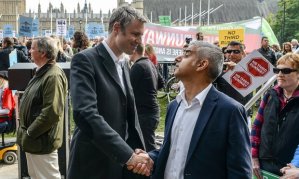
Zac Goldsmith or Sadiq Khan for London? Who cares?

“I think voting is great, but if I have to choose between a douche and a turd, I just don’t see the point” – Stan Marsh, South Park

Apparently Thursday 5th May – local election day across the UK – is being dubbed “Super Thursday“.

Except that unlike the Super Tuesdays of the American presidential primary calendar, there is nothing remotely exciting about these local elections, with the partial exception of the Scottish and Welsh assembly polls.

In London, we are bestowed with the awesome privilege of choosing between two leading candidates for mayor – Zac Goldsmith and Sadiq Khan – neither of whom have any meaningful executive experience and both of whom fail the first test of competence and political courage by failing to support the immediate expansion of Heathrow Airport. For this dismal failure alone I cannot bring myself to vote for either man.

Depressingly, the only remotely praiseworthy recent act of English localism – the introduction of Police and Crime Commissioners – has been badly administered and (with a few honourable exceptions) increasingly captured by the same mindless party line approach to voting seen elsewhere. And the scheme does not even apply to London – here, the mayor holds the powers of police commissioner, meaning there is no possibility of a New York style Giuliani-Bratton double-act to crack down on crime. Nobody in London specifically responsible for crime can be removed at the ballot box.

Granted, “Super” Thursday carries a little more weight if one is hugely invested in how aggregate tallies of local council seats reflect on the leadership of the main political parties. But with all the parties committed to campaigning for Britain to remain in the European Union (save UKIP, who often may as well be fighting for the Remain camp) again there is little incentive to specially reward or unduly punish one of the parties currently engaged in the process of selling out our democracy more than any other.

Besides, if you are choosing the person to represent your local ward or district because of something that David Cameron or Jeremy Corbyn said on TV or because everyone in your family/workplace/pub votes a certain way out of tribal loyalty, then you probably don’t understand how local politics is supposed to work. But then I cannot really fault those who do so, for in nearly all cases local authorities have so little real power in over-centralised Britain that it doesn’t much matter who controls the council anyway.

So, if you are a hardcore Sadiq Khan or Zac Goldsmith supporter (assuming that a human watercolour painting like Zac Goldsmith actually has any hardcore fans) – good luck today. May your man win, and may you dance in the street in celebration.

To those pundits waiting to pounce on the results as they come in, and speculate feverishly about whether significant council seat losses for Labour will bring forward the much-anticipated coup against Jeremy Corbyn – knock yourselves out.

To my bloggers-in-arms, fighting the good fight to make the thinking person’s case for Brexit and the restoration of our democracy – keep doing what you are doing. Working alongside you is an honour and a privilege.

…and may all your Super Thursdays be bright.


Zac Goldsmith - Sadiq Khan - London Mayoral Election

Bottom Image: The Guardian

Agree with this article? Violently disagree? Scroll down to leave a comment.

Follow Semi-Partisan Politics on TwitterFacebook and Medium.

The Seven Deadly Sins Of Pro-European Union ‘Remain’ Campaigners

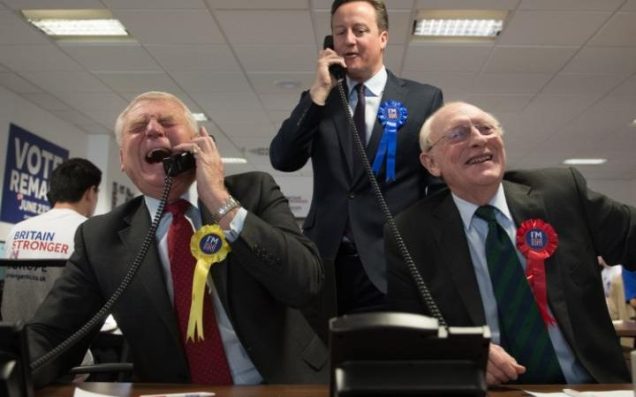
David Cameron - Neil Kinnock - Paddy Ashdown - Stronger In - EU Referendum - Brexit

Zealotry, pessimism, denialism, idiocy, treachery, materialism and sloth – the Seven Deadly Sins of those campaigning for Britain to remain in the European Union

The Financial Times reports on German moves to bring long-simmering plans for an eventual European army back to the boil with the submission of a significant new white paper – the release of which has been conveniently deferred until Britain’s EU referendum is concluded:

Germany is to push for progress towards a European army by advocating a joint headquarters and shared military assets, according to defence plans that could ricochet into Britain’s EU referendum campaign.

Although Berlin has long paid lip-service to forming a “European defence union”, the white paper is one of the most significant for Germany in recent years and may be seized by anti-integration Brexit campaigners as a sign where the bloc is heading.

Initially scheduled to emerge shortly before the June 23 referendum vote but now probably delayed to July, the draft paper seen by the Financial Times outlines steps to gradually co-ordinate Europe’s patchwork of national militaries and embark on permanent co-operation under common structures.

[..] At the European level, the paper calls for “the use of all possibilities” available under EU treaties to establish deep co-operation between willing member states, create a joint civil-military headquarters for EU operations, a council of defence ministers, and better co-ordinate the production and sharing of military equipment.

“The more we Europeans are ready to take on a greater share of the common burden and the more our American partner is prepared to go along the road of common decision-making, the further the transatlantic security partnership will develop greater intensity and richer results,” the paper states.

This is not shocking. This is not surprising. This is what the gradual creep toward European political union looks like. Proposals like this are raised before being quietly deprioritised, seemingly dropped in the face of political backlash, only to be resurrected and advanced once more, each time gaining a little more ground until the end result is achieved – not necessarily by its original name (as with the Constitution) but always in practical effect. No never means no with the European Union. It simply means brief retrenchment before pressing ahead the same thing with a slightly different label.

At this point I do not know what more can be said, what further evidence can be presented, to convince people that the European Union is not the benign, happy-go-lucky club of friendly countries occasionally coming together on a super voluntary basis to fight crime, Save the Earth and braid each other’s hair that they are so desperate to believe it to be.

The EU is not shy about its intended direction of travel. None of the EU’s “founding fathers” were remotely shy about what they wanted their creation to become. For all of its bureaucracy, the Brussels machinery is usually quite transparent in its workings, for those with the patience to look and discover what they do in our name. And yet there persists a massive disconnect between the European Union’s own self-declared purpose and the way in which it is perceived and portrayed in Britain.

I once ran for the train at London Euston station, intending to go to the city of Wolverhampton (don’t ask why). But I didn’t look closely enough at the departure screen, and accidentally boarded the service to Manchester, engrossed on a phone call, only realising my error when the train first stopped at Stoke-on-Trent. But crucially, once I realised my mistake I did not stay on the train in the forlorn hope that by staying in my seat I might still somehow end up in the West Midlands. No – I got off the train and rectified the error. I did so because like most people, on matters of travel I am capable of perceiving and understanding objective reality – in this case, the reality that I was sitting on a train taking me at great speed to somewhere I had no wish to go. My destination and that of the other passengers were irreconcilably different.

As it was with my ill-fated train adventure, so it is with Britain, currently being borne along on the semi-fast service to European political integration. It should now be abundantly clear to everyone that the destination is not “friendly trade and cooperation” as the EU’s desperate apologists claim, and yet many wavering voters still believe that if they close their eyes, ignore the mounting signs and stay fearfully on the train, it will take them somewhere acceptable.

And I don’t get it. I just do not understand those of my fellow countrymen who are educated people and not hardcore European federalists – people who do not want Britain to become subsumed into a European political union or cast aside as the rejected half-member with no influence on the periphery – but who nonetheless intend to vote Remain in this EU referendum. I’m not being dramatic. I have tried very hard to put myself in the position of a soft Remain supporter, and I can no longer do it. Clearly I have passed the Brexiteer event horizon and can no longer turn back, not that I wish to. And I speak as a former hardcore euro-federalist (back in my student days).

Basically, to vote Remain in this EU referendum, one quite simply has to either:

1. Be a committed euro-federalist, eager for a United States of Europe

2. Understand that this is the end goal, abhor it, but think so little of Britain’s prospects as an independent, globally-engaged nation that being part of such a European state seems like the “least worst” option

3. Summon enormous powers of denial in order to ignore the EU’s trajectory and accept at face value David Cameron’s fraudulent assertion that he has secured meaningful concessions from Brussels

4. Be incredibly ignorant of recent history and basic, easy to research facts

5. Actively wish harm to one’s own country and democracy

But perhaps that is not entirely fair. As I wrote recently, I can see how some voters – particularly those from my own Millennial generation – might choose to prioritise short term financial stability over long-term democratic health, though I think that such people seriously underestimate the risks inherent in surrendering the last vestiges of our democracy to an unaccountable supra-national government. And of course some people are just incredibly apathetic.

So there are also the further two possibilities:

6. Self-centred materialism

7. Laziness and apathy concerning an issue of fundamental importance

That’s it. Those are the choices. Zealot, pessimist, denialist, idiot, traitor, materialist or sloth.

If you are planning to vote Remain in the EU referendum, which one are you?
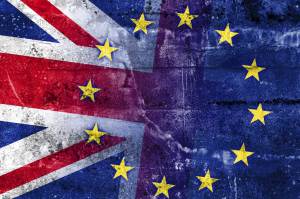
 

European Union - United Kingdom - Britain - Flags

Agree with this article? Violently disagree? Scroll down to leave a comment.

Follow Semi-Partisan Politics on TwitterFacebook and Medium.

What Hath Social Justice Wrought?

It is our duty to fight.

It is our duty to win.

We have nothing to lose but our chains.


So chant thousands of students at rallies and protests in universities all across the United States of America.

Except that none of these students are oppressed. Not a single damn one of them.

None of them are chained.

They are all students attending university in the most powerful and prosperous country on the face of the Earth.

An ocean of possibility stands before each and every single one of these young students, the likes of which can only be dreamed of by millions of children in war torn, impoverished or otherwise benighted parts of the world.

This is a cult.

These people are cultists.

This is what the Cult of Social Justice and Identity Politics hath wrought.


Postscript: To be fair, from the smirks of some of the students in the last video it does appear that they realise deep down that this is all a fraud, that none of them are “chained”, and that this huge collective tantrum from the most privileged generation in history is nothing but a massive insult toward previous generations who really did have to fight, win, and yes, even cast off their chains.


More Tales From The Safe Space here.


Safe Space Notice - 2

h/t Sargon of Akkad

Agree with this article? Violently disagree? Scroll down to leave a comment.

Follow Semi-Partisan Politics on TwitterFacebook and Medium.

In Turkey, Journalists Sentenced To Jail For Charlie Hebdo Solidarity

Charlie Hebdo cover - Tout Est Pardonne

In Turkey, Theocracy – 1, Free Press – 0

Turkey takes another step towards fundamentalist theocracy as freedom of the press recedes even further.

Hurriyet Daily News reports:

Two journalists were sentenced to two years in prison on April 28 for republishing in their columns a cover of French satirical magazine Charlie Hebdo featuring an image of the Prophet Muhammad.

Istanbul’s Second Criminal Court of First Instance sentenced daily Cumhuriyet journalists Ceyda Karan and Hikmet Çetinkaya to two years on charges of “openly encouraging hate and enmity among people via the press” for reprinting the caricature of the Islamic prophet after the Jan. 7, 2015, attacks on Charlie Hebdo in Paris that killed 12 people.

However, the court ruled for the acquittal of the journalists on charges of “insulting people’s religious values” on the grounds that the criminal factors had not been constituted.

Some 1,280 people had filed a criminal complaint against Karan and Çetinkaya for republishing in their columns the cover of Charlie Hebdo, including Turkish President Recep Tayyip Erdoğan, his daughters Esra Albayrak and Sümeyye Erdoğan, his son Bilal Erdoğan, his son-in-law Energy Minister Berat Albayrak and his adviser Mustafa Varank.

So the climate for journalism in Turkey is now such that a despotic thin-skinned president and members of his parasitic family feel that it is appropriate to drag journalists before the court and have them convicted simply for carrying out objective reporting.

Closing down independent newspapers and converting them into pro-government propaganda outlets is apparently no longer enough. Individual journalists must also be persecuted and jailed for offending the sensibilities of the Turkish president, his close family members and a thousand or so other assorted religious fundamentalists who believe that their right to sail through life unoffended trumps the right of journalists to report the news.

The Telegraph outlines the wider negative trend:

But the sentencing comes amid a mushrooming crackdown on Turkish and international news media within the country. According to PEN International, some 28 writers and journalists were either detained or imprisoned in Turkey at the end of 2015 while more than 100 remained on trial, most for national security offenses.

Cumhuriyet’s editor-in-chief, Can Dündar, and the paper’s Ankara bureau chief, Erdem Gül, are currently on trial on trial behind closed doors on charges of revealing state secrets and could face multiple life sentences if found guilty.

International trial monitors and press freedom groups have condemned those proceedings, describing the case as an instance in which “journalism is on trial”.

And this is a country which entertains hopes of joining the European Union.

This is the regime which Europe Germany is scrambling to appease.

The sentencing of these journalists is unacceptable. But it is also exactly what many in Britain and the West tacitly condone when they leap to their feet in defence of the right of “marginalised” people to avoid having their religious faith and political opinions subjected to the same scrutiny, discussion and criticism as those from the “privileged” majority.

This is the legacy of every single person who supports the concept of “hate speech”, or whose condescending, neo-colonialist views of Muslims and other minorities hold that they are inherently less intelligent, less capable of engaging in debate and more prone to violence than the white majority, who should indulge them in their fragility or violent excesses like understanding parent figures.

As soon as one accepts the racist notion that some people are inherently less capable than others of having their beliefs and opinions challenged or even mocked, one opens the door to civil or criminal penalties for doing so.

When the Metropolitan Police arrest a man in London for tweeting something deemed by completely unconnected third parties to be “Islamophobic”, it becomes that much easier for authoritarian regimes in parts of the world with weaker democratic traditions to claim that they are only following “best practice”, that their despotic excesses are just a nothing but a difference of degree. And at the very least, this makes it much harder for Britain to remonstrate with Turkey. How can we lecture Turkey that arresting journalists is abhorrent when we do the same thing ourselves?

It is time for Britain and the West to reoccupy the depressingly deserted moral high ground. Yes, criticise Turkey for their government’s chilling suppression of free speech and a free press, and yes, proclaim that you are still Charlie (but only if you really are).

But as we do so, we should not allow the beam in beleaguered Turkey’s eye to distract us from the steadily-growing speck in our own.


Freedom of Speech - Free Speech

h/t Brendan O’Neill and  Mashable

Agree with this article? Violently disagree? Scroll down to leave a comment.

Follow Semi-Partisan Politics on TwitterFacebook and Medium.

On Brexit, Nigel Lawson Should Stick To Being A History Professor

Nigel Lawson - Brexit - EU Referendum

When it comes to the history of the EU, Nigel Lawson actually has his facts straight. It’s a shame he also feels the need to weigh in on the political and economic aspects of Brexit

When he isn’t single-handedly torpedoeing the thinking Brexiteer’s case for leaving the European Union with fatuous and cavalier pronouncements on the economic aspect – or wrongly whipping up fears that Brexit would mean border controls with Ireland – Nigel Lawson can sing quite a nice tune on the issue of democracy and the unabashedly federalist imperative of the EU.

From Lawson’s OpEd in yesterday’s Telegraph:

On the European mainland it has always been well understood that the whole purpose of European integration was political, and that economic integration was simply a means to a political end.

In Britain, and perhaps also in the US, that has been much less well understood, particularly within the business community, who sometimes find it hard to grasp that politics can trump economics.

The fact that the objective has always been political does not mean that it is in any way disreputable. Indeed, the most compelling original objective was highly commendable.

It was, bluntly, to eliminate the threat to Europe and the wider world from a recrudescence of German militarism, by placing the German tiger in a European cage.

Whether or not membership of the EU has had much to do with it, that objective has been achieved: there is no longer a threat from German militarism.

But in the background there has always been another political objective behind European economic integration, one which is now firmly in the foreground.

That is the creation of a federal European superstate, a United States of Europe. Despite the resonance of the phrase, not one of the conditions that contributed to making a success of the United States of America exists in the case of the EU.

But that is what the EU is all about. That is its sole raison d’être.

This is a condensed and fairly accurate restatement of the EU’s underlying purpose, more fully laid out in “The Great Deception” by Dr. Richard North and Christopher Booker – though this essential book makes the additional important point about just how much of the EU’s evolution has taken place by stealth, cloaked in deliberate secrecy.

Anyone still labouring under the illusion (or burying their heads in their sand to convince themselves) that the EU is nothing but a happy-go-lucky club of countries coming together voluntarily to “cooperate” and solve common difficulties together should read “The Great Deception” and let the scales fall from their eyes. For all his other faults, Lawson does at least have a firmer grasp of history than most starry-eyed EU apologists.

Does this OpEd make up for everything else that Lawson has unfortunately done to retard the case for Brexit? No. But it does show quite starkly the positive case for Brexit which the main Leave campaign is throwing away by refusing to commit to an anxiety-soothing EEA-based exit plan and then, once the public’s understandable economic concerns are neutralised, letting the case for democracy speak for itself.


European Union - United Kingdom - Britain - Flags

Top Image: The Irish News

Agree with this article? Violently disagree? Scroll down to leave a comment.

Follow Semi-Partisan Politics on TwitterFacebook and Medium.