Reluctant Conservatives For Hillary

hillary-clinton-2016-campaign-rally-charlotte-nc

Conservatives who feel forced to vote for Hillary Clinton are not “With Her”. They are putting country before party, and ahead of their own political preferences

I don’t always agree with David Frum, but his latest piece in The Atlantic, advancing the conservative case for choosing Hillary Clinton over Donald Trump in this most depressing of presidential elections, is well worth a read.

Frum is under no illusions that a Clinton presidency will do anything to promote or further conservative ideals. He is wide eyed in his acknowledgement of Clinton’s character flaws and ethical shortcomings. But he recognises that by voting for Hillary Clinton in 2016, we stand the best chance of ensuring that the Republic does not become immeasurably worse off before conservatives have an opportunity to regain the White House in 2020. In other words, he believes that Clinton will do little good, but Trump could do existential harm.

Frum’s conclusion is worth quoting at length:

I have no illusions about Hillary Clinton. I expect policies that will seem to me at best counter-productive, at worst actively harmful. America needs more private-market competition in healthcare, not less; lighter regulation of enterprise, not heavier; reduced immigration, not expanded; lower taxes, not higher. On almost every domestic issue, I stand on one side; she stands on the other. I do not imagine that she will meet me, or those who think like me, anywhere within a country mile of half-way.

But she is a patriot. She will uphold the sovereignty and independence of the United States. She will defend allies. She will execute the laws with reasonable impartiality. She may bend some rules for her own and her supporters’ advantage. She will not outright defy legality altogether. Above all, she can govern herself; the first indispensable qualification for governing others.

So I will vote for the candidate who rejects my preferences and offends my opinions. (In fact, I already have voted for her.) Previous generations accepted infinitely heavier sacrifices and more dangerous duties to defend democracy. I’ll miss the tax cut I’d get from united Republican government. But there will be other elections, other chances to vote for what I regard as more sensible policies. My party will recover to counter her agenda in Congress, moderate her nominations to the courts, and defeat her bid for re-election in 2020. I look forward to supporting Republican recovery and renewal.

This November, however, I am voting not to advance my wish-list on taxes, entitlements, regulation, and judicial appointments. I am voting to defend Americans’ profoundest shared commitment: a commitment to norms and rules that today protect my rights under a president I don’t favor, and that will tomorrow do the same service for you.

Vote the wrong way in November, and those norms and rules will shudder and shake in a way unequaled since the Union won the Civil War.

I appreciate that Donald Trump is too slovenly and incompetent to qualify as a true dictator. This country is not so broken as to allow a President Trump to arrest opponents or silence the media. Trump is a man without political ideas. Trump’s main interest has been and will continue to be self-enrichment by any means, no matter how crooked. His next interest after that is never to be criticized by anybody for any reason, no matter how justified—maybe most especially when justified. Yet Trump does not need to achieve a dictatorship to subvert democracy. This is the age of “illiberal democracy,” as Fareed Zakaria calls it, and across the world we’ve seen formally elected leaders corrode democratic systems from within. Surely the American system of government is more robust than the Turkish or Hungarian or Polish or Malaysian or Italian systems. But that is not automatically true. It is true because of the active vigilance of freedom-loving citizens who put country first, party second. Not in many decades has that vigilance been required as it is required now.

Your hand may hesitate to put a mark beside the name, Hillary Clinton. You’re not doing it for her. The vote you cast is for the republic and the Constitution.

That is precisely where I find myself (though not quite yet a US citizen, so spared from the pain of having to personally make that call – roll on 2020). I don’t believe that Hillary Clinton stands for any real, fixed political values and I have grave concerns about aspects of her judgement and ethical compass – and so did many Democrats, until the DNC furtively helped to push Clinton over the line in her unnecessarily tough primary battle.

But these concerns pale in comparison to the danger presented by Donald Trump, whose supposed miraculous Damascene conversion to conservatism I do not believe for one moment, whose appalling personal behaviour is the subject of hard evidence rather than partly-conspiratorial conjecture (as it is with Clinton) and whose temperament makes him the absolute worst person to assume the role of Commander in Chief and Chief National Voodoo Doll, a focus for the endless complaints of an entire nation.

Like him or not, Barack Obama has served his terms of office with grace and dignity, even when under withering personal attack. This will not be so under Trump. As comedian Louis CK said in his endorsement of Clinton on the Conan O’Brien show, when Donald Trump is personally attacked everything stops so that Trump can punch back. That is simply not a luxury which the President can afford.

In sizing up Trump’s support, Frum also makes a devastating indictment of modern America:

The lesson Trump has taught is not only that certain Republican dogmas have passed out of date, but that American democracy itself is much more vulnerable than anyone would have believed only 24 months ago. Incredibly, a country that—through wars and depression—so magnificently resisted the authoritarian temptations of the mid-20th century has half-yielded to a more farcical version of that same threat without any of the same excuse. The hungry and houseless Americans of the Great Depression sustained a constitutional republic. How shameful that the Americans of today—so vastly better off in so many ways, despite their undoubted problems—have done so much less well.

How true this is. Now, this blog has every sympathy for many of Donald Trump’s supporters, who feel utterly let down by an American political class which has alternately pandered to them before betraying them, ignored them or held them in open contempt. And while this blog is very much pro free trade and managed immigration, the fact that Americans have not even had a choice when it comes to these issues based on the position of the two main parties is sufficient reason alone for the rise of a populist like Trump, albeit not necessarily a candidate with Donald Trump’s gargantuan personal flaws.

So yes, things are bad, and yes, the political class has not been responsive. But America managed to survive world war and economic depression in the twentieth century without coming this close to electing a dangerous authoritarian. Whatever afflictions the struggling “left behind” class said to make up much of Trump’s support may now be experiencing is nothing compared to the suffering of, say, the Dust Bowl. To react to these present circumstances by reaching for Donald Trump when their ancestors typically bore their tribulations far more stoically is in some way a reflection of American moral decline, which is very worrying indeed.

This blog would have loved to have seen a radical right-wing candidate willing to question failing old mantras about immigration and trade deals and other issues. I may be a #NeverTrump person, but I acknowledge that Trump often raises valid problems which have received scant attention from other politicians. The only miracle is that Trump manages to betray those causes by somehow managing to be an even more imperfect vehicle for his policies than Hillary Clinton is for hers.

There is no sugar-coating that the next four years are going to be depressing and barren of achievements for American conservatives. But as Frum rightly points out, sometimes there are more important things than getting one’s own way in a traditional left-right political dispute. Sometimes the cost of letting the nation drift a little further to the left is less than the cost of handing it over to somebody as unstable as Donald Trump.

After all, Republicans screamed for eight years that President Obama would turn America into a socialist hellhole and usher in the end of the Republic, and it didn’t happen. Hillary Clinton is no more left-wing than Obama, though a cannier and more ruthless political operator, but if America didn’t turn into North Korea on Obama’s watch it is unlikely to do so in four years of a Hillary Clinton presidency.

The people who will vote for Donald Trump on November 8th deserve to have their political views represented by someone better than the thin-skinned egomaniac who gets into Twitter wars with D-list celebrities in the early hours of the morning. Even if one agreed with all of Trump’s policies – many of which are actually profoundly un-conservative and much closer to being nakedly authoritarian – that would be no excuse for electing a man with such huge and concerning personality flaws.

David Frum did the right thing. This most eye-catching of elections has been the most depressing presidential campaign in my lifetime, but at least if Clinton wins we will have a shot at making 2020’s campaign a bit more inspiring, substantive, policy-based and (hopefully) less existentially threatening.
 

donald-trump-hillary-clinton-first-presidential-debate-1

Top Image: Kristopher Harris / Wikimedia Commons

Support Semi-Partisan Politics with a one-time or recurring donation:

Agree with this article? Violently disagree? Scroll down to leave a comment.

Follow Semi-Partisan Politics on Twitter, Facebook and Medium.

The Southern Poverty Law Center Is Enabling Islamist Extremism By Smearing Its Most Stalwart Opponents

maajid-nawaz-southern-poverty-law-centre-splc-extremism

By labelling dedicated anti-extremism campaigners like Ayaan Hirsi Ali and Majid Nawaz as anti-Muslim extremists themselves, the deluded and morally compromised Southern Poverty Law Centre is doing the Islamists’ work for them

There have been few sadder debasements of once-fine and noble institutions this year than the Southern Poverty Law Center’s decision to stop serving as a fearless searchlight highlighting violent extremism and instead become a trendy-lefty Islamism-denying propaganda outlet.

That might sound harsh, but there really is no other way to describe the SPLC’s fawning, slavish deference to leftist SJW dogma – a philosophy which furiously denies that there is any problem within the Islamic community or with a certain branch of the Muslim faith, and that anybody who disagrees and dares to draw attention to problems within Islam is effectively Hitler.

Last week, in a blaze of publicity, the Southern Poverty Law Center published a list of fifteen individuals singled out by that organisation as holding and disseminating false and extremist information and opinions about Islam.

In the preface to their report, the SPLC declares:

The anti-Muslim extremists profiled here have, between them, claimed that Islamic extremists have infiltrated the CIA, FBI, Pentagon and other agencies; asserted that there are “no-go zones” in Europe where non-Muslims including police are afraid to enter; suggested that there is a Muslim plot to impose Sharia religious law on U.S. courts; and claimed that President Obama is a secret Muslim. These claims, along with many others, have been shown conclusively to be false.

This misinformation and hateful rhetoric have consequences. When huge numbers of Americans believe that a majority of Muslims are terrorists or terrorist sympathizers, it can hardly be a surprise that some percentage of them engage in hate crime attacks. After all, they learned of the threat they believe Muslims pose from sources who were presented by the media as authoritative experts.

This country faces an array of complex and daunting problems, the threat of terrorism indisputably among them. Let’s not make them worse by allowing self-described “experts” to propagandize our fellow Americans with defamatory and frightening falsehoods. Our media, in particular, has the opportunity to present an objective picture that illuminates, rather than distorts, reality.

So far, so noble, you might think. There is certainty a lot of hyperbolic and often baseless scaremongering about Muslims and Islam in the media, and flagging particularly odious or disreputable sources for media attention is not in and of itself a bad thing. Until you realise who is on the list.

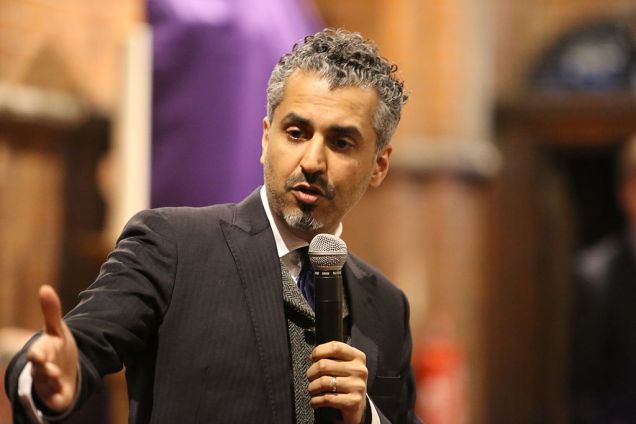
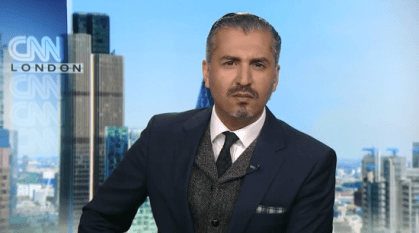
Some of the names are old suspects that one would expect to see. But in news which has provoked widespread outrage, the list also includes the names of entirely innocent and worthy activists fighting against Islamist extremism, like Ayaan Hirsi Ali and Maajid Nawaz.

And what is the SPLC’s charge sheet against Maajid Nawaz? What actions classify him as an “extremist”?

In the list sent to a top British security official in 2010, headlined “Preventing Terrorism: Where Next for Britain?” Quilliam [Nawaz’s anti-extremism think tank]  wrote, “The ideology of non-violent Islamists is broadly the same as that of violent Islamists; they disagree only on tactics.” An official with Scotland Yard’s Muslim Contact Unit told The Guardian that “[t]he list demonises a whole range of groups that in my experience have made valuable contributions to counter-terrorism.”

Well, what’s so shocking about that? It as an entirely logical statement on Nawaz’s part. Unless the people at the SPLC are truly dim and do not recognise a difference between Muslims and Islamists then there is no excuse for trying to turn a perfectly obvious point – that some people who support a fundamentalist ideology will choose violence while others do not – into some kind of “gotcha” smoking gun evidence of Nawaz’s secret Islamophobia.

And worse:

According to a Jan. 24, 2014, report in The Guardian, Nawaz tweeted out a cartoon of Jesus and Muhammad — despite the fact that many Muslims see it as blasphemous to draw Muhammad. He said that he wanted “to carve out a space to be heard without constantly fearing the blasphemy charge.”

Was this provocative? Perhaps. But again, Nawaz is himself a Muslim. Who better to judge what is or is not offensive to one’s religious moral code than the person tweeting the image? And even if doing so is “offensive”, are there not times when the offence is a price worth paying to make a broader argument in support of universal free speech? And if the Southern Poverty Law Center is so concerned about the emotional harm that may be inflicted by “blasphemous” acts like this, how do they explain their deafening silence when it comes to Christian beliefs and symbols being mocked in the popular culture?

The SPLC is not taking the side of ordinary Muslims here, some of whom may indeed be quietly offended by depicting Muhammad. They are taking the side of violent Islamists who seek to enforce blasphemy laws in the 21st century.

And then the SLPC really descends into the gutter:

Nawaz, who had described himself as a “feminist,” was “filmed repeatedly trying to touch a naked lap dancer,” according to an April 10, 2015, report in the Daily Mail. The paper apparently got the security film from the owner of a strip club who was incensed by Nawaz’s claims to be a religious Muslim.

And how we have the inevitable SJW identity politics hit job, seeking to ruin Nawaz’s reputation in the court of public opinion by repeating the shocking news that Nawaz has not at all times lived according to the letter of his faith. Well, so what? Sometimes, without thinking, I accidentally eat meat on a Friday during Lent. Does that make me virulently anti-Catholic and unable to fittingly discuss my faith in the media? Of course not. People’s actions diverge from their faith in a myriad of ways, small and large, and this applies just as much to those who got upset about Nawaz’s strip club visit (like the Muslim strip club owner) as to Nawaz himself. None are in a position to judge. Yet the SPLC feels that any divergence from Islamic teaching is sufficient to declare people that they don’t like to be somehow anti-Muslim.

This National Review editorial laments the SPLC’s corruption and decline:

The SPLC is an example of the way in which the Left corrupts and perverts the institutions it controls, from the IRS to the universities. While decrying “conspiracy theorists,” the SPLC itself is obsessed with “Terror from the Right” that is, pardon us for noticing, so rare as to be nearly insignificant. For all of the SPLC’s hysteria about neo-Confederates, skinheads, secret Nazi cabals, and the like, there is very little evidence that these organizations, to the extent that they exist as more than shared social-media fantasies, are actually up to much of anything. Even if we accept the tendentious characterization of SPLC favorite Timothy McVeigh as some kind of right-wing extremist (as with many such figures, his actual beliefs were confused, contradictory, and eccentric), the main organ of white-supremacist nuttery in the United States is prison gangs, which constitute a fairly constrained and peculiar phenomenon with relatively little effect on the outside world.

Not so violent Islamic radicalism, which is a factor in the United States and in practically every country in Europe, Africa, South Asia, and beyond. That is the great irony here: People like Ayaan Hirsi Ali are doing the work the SPLC is supposed to be doing — understanding and countering violent extremists — and the SPLC denounces them for it.

Very strange.

Some of those on the SPLC list are Muslims, former Muslims, and lifelong students of Islam. What they mostly have in common is that they are, broadly speaking, conservatives, people who are influential among conservatives, or writers and activists admired by conservatives. The SPLC is so drunk on its own poisonous ideological brew that it has simply come to conflate conservatism with violent or potentially violent extremism. One of these things is not like the others: A category of social tendencies that includes both Aryan Brotherhood felons in San Quentin and Somali-Dutch atheist women with celebrated literary careers is not an especially useful category.

While Nick Cohen provocatively (but accurately) declares in The Spectator that “the white left has issued its first fatwa” against Nawaz:

It is an organisation that ought to share Nawaz’s values, but because of the crisis in left-wing values does the dirty work of the misogynists, the racists, the homophobes, the censors, and the murderers it was founded to oppose. It does it with a straight face because, as I am sure you will have guessed, the fascism in question is not white but Islamic. And once that subject is raised all notions of universal human rights, and indeed basic moral and intellectual decency, are drowned in a sea of bad faith.

Nawaz is from Essex. He has fought and been beaten up by white British neo-Nazis. He fell in with Hizb ut-Tahrir while he was young. When he ended up in a torture chamber in an Egyptian jail, he abandoned Islamism for liberalism. Since then, he and his Quilliam Foundation have struggled against both the white far right and the Islamist far right. They have defended liberal Muslims and, indeed, all of us from lethal blasphemy taboos and the threat of terrorism. They respect freedom of speech, including the freedom of their enemies to speak.

A significant faction on the left hates them for upholding the values they have forgotten,  and will use any smear to denigrate them. As my secularist friend Faisal Saeed Al Mutar observed, when he, Nawaz and hundreds of others step forward and try to liberalise Muslim communities from within, they are attacked, ‘for being not Muslim enough, not Arab enough, not Pakistani enough, not filled with enough revenge and enough hatred’.

In the liberal orientalist world view the only ‘authentic’ Muslim is a barbarian. A battery of insults fires on any Muslim who says otherwise. They are ‘neo-conservatives,’ ‘native informants,’ and ‘Zionists’: they are as extreme as jihadists they oppose, or, let’s face it, worse.

This searing criticism could not be more accurate. For there is nothing so racist as the tyranny of low expectations in which the fashionable leftist intelligentsia holds the Muslim world, viewing them not as people with moral agency of their own but as little pets to be protected (or overgrown pets to be cowered from), people whose sometime decision to commit violence and murder cannot be condemned because it is supposedly “provoked” by forced beyond their control.

I have personally interviewed Maajid Nawaz, back when he was running as the Liberal Democrat candidate for the London constituency of Hampstead & Kilburn in the 2015 UK general election, and whatever one may think of his domestic political views, this is clearly not somebody who belongs on a list of violent, hateful extremists.

What is concerning is that the Southern Poverty Law Center would actually now prefer the old incarnation of Maajid Nawaz, back in the days when he was a member of a legitimate extremist group, Hizb ut-Tahrir. As such, he would be protected under the umbrella of leftist denial and fawning appeasement, so central to the SPLC’s new dogma, and they would bend over backwards to excuse his fundamentalist beliefs and violent actions.

By contrast, having long since rejected violence and an extremist fundamentalist interpretation of Islam, the SPLC would have us believe that Nawaz is somehow full of hatred and antipathy to normal Muslims, the equivalent of a knight of the Ku Klux Klan. It is absolute nonsense – pure, amoral leftist bilge.

This is also how Western civilisation destroys itself – by furiously denying the existence of opposing forces or in some cases openly bending the knee to them, while attacking those who actually recognise the danger and seek to confront it. In a world where precious few people have a remotely coherent strategy for tackling fundamentalist Islamism, Maajid Nawaz stands out as one of those with genuine understanding of the problem, and a plan for addressing it – and so the debased SPLC must now attack and undermine him at all costs, by pretending that he is an anti-Muslim extremist.

And one can only concur with Nick Cohen’s assessment that it is “heartbreaking” to witness an organisation so integral to the American Civil Rights movement, which bravely shone an unforgiving light on genuine violent extremism where it once existed, now creating McCarthyite lists of people who offend leftist/Islamist dogma and labelling them with the same term of “extremist”.

Ayaan Hirsi Ali makes the Southern Poverty Law Center’s list too. Why? Because she actively and gleefully foments prejudice and violence against ordinary innocent Muslims? Of course not. The SPLC include Ayaan Hirsi Ali in their leftist collaborationist fatwa because she had the temerity to renounce her faith and speak out passionately for the cause of secularism, thus gravely offending the real extremists to the point where she has to hire bodyguards to ward off assassination attempts.

It takes some twisted morality to come down on the side of those who seek to carry out an execution for the crime of apostasy over their intended victim, but somehow the SPLC has found a way.

Cohen concludes:

Do these jerks not think about the consequences of their rote-learned, pseudo-leftist bombast? Have they not heard that, across the world, lists circulate of ‘apostates’ along with invitations to the faithful to kill them when they can?

Maybe they have but do not care, and it will take drastic action to shake them out of their spiteful stupor.  A court action could do it. If Nawaz sues, SPLC’s work in fighting the white far right will suffer grievously. But, as it is so eager to be on the wrong side in the fight against the religious far right, I think we could call it evens.

It is hard to disagree. Gone, it seems, are the days when the Southern Poverty Law Center could be found seeking justice for the victims of real prejudice, oppression and extremist violence.

Where once the SPLC battled segregation and fought civil cases to ensure that racist lynchings and arson attacks were acknowledged at a time when the criminal justice system did not want to prosecute them, now they can be found patrolling the borders of our language, seeking to excommunicate decent and honest people from polite society for the high crime of having caused “offence” to certain protected groups.

And when an organisation has drifted so far from its founding ethos to the extent that a one-time civil liberties group is now in the business of making McCarthyite-style lists of people whose blasphemy offends Islamist extremists, then the time has probably come to wash our hands of that organisation, sad though it may be.


maajid-nawaz

southern-poverty-law-center

Top Image: Wikimedia Commons

Support Semi-Partisan Politics with a one-time or recurring donation:

Agree with this article? Violently disagree? Scroll down to leave a comment.

Follow Semi-Partisan Politics on TwitterFacebook and Medium.

Donald Trump, World’s Best Christian

donald-trump-bible

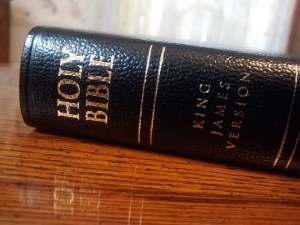
If you seriously believe that Donald Trump understands the Christian faith, has read the Bible or would choose the defence of religious values and freedom over some other passing whim while serving as president, then I have a bridge across the River Thames to sell you

Eric Zorn has a great column in the Chicago Tribune in which he systematically takes apart Donald Trump’s pretence that he is a Serious Christian and the default choice for those voting with their Christian faith foremost in their minds.

Zorn writes:

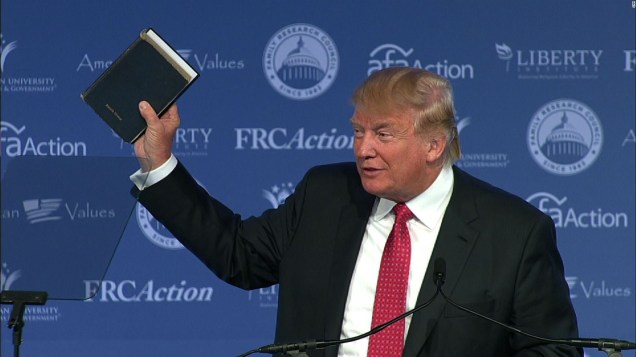
Nothing illustrates what a flim-flam man Donald Trump is better than his frequent and oily allusions to the Bible.

It is his favorite book, he tells the credulous masses at his rallies. Nobody reads it more than he does.

But a review of the record suggests he may not have read it at all.

During a televised interview with John Heilemann and Mark Halperin of Bloomberg Politics in August 2015, Halperin noted Trump’s frequent professions of fondness for Judeo-Christian scripture and said, “I’m wondering what one or two of your most favorite Bible verses are and why.”

“I wouldn’t want to get into it,” Trump said, “because to me that’s very personal. You know, when I talk about the Bible it’s very personal so I don’t want to get into verses. The Bible means a lot to me but I don’t want to get into specifics.”

“Are you an Old Testament guy or a New Testament guy?” Heilemann asked.

“Probably equal,” Trump said. “I think it’s just incredible, the whole Bible is incredible.”

How utterly convincing. Zorn continues:

That unfamiliarity showed up again in April when host Bob Lonsberry of WHAM-AM in Rochester, N.Y., broached the subject in a phone interview: “Is there a favorite Bible verse or Bible story that has informed your thinking or your character through life, sir?”

“Well, I think many,” answered the would-be exegete-in-chief. “I mean, you know, when we get into the Bible, I think many, so many. And I tell people, look, ‘An eye for an eye,’ you can almost say that.”

You can, sure.

But not only is “An eye for an eye, a tooth for a tooth” an Old Testament verse that condones barbaric vengeance (“… hand for hand, foot for foot,” it goes on, “burn for burn, wound for wound, bruise for bruise”) it was also expressly repudiated by Jesus in the Sermon on the Mount: “You have heard that it was said, ‘Eye for eye, and tooth for tooth.’ But I tell you, do not resist an evil person. If anyone slaps you on the right cheek, turn to them the other cheek also” (Matthew 5:38-39).

I get it. Actually making time to sit down and read the Bible every day while trying to internalise parts of it is tough. Particularly, I imagine, when you are rich and famous and your free time is largely given over to grabbing women “by the pussy”. Personally, I have only read the entire Bible cover-to-cover once, when I was eighteen and preparing for my adult confirmation into the Roman Catholic church after converting from Anglicanism. More than a decade later I am now finally trying to do so again, with the help of a great online Bible app which comes with a manageable “Bible in a year” reading plan.

The point of which being that it is fairly easy to spot someone who has actually attempted the feat and possesses a genuine (if still somewhat patchy, like mine) familiarity with the Bible, and somebody who is just putting on an act, attempting to fake religious observance as a kind of cultural marker. And Trump clearly falls into the latter category.

Eric Zorn concludes:

Is Trump the first politician to exaggerate his piety in order to win favor with the American public, 70 percent of which identifies as Christian and 6 percent of which identifies as belonging to another faith tradition?

No, but he’s the worst at it — the most transparent — that we’ve ever seen on the national stage.

It’s not just that he’s a brazen Bible huckster, it’s that he’s really bad at it.

Those who put their faith in him should prepare to have it shattered.

This is depressing for all those Christians who have been taken in by Donald Trump’s false displays of piety, as well as those resigned Christians who recognise that Trump is a charlatan but feel that Trump represents a better bulwark against attacks on their values and way of life than Hillary Clinton.

But it is also darkly amusing. Because for eight years it has been the habit of more than a few Republican Party politicians to insinuate that President Barack Obama is somehow not a Christian, or even that he is a closet Muslim, despite endless evidence of the Obama family attending church and Obama himself being capable of speaking about his faith without getting completely tongue-tied or reporting to bland banalities. Some Republicans stood up to the “Obama is a Muslim” hysteria – notably John McCain at a town hall meeting during the 2008 presidential campaign. But many others remained cynically silent, allowing prejudice and misinformation to take hold, thinking that it would advantage them politically.

And now it is the GOP’s turn to field a presidential candidate who doesn’t merely “exaggerate his piety” but effectively invents it from thin air to get himself out of a tight spot in a TV interview. Of course, the Democrats are in absolutely no position to take advantage of this fact – Hillary Clinton is a Christian, like Obama, but has chosen to downplay her faith in this election because many of her supporters place more faith in the god of Social Justice and Identity Politics than the God of the Old and New Testaments.

As Ben Wolfgang notes in the Washington Times:

Hillary Clinton’s Christianity, which she wielded as a political weapon in her 2008 Democratic presidential primary campaign, largely has been missing in this year’s election.

She hasn’t hidden her Methodist upbringing, but scholars say it’s not front and center. And where in the past she used it as a window into her character, this year she’s deployed it as a debate tactic to push criminal justice reform and other policy goals.

Church attendance also has been all but absent from Mrs. Clinton’s schedule, except when she’s turned up behind a pulpit to stump for votes, particularly in predominantly black churches, where her appearances focus largely on how she intends to work with religious leaders to accomplish shared political objectives.

Since 2008 she’s also abandoned traditional Christian positions on issues such as same-sex marriage, coming in favor of the practice in 2013 after years of opposing it.

The reason for the shift, analysts say, is twofold. Mrs. Clinton is taking on an opponent, Republican Donald Trump, who is seen as one of the most nonreligious presidential candidates in modern history. Pew polling from earlier this year found that just 30 percent of American voters say they consider Mr. Trump religious, while 48 percent said the same about Mrs. Clinton.

Perhaps more importantly, she now leads a party that, among its white base, if not its core black and Hispanic members, has become an increasingly secular institution. Recent polling shows the Democratic Party includes in its ranks nearly four times as many atheists and agnostics as the GOP.

Ultimately, the “Donald Trump is a better Christian than Hillary Clinton” argument comes to the two candidates’ respective positions on abortion. And if abortion is a deal-breaker for you then yes, Trump’s currently stated position on abortion (which has certainly changed since his liberal days of a few years back, as well as during this campaign, both without satisfactory explanation) is more in line with Church teaching about the sanctity of life.

But as with all of Donald Trump’s other stated policy positions, there is absolutely nothing to give confidence that his current position either represents his true beliefs on the subject, or that he would not flip-flop on the issue without a second thought if he saw political value in doing so.

Christians – particularly Evangelicals – should really be used by now to cynical Republican politicians who have trained themselves to speak the language, say the right things and push all the right buttons on social issues in pursuit of the evangelical vote, only to sell out the movement once safely ensconced in power. George W. Bush won a tough 2004 re-election campaign against John Kerry in spite of his disastrous mismanagement of the Iraq invasion and its aftermath largely by switching the focus to social issues, namely gay marriage, in order to motivate his base. And in nearly every election before and since, evangelicals have been flattered, threatened and otherwise called upon to support the Republican candidate only to have their causes betrayed or ignored after election day once their usefulness was over.

Donald Trump is doing exactly the same thing all over again. But he is so inept and transparent in his attempt to feign Christian piety that a fool should be able to see through his cynical machinations. And yet many bright and decent people are taken in by Trump’s amateur act.

Don’t get me wrong – Hillary Clinton, largely beholden to the Cult of Social Justice and Identity Politics, will be no great defender of religious freedom or interests. But Donald Trump will be little better, as Christians should realise from bitter past experience and Trump’s unique untrustworthiness when it comes to holding true to his stated beliefs on fundamental issues.

Neither candidate, in office, would be a great friend of religion, though Donald Trump would likely continue to pay more lip service to Christian priorities thanks to the composition of the Republican Party. But both options are pretty bleak, and Christians seeking to vote based on their faith would actually be well advised to admit defeat and make their choice based on some other criteria.

Whoever wins this election, it looks quite safe to say that Christianity will lose.


bible-king-james-version

Bottom Image: Pixabay

Support Semi-Partisan Politics with a one-time or recurring donation:

Agree with this article? Violently disagree? Scroll down to leave a comment.

Follow Semi-Partisan Politics on TwitterFacebook and Medium.

FBI Reopens Investigation Into Hillary Clinton’s Emails As More Come To Light

hillary-clinton-hagiography

Hell hath no fury like a Clinton facing an existential political threat

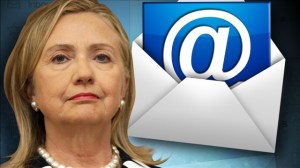
And so with just eleven days until the presidential election, the week closes with the shock announcement that the FBI is reopening its investigation into Hillary Clinton’s use of a private unsecured email server now that new potentially significant emails have come to light through a separate, unrelated investigation into former congressman (and estranged husband of Clinton aide Huma Abedin) Anthony Weiner.

Cue the standard reactions you would expect from the major players. Donald Trump took to the stage at his next campaign rally and solemnly (well, with what passes for solemnity when delivered by Trump) told his supporters that there had been a critically important development in the campaign, relaying the news of the FBI’s reopened investigation to tumultuous cheers from the crowd. He went on to claim that the developing story was “bigger than Watergate“.

Meanwhile, the cable news channels, grateful for anything which disrupts the rather predictable “Clinton romping to near-certain victory” narrative which is so bad for ratings, eagerly talked up the “bombshell” development.

The only one we had yet to hear from was Hillary Clinton herself. She had precious little to say on the subject at her next campaign rally in Iowa, but we have now heard that the campaign is understandably furious at the timing of the announcement, and is pressing for immediate answers (and a swift second exoneration) from the FBI.

But what is the likely significance of this flurry of Friday activity? I think that Jonah Goldberg’s initial hot take is right on the money:

I think Comey has to have found something significant to have done this. Re-injecting himself into the presidential campaign eleven days before the election is not something he would do lightly or happily. But I have no idea what that something might be.

I agree. James Comey has a reputation to protect, one which will not be enhanced by making himself the sudden focus of the presidential election campaign this close to polling day if it turns out that there is nothing to the newly discovered email stash. Serious conversations would have gone on before Comey made the final decision to write that letter to congressional committee chairmen informing them of his decision to reopen the investigation, and that alone counts for something.

Goldberg continues:

I’m more confident, however, that if the Clinton campaign was holding back any opposition research in reserve, it is now very likely to get dropped like the payloads from a squadron of B-52 bombers. So far the Clinton camp has been very, very skillful in deploying its oppo. It doesn’t rush things and has been comfortable letting story lines develop. (Yes the Trump team is right that many of these sexual abuse stories are “orchestrated.” But “orchestrated” isn’t a synonym for “untrue”).

What would that oppo look like? I don’t know. But, unless there’s something much worse than the “groping” storyline we already know, the sexual-abuse charges are now baked in with most of the public (and among Republican apologists). Until today, that was probably fine with the Clinton camp because she’s been on course for a big win. If you’re in the clear lead, the incentive to drop more oppo is not there because there’s always the risk of blowback.

But the polls have tightened a little. More troubling for her is the fact that between the Doug Band story and now this, Clinton is likely to be in the spotlight for the next few days or longer. (By the way, how happy is Doug Band to be wiped out of the news cycle?) And the dilemma for Clinton is that whichever candidate is in the spotlight tends to suffer in the polls because the American people don’t like either of them.

And that’s why I think we can expect the Clintonites to do what they do best: change the subject from their wrongdoing to someone else’s, presumably Donald Trump’s. Maybe it won’t happen, but I wouldn’t be surprised if by the time the Sunday shows are on, or by Monday morning at the latest, we’ll have at least two “bombshells” to discuss.

Most people I have spoken to seem agreed that Hillary Clinton is holding something back in reserve – an additional Trump scandal (either real or confected) different in tone and nature to the others, which could be deployed as a kind of political doomsday device if Clinton found herself behind in the polls or facing serious political difficulties going into the home stretch. Anyone who knows how the Clintons operate would probably concur that this would be absolutely in character.

The only question, to my mind, is whether Hillary Clinton panics and deploys her doomsday device now, in an attempt to change the narrative and avoid losing a whole weekend’s worth of news cycles, or if she holds her nerve and waits to see any potential wobble in the tracking polls before deciding whether or not to take action.

As Jonah Goldberg rightly points out, there are disadvantages to unleashing an opposition research-generated political doomsday device this close to the end of the election. If the scandal is “good” enough, it could succeed in driving more moderate Trump supporters away or depressing his overall voter turnout. But if it is perceived as being little different to a restatement of Donald Trump’s personal flaws which have already been “priced in” by his supporters then it will make little positive difference, while potentially tarring Clinton with having used underhanded tactics in the home stretch.

There is no margin for error in this decision, so if we do see a big revelation from Hillary Clinton it will be a good sign that her campaign is seriously worried – and perhaps that they do not have full confidence in the many polls which have shown her maintaining a consistent lead over Donald Trump.

So while on face value this has been a rare good news day for the Trump campaign – probably the best since Hillary Clinton’s “medical episode” in New York on 9/11 – rather than rejoicing and taking a premature victory lap, now might actually be the time for the Donald Trump campaign and his supporters to hunker down and prepare for the worst.

Sticking their heads above the parapet to enjoy the spectacle of Hillary Clinton flailing in response to new questions about her improper use of email may be tempting and even cathartic, but it also increases the risk of being taken by surprise in the event of the deployment of Hillary’s Revenge.

If Hillary Clinton has something, anything else on Donald Trump, the temptation now comes hardest upon her to use it. This election campaign has either been blown wide open in Donald Trump’s favour, or is about to be slammed shut in his face.


hillary-clinton-email-scandal

Top Image: Pixabay

Support Semi-Partisan Politics with a one-time or recurring donation:

Agree with this article? Violently disagree? Scroll down to leave a comment.

Follow Semi-Partisan Politics on TwitterFacebook and Medium.

Constitutional Originalists Are Right To Oppose Donald Trump And Fear Him More Than Hillary Clinton

american-us-constitution

For some Constitutional Originalists, there are worse things than a potential Hillary Clinton presidency

The Weekly Standard has an interesting article by Terry Eastland, recounting a conversation with Stephen Sachs of Duke Law School, in which Sachs made the Constitutional Originalist case against Donald Trump.

Originalists – typified by the late Supreme Court Justice Antonin Scalia – are those who believe that when deciding cases or evaluating potential laws, the Constitution should be interpreted in the context of how the text was commonly understood by society at the time of writing. They are the opposite of Living Constitution advocates, who believe that the US Constitution is a “living and breathing” document which should be continually reinterpreted in line with changing moral values and societal views.

Eastland writes:

Originalists Against observes that the Constitution vests in a single person the executive power of the United States but contends that “we would not vest that power in Donald Trump,” in light of his “character, judgment, and temperament.”

Originalists Against also doubts that Trump would do as the president’s oath of office (itself in the Constitution) requires, and protect the Constitution. Trump has “shown [himself to be] indifferent or hostile to the Constitution’s basic features—including a government of limited powers, an independent judiciary, religious liberty, freedom of speech, and due process of law.”

The statement identifies several instances of this constitutionally indifferent and hostile Trump. The president must take care that the laws be faithfully executed, but Trump admires dictators as above the law. The president must hold a public trust on behalf of all Americans, but Trump courts those who would deny to others the equal protection of the laws. The president must preserve, protect, and defend the Constitution, but Trump has treated the legal system as a tool for arbitrary and discriminatory ends, especially against those who criticize him or his policies.

And Eastland summarises:

“Originalists Against also does not trust Trump to respect constitutional limits in the rest of his conduct in office, of which judicial nominations are only one part.” Here the signatories recognize that because a constitutional government is necessarily a limited government, political actors may not simply do as they wish.

Of course, none of this means that Hillary Clinton is anything like a principled Originalist herself – quite the opposite. Only at the last presidential debate against Donald Trump, when the subject of nominating Supreme Court justices was raised, Hillary Clinton immediately started waxing lyrical about the importance of selecting judges who would be partners in achieving progressive change. She sees the judiciary as wielding an explicitly political role which of course is the absolute last thing that a good Supreme Court nominee should do.

As this blog summarised the exchange at the time:

Chris Wallace’s first question is about the Supreme Court, and where both candidates “want to see the court take the country”. He follows on to ask whether they believe the Constitution is a living document or set in stone.

[..] Hillary Clinton immediately politicises the Supreme Court, saying that it should stand on the side of “the people” (meaning her leftist policies). I’m sorry, but no. The Supreme Court should stand on the side of the Constitution, not on the side of whatever basket of special interests Clinton decides to label “the people”.

Clinton sees the Supreme Court as an essential vehicle for continual, aggressive social change, far beyond anything that can be reasonably inferred from the text of the document and the original intent of the Founders. Not good.

But it is encouraging to see the Originalists Against Trump movement place fidelity to America’s fundamental governing document over narrow political interest. One cannot imagine that many of the Originalists are enthusiastic Hillary Clinton supporters, yet they seem principled enough to declare that some things matter more than the outcome of a single presidential election:

Trump says he will pick individuals with views of judging like Scalia’s to the Supreme Court and the lower courts. Advised by the Federalist Society and the Heritage Foundation, he has compiled a list of 21 prospects for the Supreme Court among whom he could choose in filling vacancies, starting with Scalia’s seat.

[..] The problem would not appear to be with any of the 21 on his list—the originalists have not doubted them—but with Trump himself, whom they do not trust to do what he says. Here again character is the concern.

Originalists Against thus are willing to accept a Clinton presidency even if that means a Clinton Court. Says the statement: “Our country’s commitment to our Constitution is not so fragile that it can be undone by a single administration or a single court. Originalism has faced setbacks before; it has recovered. Whoever wins in November, it will do so again.”

This chimes with my own thinking. I’ve been clear all along that I find this US election an unpalatable but obvious choice. In many ways Hillary Clinton represents a continuation of everything that is bland, uninspiring and statist about American politics – but she is the kind of bad that America as endured before and can endure again if necessary. Or as PJ O’Rourke recently put it, “she’s wrong within the normal parameters of wrong”.

With Donald Trump, by contrast, you just don’t know. What we do know of his policies and instincts suggest a frighteningly authoritarian mindset which doesn’t sit any more comfortably with American liberty than Hillary Clinton’s reflexive statism and faith in Big Government. And there is much that we still don’t know about Trump, like when his miraculous Damascene conversion from being a Clinton-admiring Democrat to a strident nationalist actually happened, and if it is even for real. Never mind whether Donald Trump’s policies are good or bad – at this point we don’t even know whether or not they are just a cynical act.

Ultimately, my thinking comes down to this: one should not take risks with the US Constitution. Of course it is likely that Hillary Clinton would do her best to pack the Supreme Court with as many “Living Constitution” acolytes as new vacancies permit over her four or eight years in office, which would be a mostly bad thing in terms of policy outcomes and a comprehensively bad thing in terms of the law. But I have no faith that Donald Trump remotely respects the Constitution either; in fact, I think it is far more likely that Trump would seek to override or subvert the Constitution in a fit of pique than would a machine politician like Hillary Clinton.

Originalists Against Trump seem to recognise this danger too, and no matter how much some of them may prefer the policies and attitudes currently being expressed by Donald Trump, they know better than to trade their support for the Constitution for any potential short-term political gain.

Which makes Originalists Against Trump one of the most principled and selfless actors in this entire tawdry presidential election season.


us-constitution-convention-signing

Top Image: Pixabay

Support Semi-Partisan Politics with a one-time or recurring donation:

Agree with this article? Violently disagree? Scroll down to leave a comment.

Follow Semi-Partisan Politics on TwitterFacebook and Medium.