At this difficult time we can take inspiration from our recent history and our last successful effort at national renewal
So it’s Theresa May versus Andrea Leadsom – the final two candidates in the Conservative Party leadership race whose names will now go forward to the wider Tory Party membership in September.
I’m delighted that the Conservatives will soon have given Britain her first two female prime ministers, I really am. When it comes to equality of opportunity the Tories deliver, while Labour bang on endlessly and fruitlessly about equality of outcome, peddle in tawdry identity politics and choose one white male after another to lead them onwards.
But does the successor to Ted Heath Mark II David Cameron really have to be one of these two women? When she entered 10 Downing Street, Margaret Thatcher already had the “Stepping Stones” report in her pocket and on her mind. By contrast, Andrea Leadsom brandishes an overhyped yet still rather thin CV, while Theresa May has your entire internet browsing history and the paranoia to use it against you.
And so, when deciding who to support in this battle to be the next British prime minister I find myself faced with an impossible choice – one may as well flip a coin.
This blog will inevitably write more about the Conservative Party leadership race in the coming days and weeks as I try to make a decision – right now I see pitifully few upsides to either candidacy, and great risk behind either option.
But for now I content myself with re-reading the seminal “Stepping Stones Report” authored by the late John Hoskyns, that masterful diagnosis of everything which ailed Britain in the late 1970s when the state socialist cure had almost succeeded in killing the British patient.
This report – and the solutions contained within it – quite literally saved this country when Margaret Thatcher, who had studied it, came to power in 1979. Without Stepping Stones, Britain would quite likely be a colder, more populous but equally poor and dysfunctional version of Greece. I say this to underline the amazing good which the Conservative Party can do when under the right leadership, and the thread by which such hopes often hang (Margaret Thatcher was considered a rank outsider when she first declared her candidacy for the Tory leadership in 1975).
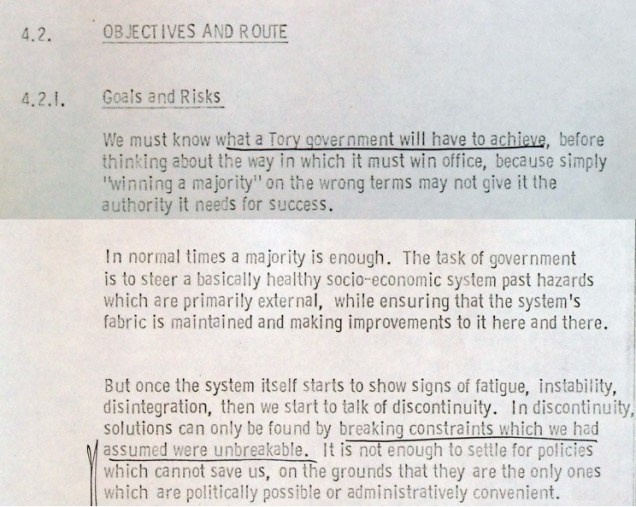
At this time I am drawn to this passage in particular:
We must know what a Tory government will have to achieve, before thinking about the way in which it must win office, because simply “winning a majority” on the wrong terms may not give it the authority it needs for success.
In normal times a majority is enough. The task of government is to steer a basically healthy socio-economic system past hazards which are primarily external, while ensuring that the system’s fabric is maintained and making improvements to it here and there.
But once the system itself starts to show signs of fatigue, instability, disintegration, then we start to talk of discontinuity. In discontinuity, solutions can only be found by breaking constraints which we had assumed were unbreakable. It is not enough to settle for policies which cannot save us, on the grounds that they are the only ones which are politically possible or administratively convenient.
It is safe to say that the Conservative government of David Cameron and George Osborne has been in office but not really in power since being re-elected with a tiny outright majority in 2015. And aside from their creepy manifesto pledge about having “a plan for every stage of your life” it has been almost impossible to discern what the Tories actually stand for, besides staying in power.
Winning a majority has not been enough because the majority was won on the wrong terms – by a prime minister who often pitched himself to the left of Tony Blair in the tawdry hunt for centrist votes. And these are far from ordinary times. As this blog recently pointed out, quoting Lincoln, the dogmas of the quiet past are inadequate to the stormy present.
Theresa May is an accomplished technocrat, but also a fierce and implacable authoritarian. Even her more restrained actions – such as denying the former London mayor Boris Johnson the power to use his expensively purchased second hand German water cannon for crowd control – smack more of political chicanery rather than any shred of liberal principle.
On civil liberties, May is utterly monstrous. But more to the point, Theresa May came down on the wrong side of the most fundamental, existential question to face this country since the end of the Second World War.Worse, she supported the Remain campaign with a calculated half-heartedness, refusing to boldly commit and make the public case for her position. What kind of leadership is this?
Andrea Leadsom is no better. She has publicly and irresponsibly spoken about triggering Article 50 almost immediately, well before any initial scoping discussions have even had the opportunity to commence and well before the British government has had the proper chance to decide how best to implement Brexit, and seems intent on taking us out of the EEA as we secede from the European Union. Her haste is not evidence of super-virtuous commitment to democracy or an uncommon respect for the will of the people, but is the conclusion reached by what seems to be a rather glib and uncurious mind.
But whether you are less repulsed by the flinty-eyed authoritarianism of Theresa May or the oversimplifying, CV-padding antics of Andrea Leadsom, it seems reasonable to say that neither of the two remaining candidates have anything approaching a latter-day Stepping Stones report waiting in their pockets for immediate unveiling as soon as the Queen has invited one of them to become prime minister. And that is what we need most of all right now.
Theresa May’s authoritarian streak, contempt for civil liberties and belief in wielding the coercive power of the state is incredibly objectionable to this blog – yet as by far the more experienced candidate, May is best placed to negotiate good secession terms for Britain with the EU (assuming that she doesn’t double-cross us and effectively condemn Britian to “associate membership” on the margins).
Andrea Leadsom has precious little track record in government or politics in general, and has distinguished herself by saying some downright irresponsible things about Brexit. As a result, she could potentially overshadow the democratic dividend of Brexit through unnecessary self-inflicted economic wounds (e.g. by taking Britain out of the EEA). Yet she is superficially more Thatcher-like (I won’t say Thatcherite), and has the potential, however small, to grow into a far more radical Conservative leader than the soul-sappingly ideology-free Theresa May could ever be.
Choose May and you risk turning Britain into a dystopian police state while rewarding yet another ideology-free, politics-by-numbers technocrat, the kind of person whose unambitious, managerial approach to the great issues of the day turns millions of people off politics altogether.
Choose Leadsom and you risk a tumultuous and highly suboptimal form of Brexit while taking an enormous leap of faith that an untested neophyte will successfully get to grips with one of the steepest learning curves in the world, and that they will be advised well in the process.
Who can choose between these two flawed options with any degree of certainty?
Apparently there is panic in Number 10 Downing Street and among the slavishly pro-EU establishment. Good. They have waged a contemptible, negative and deceitful campaign, and whether or not it prevails on June 23 the hearts, minds and consciences of all those involved richly deserve to be troubled
Having done everything but fill in all of the ballot papers himself to ensure a “Remain” vote on 23 June, at this point in the unevenly fought EU referendum campaign we might expect to see a bit of magnanimity or statesmanship from the prime minister as he coasts toward the closing stages.
But the polls have tightened unexpectedly as the British public rightly begin to suspect that the near-unanimous hysterical screeching from the establishment in favour of Remain sounds more like naked self-interest and wretched pessimism about Britain than a realistic warning about what might happen in the event of Brexit. And this has caused David Cameron – a notably weak strategist only capable of thinking one step ahead, unlike his gifted general election campaign manager – to panic, and start behaving in a most un-prime ministerial manner.
Three interventions in particular mark out the descent of David Cameron from oleaginous, confident salesman to the nation’s Bully in Chief – the impromptu rooftop press conference at which Cameron openly accused ministers in his own government of knowingly peddling falsehoods, the statement that Cameron would take Britain out of the single market in the event of a “Leave” vote despite leaving the EEA not being on the ballot paper, and his shameful attempts to bully and coerce Britain’s pensioners, effectively holding a gun to their heads and commanding them to vote Remain or see their pensions fall.
David Cameron doesn’t do that many press conferences at all, despite promising in Opposition that he would hold a monthly one, and so when he summons hacks to the roof of a hotel at short notice, you know that there is a Crisis that the Prime Minister is taking Very Seriously indeed.
Cameron then proceeded to list six ‘complete untruths to the British people’ that the Leave campaign was guilty of producing. These were that the UK is liable to bail out eurozone countries, that our rebate is at risk, that we have given up our ability to veto EU treaties, that we have no ability to stop EU spending from going up, that we are powerless to stop Britain being forced into an EU army and that we would save £8bn if we left the EU.
Were these untruths really so heinous that he was forced to hold a press conference at short notice? Or was it, as one of the journalists sitting on the roof with the Prime Minister suggested, that the Leave campaign currently had the momentum and the debate was all about immigration, which damages Remain? Cameron replied:
‘Look, I was watching the news last night and it just came over to me so clearly that there is such a contrast between the weight of independent expert opinion that wishes our country well but is giving us an unvarnished view of the decision we could be taking, there’s a massive contrast between that – respected, independent experts warning us about lost jobs, about instability, about a smaller economy, about the effect on our country. The contrast between that and a series of assertions from the Leave campaign that just simply aren’t right…’
So the Crisis was that the Prime Minister had been watching the news last night.
Some archly dry humour there from Isabel Hardman. When The Spectator openly mocks a Conservative prime minister in this way, you know things are bad.
Cameron’s specific counterpoints are immaterial here – they were aimed at the ravings of the official Vote Leave campaign, which does not speak for all Brexiteers. But what is telling is the fact that David Cameron – a man who promised that he “ruled nothing out” in his renegotiation with the EU while actively colluding with business leaders to plan the eventual Remain campaign, and who then presented the empty gift bag given to him by Brussels as a deal which had fundamentally “reformed Europe” – is willing to go on live television and accuse his Brexit-supporting ministers of being liars.
More insidious than this, though, was the way that David Cameron pledged on the Andrew Marr show last weekend that in the event of a Leave vote he would seek to take Britain out of the single market, despite this being just one (incredibly sub-optimal) mode of Brexit, and the referendum question saying nothing at all about the single market or EEA.
Dr. Richard North of the eureferendum.com blog remarks on:
[..] an extraordinary interview on the Marr Show yesterday which had David Cameron pledging to take the UK out of the Single Market in the event of a Brexit vote. This was despite Andrew Marr suggested that we could stay in, with Cameron refusing to entertain the idea, “because the ‘leave’ campaign had specifically rejected that option”.
The segment of the interview started with Andrew Marr reminding the Prime Minister that he had promised to “carry out the wishes of the British people” if we vote to leave. The trouble is, Marr then said, is that “the wishes of the British people” is a rather indistinct thing – it’s a blunt “yes” or “no”.
Cameron responded by saying that if we vote to leave the Government would carry out the instructions of the British people. That, Marr averred, would put the Prime Minister in “a very strange position”. He’d be doing things like introducing an Australian-style points system that he didn’t believe in. As for, the Single Market, though, Marr said, “there is room for a Prime Minister to negotiate that”.
It was here that the role of Vote Leave came to the fore. “I think one of the most important moments in this campaign”, Cameron said, “was when the ‘out’ campaign said they wanted to leave the Single Market”. He continued: “They didn’t have to make that choice. They’ve made that choice. And what the British public will be voting for … would be to leave the EU and leave the Single Market”.
What the Prime Minister is doing, therefore, is using Vote Leave as a proxy for the entire British public. However, this is a small group of individuals with singular views, put in place by an unelected Electoral Commission to carry out the role of lead campaigner. This can’t in any way be taken to represent the will of even those who favour Brexit – much less the entire British population.
Dr. North is absolutely right to emphasise firmly that Vote Leave do not represent the ideas and wishes of all Brexiteers. They were not elected to represent us, and their most prominent figurehead (Boris Johnson) had not even decided which side he was going to support until a couple of months ago.
Just because the same idiots who stubbornly persist in peddling their “£350 million a week for the NHS” falsehood in the face of endless rebuttals and fact checks have airily decided that Britain should not Brexit to an interim state preserving single market access in no way precludes that option. As Richard North reminds us, the ballot paper asks whether we want to leave or remain in the European Union – nothing more and nothing less. We should know, we spent long enough haggling over the wording at the time.
All the evidence suggests that if Britain leaves the EU without securing an “off the shelf” deal to ensure continuity of access to the single market (while fully extricating us from political union, which is what the referendum is all about) there will be at least some negative short term economic consequences, as no new trade deals can possibly be negotiated in the two-year window provisioned in Article 50 of the Lisbon Treaty. By contrast, Brexiting to an interim EFTA/EEA arrangement (the so-called Norway Option) would maintain our full access to the single market in the short to medium term while we work on a better bespoke solution for Britain.
The attractiveness of the interim EFTA/EEA route is self-evident: Britain would immediately be free of ever-closer political union and democracy would be restored, while maintaining single market access (for which we would pay) would return our relationship with the EU to the state that people believed they were voting for in the 1975 referendum. Therefore, it is unsurprising that Remainers are desperate to slander and dismiss the option as unworkable – it represents dynamite which would obliterate their entire case for continuing to suffer the EU.
But while David Cameron’s eagerness to problematise the Norway Option is understandable politically, for the prime minister to flat-out state that he would not pursue this option and instead take Britain out of the single market (despite no mandate to do so from the electorate) is bordering on threatening self-harm. Any Brexit model not involving keeping interim access to the single market would inevitably come with higher risks and potential economic costs than adopting the Norway Option. By ruling it out, David Cameron is essentially threatening the electorate, saying that if we vote Leave he will pursue the most disruptive and costly form of Brexit within his power, purely as an act of spiteful vengeance.
Just stop and think about that for a moment. David Cameron has effectively told voters that if we vote to leave the European Union, he will sneer “your wish is my command” and then set about doing so in the most reckless and ill-considered manner possible, just to teach us a lesson. The prime minister of this country has just threatened our own national interests on live television. Is that something which we should just blink and accept, writing it off as “fair play” in a hard fought referendum? I profoundly disagree. I think that it is contemptible behaviour, the kind of action which immediately disqualifies the perpetrator from holding further public office.
And if this still wasn’t enough, David Cameron then went from threatening the British people in general to attempting to scare Britain’s older voters in particular, with despicable threats that Brexit would automatically and inevitably lead to pension cuts.
Project Fear has turned into Project Frightened. Remain are losing ground in opinion polls and running scared. So what do they do? Go positive? Make a better, brighter case for the EU? No. They double-down and turn to blackmail.
That’s the only word that suits David Cameron’s threat that Brexit might lead to pensions being cut, made today in this newspaper. His logic is that Brexit will create a gap in the finances that will have to be filled somehow. The triple lock on pensions, guaranteeing rising incomes, would probably have to picked. Even if it were a moral necessity to help the aged, it would suddenly become unaffordable.
This is rubbish for two reasons. First, it’s based on the Government’s assumption that Brexit will lead to a collapse in trade that will wipe billions off GDP. The Treasury forecasts that this is based on are alarmist and absurd – they suggest a retraction worse than the Great Depression. Businessmen who actually deal with Europe every day, such as Sir James Dyson, report that they don’t see such a risk and are confident that Britain will continue to grow.
Second, Cameron suggests that the Government would have no choice but to cut pensions – as though the invisible hand of the free market would be clasped around its throat. Nonsense. It would face spending choices and, Cameron is telling us, it would choose to cut pensions. Much as the Government has chosen in the last few years to cut the highest rate of income tax on the rich or chosen to cut benefits for the poor. If Brexit did trigger a recession, the Government would once again have to do what it’s supposed to do and make budget decisions based upon its political preferences. I humbly suggest it chases the tax evaders and closes some loopholes before it bleeds pensioners dry.
And Stanley’s devastating conclusion:
The bottom line is this: the Prime Minister has moved from warning the British people to threatening them. And picking on the elderly – some of whom are legitimately worried about the future – is one of the lowest things you can do in politics.
What utterly despicable and unmanly behaviour from our prime minister. What debased, fearmongering garbage this man is capable of spewing in order to get his way in the EU referendum. David Cameron’s legacy as prime minister has long been in question, having governed for five years as part of an unmemorable centrist coalition and latterly as a party which blind observers might guess to be the work of Blue Labour, if not Blair’s New Labour. But now that legacy has crystallised – Cameron is the prime minister who betrayed conservatism and bullied his own people, preferring to serve the interests of the EU than those of his country.
David Cameron doesn’t have a conservative bone in his body. He doesn’t have an ideological bone of any kind, and from his craven behaviour in this referendum campaign it is quite clear that he lacks a backbone, too. And like a common school bully, he is willing to throw the full weight of his office and government around, breaking conventions and standards of common decency left, right and centre as he seeks to gain every inch of advantage.
That’s why the prime minister’s days are numbered. At present he takes false courage from the fact that his normally sworn enemies in the Labour Party and on the generic Left are holding their fire in their shared desperation to keep Britain in the EU. But on June 24, Cameron will quickly realise that a good half of his own Conservative Party, together with everyone else in the country, will be straining at the leash to eject him from office, strip him of the bully pulpit he has so abused, and send him marching barefoot back to Witney in sackcloth and ashes.
And such is the amount of political capital and personal goodwill Cameron has squandered, barely a single person will come to his defence when the inevitable party leadership coup takes place. In the minds of many people – now including this blog – whether his successor is just as bad (i.e. Boris Johnson) is almost immaterial. The pleasure of seeing such an arrogant and dishonest man as David Cameron driven from power in disgrace, his reputation rightly in ruins, will be its own reward.
There is a legitimate and intellectually coherent case for Britain remaining in the European Union, but David Cameron has not made it. In fact, when it comes to the rarely heard (in this country) principled euro federalist case, its proponents all seem to have been abducted and held far away from any television studio so that they don’t open their mouths and drive thousands more people into the Brexit column.
Whether the prime minister is among their number is not known. It is possible that the man is catastrophically misguided and actually believes some of the nonsense he has spewed about securing a “better deal” for Britain, and that Britain could somehow prosper as a country inevitably on the margins of an ever more tightly integrating eurozone. Perhaps.
But either way he has not been honest with the British people. Worse than that, though, he treats the people with open contempt. Some politicians lie because they fear the people, but not so with Cameron. David Cameron lies because he despises the people, holds their intelligence in low regard, and is more than willing to alternately deceive, belittle and threaten the people in the service of his establishment masters and instincts.
This is a prime minister who, when given the choice between vociferously defending the national interest of his country against the EU elite or siding with that same elite and bullying his own people into submission to their will, gladly chooses the latter course of action every single time.
There are few words strong enough to adequately describe the prime minister’s odious character and behaviour as revealed over the course of this EU referendum campaign – certainly none which I am willing to publish on this blog.
Which is why I am ending this piece here, in utter disgust at the conniving, arrogant, untrustworthy and weak approximation of a man presently in charge of our country – before I say something that I might later come to regret.
–
Agree with this article? Violently disagree? Scroll down to leave a comment.
By waging such a disingenuous, fear-based campaign for Britain to remain in the European Union, David Cameron and George Osborne are sowing the seeds of their own political destruction
The excellent Archbishop Cranmer blog gives it to David Cameron and George Osborne with both barrels for the grubby, underhanded way in which they have gone about fighting the Remain case in this EU referendum campaign.
Frankly, both George Osborne and David Cameron have disgraced their offices of state in this referendum campaign, with their lies, hyperbole, disinformation and deceit. Whether or not the UK takes the first step toward leaving the EU on 23rd June; whether or not it becomes our Independence Day or is confirmed as the day we resigned to plod inexorably toward becoming an offshore regional council of a United States of Europe, David Cameron and George Osborne will go down in history as Tory charlatans, cheats and political frauds. They have successfully re-toxified the Conservative brand and made it impossible for many to support a party led by either. You cannot call a referendum on something as crucial as fundamental identity or the determination of national destiny, and then collude with corporates and conspire with other elites to feed the electorate a diet of blight, pestilence and woe. It’s enough to make a man never trust a Tory again.
Amen. And the curious thing is that both Cameron and Osborne seem utterly oblivious to the medium and long term damage they are wreaking on their party. Wanting their side to win the referendum is understandable – both men’s authority and political careers ride on the public voting remain. But the desperate and underhanded means to which they are going to win the referendum – the national propaganda leaflet, the Treasury statistics mysteriously missing an analysis of the Brexit to EFTA/EEA scenario – are storing up serious problems for the future.
In this blog’s opinion, both Cameron and Osborne are overrated as master political and strategic minds. Cameron actually failed to win the 2010 general election, and prevailed in 2015 only against a phenomenally weak Labour leader. Osborne, meanwhile, is much more of a tactician than a strategist, often quick to exploit opportunities to win a particular argument, but with little sense of the knock-on impact on other matters.
This is exactly what is happening now. Cameron and Osborne look at the polls, which generally show a steady lead for Remain, and mistakenly assume that this is the same as approval of themselves. But this is not so. Strip away the vast majority of Labour and non-aligned voters siding with Remain out of fear or ignorance, and over half of the Conservative Party may well oppose the prime minister. Had David Cameron conducted his campaign with a shred of decency or respect for the opposing side, this might not be a problem, and eurosceptic Conservatives might well have kissed and made up after being defeated on 23 June. But the sheer barrage of misleading statistics, analyses and inappropriate interventions from global figures organised by Cameron means that no rapprochement will be possible.
The bitter truth is that far from detoxifying the Conservative Party, David Cameron has retoxified it – to a supercharged degree. The prime minister may not be to blame for the Left’s hysterical reaction to any and every limited attempt at fiscal restraint by this government – with Labour shrieking that attempts to curb growth in public spending amount to a holocaust of the sick and disabled, the Left are to blame for much of the toxicity in our politics today. But Cameron is very much responsible for alienating vast swathes of his own side.
After the referendum is done, there will be a large number of small-c conservative voters who would sooner die than lift a finger to support a Conservative Party led by David Cameron or any of his cabinet allies from the Remain camp. This blog is among them. The Conservative Party is now as toxic among many conservatives as it is among the British Left. How then to fight a general election once the Labour Party finally gets itself organised?
This is David Cameron’s true legacy – a Tory Party hated by the Left despite being so boringly, forgettably centrist as to be indistinguishable from New Labour, and equally hated by many on the Right for having betrayed innumerable conservative principles through a policy of government by appeasement rather than the bold pursuit of conservative goals. Hated by the Left for having risked Britain’s place in the European Union by holding the referendum in the first place, and equally hated by the Right for having shamefully come down on the side of supranational, antidemocratic rule from Brussels.
Dave and George are probably not looking that far ahead right now – they are probably too busy lining up the next NGO head to go public about how apocalyptic Brexit would apparently be. But you could not pay me enough money to change places with either of them when it comes time for the first meeting of the Conservative Parliamentary Party after the referendum.
The anger and vitriol will be immense, and may well consume our arrogant prime minister and his chancellor soon after their moment of ill-begotten triumph.
And who will mourn their loss? If David Cameron and George Osborne are the best that the Conservative Party can offer, we may as well have a Labour government anyway.
This supposedly conservative government is no longer in the business of conserving things – even ancient Roman ruins of great historical and national significance
What kind of a country is modern Britain? And what kind of a people are we?
Sadly, if the behaviour of our own government is any guide we are now such a has-been, good for nothing failure of a once proud country that when we stumble upon one of the largest and most significant domestic archaeological discoveries in a century, we simply shrug our shoulders and cover it back up with dirt because the cost and inconvenience of fully excavating and restoring it would be too great.
Apparently, discovering the immaculately preserved remains of a great Roman villa – with all of the potential it offers to better understand our past – simply isn’t possible when every last penny of government money has to be diverted to ensure that we continue blindly throwing 0.7% of our GDP into the furnace so that we can be “world leaders” in international aid.
While laying an electricity cable beneath the grounds of his home, near the village of Tisbury, in Wiltshire, Luke Irwin found the remains of what appeared to be an ornate Roman Mosaic.
But what emerged when archaeologists from Historic England and Salisbury Museum began excavating the site was even more of a surprise.
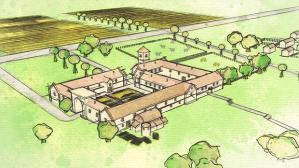
They found the mosaic was part of the floor of a much larger Roman property, similar in size and structure to the great Roman villa at Chedworth.
But in a move that will surprise many, the remains – some of the most important to be found in decades – have now been re-buried, as Historic England cannot afford to fully excavate and preserve such an extensive site.
Dr David Roberts, archaeologist for Historic England, said: “This site has not been touched since its collapse 1400 years ago and, as such, is of enormous importance. Without question, this is a hugely valuable site in terms of research, with incredible potential.
“The discovery of such an elaborate and extraordinarily well-preserved villa, undamaged by agriculture for over 1500 years, is unparalleled in recent years. Overall, the excellent preservation, large scale and complexity of this site present a unique opportunity to understand Roman and post-Roman Britain.”
He added: “Unfortunately, it would cost hundreds of thousands of pounds to fully excavate and the preserve the site, which cannot be done with the current pressures.
“We would very much like to go back and carry out more digs to further our understanding of the site. But it’s a question of raising the money and taking our time, because as with all archaeological work there is the risk of destroying the very thing you seek to uncover.”
I genuinely don’t know what is worse here – the fact that the government (for Historic England is a subsidiary of DCMS) has become so distracted by trying to trick and scaremonger its way to victory the EU referendum and so untuned from the daily life of this country that nobody within DCMS thought to intervene when they found out that we just weren’t going to bother with this particular ruin, or the fact that one of the archaeologists (Dr. Roberts) himself seems serenely resigned to the fact that he will probably be an ancient relic himself by the time the UK government scrounges the spare change to properly excavate, understand and display this piece our history for the education of all.
This blog constantly drones on about the virtues of small government and a leaner, more agile state. There are many ways in which the state spends time and resources doing badly things which could and should be done in the non-profit, charitable and private sectors, and this blog will continue to advocate for these libertarian and conservatarian ideals. But surely if we are to have a national government at all, one of the things it absolutely should do is to take some measure of stewardship over our natural and historical built environment.
This blog would be the first to admit that in many areas, excessive government involvement in the arts (as well as a lack of personal tax incentives) crowds out the private sponsorship and philanthropy which so distinguishes the fine arts and cultural in America. But while a plausible case can be made that the state should not be operating its own massive media organisation in the form of the BBC, the historical nature of archaeological discoveries (as well as thorny issues of property rights springing from such discoveries) mean that this is an area where the state can and should get involved.
So here we are, a country so lacking in motivation and curiosity that we are willing to re-bury one of the most exciting domestic archaeological discoveries in recent history because it would simply cost too much money and take too much effort to properly excavate the site, study and catalogue it, and maybe throw up a visitors centre at some point so that the thing can begin to pay for itself.
A country where we have much to say about our public services and everything we believe we are owed by the state, but far less to say about what we might do for our country, our society, our community and those who will live here after we are gone.
A country where the ruling Conservative Party has forgotten even how to conserve.
Welcome to David Cameron’s dreary, unaspirational Britain.
The Prime Minister has already done things that will underpin his eventual legacy: winning the Scottish independence referendum and the general election.
Because it is quite true – some of the greatest accomplishments of David Cameron and his core team of loyalists since 2010 are avoiding having the country disintegrate on their watch, and managing to win a second general election against a historically weak Labour leader pursuing a transparently flawed strategy. If the bar for success in British government has truly been set so low then we are in real trouble.
But David Cameron is not a visionary leader. He came to power in 2010 promising to get Britain through difficult economic times, and was re-elected in 2015 promising to be a reasonably competent Comptroller of Public Services. And to be fair to the man, he never really promised to be a great statesman or a formidable world leader.
Being a doggedly centrist technocrat is all well and good, but eventually people quite rightly start to ask what your government is for, besides acquiring the reins of power and then keeping hold of them for as long as possible. David Cameron’s best answer – the main headline from the Conservative Party’s 2015 general election manifesto – was that we should vote Tory because they have a “plan for every stage of your life“.
Nobody within the Conservative Party seemed to care that this sounded alarmingly socialist and suggestive of the Nanny State – people craved security above freedom, it was believed, and so that’s what would be promised and delivered. More of the status quo, whether the status quo worked well or not.
I won’t lie: my first reaction on hearing the news that Iain Duncan Smith – who together with Michael Gove is one of the few Conservative heavyweights left with any discernible core conviction – had finally snapped and told George Osborne exactly what to do to himself was “great – anything to make the smug little cretin sweat”.
Because George Osborne is David Cameron with less charisma. And since David Cameron has almost no charisma of his own, that puts George Osborne well into negative territory. Given the fact that his blunders (the Omnishambles Budget, tax credits, PIPs) have done as much to colour the political landscape as his “victories”, I also find his reputation as a master political strategist to be hugely overinflated.
If running to the political centre by jettisoning core conservative principle by adopting left-of-Labour policies like a £9 minimum wage counts as political genius then sure – anybody who can successfully cross-dress as a politician from a different party to pick off some extra votes is a master strategist. But it makes George Osborne a lousy conservative.
Not everything in Osborne’s budget was wrong. Should the thresholds for tax brackets move upwards with inflation? Ideally yes, they should do so every year to neutralise the effect of fiscal drag. But to package measures such as this with reductions in the Personal Independence Payments to hundreds of thousands of disabled people is frankly idiotic.
Mr Osborne’s reputation as a tactical political genius has gone south too. Maybe that’s been the problem all along: his understanding of politics was all about tactics – about messaging and grids, presentational gloss and re-branding – and had nothing to do with fundamental, irreconcilable principle. I am prepared to guess that he quite literally does not understand politicians who are prepared to risk everything for an idea, a conviction: a personal moral mission.
He thinks that they are bloody-minded and naive, with no comprehension of the modern science of winning elections. But that, it seems, is not what the people believe: they are beginning to think that their leaders should stand for something, should have a fundamental sense of what they are in politics for. It’s what they call “authenticity”, and it could turn out to be more of a winner than all the clever marketing techniques in the world. Imagine that.
I get all of that. But I have no idea what David Cameron is trying to accomplish as prime minister, or what George Osborne thinks he is doing at the Treasury. Because it certainly isn’t paying down Britain’s debts, as they both like to claim. Nor is it guarding Britain’s sovereignty and place in the world – Cameron has gutted Defence, and is in the process of tricking the British people into voting to remain in what he falsely claims to be a “reformed” European Union.
Neither Cameron or Osborne are motivated by the desire to roll back the state and make the British people more free – their heavy-handed government is all for ever-greater restrictions on both ancient and recent hard-won civil liberties, and is seemingly anxious to sacrifice what freedom we have left upon the altar of “national security”.
There is almost nothing about shrinking the state and expanding personal liberty in this government. But there are lots of policies – cutting state spending on the poorest and weakest in society while continuing to lavish stage largesse on wealthy older people (through non-means tested benefits and the lack of a housing supply policy to benefit the young) – which play right into Labour’s hands, making the Tories (and those who support them) look like nothing more than selfish, grubby opportunists, lining the pockets of the already wealthy while others suffer.
In short, I don’t know what this Conservative government is for, besides trying to stay in power and preventing Labour from stealing it. And apart from the work he was doing in his own department, I suspect that Iain Duncan Smith didn’t know either, no matter how much obligatory praise he heaped on Cameron in his resignation letter.
And if Iain Duncan Smith’s resignation destabilises the government – so what? We currently have a nominally conservative prime minister who is busily enacting Tony Blair’s fourth term of office. We effectively already have a Labour prime minister – or a New Labour one, at least.
Maybe an improbable defeat to Jeremy Corbyn’s Labour Party – or a good scare, at least – is the shock the Tories need to dig deep and find a real conservative leader.
Postscript: Iain Duncan Smith’s full resignation letter – which this blog believes was far too generous and courteous – is shown below.
I am incredibly proud of the welfare reforms that the government has delivered over the last five years. Those reforms have helped to generate record rates of employment and in particular a substantial reduction in workless households.
As you know, the advancement of social justice was my driving reason for becoming part of your ministerial team and I continue to be grateful to you for giving me the opportunity to serve. You have appointed good colleagues to my department who I have enjoyed working with. It has been a particular privilege to work with excellent civil servants and the outstanding Lord Freud and other ministers including my present team, throughout all of my time at the Department of Work and Pensions.
I truly believe that we have made changes that will greatly improve the life chances of the most disadvantaged people in this country and increase their opportunities to thrive. A nation’s commitment to the least advantaged should include the provision of a generous safety-net but it should also include incentive structures and practical assistance programmes to help them live independently of the state. Together, we’ve made enormous strides towards building a system of social security that gets the balance right between state help and self help.
Throughout these years, because of the perilous public finances we inherited from the last Labour administration, difficult cuts have been necessary. I have found some of these cuts easier to justify than others but aware of the economic situation and determined to be a team player I have accepted their necessity.
You are aware that I believe the cuts would have been even fairer to younger families and people of working age if we had been willing to reduce some of the benefits given to better-off pensioners but I have attempted to work within the constraints that you and the chancellor set.
I have for some time and rather reluctantly come to believe that the latest changes to benefits to the disabled and the context in which they’ve been made are a compromise too far. While they are defensible in narrow terms, given the continuing deficit, they are not defensible in the way they were placed within a Budget that benefits higher earning taxpayers. They should have instead been part of a wider process to engage others in finding the best way to better focus resources on those most in need.
I am unable to watch passively whilst certain policies are enacted in order to meet the fiscal self imposed restraints that I believe are more and more perceived as distinctly political rather than in the national economic interest.
Too often my team and I have been pressured in the immediate run up to a budget or fiscal event to deliver yet more reductions to the working age benefit bill. There has been too much emphasis on money saving exercises and not enough awareness from the Treasury, in particular, that the government’s vision of a new welfare-to-work system could not be repeatedly salami-sliced.
It is therefore with enormous regret that I have decided to resign. You should be very proud of what this government has done on deficit reduction, corporate competitiveness, education reforms and devolution of power. I hope as the government goes forward you can look again, however, at the balance of the cuts you have insisted upon and wonder if enough has been done to ensure “we are all in this together”.
–
Agree with this article? Violently disagree? Scroll down to leave a comment.








 Semi-Partisan Politics