Banning Hate Preachers Will Not Eradicate University Campus Extremism

Islamist Extremism University Campus Britain 1


Prohibiting extremist preachers from speaking on university campuses will not stop the radicalisation of impressionable young minds – and the ongoing coalition row between the Conservatives and Liberal Democrats shows the Tories at their authoritarian worst.

“Should these men be allowed in UK universities?” frets The Times of London, in a report which begins:

Radical and intolerant Islamist leaders preached to crowds of students at almost 200 official events in the past year, according to a study of external speakers at universities including Cambridge, Birmingham and University College London.

Segregated seating for male and female students is understood to have been implemented for at least a quarter of those public meetings held by the Islamic societies at 21 universities.

The issue of university campus extremism has been brought into sharp relief since it emerged that Mohammed Emwazi, or “Jihadi John”, may have been radicalised while studying at Westminster University in London. This revelation has led to renewed scrutiny of various Muslim student organisations, their invited speakers and their practices (such as segregated seating in some instances). And this scrutiny is often welcome.

But the government goes too far when it seeks to make universities responsible for enforcing the censorship of ideas deemed “extremist”, as the BBC reports:

Continue reading

Yes, Terrorism Is A Price Worth Paying For Liberty

Civil Liberties Government Surveillance Terrorism


When determining how society should deal with people who have committed the most heinous crimes, one does not turn to the victims or their surviving family members for advice. And if one were to be so rash as to base Britain’s penal system on the vengeful feelings of grieving parents, spouses and children, there would be gruesome public executions every day in every town up and down the length of Britain, from Land’s End to John O’Groats.

So while we may feel every sorrow in the world for those who have been the victim of dastardly terrorist attacks, why do we give such credence to terror victims when it comes to formulating our approach to national security and civil liberties? While human compassion dictates that we offer our utmost sympathy to those who have suffered, allowing ourselves to be manipulated into making sweeping and draconian decisions based on heart-wrenching personal testimony is no way to run a country – whether we are talking about the NHS or government snooping laws.

Those in the media who report on these subjects for a living should know this best of all. And yet large swathes of the British press have spent today tacitly attacking the campaigning groups who defend our civil liberties, simply because they refuse to display the grovelling, servile fearfulness that begs government to take as many of our freedoms as they want in return for the illusion of greater safety.

The Times print edition, in an article bearing the sub-headline “outcry over campaigners’ attack on state snooping”, reports:

Continue reading

Beware The Short-Termism Of Those Who Fail To Prioritise Defence Spending

HMS Queen Elizabeth


As Britain heads toward an incredibly hard-to-predict general election, nearly everything about our country seems up for discussion – everything except Britain’s declining level of military spending, our long-term national defence strategy and our commitment to the armed forces we are quick to call heroes but grudgingly slow to fund.

James Forsyth, writing in The Spectator, talks about the bear in the room:

You wouldn’t know from this election campaign, but Europe is in crisis. On its eastern border, the threat from Russia is as great as at any point since the end of the Cold War. Crimea has been annexed and large parts of eastern Ukraine are under control of Russian-backed forces. Russian aircraft have even been taunting the RAF in the English Channel. The Baltic states are increasingly fearful that they will be next to suffer from Vladimir Putin’s attempt to reassert Russian dominance on its doorstep.

On Europe’s southern border, Islamic State continues to cause death and destruction — the recent decapitations in Libya were filmed along the shore to make the point that the jihadis have reached the Mediterranean. More worrying, perhaps, is the number of Europeans fighting for it. Last weekend, Manuel Valls, the French Prime Minister, warned that the number of Europeans who will have taken up arms with Isis may treble to 10,000 by the end of this year. As these radicalised youths return home, the terrorist threat in Europe will rise exponentially.

But neither of these subjects features with any prominence in the election campaign. Isis and the Russian threat are deeply inconvenient truths that don’t fit into the party leaders’ scripts. The Tories’ six-point long-term economic plan doesn’t have room for foreign entanglements. Labour wants to talk about the National Health Service, not international security.

These are sobering words. There has been a worrying tendency of late in the Tory-friendly press to excuse David Cameron’s various failings and oversights – be it refusing to champion the conservative case in the televised leaders’ debates, or failing to ringfence defence spending during a period of global turmoil – in order to help push the Conservatives across the finish line on 7 May. It is good to see The Spectator taking a firmer stance on the issue of defence, at least.

Continue reading

The EU Still Wants To Control Foreign Policy And Create Its Own Army

Martin Schulz Joe Biden European Union Common Foreign Policy EU Army


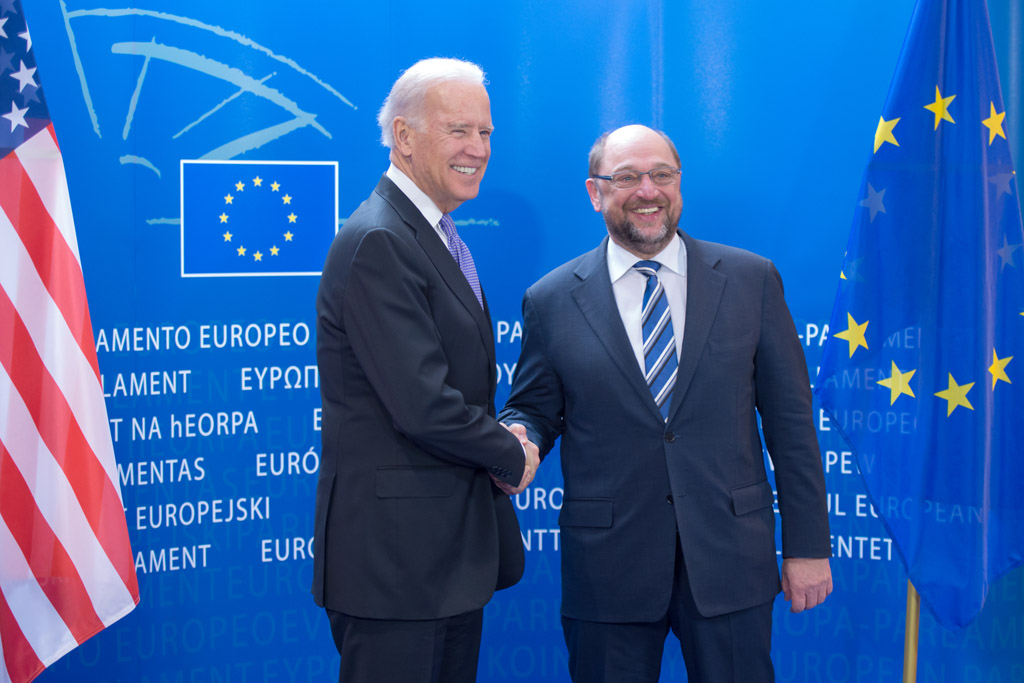
“I appreciate that it is not easy to explain to people back home why we need to cooperate more closely at European level in such a sensitive field as defence and security policy. Protecting its citizens has traditionally been a key task of the nation State and therefore also one of the foundations of its legitimacy. But we cannot close our eyes to reality: the world has changed and we are existentially connected to that world. Nowadays we can only defend our citizens jointly” – Martin Schulz, 2013


Here’s a good rule of thumb: the more powerful and undemocratic the institution, the better it becomes at using weaponised public relations tools in order to present a softer, friendlier, less threatening – and entirely false – picture of themselves.

Thus the President of the European Parliament, Martin Schulz, spent Monday morning hosting a laid back online live-chat on Facebook, in which he fielded carefully-screened softball questions from members of the public. And sneaking back onto the radar during that live-chat today was the prospect of a common European foreign policy, and a European army to enforce it.

From the EU’s own press release today:

To questions concerning the recent proposal on a common European army, Schulz replied “we need a common foreign and security policy”, explaining that combined military capacities would be a way of reducing military spending in a time when “money is certainly needed elsewhere”.

Meanwhile, others in the European Parliament are making rumblings about moving toward “permanent structural co-operation” – meaning there will be no way back once the EU starts taking major steps as an independent actor on the world stage:

Continue reading

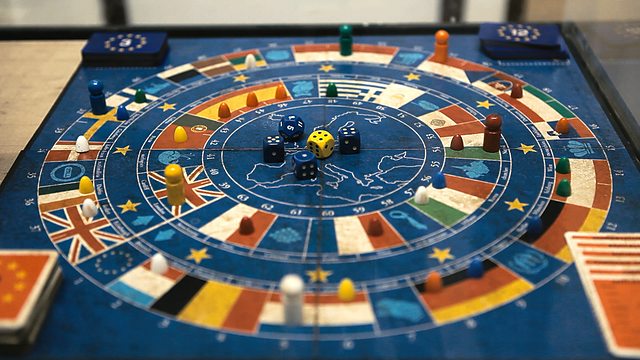
Review: The Great European Disaster Movie, BBC Four

The Great European Disaster Movie BBC EU UKIP bias 2


Imagine that you are a young child in an alternate universe, a future world in which the European Union has been disbanded amid popular uprising and economic depression.

Then imagine that you are circling Berlin in an airplane suffering a technical emergency, while Angus Deayton (of all people) sits next to you and bores you to tears with dull morsels of selectively-remembered EU trivia, interspersed with told-you-so left wing laments about how everything would have been so much better if only his generation had spent more time loving the European Union.

Even the most happy-go-lucky child would be willing that aircraft into a terminal nosedive and sweet oblivion after an hour of such torture. I certainly was, after just ten minutes watching The Great European Disaster Movie on BBC Four last night.

The Telegraph says that the rare elements of truth contained in the film were completely overshadowed by the condescending delivery:

Continue reading