Why Can’t We Raise The Quality Of The Debate On Europe?

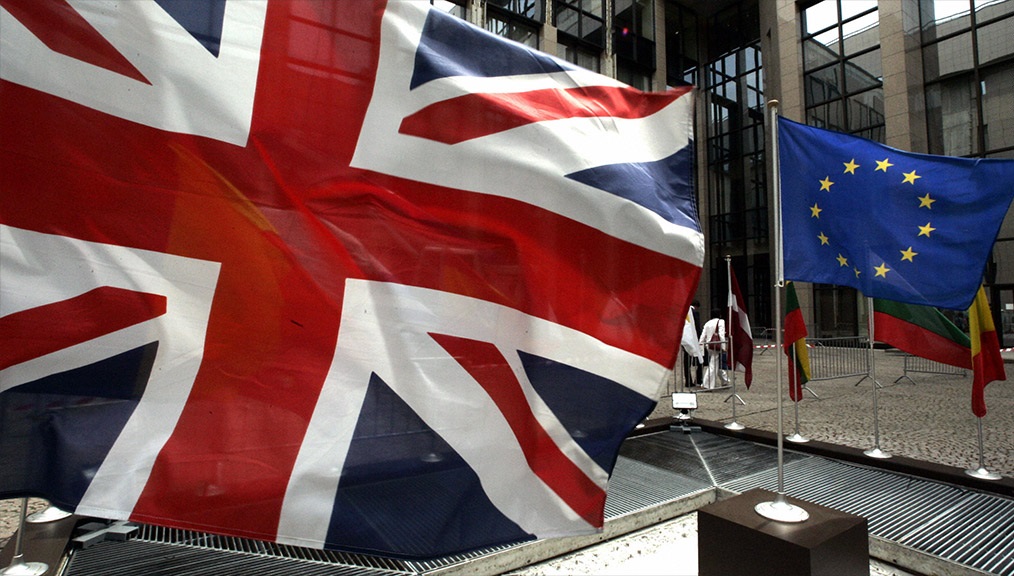
EU UK Britain Flags

The stakes could not be higher for our country, and yet the debate about Britain’s place in Europe takes place in a febrile atmosphere where blinkered partisanship and confected outrage on social media draws a larger audience than reasoned argument. No wonder we are incapable of disagreeing with honour when it comes to our place in the EU

Why can’t we disagree well on Europe?

That is the question posed by Justin Welby, Archbishop of Canterbury, in a thought-provoking intervention posted at Reimagining Europe, a new Church of England blog examining Britain’s place in Europe and the world from a Christian perspective.

In his piece ‘Learning to disagree well on Europe’, Welby writes:

People will say that we should not take the risk of leaving, others that it is less of a risk than staying. There will be talk of national sovereignty, of national confidence, of repatriation of laws, or being bound by European laws over which we have no control. The only certainty is that there will be much heat, probably slightly less light, but that it is a hugely important decision, with thoughtful and committed people, including Christians, on both sides.

But what about those in the UK for whom our membership, or withdrawal, from the Union, is not a major question, those for whom the needs and responsibilities of each day take precedence, and mention of political debates such as this leave them cold?

[..] How can we revitalise ideas such as sovereignty and subsidiarity – ideals formed out of Christian faith whose political dimensions capture their meaning only in part – and help encourage a clearly values-based approach to Britain’s future relationship with the EU; one that includes, but does not end with, economic and political perspectives?

All worthy questions. And in the spirit of making a constructive response, I would offer two main reasons that the quality of the debate has been – and is likely to remain – so desperately low.

First, the stakes of the debate are so high: we are not talking about tweaks to the tax code or welfare system which can be easily undone by a future administration, this decision will shape the future of our country, and the way in which the whole world responds to the challenges of globalisation. And secondly, the quality of our political discourse in general is driven by the internet and social media, democratising in their way but also a megaphone for those with the loudest and most outrageous opinions to seize control of the narrative.

Continue reading

Cecil The Lion’s Death Marks Open Season For Cheap Virtue-Signalling

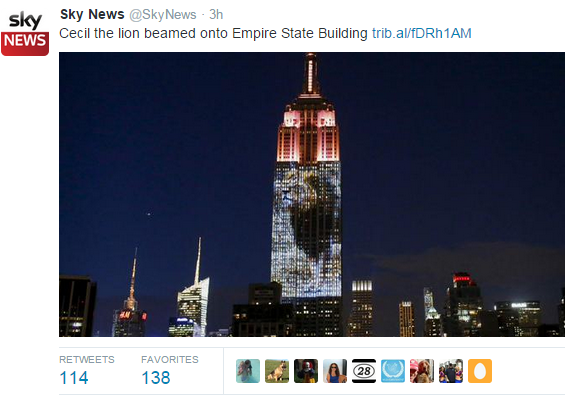
Cecil The Lion beamed onto Empire State Building


The killing of Cecil the lion has been a virtue-signaller’s dream, a golden opportunity for people to flaunt their enlightened and compassionate credentials without doing any of the hard work required to stop it from happening again

Riding home on the night bus this weekend, Jeremy Corbyn-style, I found myself sitting behind a young couple sharing a convivial meal of Kentucky Fried Chicken. Between chicken wings and mouthfuls of fries, one of them opined to the other about how terrible it was that a human being could do anything so beastly as murder Cecil the Lion, an innocent animal.

“It’s awful, the man who did it should be shot” wailed the companion, as a piece of popcorn chicken slipped from his greasy fingers, rolled past me down the aisle and pinballed down the stairs to the lower deck. Casually imagining the execution of a man for the inhumane treatment of an animal, while devouring the factory farm-raised contents of a KFC bargain bucket. Sure, okay.

Now, I have no time for people who jet off to Africa to shoot unsuspecting endangered animals in order to mount their heads on a wall. It’s not real hunting, for a start, in reality being much closer to shooting fish in a barrel. Quite what such people are compensating for, I won’t begin to speculate. And of course it is sad when any great and noble creature like a lion is unnaturally killed, especially a creature known and loved by so many tourists and safari enthusiasts from around the world.

But some of us are starting to lose perspective over Cecil the lion, and could perhaps do with a quick reality-check. Take the people who decided to beam Cecil the lion’s face onto the side of the Empire State Building in New York:

Continue reading

Labour Leadership Candidates United By Arrogance On Europe


Anyone hoping that Labour Party’s haemorrhaging of northern votes to UKIP or the EU’s sacrifice of Greece to preserve the Euro might lead to a reconsideration of Labour’s reflexive, metropolitan pro-Europeanism must be sorely disappointed with the four candidates jostling for the honour of leading the party to defeat in 2020.

Although there is a groundswell of euroscepticism building across the country – and even though many prominent left-wingers are now calling for “Lexit”, including the ubiquitous Owen Jones – those who aspire to lead the Labour Party remain wedded to their desperate belief that the EU is somehow good for Britain.

Even as the contrary evidence mounts and public pressure for a left-wing eurosceptic political outlet grows, the Labour Leadership candidates prefer to stick to their increasingly hollow-sounding scripts, proclaiming the dubious virtues of political union and the supposed horrors that would befall Britain if we were to regain our independence.

This much became clear during the LBC radio Labour Leadership hustings, when a certain “Nigel from Kent” (yes, that one) phoned in with a question, asking the candidates whether there were any scenarios in which they could envisage campaigning for Britain to leave the EU and voting “no” in the Brexit referendum.

The responses were predictably depressing.

Continue reading

2015: A Good Time To Be Eurosceptic

Europe - EU Flag - Brexit - Eurosceptic - Fading Flag


First published at Conservatives for Liberty

It’s hard to remember the last time it felt this good to be a Eurosceptic, to love Europe but abhor the mid-century anachronism that is the European Union.

Since the dying days of the Major government we eurosceptics have been on the back foot, forced to watch Britain sign the agreements and ratify the treaties which lashed us ever more tightly to the post-war dream of ever-closer union, totally incapable of mounting an effective defence. And when we did speak up, we have consistently been portrayed as cranks, obsessives (and far worse) by left-wing politicians, Conservative sympathisers and the media.

Aside from the recent morale boost courtesy of Nigel Farage and UKIP, it has often felt as though we eurosceptics were waging a lonely and futile battle against progress itself – that the inevitable world of 2115 would be organised into huge, supranational, protectionist trading blocs, with nation states stripped of power and relevance, and representative democracy having long since slipped down the crack between the two.

But not now, not in 2015. Not after Greece.

It should not have taken the immolation of a small, southern European country – sacrificed for the “greater good” of monetary union – for so many people to finally wake up and realise that the European Union does not mean them well, that the Eurogroup’s treatment of one recalcitrant member is the rule, not the exception.

Continue reading

The Curiously Brittle Bonds Of Left Wing Patriotism In Britain

EU - European Union - Flag - Cross - Eurosceptic - 2


People of all political stripes sometimes say things they don’t mean, or come to regret, in the heat of passionate argument, either out of anger or just for dramatic effect.

The Sun newspaper once famously warned the last person fleeing Britain in the event of a Labour election victory to “turn out the lights”. Every Labour Party campaign in living memory has warned voters that they had only “24 hours to save the NHS”, though somehow it never seems to disappear in the Tory years. Paddy Ashdown said he would eat his hat if the Liberal Democrats did as badly in the 2015 general election as the exit poll predicted (they did worse).

Meanwhile, across the Atlantic, angry liberals threatened to move to Canada when George W. Bush was re-elected, while social conservatives – high on passion but lacking in international awareness – responded to the Supreme Court’s ruling legalising gay marriage by themselves threatening to move to Canada, that well-known bastion of homophobia and social conservatism.

So rhetorical hyperbole is not restricted to any one political party or any one type of outlook or worldview. But there is a certain type of political argument to which those on the political Left seem to resort far more often than their opponents on the Right.

When faced with electoral defeat and years in political opposition, those of a conservative mindset tend to lick their wounds for awhile and then set about the business of trying to re-acquire power and influence, however angrily or unsuccessfully. However, when those of a left-wing mindset are faced with rule by the other side, they are far more likely to view the situation as intolerable to the extent that even remaining part of the same country or political structure becomes undesirable.

Continue reading