Donald Trump, World’s Best Christian

donald-trump-bible

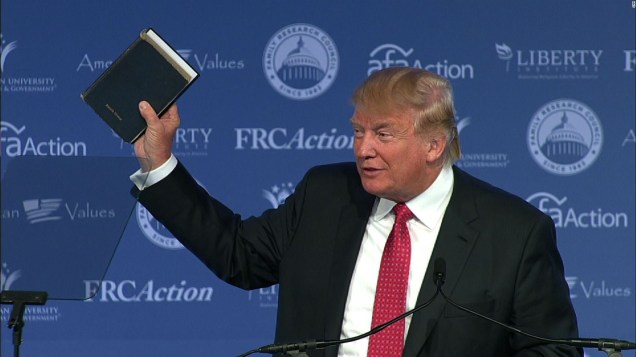
If you seriously believe that Donald Trump understands the Christian faith, has read the Bible or would choose the defence of religious values and freedom over some other passing whim while serving as president, then I have a bridge across the River Thames to sell you

Eric Zorn has a great column in the Chicago Tribune in which he systematically takes apart Donald Trump’s pretence that he is a Serious Christian and the default choice for those voting with their Christian faith foremost in their minds.

Zorn writes:

Nothing illustrates what a flim-flam man Donald Trump is better than his frequent and oily allusions to the Bible.

It is his favorite book, he tells the credulous masses at his rallies. Nobody reads it more than he does.

But a review of the record suggests he may not have read it at all.

During a televised interview with John Heilemann and Mark Halperin of Bloomberg Politics in August 2015, Halperin noted Trump’s frequent professions of fondness for Judeo-Christian scripture and said, “I’m wondering what one or two of your most favorite Bible verses are and why.”

“I wouldn’t want to get into it,” Trump said, “because to me that’s very personal. You know, when I talk about the Bible it’s very personal so I don’t want to get into verses. The Bible means a lot to me but I don’t want to get into specifics.”

“Are you an Old Testament guy or a New Testament guy?” Heilemann asked.

“Probably equal,” Trump said. “I think it’s just incredible, the whole Bible is incredible.”

How utterly convincing. Zorn continues:

That unfamiliarity showed up again in April when host Bob Lonsberry of WHAM-AM in Rochester, N.Y., broached the subject in a phone interview: “Is there a favorite Bible verse or Bible story that has informed your thinking or your character through life, sir?”

“Well, I think many,” answered the would-be exegete-in-chief. “I mean, you know, when we get into the Bible, I think many, so many. And I tell people, look, ‘An eye for an eye,’ you can almost say that.”

You can, sure.

But not only is “An eye for an eye, a tooth for a tooth” an Old Testament verse that condones barbaric vengeance (“… hand for hand, foot for foot,” it goes on, “burn for burn, wound for wound, bruise for bruise”) it was also expressly repudiated by Jesus in the Sermon on the Mount: “You have heard that it was said, ‘Eye for eye, and tooth for tooth.’ But I tell you, do not resist an evil person. If anyone slaps you on the right cheek, turn to them the other cheek also” (Matthew 5:38-39).

I get it. Actually making time to sit down and read the Bible every day while trying to internalise parts of it is tough. Particularly, I imagine, when you are rich and famous and your free time is largely given over to grabbing women “by the pussy”. Personally, I have only read the entire Bible cover-to-cover once, when I was eighteen and preparing for my adult confirmation into the Roman Catholic church after converting from Anglicanism. More than a decade later I am now finally trying to do so again, with the help of a great online Bible app which comes with a manageable “Bible in a year” reading plan.

The point of which being that it is fairly easy to spot someone who has actually attempted the feat and possesses a genuine (if still somewhat patchy, like mine) familiarity with the Bible, and somebody who is just putting on an act, attempting to fake religious observance as a kind of cultural marker. And Trump clearly falls into the latter category.

Eric Zorn concludes:

Is Trump the first politician to exaggerate his piety in order to win favor with the American public, 70 percent of which identifies as Christian and 6 percent of which identifies as belonging to another faith tradition?

No, but he’s the worst at it — the most transparent — that we’ve ever seen on the national stage.

It’s not just that he’s a brazen Bible huckster, it’s that he’s really bad at it.

Those who put their faith in him should prepare to have it shattered.

This is depressing for all those Christians who have been taken in by Donald Trump’s false displays of piety, as well as those resigned Christians who recognise that Trump is a charlatan but feel that Trump represents a better bulwark against attacks on their values and way of life than Hillary Clinton.

But it is also darkly amusing. Because for eight years it has been the habit of more than a few Republican Party politicians to insinuate that President Barack Obama is somehow not a Christian, or even that he is a closet Muslim, despite endless evidence of the Obama family attending church and Obama himself being capable of speaking about his faith without getting completely tongue-tied or reporting to bland banalities. Some Republicans stood up to the “Obama is a Muslim” hysteria – notably John McCain at a town hall meeting during the 2008 presidential campaign. But many others remained cynically silent, allowing prejudice and misinformation to take hold, thinking that it would advantage them politically.

And now it is the GOP’s turn to field a presidential candidate who doesn’t merely “exaggerate his piety” but effectively invents it from thin air to get himself out of a tight spot in a TV interview. Of course, the Democrats are in absolutely no position to take advantage of this fact – Hillary Clinton is a Christian, like Obama, but has chosen to downplay her faith in this election because many of her supporters place more faith in the god of Social Justice and Identity Politics than the God of the Old and New Testaments.

As Ben Wolfgang notes in the Washington Times:

Hillary Clinton’s Christianity, which she wielded as a political weapon in her 2008 Democratic presidential primary campaign, largely has been missing in this year’s election.

She hasn’t hidden her Methodist upbringing, but scholars say it’s not front and center. And where in the past she used it as a window into her character, this year she’s deployed it as a debate tactic to push criminal justice reform and other policy goals.

Church attendance also has been all but absent from Mrs. Clinton’s schedule, except when she’s turned up behind a pulpit to stump for votes, particularly in predominantly black churches, where her appearances focus largely on how she intends to work with religious leaders to accomplish shared political objectives.

Since 2008 she’s also abandoned traditional Christian positions on issues such as same-sex marriage, coming in favor of the practice in 2013 after years of opposing it.

The reason for the shift, analysts say, is twofold. Mrs. Clinton is taking on an opponent, Republican Donald Trump, who is seen as one of the most nonreligious presidential candidates in modern history. Pew polling from earlier this year found that just 30 percent of American voters say they consider Mr. Trump religious, while 48 percent said the same about Mrs. Clinton.

Perhaps more importantly, she now leads a party that, among its white base, if not its core black and Hispanic members, has become an increasingly secular institution. Recent polling shows the Democratic Party includes in its ranks nearly four times as many atheists and agnostics as the GOP.

Ultimately, the “Donald Trump is a better Christian than Hillary Clinton” argument comes to the two candidates’ respective positions on abortion. And if abortion is a deal-breaker for you then yes, Trump’s currently stated position on abortion (which has certainly changed since his liberal days of a few years back, as well as during this campaign, both without satisfactory explanation) is more in line with Church teaching about the sanctity of life.

But as with all of Donald Trump’s other stated policy positions, there is absolutely nothing to give confidence that his current position either represents his true beliefs on the subject, or that he would not flip-flop on the issue without a second thought if he saw political value in doing so.

Christians – particularly Evangelicals – should really be used by now to cynical Republican politicians who have trained themselves to speak the language, say the right things and push all the right buttons on social issues in pursuit of the evangelical vote, only to sell out the movement once safely ensconced in power. George W. Bush won a tough 2004 re-election campaign against John Kerry in spite of his disastrous mismanagement of the Iraq invasion and its aftermath largely by switching the focus to social issues, namely gay marriage, in order to motivate his base. And in nearly every election before and since, evangelicals have been flattered, threatened and otherwise called upon to support the Republican candidate only to have their causes betrayed or ignored after election day once their usefulness was over.

Donald Trump is doing exactly the same thing all over again. But he is so inept and transparent in his attempt to feign Christian piety that a fool should be able to see through his cynical machinations. And yet many bright and decent people are taken in by Trump’s amateur act.

Don’t get me wrong – Hillary Clinton, largely beholden to the Cult of Social Justice and Identity Politics, will be no great defender of religious freedom or interests. But Donald Trump will be little better, as Christians should realise from bitter past experience and Trump’s unique untrustworthiness when it comes to holding true to his stated beliefs on fundamental issues.

Neither candidate, in office, would be a great friend of religion, though Donald Trump would likely continue to pay more lip service to Christian priorities thanks to the composition of the Republican Party. But both options are pretty bleak, and Christians seeking to vote based on their faith would actually be well advised to admit defeat and make their choice based on some other criteria.

Whoever wins this election, it looks quite safe to say that Christianity will lose.
 

bible-king-james-version

Bottom Image: Pixabay

Support Semi-Partisan Politics with a one-time or recurring donation:

Agree with this article? Violently disagree? Scroll down to leave a comment.

Follow Semi-Partisan Politics on TwitterFacebook and Medium.

Tales From The Safe Space, Part 43 – DePaul University Censors Pro-Life Conservatives To Placate Black Lives Matter

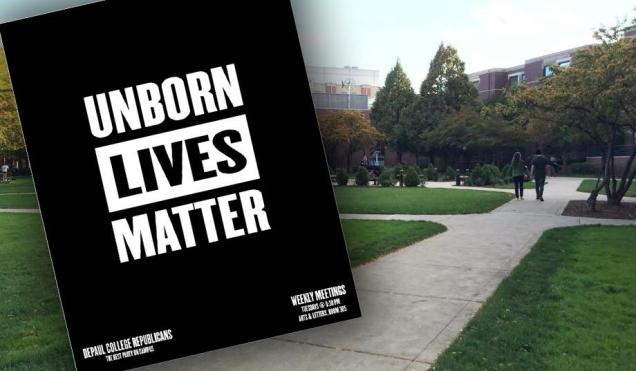
depaul-university-college-republicans-unborn-lives-matter-blm

Appeasing the gods of social justice and identity politics now overrides a Catholic university’s commitment to Catholicism itself

It is now indisputable: Black Lives Matter are rapidly becoming the one absolutely holy and inviolable interest group on American college campuses, a favoured priesthood of living saints who must be protected from blasphemy and offence at all costs.

There really is no other way to describe the privilege enjoyed by this organisation following the news that DePaul University in Chicago – a Catholic institution – recently banned a poster produced by the DePaul College Republicans because their catchphrase “Unborn Lives Matter” is supposedly deliberately provocative and hurtful to the delicate Black Lives Matter snowflakes.

I repeat: the president of a Catholic university actively suppressed the free speech of his own students because they dared to publicly support traditional Catholic teaching on the sanctity of life and the rights of unborn children – which might have offended a group of people who are supposedly concerned about racial justice, not abortion rights.

Campus Reform reports:

The DePaul College Republicans chapter has been censored yet again, this time over promotional flyers proclaiming that “Unborn Lives Matter.”

According to University President Rev. Dennis H. Holtschneider, the club was forbidden from using the flyers because they were “bigotry…under the cover of free speech,” meant to “provoke” members of the Black Lives Matter movement.

DePaul College Republicans Vice President John Minster told Campus Reform that his group wanted to use the “Unborn Lives Matter” flyers to draw members to their club meetings, but had to submit the design to the Office of Student Involvement for approval.

OSI Director Amy Mynaugh was out of town during the approval process, however, and the design proposal made it all the way to President Holtschneider.

Holtschneider not only declined to approve the flyers, but sent a letter to the entire university body explaining that the pro-life posters constituted “bigotry” and were not considered free speech.

The letter from President Holtschneider reads in part:

DePaul is a private Catholic institution, and we also are part of the academy.  By our nature, we are committed to developing arguments and exploring important issues that can be steeped in controversy and, oftentimes, emotion.  Yet there will be times when some forms of speech challenge our grounding in Catholic and Vincentian values.  When that happens, you will see us refuse to allow members of our community to be subjected to bigotry that occurs under the cover of free speech.  In fact, you have seen this in past months, as we have declined to host a proposed speaker and asked students to redesign a banner that provokes the Black Lives Matter movement.

Some people will say that DePaul’s stance unfairly silences speech to appease a crowd.  Nothing can be further from the truth.  As we experienced last spring, it’s not difficult to agree that there is a difference between a thoughtful discussion about immigration and a profane remark about Mexicans scrawled in the Quad; or between a panel on racial climate and a noose — a powerful symbol of violence and hatred — outside a residence hall.  In both recent cases, the first, we encourage; the second, we abhor.

Because co-opting a topical phrase to express support for the Church’s pro-life stance is apparently “provocative” – the “provocation” outweighing the moral question at stake in the eyes of DePaul University.

And putting up a poster declaring that “Unborn Lives Matter” – the clearly stated and strongly affirmed position of the Catholic Church, the institution with which DePaul is inseparably affiliated – is not a statement of moral purpose, but is instead deemed the equivalent of a “profane remark about Mexicans scrawled in the Quad”.

The letter continues:

If you read DePaul’s Guiding Principles on Speech and Expression, you will see that our Vincentian values were in the forefront six years ago when these guidelines were developed.  Though a group of your own DePaul colleagues are giving them a fresh look for updates, the current guiding principles still apply.  I encourage you to read the entire document to gain a better understanding of the balance between our values and speech.  In particular, I ask you to reflect on these sentences: “We accept that there is a distinction between being provocative and being hurtful.  Speech whose primary purpose is to wound is inconsistent with our Vincentian and Catholic values.”

More:

Disagreements will happen on important issues—many that are personal to members of our community for whom race, immigration, gender disparities, religious beliefs and economic privilege are more than conversation topics; they are part of an inescapable lived experience.  Students and others will almost certainly continue to explore and seek the exact limits of our tolerance for free expression when that expression is meant to cause distress.  Certainly, everyone is allowed to have their opinions on these topics.  I simply ask when you are expressing your opinion that you respect the difference between a reasoned discussion and words whose primary purpose is to wound.  I also ask that the university community refuse to “rise to the bait” in those moments when speech may become uncomfortable or even exasperating, but falls within the bounds of the academy’s commitment to full and robust debate.

Because hurt feelings are far more important than abortion. And the omniscient president and administrators of DePaul university can look clearly inside the human heart and discern whether a given student intends to provoke, offend or hurt when determining their right to speak.

This is ludicrous. Holtschneider made no attempt to speak with the DePaul College Republicans before censoring their poster and banning it from campus – he high handedly presumed to know what motivated them to speak out in favour of the rights of the unborn, and then publicly find them to be morally deficient and their motives cynical. That is effectively the judgment on their character that Holtschneider passed by revoking their right to express themselves – that they are Evil Racists more interested in “provoking” certain members of the black community than witnessing to their faith and speaking their consciences.

The National Review rages:

As a private, Catholic university, DePaul is not explicitly obliged to respect students’ free-speech rights like a public university would be. But it is disturbing that the university would choose not to do so, and even more disturbing that DePaul’s administration justified their decision by invoking the university’s “Catholic values.” It is hard to believe that the phrase “Unborn Lives Matter” is in violation of a Catholic university’s values when, in fact, this phrase ought to embody them.

This is not the first time that DePaul’s administration has been confused about the proper application of its Catholic guidelines. For instance, one of the university’s 2016 commencement speakers was Martin Castro, chairman of the U.S. Commission on Civil Rights, who in his professional capacity has advocated same-sex marriage and radical gender theory, and opposed religious-freedom legislation that would have enabled Catholic institutions to uphold their values. DePaul was also found to have referred students to jobs and internships at Planned Parenthood, and to have promoted social-media posts celebrating the Supreme Court decision recognizing same-sex marriage nationwide.

While it is the university administration’s prerogative to take these actions — even though they openly conflict with established Church doctrine — it is appalling that the same administration would invoke its Catholic principles to ban pro-life flyers from campus. It is evident that Holtschneider and his staff are intent upon silencing conservative student voices, even if they must wield their Catholic identity as a cudgel to do so.

It is particularly depressing that the SJW snowflakes of DePaul have their grubby hands on the university’s Guiding Principles on Speech and Expression – we can safely assume that the next version of this document will be even more restrictive, and prioritise the feelings and “identities” of coddled students even more strongly over the imperative for debate and the quest for truth. Which will be some achievement, considering the current version already draws a specious “distinction between being provocative and being hurtful.

But one can only be so angry at the students themselves. As this blog has explored repeatedly, these thin-skinned students are very much a product of their environment and their upbringing. They are the result of Everyone Wins A Prize schooling, parental paranoia about a child abductor lurking on every corner and the endless, nauseating praise for the most pedestrian of accomplishments and the corrosive idea, inculcated at every stage of their academic lives, that “sticks and stones may break my bones but words will kill me stone dead”.

Far more to blame are the adults – the liberal college professors now struggling to stay ahead of their students in the race to be ever more strident, intolerant and authoritarian in response to ideas they dislike, and the spineless university administrators who would sooner collaborate with the new regime and stab academic freedom in the back than push back against their millennial masters.

But special criticism has to be levied at the leader of a Catholic educational institution – somebody with Reverend in their title – who prioritises the prickly feelings of Black Lives Matter (and their proprietary sense of ownership over the phrase “[insert interest group] lives matter”) over and above the Church’s teaching on a core social issue.

I happen to be Catholic myself. Personally, I do believe that All Lives Matter. I believe that life begins at conception, and that therefore abortion inherently means the taking of a life. But I also believe that this is also sometimes the lesser of two evils, or an understandable choice in an impossibly difficult situation. As well as the commonly given exceptions – rape, incest, the life of the mother – I believe that abortion should be a legal, safe and much, much rarer. And part of making abortion much rarer must surely involve easier access to (and education about) contraception. One of the best ways to stop new lives being discarded before they begin is to prevent the hideous situation from arising in the first place.

I recognise that all of the above places me in conflict with the church’s teaching, and that is something which I have to wrestle with. I’m reasonably sure that I am right, and that my viewpoint will be vindicated and adopted by the Church in the fullness of time, but that doesn’t lessen the sense of unease at being out of communion with my religion on such an emotive issue.

But here’s the difference: I don’t expect external authority figures to step in, suppressing the free speech of others to prevent my guilty conscience from being pricked. Nor do I expect them to do so because the language they choose to use in affirming traditional Church teaching “appropriates” the name of another cause I happen to care about, or which impacts me. I can think and write what I want – I have no business limiting the freedom of others to do the same.

And students at a Catholic university, of all places, should be free to affirm Catholic teaching through articles, peaceful protest and harmless posters without fear of censorship by craven university authorities – spineless, degenerate cowards who would sooner suppress freedom of speech and publicly reject their own religion’s teaching than risk the slightest offence to their new deity: the Cult of Social Justice and Identity Politics.

Bigotry “under the cover of free speech”? That is to be DePaul University’s sneering, dismissive and hostile attitude toward young conservative Catholics who dare to affirm the teachings of their faith?

People of faith should pray for the censored College Republicans (whether or not you agree with their cause), and for DePaul University. Because religion counts for nothing if it has to disregard doctrine and bend the knee to social fads and new secular shibboleths.

And I don’t know how much longer the academy can plausibly survive the continued ruthless letting of its most vital lifeblood – the right to free speech.


Safe Space Notice - 2

Top Image: National Review

Support Semi-Partisan Politics with a one-time or recurring donation:

Agree with this article? Violently disagree? Scroll down to leave a comment.

Follow Semi-Partisan Politics on TwitterFacebook and Medium.

Banning The Burqa And Burkini Is Not The Correct Liberal Response To Conservative Islam

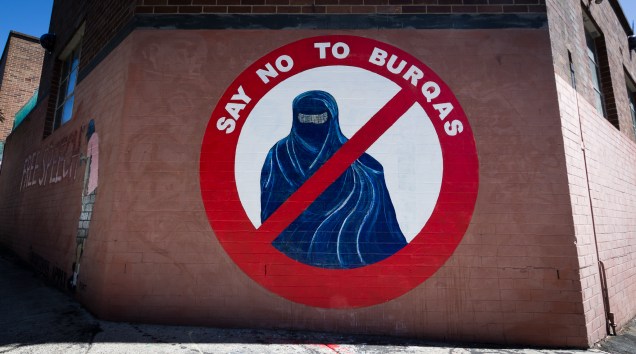
Free Speech - Say No To Burqas - Burkini - Mural

In a liberal democracy, government has no business dictating what clothing is or is not acceptable to wear – and banning the burqa or burkini only further delays the long-overdue day of reckoning between conservative Islam and modern Muslim women

France is now taking its official ban of the burqa one step further, as the mayor of Cannes announces a ban on burkini beachwear on the grounds that the concealing garment poses a security risk.

The New York Times reports:

The mayor of the French resort city of Cannes has barred women from bathing on public beaches in swimsuits that reveal too little skin.

At issue are the full-body, head-covering garments worn in the water by some Muslim women, which have been nicknamed burkinis, an amalgam of burqa and bikini. The mayor’s ban has drawn protests from French Muslims who say it is discriminatory.

That the debate is occurring on the Riviera, the Mediterranean vacation area that has been on edge since the terrorist attack on a Bastille Day celebration in nearby Nice, has only added to the controversy.

Critics of the ban say it risks deepening rifts with France’s Muslims. It is the latest example of the long-running tensions between France’s forceful — some say inconsistent — commitment to secularism and the desire of many Muslims to express traditional values like modesty through their attire.

The mayor’s ordinance, which runs until Aug. 31, bars people from entering or swimming at the city’s public beaches in attire that is not “respectful of good morals and secularism” and that does not respect “rules of hygiene and security.” Offenders risk a fine of 38 euros, or about $42.

Why are burkinis against the rules? “Beach attire that ostentatiously displays a religious affiliation, while France and places of worship are the target of terrorist acts, is likely to create risks to public order,” the ordinance says.

If this were being done in a public place on the grounds of security, the mayor of Cannes would be in a much stronger position, and would gain this blog’s sympathy, particularly after the appalling terrorist truck attack in Nice on Bastille Day. There is a very logical and powerful argument to be made against the prohibition on wearing any overtly concealing clothing when entering public buildings such as town halls, courts, public schools, parks or beaches, just as motorcycle owners are asked to remove their helmets before entering a bank branch.

But the mayor of Cannes has taken this action with specific reference not to security, but in the name of  laïcité (the separation of church and state). We know this because French government officials have explicitly said so:

This costume [the burkini], Mr Lisnard [the mayor] declared, “ostentatiously displays religious affiliation”, could “disrupt public order”, and might even, in the words of one official, demonstrate “an allegiance to terrorist movements”.

Now secular government is broadly a very good thing, and societies become more free as they cast off the remaining vestiges of theocracy – one of the reasons that this blog is so keen to get rid of the Lords Spiritual and remove Britain from Iran’s company as the only countries where unelected theocrats sit in the legislature by right.

However, while citizens – even those of faith – should absolutely demand secularism from their government, it does not follow that the government can unjustly impose secularism on the people as they go about their lives. That would be a grave wrong, and the growing movement to ban the burqa represents an abuse of power by governments against their own citizens.

The Telegraph’s Juliet Samuel agrees:

Now it’s hard to muster much enthusiasm for the burkini. It harks back to an age, still dominant in much of the world, when a woman’s worth was measured by her modesty. It belongs to a belief system in which women cannot experience one of the joys of the natural world – feeling the wind and sea on her body. It suggests that the female form is shameful and provocative. But those who want to ban the burkini for these reasons are forgetting one of the most important values of a free society: we don’t all have to believe the same thing in order to live together.

Every day, thousands of Britons wake up and do things I think are crazy and wrong. They drink instant coffee, listen to Magic FM and wear Spandex. Some wear high heels or bowties. Others have plastic surgery, get tattoos, cheat on their spouses, drink too much, shout too much and vote Labour. They get their news from Facebook and watch hours of trashy TV. Many of them pray to a god, convert to Buddhism, believe in crystal healing or sing in Church on Sundays with their eyes closed and their arms in the air. I don’t do or understand any of these things. But I let them get on with it.

[..] Like a theocratic regime, the Cannes burkini ban forces some Muslim women to choose between their religious and their national identity and perniciously suggests that their choice of dress is a political statement, whether they mean it to be or not. It is unsurprising that the French should lead the way in this kind of thinking, because in France nothing is allowed until the law permits it, whereas in Britain, everything is allowed until the law forbids it. So, in the name of enforced secularism, France forbids covering the face in any public setting, whether it’s for religion or Hallowe’en, and bans religious symbols like hijabs (hair coverings) in state institutions such as schools. The burkini ban takes this illiberal trend even further by making it illegal to wear “ostentatious” religious symbols even when going about one’s own private business.

[..] A normal Muslim, who has grown up seeing a hijab as an unremarkable but important symbol of womanhood, finds herself forced to choose between respect for the law and her family’s everyday customs. Is this senseless, banal and brutal ban more likely to awaken a hidden feminist creed and a love of La République in her heart or to make her feel attacked and excluded from mainstream society?

Strong societies cannot permit parallel legal or political systems, such as Sharia courts or caliphates. But they can cope with differences in dress and customs. They should not allow obstructive religious clothing like face‑coverings to disrupt teaching or court hearings. But if a Muslim woman wants to wear a baggy wetsuit and go for a swim on a public beach, that does not make her a threat to Western society. The real enemies of freedom are not the burkini-wearers, but the politicians who want to ban them.

Amen to this. Samuel is quite right to fear the politicians over the burkini-wearers, even if we may disagree with their sartorial and religious motivations. Indeed, we should fear any further legitimisation of the idea that our rights derive from the state, who can suspend our freedoms at will in the name of “security”.

One of the most alarming things about this century has been the rejuvenation of authoritarianism, spurred on by the growing threat of Islamist terror. Whether it is manifested in airport security theatre, the banning of religious jewellery or other symbols from the workplace or the dystopian suppression of free speech in universities, public squares and social media, we have become markedly less free in sixteen years with precious little to show for it.

But more than all of that, if we are serious about tackling the skewed ideology and belief system which preaches that women must be modest to the point of having to bathe fully clothed, then a government ban is the absolute worst way to go.

Such a diktat of law effectively exonerates conservative Islam (or fundamentalists of other religions) from any responsibility to reform and recognise the equality of women, gay people and other minority groups. Ban the burqa (or burkini) and conservative Muslims may obey. But not only will they immediately be able to portray themselves as victims in the process, claiming persecution for their religious beliefs, they will be under no further internal pressure to reconsider and reform centuries-old religious diktats in the changed context of modern society.

If we want a world where the burqa is relegated to fringe extremists and museums, then the pressure must come primarily from Muslim women. Only when they demand their right to dress as they please and force the reluctant accommodation of religious authorities will they be able to win the parity of treatment which has been missing for so long.

The job of Western governments in all of this is not to interfere or seek to be a white knight, banning the burqa or burkini on the behalf of oppressed women. Government’s role is to make sure that Muslim women have full access to the legal system to sue for their equal treatment in court where it is being infringed, and to clamp down insidious efforts to set up parallel justice systems based on Sharia law or any other religious code instead of shamefully welcoming them in the name of “multiculturalism”.

We should be encouraging a more liberal form of Islam to prevail over the more oppressive and fundamentalist conservative wings. We need more Ahmadis and others like them, openly tolerant of other faiths and proudly patriotic. And when these groups of progressive Muslims are attacked we should stand shoulder to shoulder with them rather than shamefully currying favour with their persecutors in the name of “multiculturalism”.

But ultimately, this is an internal enlightenment which must take place within Islam. It is not the job of provincial mayors in France or government departments in Britain to “rescue” their female Muslim citizens from oppression; nor would any such rescue hold any legitimacy. Western society can take certain actions to encourage this revolution among its Muslim communities, but ultimately the heavy lifting must be done by Muslim women standing up to claim their own full rights as citizens.

Widespread bans on the burqa or burkini may make us feel good or even allow some of us to burnish our feminist credentials, but that is the only good that they will accomplish. And meanwhile, the long-overdue day of reckoning between modern Muslim women and the conservative wing of the Islamic faith will be deferred indefinitely, to everyone’s cost.


Burkini ban

Top Image: Impulse Today

Support Semi-Partisan Politics with a one-time or recurring donation:

Agree with this article? Violently disagree? Scroll down to leave a comment.

Follow Semi-Partisan Politics on TwitterFacebook and Medium.

The Pope Is Dangerously Naive To Absolve Islam Of Responsibility For The Islamist Murder Of A Catholic Priest

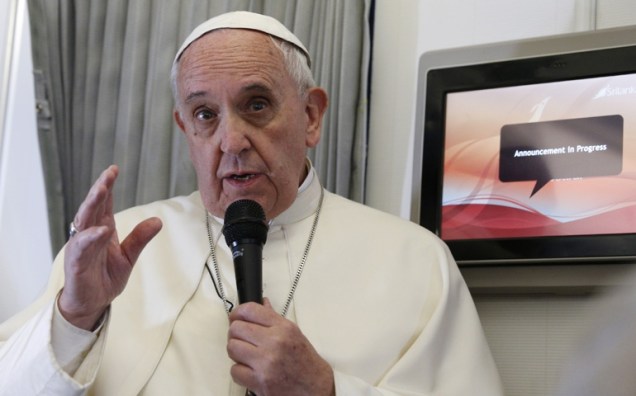
Pope Francis - Aeroplane Press Conference

Islamist terror alone cannot defeat Western civilisation. Only we have the power to do that – and some of us are doing our darnedest to try

It is difficult to see how Western civilisation and enlightenment values can fight back against the forces of fundamentalist, Islamist terrorism when the spiritual leader of 1.27 billion Catholics worldwide – my spiritual leader – desperately refuses to accept that Islam is connected in any with with Islamist terror attacks, and doggedly insists that there is no real difference between “Catholic violence” and Islamist violence.

From the Huffington Post:

Pope Francis said on Sunday that it was wrong to identify Islam with violence and that social injustice and idolatry of money were among the prime causes of terrorism.

“I think it is not right to identify Islam with violence,” he told reporters aboard the plane taking him back to Rome after a five-day trip to Poland. “This is not right and this is not true.”

Francis was responding to a question about the killing on July 26 of an 85-year-old Roman Catholic priest by knife-wielding attackers who burst into a church service in western France, forced the priest to his knees and slit his throat. The attack was claimed by Islamic State.

“I think that in nearly all religions there is a always a small fundamentalist group,” he said, adding “We have them,” referring to Catholicism.

“I don’t like to talk about Islamic violence because every day when I look at the papers I see violence here in Italy – someone killing his girlfriend, someone killing his mother-in-law. These are baptized Catholics,” he said.

“If I speak of Islamic violence, I have to speak of Catholic violence. Not all Muslims are violent,” he said.

The Pope, like every apologist for Islamist terror, is arguing against a straw man here – nobody but people on the lunatic fringe believes that all Muslims are violent. This is simply not an argument being advanced by any serious person or organisation, yet time and again the forces of denial (particularly strong among the political Left and the church) seem to feel the need to waste precious time reminding us of the fact that most Muslims are immensely peaceful and decent.

Newsflash: we get it. Unfortunately, that does not erase the fact that the small proportion who harbour violent and murderous intentions are called to do so by a highly literal and entirely valid (if not mainstream in the West) interpretation of Islam. To take the actions of Al Qaeda and Islamic State terrorists and strip them of their religious justification is to remove the only context in which they make sense and can be properly understood.

The people who flew airplanes into the twin towers, blew up the London Underground, killed the Charlie Hebdo cartoonists, massacred Parisian concertgoers at the Bataclan, used a truck to mow down families celebrating Bastille Day in Nice and who last week slit the throat of an elderly Catholic priest while he celebrated Mass did not commit these barbaric acts because of social isolation or economic deprivation. Other people bear far worse isolation and deprivation stoically, and do so without resorting to mass murder. Religion is the catalyst – in this case, a fundamentalist and literalist interpretation of one religion in particular. To deny this much is insane.

And yet Pope Francis proceeds to do just that. “I think it is not right to identify Islam with violence,” he tells us. Well nobody is seriously suggesting that all Muslims are violent, or indeed that Islam has a monopoly on violence. But to deny the causal factor which links hundreds of deadly terror attacks across the world over several decades is sheer lunacy.

Of course all religions have a fundamentalist sect within them, Christianity included. But in the year 2016 there are no armed groups of fundamentalist Christians seizing sovereign territory and declaring their own theocratic state in which horrendous Biblical punishments are meted out to gay people, adulterers, shellfish eaters, blasphemers, those who work on the Sabbath or those who are rash enough to wear clothing made from more than one type of cloth. And while you might get the odd lone wolf deciding to blow up an abortion clinic, there is no worldwide Christian jihad underway – despite Christianity being less favoured and more under threat in Western societies than has been the case for centuries.

Most concerning, though, is when Pope Francis says “if I speak of Islamic violence, I have to speak of Catholic violence. Not all Muslims are violent”. Firstly, it is not necessary to balance any criticism of Islam with an equal measure of Christian self-flagellation. This isn’t a children’s party game, ensuring that everyone gets equal time is not an important prerequisite. So no, on does not have to speak of Catholic violence when one speaks of Islamic violence.

Francis then goes on to literally equate “someone killing his girlfriend, someone killing his mother-in-law” with Islamist terror attacks. Now, of course murder is murder in God’s eyes, just as all life is sacred. But murder and domestic violence have sadly been with us for as long as humans have existed – since Cain killed Abel, in the Bible. Islamist terror, on the other hand, is not an inherent part of the human condition. It is a political and religious phenomenon which must be closely examined and confronted in isolation, not merely swept up together with all the other violence in the world.

By and large, Catholics who kill do not attempt to use their faith as a pretext or justification for their actions – their faith is incidental to their crime. But with terror attacks and honour killings it is quite the opposite. Islam is placed front and centre as the justification for the crime, not by the evil Islamophobic media but by the expressed words and sentiments of those people who carry out the attacks. It is they who insist that they murder in the name of their Islamic faith. It is they who bring death to those they regard as infidels based on the literal teachings of their holy books. It is they, not the racist and Islamophobic media, who call their organisation the Islamic State.

Why are we so unwilling to take the actions of these mass murderers at face value? If a man turns himself in to a police station and admits killing his neighbour for having an affair with his wife, after corroborating the basic facts we would take the man at his word as to the motive. We would not waste endless days and column inches wringing our hands trying to come up with other, far-fetched reasons why the defendant might have killed the man he caught sleeping with his wife. And so it is with radical Islam.

When Islamist terrorists force an elderly priest to kneel at the altar of his own church before slitting his throat in front of his congregation and do so in the name of the Islamic State, we should accept their sincerity (and their declared religious motive) just as we accepted that those terrorists who brought death to civilians, politicians and soldiers during the Troubles did so because of their desire to bring about a united Ireland. To stubbornly refuse to accept the reality of Islamist terror direct from the mouths of the terrorists is to patronise and condescend to the Islamists, stripping them of agency (and responsibility) for their own actions and turning them into helpless pawns, “forced” to commit their terrible atrocities by dark and mysterious outside forces.

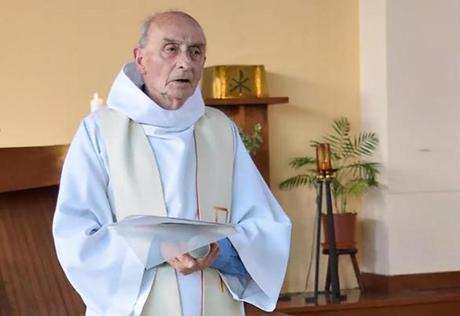
This is dangerous nonsense, which would be bad enough coming from the mouths of cookie-cutter leftist politicians. But coming from the heir to St. Peter and the ultimate boss of the slain Abbé Jacques Hamel – the man who more than anyone should be pained by his murder and determined to confront and root out the violence which caused it – it is doubly depressing. When Islamist terrorists strike, we must take their declared motives at face value just as we would do for any other terrorist or criminal. And then we must harden our resolve to destroy the scourge of fundamentalist Islamism once and for all.

To do anything else is not only to bury our heads in the sand as to the nature and severity of the threat that we face, but it is also to dishonour the memory of the many victims of Islamist terror attacks. For they are casualties in a clash of ideologies and cultures – progessivism versus fundamentalism, moderate Islam versus militant Islam, the enlightenment versus the dark ages – which too many people, nominally on “our” side, seem more than willing to deliberately lose, so long as they can avoid giving offence to certain mystifyingly protected classes and ideas.


Postscript: It appears that the Spectator’s Damian Thompson has been thinking along the same lines:

In the 21st-century Middle East, Christianity has been suppressed on an astonishing scale. Countless atrocities have reduced ancient Christian communities to shrivelled and terrified ghettoes or underground churches. Although this persecution has been reported in the West, it is of no great interest to secular politicians or the media. It is, as Neville Chamberlain said in a different context, part of ‘a quarrel in a faraway country between people of whom we know nothing’.

On Tuesday, the blood of a martyr was spilled at the other end of the Channel Tunnel. Now Christians in the West have had a glimpse of what it’s like to be a follower of Jesus in the lands of the Bible and many other countries — not all of them Muslim, but a troubling number of them ‘close allies’ who benefit from British trade deals, foreign aid and general diplomatic brown-nosing.

Will the murder of Father Hamel awake Christendom from its torpor? Let me refer you to the Twitter account of one Dr Austen Ivereigh, hagiographer of Pope Francis and former spokesman for the English Catholic Church. He referred to the ‘pointless banality of the Rouen murder’ and urged us not to glorify it by ‘ascribing religious motives’. There’s your answer.

God help us.


Fr Jacques Hamel - Catholic Priest

Top Image: NCR

Support Semi-Partisan Politics with a one-time or recurring donation:

Agree with this article? Violently disagree? Scroll down to leave a comment.

Follow Semi-Partisan Politics on TwitterFacebook and Medium.

Not All Muslims

Muslim call to go to Sunday Mass

After the appalling terrorist murder of a Catholic priest committed in the name of Islamic State, a moving gesture of interfaith solidarity by French Muslims should be acknowledged and applauded

It is important, I think, when criticising the fundamentalist element of Islam and the degree to which it is often tolerated or tacitly encouraged by parts of the mainstream, to give credit where it is due and acknowledge work done and gestures made against extremism by the Muslim community.

One way that we have been doing that this week is by celebrating again the life of slain US army capt. Humayun Khan and his gold star parents, who appeared on stage at the Democratic National Convention in Philadelphia last week to repudiate the anti-Muslim rhetoric spewed forth by the Donald Trump presidential campaign.

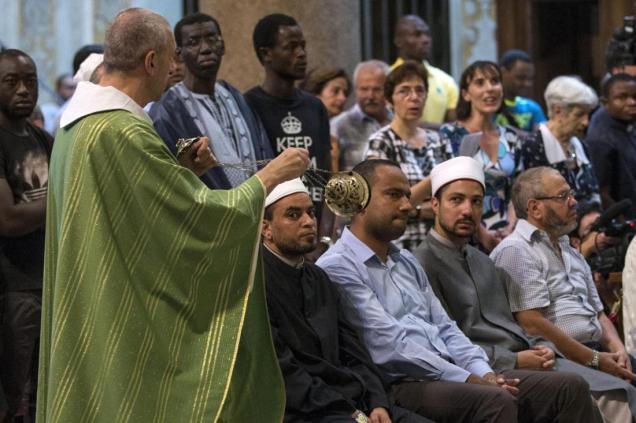
And another way should be to acknowledge the moving gesture of so many French Muslims attending Catholic Mass at their nearest church or cathedral, showing solidarity with a Catholic community still reeling from the murder of a beloved parish priest at the hands of Islamist terrorists.

From the Daily Mail, displaying unusual magnanimity:

Muslims in France and Italy flocked to Mass on Sunday, a gesture of interfaith solidarity following a drumbeat of jihadi attacks that threatens to deepen religious divisions across Europe.

From the towering Gothic cathedral in Rouen, only a few miles from where 85-year-old Rev. Jacques Hamel was killed Tuesday by two Muslim fanatics, to Paris’ iconic Notre Dame, where the rector of the Mosque of Paris invoked a papal benediction in Latin, many churchgoers were cheered by the Muslims in their midst.

[..] French television broadcast scenes of interfaith solidarity from all around France, with Muslim women in headscarves and Jewish men in kippot crowding the front rows of Catholic cathedrals in Lille, Calais or the Basilica of St. Denis, the traditional resting place of French royalty.

There were similar scenes in Italy, where the head of Italy’s Union of Islamic communities — Izzedin Elzir — called on his colleagues to “take this historic moment to transform tragedy into a moment of dialogue.” The secretary general of the country’s Islamic Confederation, Abdullah Cozzolino spoke at the Treasure of St. Gennaro chapel; three imams also attended Mass at the St. Maria Church in Rome’s Trastevere neighborhood, donning their traditional dress as they entered the sanctuary and sat down in the front row.

Ahmed El Balazi, the imam of the Vobarno mosque in Italy’s Lombard province of Brescia, said he did not fear repercussions for speaking out.

“These people are tainting our religion and it is terrible to know that many people consider all Muslim terrorists. That is not the case,” El Balazi said. “Religion is one thing. Another is the behavior of Muslims who don’t represent us.”

This blog and others often focus, reasonably, on the failings within the Muslim community – failure of integration and assimilation, failure to stand up for British values (though we are often just as much at fault for failing to transmit those values), failure to confront and root out the extremism in the midst of families and communities. These things are important.

But it is also sometimes the case that we fail to acknowledge those times when the Muslim community does come out strongly in condemnation of fundamentalist, Islamist terror. Anti-extremist counter-protests by Muslim groups often do not receive the media coverage extended to telegenic extremists and their “behead those who insult Islam” placards. Hard and difficult work accomplished in communities goes unrecognised.

And so, as an outspoken opponent of fundamentalist Islam and as a practising Catholic, it is important that I choose to be magnanimous and welcome this touching gesture made by so many Muslims in France and Italy.

Archbishop Cranmer is also moved:

Praying before a blasphemous icon of another Jesus, standing in the shadow of a sacrificial cross which they deny, beneath the dome of a cathedral church steeped in idolatry, myths and deception, Muslims throughout France and Italy attended Mass yesterday. From Rouen, Nice and Paris to Milan, Naples and Rome, hundreds flocked to express solidarity and compassion with Europe’s Roman Catholics, many still reeling, weeping and mourning the loss of a much-loved elderly priest, Abbé Jacques Hamel, whose throat was slit by Islamists as he celebrated Mass last week.

All Muslims are exhorted to the greater jihad, to strive against the flesh and persevere in the purposes of Allah, but not all jihad is holy war. All Muslims are not Islamists, but Muslims are becoming terrorists. It is futile, patronising and dangerous to deny it. Islamists are extremists who kill the innocent; Muslims who are moderate and enlightened seek to worship in peace. Islam is not all about oppressing, torturing, murdering and slaughtering. It just seems like it. And no wonder, when the news dishes up a daily diet of Islamic State videos exhorting the faithful to attack the enemies of Allah; Western Muslims who fight for their country are condemned as apostates; hotels are bombed; ancient shrines blown up; ‘spies’ are beheaded; oil fields blaze; and British imams preach to young boys that it’s okay to have sex slaves. That’s just today’s coverage of degradation and destruction.

Amidst all this global trauma, suffering and strife, it is a cause of great hope that so many Muslims can put aside their theological scruples and multifaith ecumenical aversion to attend the Sacrifice of the Mass. It is profoundly offensive to their beliefs, and utterly repugnant to their teachings: Jesus is not the Son of God; he is not divine; he did not die on a cross; he does not become a wafer; praying with wine is haram.

[..]

There were tears during the sign of the peace. ‘God was in Christ, reconciling the world unto himself‘ (2Cor 5:19). In their shared humanity, Muslims and Christians bore witness to the humanity of Jesus, his sacrifice and death, his reconciling love, his resurrection and glorification. ‘For where two or three are gathered together in my name, there am I in the midst of them‘ (Mt 18:20). The Living God is present in the world, if not in bread and wine. We can meet Him, pray to Him and listen to Him. That is our privilege through Christ. And in that communion we stand with all believers in the world and throughout all history. And we stand with all participant peace-loving Muslims, too. ‘This is my blood…

Wordless interfaith dialogue is the best remembrance.

In a sign of just how bad things have gotten in Europe, this blog was actually surprised when there was no major, high-profile terror attack last Friday, perfectly timed to dominate television coverage leading into the weekend, when previous weekends had seen such attacks.

No matter how routine this destruction and insecurity may become in the short and medium term, we should not allow this “new normal” in Europe to become in any way acceptable or excusable, and we should hold European leaders firmly to account for the whole range of bad decisions they have made – from social policy and a lack of focus on protecting national culture and encouraging assimilation right through to the migration crisis – which have increased the risk of Islamist terror attacks on our soil.

But as we witnessed at Catholic Masses across France this Sunday, it is not all bad news – a fact which those of us who report or comment on human events should be careful to acknowledge.


Fr Jacques Hamel - Catholic Priest

Top Image: Time

Support Semi-Partisan Politics with a one-time or recurring donation:

Agree with this article? Violently disagree? Scroll down to leave a comment.

Follow Semi-Partisan Politics on TwitterFacebook and Medium.