What to say about the slow-motion tragedy unfolding in Ferguson, Missouri?
The few known facts – that a black teenager, Michael Brown, was shot to death by Darren Wilson, a white police officer, in disputed circumstances – belie the visceral anger that has consumed the town.
The subsequent actions by the authorities, notably the St. Louis County Police – stonewalling on releasing the name of the officer involved, refusing to release the autopsy details, waging an increasingly military-style war of aggression against legitimate protesters and journalists, and releasing CCTV footage of Michael Brown purportedly robbing a convenience store in what can only be interpreted as an act of pre-emptive character assassination – have only compounded the sense that a predominantly white establishment have more interest in protecting their good names and quelling dissent than administering justice.
St. Louis is a city that I know, have spent much time in, and feel close to. People should not be put off St Louis, Missouri and the surrounding area by the horrible scenes unfolding there now on television and Twitter, because the current crisis is not representative of the state and its citizens. But having personal experience of the area, it is also glaringly evident that the violence and racial tension that forced itself into our collective consciousness with the shooting of Michael Brown last week was looming, unaddressed, for a long time.
Since I have known St Louis, it has been a city of two halves – the still somewhat dicey downtown area and select suburbs with higher black and lower income populations on one level, and the highly desirable enclaves and suburbs (such as Clayton and University City) that surround them, populated by a much wealthier (and whiter) demographic on the other. Everyone may cheer on their hometown St. Louis Cardinals baseball team on game day, but there is a clear divide between those who can afford tickets to watch the game at Busch Stadium and those who have to tune in on the radio or TV. Tensions between the city’s two halves, while not ordinarily visible to the casual observer, have roiled this part of Missouri for years.
The New York Times thoroughly summarised the history of this divide in a recent article, revealing the underlying causes of the difference between St. Louis City and County:
Back in 1876, the city of St. Louis made a fateful decision. Tired of providing services to the outlying areas, the city cordoned itself off, separating from St. Louis County. It’s a decision the city came to regret. Most Rust Belt cities have bled population since the 1960s, but few have been as badly damaged as St. Louis City, which since 1970 has lost almost as much of its population as Detroit.
This exodus has left a ring of mostly middle-class suburbs around an urban core plagued by entrenched poverty. White flight from the city mostly ended in the 1980s; since then, blacks have left the inner city for suburbs such as Ferguson in the area of St. Louis County known as North County …
Many North County towns — and inner-ring suburbs nationally — resemble Ferguson. Longtime white residents have consolidated power, continuing to dominate the City Councils and school boards despite sweeping demographic change. They have retained control of patronage jobs and municipal contracts awarded to allies.
This history lesson may seem a million miles away from the reality on the streets of Ferguson today, but it is directly relevant. It is because of structures such as this, where the now-minority white establishment continues to wield almost unchallenged control over the levers of local government, that allow the scenes of high-handed crackdowns on civil assembly and free speech as practiced by the predominantly white County Police.
The attitude – sometimes explicit, sometimes more subtle – of many of the wealthy St. Louis County residents to their St. Louis City and poorer County neighbours – has often been one of impatience and grudging forebearance on one end of the spectrum, and wilful ignorance on the other.
In 2009, St. Louis residents faced draconian cuts to their Metro public transportation service, the network of buses and light rail that connects the city. Residents of generally wealthy St. Louis County voted against an increase in the transit sales tax that would have raised $80 million to fund the Metro’s operation. They made little use of public transportation themselves – they were wealthy and drove cars. But the subsequent service cuts predominantly impacted the poorer County residents and the City residents who rely on public transport to get around. One figure implied that access to jobs in St. Louis County was reduced from 98 to 71 per cent.
Why does this matter? Because it was the poorer, predominantly black workers who served the coffee, sold the groceries and worked in the nursing homes used by the wealthy St. Louis county residents. A measure came up for vote that would have prevented it from becoming exponentially harder for these people to get to work in their low paid jobs every day. And the response of the County voters: Tough luck, we won’t pay a penny more to fund the civic infrastructure that you need. Screw you, we got ours.
Take this attitude and repeat it in every area, from education to police traffic stops, and you get a sense of the climate in which the Michael Brown shooting took place, and how little the two sides of St. Louis have historically been able to empathise with one another.
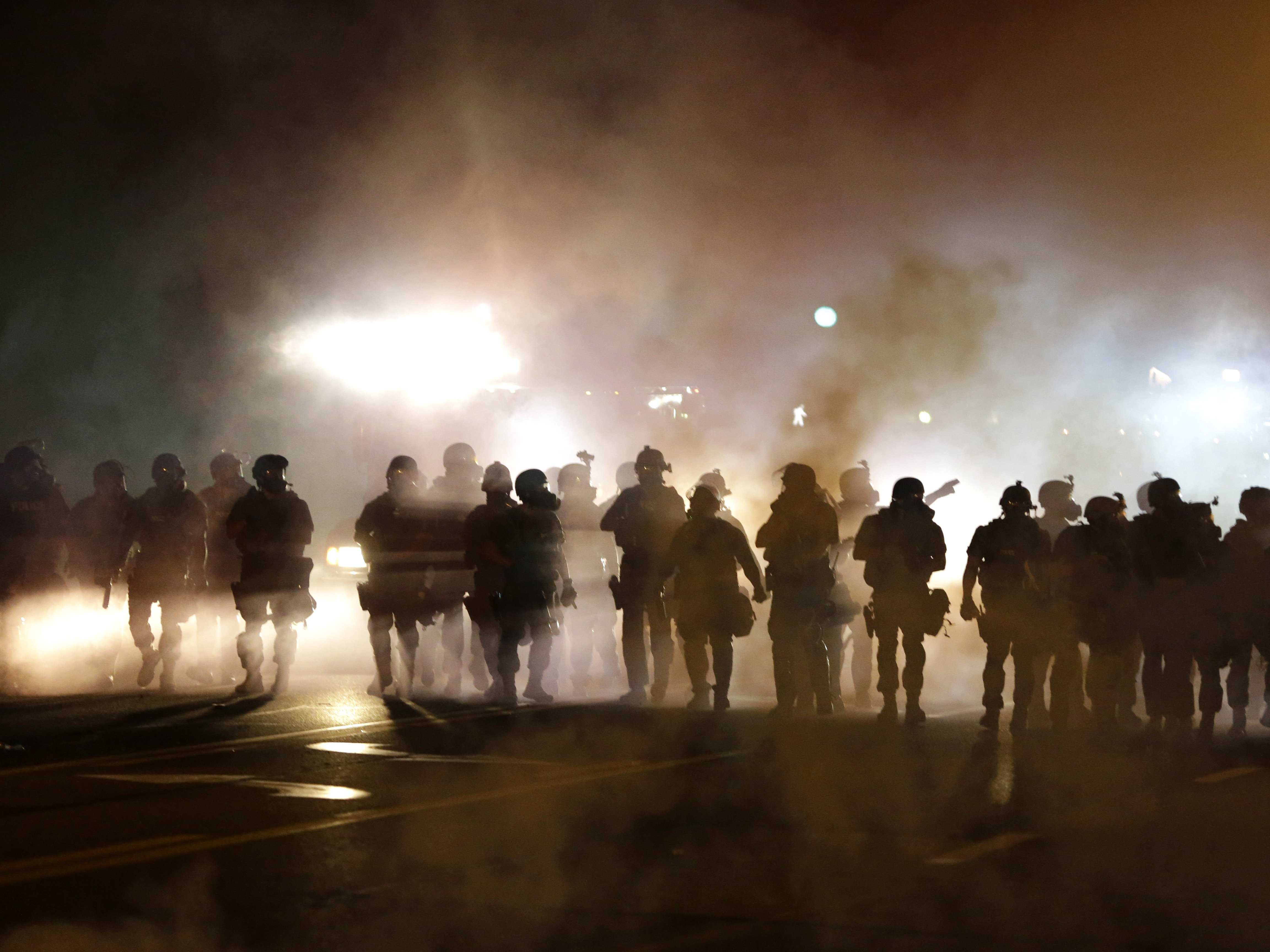
And on Saturday 9th August, it led to this:

On my visits to St. Louis, a visit to the Episcopalian Christ Church Cathedral was always on the itinerary. The church and its community made a lasting impression on me with their many acts and expressions of love, welcoming and tolerance which sometimes seem so much at odds with the prevailing impression of Midwestern Christianity in America.
The way that Christ Church Cathedral (both in its grand stone home on Locust Street and its lively Facebook presence online) is responding to the crisis as it roils the city is perhaps a model to be studied and followed by all of the jostling interest groups – police forces, politicians, civil rights groups, the media and the oft-reported but scarcely-heeded residents – that have descended upon the area.
Yesterday, the Cathedral’s Dean Michael Kinman had this to say:
“The police and the justice system needs to hear the cries of the people and the people need to hear the cries of the police and the justice system, and we as followers of Jesus are the ones to stand in the breach between and even as we are being convicted and converted ourselves, help everyone on every side have their Jesus moment of conviction and conversion, of truth and reconciliation….
“The cry is ringing out from St. Louis around the world. The mothers are crying “Save my child,” and it is time for us to hear that cry and let it change our hearts and with changed hearts together lead this change in the world.
“St. Louis, this is our moment. And we know that this is not a child that will be healed instantly. The tasks are many, the obstacles are large and the journey will be long. But we are the Body of Christ and, with God’s help, together we will get the job done.”
Amen to this. Thus far, the police and the justice system have not been hearing the cries of the people. And in many cases they have conspicuously not been listening, either. Not in Ferguson, Missouri, and, sadly, not in many other towns and cities across America. For black Americans, the police are not automatically the reassuring presence on the street that they are to most whites – in fact, quite the opposite.
The protests taking place now would not be happening on their current scale and intensity if the death of Michael Brown was not just the latest of a litany of tragedies – and perhaps even injustices, depending on the outcome of this investigation – to disproportionally befall black victims and black communities. Looting and violence are reprehensible, but the situation in Ferguson does not exist in a vacuum, and it is not fair or intellectually honest to haughtily condemn them exclusively as failures of personal responsibility and ethics without taking the context of deprivation and repression in which they are happening.
That is not to say that a better, more peaceful path is not there for the taking. The police captain whose empowerment to take over control of the ongoing Ferguson situation from the hapless (and very culpable) St Louis County Police initially caused such a lull in the violence and bitter feeling showed the way with his early remarks:
“And we all ought to be thanking the Browns for Michael. Because Michael is going to make it better for our sons to be better black men. Better for our daughters to be better black women. Better for me so I can be a better black father. And, our mothers, so they can be even better than they are today. Lets continue to show the nation who we are. But, when these days are over and Michael’s family is still weeping, still on their knees praying. No matter what positive comes out, we still need to get on our knees and pray. We need to thank Mike for his life. We need to thank him for the change that he is going to make in America. I love you, I stand tall with you and I’ll see you out there.”
The difference that good leadership – and one man – can make is telling, and is encapsulated in this quote from a local resident, given last Thursday when hopes that the crisis was easing were still high:
But the presence of Johnson was clearly the difference between Thursday and the four nights of turmoil that preceded it.
“I love this man so much,” said Angela Whitman of Berkeley. “He’s been here since the beginning,giving us encouragement and letting us know we’ll get through this.”
Conversely, the fact that the residents of Ferguson are not yet “through this” shows the limitations of good leadership and one man. Putting a local police chief – with black skin and roots to the community – in charge was a good first step, but it does not make up for the woefully slow response of Missouri Governor Jay Nixon. Nor does it make up for the fact that America’s libertarian political cheerleaders paused so obviously to test the waters before finally jumping into the fray.
The parachuting in of a black police captain does not make up for the many blatant violations of civil liberties – and the dignity of Ferguson protesters – inflicted by the overequipped and underprepared St Louis County Police in the preceding days. It does not make up for the flagrant inequalities in the American justice system, which incarcerates and punishes a huge number of young black men, stamping an indelible black mark on their records and making it even harder for them to ever break free from their circumstances and achieve the American Dream. And it does not make up for the false but universally known fact – reinforced over and over again, in lessons from cautionary tales like those of Trayvon Martin and now Michael Brown – that in America, a black life is worth far less than a white one.
One way or another, the protesters will eventually leave the streets of Missouri. So will the riot police, the clouds of tear gas and the world’s media filming it all. Michael Brown’s family will continue to grieve. These facts are certain, predictable, unchangeable. What remains within the power of people to influence is the legacy of this latest tragic black death on a city street. Will there be a meaningful and lasting change in police tactics, and a broader change in the way that the police seek to interact with – and reflect – the communities that they serve? And will there be a recognition that on America’s present trajectory, Michael Brown’s death was every bit as inevitable as that of the next person shot down without justification or consequences?
It takes a lot to change the culture of a local police department, let alone the judicial system of an entire nation. And for all the good that the players in Ferguson can do to bring these issues to our attention and make us face uncomfortable facts as they seek to reconcile and come to terms with what has taken place, it is usually at the state and national level where any lasting, widespread changes are enacted.
Unfortunately, this means that it is left to the slow-moving and cautious Missouri governor Jay Nixon, the vacationing President Obama (himself hamstrung in his response after failed interventions in the Trayvon Martin shooting and other incidents) and a host of national politicians who are more inclined to use the pain of Ferguson, Missouri for their own ends than to solve a common problem. With this predictable cast list, there seems little hope that we will not be reassembling in a few months’ time to beat our breasts over the next police shooting, mass shooting or other act of wanton violence.
But still, we must hope. And in the absence of any meaningful national leadership, the people of Ferguson, Missouri must lead the way themselves in turning a case study in “Community Policing – How Not To Do It” into a model of outreach and reconciliation for the rest of America.
For the sake of everyone, black and white, city and county, this dark chapter in American history must not be endured for nothing.
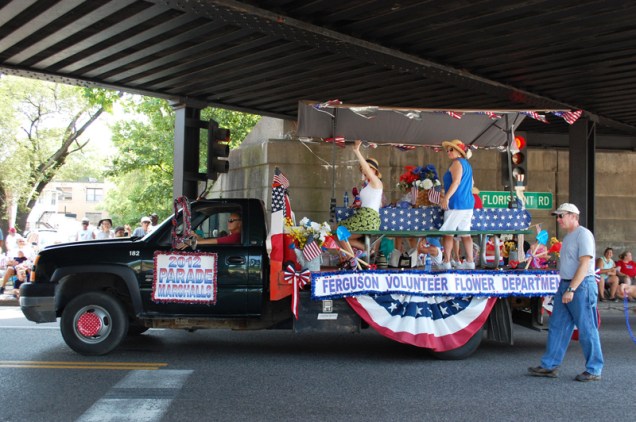
Cover Picture: Fourth of July Parade in Ferguson, Missouri – NOCO magazine
Middle Image: Police in riot gear advance through clouds of tear gas in Ferguson
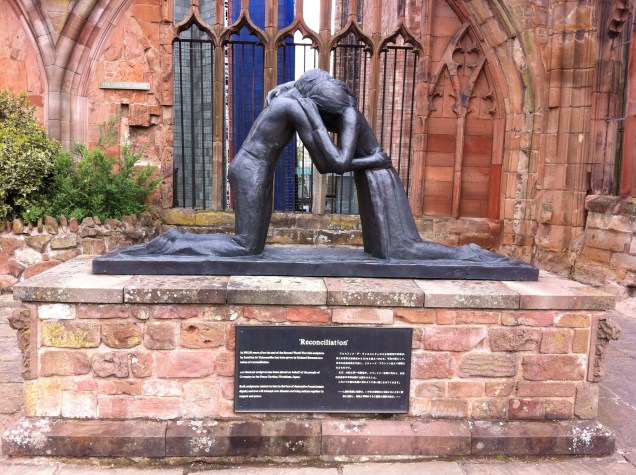
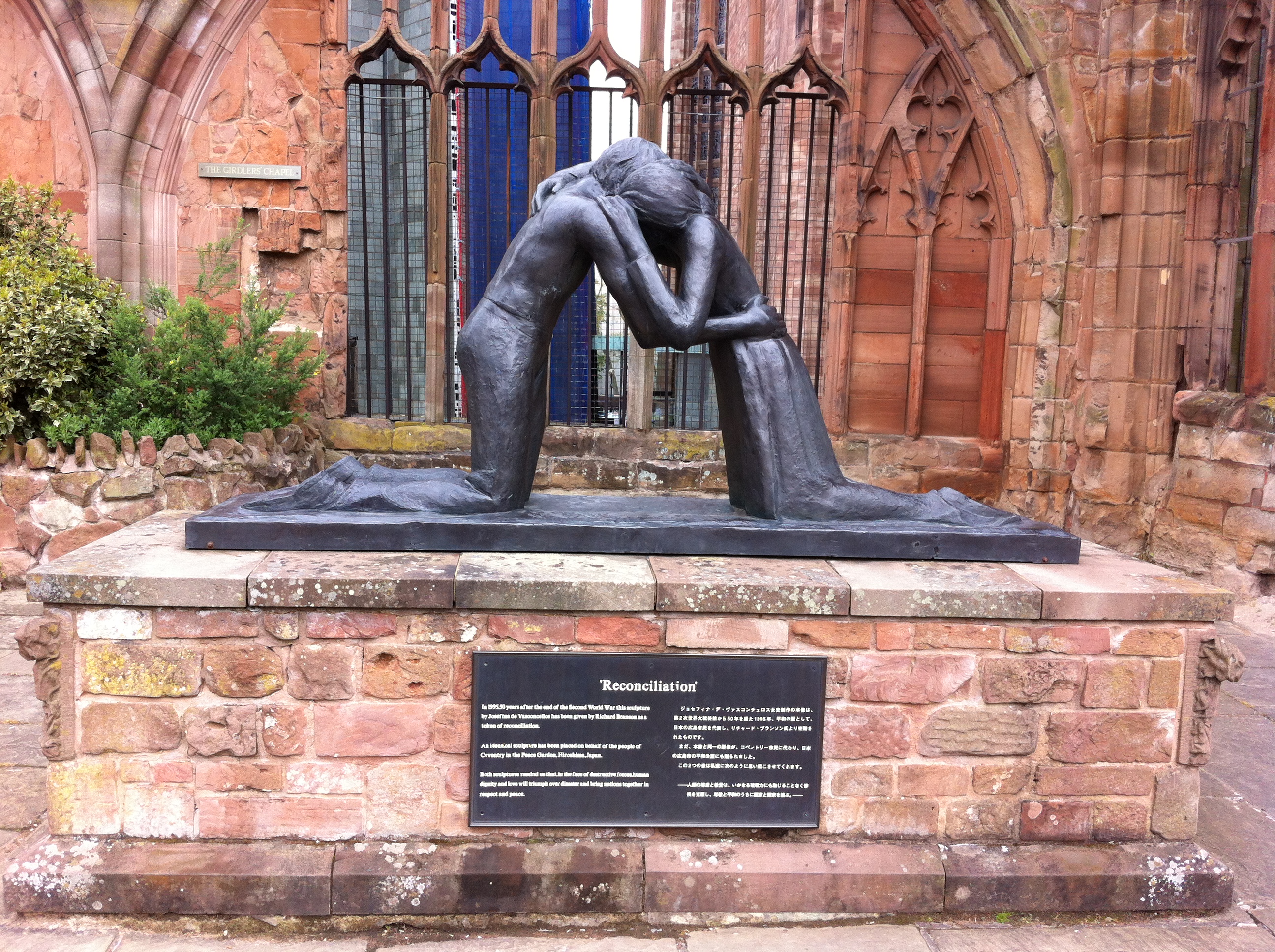
Closing Image: Statue of Reconciliation, Coventry Cathedral, Coventry, UK







 Semi-Partisan Politics