Bring It, Benedict

Benedict Cumberbatch - EU Referendum - Brexit

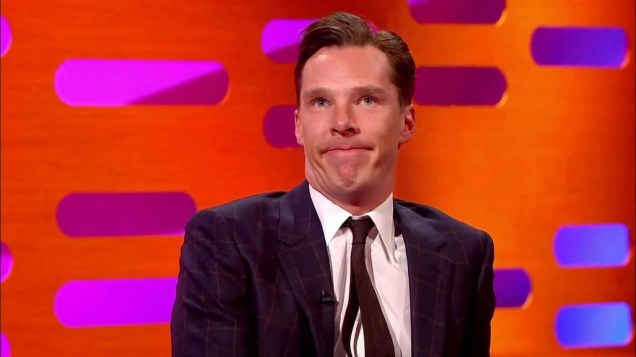
In their barely literate open letter praising the European Union, Benedict Cumberbatch and his cohort of EU apologist luvvies not only fail to understand what the EU is or how it works, they also shamefully pass off their own financial self interest as high-minded concern for the future of Britain

If assorted celebrities are going to sign their names to a public letter calling for the British people to vote a certain way in a referendum of existential importance, it would be decent of them to be honest about why they really want people to make that choice.

This is hardly rocket science, but apparently it was too much for the cognitively tepid minds who signed their names to a letter calling for Britons to reject Brexit for the supposed good of the arts.

The signatories are exactly the kind of people you would expect to see flaunting their right-on, progressive virtue to their fans and peers. Tracey Emin. Anish Kapoor. Vivienne Westwood. Jo Brand. Patrick Stewart. Keira Knightley. Jude Law. John Hurt. The ubiquitous Benedict Cumberbatch.

So to what exactly did they put their gilded names? Here is the full text of the letter:

The EU referendum marks the biggest democratic decision of our time, and the outcome will have lasting and far-reaching consequences for the future of this country for generations to come.

The referendum forces us to look in the mirror and ask ourselves: what kind of nation do we want to be? Are we outward-looking and open to working with others to achieve more? Or do we close ourselves off from our friends and neighbours at a time of increasing global uncertainty?

Because choosing to step out of a steadily integrating political union with an overarching supra-national government obviously means “closing ourselves off”. There are only two models of engaging with the world – the path to euro federalism or North Korea. Absolutely no other options in there at all. Sure.

From the smallest gallery to the biggest blockbuster, many of us have worked on projects that would never have happened without vital EU funding or by collaborating across borders. Britain is not just stronger in Europe, it is more imaginative and more creative, and our global creative success would be severely weakened by walking away.

And where exactly do you think that “vital EU funding” actually comes from, Benedict? Did you fall for that old chestnut about the secret magic money volcano deep beneath the European Parliament building in Strasbourg, regularly belching out €500 notes and showering them down upon grateful starving artists?

Of course there is no “EU money”. There is only British taxpayer money, the majority of which contributes toward general EU spending with only a small proportion being disbursed to various organisations in Britain, to be spent strictly as agreed by whichever organ of Brussels loftily granted it in the first place.

So is your argument actually that if Britain no longer contributed to EU cultural initiatives, the government would be inclined to use the money for other purposes? And if that is your legitimate fear, why don’t you take it up with your fellow citizens, whom you apparently believe do not value the arts highly enough? Why are you content for higher levels of taxpayer funding of the arts to take place in Britain than you think the British people themselves would allow? Doesn’t that make you the textbook definition of an enemy of democracy?

And what is all this bilge about “collaborating across borders”? Nearly all of the high profile signatories to the letter have worked on various international projects – many of them involving the United States of America, with whom of course we share no political union. Does the lack of a parliament overseeing both Britain and America mean that artists in each country can no longer collaborate on projects? Hardly.

The letter continues:

And what would ‘Out’ really mean? Leaving Europe would be a leap into the unknown for millions of people across the UK who work in the creative industries, and for the millions more at home and abroad who benefit from the growth and vibrancy of Britain’s cultural sector.

Remember when art was bold and visionary? No, neither do I. I was born in 1982, so I do not recall a time when the artistic establishment was not firmly in the orbit of government, keeping the politicos sweet in order to keep a hand in the Treasury.

But despite never having known a time when (unlike the United States of America) our greatest artistic institutions were privately funded and supported by great philanthropists, I still get the nagging feeling that any artist worth their salt – unless of the Soviet variety – should instinctively chafe at the idea of stale political union and remote continental governance, rather than rejoice in it and argue for its continuance.

Leaps into the unknown seem to me to be the whole purpose of art – to boldly go in new directions, try new things and above all seek the maximum freedom possible (the EU hardly being synonymous with freedom). And yet here assembled are the great and the good of Britain’s acting crop, telling us that the best we can now hope for is continued membership of an anachronistic 1950s model of governance dreamed up by old men scarred from the 20th century’s wars. The utter lack of vision and ambition from people supposedly paid to be bold visionaries is as shocking as it is profoundly depressing.

More:

From the Bard to Bowie, British creativity inspires and influences the rest of the world. We believe that being part of the EU bolsters Britain’s leading role on the world stage.

Let’s not become an outsider shouting from the wings.

“We believe”. Well, good for you. I believe in unicorns. But just stating a belief does not make it so. Where is the proof that being a member state of the European Union increases the demand for art, films, television programmes, sculptures, compositions, songs, albums, plays, skits, musicals or operas conceived, designed or produced in the UK? They provide no evidence because there is no evidence. If and when Britain exits the European Union and moves to an interim EFTA/EEA relationship to maintain single market access, the only thing we lose is the supra-national government. Is Cumberbatch seriously suggesting that the political institutions of the EU are his muse of fire?

It hardly needs pointing out that the two British icons cited by the signatories themselves – William Shakespeare and David Bowie – both took the world by storm before Britain joined the European Economic Community, in Shakespeare’s case by quite a few years. The beauty of art is that good or bad, high or low, it has ways of crossing political and cultural boundaries. That’s how a future North Korean defector came to watch a smuggled copy of Titanic in silent wonder, shocked and captivated by the idea of dying for a love other than love of the Dear Leader. That’s how the opening bars of Beethoven’s Fifth Symphony became a symbol of British resistance when all around us was pulverised to rubble during the Blitz. So don’t stand there and fatuously tell me that political union is required in order for art to thrive and spread, Mr. Cumberbatch. You should know that this much is a filthy lie.

Ultimately, one simply cannot take this letter seriously. And neither can one take the signatories seriously. It is certainly much harder to respect someone in public life when they knowingly use their public position to help propagate a series of lies, half-truths and obfuscations in service to an anti-democratic, embryonic government of Europe; an unrequested, unwanted and unloved supra-national government which buys the unconditional praise of scientists, university leaders, politicians and artists with your taxes and mine.

If Benedict Cumberbatch and his right-on friends want to virtue-signal their trendy, progressive opinions then good for them. Have at it. But when they seek to use their fame to influence others in the referendum debate, they should expect to be attacked for casually parachuting into the middle of the fray for the sole purpose of spreading lies, half-truths and a childishly naive view of the European Union which makes one wonder when they last watched the news (if ever).

This risible letter is nothing but a childish hymn of praise to the EU written by people convinced of their own righteousness despite being among the least educated on the topic, and who think they can trick the public by constantly conflating Europe with the power-hungry political entity which wishes to control it. In other words, the letter’s signatories are pawns, and not very bright ones at that, to allow themselves to be used in such a way. I give the whole sorry performance one star out of five, and I’m probably being too generous.

Don’t like what I’m saying? Then bring it, Benedict. I’m available to debate morning, noon or night, any time between now and the referendum. You’re an actor. I have been a lifelong supporter of the arts, and in my 20s was the London Symphony Orchestra’s youngest ever patron. You pick the time and the place, and we’ll talk a bit about the role of the arts in British and European life, and just how intertwined – or not – they are with the political construct known as the European Union.

But do your homework first – and I don’t mean learning canned lines from Britain Stronger in Europe. I mean actually trying to learn something about the subject before you start grandly soliloquising and attempting to sway other people.

Maybe the kind of unrehearsed extemporising revealed in this letter works when you try it on hordes of screaming fans at the rope line after one of your performances. But when you try and pull the same stunt in front of the British electorate you and your chums in the art world look stupid. Very stupid.

And until you either issue a retraction or double down with a proper grown-up argument, I will continue to say so.

 

European Union - United Kingdom - Britain - Flags

Support Semi-Partisan Politics with a one-time or recurring donation:

Agree with this article? Violently disagree? Scroll down to leave a comment.

Follow Semi-Partisan Politics on TwitterFacebook and Medium.

The Feeble Christian Case For Remaining In The European Union

Christians for Britain

Nobody has yet made a convincing Christian case for the EU. That should tell us something.

If nothing else, the Church of England’s Reimagining Europe blog has served to highlight – with a few very worthy exceptions – the exceedingly low quality of Christian thinking when it comes to the EU referendum question, and Britain’s place in the world more broadly.

The latest dismal example is a case in point, in which Andrew Gready (chaplain to the Anglican Church in the Hague) bemoans the fact that nobody is making a more positive case for staying in the EU:

Although there are certainly problems with the European Union (no one is seeking to gloss over these), the Dutch are at least able to see some of the positive benefits that belonging to a bigger whole has brought. It seems that they hoped that the debate in the UK would be more positive, more constructive than it has been. A number of people have said ‘Surely they can talk about the benefits of belonging, rather than just saying we are not sure what is going to happen, so let’s stay where we are!’

I think there is a real hope that the vote to Remain will actually be a positive statement of intent, rather than a negative one of fear and uncertainty. We will have to wait and see!

Newsflash, Gready – Britain is and will always remain part of a “bigger whole” whether we remain in the European Union or not. The European Union is a political construct, and a very recent and unproven one at that. It is not interchangeable with the continent of Europe, and it has no democratic legitimacy when it arrogantly claims to speak and act on behalf of the many diverse European peoples. There is a positive case for Brexit based on leaving euro-parochialism behind and engaging more fully in the world, and pro-EU Christians participating in the debate should at least acknowledge this fact rather than arguing against the two-dimensional cartoon Ukipper they hold in their minds.

But this is the very low standard of debate we have sadly come to see from those who claim to represent the Christian perspective. At its core, their argument amounts to little more than “the EU is about friendship and peace and cooperation, and Jesus was in favour of all those things, so what’s not to like?”

Or as the founder of Christians for the EU, the Very Revd Michael Sadgrove, puts it:

“I think life is meant to be lived together in partnerships and collaboration. To walk away from an institution that was set up to pursue those ideals is a big mistake.

“Link that with the Genesis principle that it is not good for a man or a woman to be alone. The EU is very much not perfect, but the essential ideal and aim is still valuable. The world needs nation states to be grouped together in alliances that will be good for the human race.”

Because partnership and collaboration is only possible through political union, of course. The sheer superficiality of this thinking is mind-boggling.

Seriously – boil down most of the pro EU articles over at Reimagining Europe and they amount to little more than that. You’ll hear endless variations on the theme that because we are all brothers and sisters in Christ, somehow it naturally follows that we should be united under the same supranational political umbrella – though curiously the Church of England never wastes its time clamouring for Asian countries to merge together, or for Canada, Mexico and the United States to institute a shared parliament.

Ben Ryan of Theos does a good job of summarising the many-layered complexity of Europe:

Yes, Europe is a Christian continent. But it’s not only a Christian continent, and that’s important to note. It’s a Christian continent, but it is also a ‘Greek’ continent, it is also a democratic continent; which is to say that the space that we call ‘Europe’ is not really a geographical thing. There is no border of Europe, geographically speaking. There are islands off the coast, there is no clear Eastern border.

Instead, what defines the border of the space that we call Europe is a cultural and intellectual thing. It is a space which is defined by what has come before; it is defined by Christianity, and by Greek philosophy, and by a number of other cultural and intellectual movements. So, it’s a mistake to think we are actually a real continent. There is no such thing as a ‘geographical Europe’, it can only really be seen as an intellectual space.

Sadly, many within the Church deliberately ignore these awkward facts, and have convinced themselves that pressing ahead with a uniquely 20th century vision of uniting the diverse under a single supranational government is a wise and moral thing to do – democracy be damned. And they do damn democracy through their actions, because what little organic desire and impetus for European political union there is always comes from the political elites, and not the ordinary people.

As a Catholic eurosceptic, it is frustrating to witness so many fellow Christians accepting the pro-EU, pro-Remain position almost by default, without actually engaging their brains or making considered reference to their faith. I’m no theologian myself, but I’ve read my Bible and I know that the New Testament offers little by way of clear instruction or even guidance as to how any entities larger than individuals and faith groups should organise or govern themselves, while much of the Old Testament reads as a “how not to do statecraft” manual.

If we restrict ourselves then to the teachings of Jesus, from where do Christian EU apologists draw their inspiration? The EU is not a democratic entity, nor is it likely to become one any time soon. What is so Christian about defending an organisation which insulates a continent’s leaders from the practical and political consequences of their rule? What is so Christian about sticking one’s fingers in one’s ears and loudly repeating the mantra “the EU is about peace and cooperation, the EU is about peace and cooperation”, while ignoring the known history of European political union and disregarding the fact that fruitful inter-governmental cooperation could take place just as well outside the EU’s supra-national structure?

Canon Giles Fraser, founder of Christians for Britain, gets it:

“If the Tower of Babel teaches us anything, it is, when man tries to control too much and usurp the power of God then God disperses them,” he said. “Government that is centralised tends towards corruption: that is the history of human nature.

“The biblical pattern is not always for agglomeration of power. God also divides in order that powers would be controlled.”

As I say, I’m no theologian. But I’ve been on the lookout for a more substantial Christian case for the European Union which is not based on wilful ignorance or wishful thinking about the EU’s true nature, and so far I have come up short. Meanwhile, Brexit offers at least the chance of democratic renewal in Britain, potentially giving people (including the faithful) greater control over their lives and communities.

Regrettably, I have come to the conclusion that much of the Christian case for Remain rests either on a lazy “agree with the Left by default” mindset, or the desire to virtue-signal generally “progressive” values across the board. I will be happy to be proven wrong, and to be presented with a serious Christian case for the EU based on the argument that staying part of a supranational political union unreplicated in any other part of the world is 1) what Jesus would do, or 2) what is best for Christians in Europe. But I’m not holding out much hope.

And if that’s what this is really about – cheering on the EU because it signals that one holds the “correct” progressive opinions in other areas – then they picked a really lousy time to do it. Our politics is suffering a crisis of legitimacy, and yet many in the Church have taken the decision to cheer on the one entity which best represents the interests of a narrow European elite overriding the interests of ordinary people.

For the Church as a whole, the consequences of coming down on the wrong side of this issue – or at least failing to come down convincingly on the right side – could be profound. One way or another, now or twenty years down the line, Brexit is coming. And when it does, many leading authority figures within the church will have placed themselves firmly on the side of governing elites rather than the people who fill their emptying pews.

This should be provoking a great degree introspection and self-reflection from Britain’s most high profile Christian leaders. So far, one gets the distinct impression that it is not.


Christianity - Europe - EU - Brexit

Agree with this article? Violently disagree? Scroll down to leave a comment.

Follow Semi-Partisan Politics on TwitterFacebook and Medium.

Stik’s Street Art, Like His Life Story, Is Moving. But This Worship Of The NHS Is Dangerous

NHS worship - Stik - National Religion

In secular Britain, the only things left to worship are ourselves, government and the NHS. And boy, do we do it well

Here is an interesting variant on the usual deification of the NHS we are used to seeing and hearing from the organisation’s cult-like defenders.

From the Hackney Citizen:

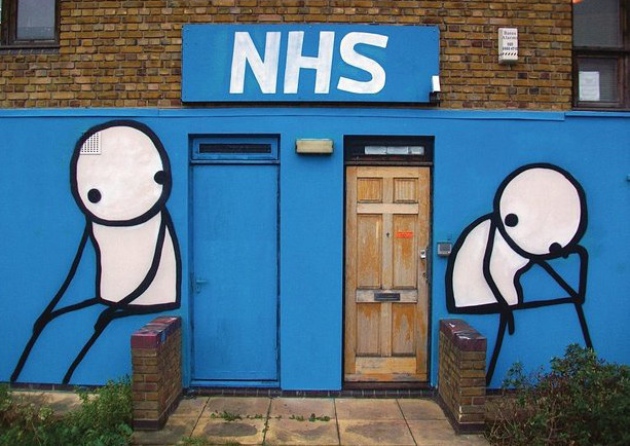
Stik, the once-homeless graffiti artist, whose stick-like figures adorn the streets of East London and beyond, has announced that a full set of his NHS Sleeping Baby print is to be auctioned at Christie’s later this month.

The prints, expected to sell for £2,000 to £3,000 as a set of four, will raise money for the Homerton University Hospital NHS Foundation Trust Art Charitable Fund.

This is not the first time Stik has used his art to help the hospital. The original ‘Sleeping Baby’ mural can be seen in the garden of Homerton Hospital itself, and last year Stik sold £50,000 worth of prints of the image with all the proceeds going to the Homerton Hospital’s art room.

The iconic image of a sleeping baby, painted in Stik’s usual style of block colour and thick-black lines, has since been adopted as a symbol by NHS workers. “It represents the vulnerability of the NHS and the feeling of fondness we have for it. The NHS is our baby and we have to protect it,” Stik says.

During the recent junior doctors strikes, the image was printed on placards with slogans such as ‘Hands off our NHS’ and ‘The NHS is our baby’.

To be clear: doing anything to raise money for hospitals is a selfless and noble act, to be applauded. That much is great. What is troubling are the sentiments expressed which accompany the philanthropic act – in this case, an almost slavelike devotion not to the idea of healthcare, hospitals or the work of medical professionals, but rather to one specific organisation, government department and method of healthcare delivery.

Speaking about the NHS as a vulnerable infant, almost like the Christ child, is not healthy behaviour. Nor is placing ourselves in the position of loving parents to this baby, charged with protecting it from all harm (though it does make a refreshing change from portraying ourselves as the children, being tended to by the watchful parent of big government).

Equally offensive is the way that NHS cultists presume to speak for everyone in the country, and routinely pontificate about things like “the feeling of fondness we have for it”. Oh do we, now? I’m fairly certain that NHS-loving drones are indeed in the majority, but I would also wager that there is a not insignificant number of people who fully support the idea of universal healthcare and are very grateful to doctors and nurses, but who have very little attachment to Britain’s unique model of centralised, government-owned delivery.

And yet the NHS cultists, much like the Princess Diana cultists nearly two decades ago, have the nerve to speak on behalf of us all. They declare on our behalf just how much we love the NHS and will fight to protect it from change, just as the Diana cultists wept into every passing television camera, sang along to Elton John and declared the entire nation to be in mourning.

Stik is a gifted artist, and many people find his murals poignant and beautiful. But we should not allow our respect for an artist and sympathy with his powerful life story to cause us to unquestioningly swallow NHS propaganda, hook, line and sinker. Other countries, without an NHS of their own, manage to build and operate hospitals too. Many of them provide their citizens with healthcare free at the point of use. Many also help the homeless, or indeed anyone in urgent need of medical care. Believe it or not, generosity, compassion and public spiritedness are not uniquely British values.

Whether we are allowing Stik to lead us in worship of the fifth biggest employer in the world, childishly painting the NHS logo on our faces, wearing it on our clothes or propelling a schmaltzy NHS Choir ballad to the Christmas No. 1 slot in the charts, in each cases we are disengaging our brains and allowing ourselves to be swept up in a cult rather than thinking rationally. Maybe the NHS was just what Britain needed back when we were struggling to pick ourselves up from the rubble of the second world war. But 68 years later, even in this age of globalisation, no other country has chosen to copy our approach. Not one. Shouldn’t that tell us something?

Faith is important*, but it is generally best applied to the spiritual realm. In the temporal realm here on Earth, we are able to look at evidence, test hypotheses and innovate new solutions when old ideas and ways of working become obsolete. Nowhere is this more true than the field of medicine. If we or a loved one were gravely ill, few of us would put our trust in a faith healer or wait for a divine miracle alone to provide a cure. Indeed, we tend to scorn and even prosecute those who do so.

And yet when it comes to the system of healthcare delivery we choose for our country, we proudly spurn new information and cling desperately to the familiar, seizing on any news story which confirms our present pro-NHS biases while simply ignoring heretical contrary evidence. In other words, we act entirely through (misplaced) faith, not reason.

Of course we should all hope that Stik’s Sleeping Baby prints raise much money for the Homerton University Hospital NHS Trust when they are auctioned – nobody disputes the worthiness of the cause. But in post-religious, increasingly secular Britain, we should be very wary of what we choose to fill the void once occupied by the Church. The human urge to worship has clearly not been vanquished, and venerating the NHS as we currently do is terrible for us, and calamitous for our flailing healthcare system.


* Long-time readers will recall that I am a Roman Catholic


NHS Logo - Cross - National Religion - Worship - Idolatry

Top Image: London24

Agree with this article? Violently disagree? Scroll down to leave a comment.

Follow Semi-Partisan Politics on TwitterFacebook and Medium.

Universities UK And Scientists For EU, Selling Out Democracy And Academic Freedom In The Grubby Pursuit Of Cash

Universities for Europe

Pro-EU academic umbrella organisations like Scientists for EU and Universities for Europe are actively peddling myths and propaganda rather than dealing in ideas, in a heinous betrayal of their supposed professional ethics

The LSE’s BrexitVote blog is carrying a great rebuttal to the endless, whining, selfish demands from Scientists for EU and others that the British people should reject Brexit because leaving the EU might hinder some money from flowing unimpeded into the pockets of various grubby special interests.

Christopher Bickerton and Lee Jones, both university lecturers, write:

When scientists wail that their ‘lab would fall apart’ outside the EU, they reflect the lamentable, Not-In-My-Back-Yard attitude of many academics to the forthcoming referendum. Any critical argument about the EU, and indeed any political argument whatsoever, seems to fall by the wayside, deemed irrelevant by those thinking only of their present research activities. The referendum is not about anyone’s lab; it is about democracy. The consequences of EU membership or exit are so vast and wide-ranging that this is the most significant political decision that will occur in our lifetimes. It is too important to reduce to pounds and pence. We all have our own interests, but sometimes we should aim to look a bit further than that.

If you don’t like the immigration regime as it applies to students and academic staff, then campaign to change it. If you think that UK science is under-funded, making us overly reliant on EU money, then demand that government funds universities properly. If this idea that popular demands should translate into government policy seems unrealistic, it simply signifies how degraded our democracy has become after decades of EU membership.

If you want to stay in the EU, then campaign for it – honestly. Don’t hide behind dodgy statistics and present what is really a cultural and political preference as a matter of economic and scientific necessity.

Read the whole thing.

How refreshing – and how long overdue – it is to see this fightback occurring within academia. Too often, the people in our country who are supposed to be the most adept at thinking, the best equipped to understand abstract concepts and possessed of the best knowledge of history have in practice spurned all of these gifts and sung uncritical hymns of praise to the European Union, and looked at the most fundamental question to face our country in decades as a parsimonious question about how much money will flow into their coffers in the event of a Leave or Remain vote.

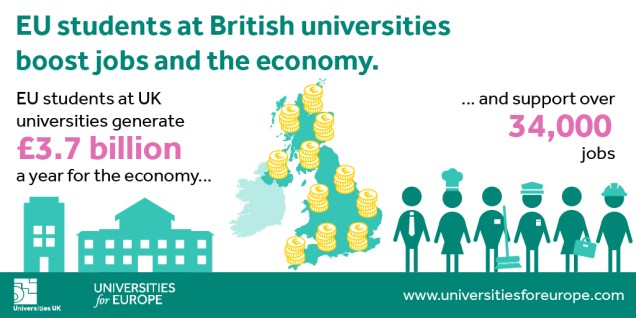
The dismal lack of vision or serious thought behind Scientists for EU and Universities for Europe is laid bare in the campaign poster shown at the top of this article, which trumpets the benefits to the British economy of European students studying here. Great. But are they seriously suggesting that these students would no longer come to Britain if we were to leave the political construct of the EU? Would all European students currently here be summarily deported, dragged from their halls of residence in the middle of the night by Home Office SWAT teams? Of course not. But those who claim to speak for scientists and universities are not above falsely implying that European students would automatically disappear from our shores in the event of Brexit.

We can rule out the idea that Universities for Europe are misinformed, and labouring under the misapprehension that something so apocalyptic might really occur – these are supposedly bright people, after all. So that leaves us with the rather distasteful truth – that they are actively lying and seeking to scare and deceive the British people, in order to defend what they see as a lucrative revenue stream of EU funding. In other words, not only have British universities abandoned the pursuit of truth, they are now enthusiastically peddling misinformation and propaganda. I hope they can sleep at night.

Of course, it is not only the academic establishment at fault for slavishly joining in the EU praise chorus – the same can be said of the entire Remain campaign from David Cameron and the government on downward. Neither feel comfortable talking about the big issues of democracy, accountability and national self-determination, which is why they constantly bring the focus back to tedious and unprovable economic arguments about pounds saved or GDP growth at risk.

Neither academia nor government can talk about Britain’s gradual absorption into a European political union in warm and enthusiastic terms, because to do so would be too immediately repellent to voters. And so unable to make the real positive case for the EU and for European federal union, instead we see this endless parade of risibly apocalyptic warnings about Brexit.

Which is a shame, because it would actually be quite nice to know whether our political and intellectual leaders believe that the top-down supra-national government of Europe is a good objective, or whether they are merely going along with it because of perceived short term social and financial advantage.

And if nothing else comes from this abysmally fought EU referendum, it would be nice to know whether our pro-European betters in Westminster and the academy are more stupid or greedy. Right now it seems quite finely balanced.


European Union - United Kingdom - Britain - Flags

Agree with this article? Violently disagree? Scroll down to leave a comment.

Follow Semi-Partisan Politics on TwitterFacebook and Medium.

Tales From The Safe Space, Part 37 – Whisperings Of A Revolt

NUS Disaffiliation Campaign

Has the NUS finally gone too far?

All tyrants, petty or otherwise, eventually go too far and overextend their vast authority. Maybe they get cocky. Maybe they surround themselves with so many Yes Men that they lose the pulse of the people. But inevitably, somehow or other, they will at some point find themselves overextended, and see their exalted position threatened as a consequence.

It is delightful to see such a thing now happening to the National Union of Students, that censorious, moralising platform for embryonic leftist politicians and demagogues, which long ago gave up any pretence at advocating for students, preferring to exercise paranoid control over them instead.

Now, some students are fighting back. A number of smart, more liberty-minded students have realised that since most Student Unions derive their democratic “legitimacy” from a vanishingly small slice of their respective student populations, it should be relatively easy to mount a small insurgency of their own to topple the Social Justice and Identity Politics cultists in charge, and make their local unions work for the students rather than simply trying to control their thoughts, behaviour and speech.

Hence the brilliant NUS disaffiliation campaigns now springing up at campuses around the country.

Spiked’s Tom Slater reports in The Spectator:

In a move that has left student union politicos across the country clinging to their therapy dogs, the University of Lincoln Students’ Union has voted to disaffiliate from the NUS. Springing from the new, anti-NUS sentiment that is brewing on campuses across the country, Lincoln students voted 881 to 804 to leave.

This was a big breakthrough, putting wind in the sails of disaffiliation campaigns currently being fought at York, Oxford, Exeter and Manchester. And though this was all sparked by the election of new NUS president Malia Bouattia – the overgrown student fond of waxing lyrical about the ‘zionist-led media’ – the gulf between NUS leadership and its members has been growing for years.

After Lincoln’s vote, outgoing NUS president Megan Dunn said she was ‘sorry this decision was made by such a small number of students’. Which was a bit rich, seeing as she was elected in 2015 by a whopping 413 NUS delegates, and turnout at campus NUS elections – which select those delegates – is notoriously low.

Lincoln’s vote is significant. Not least because so many felt so detached from the NUS they didn’t even turn out to vote. And, in an interesting twist, Lincoln SU’s own president appeared to approve of the move, telling the Independent that ‘for some time… the NUS has been far removed from the issues our students tell us are important’.

And now Newcastle University has followed suit:

Newcastle University Students’ Union (NUSU) has become the second to announce it is to disaffiliate from the National Union of Students (NUS) following a controversial National Conference in Brighton last month.

The move has come as a double blow for the national student campaigner after Lincoln University announced on Monday it, too, will be breaking away from the NUS at the end of the year.

NUSU confirmed on Thursday that 1,469 total votes had been cast in the referendum by Newcastle University students, with a majority of 67 per cent voting in favour of disaffiliation.

Brilliant. While this blog contends that the power and influence now wielded by the Cult of Social Justice and Identity Politics can only be truly broken when those with most authority – professors and university administrators – finally rediscover their backbone and begin to defend academic freedom and free speech rights, it is heartening to once again see students in the vanguard of the resistance.

For in truth, it is in the interests of almost no students – save the Identity Politics priests who derive power and influence from policing the culture of their institutions and the behaviour of their peers – to allow the NUS to continue along its present, authoritarian path. As Tom Slater argues in The Spectator, students deserve local unions which fight for their interests as students, rather than a union which wastes its time fighting a culture war and playing off different groups of students against one other based on an arbitrary judgement over how “oppressed” they happen to be.

The growing NUS disaffiliation movement should be encouraged and helped to spread like wildfire, burning through the rotten foundations and (ideally) causing the whole organisation to topple. And now is the time to strike, when the enemy is dangerously overextended, making very specific and highly controversial claims (pro-censorship and the identity politics agenda) on behalf of all students when in fact they speak only for a small but noisy illiberal minority.

First Lincoln, then Newcastle. Who will be next to throw off the puritanical, totalitarian shackles of the National Union of Students?


Safe Space Notice - 2

Agree with this article? Violently disagree? Scroll down to leave a comment.

Follow Semi-Partisan Politics on TwitterFacebook and Medium.