A Strong, Christian Case For The Nation State (And Against The European Union)

Justin Welby - John Sentamu - Archbishops - Church of England - EU Referendum - European Union - Brexit - Remain

Here is an intellectually robust, theologically rooted argument in support of the nation state and against the European Union. Why are Christian EU apologists unable to produce a similarly heavyweight case of their own, instead of relying on woolly platitudes about ‘togetherness’ and ‘co-operation’?

The Reimagining Europe blog has just published a serious intellectual (and even theological) but highly readable case for the continuance of the nation state, and criticism of those who suggest that the age of supranational government is either logical, inevitable or a goal to which Christians should aspire.

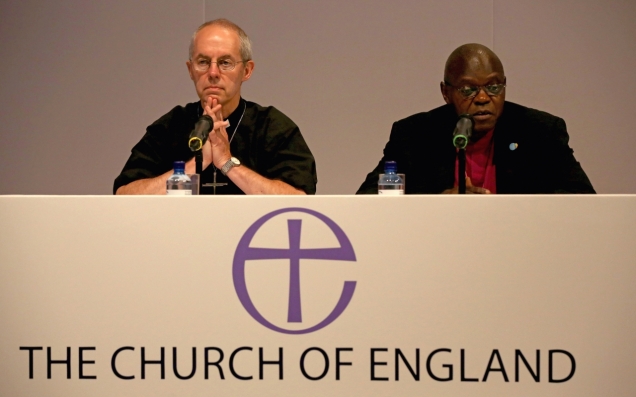
While I do not agree with every single nuance of the argument put forward by Nigel Biggar (Regius Professor of Moral and Pastoral Theology at Christ Church college, Oxford) the overall thrust of his argument is quite unimpeachable. It certainly is rooted in a far deeper reading of scripture and theological analysis than the glib statements of support for the European Union and Remain campaign from Archbishops John Sentamu and Justin Welby.

Biggar begins:

Thirty years ago I was told by a senior Anglican clergyman that the nation-state was passé. I can’t remember why he thought as he did, but I do remember that his conviction was a fashionable one. Quite why it was fashionable isn’t clear to me now. The mid-1980s were too early for globalisation’s transfer of power from national governments to free global markets and transnational corporations to have become evident. Perhaps it was the recent entry of an economically ailing and politically strife-torn Britain into the arms of the European Economic Community that made the nation-state’s days look so numbered. And, of course, the Cold War, which would not thaw until 1989, made international blocs look like a monolithic fact of global political life.

Finally, someone raises the historical context of Britain’s entry into the EEC in their Christian argument about the EU referendum. Good. Nothing can be understood without understanding the history and purpose of the European Union, but also the circumstances which led Britain to join in the first place. For if those circumstances (global obsolescence and lack of a “role”, economic decline, industrial strife, the very real risk of being ejected from what Michael Moore might call the “Premier League” of nations) are no longer present, why on earth would we now wish to stay, given all of the EU’s manifold flaws and failings?

Biggar goes on to discuss differing national attitudes toward being a quasi-autonomous member of a larger supranational grouping:

But there’s another, historically deeper reason. This was graphically impressed upon me during a visit to last year’s exhibition at the British Museum, “Germany: Memories of a Nation”. (I’d strongly recommend the book, by the way.) One of the exhibits was a map of north-western Europe in the mid-18th century, on which were superimposed the coinages current in Germany and Britain at the time. In Britain, there was one coin; in Germany, about sixty. Britain was a unitary state; Germany a territory with a common language, but comprising dozens of different kingdoms and principalities.

And here’s where being both German and Roman Catholic comes into play. For the dozens of mini-states in mid-18th century Germany were the vestiges of the multinational, Catholic, Holy Roman Empire, which the Protestant Reformation had helped to destroy. For Roman Catholics, especially on the European continent, and especially in Germany, the notion of a federation of states, sharing a broadly common culture and subject to a transcendent, quasi-imperial authority seems a perfectly natural condition.

Not so for the English, who have inhabited a nation-state whose basic structures span a thousand years, and whose history has taught them to fear the concentration of continental power. It’s no accident, therefore, that one can find in Anglican thought a marked tendency, from F. D Maurice in the mid-19th century to Oliver O’Donovan now, to affirm the existence of a plurality of independent nations, whose external relations are governed by international law rather than a supranational state.

Quite so. The lived experience of Britons, and our national history, is simply too different to reconcile with that of continental Europe under the umbrella of an overarching set of political institutions. In some areas of Europe, particularly the disputed regions which have changed back forth between countries over centuries (think Alsace-Lorraine), people have a history of maintaining a cohesive identity almost separate to whichever nation happened to claim their territory at the time. There is no similar history in Britain (though one could argue that the experience of the non-England home nations within the UK comes closest).

The upshot is that there is precious little in our folklore, literature, art or indeed politics which well equips us to carry on functioning happily no matter which foreign king makes the key decisions, or from which city they may do so. We are not built for supranational rule – despite ourselves having presided over an empire which did exactly that, we have not been on the receiving end in a thousand years.

Biggar then gets biblical, something which too few of the most prominent Christian apologists for the European Union have been willing to do:

Christians tend to view the nation-state and so the prospect of a European federation differently, according to whether they are Roman Catholic or Protestant, and according to their historical experience. All Christians, however, are accountable to the Bible. What does it have to say about these matters?

On the one hand, the New Testament makes quite clear that a Christian’s affection and loyalty have to go beyond the nation. They have to transcend it. Primarily, they have to attach themselves to God and to His coming Kingdom or rule. This we read in the third chapter of the Epistle to the Philippians, where St Paul, having identified himself strongly with the Jewish nation—“a Hebrew of the Hebrews”—then firmly subordinates his Jewish identity to his loyalty to God in Christ:

“But whatever were gains to me I now consider loss for the sake of Christ. What is more, I consider everything a loss because of the surpassing worth of knowing Christ Jesus my Lord, for whose sake I have lost all things. I consider them rubbish, that I may gain Christ…. [O]ur citizenship”, he tells the Christians at Philippi, “is in heaven” (vv. 7-9, 20).

Taken at face value, it would seem that Paul is saying that Christian identity must obliterate and completely replace national identity. But Paul, I think, is speaking hyperbolically here; he’s exaggerating. In fact, he never entirely repudiated his Jewish identity, but rather sought to understand how his new-found loyalty to God in Christ could actually fulfil his original national loyalty.

Biggar is right to suggest that St Paul’s injunction to completely erase national identity is a rhetorical exaggeration. And it is certainly the case that if British Christians were indeed called to renounce their Britishness, there is absolutely no reason why they should then take up a European identity – if any passing allegiance to country is wrong, then allegiance to a supranational body which is actively trying to become a country in its own right is just as wrong.

As Jesus Himself said, “My kingdom is not of this world” (John 18:36). While we are indeed all brothers and sisters in Christ, it is made very clear to us that our common citizenship is at an embryonic stage in this temporal world, represented by the global Church, and that the nation to which we shall all one day belong is not one of Earth.

Biggar goes on to concede the transitory nature of nation states:

Against such idolatrous nationalism, Christians must refuse the claim that nations have an eternal destiny, and that their survival is an absolute imperative. Nations are in fact contingent, evolving, and transitory phenomena. They come and they go. The United Kingdom did not exist before 1707 (and could have ceased to exist this year, had the Yes campaign won the Scottish independence referendum.) The United States could have ceased to exist in the early 1860s. Czechoslovakia did cease to exist in 1993.

So a Christian cannot be a Romantic nationalist, idolatrously attributing an absolute value to any nation. That’s one part of the truth.

With this important counterpoint:

But there is another part. This is alluded to by St Paul’s continuing identification with the Jewish people. And it’s made explicit in the Old Testament, where the prophet Jeremiah addresses the Jews, who had been carried off into exile in Babylonia, after the sacking of Jerusalem in the year 586BC. This is what he says:

“This is what the Lord Almighty, the God of Israel, says to all those I carried into exile from Jerusalem to Babylon: “Build houses and settle down; plant gardens and eat what they produce. Marry and have sons and daughters; find wives for your sons and give your daughters in marriage, so that they too may have sons and daughters. Increase in number there; do not decrease. Also, seek the welfare of the city to which I have carried you into exile. Pray to the Lord for it, because if it prospers, you too will prosper (vv. 4-7).”

Though they are citizens of another country, though they are currently exiles in Babylon, the people of God should nevertheless “seek the welfare of the city”.

Why is this? The answer lies in our created nature as human beings. We are finite, not infinite; creatures, not gods. We come into being and grow up in a particular time, and if not in one particular place and community, then in a finite number of them. We are normally inducted into particular forms of social life by our family and by other institutions—schools, churches, clubs, workplaces, political parties, public assemblies, laws. These institutions and their customs mediate and embody a certain grasp of the several universal forms of human prosperity or flourishing—that is to say, the several basic human goods—that are given in and with the created nature of human being. It is natural, therefore, that we should feel special affection for, loyalty toward, and gratitude to those communities, customs, and institutions that have benefited us by inducting us into human goods; and, since beneficiaries ought to be grateful to benefactors, it is right that we should.

This is true – we do indeed feel special affection and loyalty toward communities, customs and institutions which give us utility. But we should be wary of where this particular strand of thought may lead us. For as we know, the European Union is particularly adept at “purchasing loyalty” by using funds raised from nation state taxpayers and sent to Brussels as EU membership fees to then bribe national citizens with their own money in the form of development spending or sponsorship of various arts and community projects.

Pete North warns about this very phenomenon with this brilliant observation:

The founding fathers were savvy in their design of le grande project. They always knew it could never be done all at once because the central vision would never secure a mandate. Integration by deception has always been the modus operandi. It salami slices powers little by little, so gradually that few ever notice. And you’d never see it unless you know what the game plan is. They were long term thinkers. They knew it would take a generation or so to advance their agenda and they had a roadmap to do it.

It has always used funding of local projects to manufacture consent. It’s why you’ll find EU logos emblazoned on any nature reserve or community hall or obscure museum out in the shires, to convince the plebs that their benevolent EU guardians cared more for them than the London government. It is why it funds universities too. Every strata of civil society has an injection of EU cash. Education, NGOs, you name it. And it works.

[..] The founding fathers always knew a day would come where the legitimacy of the EU would be questioned. And now you see how well their pernicious scheme worked, with the entirely of the civic establishment coming out in favour of remain. They have made idle supplicants of our institutions, robbing them of their vitality, curiosity and dynamism.

While Biggar is absolutely correct to make his point, defenders of the nation state must be careful that this is not then used as justification by EU apologists for the behaviour and existence of the EU – a kind of retroactive justification for unwanted supranational political union based on the wheedling claim that people like it when Brussels gives them back their own money.

Biggar’s conclusion is a resounding rejection of pessimism about the nation state and the ignorant embrace of the EU by many in leadership positions in the church, based only on the woolliest of Christian thinking (my emphasis in bold):

Of course, institutions at a national level are not the only ones that enable us to flourish as human beings, but they do remain among them; and they are still the most important. This is true, notwithstanding the easy illusion of global identity that today’s social media create. While international institutions such as the United Nations have developed since the Second World War, they haven’t replaced nation-states and don’t seem likely to do so any time soon. Indeed, the UN only has as much power as nation-states choose to give it. So the nation-state is here to stay for the foreseeable future, and it continues to have great power to shape the lives of individual human beings. Insofar as it has shaped our lives for the better, helping us to prosper, we owe it our gratitude and loyalty; insofar as it has mis-shaped our lives (or other people’s) for the worse, we owe it our commitment to reform. Either way, we owe it our attention and our care.

So, in sum, as I see it, the Bible teaches on the one hand that no nation-state deserves absolute loyalty. Every state is subject to the universal laws of God, of which it may fall foul and deserve criticism. On the other hand, Scripture implies that nation-states can, and should, and often do furnish the structures necessary for human flourishing. They cause us to prosper. Therefore, they deserve our loyal, if sometimes critical, care.

[..] In the age of global capitalism, they are less powerful than they used to be. And they have always been bound, more or less, to each other by need, by treaty, and by law. Nevertheless, nation-states remain the fundamental units in the international order, and the day when they will be superseded by a global state is nowhere in sight.

Nation-states are not in fact passé, and the Bible doesn’t tell us that they should be. What’s more, my German Catholic friend really shouldn’t argue for Britain’s remaining in the European Union on the ground that the age of the nation-state is over. Because, of course, a federal EU would be nothing other than a larger state, serving the newly self-conscious nation of Europeans, and able to hold its own against the United States on the one hand, and Russia and China on the other.

There may well be good reasons for Britain to remain in the E.U. But if that is so, the unchristian nature, or the obsolescence, of the nation-state is not one of them.

An intellectually rousing piece with a resoundingly clear conclusion – that the nation state, for all its flaws, has been the underwriter of our most fundamental freedoms and liberties for too long to carelessly cast it aside in the blinkered rush toward supranationalism.

Those with senior leadership positions within the church – I’m thinking here particularly of Archbishops John Sentamu and Justin Welby of the Church of England – are too intelligent not to know the history, purpose and inevitable future trajectory of the EU. Unlike the average man on the street, we need not extend to them the charitable assumption that they are simply ignorant on the matter – after all, our state church is about as deeply embedded in the British establishment as it is possible to be.

Therefore, when the likes of Justin Welby or John Sentamu argue that Britain should vote to remain in the EU in the coming referendum, they do so from a clear base of knowledge that this would mean our continued participation in a project whose ultimate direction has never wavered – the creation of a common European state. This means that they either want Britain to be part of this reckless European endeavour (though they are too dishonest to admit as much, perhaps believing it is their duty to mislead their congregations, who they consider too stupid to appreciate the necessity of political union), or they think that Britain can somehow flourish as a kind of “associate member” on the margins of an ever-tightening political union of the eurozone countries, in which our existing influence would be greatly diminished.

If it is the former, and the Archbishops are closet euro federalists who dare not declare their ultimate goal in public, then this is a truly reprehensible way for them to behave, advocating as they do a wishy-washy, hand-wringing argument for Remain based on economic fears rather than making their true political intentions clear. And if it is the latter, and they have convinced themselves that remaining on the margins of a steadily integrating European Union can do anything but marginalise us and diminish our presence on the world stage then their political judgement is bordering on the catastrophic – and only reinforces the case that the Church of England should be fully disestablished and severed from its anachronistic, unjustifiable constitutional role in the United Kingdom.

But here we have it – a muscular Christian case in support of the nation state, and implicitly against the European Union. Will we ever hear the equivalent pro-EU Christian case articulated so eloquently, or at such length? We have certainly seen nothing to date. In fact, the further up the church hierarchy the Christian EU apologists are found, the weaker and more insubstantial their arguments generally become.

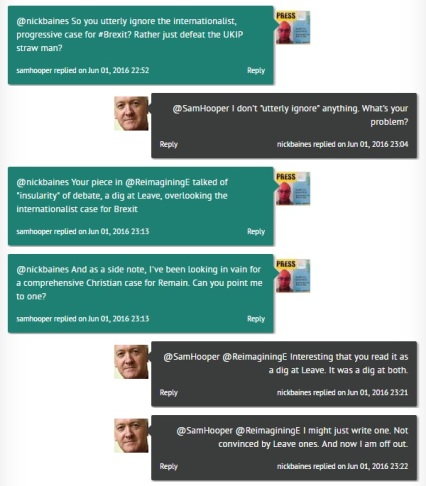
I recently had an exchange on Twitter with Nick Baines, the Anglican Bishop of Leeds, in which I questioned his description of the Leave campaign as “insular” and asked when we might expect a substantive Christian case in favour of the EU:
Bishop Nick Baines - Sam Hooper - EU Referendum - Brexit - Christian case for EU

Bishop Baines promised just such an article, but none has yet been forthcoming. Indeed, a clear, unambiguous and unapologetic Christian case in favour of the European Union and a Remain vote in the EU referendum can scarcely be heard, despite the weight of establishment Christianity coming down on the side of remaining in the EU.

This is untenable. If the bishops are to retain any kind of temporal authority – at least in my eyes – it is not enough to make wishy-washy statements vaguely supportive of the Remain campaign without any intellectual or theological legwork to back them up. This reeks of confirmation bias – of bishops, comfortably ensconced in the establishment, making up their minds that the EU is a good thing in advance, and then cherry picking facts to support their existing viewpoint.

A common Christian complaint is that our religion is being increasingly forced from the public square in this new secular age. And it is partly true – freedom of speech and religious expression are sometimes outrageously curtailed in this country. But participation in the public square comes with a price: if one wants to be heard and taken seriously, one must say sensible things and be prepared to back them up with a solid argument.

At present, too many bishops of the church are willing to sell out the public square and everything else in this country to Brussels, and do so without offering a sound argument for remaining in the European Union based on our knowledge of the nature, purpose and direction of the EU. The bishops believe that a sprinkling of glib words about “togetherness” and “co-operation”, mixed with some hand-wringing concerns about the short term economic impact of Brexit taken straight from the Remain camp’s playbook, amount to a sufficient case. But they do not.

Ideally, the bishops should come down unanimously on the right side of this issue. But since that is not going to happen, they should at least participate in the debate with a shred of honour. And if they arrogantly proceed with their current approach, preaching the Remain argument on the flimsiest of pretexts, then they should not be surprised if they cause the gates to the public square to be permanently locked to Christians.

And what a dismal legacy that will be.


Postscript: More on the Christian case for Brexit hereherehere and here.


European Union - United Kingdom - Britain - Flags

Top Image: New Statesman

Support Semi-Partisan Politics with a one-time or recurring donation:

Agree with this article? Violently disagree? Scroll down to leave a comment.

Follow Semi-Partisan Politics on TwitterFacebook and Medium.

Who Is To Blame For Donald Trump?

A problem of American conservatism’s own making

In a recent show, Bill Maher took American conservatives to task for daring to suggest that responsibility for the rise Donald Trump rests with liberals.

Money quote:

Is political correctness out of control? Of course it is. I think I might have done some sort of show about that once [Maher was host of “Politically Incorrect with Bill Maher”]. I’ve been telling liberals when they had spinach on their teeth since 1993. I’ve ridiculed them for everything from offensive Halloween costumes to Islamophobia, from the self esteem movement to college campuses forgetting what free speech is. But none of that justifies embracing a dangerous buffoon, simply because his lack of political correctness is cathartic.

Trump is your problem. But somehow the party of personal responsibility doesn’t want to take responsibility for this one. Somewhere along the way, the slogan went from “Make America great again!” to “Look what you made me do!”

Amen to all of this. American leftists do indeed have much to answer for, but the rise of Donald Trump is not a problem primarily of their making.

It was the tri-cornered hat brigade whose admirable devotion to fiscal responsibility only materialised once Barack Obama took office, and then failed to force any meaningful change in Washington despite many of their number being elected to Congress in the 2010 midterms which, who have a case to answer. They were the Great White Hope whose inevitable failure formed the third strike against the political class.

It was not the Democratic Party which fanned the flames of birtherism (and then considered a nominee for president who was born in Canada) and refused to stand up to angry constituents demanding to see a birth certificate. That was all on the Republicans. Donald Trump led that effort, and nearly the entire GOP sat back with a tub of popcorn, thinking that the circus would benefit them politically. And so it did, until their attack dog finally broke the leash and turned on its handlers.

Has Barack Obama been a decidedly left-wing and in some (though by no means all) ways unimpressive president? Yes, he has. But is he a closet Communist, a secret Muslim planning to enforce hardline Islamism on America or a hopelessly incompetent buffoon? Absolutely not. He is a centre-left politician with undeniable skills, twice elected on a centre-left platform and governing according to a centre-left approach. But in their greed to quickly win back power without doing the hard work of making their own pitch to the voters more appealing, too many Republicans were willing to tolerate and sometimes actively participate in the anti-Obama hysteria for short term political gain.

If Democrats shoulder any responsibility for the danger that Donald Trump could soon be elected US president, it is only because they are now on the verge of nominating Hillary Clinton as their favoured successor – again, a highly competent technocrat and somebody with undeniable experience of executive power at the highest levels, but also somebody with no discernible core beliefs or values beyond the “bridges, not walls” buzzwords du jour.

Clinton’s political judgement has at times been…questionable. And she is dogged by a legitimate and troubling email scandal that cannot be dismissed as a mere partisan attack – to the extent that she is currently under investigation by the FBI. And that is to say nothing of the fact that the American political party supposedly the most committed to equal opportunity and social mobility is complicit in making the presidency a family affair. But none of this is remotely comparable to the danger which the Republican Party has unleashed on the country.

The warning signs were all there four years ago – a GOP primary debate stage filled with candidates like Herman Cain and Michele Bachmann, and whose few quasi intellectuals (like Newt Gingrich) were burdened with so much personal baggage that they were non-starters. Mitt Romney was the GOP’s best bet, but as their chosen candidate he was prone to gaffes and clangers (like the 47% remark) which helped ensure he would never reach the Oval Office. But did this generate any serious introspection as the GOP picked through the wreckage of the 2012 presidential election? No.

2015/16 saw a new slate of Republican candidates ranging from the well-meaning but vaguely ridiculous (Ben Carson) to the gormlessly patrician (Jeb Bush) to the empathy-devoid social conservative (Ted Cruz) to the not-quite-ready (Marco Rubio). No Paul Ryan. No promising new blood. The only candidate who fit the typical mould of a viable centre-right Republican candidate (John Kasich) never stood a chance, because he stubbornly refused to deal out sufficient quantities of crazy every time he opened his mouth.

Yes, the Democrats peddle in identity politics and often come down on the wrong side when it comes to favouring political correctness over freedom of speech, religion and behaviour. But it was the Republicans who opted to whip up (and profit from) blind fury about the state of the country instead of articulating a serious, coherent alternative. And in the end they were beaten at their own game. Why vote for the politician who smirks or winks when someone else is making ignorant, bigoted remarks when now you can vote for the real deal?

None of this means that the Democrats are not firmly capable of pushing Trump over the finishing line in November – as this blog has made clear. If their flawed presidential nominee doesn’t self-destruct on the launch pad before election day, the Left’s unbearable condescension toward those who disagree with them (you’ll see it earlier in the Bill Maher video, where he gloats about being the sole custodian of facts and truth) could well do the job.

But the Democrats and other American liberals did not cause this mess. Donald Trump is the presumptive Republican nominee for president because there is a gaping void where serious, credible conservative policies which speak to Americans from every social strata (and which do not reek so strongly of elitist self interest) should be.

Or as Bill Maher puts it:

The Tea Party is named after a tax revolt. And TEA stands for Taxed Enough Already. And yet two years after Obama lowered taxes on 95 percent of Americans, 90 percent of tea people believed he’d raised them.

So if you don’t know the first thing about the thing you claim is the most important thing to you, are you bright? And is it my fault for pointing out “No”?

And through that gaping void of ignorance rode the host of The Apprentice, a man with no ideology, no policies and no impulse control, a man who gets into Twitter feuds with D-list celebrities and believes that the globalisation of trade can be reduced to a zero-sum game in which America always “wins”.

Oh, there is lots of blame to be appointed for how we arrived in this position. But as Bill Maher says, the party of personal responsibility should stop behaving like a petulant child – an innocent victim on whom Donald Trump was arbitrarily and unfairly inflicted – and take the lion’s share of responsibility themselves.


Donald Trump - school

Agree with this article? Violently disagree? Scroll down to leave a comment.

Follow Semi-Partisan Politics on TwitterFacebook and Medium.

Tales From The Safe Space, Part 39 – UC San Diego, The Koala And The Battle To Censor Student Media

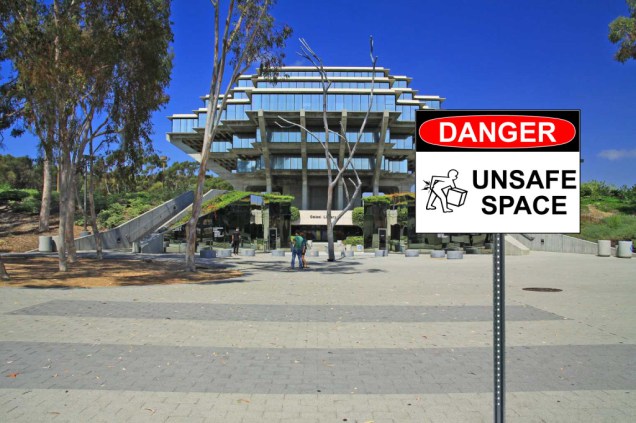
Danger Unsafe Space Sign - The Koala - UCSD

Student identity politics cultists and their craven university administration enablers are now gunning for student journalism and the free press

When University of California – San Diego student publication The Koala published this satirical article, they probably had some idea of the reaction that it would inevitably provoke:

Too long have trigger warnings plagued the airwaves. Too long has the no-blacks rule been removed from our campus. Too long have students not been free to offend their hypersensitive peers. “Spam Musubi only $1” and “Holy shit they opened up Starbucks” have replaced the long-gone chants of “Nigger nigger nigger nigger nigger.” Next week, that will all change.

Administrators at UC San Diego are creating an all new, state-of-the-art Dangerous Space for UCSD students who just don’t feel like their needs have been met on campus. In the past few weeks, the lack of dangerous space at UCSD has become increasingly apparent; students have been lashing out with puppy parades, non-violent protests, and other equally safe gimmicks. Safe spaces at UCSD are commonplace, and threaten individuals who do not like feeling safe. The logical next step has been taken by the university in creating a place to fairly support all UCSD students, continuing the university’s theme of inclusion and equality.

Located in the center of Library Walk, the new Dangerous Space is the ideal place for students to do whatever the hell they want. Senior Frank Yu gave The Koala the following statement: “The needs of dangerous-space students have been overlooked for generations, but UCSD is finally recognizing what means the most to 19-year-old Asian nerds: fucking a dead body with a picture of my waifu taped on the face.”

F. Yu isn’t alone. Not only will this new dangerous space allow people of all ethnicities and sizes – even unnaturally large sizes – it will allow for knifes, guns, opinions that might be different than yours, drug paraphernalia, sharp writing instruments, and explicit pornography.

The new Dangerous Space is guaranteed to get students excited for a good time, and will probably end like all good things do, with body mutilation and feelings of remorse.

Not world class humour, you might think, but certainly something that falls well within the boundaries of constitutionally protected speech in America.

(And from this blog’s perspective, an always-welcome attack by students on the illiberal cancer metastasising through the English-speaking Western academia.)

But on this occasion, the publication was not merely the recipient of angry protests and tearful accusations from “triggered” snowflake students. Instead, the entire weight of the university leadership, egged on by vengeful student protesters, came crashing down on the small student newspaper.

From Inside Higher Ed:

On Nov. 18, the university’s administrators responded to student complaints, condemning the Koala in a statement. “We, the UC San Diego administration, strongly denounce the Koala publication and the offensive and hurtful language it chooses to publish,” several administrators, including the university’s president, stated. The Koala responded to the denouncement by publishing a series of profanity-laden and slur-filled fictional emails meant to be written by administrators.

So far, so unsurprising. Just another craven university administration cowering in fear and issuing Stalin-like denunciations of alleged thoughtcrime at the behest of entitled student protesters.

But it gets worse:

In an attempt to starve out a controversial student publication without violating the First Amendment, the student government at the University of California at San Diego voted last week to cease any funding of student media.

The move — which First Amendment experts said does not pass constitutional muster, despite the student government’s maneuvering to avoid targeting a specific group — came after UCSD administrators condemned the most controversial of the university’s publications amid student protests about racism on campus.

In other words, the officious student council was not satisfied with having bullied the spineless UCSD university administration into denouncing humorous free speech, they wanted to starve The Koala of funding, effectively shutting it down.

In Britain, this would have been a slam-dunk. Game over. But in America, the pesky First Amendment makes such blatant retaliation illegal, and so instead the student government had the bright idea of ceasing funding to all student media organisations – essentially killing off an entire campus industry and ruining everyone’s fun in order to punish one organisation accused of causing “offence”.

The political machinations here are so crude that there is simply no disguising them, try as the student council might:

Student leaders appear to have been worried that if they just ended funding for the Koala, and did so based on its content and language, they would be violating the First Amendment. So later that day, the Associated Students Council voted to defund all student media by removing a section from its constitution about financial support of student media organizations.

The Associated Students provides about $15,000 per year, drawn from student fees, to several student media organizations, including student-run research journals and magazines. The twice-weekly student newspaper, the Guardian, is independent and was not affected.

“When this was brought to council floor, I made it a point to address that this issue was not to be tied to any particular organization,” Dominick Suvonnasupa, the student government’s president, said in an email. “The question was whether to fund media at all, and at the end of the meeting, council decided not to. AS decided to discontinue print media funding as it was determined that there were other areas of campus that could better benefit from the limited resources of the Associated Students. All campus media organizations have received suggestions of alternative funding sources.”

Uh-huh. Sure. And of course the Associated Students Council would have come to exactly the same conclusion, independently, had The Koala not published their heretical article back in November of 2015 (funding was withdrawn from all student publications a week later). Right.

Incidentally, these are exactly the same tawdry tactics which were once used by die-hard segregationists during the last gasp of Jim Crow, where some racist whites chose to privatise their school districts and close their public amenities rather than submit to federally mandated integration. Only now it is moralising student activists and their cowardly enablers within academic leadership who would rather burn all student media to the ground than allow one publication to continue posting material which they find “offensive”. But don’t expect today’s virtue-signalling student activists to note the irony.

Just as many British leftists are desperate for Britain to vote to remain in the European Union in the coming referendum because deep down they don’t think that the people are capable of making the “right choices” if proper democracy was restored with Brexit, so these Social Justice and Identity Politics cultists on both sides of the Atlantic seem to think that fellow students are somehow unable to handle free speech, and that it must therefore be withdrawn or highly circumscribed in order to prevent “harm” from occurring.

Fortunately, the San Diego chapter of the American Civil Liberties Union is now riding to the rescue. From The Daily Caller:

The American Civil Liberties Union (ACLU) filed a lawsuit against the University at California at San Diego (UCSD) for defunding a student publication that offended UCSD students.

[..] The ACLU alledges this action runs afoul of the First Amendment.

“The student government violated the First Amendment in two ways,” a statement from the ACLU read. “First, it targeted the student press by stripping it of revenue that remains available to support other student speech. Second, it retaliated against the editorial viewpoint of The Koala, an action that is not immunized by inflicting collateral damage on all student media.”

Although the organization expressed sympathy with those offended, it asserted The Koala piece was “classic protected speech.”

“Trauma is real,” said David Loy, legal director of the ACLU in San Diego and Imperial Counties, “but censorship is not the cure, because it inevitably blows back on those it purports to protect.”

It is good to see the ACLU come down on the right side of this issue and take up the case of this small student-run publication. One does not have to approve of The Koala, or this article in particular, to decry the way that the UC San Diego student government, drunk on power, sought first to shut down the paper and then effectively silence all campus media as a collective punishment for the heretical editorial viewpoint of one outlet.

The ACLU’s case seems quite watertight, and it is likely that the lawsuit will succeed, but student protesters will not take a defeat lying down. If they cannot accomplish their primary objective (shutting down the offensive publication) or secondary objective (suppressing student journalism altogether) they will come back with a third strategy, and a fourth.

These people are relentless. Caving in to their shrill and authoritarian demands encourages them to come back for more, while rebutting them only encourages the snowflakes to shout louder. All of which might be admirable, if only their cause was a just one. But despite the name, there is nothing “just” about the Cult of Social Justice and Identity Politics.

On the contrary, it is a poisonous, tawdry ideology which preaches personal fragility, collective guilt, voluntary re-segregation and a rampant culture of victimhood. And as such it must be actively opposed on all fronts.

God speed the ACLU lawsuit, and may The Koala survive to publish many more editions filled with edgy, unapologetically provocative student humour.


Safe Space Notice - 2

Top Image: The Koala

Agree with this article? Violently disagree? Scroll down to leave a comment.

Follow Semi-Partisan Politics on TwitterFacebook and Medium.

Jonathan Haidt On The Social Justice Self-Destruction Of Our Universities

Jonathan Haidt discusses the madness which has taken hold of our colleges and universities

Social psychologist and author Jonathan Haidt has an excellent interview on The Rubin Report, talking about the takeover of universities in the English-speaking Western world by the Cult of Social Justice and Identity Politics.

The full 30 minute video is well worth a watch, but these selected observations in particular stand out.

On the cult-like nature of the new PC movement:

We love to identify something as a sacred object, like a rock or a tree. Traditional religions would make a person or a river, something as sacred. And then we circle around it, we worship it, we make sacrifices to it. And that’s the way religions have always worked.

Well, now that formal religions are fading out, we have these new moralistic religions. So – “fighting racism”. You know, very good cause. But when fighting racism becomes the centre of a religious cult, you get all these extreme policies. And this is what universities have been for several decades – they have been basically been cults devoted to fighting racism. Again, a good aim. But it has been warping research.

And as it applies to racism, so it applies to today’s transgender bathrooms furore in North Carolina and across the United States:

Everybody at university is totally in favour of gay rights, gay marriage, that’s been true for decades. And it’s the most amazing thing that American society just in that twenty years we go from like “no way, never!” to “wow, okay, I guess that’s the law of the land” and most people accept it. So twenty years, that’s amazing.

Okay, but now what’s weird is three years ago nobody knew a transgender person, nobody thought about it – it wasn’t on anybody’s radar. So to make it in three years from that to “You must do this!” – this, I think, is a bridge too far. And this, I think, Obama is going to be remembered for this, I think it’s gonna cause a lot of reaction, because the country was not ready for this and it’s not appropriate for the federal government – I can see why the supreme court would way in on marriage rights because marriage has to be coordinated among the states, I get that – bathrooms? The federal government, bathrooms? Did nobody read The Federalist Papers? Has nobody read the Constitution? This is nuts.

And once this battle has been won by the Social Justice Warriors, new demands will be made:

As certain elements of the social justice Left have been victorious on certain fronts, this is the newest battleground. And so this becomes an object of sort of sacredness and extreme devotion. So the way to understand all these moral movements is as a kind of a crusade that binds people together.

[..] A good moral and political movement needs a good clear enemy. So you must, you must believe that the other side is really strong and is adamant against you, and racism is everywhere, sexism is everywhere, transphobia is everywhere, homophobia is everywhere. So you need a good solid enemy. And even though universities are the most anti-racist, anti-sexist places in the country, but it’s an article of faith that they are institutionally racist, institutionally sexist.

So it’s an incoherent movement if you look at it from the outside, but psychologically it’s very standard sort of Manichean, Us versus Them religion.

And on victimhood culture, and the hierarchy of the oppressed:

What’s happening is kind of a moral movement on campus, where the sort of social justice Left – and you find this on every campus, you find a group, they’ll meet, they’ll often take gender studies courses and intersectionality stuff, all that stuff – so you’ll have a group which is very much in an Us versus Them mindset. And everybody on every side thinks they’re the victim, that’s what’s so interesting here.

[..] So there’s seven. So there’s the big three, which is where almost all the controversy, almost all the stuff on campus is about, so it’s African Americans, women and LGBTs. That’s what almost everything is on campus. Then there’s what you might call the little three – not that they’re small, just less prominent – and that is Latino, handicapped of any kind, and Native Americans. Those are the six that have been around for decades. Just in the last year it’s Muslims. So the Left – and this is very alarming to me, I’m Jewish, and suddenly to say, you know, Jews are oppressors, Jews are evil, so there’s a lot of sympathy on the Left.

Also fascinating is the breakdown by subject – the illiberal, regressive Left has utterly captured some sections of the university while others are holding out far better:

The illiberal Left is a small portion, and then the liberal left – because liberals traditionally believed in freedom, freedom of speech, freedom of thought – so the illiberal Left has everybody else scared. It’s the students overwhelmingly. Because the students – everyone is afraid of the students. Students are afraid of the students, professors are afraid of the students. So the illiberal Left make these demands, they march into the president’s office, they demand this and that, they accuse everybody of racism and sexism, and because everybody is on the Left and everybody is afraid of the students, nobody stands up.

So when the Christakis at Yale [see here for more on the Yale Halloween Costume Drama of 2015]  so within three days there was a giant petition, five hundred Yale professors backing the students. Well, I had one of my research assistants find out what departments they’re all in, it was gender studies, film studies, English, it was that stuff. So the humanities, they’re totally onboard with this. The humanities are full of illiberal leftists.

Four weeks later, a small petition, forty names, mostly STEM – mostly scientists. So the natural scientists are still liberals, they believe in openness, they believe in debate. So that’s what you have to keep in mind. The problem comes out of the humanities, the social sciences are in the middle, and the question is where does the illiberal Left have such dominance that the professors are afraid to speak?

And finally, on the nascent fightback:

The methods that the students have demanded – more social justice training, more bias reporting systems, anonymous reporting systems, diversity training – these are going to make things so much worse.

And what I’m really encouraged by is this: outside the university, everyone thinks they’re crazy. And so the first university presidents who just caved in – so Peter Salovey at Yale, Christina Paxson at Brown, the first university presidents who were faced with a mob of angry students just said “woah, you’re right! We’re so racist! Brown is racist, Brown is racist, oh my god! Here’s fifty million dollars!”, Peter Salovey said. A hundred million dollars for diversity! So the first presidents did that.

What happens? The alumni are like, “what are you doing?! What are you doing to our – no. We’re not giving to you any more”. And Missouri, things are way down in Missouri, they’re in big trouble. The first presidents all caved in. But then they started hearing from alumni, they were laughing stocks, everyone was making fun of them, and so now we’re seeing some presidents willing to stand up because they know that if they cave in they are going to be made fun of forever and they care about their legacy.

The same situation has been observed in Britain, with leaders of Oriel College at Oxford University scrambling to backtrack on lavish concessions granted to angry “Rhodes Must Fall” students after being contacted by furious alumni and finding major pledged donations suddenly in calamitous jeopardy.

Haidt’s conclusion:

So I think we have turned a corner. Presidents aren’t just going to lie down and give in any more, that’s one. Alumni are mad as hell, they’re saying “we’re not giving if you do this because we believe in free speech and we don’t want to turn it into a left wing propaganda factory”. And I think we’re gonna see more students rising up, we’re not that yet. I mean, there are conservative groups on each campus but even they are often afraid to speak up. But I think next year we are going to see a lot more students standing up, alumni standing up, so I think the tide is turning.

I hope and pray that this is the case. But as Britain lags a couple of years behind the United States in the progression of the disease, it could well be that remission is similarly further away.

And:

So I think things are going to change when the younger – when the high school kids now, kids who are in high school now, when they join in laughing at these silly campus snowflakes, at students who are afraid to see a photograph or hear a word – so I think mockery and humour is actually the way that honour revolutions happen. So keep up the mockery and humour, I say, good work.

That certainly chimes with the message of this blog – see here and here.

Haidt himself admits to having been pushed from being first left-wing to centrist, and then again to a sometimes libertarian stance by these developments. And one suspects that Haidt is far from alone in this – that many people with absolutely no racist or homophobic tendencies are nonetheless being alienated by a social justice movement which preaches collective guilt and brings shrill charges of heresy against anybody who does not instantly conform 100% to the latest Newspeak.

This relates to the remarkable lack of magnanimity shown by the victors of the culture wars towards those whose only crime was not to be in the vanguard of change, loudly cheering from the front – something picked up on by Andrew Sullivan, among others.

But then Jonathan Haidt and Andrew Sullivan are just middle-aged white males, so what would they know about anything?


Jonathan Haidt - Social Justice

Bottom Image: The American Conservative

Agree with this article? Violently disagree? Scroll down to leave a comment.

Follow Semi-Partisan Politics on TwitterFacebook and Medium.

Segregation Comes To Glastonbury, In The Name Of Social Justice

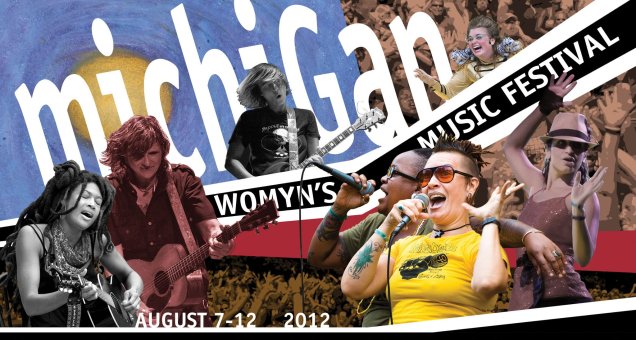
Womyns Music Festival 2

As if going to Glastonbury were not already insufferable enough, now those who do will implicitly be condoning segregation – in the year 2016.

Vice reports:

When you’re a woman, going to a festival brings a new set of problems, whether it’s batting off the advances of some limp chirpser in the healing field, or, worse, feeling unsafe in a space that has a serious and unaddressed problem of sexual assault. While some festivals have been attempting to tackle the issue with safety awareness campaigns, sometimes all you want to do is drink and dance in a space where those problems are less likely to occur.

This year at Glastonbury, for the first time, there will be a venue for women only, which will be tucked away in the Shangri-La zone of the festival. The venue itself is ran by an organisation called The Sisterhood, who describe themselves as an “intersectional, queer, trans and disability-inclusive space open to all people who identify as women”. All staff working in the venue will also be those who identify as women, whether they are the acts who are performing, bar staff or security guards.

“The producers of The Sisterhood believe that women only spaces are necessary in a world that is still run by and designed to benefit mainly men,” the festival organisers explained. “Oppression against women continues in various manifestations around the world today, in different cultural contexts.”

“In the UK, the gender pay gap in the workplace, cuts to domestic violence services and sex worker rights are current talking points that highlight this issue. Sisterhood seeks to provide a secret space for women to connect, network, share their stories, have fun and learn the best way to support each other in our global struggle to end oppression against women and all marginalised people, whilst showcasing the best and boldest female talent in the UK and beyond.”

If you think this defence of sexual segregation at Britain’s most popular music festival sounds more like a spiteful two-fingers up at men in general rather a defensive act in response to a specific threat, you would be quite right – The Sisterhood spent more time ranting about the “oppression” of women around the world than fretting about any specific perils faced by women at Glastonbury.

Digital Music News also questions the rationale:

The group dubbed this ‘the 1st ever women only venue’ on Twitter, though the rationale for the space seems less celebratory and pro-women, and frankly, more anti-male.

Still, ISIS would be thrilled with this segregationist nod to their hardline Islamist ideology. Or they would, if only music festivals weren’t themselves haram.


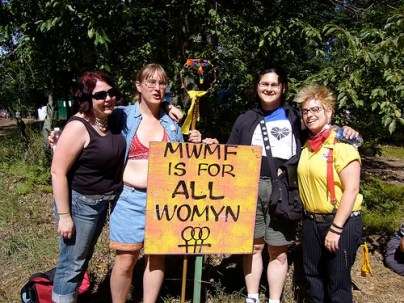
Womyns Music Festival

Safe Space Notice - 2

Agree with this article? Violently disagree? Scroll down to leave a comment.

Follow Semi-Partisan Politics on TwitterFacebook and Medium.