More Christian Brexit Hysteria From The Anglican Church

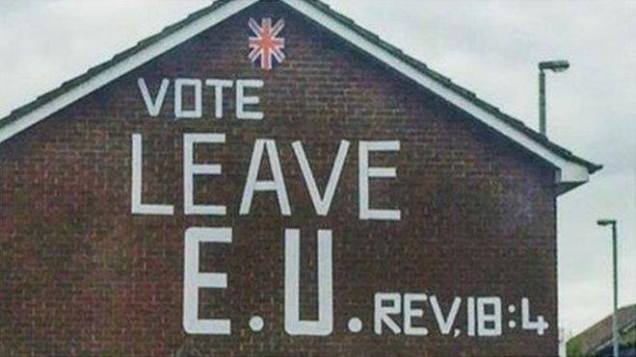
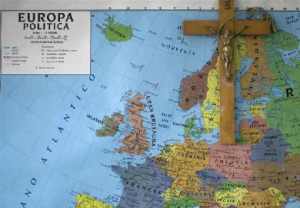
Brexit - Christianity - House mural - Revelation Chapter 18 verse 4 - EU Referendum

To believe that Brexit is the greatest threat to Britain’s Christian heritage and values is profoundly misguided

The people over at Reimagining Europe are at it again.

The Rt. Revd. Dr. Gregory Cameron, Bishop of St Asaph, is concerned that Britain may be about to throw it’s European-given Christian heritage out with the EU bathwater. One might consider it strange that he considers Brexit to be the existential threat to British Christianity rather than, say, increasing secularisation or the aggressive attacks by the Cult of Social Justice and Identity Politics on what were once traditional Christian family values, but such is the way of things these days within the Churches of England and Wales.

Bishop Cameron writes:

In spite of the fact that the Bible has more to say about the distribution of wealth, social justice and the welfare of nations than ever it does about eternal life, Christianity and religion have gently been tidied away by many to the sidelines of political life. To ask therefore about a “Christian Brexit” might provoke the response “Why should there even be talk of such a thing?” While fear of religious extremism may have fuelled the leave vote, Brexit is trumpeted as a clinical economic exercise, perhaps with a little national pride thrown in but free from ideological fancy. So many might wonder why would religion get mixed up in it?

In fact, Christian philosophy is something woven into the very fabric of British society.  It undergirds many of our attitudes and values, even if the rationales have become obscure, and the foundations repudiated by many.  Christianity came to us from the continent, and bound us to the continent, whether it was the mission of Pope Gregory to the Angles on the cusp of the seventh century, or the repudiation of one sort of Europe (the Catholic) in order to embrace another (the Protestant) in the sixteenth.  Even if we’ve chosen to renounce the politics of European integration, this doesn’t imply a rejection of a shared European culture – which is just as well given that most of British culture derives from a classical and Christian European past.  Could there even be a Britain without Christendom, the Angevin Empire, and the struggles for the European soul played out in the Napoleonic and World War conflicts?

It’s great that somebody is now asking these questions. I’m just astonished that the good bishop has identified Brexit as the greatest threat to this cultural heritage, rather than any of the other far more pressing issues. Of course Britain would not exist in anything like it’s current form without Christendom. Why does that mean that Britain should have voted to remain in a supranational political union beset with so many problems and unloved by so many?

And of course renouncing the EU’s explicitly political union and integrationist purpose does not mean that we reject our “shared European culture”. Given that Bishop Cameron understands that these are two different things, one wonders why he is concerned that rejecting one would even endanger the other.

More:

So which Christian values do I wish to see thrive in a Britain set apart?  One of the worst aspects of the Brexit vote, much commented upon, was the permission unintentionally given for xenophobia.  Too many immigrants (even to the third or fourth generation) are now made to feel unwelcome; too many folk have been given licence to be rude or violent.  I want to see a Britain which affirms our human connectness and the fundamental attitudes of respect and hospitality.  We need a people centred Brexit, which respects the individual choices and irrevocable commitments that immigrants and ex pats have made about their futures in the expectation of a border free Europe which is now slipping away from us.

I’ll have to take the bishop’s word for this. I have many friends and acquaintances in parts of the country condescendingly referred to by elites as “Brexitland“, but I myself live in cosmopolitan London, where Brexiteers and not “immigrants” are the scorned and endangered species. And while I do not question the veracity of media reports of xenophobic and racist incidents in the wake of the EU referendum campaign, from my own experience of strongly pro-Brexit places such as Stoke-on-Trent or my hometown of Harlow, neither have I witnessed anything like the wave of supposed anti-immigrant sentiment which the left-wing, pro-EU media insist is taking place.

Furthermore, if third and fourth generation immigrants are being made to feel unwelcome, clearly this is an issue which extends far beyond Brexit and Britain’s place in the European Union. As with the disastrous start to Donald Trump’s presidency in America, there is a tendency to blame every bad thing that happens in Britain on Brexit rather than seek to intelligently separate those factors which existed prior to the referendum and need addressing separately, and those which are legitimately connected with Britain leaving the EU.

The bishop then waxes lyrical about the “irrevocable commitments that immigrants and ex pats have made about their futures”. I’m sorry, but I have to take issue with this. The ultimate expression of making an irrevocable commitment to a new country that you want to call home is to become a citizen of that country. When my wife and I eventually move back to the United States, I eagerly look forward to the day when I receive my US citizenship as it will be an acknowledgement of the commitment I am making to that great country. Why should it be any different for somebody who intends to permanently settle and build their new life in Britain?

While EU citizens have been bribed for several decades with promises of a “borderless world” – while politicians have simultaneously kept silent about the damage done by undermining the nation state through the EU project – there is in fact nothing abnormal about expecting people to take that final oath of loyalty and allegiance before fully accepting them as a fellow countryman. You don’t prove your commitment to small-L liberal, British values simply by turning up, getting a job and starting a life here. An immigrant’s commitment to their new country should be more than the sum of the taxes that they pay and the personal enjoyment that they and their families receive as a result of making the move. To paraphrase John F. Kennedy, citizenship is about asking what you can do for your (new) country, not just what your (new) country can do for you.

More:

I want to see a Britain which reasserts its care for the weakest in its own society and in the citizenry of the world; which is committed to international development and international exchange.  We need a culture which is open to and accepting of heterogeneity.  In such a future, “British” should not stand in contradiction to “European”, but incorporate an international spirit: a continuing commitment to lowering barriers and not raising them.

Now this is just generic leftist pablum. Do we not already have an extensive welfare state? Do we not already lead the world by (wrongly, in my opinion) devoting an extraordinary fixed percentage of our GDP to inefficient, government-administered international aid? “British” does not stand in contradiction to “European”. But rather than becoming interchangeable, as EU integration ultimately demands, in future

Of course we should remain an open and tolerant society, but a culture which is “open to and accepting of heterogeneity” to an unlimited degree is a culture which refuses to assert its own values, fails to properly assimilate new immigrants and which fosters breeding grounds for unimaginable, unforgivable horrors like the sexual abuse epidemic in Rotherham, or the infant mortality rate as a result of consanguineous relationships in the London Borough of Redbridge. One might expect a Church of Wales bishop to be at least as equally concerned with these social problems as with the feelings of immigrants who felt perfectly happy in Britain until the Brexit vote but who now apparently feel besieged and despised, but apparently this is too much to ask.

More:

Brexit may not be a spiritual or religious enterprise, but we do have to defend the best aspects of our national life to build a future of which to be proud.  All the churches, including the Church in Wales, have to engage vigorously in the public debate about Brexit and our society as advocates of a Christian vision of social inclusion and people centred politics.

No. The trouble is that the Church has been lustily involved in the Brexit debate all through the referendum campaign and now it’s aftermath, but in an incredibly one-sided manner. Almost to the last person (with a few honourable exceptions) the bishops and clergy have come down hard on the side of remaining in the EU, often argued by clerics with a tissue paper-thin understanding of the issues at hand but a burning desire to signal their progressive virtue.

Has Bishop Cameron ever stopped to consider how an ordinary, decent, Brexit-supporting person might feel when confronted with the Anglican church’s institutional metro-leftism and scornful opinion of Brexiteers? Has he stopped to think what effect the Archbishops of Canterbury and York might have on the Brexit-supporting faithful when they so transparently agitate in favour of remaining in the European Union, and cast aspersions on the morals of those who dared to take a different position?

The bishop’s article concludes:

In challenging times of change it falls to us to demonstrate what loving our neighbours really means.

Yes, it does. Bishop Cameron might like to reflect on how he lives out those values in his own ministry, with particular regard to how he engages with the sincere beliefs of those within his own Welsh diocese who voted in good conscience for Brexit, are now looking forward in a spirit of optimism to its enactment, and are perhaps hoping for some pastoral encouragement (rather than despairing forgiveness) as they do so.

Because if this article is any guide, he has a long journey ahead of him.


christianity-europe-eu-brexit-3

Support Semi-Partisan Politics with a one-time or recurring donation:

Agree with this article? Violently disagree? Scroll down to leave a comment.

Follow Semi-Partisan Politics on TwitterFacebook and Medium.

The Abnormalization Of President Trump

Abnormalization of Donald Trump

Donald Trump is not the first US president to ride roughshod over the Constitution or flout the checks and balances on executive power – and an honest media with any credibility would acknowledge as much

In highlighting the latest craven example of oversensitive American university students and administrations rescinding invitations to prominent conservative-leaning speakers, the Washington Post reports:

Once reserved for cheesy senior photos at campus landmarks, college commencement exercises have graduated into something different six months after Donald Trump was elected president: a battleground for protesting conservative policies and the people who promote them.

This is incredibly disingenuous. The trend of academic institutions and strident students refusing to tolerate the presence of anybody whose opinions diverge from the current leftist, social justice orthodoxy has been on the ascendance for well over a decade now, has accelerated rapidly in the last five years and has been widely commented on, written about and discussed – not least on this blog.

And yet here the Washington Post seeks to present the “student snowflake” syndrome as a new development which only now is rearing its head “six months after Donald Trump was elected president”. This comes perilously close to excusing the rising tide of illiberalism as merely a symptom or reaction against Trump’s unexpected victory, when in actual fact anybody with a functioning brain knows that Donald Trump’s victory was largely the symptom or reaction against the illiberal, intolerant Control Left.

But we are now witnessing a trend of articles and Op-Eds such as this, all seeking to portray every last one of Donald Trump’s actions as US president as being extreme and unprecedented in recent history. On foreign policy, domestic policy, constitutional matters and social issues, critics of Donald Trump (including the prestige Washington media) often seek to portray Trump as far more extreme than he has thus far shown himself to be, at least as far as policy initiatives and executive actions are concerned.

None of this is to support Donald Trump or excuse the atrocious start he has made to his presidency, which has been characterised by one largely self-inflicted political wound after another. Rather, the point is that by falsely pretending that every time Donald Trump breathes he is gravely wounding the Republic in ways unmatched by any previous president, Trump’s critics and the media inadvertently excuse serious failings in US policy and of past US administrations which deserve to be studied, criticised and rectified rather than merely glossed over.

Nicole Hemmer picked up on some of these areas as part of an article in Politico Magazine:

Many journalists covering the White House have lapsed into a practice of “Trump exceptionalism,” a tendency to assume each move the administration makes is new and nefarious. This assumption comes from a well-meaning place—a worry that they will be complicit in normalizing dangerous behavior in an American leader. But there are real risks, too.

First, it leads to quick-trigger panic over events that are normal. Take the reaction to the administration’s dismissal of 46 U.S. attorneys. Journalists framed it as a purge, and the panic escalated when one of those attorneys, Preet Bharara, refused to resign and was subsequently fired. But the dismissal of U.S. attorneys has been standard practice since the 1990s. The novel behavior here was Bharara’s. There’s a cost to getting this wrong: Cry wolf too many times, and readers are less likely to listen when the real dangers appear.

But perhaps the more important consequence of Trump exceptionalism is that it encourages journalists to overlook continuities. Trump is an abnormal president, unprecedented in many ways. But he is not sui generis. His anti-Muslim policies, hard-line anti-immigration stance, even his economic populism and free-trade skepticism all have long histories—even within mainstream conservatism. His nomination of Neil Gorsuch to the Supreme Court was as straightforwardly Republican as it gets.

One can quibble over the wording and focus of Hemmer’s argument – hysterically and disingenuously talking about Trump being “anti-immigration” when he has expressed no clear reservations whatsoever about legal immigration, for example. But her basic point is correct – inexperienced and superficial DC journalists have been too eager to cram every piece of news into their “Trump is unprecedented” narrative, whether each individual action happens to fit the mould or not.

When it comes to the Trump administration’s recent overtures to more authoritarian regimes (including Saudi Arabia and Turkey’s dictator-in-gestation Recep Tayyip Erdoğan), Glenn Greenwald does a far better job counting the ways that US support for morally questionable allies is far from unprecedented:

Since at least the end of World War II, supporting the world’s worst despots has been a central plank of U.S. foreign policy, arguably its defining attribute. The list of U.S.-supported tyrants is too long to count, but the strategic rationale has been consistent: In a world where anti-American sentiment is prevalent, democracy often produces leaders who impede rather than serve U.S. interests.

Imposing or propping up dictators subservient to the U.S. has long been, and continues to be, the preferred means for U.S. policymakers to ensure that those inconvenient popular beliefs are suppressed. None of this is remotely controversial or even debatable. U.S. support for tyrants has largely been conducted out in the open, and has been expressly defended and affirmed for decades by the most mainstream and influential U.S. policy experts and media outlets.

The foreign policy guru most beloved and respected in Washington, Henry Kissinger, built his career on embracing and propping up the most savage tyrants because of their obeisance to U.S. objectives. Among the statesman’s highlights, as Greg Grandin documented, he “pumped up Pakistan’s ISI, and encouraged it to use political Islam to destabilize Afghanistan”; “began the U.S.’s arms-for-petrodollars dependency with Saudi Arabia and pre-revolutionary Iran”; and “supported coups and death squads throughout Latin America.” Kissinger congratulated Argentina’s military junta for its mass killings and aggressively enabled the genocide carried out by one of the 20th century’s worst monsters, the Indonesian dictator and close U.S. ally Suharto.

Nor is Trump’s foreign policy behaviour a particular departure from more recent US administrations:

U.S. devotion to the world’s worst dictators did not end, or even recede, upon the end of the Cold War. Both the Bush and Obama administrations continually armed, funded, supported, and praised the world’s worst dictators.

In 2009, then-Secretary of State Hillary Clinton actually said of the murderous Egyptian dictator supported by the U.S.: “I really consider President and Mrs. Mubarak to be friends of my family.” When Egypt’s defense minister, Gen. Abdel-Fattah el-Sisi, overthrew that country’s first elected government, Clinton’s successor, John Kerry, hailed him for “restoring democracy,” and as Sisi became more brutal and repressive, the Obama administration lavished him with more weapons and money. The U.S. government did the same for the human-rights abusing dictators in Bahrain.

And of course this is to say nothing of Saudi Arabia.

It is bad enough having a US president who seems to suffer from self-delusions. That the Washington media and commentariat are engaging in fantastical delusions of their own is doubly dangerous for American democracy and policy.

To read the combined output of the American media, one would be forgiven for thinking that the George W. Bush administration never sanctioned the illegal torture of prisoners through dubious legal memos, and that the Obama administration never once decided to blast American citizens off the face of the earth with drone strikes, maintaining a “kill list” of US citizens who could be zapped without any due process.

No, apparently all of these sins are now forgiven – to the extent that the servile, sycophantic Washington media bothered to hold past administrations or senior officials accountable for their actions in the first place, generally preferring to party and intermarry with the political elite rather than be remotely adversarial.

In fact, the harsh truth is this: the only reason that Trump administration officials are being dragged over the coals for their own skirting of the Constitution and departures from US diplomatic and international norms are that Donald Trump has refused to cozy up to the Washington media class in the manner typical to all previous presidents, and so has failed to build up the traditional reserves of goodwill which would otherwise lead to effective immunity from scrutiny or criticism of himself and his administration.

This is a real and pressing problem, because every instance when the mainstream US media freaks out and acts as though Donald Trump is breaking new ground in authoritarianism by simply behaving in the same way as his predecessors only serves to drive a wedge between those media outlets and Trump-sympathising voters who already widely distrust the mainstream media – often with good reason.

Trump supporters need to be legitimately informed of occasions when the US president is acting in an unprecedentedly negative way, and examples of such behaviour – like the firing of FBI director James Comey for an ever-changing kaleidoscope of official reasons – are already rapidly mounting up. But their impact is massively diluted when Trump supporters have legitimate reason to believe that the media, angry at their rude treatment by the White House, is deliberately whipping every story into a major scandal, regardless of individual merit.

And the same goes for the rest of us, too. It does dissenting Republicans, Democrats and independents no favours when their every prejudice about Donald Trump is endlessly reconfirmed by an hysterical media which was only too happy to overlook some of the same faults, vices and mistakes in his predecessors of both parties. This behaviour by the media is not new, but the partisan debasement of political journalism has certainly sunk to new lows since Donald Trump took office.

A strong, almost irrefutable argument can be made that Donald Trump has brought the US presidency to an historical nadir through his personal coarseness, egotism, vengefulness and sheer inability to get to grips with public policy. The degree to which Trump’s political radar – so astute in helping him triumph over the establishment in the Republican primaries and general election – has now deserted him as he seeks to manipulate the levers of power in Washington D.C. is remarkable, if somewhat predictable.

Last week, a journalist was arrested in Washington D.C. for questioning Donald Trump’s Health & Human Services secretary, Tom Price, supposedly too aggressively. The alarming story was widely covered in American media at the time, but it has not driven the news cycle to nearly the same extent as other events which have ultimately proved to be little more than Donald Trump following the precedent set by previous administrations.

Why? Because too many in the media are ready and eager to go to DEFCON 1 every time that Trump opens his mouth, rather than cross-checking to see whether the latest presidential pronouncement or action is genuinely unprecedented or merely a more coarsely-worded rehash of something which would have gone unreported during the Clinton, Bush or Obama years.

Those of us with an active interest in the US media repairing and retaining its credibility in the wake of Donald Trump’s presidency should demand better from journalists, pundits and TV talking heads who currently paint every decision made by the Trump White House as an unprecedented step down the road to dictatorship.

The prestige media pretending to its audience that Donald Trump’s upcoming meetings with authoritarian dictators like Turkey’s Recep Tayyip Erdoğan are somehow unprecedented in American history is every bit as “fake news” as the ludicrous stories on the fringe Right about President Obama operating a paedophile ring out of the White House – only the prestige media’s lies and distortions are ultimately far more damaging, being read and believed by people with real power and influence in American society.

In short, Donald Trump is providing enough fresh new worrying material for us all. There is no need for the media to add to the drama by inventing more.


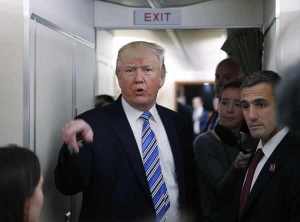
Donald Trump speaks to reporters

Support Semi-Partisan Politics with a one-time or recurring donation:

Agree with this article? Violently disagree? Scroll down to leave a comment.

Follow Semi-Partisan Politics on TwitterFacebook and Medium.

Did The Russians Just Hack Our NHS?

NHS Cyber Attack Crisis - Russian Hacking Foreign Power Question

Our NHS is under attack – and not by the Evil Tories, for once!

Newspaper and television news networks are now reporting a major cyber attack targeting NHS England hospitals – apparently all systems are down and an emergency has been declared to initiate backup/recovery processes.

From the Guardian:

A number of hospitals have been hit by a large scale cyber attack, NHS England has confirmed.

Hospitals across the country appear to have been simultaneously hit by a bug in their IT systems, leading to many diverting emergency patients. NHS England said it was aware of the problem and would release more details soon.

Meanwhile doctors have been posting on Twitter about what has been happening to their systems.

A screen grab of a instant message conversation circulated by one doctor says: “So our hospital is down … We got a message saying your computers are now under their control and pay a certain amount of money. And now everything is gone.”

This is obviously potentially very serious, with possible impacts on patient care – apparently local NHS hospitals are reverting to pen and paper, while tweeting that patients should avoid going to A&E.

Was this a coordinated attack by a foreign power, or is it simply the case of a dozy NHS office admin clicking a dodgy link in an email and falling prey to a traditional money-grubbing scam?

(The answer is almost certainly the latter – this time. NHS Digital itself has confirmed that the generic ransomware attack was not specifically targeted at the health service, as a number of other organisations in multiple regions and sectors are affected; so the outraged NHS priests and priestesses on Twitter calling for the execution or maiming of these hackers can probably stand down now).

But since politicians and armchair pundits have been quick to blame Russia for everything else that hasn’t gone their way lately, I’m sure that Vladimir Putin’s name will be put forward as the man behind this craven attack on Our Blessed NHS.

But Putin should be careful – while Britain and the international community will apparently sit on our hands and dither while he invades Ukraine and drags his country ever further backward toward nationalist authoritarianism, provoking a fight with the NHS might be a step too far.

Even Jeremy Corbyn’s Labour Party election manifesto reserves the right to use nuclear weapons, with great cautionin extremis. Well, since the National Health Service is the closest thing we now have to a religion in secular Britain, attacking Our Blessed NHS may be the one hostile act by a foreign power that could still rouse half the country to press the red “launch” button and fire off some Trident missiles.

But when the dust settles, it may be worth considering that yet another drawback of having a monolithic national healthcare system serving all 65 million people in Britain is that it represents a singular target for mischief-makers and hostile foreign powers alike.

Presumably GCHQ and other agencies are constantly on the case protecting Britain’s national energy grid and other core infrastructure. But as a country have we been so busy singing endless hymns of praise to “Our NHS” that we neglected to realise that it has also potentially become our national security Achilles heel?

At this grave time, let us all repeat the Pledge of Allegiance to Aneurin Bevan’s glorious creation, our country’s pride and joy:

I pledge allegiance to the logo of Our #NHS
The envy of the world
One health system, indivisible
With increasingly poor healthcare outcomes for all

And when NHS England has fixed the problem and we have all made ourselves feel good by cheering on the saintly people who work in the world’s fifth largest bureaucracy, maybe we can have a sensible conversation about breaking up the NHS monopoly – for the good of all patients and, apparently, our national security too.


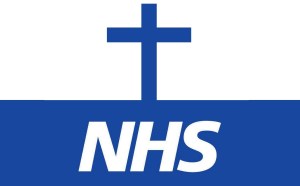
NHS Logo - Cross - National Religion - Worship - Idolatry

Support Semi-Partisan Politics with a one-time or recurring donation:

Agree with this article? Violently disagree? Scroll down to leave a comment.

Follow Semi-Partisan Politics on TwitterFacebook and Medium.

No, Brexit Is Not The Fault Of The Evil British Tabloids

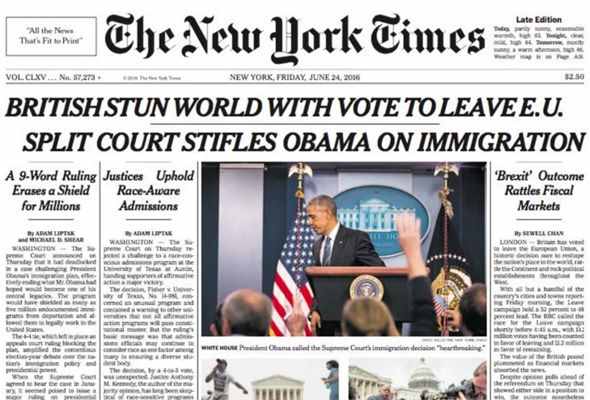
New York Times - Brexit Headline - EU Referendum - British stun world with vote to leave EU

The fearless and forensic New York Times continue their penetrating post-mortem investigation into the causes of Brexit. This week’s scapegoat – the Evil British Tabloid Press

Fresh from speculating about how the impact of Brexit on London will equal the fall of Babylon in terms of destruction and woe, the New York Times is back with another self-exonerating tonic for the global metro-left, reassuring them that Britain’s imminent departure from the European Union in no way reflects a serious failing on their part, but instead is entirely the result of sinister machinations by evil outside forces.

In the crosshairs this week: Britain’s tabloid press, led by The Sun newspaper, everybody’s favourite bogeyman. The strong implication of the New York Times article is that Britain’s tabloids are powerful and nefarious, exerting great sway over the political leanings of their simple-minded, provincial readers. The natural inference is that it is a worrying phenomenon when Evil Tabloids “influence” their gullible readers in a populist direction, but entirely laudable and unremarkable when the prestige media – outlets like the New York Times and the Guardian – serve their wise readers up with a consistent globalist, elitist worldview.

One can imagine the tone and content of the piece – sanctimonious, condescending and displaying a stunning lack of self-awareness – without even reading a word, but below are a few choice quotes:

In Britain after the so-called Brexit vote, the power of the tabloids is evident. Their circulations may be falling and their reputations tarnished by a series of phone-hacking scandals. But as the country prepares to cut ties with the European Union after a noisy and sometimes nasty campaign, top politicians court the tabloids and fear their wrath. Broadcasters follow where they lead, if not in tone then in topic.

Of course, when the Times talks about a “sometimes nasty campaign”, they are alluding exclusively to supposedly nativist and anti-immigration rhetoric, and not the hatred and contempt frequently pored on people who campaigned and voted in good conscience for Brexit. This becomes clear through all of the campaign incidents cited in the article, culminating in an attempt to link the murder of Jo Cox MP directly to pro-Brexit rhetoric.

More:

Their readers, many of them over 50, working class and outside London, look strikingly like the voters who were crucial to the outcome of last year’s referendum on membership in the European Union. It is these citizens of Brexitland the tabloids purport to represent from the heart of enemy territory: Housed in palatial dwellings in some of London’s most expensive neighborhoods, they see themselves as Middle England’s embassies in London.

In the campaign leading up to a snap election on June 8, most tabloids can be counted on to act as the zealous guardians of Brexit and as a cheering section for the Conservative government of Prime Minister Theresa May — even though the city that houses them voted the other way.

This is actually true. And the reason that many of the tabloids are bastions of working class populism surrounded by a sea of metro-leftism is that these are national newspapers, not city-specific or regional publications.

One has to take issue with the Times’ reference to “Brexitland” though, as if despite representing a majority of voters, Brexit supporters are somehow strange and exotic creatures whose behaviour requires analysis and interpretation by the prestige media – which, of course, is exactly how the New York Times sees them.

A more worthy article would turn the gaze back toward “Remainland” or “Europeland” and seek to understand how 48 percent of the country managed to drift away and treat the concerns, fears and aspirations of the 52 percent with such complete indifference. But this is the New York Times, and they have no interest in turning a forensic gaze on people like their own reporters, editors and readers – the “good people” whose behaviour needs no explanation or introspective analysis.

The article then takes a divergence to discuss Boris Johnson, even though the Foreign Secretary’s execrable journalistic career was spent at supposedly prestige broadsheets, not tabloids:

In the marble-and-glass lobby of the 17-story News Building, home to Mr. Murdoch’s British media empire, there is a small plaque that commemorates the building’s 2014 opening by Boris Johnson, then the mayor of London and now the British foreign secretary.

Mr. Johnson, wild-haired and witty, became a chief architect of Brexit when, four months before the referendum, he threw his weight behind a cause until then most closely associated with the populist U.K. Independence Party. But his main contribution to Brexit may go back more than two decades.

A correspondent in Brussels for The Daily Telegraph in the early 1990s, Mr. Johnson was credited by fellow reporters with pioneering the euroskeptic coverage of the European Union that has since become the default setting for much of the British press. With little regard for the truth — he was previously fired by The Times of London for making up a quote — Mr. Johnson wrote about a Europe scheming to impose standard condom sizes and ban his country’s beloved prawn-cocktail-flavored chips (both untrue).

“Boris invented fake news,” said Martin Fletcher, a former foreign editor of The Times, who was in Brussels shortly after Mr. Johnson. “He turned euroskepticism into an art form that every news editor in London came to expect.”

Ah, so the reason for bringing up Boris Johnson in an article supposedly about tabloid journalism was in order to shoehorn “fake news” into the discussion. Well, while nobody would seriously defend the quality of Johnson’s Europe reporting for either the Times of London or the Telegraph, these stories were primarily consumed by broadsheet-reading elites, not the oafish, Sun-reading working classes held in such contempt by the New York Times. And it should be noted that whatever the failings of the British newspaper media with regard to Brexit – and they are many – serious journalists like the Telegraph’s Christopher Booker have contributed consistently powerful analysis and criticism of the EU, shedding far more light than heat (unlike Johnson).

Besides, as this blog has previously discussed, focusing exclusively on “fake news”, much of which is so obviously hysterical and false as to be unbelievable to all but the most swivel-eyed of social media sharers, ignores the far more pernicious impact of ideologically skewed mainstream news, which is read by elites and decision-makers, often actually driving the political debate.

The example I always return to is the fact that nearly all prestige American news outlets have stopped referring to illegal immigrants as such, referring to them euphemistically as “undocumented” or “unauthorised” immigrants instead. Similarly, when an American politician seeks to crack down on illegal immigration they are nearly always described as being antagonistic toward the “immigrant community”, suggesting a deep-seated conservative antipathy toward all immigrants, making them seem far more extreme than they really are.

This linguistic trickery, common throughout the American mainstream media, seriously impacts the way that people view the subject of immigration. Read about Donald Trump’s hostility to “immigrants” often enough and you could be forgiven for thinking that the American president is actively plotting the deportation of law-abiding, visa or green card-holding immigrants, when this is simply not the case. American news outlets know that they are misleading their readers and viewers by stoking these alarming fears but do so anyway, purely in order to push a certain political outcome (acceptance and normalisation of illegal immigration).

All of this should be borne in mind when the New York Times article goes on to discuss tabloid treatment of immigration in the Brexit debate:

Britain makes many of its own laws, of course. But it is an interesting choice of example. A more obvious one might have been immigration.

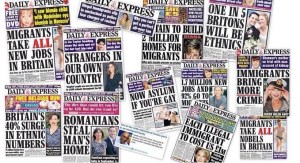
Research by a former Times journalist, Liz Gerard, showed that tabloids pounded the immigration issue, with at least 30 hostile front-page splashes in The Daily Mail in the six months leading up to the referendum, and 15 in The Sun. The headlines — “Britain’s Wide Open Borders” The Daily Mail shouted — often tended toward histrionic. The Sun insinuated that child refugees arriving in Britain were lying about their ages and should have dental X-rays.

“Tell Us the Tooth,” the headline read.

A week earlier, I had met Kelvin MacKenzie, a former Sun editor and a columnist who was subsequently suspended for referring to a mixed-race soccer star as a “gorilla.” He said that the paper still reflected the “beating heart of Britain,” and that Brexit was won on immigration “by a thousand miles.”

Has the British tabloid media focused heavily on immigration, and often covered the subject in a crass and obnoxious way? Yes, of course – both news reporting, editorial lines and political commentary in the tabloids have been troubling at times. But one must remember that left to their own devices, the prestige media would hardly cover the issue at all. Newspapers like the high-minded Guardian have zero sympathy for those who object to uncontrolled mass immigration, and even more supposedly conservative outlets like the Times or Financial Times would happily ignore the subject altogether were it not for the tabloids keeping the issue on the national agenda. One cannot examine the sins of the tabloid press while pretending that the prestige press is somehow faultless.

Or can we?

Well, the New York Times certainly seems capable of obsessing about the mote in their British cousin’s eye while ignoring the beam in their own. As far as the New York Times is concerned, Brexit is purely the result of rabble-rousing tabloids (with an assist from glib superficial coverage in the prestige conservative press) whipping up xenophobic feelings among their working class readership. According to this self-exonerating narrative, Brexit has absolutely nothing to do with the prestige media failing to hold politicians to account for progressively signing away sovereignty and governing competencies to a barely accountable supranational government, or helping to make a nuanced conversation about immigration impossible.

No, instead we are expected to believe that the earnest saints of the prestige media and their establishment readers and cheerleaders are totally blameless. We are expected to close our minds to the possibility that more people might have heeded some of (say) the Guardian or the New Statesman’s more accurate concerns and reporting during the EU referendum if those publications had not conducted themselves for years in such a screechingly, stridently blinkered pro-EU manner.

And even now, after the New York Times managed to cocoon its own readership in such a self-reinforcing ideological bubble that almost none of them saw Donald Trump as a potential threat to their world order, in examining Brexit America’s newspaper of record is unable to question whether producing news and commentary almost entirely of the elites, by the elites and for the elites might not be the smartest way to approach journalism.

For God’s sake, New York Times, wake up. Turn your concerned gaze around 180 degrees and question the assumptions, biases and blind spots in your own reporting. Stop worrying about the evil tabloid press and its hold over the impressionable British working class mind for two seconds, and spend at least a moment considering how your own prestige journalism has unhelpfully perpetuated and reinforced failing globalist shibboleths for years, leading to these harsh instances of political correction in domestic and world affairs.

Because if the unexpected election of Donald Trump and the vote for Brexit (different though the two phenomena are) have taught us anything, it’s that blue-collar, working-class folks are far from being the only people who can be plausibly accused of being brainwashed by the news media that they consume.


Brexit - Daily Express Headlines - immigration

Support Semi-Partisan Politics with a one-time or recurring donation:

Agree with this article? Violently disagree? Scroll down to leave a comment.

Follow Semi-Partisan Politics on TwitterFacebook and Medium.

At The White House Correspondents’ Dinner, The Political Media Circle-Jerk Proceeded Minus Donald Trump

White House Correspondents Dinner - First Amendment - Washington Political Media

At the annual Washington D.C. bash, the political media class were more concerned by the lack of Hollywood celebrities to ogle than the fact that half the country holds them in contempt, feels deliberately misunderstood and distrusts nearly everything that they have to say

The Washington Post reported today on the fact that brave members of the Washington D.C. political media class somehow managed to soldier on and enjoy themselves at the annual White House Correspondents’ Dinner and associated glitzy after-parties despite President Trump’s cruel boycott of the event (Trump decided to hold another one of his dubious rally-style events in Pennsylvania).

Without a single hint of self-awareness, the Post reports:

His voters sent him to Washington to break stuff, and this weekend Donald Trump tried to break the annual dinner of the White House Correspondents’ Association. As with some of his business ventures, he was not wholly successful.

“They’re trapped at the dinner,” the president boomed at a rally in Harrisburg, Pa., celebrating his first 100 days in office. “Which will be very, very boring.”

Instead, it was just fine. It happened. There’s an inertia to these Washington traditions, and a determination to soldier on in the face of — whatever it is we’re facing. Everyone survived this weekend without the president, or without the crush of Hollywood celebrities who for years had been decorating the dinner in ever-increasing density, until now.

It was a bit like an off-year high school reunion: diminished numbers and fewer crazy stories but still no shortage of hors d’oeuvres and dancing and gossip. Everyone settled for sightings of Michael Steele and Debbie Dingell instead of Jon Hamm or a Kardashian. In past years, virtually the entire cast of “Modern Family” would come to the dinner; this year, United Talent Agency only secured the kid who plays Luke.

Well, now we can all sleep easy in our beds. Despite the president of the United States refusing to perform the traditional routine of being self-deprecating and massaging the egos of the people supposed to hold him to account, the Washington press corps somehow managed to rescue the evening and enjoy themselves. Despite being deprived of the opportunity to rub shoulders with Hollywood royalty, the assembled journalists and media executives still managed to mingle, network and slap each other on the backs for a job well done serving the interests of American democracy.

Aren’t you relieved? I know that I am.

More:

Was it only a year ago that Barack Obama dropped the mic, literally, at his final correspondents’ dinner, as if to put an exclamation point on eight years of media savvy and pop-culture propaganda? He knew his role in this circus. It was Obama’s yearly chance to inspire a meme, rib a rival, come off as folksy royalty, remind the public that the media was not the enemy. His cool factor iced out the haters, smudged away red lines, papered over unkept promises. Afterward, the French ambassador’s mansion would swell with swells — both conservatives and liberals, all buddy-buddy in private, united by the daytime charade they pulled off together on TV.

As yes, good old Obama knew his place, knew his role in the “circus” – to dance like a performing seal in an attempt to make the self-satisfied hacks chuckle. Sure, Obama was more successful than most – thanks to a largely uninquisitive media he managed to maintain the “cool factor” right to the end of his presidency – but he stayed firmly within the tramlines of what was expected of him.

And what was that role? What has it traditionally been for administration after administration? Nothing more than making the media class look noble for one evening a year when they spend the other 364 making themselves look tawdry and partisan. Fudging important ideological questions and reducing them to laughing points. Papering over “unkept promises” as the trivialities that they are to the Washington political class – little frauds perpetrated on the American voters, some of whom are naive enough to expect political promises to be kept.

But the Washington Post is certainly in no mood to dwell on the accumulated failure of prestige American news outlets to hold leaders to account or properly represent the range of interests and opinion in the country. After all, the Post are enjoying a bumper season of increased subscriptions and web traffic thanks to the Trump presidency, drunk not on $25 cocktails but on their own sense of nobility (as evidenced by their hilariously overwrought “Democracy Dies In Darkness” motto).

Indeed, the Washington Post seems most anxious for us to know that this year’s event was a dud because Trump might have attended, not because he ultimately chose not to do so:

The guest list suffered not because Trump sent his regrets but, more likely, because of the chance he might attend; he remains dauntingly unpopular with the New York and Hollywood A-list that he had long aspired to join. The pre-dinner receptions, hosted by outlets such as the Wall Street Journal and The Washington Post, were staid and perfunctory, absent the usual angling for a sighting of a “Game of Thrones” star.

Apparently at no point has it occurred to the Post or other such outlets whether the presence of Hollywood celebrities at a political media event might actually be a bad thing rather than something to be celebrated and missed in its absence. It is merely taken for granted that the presence of numerous multimillionaires from the entertainment industry is some kind of sign that the health of American political journalism and culture is in fine fettle.

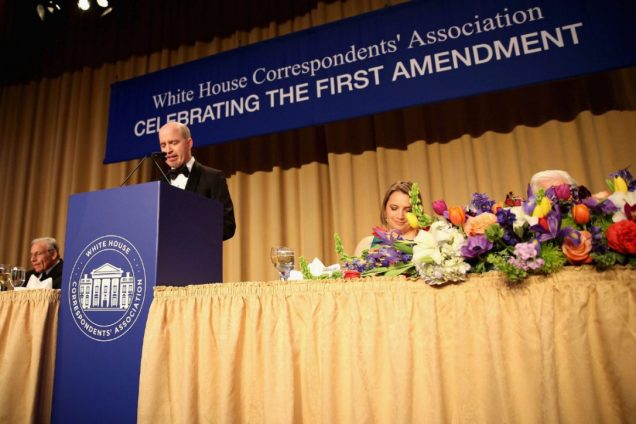
The focus of the stripped-down event was on defending free speech and celebrating the importance of a free press guaranteed under the First Amendment, something which we can certainly all applaud but which rarely merited such prime-time coverage when the Obama industry was, say, prosecuting whistleblowers with uncommon zeal. Has Trump made numerous troubling statements with regard to freedom of the press, libel laws and freedom of speech and association in general? Absolutely.  But it is telling that much of the media is happy to trumpet the issue now, when it costs them little reputationally or financially, but maintained a pained silence under a more popular “liberal” president.

More:

The dinner itself featured a dutiful pep talk by Watergate legends Bob Woodward and Carl Bernstein.

“Mr. President, the media is not fake news,” Woodward said from the dais, and the media elite applauded.

“CNN and MSNBC are fake news,” Trump said in Pennsylvania, and some of the 97 percent who say they’d still vote for him applauded.

Two worlds, talking past each other, from 100 miles apart. The latest prime-time iteration of POTUS vs. Beltway.

Only it isn’t just POTUS vs Beltway. It is half of America versus the Beltway news outlets and punditocracy. The cosseted Washington media class is so busy being angry at Donald Trump for his bombastic insults and threats that they remain largely unable to look beyond the president to see the many Americans who may not agree with Trump but who share his hatred of the people who filter and report the news.

As this blog has previously discussed, the mainstream American news media is indeed not “fake news” inasmuch as the likes of CNN or the New York Times do not routinely print sensationalist and patently false accounts of fabricated events designed to excite partisan zealots. But they have other far more insidious and effective methods of shaping the narrative through their editorial stances and very deliberate use of language.

As I wrote last year:

Fake news can incorporate false facts, but also correct facts which have been deliberately misinterpreted or spun. And far more insidious than any one fake news story, no matter how egregious, is the way in which language is often used to subtly change public perceptions over time – note how we now speak about “undocumented” rather than “illegal ” immigrants, a change adopted by nearly all of the mainstream media in America, and now in Britain too.

When the media is secretly complicit in ideologically-driven agendas, trust in the more reputable media is rightly weakened. But this leaves people more vulnerable to peddlers of deliberately fake news, as they search for alternatives. The obvious answer is for mainstream prestige outlets to rediscover their integrity and stop forcing readers away with ideologically skewed coverage, but they will not desist, and so they fuel the exodus of readers away to the fringes of the internet, a place where the more outrageous a story sounds, the more people will read it.

But there they all sat, facing a stage emblazoned with the words “Celebrating the First Amendment” and no doubt feeling inordinately pleased with themselves for the stellar work they believe they are doing in standing up to the Trumpian dystopia, unaware or more likely just unconcerned by just how hated and distrusted they are throughout vast swathes of their own country.

The New York Times had an interesting feature article today looking at the upcoming final round of the French presidential election between centrist empty-suit Emmanuel “status quo” Macron and depressing protectionism advocate Marine Le Pen. The piece focuses on the struggling northern town of Calais, a place I know quite well through many visits during my adolescence, and is actually quite fair in its examination of the erosion of the town’s biggest industry in the face of global competition and the lack of political answers

For a piece of New York Times journalism, it is pretty good – especially compared to their godawful “Will London Fall?” hitpiece on Britain and their generally hysterical and uncomprehending coverage of Brexit.

The only problem? The New York Times has to send reporters on expeditions into towns like Calais in order to talk to the locals and get to know their concerns, just as American reporters descended with newfound intensity on Trumpland after the US presidential election trying to figure out what went wrong, and just as shellshocked London political journalists stumbled shellshocked beyond the great metropolis in a bid to understand what Middle England was thinking.

The New York Times article’s author, Liz Alderman, is naturally based at the newspaper’s Paris bureau. Unless she makes a conscious effort, nearly every human interaction she makes will be likely with somebody who intends to vote for Macron in the second round. This is not to impugn Alderman’s work or journalistic ethics – the Calais piece proves that she does seek out contrary opinions in the unloved regions of France when required. But when the majority of your professional and social life is spent among people who hold one set of values, the occasional field trip to the other side of the tracks cannot make up for deep-rooted understanding of – and empathy with – the more pro-globalism, pro-EU, pro-market side.

And so it is in Washington D.C. The people who gather each year for the White House Correspondents’ Dinner (and then grumble about how they no longer get to rub shoulders with Hollywood stars thanks to the big bully in the White House) may make the occasional foray into Trumpland if the needs of a story require it. But the vast, vast majority do not live the lives of Trump supporters, nor live among them, nor count such people among their friends or family. And you simply cannot report fairly, accurately or honestly about people whom you have to interview to get any kind of sense of who they are or what their hopes, dreams and fears may be.

The White House Correspondents’ Association clearly does not care. They have calculated that they can prosper just fine by continuing to swagger around like noble seekers of truth, bellowing about free speech and holding President Trump to “account” (while furiously ignoring just how much their lust for TV ratings and pageviews fuelled his rise in the first place). But should one of the tuxedoed dinner attendees ever stop to wonder how Donald Trump is able to effortlessly turn a crowd of people against the media at a campaign rally, this is the reason.

Trump’s non-attendance was the perfect excuse to cancel a sleazy and tawdry annual event which should have been axed many years ago, if only the bipartisan ruling class had any self-awareness or a care for how they appeared to the rest of the country.

But even now they party on, while America burns.


Chris Matthews - Al Sharpton - MSNBC

Support Semi-Partisan Politics with a one-time or recurring donation:

Agree with this article? Violently disagree? Scroll down to leave a comment.

Follow Semi-Partisan Politics on TwitterFacebook and Medium.