“Fantasy in C” by Orlando Gibbons, performed here on the piano by Glenn Gould:
This piece always reminds me of New York. I first heard it while listening to Glenn Gould’s “Great Pianists of the 20th Century” album on the sample headphones at a Barnes & Noble store somewhere near Chinatown, a decade ago, after having walked all the way downtown from my cheap, two-star hotel.
The liner notes to this CD, if I recall correctly (and I’m paraphrasing here), pay homage to Gould’s plausible, natural “English accent” when playing the pieces from this release. Listening again now, it’s hard to disagree.
Take one part Republican politician, add two parts Real Housewives of Wherever, sprinkle some MySpace circa 2003 and then add a whole lot of stupid, and if you are still smiling and nodding, vote Mindy Meyer for New York State Senate.
She’s great, because she is against corruption: “I have no experience in corruption … This is how politics has to change. There is always corruption, but I have the intention to follow my values and ensure that none of what happens in my district is corrupt”. See? You can’t lose by betting on this horse.
I defy anyone to read Meyer’s policy positions on Stop & Frisk, school choice or abortion and understand whether she is for or against any of them. But hey, after 3 minutes of serious head-scratching thought, “Mindy believes in capital punishment for cop killers”. So there.
She needs to go away and go back to work on her fake tan, and leave politics to people who a) understand, b) legitimately care and c) don’t mock people who do A and B.
P.S. If this is just an elaborate prank planned by some organisation or another, then well done, you got me good.
It finally happened. For the first time in over three thousand years, a British man actually won the Tour de France. This is exciting stuff, a sure sign of a British road cycling resurgence, perfectly timed in the run-up to the Olympic Games.
So who would be best to represent Britain by singing our National Anthem at the prize-giving ceremony? Go on, have a guess.
Whoever you just thought of, the answer is “no”. The correct answer (apparently) was Lesley Garrett. That’s L-e-s-l-e-y G-a-r-r-e-t-t.
I can’t seem to embed Telegraph videos in this blog (thanks, WordPress), but you can watch the performance for yourself here.
…
When Garrett abruptley switches key mid-warble, poor Bradley Wiggins looks like he wants to leap to his death from the winners podium, if only it were a little higher off the ground.
This was another opportunity to showcase the best of Britain. If (and I’ll never understand why you would do this, given the material the performer has to work with) you decide to go with an a capella, soprano rendering of “God Save The Queen”, at least pick from one of the many talented British sopranos that are out there. Instead, I find myself listening to someone who looks and sounds like an aging drag queen on a budget Mediterranean cruise ship. And then, a la Katherine Jenkins, they incorrectly labelled her an “opera singer”. Who made this casting decision, and how was it allowed to proceed unchallenged?
Rupert Christiansen, writing in The Telegraph, agrees with me:
What I would really like to know is who was responsible for selecting Miss Garrett for this delicate task. She is emphatically NOT an opera singer – apart from one operetta, she hasn’t sung a single role in an opera house since the turn of the millennium – but to the powers-that-be she depressingly appears to remain the publicly recognised face of British classical music (there’s Katherine Jenkins too now, of course, but in every artistic respect she’s even worse).
It enrages me that there are so many fabulously good and attractive young British sopranos out there – Elizabeth Llewellyn, Sophie Bevan and Lucy Crowe to name but three – who could have turned this cringe-making moment into a tear-jerking one.
Precisely.
And does this make me a classical music snob? No, I would have had to have been listening to a classical musician to be considered for that charge.
But at least she remembered the words, unlike a certain Christina Aguilera:
I hope she gave back her fee. Actually, I hope both of them refunded their artists fees. Double Fail.
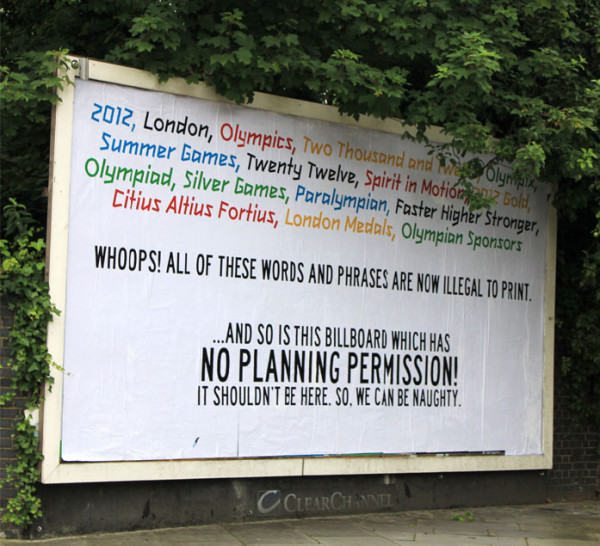
Marbury finds a wonderful example of people not being cowed or bullied by the over-reaching, un-democratic London Olympic Games and Paralympic Games Act 2006:
Image from marbury.typepad.com
2012, London, Olympics, Two Thousand and Twelve, Olympix, Summer Games, Twenty Twelve, Spirit In Motion, 2012 Gold, Olympiad, Silver Games, Paralympian, Faster Higher Stronger, Citius Altius Fortius, London Medals, Olympian Sponsors.
Our government, in their infinite wisdom, have decided that any business using two or more of the words or phrases from this list in their advertising, products or promotional materials without having signed a sponsorship agreement with the London Olympics authorities, is committing a criminal offence. Long live free speech…
“Quiet City”, by Aaron Copland, 1941. A beautiful, haunting piece for english horn, trumpet and strings, but most remarkable for the beautiful, yearning, pure, melismatic trumpet solo which soars over the still, muted orchestral accompaniment.
My favourite recording of this piece is by the London Symphony Orchestra and their principal trumpet of the time, Howard Snell, conducted by the composer himself; but in this case the images of still, quiet cities in the accompanying YouTube video make this the version to share.
The original version, scored for trumpet, saxophone, clarinets and piano (written as music for a play but never used) can be found here.
Wishing everyone a peaceful and productive start to the new week.


 Semi-Partisan Politics