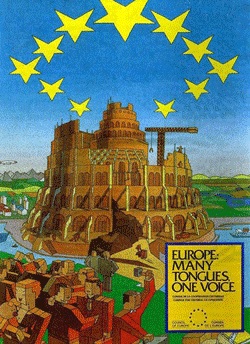
St George’s Day brings yet another wildly misguided and inappropriate intervention from a Church of England bishop, this time the Rt Rev Michael Langrish, Bishop of Exeter.
While back-handedly praising Prime Minister David Cameron for the zeal of some of his reforming efforts, he goes on to expound at length on the question of whether Cameron might be – wittingly or unwittingly – undermining the “deep spiritual roots” of the European Union.
From The Telegraph:
The Rt Rev Michael Langrish, who sits in the House of Lords, told Peers that he was concerned that Mr Cameron’s policies could contribute to the “loss of the European soul”.
He told how the European project has “deep spiritual roots” and said the Church of England “engages with the EU itself through its own representation and structures”.
The Bishop of Exeter is, of course, a Lord Spiritual, one of those Church of England bishops given the right and authority – unique among leaders of all other religions and denominations in this country – to sit in the upper house of the British parliament and meddle in our lawmaking. The Telegraph continues:
Speaking in the House of Lords this week the Rt Rev Langrish insisted that the Church of England has a “European perspective”.
“It may be thought that the Church of England does not have a particularly European perspective, but that is far from being the case,” he said. “Through its diocese in Europe it is present in all the member states of the EU. It has effective links with other churches throughout Europe and is active in the Conference of European Churches. Together with our partner churches, we are also deeply aware of some of the roots of the EU and the vision of its founders in Catholic social teaching.”
First of all – deep spiritual roots? Really? I am not wholly ignorant of Catholic social teaching, and I am probably better informed than most about the history and development of the European project from its humble beginnings as the European Coal & Steel Community. In my misguided undergraduate days I curated a half-hearted, rightly neglected website called the Pro-European Alliance which aimed to explain some of this history and spin it in a way that case favourable light on the modern-day European Union.
Bishop Langrish’s attempt to describe the institutions, mechanisms and workings of the EU as having any spiritual dimension to them whatsoever seem to be a rhetorical step too far. That is not to say that there was or is nothing noble in the idea and reality of the EU. Binding the fractious nations of Europe together through increased trade, some common institutions and a mechanism to resolve local disputes was undoubtedly a good thing. So potentially a tenuous argument could be made that the existence of an organisation such as the EU served or serves some spiritual goal.
But the European Parliament? The Council of Ministers? The Commission, which hasn’t produced an audit-worthy budget and financial statements for years beyond counting? The European Courts? How do any of these inefficient, undemocratic, self-serving institutions, created by bureaucrats to serve the interests of bureaucrats, nourish the roots of spirituality? In any way?
The only way that one can see any spiritual element to any of this is if one subscribes to the view that the nation state and international institutions are the most suitable – or only acceptable – forums for key aspects of the modern welfare state such as regulation, income redistribution and the like to be administered. That people are inherently selfish, thoroughly unaltruistic, and that only through government coercion (either at a national or European level) can we make ourselves administer fair justice and look after the weak and vulnerable in our societies.
And of course this is exactly what large swathes (though not all) of the Church of England does believe today – see “Christ would not privatise our NHS” as just another recent, damning example. Build and maintain a big state sector to do all of the things that humans are too selfish or wicked to do of their own volition for the good of their fellow men, and criticise anyone who holds opposing views from the pulpit every Sunday.
The Bishop concludes:
“I hope that the failure of successive British Governments to articulate a coherent and constructive policy towards our European partners and to manage to take public opinion along with this will not contribute to that loss of the European soul.”
When the Bishop of Exeter defends the spiritual roots of the European Union and attacks David Cameron for seeking to repatriate powers from the EU and return them to the nation state or to the individual, not only is he wrong, but in so doing he is no less than abdicating his own Church’s spiritual roots and its responsibility to empower and enlighten the individual.


 Semi-Partisan Politics