An excellent comedy video from NonStampCollector, successfully (and rather wittily) debunking “young Earth” theories and denial of evolution.
I believe that the creator of this series of videos (which I highly recommend – very amusing) is an atheist. I, of course, am Roman Catholic. That doesn’t make his critiques of biblical literalism and fundamentalism any less funny or pertinent.
And the “tornado through a junkyard” analogy is priceless.
If you want to understand just how vastly different this Pope is from his predecessor, read the full and best translation of his recent impromptu remarks to the Latin American and Caribbean Confederation of Religious Men and Women. They blew me away. Can you ever imagine the anal-retentive doctrine cop, Ratzinger, ever saying this about the body that dictates doctrine that he once headed, the Congregation For The Doctrine Of The Faith:
They will make mistakes, they will make a blunder [meter la pata], this will pass! Perhaps even a letter of the Congregation for the Doctrine (of the Faith) will arrive for you, telling you that you said such or such thing… But do not worry. Explain whatever you have to explain, but move forward… Open the doors, do something there where life calls for it. I would rather have a Church that makes mistakes for doing…
Will Hutton is quite possibly the only person left in Britain who thinks that it would have been a good idea if we had joined the Euro at the currency’s inception (disclaimer: I thought so too at the time, but in my defence I was a naive sixteen-year-old and I didn’t know anything back then). So at this point in time we should probably take most of his public pronouncements with a very large pinch of salt.
However, when the bestselling author and economist writes about matters other than economics, he can sometimes make a lot of sense. Writing in The Guardian today, Hutton makes a very cogent point relating to architecture and town planning, and the way in which too much development in Britain today is focused solely on commercial and retail space, with little or no thought given to public areas or civic spaces that are often the heart of a neighbourhood.
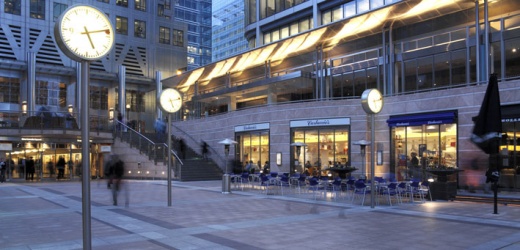
Canary Wharf – Hundreds of restaurants and shops, no public spaces
With regard to London’s Canary Wharf district (where I have experience of working), a large financial centre increasingly luring business away from the City of London, he writes:
Commercial developers behind the likes of Canary Wharf – the pioneer of vast, privately controlled spaces since emulated in the shopping centres of Liverpool One and Bristol’s Cabot Circus – want to reduce public space as much as they can. They want to be free to configure where we walk, what we visit and who has access because thus they can maximise sales per square foot of shopping and rents.
Public space costs money twice over: it has to be paid for by taxes (and we know many corporations do their utmost to avoid tax) and public space represents lost revenue. In a world in which everything has to be consecrated to “wealth generation”, providing a critical mass of public space that can be used for multiple public and social uses has been a burden too far in almost all recent large-scale urban regeneration projects throughout the country.
This is certainly true. While I love the architecture and the tall, glass and steel buildings that dominate the skyline in that part of the city (a little bit of lower Manhattan in London), it is also true that at times it can feel almost crushingly soulless. And the reason is precisely as Hutton states – almost every square foot of land is designed either to generate revenue, or to ease the passage of pedestrians so that they can move from making one transaction to the next, and then back to their office, with the utmost efficiency.
The most damning proof can be seen after the last Friday-night office revelers leave the bars and steak houses by the waterfront late on Friday night – until Monday morning, when the first bankers sleepily ascend from the tube station, the place is a ghost town for the duration of the weekend. Why go to Canary Wharf if you are not working there? And it is a terrible shame, because but for the addition of a small park, an area of grassland for people to picnic on, and a few other minor alterations, the area could be pleasant to visit at any time of the week.
Hutton continues:
One of the delights of Brighton’s Lanes or Oxford’s covered market is the possibility of escaping the tyranny of the shopping chains. You can go there just to hang out, shop, eat, browse or go for a stroll – and in this environment there is a chance to encounter the new shop, pub or restaurant. The insurgent is on level terms with the incumbent. Minton quotes many European architects who despair at our impoverished, weak municipal authorities unable to deliver such a social and public ethos compared with those in Europe: the Swiss, hardly tribunes of the left, have a strong civic tradition and fabulous livable cities. Why can’t we?
And he concludes:
Britain can do better than be a land fit for the owners of Westfield and Canary Wharf. It can be a place we want to live in; where we go to the city because we want to go to the city – not just to shop. The Victorians built great parks and civic spaces with great pride, openly revolting against the depredations of free market capitalism.
Of course, as with most Will Hutton articles, his central point is served alongside a healthy scoop of scepticism about capitalism and the free market, but in this case his well-worn views on that subject are worth enduring in order to appreciate the central message.
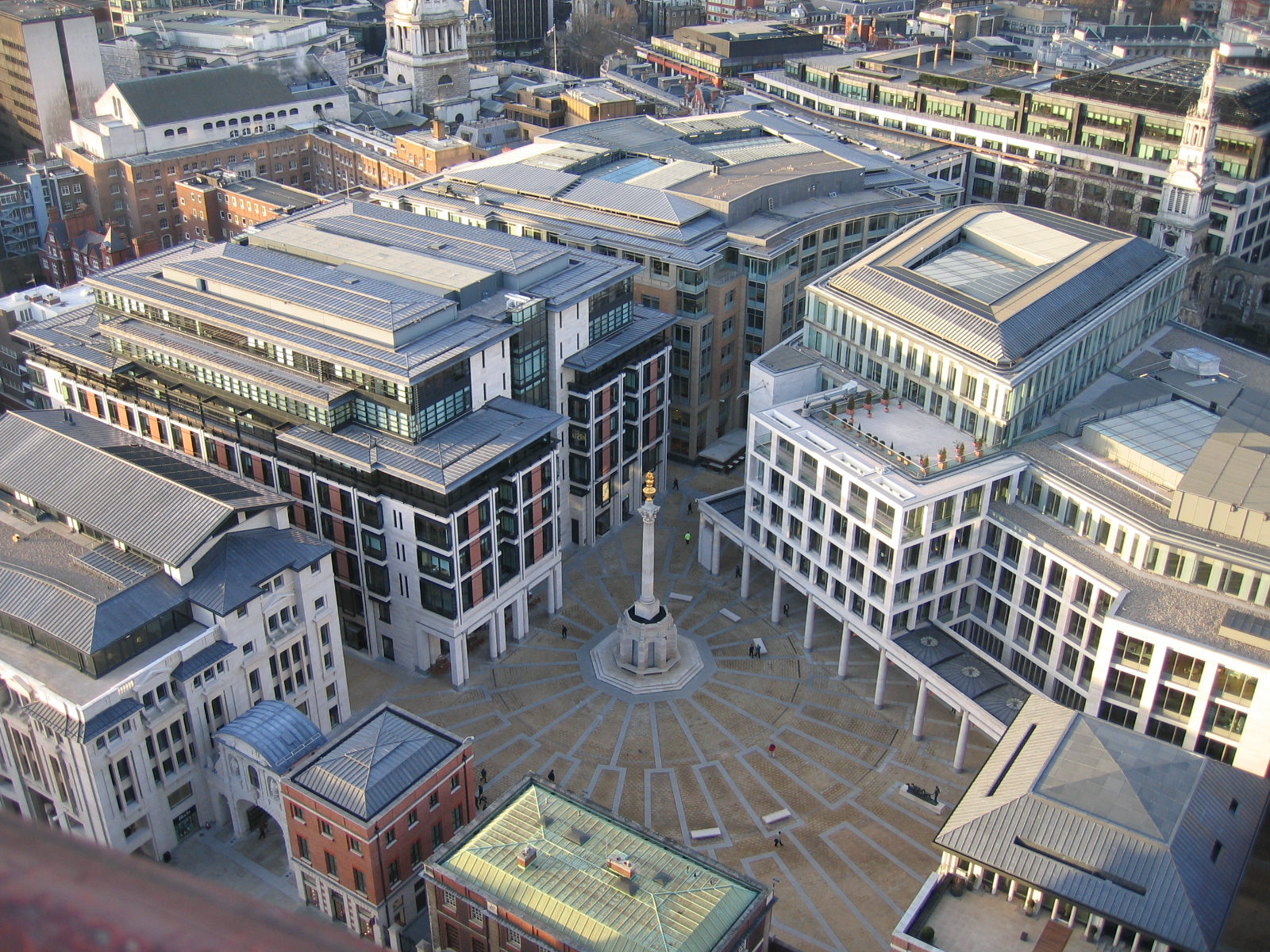
Many times, wandering around Canary Wharf or other similar developments (such as Paternoster Square near St Pauls) I feel almost resentful that in the midst of many areas in this wonderful city, there is nothing to do but eat and shop. Very few benches, almost no green space but a multitude of signs reminding me that this is privately owned land and that I must at all costs obey the directions of the ubiquitous security guards who patrol the courtyards and wield their authority.
Paternoster Square – a cathedral to consumerism next to St Paul’s Cathedral
To reiterate, I am not against any of these new developments – no Price Charles, I. I love the new architecture that is changing the face of London, and many of these new precincts have helped to revive struggling areas – the new Westfield shopping centres in Shepherds Bush and Stratford, for example.
But an insufficient balance has been struck in recent years, and given the current anti-establishment and (to some degree) anti-capitalist feeling currently roiling the country, it does not speak well that many of London’s newest, shiniest developments – with rare exceptions – serve as pure consumerist temples, with no civic heart.
“Sad Professor”, by the band R.E.M. from Athens, Georgia, USA.
If we’re talking about love
Then I have to tell you
Dear readers I’m not sure where I’m headed.
I’ve gotten lost before.
I’ve woke up stone drunk
Face down in the floor.
Late afternoon the house is hot.
I started I jumped up.
Everyone hates a bore.
Everyone hates a drunk.
This may be a lit invention
Professors muddled in their intent
To try to rope in followers
To float their malcontent.
As for this reader,
I’m already spent.
Late afternoon, the house is hot.
I started, I jumped up.
Everyone hates a sad professor.
I hate where I wound up.
Dear readers, my apologies.
I’m drifting in and out of sleep.
Long silence presents the tragedies
Of love. note the age. get afraid.
The surface hazy with attendant thoughts.
A lazy eye metaphor on the rocks.
Late afternoon, the house is hot.
I started, I jumped up.
Everyone hates a bore.
Everyone hates a drunk.
Everyone hates a sad professor.
I hate where I wound up.
I hate where I wound up.
As Commander Chris Hadfield, a Canadian astronaut serving aboard the International Space Station, prepared to leave space and return to Earth – quite possibly for the final time – he released this excellent cover of David Bowie’s “Space Oddity”, featuring vocals and guitar which he recorded while floating in zero gravity on board the ISS:
As Andrew Sullivan says, not a bad voice for an astronaut.



 Semi-Partisan Politics