The Future Of This Blog: Readership Poll

Political Blogging 2

To infinity, and beyond…


UPDATE – 18 September: Many thanks to all those who have completed the surveys and taken the time to share comments or send me emails with your further thoughts as to the future of this blog – your input is very much appreciated, and the feedback I am getting is very useful. The polls will stay open for a further five days and then I will review the results in detail and blog my response and future plans. In the meantime, business as usual…


Driven primarily by the recent EU referendum, 2016 has already been by far the biggest year in the four-year history of Semi-Partisan Politics, with all daily, monthly and annual pageview records easily surpassed and many new readers arriving from around the world – not to mention a successful appearance on the BBC Daily Politics.

I want to thank all of you for your readership and support, and for making my angry and sometimes less-than-coherent rantings a part of your daily reading. To those who made generous financial contributions during the EU referendum campaign – a heartfelt thank you. I could not have sustained the pace of blogging and analysis over that hectic period without your help. And to those who have become regular commenters – you continue to teach me, challenge and stretch my thinking in new directions rather than simply reinforcing my existing prejudices. Your input has made me a more rounded thinker and (I hope) a better writer. Thank you.

But now we must look to the future…

Soon, both the EU referendum and the upcoming historic US presidential election will be receding dots in the rear-view mirror, and at this time of change I wanted to reach out to you, my loyal readers, to get a sense of how you would like to see this blog grow and develop over the next 12 months and beyond. I am particularly keen to know whether you think the current blog format (length and frequency of posts) is about right, or if you would like to see stylistic changes, as well as to get a sense of what you think I should be writing about in terms of issues.

I have my own thoughts on the matter, and may as well put my cards on the table. In order to increase readership (and hopefully engagement) further I am thinking of continuing the current schedule of 1-2 normal length commentaries per day, but to supplement this with an additional number (3-5) of short commentaries or reactions to different political developments or stories, as is common in most successful political blogs. These would just be a couple of paragraphs of commentary in reaction to a developing story or a noteworthy piece published elsewhere.

I am conscious that by only posting once or twice per day this blog fails to articulate a position on a lot of significant stories, and this is something I would like to change. And while I will never equal the prodigious output of my blogging hero, the great Andrew Sullivan, I have come to believe that more frequency and variety of posts will hopefully be of interest, encourage more debate and hopefully force me to grow as a political writer.

But all of that being said, I am open to persuasion. Therefore I would be very grateful if you could answer the three main poll questions shown below, to give me a better sense of what you enjoy at Semi-Partisan Politics and what you think can and should be changed.

The first question relates to the format of the blog, i.e. the length and frequency of posts. Please select your one preferred option here:


The second question relates to the topics covered at Semi-Partisan Politics, and whether you think that the site would benefit from a change or sharpening of focus. Here, you can select as many options and topics as you like:


While the third question looks at whether or not I should expand into other social media to reach a potentially much larger audience. Again, you can select as many options as you want in this case:


I would greatly appreciate your feedback on these key questions. Each mini-poll lets you add in your own answer if none of the pre-set responses accurately capture your preference. But if you have any longer or more general comments, please do use the Comments feature to let me know your more detailed thoughts.

Though this blog remains small and relatively unknown (or at least generally unacknowledged by the Westminster media – increasingly I see themes and analyses first expounded here cropping up some months later in more prestigious publications), I think that over the past year in particular something of a community has been forged here, one which I greatly value. I am eager for this growth to continue, and look forward to receiving your input as to how Semi-Partisan Politics should best adapt to face the future.

Thank you for your continued readership and support.


Political Blogging

Support Semi-Partisan Politics with a one-time or recurring donation:

Follow Semi-Partisan Politics on TwitterFacebook and Medium.

Neutrality Is Not An Option For Conservative Pundits Against Trump

Donald Trump - RNC - Republican National Convention - Cleveland - Nomination - 2

Failing to support Donald Trump as the Republican presidential nominee effectively means advocating a Hillary Clinton presidency as the least-worst option in 2016. And #NeverTrump conservative pundits should find the courage to do so.

The veteran US conservative blog Ace of Spades has nothing but derision for those conservative pundits, commentators and other associated “thought leaders” who denigrate Donald Trump at every opportunity while lacking the courage to state the obvious inference from their criticism – that they would rather see Hillary Clinton as president.

Ace thunders:

Hardest hit: The #NeverTrumper Pundit Class, who are depending on a blowout to maintain that their constant anti-Trump agitations cannot possibly affect the election.

Oddly enough, none of these people claim to have zero influence on the conservative population except when they agitate against Trump. I’ve asked several people to provide past resumes and book proposals to demonstrate they have previously claimed to have absolutely no readership or influence over other conservatives; none of them have come forward with such book proposals stating, “I vow to you that I have barely any readers at all and that my book, should you publish it, will make nary the faintest ripple in the national debate.”

It’s only now, during 2016 (specifically from May of 2016 to November 2016), that this obviously highly-self-regarding group of Thought Leaders is making this claim of having no importance and no following.

I imagine these claims will evaporate ’round the second week of November.

Then they’ll all be back in Highly Influential Thought Leaders of the Conservative Movement mode again.

Sorry, I consider these claims to be cowardly, dishonest, and utterly chickenshit. People who have been cashing checks for decades based on their very value as magnets for conservative eyes can’t suddenly claim that, at least for a six month period from May to November 2016, they haveno influence whatsoever and are doing nothing at all to advance Hillary Clinton’s election prospects.

It’s cowardice, pure and simple. If you consider Trump so terrible that you feel obligated to support Hillary, then at least have the guts to say that, instead of putting on this childishly dishonest and evasive act of claiming that words people care enough about to pay you cash money for suddenly have no impact on anyone, anywhere, ever.

This bullshit that obviously-influential people who get paid advances to write books on conservative politics don’t have influence is unworthy. If you want a defense, then say, “I’m doing what I always do: I’m arguing for what I believe to be for the best for America.” (And that just happens to be arguing for the One True Conservative in the race, Hillary Clinton.)

He’s not wrong. There is no characteristic more despicable in people who claim to be part of the political and media elite than political cowardice and the craven unwillingness to boldly state inconvenient truths. Nor is there a spectacle more corrosive to the public trust in journalism and politics in general than those plump, oily fence-sitters who hedge their bets at every opportunity while still demanding that the rest of us sit and hang on their every word.

This blog took the plunge back at the time of the Democratic National Convention in Philadelphia. Though the words “I’m with her” had to be choked out together with no small quantity of bile, I uttered them nonetheless and this blog nailed its colours to the mast. Now Trump fanatics and those who fantasise about a Trump administration “dream team” involving the likes of Rudy Giuliani, Mike Huckabee and Sarah Palin can damn me if they wish, and never set digital foot here again.

A Hillary Clinton presidency gives the Republican Party four more years to come up with a more palatable option than John McCain, Mitt Romney and Donald Trump. In those four years, precious little will happen to fill conservative hearts with glee. But it is also highly unlikely that anything cataclysmicly, unfixably awful will happen either. That, to this blog, seems like a much better deal than letting Donald Trump loose on the Oval Office and potentially having him tarnishing the conservative and Republican brands even more than he has been able to as a presidential candidate.

Many of Trump’s desperate apologists try to trip up the #NeverTrump brigade by pouring scorn on the idea that Hillary Clinton is more conservative than Trump (see Ace of Spades’ sarcastic description of Clinton as “the One True Conservative in the race”). This misses the point. Many of us see Hillary Clinton exactly for what she is – namely a very calculating centrist with no core political convictions whatsoever. She was never the swivel-eyed leftist that Newt Gingrich tried to suggest – witness her glacial movement on gay marriage, only cautiously signalling her support once she was sure that Joe Biden and Barack Obama had not done themselves any political damage.

So the question is not one of whether Hillary Clinton is “more” of a conservative than Trump (though Donald Trump certainly is no conservative). The question is one of temperament and basic competence to execute the job. And while Hillary Clinton may be dogged by many legitimate ethical questions, few doubt that she could handle the levers of government, if only to maintain America on its present course.

Donald Trump, by contrast, is a complete unknown quantity, and a hugely volatile one at that. When he goes off-script he is liable to say or do anything (insulting the most sympathetic of characters or getting into Twitter wars with D-list celebrities) which comes to mind, and when he is on-script (as at his recent summit with Mexican president Enrique Peña Nieto) he sounds like he has been lobotomised. I have about as much confidence that Donald Trump has read, understood and respects the US Constitution as I believe his claim that “nobody reads the bible more than me“.

The choice, then, is not between a leftist ideologue and an honest, hard-workin’ conservative whose only crime is to be a bit politically incorrect sometimes, as Trump’s loyal cheerleader Sean Hannity loves to put it. The choice is between an ideologically rootless centrist who will likely maintain the status quo because she and her family have too much vested in it to see it fail, or a madman.

There are some occasions when the plucky, anti-establishment, populist insurgency is wrong. Shocking, I know, coming from an ardent Brexiteer, but true nonetheless. The cherished goal of Brexit – reasserting nation state democracy and reclaiming power from distant, unaccountable, technocratic elites – is pure and noble, at its best. Trumpism is not. Even if many of the complaints of Donald Trump supporters are valid – and they certainly are, and have been ignored by mainstream politicians for too long – Trump’s solutions are not equal to the difficulties he identifies.

“The dogmas of the quiet past are inadequate to the stormy present”, Abraham Lincoln once remarked in an address to Congress. True – and nothing represents the dogmas of the past better than Hillary Clinton. But still it is better to sit in the harbour and make scant progress for four years than to unfurl the Trump sail and set a course right for the centre of the storm.


Donald Trump Hosts Nevada Caucus Night Watch Party In Las Vegas

Support Semi-Partisan Politics with a one-time or recurring donation:

Agree with this article? Violently disagree? Scroll down to leave a comment.

Follow Semi-Partisan Politics on TwitterFacebook and Medium.

Sincere Congratulations To The Spectator For Their All-Women Cover Issue

Fraser Nelson - The Spectator - Westminster Media - Journalism

A brief rant before normal service resumes…

The Spectator editor Fraser Nelson today felt the need to publish a self-congratulatory humblebrag remarking on the fact that their latest print edition’s cover page apparently features only the work of female writers, despite no conscious decision having been made to indulge in affirmative action.

Nelson gushes:

Just before The Spectator went to press yesterday, my colleague Emily Hill pointed out that I’d just taken away the only male name away from the cover: all seven of our coverlines were stories written by women. Did I really want that? I hadn’t thought about it until then, and for a while I did consider engaging in tokenism and slapping a man on for the sake of it. But why bother? Spectator readers don’t really care about gender, just good writing.

In fact it hadn’t occurred to any of us, until that point, that we were about to run what Ariane Sherine, who writes our cover story, today hails as the first all-woman cover in The Spectator’s 188-year history. But this wasn’t a patronising attempt at a ‘wimmin’s issue’ or some other awful tokenistic wheeze. Our all-women cover wasn’t deliberate, it was just the way the cards fell. Each week we want to get the best writers on the most original topics: this week, they all happened to be women.

That’s not to say there’s no difference when it comes to getting hold of good writers. As Emily will tell you, women don’t put themselves forward as much as men. To get the full range of talent from all available writers can mean people like Emily going to great lengths to find and encourage new writers – like Ariane Sherine. As so often, Fleet Street follows up. As I write, two national newspapers are vying for the right to republish her cover story.

Full disclosure: I have a bit of a beef with lead article author Ariane Sherine (a one-sided affair; she, I’m sure, has no idea who I am) following her previous effort for The Spectator, an appallingly condescending report about how she performed a comedy gig in the heart of UKIP-supporting coastal Essex and somehow, miraculously, was not ripped to shreds by the rabidly racist, evil Brexiteers who dwell there.

It is interesting, too that Sherine (and apparently other women writers published in The Spectator) had to be sought out, coaxed and persuaded to write for the venerable magazine because “women don’t put themselves forward as much as men”. Funny, that. I, a despicably privileged man, have pitched to The Spectator before – it was actually a terrible piece from a few years back when my writing was very green, not at all worth publishing – but then I never had the pleasure of being sought out and implored to honour The Spectator’s readers with the fruits of my keyboard. That must be quite a nice feeling.

I don’t normally do this, but let’s just muse on the topic of gender equality for a moment, particularly as it relates to journalism. Regular readers will know that I spent pretty much every spare moment of the past year campaigning for Brexit in the EU referendum, initially rather haphazardly but (I hope) increasingly coherently as I read Richard North’s peerless eureferendum.com blog, learned about Flexcit and fell in with The Leave Alliance. I claim zero credit for any of the specific ideas this blog has supported around Brexit and the future of international trade – my tiny bit part in this effort consisted merely of standing on the shoulders of giants, particularly Richard North and Pete North, whose technical mastery and polemical writing I admire enormously.

The point, I suppose, is this. For some time now, a group of independent, citizen bloggers have churned out consistently better analysis and commentary on the EU referendum and Brexit on any given day than the mainstream media has given the British people in an entire year. Even now, dim-witted publications like the Guardian and FT are scrambling to catch up and think through some of the ramifications and issues which the people in my circle have been writing about for months. And what mention or recognition has this work prompted from the Westminster media? How many links to our widely-read and shared articles have appeared in mainstream outlets like The Spectator?

I think you know that the answer is zero.

Now, you don’t have to rate Semi-Partisan Politics at all – though I am personally quite frustrated, this issue is much bigger than little old me. But doesn’t it seem slightly odd that the entire Westminster media managed to somehow overlook the hard work of a small army of pro-Brexit bloggers on the biggest political issue to face Britain, just when fresh analysis was sorely needed, and yet The Spectator has time to scour Britain at great length for underappreciated female talent to promote to the front page?

Fraser Nelson claims that The Spectator’s all-women front page was entirely accidental, and I take him at his word. But isn’t it telling that this feat was achieved at the height of silly season, the summer recess, when the political news which is the Spectator’s bread and butter is almost entirely absent? When MPs come back from recess and things get serious again, let’s see how many months or years it takes for the next unintentional all-women issue to go to print. My guess is that it will be some while; that when PMQs is back and party conference season gets underway we will be seeing a lot more of James Forsyth, James Delingpole and Rod Liddle on the cover. Just a hunch.

So what was the amazing piece which made the cover of The Spectator anyway, you ask? Well, it was a thrilling exposé of a growing trend among millennials whereby single women stop looking for a suitable man and choose to marry themselves instead.

A snippet:

As far as the bride was concerned, the wedding was perfect. Her dress was beautiful, the vows were traditional and she changed her name after the ceremony. The clifftop scenery was breathtaking, the seven bridesmaids were encouraging and supportive: move over Princess Di. There was only one thing missing: the groom. Like a growing number of single women, Sara Starkström had decided to marry herself.

‘I thought about people marrying other people without loving themselves first,’ says Starkström, a writer, explaining what many would call a bizarre overreaction to finding herself single at the age of 29. ‘How could they pledge to do all this stuff for another person when they couldn’t promise themselves the same thing? I decided to marry myself to celebrate my independence and strength. I did it to promise to be my own best friend.’

[..] While many commentators make scathing judgments about sologamy (the feminist blog Jezebel ran a dismissive piece called ‘Single women, please stop marrying yourselves’, chiding, ‘You should be aware that you’re no trailblazer and you’re sure as hell not thumbing your nose at the system. You’re buying into it’), this hasn’t stopped increasing numbers of women from taking the plunge. For Starkström, self-marriage was a liberating act for which she is quite happy to take all the jokes ‘about me carry-ing myself over the threshold and making love to myself’.

And the thrilling conclusion:

Perhaps this is the crux of the sologamy issue: self-marriage is harmless, cheap compared to the £20,500 average cost of a classic wedding, and the union seems to make the bride very happy. If only the same could be said for the majority of traditional marriages which feature a groom. Princess Diana’s fairy tale fell apart when she found that there were three people in her marriage. Now, for an ever-increasing number of determined modern women, one is more than enough.

This isn’t even original. Even I know – don’t ask me how – that Sex and the City featured a similar storyline nearly fifteen years ago, in which protagonist Carrie Bradshaw decides to marry herself as a way of recouping the money spent on friends’ engagements and replacing an expensive pair of shoes which were stolen at a previous party. This kind of story is “and finally…” fodder on the TV news, not lead article material for The Spectator.

This may be silly season, but British politics is hardly dull at present – we have the ramifications of the EU referendum result to pick through, and the slow-motion car crash that is the Labour Party’s self-destruction, while America continues to wrestle with the Donald Trump phenomenon. In these circumstances, I’m sorry to say that Sherine’s story about sologamy has more than a whiff of affirmative action about it.

Before the inevitable feminist lynching begins, another disclaimer: I have long believed that The Spectator’s Isabel Hardman is the outstanding political journalist of her generation and, based on my couple of conversations with her, a genuinely nice person in the SW1 bubble. If The Spectator had ten Isabel Hardmans on staff, I wouldn’t expect a male-written cover story any more than once a year. It shouldn’t be necessary, but I want to put any idea that this rumination is some alt-right, anti-woman rant quickly to bed.

Note too that even when quoting the established feminist blog Jezebel, The Spectator fails to provide a link to the article Sherine cites by name. This is how unwilling the establishment British media are to share readers, clicks and opportunities. It is selfishness beyond measure, and is ultimately counterproductive – the American political blogosphere grew and thrives today not only because bloggers link to one another, but because there is a dialogue between what were traditionally the “legacy” print media outlets and alternative voices.

Readers aren’t forever lost to a publication which dares to link. In fact, readers often respect the original source all the more as a curator of other worthwhile information across the internet, thus increasing their loyalty. Maybe this doesn’t easily show up in the monthly SEO and web traffic reports which now seem to drive all media behaviour – and which have turned the Telegraph from a respectable broadsheet to a sensationalist purveyor of clickbait – but it is a real factor nonetheless. My own personal blogging hero, Andrew Sullivan, built the most influential political blog in history based entirely on this philosophy of curating the web for his readers and also providing fresh commentary which was picked up by the legacy media.

To this day, if there is a worthwhile piece of commentary or analysis on an American political blog, it is not unusual to see it linked to in a piece by an “establishment” journalist on the staff of, say, the New Republic or the National Review. Semi-Partisan Politics has been cited in the National Review a couple of times, a courtesy not once extended by any major British publication, and this despite the fact that 80 per cent of this blog’s output concerns UK rather than American politics.

So how should the British media interact with the blogosphere and promote new talent? Well, call me old fashioned but I believe that a simple commitment to meritocracy can’t go far wrong. Sure, The Spectator will always hire the likes of Pippa Middleton to write vacuous society guff about hunting for truffles in their Christmas issue, and that’s fine. But when it comes to political coverage, one wishes that established British publications would at least pretend to aspire to genuine meritocracy, seeking out the best analysis and commentary regardless of race or gender rather than indulging as they do in flagrant nepotism on the one hand and leftist affirmative action on the other.

I’ll speak plainly, because it’s better than dancing around the issue, from my perspective as someone no longer in the first flush of youth trying to build an audience and reputation as a writer. It is frustrating to pour every spare minute into this blog, providing (I dare to hope) sometimes original and refreshing commentary – particularly I think on the 2015 general election, the ongoing Labour leadership saga, free speech or academic freedom issues and the EU referendum – and see what is  objectively weaker commentary from nepotism beneficiaries or the obvious fruits of affirmative action benefit from a prestigious platform, greater recognition, and – oh yes, from monetary reward too. It’s just a little bit hard to take day after day.

I could play the minority card too, if I wanted to talk up my BAME working class background, but I would never compromise my principles by demanding that I be given a platform based on who I am rather than what I have to say. I won’t go there – it would be a violation of everything that this blog stands for. Others sadly seem happy to do so.

I write because I love to write, and because I think I have slowly created something quite small but precious here at Semi-Partisan Politics; because I have a small readership whom I love to serve, write for and debate with; because it is better than ranting into Facebook 24/7 as I used to before I opened a WordPress account. But sometimes it is a bit galling to see an inferior product exalted and given prominence when I and several of my good writer friends toil in obscurity.

Building a reputation and audience as a writer should be hard – it rightly takes time, effort, humility and perseverance. It has taken me over four years to even begin to get a sense of who my audience is / should be, and how best to serve them – and I claim no special skill at what I do, only a great deal of enthusiasm for it. But whether it is Twitter interactions, links to my site or other interactions, the amount of support I have received from American journalists and publications on the other side of the Atlantic vastly exceeds what little help or hand up I have ever received from the British media class – despite the fact that at least 80 per cent of my written output, networking and outreach efforts are focused on British politics and the Westminster media.

And I think British journalists and editors should be made to feel a little bit ashamed of that fact. Not for my sake – I’ll be just fine, and 95 per cent of the time I am happy to keep plugging away without a murmur of complaint. They should feel shame because my situation is far from unique, and because there are writers in my acquaintance whose insight, bravery and raw talent would enrich our country’s entire political discourse if only it had the bully pulpit it deserves.

The Westminster media establishment should be ashamed because the way they seek out and promote writing talent fails the British people, serving them an often substandard and derivative stream of written output and unoriginal thinking from the pens of the well-connected (either by parentage or ability to fill the checkboxes of a Diversity Officer’s form) while effectively pretending that the struggling political blogosphere – the primary outlet for so many talented, aspiring writers – doesn’t even exist, and certainly not as a source worthy of links or interaction.

Okay, rant over. I don’t have the energy to bring this piece to a neat end.

Normal business will now resume. Read it here first, or three months later from someone who gets paid to do this kind of thing.

 

Political Blogging 2

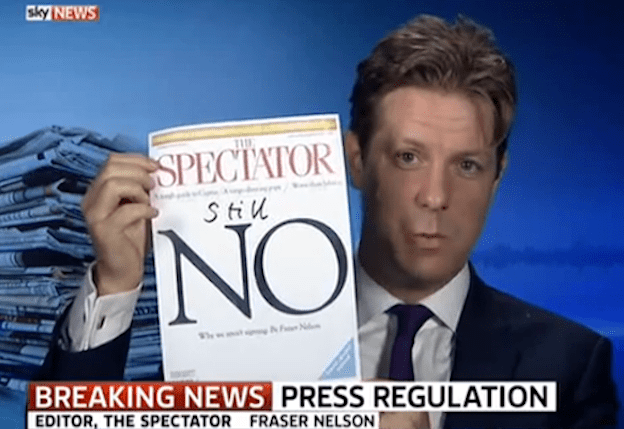
Top Image: The Spectator / Sky News

Support Semi-Partisan Politics with a one-time or recurring donation:

Agree with this article? Violently disagree? Scroll down to leave a comment.

Follow Semi-Partisan Politics on TwitterFacebook and Medium.

The American Right’s Guilty Conscience

Jeb Bush - Twitter - Gun - America

The more self-aware parts of the American conservative movement are coming to realise their part in creating the monster that is Donald Trump. Good. But with Trump’s takeover of the Republican Party complete, the genie cannot be put back in the bottle.

Slowly but surely, realisation is dawning among parts of the American Right that they might, just might, be partly responsible for feeding the national anger and distrust of elites which has given us Donald Trump, Presidential Nominee Edition.

Politico Magazine has a great extended feature on well-known Wisconsin conservative talk radio host Charlie Sykes, in which the respected political figure essentially admits that Donald Trump’s takeover of the GOP was only possible thanks to the work of the relentless Republican Party media outrage generation machine.

From the article:

Charlie Sykes’ conscience is nagging him.

Since last year, the most influential political talk show host in Wisconsin has found out just how hard it is to be a #NeverTrump conservative on right-wing radio. Ever since Sykes began denouncing Donald Trump on the air—which he does just about every time he talks about the presidential election—he’s strained his relationships with the listeners of his daily radio show.

Sykes’ many arguments with listeners over Donald Trump’s serial outrages have exposed in much of his audience a vein of thinking—racist, anti-constitutional, maybe even fascistic—that has shaken Sykes. It has left him questioning whether he and his colleagues in the conservative media played a role in paving the way for Trump’s surprising and unprecedented rise.

Hats off to Sykes for actually challenging his listeners and exhorting them not to swallow uncritically any morsel of Clinton-related scandal from the fringe web while rejecting any attempt at objectivity or fact-checking. Many a lesser talk radio host or other media personality (cough, Sean Hannity) have seen which way the Donald Trump hurricane is blowing and meekly fallen in line with his campaign, never subjecting Trump to criticism even when it is richly deserved.

The feature continues, describing a caller to Sykes’ radio show who wanted to deport Muslim American citizens, in flagrant violation of the Constitution which conservatives claim to hold so dear:

“Were these people that we actually thought were our allies?” he asks.

Sykes remains confident that Trump will lose badly in November, and he is equally fearful that Trump will drag longtime Republicans, like Senator Ron Johnson of Wisconsin, down with him. This has Sykes thinking about the long-term future of the party and what might have precipitated its looming collapse. He wonders: Did “the faux outrage machine” of Breitbart.com and other right-wing outlets foment the noxious opinions that Trump has stoked so effectively on the trail?

“When I would deny that there was a significant racist component in some of the politics on our side, it was because the people I hung out with were certainly not,” Sykes says. “When suddenly, this rock is turned over, there is this—‘Oh shit, did I not see that?’

And then:

He wants to figure out why, in his opinion, things went so wrong for the conservative movement. One problem, he thinks, is his fellow talk-radio hosts.

“Talk radio made itself relevant by beating up on other Republicans, vilifying other Republicans,” he says. “It fed this faux outrage machine that raised expectations unrealistically”—for instance, asking why Congress didn’t repeal Obamacare, though Obama’s veto pen made it mathematically impossible. Later, he would tell Business Insider’s Oliver Darcy that talk radio’s attack on mainstream-media bias has backfired, because its listeners now dismiss legitimate media fact-checking as untrustworthy.

Sykes warns his listeners to step outside the “alternative reality bubble” of Breitbart.com and other right-wing websites. Part of his audience thinks he’s sold out, he complains, because he won’t parrot dubious claims they’ve read on such sites. “A lot of the conservative talk shows around the country embrace almost whatever comes over the transom,” he says.

Slow hand clap.

This blog has been waiting for some time now for the penny to drop, for thinking American conservatives to realise that the hysterical and unseemly way in which the Republican Party carried out its opposition to the Obama agenda might possibly have some unintended negative consequences.

Because it turns out that treating every single centre-leftish or centrist policy to emanate from the Obama White House as though it were an existential threat to the republic and relentlessly exploiting wedge social issues and persisting with the same failed policies which deliver great benefits to the wealthy, educated elites while leaving the struggling middle class high and dry works really well, right up until the moment where it suddenly stops working at all.

Here’s what that approach actually is good for:

  1. Making ordinary decent citizens with limited political engagement very afraid, often unnecessarily, and
  2. Getting them to donate vast amounts of money to assorted conservative / Tea Party political organisations which exist primarily to enrich those who are part of the Ponzi scheme, with very little of the money actually going on to reach conservative candidates or campaigns

The American right-wing outrage machine has been absolutely magnificent at making people angry and then monetising the hell out of that anger. But it has been lousy at speaking to the issues and problems which weigh on the minds of America’s squeezed middle.

Too often, conservative leaders have been happy to nod along while right wing noisemakers prophesied the abolition of the Second Amendment or the sudden imposition of “socialism”, because it worked. Because it reliably delivered scores of votes to Republican candidates on election day. Right up until the moment it stopped working because a new populist candidate emerged who promised action, not just talk, to defeat these inflated or imagined threats.

Donald Trump isn’t some bizarre and unprecedented phenomenon to afflict the Republican Party. These are the people who earnestly and with a straight face asked Americans to make Sarah Palin the Vice President back in 2008. Their flirtation with ignorance and craziness has a long and dismal history, and only now is bearing full fruit in the form of Trump.

It’s great that some of the more self-aware leaders of the American conservative movement are now quietly realising, with shame, the part which they either intentionally or unwittingly played in unleashing Donald Trump on America. For while Trump’s supporters certainly include more than their fair share of racists, xenophobes and other assorted imbeciles, the vast majority are good and decent people – primarily conservatives who have been consistently let down by a Republican Party which pretended to talk their language but which never governed in their interests.

Unfortunately Trumpism cannot be easily put back in the bottle now it has been released. First, it must be defeated in November, however unappealing the thought of giving the Washington establishment four more years in charge may be. And then the rebuilding of American conservatism must start – a difficult feat since so many of its most intelligent and respected figures have sullied themselves by bending the knee to Donald Trump (a fact which the Politico article discusses at length).

Great electoral rewards await the first party to grapple with the core question of how to reconcile the imperatives of globalisation with the need to equip citizens with the skills and services needed to prosper in a modern economy which can no longer promise a high standard of living for mass unskilled labour. Republicans have the harder job here – the conservative emphasis on self-sufficiency and a small state requires inventive solutions, whereas the Democrats can wave their hands and simply promise a new government program. It’s a difficult issue for conservatives, one which this blog is still struggling to work through.

This is the challenge now facing American conservatives. The culture wars are not insignificant, and there are battles to be fought – some of which this blog sympathises with (political correctness, free speech, religious freedom) and others less so. But no longer will it be enough for Republican politicians to stoke anger about these issues while failing to meaningfully tackle them, or to ignore the economic interests of the American working and lower middle class – doing so will only open the door to another Trump-style populist insurgency.

From this Politico Magazine article, it seems as though at least one prominent conservative talk radio host is starting to get it. Hopefully others will follow.

But the renewal of American conservatism cannot begin yet – first we must hit rock bottom.


Trump Pence 2016 - Make America Great Again

Support Semi-Partisan Politics with a one-time or recurring donation:

Agree with this article? Violently disagree? Scroll down to leave a comment.

Follow Semi-Partisan Politics on TwitterFacebook and Medium.

The Inhabitants Of UKIP Country Are Our Friends And Compatriots, Not Members Of A Racist Freak Show

UKIP poster - yard sign - EU referendum

How is the fact that most Ukippers and Brexiteers are ordinary, decent people and not rabid skinhead racists such surprising news that it merits an article in The Spectator?

The metro-left have their fixed views of Brexiteers and Ukippers – basically ghastly, uncultured people with a blinkered, nationalistic worldview bordering on overt racism. Generally they hold these views not because of any personal experience meeting and talking with Brexit supporters, but rather because this caricature draws a neat contrast with the virtuous traits of openness, tolerance and progressivism that the Left love to claim as their own. This much is all well known.

But most of these views are formed at a great distance removed from the actual Brexiteers or Ukippers being judged. When Channel 4 filmmakers produce a dystopian documentary about what Britain would be like under a UKIP government led by Nigel Farage it is achingly obvious that nobody involved in the feature knows or has ever taken the time to get to know the type of people they so readily pastiche for the lazy consumption of their fellow metro-leftists.

But once in awhile someone from the metro-left bubble accidentally stumbles out of their hermetically sealed ideological environment, finding themselves deep in the heart of Brexit supporting suburbia, or – heaven forfend – UKIP country.

And when it turns out that the primitive, simple UKIP natives turn out to be perfectly decent people who just happen to hold different views on a few political issues, it is now apparently such shocking and revelatory news that it merits a whole article in The Spectator.

From standup comedian Ariane Sherine’s wide-eyed report on her accidental foray into UKIP land:

Most people would say UKIP lends itself to comedy better than Denis Healey’s eyebrows lent themselves to tweezers – but not the people of Walton-on-the-Naze, as they live in the party’s only constituency. I’m a stand-up comic, and I was booked to play the town’s first comedy night this month. I don’t know if the lovely promoter realised I was Asian when he booked me; for my part, I didn’t realise Douglas Carswell was Walton’s MP, and only discovered while Googling the town on the way to the gig, when it was too late to turn back.

When I arrived in Walton-on-the-Naze’s large ballroom with its cornicing and chandeliers (‘It looks like the inside of a prostitute’s wedding cake’ remarked one of the other comics), I was perturbed to see more skinheads than at your average EDL rally. Audiences in London are diverse both in terms of race and class; Walton’s audience was not. The first act quipped, ‘I know you’re all a bunch of racists’; whether he was joking or not wasn’t clear.

I was terrified before I went on. I generally sing a love song to Jeremy Corbyn; I thought ‘Oh no, they’re UKIP supporters – they’re going to hate it.’ I also sing about the time a beauty therapist waxed my bikini line into a Hitler moustache. Ridiculously, I thought ‘Maybe some of them are neo-Nazis and will object to this, too!’ Before our sets, the other new comic and I shared frightened glances. ‘Good luck,’ he said. ‘Thanks – I’ll need it,’ I replied. ‘Hopefully they’ll think I’ve just got a suntan and am not Asian at all?’. I was glad that my six foot six inch male friend had accompanied me to the gig.

Because we all know the seething hatred of Asian people in the heart of UKIP supporters and people who voted for Brexit? The condescension here is absolutely off the charts – first assuming that the people of Walton on the Naze are so stupid that Sherine’s clever little love ditty to Jeremy Corbyn might sail over their sloped foreheads, and second that the audience might start jumping around and flinging faeces when they realise that the person on stage is of Asian heritage.

Is there some little-reported history of Asian comics going missing after venturing too deep into small-town Essex that I am unaware of? Has Douglas Carswell quietly imported the defunct Jim Crow laws from the American South, entrenching racial segregation and discrimination in a small corner of eastern England?

This kind of foreboding and hysteria is only possible when one feels that the community in question are somehow fundamentally different to us, that they are “other”. But Ariane Sherine and her audience were both British, both English too, in fact. The idea of being afraid of one’s own countrymen because they happened to elect a mild-mannered MP like Douglas Carswell is absolutely absurd.

Sherine’s odyssey continues:

To my surprise and relief, they laughed, and went on to laugh throughout my set: at Corbyn, at the Hitler moustache, at my rude song about never having another boyfriend. They were friendly and good-natured. I tested the waters a bit, in case they hadn’t noticed my skin colour: ‘My little girl’s white and I’m brown, so I call her my secret Asian.’ They didn’t bat an eyelid. When I came off stage, the promoter’s wife said ‘They loved you! They came to life when you came on.’

In some ways, the crowd lived up to stereotypes: when the other comedian mentioned the referendum, he got heckled with ‘Brexit – out out out!’ And some of the crowd started to heckle the headline act when he maligned their hometown, with one man asking menacingly, ‘Are you taking the piss out of Walton-on-the-Naze?’ But whatever else the audience were, they weren’t racist. In fact, it occurred to me as we drove home, I was the prejudiced one, the one full of preconceived ideas about what other people were going to be like before getting to know them.

Slow hand clap.

Finally, the realisation dawns that perhaps it is the trendy lefty Londoner who holds prejudiced views – about her own countrymen, no less – rather than the much maligned white working class community which she was so alarmed to visit.

One is torn how to respond to this article. Obviously it is a very good thing that Ariane Sherine came to see the error of her ways in having prejudged Ukippers and people from Walton-on-the-Naze. One only wishes that Sherine’s epiphany could be shared with every other young, creative-industry-working, Guardian-reading, Corbyn-supporting hipster living in London and the other big cities – and that the good people living in pro-UKIP or pro-Brexit communities might eventually start to feel more understood and respected as a consequence.

But the fact that a comedian’s epiphany that people from a UKIP-voting town are not knuckle-dragging racists is such revelatory news that it merits a prominent article in The Spectator is depressing beyond belief. How is it possibly news that people in Walton-on-the-Naze didn’t racially abuse an Asian comedian and heckle her off the stage?

When so many of our fellow citizens hold other groups – the white working class, Ukippers, whoever – in such open disdain, even fearing them, then we are in trouble as a country. And when established media outlets like The Spectator feel the need to publish One Woman’s Voyage of Discovery Into UKIP Land with a straight face, just to make a point, then it is clear that our media has a long way to go in terms of understanding the country they cover.

This disconnect is why Britain voted for Brexit against the command and expectation of the country’s elite in the first place. Hasn’t the time come to give Britain’s silent, Brexit-supporting majority a little bit more respect?


UKIP Caravan

Top Image: Plymouth Herald

Support Semi-Partisan Politics with a one-time or recurring donation:

Agree with this article? Violently disagree? Scroll down to leave a comment.

Follow Semi-Partisan Politics on TwitterFacebook and Medium.