The Age Of Trump: As The Republican Party Goes To Its Armageddon

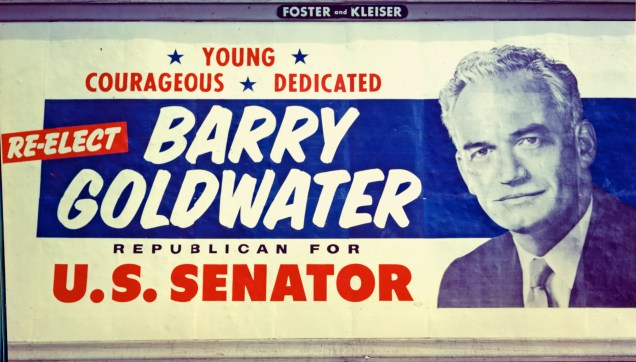
Barry Goldwater - Election Poster

To understand why the Republican Party are on course to lose their third consecutive presidential election, one must look much further back in time than the rise of Donald Trump

It gives no satisfaction to watch any storied political party hurl itself into oblivion – even the US Republican Party, which has frequently infuriated true conservatives with its sanctimonious and hypocritical habit of screeching about the dangers of encroaching socialism under Democratic administrations while themselves consistently cranking up the size and role of the state at every opportunity.

But while it now seems almost certain that the Republicans have thrown away any chance of reclaiming the White House, imploding in a foul-mouthed torrent of bluster and recrimination more worthy of Jerry Springer than a presidential primary campaign, it is worth looking back and asking how the GOP finds itself in this position, and exactly when the seeds of destruction were sown.

I have been reading widely on this, focusing less on the crowing and virtue-signalling Left, and far more on those thoughtful and introspective voices on the Right who are often appalled by the rise of Donald Trump in particular, but often sympathetic to the anti-establishment fervour which fuels his candidacy.

And if I have to pick just one excerpt from one piece to explain the predicament in which the Republican Party currently finds itself, I would encourage my readers to read “I was wrong about Donald Trump” by Daniel McCarthy over at The American Conservative.

In his piece, McCarthy concludes:

Trump succeeds because of more than outsize personality, of course. He attracts some support from everyone who thinks that Conservatism, Inc. and the GOP establishment are self-serving frauds—everyone who feels betrayed by the party and its ideological publicists. Working-class whites know that the Republican Party isn’t their party. Christian conservatives who in the past have supported Mike Huckabee and Ben Carson also know that the GOP won’t deliver for them. Moderates have been steadily alienated from the GOP by movement conservatives, yet hard-right immigration opponents feel marginalized by the party as well. Paleoconservatives and antiwar conservatives have been excommunicated on more than one occasion by the same establishment that’s now losing control to Trump. They can only applaud what Trump’s doing, even if Trump himself is no Pat Buchanan or Ron Paul.

Conservative Republicans™ somehow maneuvered themselves into a position of being too hardline for moderates and non-ideologues, but not hardline or ideological enough for the right. Trump, on the other hand, appeals both to the hard right and to voters whose economic interests would, in decades past, have classed them as moderates of the center-left—lunch-pail voters.

What’s even more remarkable is that movement conservatives, who have been given plenty of warning, ever since 2006, that their formula is exhausted, keep doing the same thing over and over again: they’ll dodge right, in a way that right-wingers find unsatisfactory but that moderates find appalling; then they’ll weave back to the center, in a way that doesn’t fool centrists and only angers the right. Immigration—which was another of George W. Bush’s stumbling blocks, lest we forget—has been the issue that symbolized movement-conservative Republicanism’s futility most poignantly. It’s not even clear that most GOP voters agree with Trump’s rhetorical hard-line on immigration—they just like it better than the two-faced talk of the average Republican politician.

Trump has a plethora of weaknesses, as general election polls amply demonstrate. But just look what he’s up against within the Republican Party: that’s why he’s winning.

I have yet to see the rise of Donald Trump explained as thoughtfully and succinctly as it is in the first three paragraphs quoted above. Sure, McCarthy’s piece does not tackle every aspect of the situation – whole books can and will be written about the causal factors of this huge anti-establishment backlash, which is far bigger than any one political party – but it does explain why the current GOP was so badly positioned to withstand a populist insurgency like Trump’s.

Much like the British Labour Party has become a fractious and increasingly unworkable coalition of idealistic left-wingers, pragmatic centrists and (let’s be frank) soulless political shapeshifters, and much as the historic splits in the Conservative Party are re-emerging following a vacillating 2016 Budget and the party leadership’s betrayal of the activist base on the coming EU referendum, so the Republican Party’s big tent of Reaganites, neo-cons, Evangelicals and social conservatives is collapsing – for those reasons outlined above by McCarthy.

Read the collected output of Rod Dreher too, and this piece by David Brooks, which looks to the future which could yet follow 2016’s rock bottom:

Trump is prompting what Thomas Kuhn, in his theory of scientific revolutions, called a model crisis.

According to Kuhn, intellectual progress is not steady and gradual. It’s marked by sudden paradigm shifts. There’s a period of normal science when everybody embraces a paradigm that seems to be working. Then there’s a period of model drift: As years go by, anomalies accumulate and the model begins to seem creaky and flawed.

Then there’s a model crisis, when the whole thing collapses. Attempts to patch up the model fail. Everybody is in anguish, but nobody knows what to do.

That’s where the Republican Party is right now. Everybody talks about being so depressed about Trump. But Republicans are passive and psychologically defeated. That’s because their conscious and unconscious mental frameworks have just stopped working. Trump has a monopoly on audacity, while everyone else is immobile.

[..] At that point the G.O.P. will enter what Kuhn called the revolution phase. During these moments you get a proliferation of competing approaches, a willingness to try anything. People ask different questions, speak a different language, congregate around a new paradigm that is incommensurate with the last.

That’s where the G.O.P. is heading. So this is a moment of anticipation. The great question is not, Should I vote for Hillary or sit out this campaign? The great question is, How do I prepare now for the post-Trump era?

As Brooks says (perhaps a little naively), this is not necessarily all bad news for conservatives. If we are honest, we have to admit that conservative policies in America and Britain are no longer perfectly calibrated to the challenges of the day as they were in Thatcher and Reagan’s time.

That is not to say that the Left are any better; Lord knows they aren’t. But it does mean we should acknowledge certain facts – like the fact that we still have a stubbornly large permanent underclass, and that for all the irreplaceable benefits of globalisation, there are still those who miss out – and seize the initiative by proposing radical conservative policy solutions to the great challenges of the new century.

In Britain, David Cameron’s Coke Zero Conservative government – or the Ted Heath tribute act, as this blog has taken to calling them – seem to think that One Nation Conservatism means stealing as many of Labour’s left-wing ideas as possible. And in America, Donald Trump’s brand of populist pseudo-conservatism doesn’t believe in One Nation at all, unapologetically carving the country up into winners and losers.

Neither is the correct approach. And as Cameronism and Trumpism run their respective courses, this blog will continue providing commentary and offering suggestions for an alternative conservatism, in Britain and America.


Postscript: This blog has decreased its focus on US politics in the past few years, primarily because I have been London based and fully occupied writing about British political issues. But Semi-Partisan Politics will begin to cover the American presidential election with a little more frequency going forward, partly because I have always remained a close follower of American politics – often more so than the household name journalists dispatched to the States by their newspapers and now portentously reporting back to us as self styled “experts”.

Having lived in America helps – particularly having lived in the American Midwest, not just the coastal enclaves of New York and Washington, D.C. familiar to most British journalists who write about America during election season. And the fact that I am married to a Hillary Clinton-supporting Hispanic Texan helps too. When I write about American politics, I know whereof I speak.

But I am also covering the presidential race because as a conservatarian with one foot firmly planted on either side of the Atlantic (and a heart divided equally between Britain and America), I believe that in my own small way I can bring a perspective to the left/right, authoritarian/libertarian debate that is often missed by those whose thinking and writing is rooted firmly in just one country’s specific conservative tradition.

To borrow an overwrought phrase from the dystopian world of Identity Politics, consider this my contribution to an “intersectional” perspective on conservatism.

They’ll absolutely hate me for that.


Donald Trump Hat - Make America Great Again

Agree with this article? Violently disagree? Scroll down to leave a comment.

Follow Semi-Partisan Politics on TwitterFacebook and Medium.

Could The Media Have Prevented The Rise Of Donald Trump?

There is no longer an Edward Murrow or Walter Cronkite to stand up to Donald Trump

Could mainstream television, radio, print and internet journalism outlets have done more to prevent the rise of Donald Trump? And should they have done more?

Glenn Greenwald thinks so:

Actually, many people are alarmed [by the rise of Trump], but it is difficult to know that by observing media coverage, where little journalistic alarm over Trump is expressed. That’s because the rules of large media outlets — venerating faux objectivity over truth along with every other civic value — prohibit the sounding of any alarms. Under this framework of corporate journalism, to denounce Trump, or even to sound alarms about the dark forces he’s exploiting and unleashing, would not constitute journalism. To the contrary, such behavior is regarded as a violation of journalism. Such denunciations are scorned as opinion, activism, and bias: all the values that large media-owning corporations have posited as the antithesis of journalism in order to defang and neuter it as an adversarial force.

[..] This abdication of the journalistic duty inevitably engendered by corporate “neutrality” rules is not new. We saw it repeatedly during the Bush years, when most large media outlets suppressed journalistic criticism of things like torture and grotesque war crimes carried out by the U.S. as part of the war on terror, and even changed their language by adopting government euphemisms to obscure what was being done. Outlets such as the New York Times, the Washington Post, and NPR refused to use the word “torture” to describe techniques long universally recognized as such — which were always called torture by those same media outlets when used by countries adversarial to the U.S. — because to do so would evince “bias,” lack “neutrality,” and “take sides” in the torture debate.

Contrary to what U.S. media corporations have succeeded in convincing people, these journalistic neutrality rules are not remotely traditional. They are newly invented concepts that coincided with the acquisition of the nation’s most important media outlets by large, controversy-averse corporations for which “media” was just one of many businesses.

I’m not so sure.

While Greenwald is absolutely right to chastise mainstream media outlets for clinging desperately to an “appearance of objectivity at all costs” dogma which routinely sees them humiliate themselves by speaking and writing about the utterly ridiculous as though it were merely an equal and opposing side to an argument, the idea that prestige nightly news anchors could have killed Trump’s candidacy in the crib either by initially declaring it ridiculous and mocking it, or by waging an Edward Murrow or Walter Cronkite crusade against him, seems to be wishful thinking.

It’s wrong because it underestimates the anti-establishment surge now underway in America (and in Britain too, as we saw with the rise of UKIP and the SNP). Suppose that mainstream news outlets like the New York Times, NBC, NPR and others had come out strongly to argue that Donald Trump’s ideas were outside the Overton window of “acceptable” political thought in America, and that he should henceforth be ignored by the media regardless of how many people were attending his rallies or how high he climbed in the opinion polls. What difference would it have made?

Political journalism is scorned by the public as much as Washington politics itself, and often for quite valid reasons – the incestuous, back-scratching relationship between the two is often entirely self serving and actively prevents the holding of government to proper account. Trump’s candidacy is fuelled in significant part by the opposition of those opinion columnists and TV talking heads who have come out to criticise him. If they were joined by everyone else, including news anchors and print journalists whose material does not appear in the opinion section of their television shows or newspapers, it is hard to see it doing anything other than confirming the suspicion of Trump fans that the “establishment” is out to get them, thus driving his poll ratings even higher.

This is important. Trump is riding high partly because of a small group of “let it burn” conservatives who believe that Washington is so corrupt that an authoritarian outsider beholden to no one is as good a choice as any to sweep out the garbage, but mostly because Trump supporters feel ignored and patronised by almost everybody else. And frankly, the opposition to Trump in the media has not helped, tending toward hand-wringing “ooh, isn’t he evil” editorials and one-sided accounts of violence at his campaign rallies rather than granular deconstructions of his policy proposals (such as his policies exist). Increasing the frequency and volume of the existing anti-Trump media coverage will not fix the problem, because it does little to tackle the sentiments and ideas which drive his support.

But more to the point, if we are to set arbitrary limits on our political discourse, beyond which any candidate promoting “unacceptable” ideas is rounded on by the corporate media as it is currently comprised, who gets to set the limits? Who gets to decide which ideas are okay to debate, and which are traps which will bring the entire media establishment crashing down on the person who dares to raise them?

There is almost nothing as infuriating as watching high profile journalists discuss an issue where one side obviously has the moral and intellectual high ground in terms that suggest that it is a finely balanced debate – witness the debates on torture, climate change, Brexit (UK secession from the European Union)  and more. But even worse than this would be a collusion between media outlets to freeze out certain ideas or candidates from being mentioned altogether because they are “evil” or contradict prevailing orthodoxies.

I’m sure that this is not what Greenwald has in mind. As a consistent advocate of free speech, I’m sure that he would prefer a brash and lively media landscape of much more fractured ownership, in which a multitude of independent news outlets are free to carry out the kind of unabashedly partisan campaigning journalism that Greenwald (and to some extent this blog) advocates. Greenwald would likely be fine if some outlets produced coverage very supportive of Trump, so long as other outlets were equally free to oppose him.

But we do not have such a media landscape right now, and moving in this direction would be a process taking years, not months – certainly too long of a timescale to have any impact on the rise of Donald Trump. The difficult truth is that given the hysterical, rabble-rousing behaviour of the Republican Party over the course of the Obama presidency – in which they chose hyperbolic, apocalyptic scaremongering over principled opposition to bigger government – there was nothing that could have prevented the monster they created from coming to life, breaking free of its chains and devouring them, as Trump is now doing.

It may feel good to imagine an American media landscape filled with luminaries like Edward Morrow and Walter Cronkite, journalists who would have taken one look at Donald Trump back when he launched his presidential bid, and masterfully snuffed it out in the course of one withering nightly news broadcast or newspaper column. But that is not the world we live in. Any attempt by major media outlets to scrutinise or inveigh against Trump in these anti-establishment times would only have fuelled his campaign even more than his many critics already have.

“Compelled journalistic neutrality” is not to blame for the rise of Donald Trump. Though corporate media has many faults – witness CBS chairman Les Moonves enthusing about the ratings Donald Trump’s presidential campaign is bringing to his network – they did not create the Trumpian monster, and nor can they stop it.

Far more deserving of blame are the Republican Party establishment, who shamelessly and hypocritically rode the anti-establishment, anti-Obama tiger for seven years before finally it turned on them. And also at fault is an entire remote and self-serving political establishment which in many ways thoroughly deserves the kicking it is now receiving – just not by Donald Trump, the opportunistic and undeserving current beneficiary.

Would it be a cathartic experience to witness more mainstream media types casting objectivity aside and coming out against Trump? Quite possibly. But would it have done anything to stop his rise? Let’s not kid ourselves.


Postscript – The following is an excerpt from Edward R. Murrow’s famous report on Senator Joseph McCarthy:

Earlier, the Senator asked, “Upon what meat does this, our Caesar, feed?” Had he looked three lines earlier in Shakespeare’s Caesar, he would have found this line, which is not altogether inappropriate: “The fault, dear Brutus, is not in our stars, but in ourselves.”

No one familiar with the history of this country can deny that congressional committees are useful. It is necessary to investigate before legislating, but the line between investigating and persecuting is a very fine one and the junior Senator from Wisconsin has stepped over it repeatedly. His primary achievement has been in confusing the public mind, as between the internal and the external threats of Communism. We must not confuse dissent with disloyalty. We must remember always that accusation is not proof and that conviction depends upon evidence and due process of law. We will not walk in fear, one of another. We will not be driven by fear into an age of unreason, if we dig deep in our history and our doctrine, and remember that we are not descended from fearful men — not from men who feared to write, to speak, to associate and to defend causes that were, for the moment, unpopular.

This is no time for men who oppose Senator McCarthy’s methods to keep silent, or for those who approve. We can deny our heritage and our history, but we cannot escape responsibility for the result. There is no way for a citizen of a republic to abdicate his responsibilities. As a nation we have come into our full inheritance at a tender age. We proclaim ourselves, as indeed we are, the defenders of freedom, wherever it continues to exist in the world, but we cannot defend freedom abroad by deserting it at home.

The actions of the junior Senator from Wisconsin have caused alarm and dismay amongst our allies abroad, and given considerable comfort to our enemies. And whose fault is that? Not really his. He didn’t create this situation of fear; he merely exploited it — and rather successfully. Cassius was right. “The fault, dear Brutus, is not in our stars, but in ourselves.”

Good night, and good luck.


Donald Trump - Make America Great Again - Hat

Agree with this article? Violently disagree? Scroll down to leave a comment.

Follow Semi-Partisan Politics on TwitterFacebook and Medium.

Announcing The Leave Alliance

The Leave Alliance Launch

A campaign that Semi-Partisan Politics is proud to support

I have written a lot of uneducated bilge about the European Union in my time.

My natural instincts – supporting democracy, self-determination, the nation state and accountable government – were generally sound, but too often I lapsed into lazy confirmation bias and weak, borrowed rhetoric when arguing for Britain’s independence from Brussels.

I would still be churning out even more bilge today, were it not for the eureferendum.com site and the group of activist bloggers who are coalescing around Dr. Richard North and Flexcit, that rigorous, comprehensive plan for safely extracting Britain from European political union while minimising risk.

If this blog has gone somewhat quiet on the finer policy details of the Brexit question over the past year, sticking to the bigger picture, it is only because through slowly becoming familiar with this body of work, I have come to realise how much I have yet to learn and understand about the workings of the EU and the international regulatory environment – and how much I thought I understood that turned out to be completely wrong.

The upshot is this: this referendum should not be about David Cameron’s fraudulent “renegotiation” deal (even though it is yet more evidence of the EU’s inability to reform even under existential threat), any more than it should be about the arbitrary and misleading statistics about jobs saved or threatened, hospitals built or universities closed. All of these alarmist talking points can be fought to a draw on the 24-hour news channels by the SW1 talking head armies of the establishment Leave and Remain campaigns.

This referendum – this rare, great opportunity that we have been given – should be about our democracy. It should be about who governs Britain, how they govern Britain and how we exercise oversight over the people who make the key decisions affecting our lives. And one thing is certain: the more people learn about the true nature of the European Union – and the more they are encouraged to think like engaged citizens rather than fearful consumers – the more they come to realise that Brexit is an essential first step toward reclaiming our democracy.

That’s what The Leave Alliance is about. TLA is an alternative to the dumbed-down, uneducated major campaigns battling it out for lead designation in the referendum campaign, whose dismal and unforgivable failure to embrace a properly worked through plan for Brexit – and then promote it in the media – means that we are now fighting the referendum campaign with our hands tied behind our backs, David Cameron chuckling to himself all the while.

The Leave Alliance launches later today, in Westminster, and it will be a campaign that engaged citizens and thinking eurosceptics and Brexiteers across the country can actually be proud to support. It is a campaign which understands that Brexit is part of a process of much-needed democratic renewal, not a fixed destination in itself. And it is a campaign which will never condescend to the British people by reducing this great question of human governance and statecraft to a disingenuous war of competing statistics.

If you feel let down and embarrassed by the well-funded but utterly amateurish Leave campaigns, then The Leave Alliance offers you a home for this referendum campaign.

If you get angry when bumbling Johnny-Come-Latelys like Boris Johnson blunder onto the Brexit scene, stealing the limelight while making a complete hash of arguments which more intelligent eurosceptic voices have been making for years and even decades, then The Leave Alliance is for you.

And if you read Semi-Partisan Politics and generally find yourself agreeing with what is written here, then I ask you to follow my lead and abandon the mainstream Leave campaigns who are cheerfully leading us to defeat, and instead support The Leave Alliance, whose strong commitment to eurosceptic principles and intellectual rigour will campaign for Brexit – and to keep the flame of genuine democracy alive in Europe – for as long as it takes to achieve our cherished goal.

The Leave Alliance

Wednesday 16th March, 2.30PM

The Council Room

One Great George Street

London, SW1P 3AA

Donate here.


European Union - United Kingdom - Britain - Flags

Agree with this article? Violently disagree? Scroll down to leave a comment.

Follow Semi-Partisan Politics on TwitterFacebook and Medium.

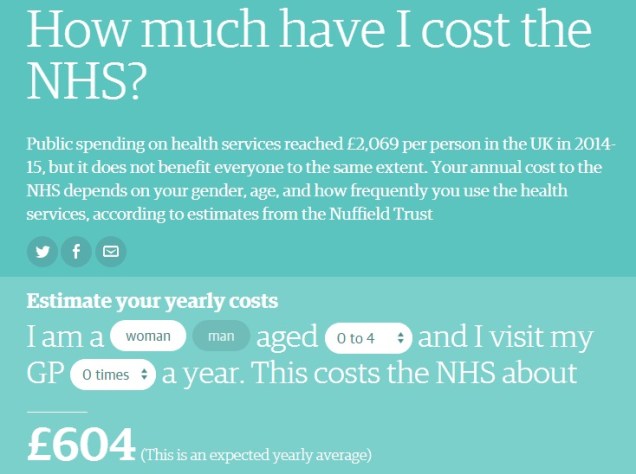
National Religion Daily Penance: How Much Do YOU Cost Our NHS?

NHS - National Religion - How Much Have I Cost The NHS - Worship - Self Flagellation - Socialism

Don’t join in the Guardian’s fawning worship of the state – you don’t owe the NHS anything

If any further proof were needed that conservatives and socialists think differently and see the world in a completely different way, you need only look at the latest feature in the Guardian’s nauseating, saccharine “This Is The NHS” series, a self-flagellating little feature asking “How much have I cost the NHS?”

In this post, the Guardian takes a break from exploiting real-life stories from doctors and patients to emotionally manipulate people into blindly supporting Britain’s unique but unexceptional healthcare system, and instead invites you to plug your personal details into their online calculator so that you can find out exactly how much money Our Blessed NHS lavishes on you every year. You ungrateful wretch.

The Guardian intones:

Public spending on health services reached £2,069 per person in the UK in 2014-15, but it does not benefit everyone to the same extent. Your annual cost to the NHS depends on your gender, age, and how frequently you use the health services, according to estimates from the Nuffield Trust.

So the total cost of your healthcare increases as you consume more healthcare services. Riveting stuff. Great investigative journalism.

The calculator does throw up some interesting numbers. Interestingly, if you sit stubbornly at home and never use a single NHS service or treatment of any kind, you somehow still manage to cost the health service hundreds of pounds a year.

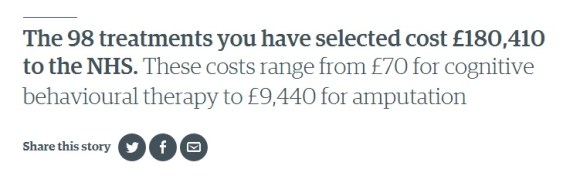
Meanwhile, at the other end of the spectrum, if you were really unfortunate and had every possible thing go wrong with you (once) in a given year, the NHS could be on the hook for as much as £180,410 – though I suspect that the calculator is holding back here, and that some patients may comfortably exceed this total without having to check every single box:

How Much Do You Cost The NHS - 3

How Much Do You Cost The NHS - 2

Also interesting is the fact that the only mention of mental health and associated problems from addiction to depression is buried deep in the “Other” section, and not given the prominence that a right-on publication like the Guardian might be expected to lavish. One can only speculate as to the reason for this sudden downplaying of mental health issues.

But the really interesting and revealing fact is that the Guardian published the article at all – and the conspicuous lack of a counterpoint piece asking how much we each contribute to the NHS (or indeed any of our other public services) every year through our taxes. Why the obsession with how much we are individually costing the state (or harming the environment with our carbon dioxide emissions, or doing any other Bad Thing) when there is no equal curiosity about how much we contribute? Looking at one side of the equation is meaningless until you also have visibility of the other.

This deliberate omission is especially galling at a time when some citizen-focused governments are now providing individual taxpayers with an itemised receipt every year, showing how much of their taxes have been spent on different areas of the budget like education, healthcare and defence. George Osborne even brought the practice to Britain, to the inevitable howls of protest (and accusations of disseminating propaganda) from the Left.

It may seem trivial, but this is a fundamental difference in mindset. Issuing a receipt showing how and where government is spending your money is an act of transparency and an acknowledgement that the government derives its legitimacy from – and can only function with the consent of – the citizenry.

Publishing a sanctimonious little online calculator so that your left-wing readership can calculate how much they cost society with every breath, on the other hand, elevates the state above all. It presupposes that we exist only at the pleasure of the government, that the state has a rightful claim on all of our possessions as well as the product of our labour, and that we should be grateful for any trivial sum that we are allowed to keep for ourselves after we have funded the Public Services behemoth.

Doing things the Guardian’s way – focusing on how much taxpayers “cost” their own government – inverts the proper power relationship between citizen and government, which should rightly be one of the state existing to serve and protect the people, not the other way around.

But of course we all know exactly why the Guardian is so eager to talk about how much we cost the state (and chide us for doing so) yet desperate to avoid talking about how much we contribute. Because to look at both sides of the equation simultaneously would be to encourage the public to ask whether they getting value for money. And it would reveal – as we now know – that the majority of us are net takers, or beneficiaries, from the system.

The Guardian’s whole anti-Tory, anti-austerity schtick is built entirely on the notion that we all contributed to our public services, and that the dastardly Evil Tories are cutting services to which we have all made substantial financial contributions. They seek to perpetuate the vague notion that we have a contributory welfare system, when in reality Britain’s welfare system is defiantly, depressingly non-contributory.

Some of us contribute vastly more to the exchequer than we will ever receive back in public services. Some of us struggle to break even. And others are on “take” mode for pretty much their entire lives – often for very justifiable reasons, but other times much less so. Most of us will fall into different categories at different stages of our lives.

But the Guardian doesn’t want people to know or think about any of this, or have access to this information. The prosperous middle-class couple on a joint six-figure income, blessed with good health and the lifestyle habits to maintain it, may well balk when they realise how much they are contributing to the NHS compared to what they receive back in a given year, or the equivalent projected lifetime figures. And they may balk again when they realise that their chain-smoking neighbour who trundles off to the doctor at the first sign of a cold contributes far less.

In short, real transparency about contributions made and benefits received would encourage a more consumer-like mindset among the people, forcing them to take responsibility and make the decisions which are best for them and for their families. And this goes against everything that the Guardian believes, because they want us to be a nation of state-dependent drones, flopping around helplessly, utterly reliant on services and/or alms disbursed by the government.

So, to recap: Itemised bills from the government for services provided to you by the state? Wonderful, brilliant idea, and a great way to remind us of everything that the beneficent nanny state does on our behalf.

Itemised receipts from the government showing the breakdown of how your tax payments are being spent? Evil propaganda designed to mislead the people and whip the lemmings up into a hysterical rage.

Glad we cleared that up.

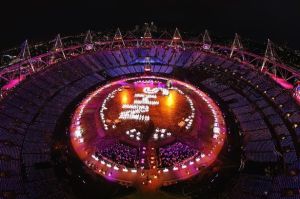
A scene from the Olympic opening ceremony celebrating the NHS

NHS Worship - London Olympic Games 1

Agree with this article? Violently disagree? Scroll down to leave a comment.

Follow Semi-Partisan Politics on TwitterFacebook and Medium.

Don’t Blame Anti-Establishment Politicians For Vile Online Abuse

Internet Troll - Cyber Online Abuse

Taking offence in the behaviour of a politician’s online supporters says a lot more about your view of that particular politician than the uniquely “hateful” nature of their fans

What do Jeremy Corbyn, Nicola Sturgeon, Bernie Sanders, Donald Trump and Nigel Farage all have in common?

Nothing to do with their political views, obviously – you would be hard pressed to imagine four more different politicians, both in terms of style and substance. But they do share something more fundamental in common: the fact that their supporters are uniquely derided as being angry and intemperate, even sexist or racist trolls, especially when compared to the supporters of their more established rivals.

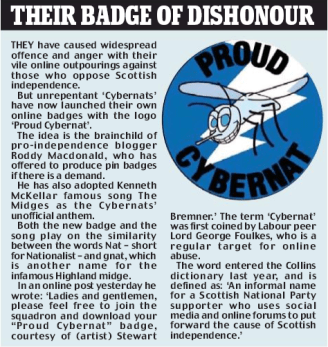
How many times have you heard a wounded, thin-skinned Westminster media type complain in hurt tones that they have received “vile online abuse” from crusading Ukippers or SNP-supporting Cybernats? And this is nearly always followed by the accusatory observation that the journalist or media star in question has never been so insulted or abused by supporters of the other mainstream parties or candidates.

You have likely seen or read this lament numerous times in one form or another. Typically, they will conclude – either explicitly or by inference – that there must be something uniquely awful and unacceptable about that particular party or candidate’s views, something which either attracts a disproportionate number of crazy people, or else makes otherwise good people behave in reprehensible ways.

Here’s the Telegraph’s James Kirkup raising an eyebrow after receiving a less than loving and nurturing response from online UKIP supporters, in a piece rather preciously titled “Why are UKIP supporters so rude and horrible?”:

A brief glance through the comments sections of the Telegraph website will show this is not an isolated incident; hostile and personal remarks are a common feature of online discussion about Ukip-related stories and columns. My email inbox tells a similar story.

I’m not alone here. There is nothing unique or special about me, no individual quality that attracts such strong feelings. All of my colleagues who cover Ukip and Mr Farage regularly receive such vitriol, and several of them get it in much larger volumes than me.

[..] I’m increasingly convinced that Ukippers are one of the political groups whose members are disproportionately likely to go in for online bile. (Scottish Nationalists are another; I haven’t had the pleasure of their electronic company for a while, but in a previous job I got to know the “cybernats” fairly well.)

Kirkup’s piece is actually fairly generous – he goes on to praise Ukippers for their passion and commitment, although it comes across in a rather condescending way.

But there is no such generosity in this farewell to the Labour Party from Barbara Ellen, who took her leave after finding herself unable to cope with the fact that her preferred centrist wing of the party finds itself temporarily out of favour for the first time in decades.

Smarting from the “howling gales” of disagreement she encountered, Ellen raged:

Still the Corbynista circus refuses to leave town, with one troubling result being that the term “moderate” is starting to look tarnished and devalued – deemed too centrist, restrained, temperate, cautious. Never mind that this describes most of Britain – or that this culture of moderate-baiting is hounding people like myself (lifelong Labour voters) out of the party. Like many in the great disenchanted Labour diaspora of 2015, I don’t feel remotely “Tory lite”, but nor do I feel that there is a place for me in this brutal and monochrome, but also silly and over-simplistic, “with us or against us” regime.

And maybe there’s a faint hope that by leaving, by voting with your feet, you’ll finally quietly reasonably (moderately!) make your voice heard. It’s a sad scary moment when “moderate” starts feeling like a insult. I’d have thought that moderates were the bricks and cement of any political party – without them, the extremes become unmoored, sucked into howling gales of their own making. The leftier-than-thou can taunt the departing “boring”, “gutless”, “Tory lite” moderates all they like. In the end, we were necessary and we’ll be missed.

The media’s hysteria about boisterous and sometimes deeply unpleasant online political discourse reached its peak with their coverage of the Jeremy Corbyn campaign, with endless finger-wagging remarks about how the actions of a few anonymous knuckle-dragging trolls supposedly make a mockery of Corbyn’s “New Politics”.

Here’s the Spectator’s Sebastian Payne rending his garments in anguish at the fact that some unhinged Corbyn fans happen to say some very unpleasant things online:

It was meant to be about open debate and discussion, consensus through dialogue. But so far, Jeremy Corbyn’s leadership of the Labour party and the arrival of the so-called New Politics has resulted in division and a lot of abuse and bad feeling. In light of last night’s vote on Syria airstrikes, Twitter and Facebook have been exploding with extraordinary levels of comments and abuse that no one, MPs or otherwise, should be subjected to.

For example, hard-left groups such as Lefty Unity, have been using Twitter to stir up agitation against the MPs they disagree with.

The article goes on to cite a tweet listing the names of Labour MPs who voted for military action in Syria, and calling for party members to deselect them. Remarkably, Payne presents this as some terrible affront to civilised behaviour rather than precisely what should happen in a democracy: MPs making decisions in public, and the public judging MPs based on those decisions. The horror!

Unfortunately, our default reaction is increasingly not just to sit back and mock the individual trolls (justified), but to then also make the lazy assumption that the internet trolls somehow speak for the wider movement or supporter base (much less justified). Everyone enjoys seeing an ignorant verbal abuser put back in their box, but we are being intellectually lazy if we then go on to believe that people like the anonymous idiot silenced by JK Rowling are representative of general UKIP or SNP opinion.

Cybernat - Online Abuse - Trolling

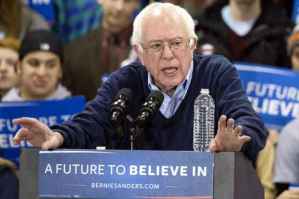
Exactly the same phenomenon can now be seen in the United States, where supporters and media cheerleaders of Democratic establishment favourite Hillary Clinton are lightning-quick to accuse their opponents of sexism, and to refer disparagingly to supporters of socialist rival Bernie Sanders – alas, a white male – as the “Bernie Bros”.

Glenn Greenwald does a superb job of debunking the myth that Bernie Sanders supporters are uniquely sexist or misogynistic among political supporters over at The Intercept, writing:

Hillary Clinton is the establishment candidate. Therefore, she has far more supporters with loud, influential media platforms than her insurgent, socialist challenger. Therefore, the people with the loudest media platforms experience lots of anger and abuse from Sanders supporters and none from Clinton supporters; why would devoted media cheerleaders of the Clinton campaign experience abuse from Clinton supporters? They wouldn’t, and they don’t. Therefore, venerating their self-centered experience as some generalized trend, they announce that Sanders supporters are uniquely abusive: because that’s what they, as die-hard Clinton media supporters, personally experience. This “Bernie Bro” narrative says a great deal about which candidate is supported by the most established journalists and says nothing unique about the character of the Sanders campaign or his supporters.

And the same blindingly obvious truth hits closer to home with the media’s reaction to – and coverage of – Jeremy Corbyn’s campaign for the Labour leadership:

This exact media theme was constantly used against Corbyn: that his supporters were uniquely abusive, vitriolic, and misogynistic. That’s because the British media almost unanimously hated Corbyn and monomaniacally devoted themselves to his defeat: So of course they never experienced abuse from supporters of his opponents but only from supporters of Corbyn. And from that personal experience, they also claimed that Corbyn supporters were uniquely misbehaved, and then turned it into such a media narrative that the Corbyn campaign finally was forced to ask for better behavior from his supporters.

Time and again we see establishment candidates and their fans in the media reaching for the smelling salts and clamouring to tell us how insulted and distressed they are, simply because something they said or wrote happened to tap into the coarsing vein of popular anger against a political establishment which grows remoter and more self-serving by the day. But we should recognise this for what it is – a cheap attempt to shut down the debate by rendering certain political ideas unthinkable or unsayable.

It is very much in the interests of centrists within Labour and the Conservative Party that people should fear policies with a genuine ideological twist to them, be they from the Right or the Left. When their entire pitch to the electorate consists of fatuous promises to be the most competent managers of our public services, as thought Britain were nothing more than a rainy island of hospitals and job centres, anything which attempts to inject some inspiration, ambition or bold thinking into our political debate is to be greatly feared, and thwarted at all costs.

Hence the continual efforts to portray Jeremy Corbyn’s left-wingery, something which would have been considered perfectly normal in 1986, as beyond the pale of acceptable thought in 2016.

Hence the sneering, virtue-signalling attacks on Ukippers, who have been shamefully portrayed by the media as a bunch of grunting, uneducated, economically “left behind” losers who wrap themselves in the Union flag because they are somehow more scared of change than a “normal” person.

Hence the apocalyptic predictions of those opposing Scottish independence, warning that Scotland would become some kind of tartan-clad North Korea if they went their own way.

Now, this blog believes that Jeremy Corbyn’s left wing policies are utterly wrong for Britain, that UKIP does have a certain unsavoury element within it, and that Scottish independence and the breakup of the United Kingdom would be a tragedy. But I don’t for a moment assume that the virtue of these ideas can be judged in any way by the behaviour of their most crude and sociopathic advocates. And nor do I attempt to suppress the expression of those ideas by linking overheated rhetoric on social media to any one particular idea, candidate or party.

All of which makes you wonder: If the establishment are so self-evidently right, if the centrist parties and politicians do indeed have a monopoly on Good and Pragmatic Ideas, and if anybody who proposes the slightest departure from the status quo is a juvenile dreamer or a tub-thumping populist, why not let the arguments speak for themselves?

If the establishment have the facts so overwhelmingly on their side, why do they not limit themselves to patiently explaining why Bernie Sanders, Jeremy Corbyn, Donald Trump and Nigel Farage are wrong on the issues? And at a time when political engagement is falling and faith in democracy ebbing, are the Corbyn critics and Farage haters really saying that they would rather people were disengaged than back a radical candidate?

This blog would argue that there is a certain nobility in all of the populist insurgencies currently roiling the political landscape in Britain and America. Whether one agrees with them or not (and there is often much to vehemently disagree with), they are at least attempting to drag us out of a stale and timid political consensus which has delivered prosperity for many but also failed too many of our fellow citizens.

Or as this blog remarked last year:

It is very easy to sit smugly on the sidelines, throwing the occasional rock and taunting those who risk hostility, ridicule and contempt as they struggle to find a way to make our politics relevant to the people. Anyone can be a stone-thrower. But it’s another thing entirely to roll up your sleeves, join the fray, pick a side or – if none of the available options appeal – propose new political solutions of your own.

Ukippers and Jeremy Corbyn supporters have often been steadfast in their political views for years, and as a result have languished in the political wilderness while those willing to bend, flatter and shapeshift their way toward focus group approval have been richly rewarded with power and success.

The “Bernie Bro” phenomenon in the United States and the centrist Labour hysterics about the antics of a few offensive people are nothing but a choreographed backlash from the establishment, whipped up by people who are happy to hijack issues like feminism and use them for their own short-term political advantage, or do anything else to disguise the yawning chasm where sincerely held convictions and beliefs should reside.

So, when you see a bunch of prominent, well-connected people feigning horror at the way in which people with whom they disagree are comporting themselves on the internet, your first thought should not be to dismiss the idea or candidate whom the obnoxious trolls support, but rather to question the real motives of the people weeping and rending their garments because they have been spoken to rudely on social media.

It may turn out that the trolls are still wrong, as well as being obnoxious and offensive. But many times, it will likely transpire that the people making the most fuss about the way that a particular candidate or party’s supporters are behaving also happen to have the most to lose in the event that those ideas gain a wider following. And their sudden desire for comity and a more respectful public discourse is cynical at best.

So what do Jeremy Corbyn, Nicola Sturgeon, Bernie Sanders, Donald Trump and Nigel Farage all have in common?

They are all flawed.

They are all willing to say things which make them wildly unpopular with large swathes of people.

Without their boldness and tenacity, few of us would still be discussing their top issues and obsessions – be it genuine socialist politics, Scottish independence, immigration or the coming EU referendum – and our politics would be left to the stale old two-party duopoly.

And none of these politicians, whatever their flaws, deserve to be judged by the online behaviour of their most angry, antisocial supporters.

Bernie Sanders - Refutes Bernie Bros

Top image: “#GamerGate is the future of troll politics”, Techcrunch.com

Agree with this article? Violently disagree? Scroll down to leave a comment.

Follow Semi-Partisan Politics on TwitterFacebook and Medium.