The Dangerous, Beguiling New Conservative Luddite Movement

img_0178

Conservative reform? Who needs it? Apparently the dogmas of the quiet past are totally adequate to the stormy present

Just as the prestige conservative media and a handful of prescient MPs are belatedly waking up to the need for serious ideological renewal within the Conservative Party, a reactionary new counter-movement seems to have popped up, determined to counsel complacency and inaction instead of urgency and reform.

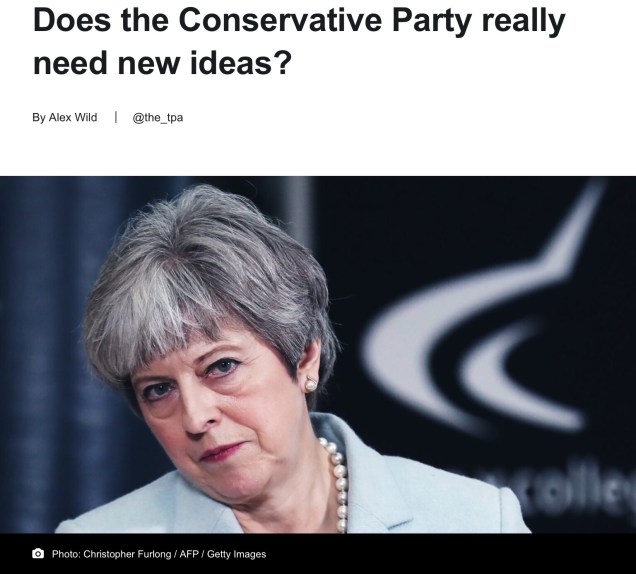
Alex Wild of The Taypayers’ Alliance has a new piece in CapX entitled “Does the Conservative Party really need new ideas?“, in which he determines that no, the Tories can apparently do just fine by reheating the ideas and rhetoric of the past.

Not everything that Wild discusses is wrong – he does at least acknowledge that the Conservative Party’s primary political error in recent years has been their cowardly acceptance of leftist ideas and frames of reference, borne out of a pathetic and hopeless desire to be liked rather than respected. That much at least is accurate. But when it comes to diagnosing solutions, Wild seems to be under the dangerous illusion that playing the old Tory Greatest Hits album on endless repeat is a solution remotely equal to the challenge of our times. It isn’t.

Wild writes:

Instead of continually accepting the Left’s diagnosis and offering halfway-house policies that don’t actually do anything to address underlying causes, more basic thinking is required.

Energy is widely regarded as a dysfunctional market. But why doesn’t this market work while others, for example retail, do?

Is it because the shareholders and executives of utility companies are much more greedy and incompetent than the shareholders and executives of major retailers?

Or is it because, unlike in the energy sector, the government does not decide which shops are built where, what they sell and at what price?

This is indeed “basic thinking”. There are a number of reasons why even passionate privatisation advocates don’t support the idea of total deregulation of the energy market, not least because short-term profit maximisation may well be in the best interests of shareholders, but does not necessarily promote energy security or national security.

The worst that can happen with a deregulated retail sector is that some of our provincial high streets lose their character and small businesses, to be replaced by out-of-town big box stores which in turn are undermined by online shopping. The worst that could happen with a totally deregulated energy sector, on the other hand, is that the lights go out. We can have a sensible discussion about whether the current mode of privatisation is working, how it can be improved and whether more can be done to give consumers access to better information and ease of switching suppliers, but airily suggesting that the government get out of the way and allow any old punter to throw up a coal-fired power plant is to indulge in libertarian fantasy – and not even the good kind.

And then we get to the main event:

For the less-careerist, more policy-orientated MPs however, a potential pitfall is not just that they advocate variations of Leftist policies, but that they try too hard to find new ideas and wheezes whilst ignoring old ones which we know would actually work.

For starters, they should revisit policies floated between 2010 and 2015 that then failed to make it through the inevitable political wrangling of coalition government.

The reality is that for most of the major challenges the country faces, there are obvious solutions. Huge amounts of time and effort have been spent trying to explain the UK’s “productivity puzzle” but even if there are yet-to-be-fully-understood factors at play there are masses of things the government could do that would significantly increase productivity.

The tax system that punishes investment by taxing profits and not allowing businesses to write off investment in machinery and property from their tax bills. Stamp duty that gums up the housing market, preventing people from moving to take up better-paid jobs. The dreadful planning system that has driven up the cost of housing to obscene levels. The 67 per cent effective marginal tax rate on some high earners. The ongoing Heathrow third runway farce.

These are all problems with obvious solutions. No “blue-sky thinking” is required.

This “programme” of policies is to fail to see the wood for the trees. Sure, some of these ideas have merit – raising the speed limit seems sensible, while we have long known that a broken, NIMBY-enabling planning system is responsible for the ongoing housing crisis (the issue here is a lack of political will to fix it, not ignorance of the solution). Most conservatives also would agree that Gordon Brown’s questionably revenue-positive tax hike should have been repealed completely, not simply reduced by David Cameron’s equivocating administration, while this blog has been championing a third runway at Heathrow since I started writing in 2012.

But given the seismic political changes we have witnessed in British politics – the rise and fall of UKIP, the wane of Labour centrists and the Age of Jeremy Corbyn, the EU referendum and Brexit itself – it should be obvious to any outside observer that there is tremendous public dissatisfaction not confined to any one specific policy or issue, but rather at a systemic level. And looking at the state of the world – with the benefits and challenges of globalisation and automation, the ongoing massive global migration and the threat posed by radical Islam – it should be equally apparent that the standard policies of the centre-left and the centre-right are unequal to these unique challenges.

Reheating the 1980s and 1990s playbook is (in some ways) also currently being attempted by the Republican Party in the United States, and equally doomed to fail there as it is in Britain. With Donald Trump in the White House, Republican congressional leaders seized the moment to pass the big tax cut for which they have been incessantly clamouring. Fair enough. But now that they are in government rather than opposition, the tax cut came packaged with no commensurate spending cuts, meaning that the resulting bill has blown an already sizeable budget deficit wide open. After all the moralistic preaching about fiscal responsibility during the Obama years, only one Republican senator – Rand Paul of Kentucky – expressed serious reservations about this hypocrisy (and even he ultimately voted for the bill).

This approach may reap some political dividends in the short term, as individuals enjoy a slight reduction in their tax burden and certain corporations reward their long-serving employees with an unexpected bonus. But in the medium to long term, all the Republicans are doing is frittering away any remaining claim they had to being the party of fiscal conservatism, kicking the can down the road on every serious entitlement reform which needs to be considered and further sullying their brand by association with President Trump’s new protectionism.

Likewise, rebooting Thatcherism for the 21st century with no introspection or modification is no solution to our present challenges. Thatcher’s privatisation programme and her government’s rollback of the worst excesses of the socialist post-war settlement were vital, and saved this country from likely terminal national decline. There are few more ardent fans of Margaret Thatcher than myself. But to pretend to oneself that the same bag of tricks will get Britain out of an entirely different set of problems four decades later is dangerous self-deception.

One gets the strong sense that the rising profile of backbench MP and Brexit Ultra Jacob Rees-Mogg, refreshing though he can be (on matters other than Brexit) for the forthrightness of his views and his refusal to disavow deeply held values, is also a symptom of this nascent reactionary movement within contemporary British conservatism, the idea that we need only find a new leader who looks and sounds like a traditional Tory in order to repeat past Tory success.

But what Alex Wild and this nascent Thatcherism Redux movement fail to realise is that Britain has entered an unstable period of political discontinuity, a time of serious national challenges, threats and opportunities where the tried-and-tested policies of the past no longer work effectively nor command majority political support. Be it Corbyn’s unreconstructed socialism, reanimated Thatcherism or whatever Theresa May’s inarticulable vision of government happens to be (nobody really knows), none of these options command the kind of enthusiasm or political support on which strong governments with mandates for change are built.

There is no tax cut which can address the fact that Britain’s public pension system is becoming little more than a national Ponzi scheme propped up only by high levels of immigration (itself a solution with rapidly diminishing returns). There is no privatisation scheme which can deliver meaningful healthcare reform within the incredibly narrow Overton window established by the high priests of the NHS. There is no instant productivity fix, or any lasting solution to that intractable problem which does not involve a much wider conversation about how our education system currently fails to churn out school leavers, apprentices, technical diploma holders and university graduates equipped to walk into the jobs of tomorrow – let alone reach back to help those adults struggling to adapt on their own.

These are some of the real root causes of voter dissatisfaction with the status quo. Public polling may not yet always the right questions in order to draw this broader, inchoate dissatisfaction out into the open, but the pressing nature of these challenges should be evident to anyone involved in strategic political thinking (apparently a particular weakness in the current Tory Party).

The absolute last thing that the anaemic British conservative movement needs, just as it starts to awaken to the danger in which it has placed itself, is for a new movement to come along peddling false reassurance that new challenges do not in fact require new policy solutions, and that there is no problem too big to be effectively cured by tax cuts and deregulation. Yet this message, if allowed to go unchallenged, may prove to be especially attractive to a Conservative Party in which only a handful of MPs are awake to the need for ideological renewal.

For many senior Conservatives – including Theresa May’s uniquely uninspired senior lieutenants and likely successors – the message that they can succeed by adopting the government equivalent of painting by numbers effectively absolves the government of any need to think for themselves, to acknowledge that the dogmas of the quiet past are inadequate to the stormy present.

And that’s what makes the siren song of Thatcherism Redux so potentially dangerous.

Conservative Party Logo - Torch Liberty - Tree

Support Semi-Partisan Politics with a one-time or recurring donation:

Agree with this article? Violently disagree? Scroll down to leave a comment.

Follow Semi-Partisan Politics on TwitterFacebook and Medium.

Left-Wing Groups Continue To Outpace The Conservative Party On Strategic Thinking

Young Fabians - Global Ready Britain - Taking Stock As We Go It Alone

While Theresa May’s rootless Conservative Party tears itself apart over Brexit and continues to fail to provide a clear, positive vision for Britain, one currently has to look primarily to left-wing groups for a systemic analysis of Britain’s challenges — and ideas to fix them

Depressing as it is to write, still it must be acknowledged that with the Conservative Party permanently stuck in neutral under the leadership of a failed prime minister, nearly all of the intellectual and political energy currently resides on the left and centre-left of British politics.

Not Jeremy Corbyn’s faction of the Labour Party, of course – Corbynism still doesn’t seem to amount to much more than reheating the planned economy policies of the 1960s and 1970s, which only failed last time because we didn’t throw ourselves behind them lustily enough when they gave us the three-day week and rolling blackouts. And an important caveat should be made that some forward-thinking Conservative MPs are doing their utmost to shock some intellectual and ideological life back into the party – George Freeman and Nick Boles being the two most prominent examples.

Yet it remains the case that when it comes to acknowledging that Britain has entered a period of discontinuity – a time when we face a new configuration of challenges which are unresponsive to the policy remedies of the past and causing people to lose faith in existing political parties, processes and institutions – the Left seems to “get it” far more than the Right. This might be forgivable if conservatives were actively using their time in government to enact an agenda of their own, however misguided. But there is no agenda, save what appears to be a concerted effort to move the Conservative Party to the left of Ed Miliband’s losing 2015 Labour Party manifesto.

By contrast, Ria Bernard, chair of the Young Fabians, has one eye fixed on the future. Writing for LabourList, Bernard urges:

As the UK prepares to leave the European Union, we need to be thinking about our position globally to ensure that we can compete and prosper economically and socially on the international stage.

While understandably most parliamentary activity is currently focused on the Brexit deal, we need to consider what happens next as Britain seeks a more independent role for itself in global trade.

The idea of auditing our strengths and vulnerabilities as a nation should not be something brought about by the decision to break ties with the EU – it should be something we are routinely doing to enable us to reach our potential and ensure prosperity for everyone in society. But it seems particularly important that at this time we consider where we stand in terms of a range of domestic policy areas and how we measure up to nations around the world.

If we look at our domestic policies, are we functioning at full capacity? Do we have the skills, expertise and structures in place to ensure that domestically we are supporting the population, and internationally we are able to compete? Which areas of domestic policy will put us in a strong position as we go it alone, and where will we need to be focusing our efforts to ensure that we can compete and participate in the global economy?

Apparently the Young Fabians have been working on this initiative for awhile, and have now published a report with the fruits of their labour. The report itself grew out of discussions around three specific questions:

  1. What are the strengths and vulnerabilities of Britain’s domestic policy in comparison with other countries?
  2. What are our core strengths as a nation that will enable us to effectively compete in the global community?
  3. What will undermine our place on the global stage?

These are absolutely the kind of questions that need to be asked in order to engage in strategic thinking. Serious political leaders ought regularly to conduct a dispassionate analysis of where we stand vis-a-vis our peer countries and competitors. They ought to fearlessly scrutinise our current strengths and weaknesses, confronting any serious liabilities rather than ignoring them. And perhaps most importantly, serious political leaders should be able to outline a clear vision for domestic political reform or management together with an unambiguous declaration of what Britain stands for in the world – and with whom we stand.

Does anybody honestly think that the incumbent Conservative government is engaging in any of these basic acts of strategic thinking? Does anybody honestly believe that they have done so since Theresa May came to power? Or even since 2010 and the coalition government led by David Cameron? In the former cases, the answer is surely no. Instead, ministers scurry around putting out fires or chasing positive headlines, picking up or dropping policies based on the next day’s news cycle rather than doing what is right, guided by conservative principle. And all of this under the “leadership” of a prime minister whose primary objective every morning is to survive the day.

Obviously it is easier to engage in strategic thinking from the luxury of opposition, when one has nothing but time to kick ideas around and undertake the kind of analysis that leads to good policy. But being in power is no excuse for a failure to plan – this government should be able to walk and chew gum at the same time, otherwise what are we paying them for?

Meanwhile, as Conservative MPs and activists glumly try to discern whether Amber Rudd or Philip Hammond is the more inspirational, charismatic future leader to replace Theresa May, the Young Fabians correctly identify many of the major challenges facing the country:

It is widely acknowledged that we are performing poorly in terms of growth, productivity and underemployment. We have a generation of young people who are encouraged to go to university, then face a limited pool of graduate-level jobs, leading to a huge mismatch between skills and demand across the skills bands. The “gig economy” and the rise in automation is at risk of eroding hard-won rights and making job security a luxury. Our levels of productivity are some of the lowest in the world and yet we are working some of the longest hours in Europe.

If we look at health and education – are our systems the most effective way to ensure a healthy, prosperous and highly skilled population? The NHS is under phenomenal strain as it performs in a context of under-funding, staff shortages and the demands of an increasingly ageing population. A country with a healthcare service that is entirely free at the point of use, and provides services far beyond the scope of when it was initially founded in 1948, spends a significantly low proportion of its GDP on it. The NHS is likely to face challenges around funding for new research and negotiating with pharmaceutical companies, as well linking up with social care and the correcting the failure to invest in prevention.

The increasingly fractured education system, which comprises a wide range of schools from privately-funded institutions and state comprehensives to academies, free schools and faith schools, is leading to postcode lotteries and a disparity in access to specialist provision. Yet, in terms of skills and innovation, we need to be evaluating whether our national curriculum is fit for teaching the skills and knowledge that will be needed to compete in the international job market. Is the next generation prepared for the new world of automation and able to compete in the era of globalisation?

At one point in the report, the Young Fabians – the Young Fabians! – even question the continued viability of the National Health Service:

Turning to the NHS, there was much discussion on whether it is the most cost-effective way of delivering high quality, free at the point of use healthcare or if the system is no longer sustainable.

Meanwhile, Conservative MPs, terrified of showing anything less than fawning deference to our national religion, continue to tweet out bland banalities and paeans of praise to the NHS without engaging in any kind of strategic or comparative analysis to determine whether that dated organisation still best serves our needs:

What is impressive here is that rather than wasting time in a divisive effort to thwart Brexit or impose an ideologically pre-determined left-wing wishlist of policies on Britain, the Young Fabians chose instead to look forward, not back. They started with a blank sheet of paper and  sought to identify all of the various challenges (and presumably opportunities) facing Britain in order to inform joined-up policymaking.

The next step – for which we have not yet seen any evidence from the Young Fabians, though hardly their fault when nobody else has led the way – is an attempt to join up these various diagnoses and identify the connections, dependencies and shared root causes between the various issues. This is an important step if we are to ensure that future policies work in concert with one another to achieve positive outcomes rather than interfering with one another or leading to the kind of confused messaging which can erode political support for a course of action.

It should be a source of abiding shame to Theresa May and those with prominent positions in the Conservative Party that one has to turn to groups such as the Young Fabians for the kind of strategic analysis that most competent governments (and nearly all major corporations) undertake as a matter of course. It should not be necessary for blogs such as this one to plead with MPs and ministers to lift their gaze from the daily news cycle for long enough to articulate a positive vision for their respective departments or for the country as a whole, and yet here we are.

When Britain last went through a period of discontinuity in the late 1970s, Labour represented declinism, fear of the future and a slavish commitment to the failing policies of the post-war consensus. Their punishment for failing to show political courage at that time was eighteen years in the wilderness of opposition, and the destruction of much which they claim to hold dear. The Tories now find themselves in a nearly identical position, painted as grim custodians of a failing status quo, an obstinately un-visionary party of technocrats and chancers who want to cling onto power only for power’s sake. Some of the issues feeding into our current period of discontinuity are different, but the political threat is identical.

And unless the Tories can stop being bested at strategic thinking by a group of earnest twenty-somethings of the centre-left, Labour’s fate of 1979 awaits them.

Conservative Party Logo - Torch Liberty - Tree

Support Semi-Partisan Politics with a one-time or recurring donation:

Agree with this article? Violently disagree? Scroll down to leave a comment.

Follow Semi-Partisan Politics on TwitterFacebook and Medium.

Unregulated, Unaccountable Corporate Megacharities Like Oxfam Are Not Fit For Purpose

BRITAIN-HAITI-CHARITY-PROSTITUTION

The Oxfam sex scandal is just more depressing proof that Britain’s giant, government-funded megacharities are almost completely unregulated and accountable only to trial by media

I have refrained thus far from writing about the Oxfam prostitution/rape scandal as the fallout metastasises throughout the charity sector, but I’m sure that regular readers can already guess exactly what I think about a largely government-funded pseudo-charity staffed by overpaid mediocrities who seem to think that their primary job consists of issuing prissy, sanctimonious reports attacking the one economic system which has lifted more people out of grinding, desperate poverty than all the charities of the world put together.

Much of the counterreaction on the Left has focused on the idea that conservatives want to cynically use this scandal as a reason to discredit and cut international aid – guilty as charged, in many cases. But there is also a creeping awareness on the Left that institutionalised compassion through government-funded charities is both inefficient and politically problematic.

As Ian Dunt wrote over on politics.co.uk today:

You could feel the story bursting at the seams of its Oxfam straightjacket and trying to become one which was sector-wide, a broader indictment of charities having generally lost their way. That’s partly because there is a small army of journalists out there intent on taking on the charity sector. The Express and Mail have been obsessed for years. But that does not make it a right-wing initiative alone. Many others on the progressive left are uncomfortable with the way the sector operates.

And there have been plenty of reasons to do so. Many charitable organisations, like Oxfam, grew so big they essentially became akin to corporate giants. They started obsessing over their reputation, which can be a prologue to hushing up that which might damage it. They began paying out eyebrow-raising sums for chief execs. Mostly they could justify these sums by stressing that they wanted the best people for important missions, but that would have made little sense to many of their donors, on low incomes, who had given some of their hard-earned income on a charitable instinct, only to find that the money was funding a salary they would never come close to achieving themselves.

The government guarantee of 0.7% of GDP on aid spending, which functions as a litmus test of the Conservatives’ moral responsibility in an age of austerity, also creates perverse incentives. It reverses the process by which a government department has to justify its spending on a project. The incentive now is to find things to spend the money on. Once that happens, it won’t be long before some dubious projects get funding.

Dunt goes on to warn that if this scandal is not rapidly contained, it could become the charity sector’s equivalent of the MP’s expenses scandal, where permanent and far-reaching reputational damage is done, leading the general public to forswear making charitable donations to international aid organisations.

Dunt’s concerns – including the perverse incentives created by the pig-headed, fixed 0.7% of GDP target for international aid – are absolutely valid, and his willingness to risk angering his own side by pointing out that megacharities like Oxfam often become extensions of the clubby, incestuous Westminster bubble from where they get their funding is commendable. In fact, one wonders how Dunt can be so perceptive and forthright on this issue while simultaneously being so hysterically blinkered on the subject of Brexit, but that’s another issue for another day.

What the Oxfam scandal and other instances of gross negligence in the charitable sector teach us is that however bad corporate governance may sometimes be in the for-profit sector, it is a strict and rigorous regime compared to the unregulated, unaccountable sphere in which the megacharities and NGOs operate.

When companies like BHS or Carillion go into administration, such is the public and political outrage that people associated with the stricken company are often hauled into court to be held accountable for their failings. But when similar outrages take place in the charity sector, the public outrage may be great but the consequences for those who oversee the failings are negligible. Why? Because they were trying to “do good”, and because they come from the same social bubble occupied by many politicians and members of the judiciary. The system protects its own.

One need only think of the fawning, uncritical praise heaped on celebrity charity CEO Camila Batmanghelidjh by politicians right up until the moment she ran her charity into the ground, leaving its service users high and dry, or by the way that she was allowed to melt back into anonymity rather than face any tangible consequences for her mismanagement.

As I wrote at the time of the collapse of Kids Company:

There is an aura around certain people – and around certain professions and political stances too, one might add – which makes close scrutiny and robust criticism almost impossible. And you can hardly do better escaping scrutiny than if you happen to work for one of those favoured organisations which enjoys the favour and blessing – and ministerial veto – of senior government officials, people who are guided by the opinion polls and an all-consuming obsession with how things look over how things really are – or could be.

But when is a charity not a charity?

Here’s a clue: If your organisation receives millions of pounds from the government, and if the state eclipses private and corporate philanthropy as the main benefactor and source of income, then it is not a charity. It is a QUANGO, a Public Service In All But Name, a de facto arm of the government. It comes with all the cons of financial burden on the taxpayer with none of the transparency or oversight that government spending at least pretends to ensure.

There are hundreds of Kids Companies operating up and down the country, charities in name but in reality monopoly providers of social care and other services under exclusive contract to local councils. This broken, unaccountable model should never have come to represent British philanthropy and charitable giving.

Unfortunately, we have a habit of seeing these scandals in isolation. We rightly get worked up about Kids Company, but then the news cycle moves on and the political class have little incentive to pursue people who so frequently come from the same backgrounds and occupy the same social circles. And bad or nonexistent charitable corporate governance is allowed to continue unchecked until the media discovers the next outrage.

Ian Dunt also makes this point:

The public anger towards the political class is not restricted to MPs. It encompasses a much larger, nebulous group, from think tanks, to journalists, to lobbyists, to bankers. Charities are increasingly seen as part of that, not least because they have often adopted many of the same techniques and mannerisms. They live in the same bubble and use the same language. If it isn’t this scandal that blows apart public trust in the sector, it’ll be the next one.

Yes. Britain’s megacharities are seen as part of that larger, nebulous group because they are very much a part of it. The vast over-reliance on state funding alone means that relationship are more opaque and questionable than should be the case, while the fact that such NGOs seem to recruit heavily from the same cultural pool which fills the ranks of politicians, journalists and think-tankers mean that the public naturally (and in this case correctly) jump to certain conclusions.

How much more generous might total British charitable donations be if they were encouraged through a tax-deduction scheme for taxpayers rather than being laundered through HM Revenue & Customs, adding to our total tax burden? And how much more efficient might out international aid efforts be if a large percentage of donations did not support support huge overheads and remuneration for senior staff?

Sadly, we are unlikely to find out. Unless we demand change or the Conservative Party finally decides to grow a backbone, Oxfam will make its insincere mea culpas, a few unfortunate scapegoats will be publicly shamed and stripped of their jobs, and the whole sleazy bandwagon will go rolling on.


Oxfam - love is safety badge

Support Semi-Partisan Politics with a one-time or recurring donation:

Agree with this article? Violently disagree? Scroll down to leave a comment.

Follow Semi-Partisan Politics on TwitterFacebook and Medium.

It’s Time For Conservative Party Donors, Members And Activists To Go On Strike

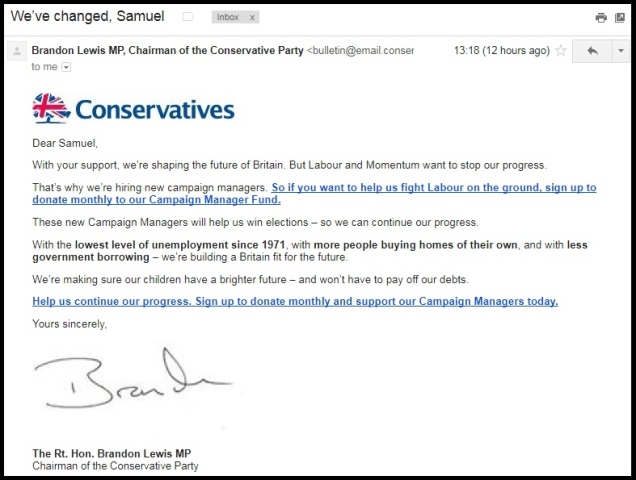
Conservative Party email bulletin - Brandon Lewis Chairman - Weve Changed

The Conservative Party: “Trust us, we’ve changed! It will be different this time, we swear. We love you, please don’t leave us.”

Apparently my incessant complaining for the past five years has finally paid off, because the Conservative Party has changed.

How do I know that the Conservative Party has changed? Because they tell me so. The following email pinged into the inboxes of everybody on the Tories’ distribution list this afternoon. Authored by new party chairman Brandon Lewis MP, the subject heading has all the grovelling obsequiousness of a husband who forgot to buy his wife flowers on Valentine’s Day while the main body offers no evidence of said change and rounds off with a petulant demand for cash.

Lewis writes:

With your support, we’re shaping the future of Britain. But Labour and Momentum want to stop our progress.

That’s why we’re hiring new campaign managers. So if you want to help us fight Labour on the ground, sign up to donate monthly to our Campaign Manager Fund.

These new Campaign Managers will help us win elections – so we can continue our progress.

With the lowest level of unemployment since 1971, with more people buying homes of their own, and with less government borrowing – we’re building a Britain fit for the future.

We’re making sure our children have a brighter future – and won’t have to pay off our debts.

Help us continue our progress. Sign up to donate monthly and support our Campaign Managers today.

The remarkable thing about this email is that every single sentence is either false or egregiously offensive to conservatives, and often both at the same time.

The lies begin at the top, with the risible notion that the current government is “shaping the future of Britain”. No, it most definitely is not. Theresa May’s government has not proactively shaped Britain or dictated the course of Britain’s fortunes or political discourse since the decision to trigger Article 50 of the Lisbon Treaty and set in motion our departure from the European Union. And even that was a colossal mistake, given the fact that the government had given precisely zero thought to what kind of future relationship it wanted with the EU, or what kind of relationship was politically, economically or logistically feasible. In other words, the one time that this government has come anything close to “shaping the future of Britain”, it punched itself (and the rest of us) in the face.

We then learn that the Tories want to hire a bunch of new campaign managers, presumably in the hope of staunching some of the inevitable massive bleeding in the upcoming local elections. But what message will these campaign managers be tasked with propagating? What vision for the future of Britain are they to devise a strategy to articulate? We still don’t know, and haven’t known since the moment Theresa May crossed the threshold of 10 Downing Street as prime minister.

In last year’s self-inflicted calamity of a general election, the whole pitch was “strong and stable”. Any idiot could have told CCHQ and Theresa May’s inner circle that “strong and stable” is a state of being, not a destination, and that people want clarity, purpose and vision in uncertain political and economic times. And this particular idiot did tell the Tories as much, repeatedly:

May’s risible pitch in the 2017 general election was strength and stability, but these are states of being, not a direction of travel. People jetting off in an aeroplane together would generally prefer less turbulence to a more bumpy flight, but more than anything they care about arriving at the correct destination. Jeremy Corbyn made his flight plan crystal clear to the British electorate. Theresa May didn’t even bother to produce one, preferring to pander to the Politics of Me Me Me.

But the political geniuses in CCHQ and Downing Street chose not to listen, and built their entire campaign around the visionary, inspirational leadership of the most wooden, uninspiring and unpersonable senior British politician in recent history. “Who needs ideas when we have Theresa May’s Kennedy-like charisma?”, CCHQ muttered to themselves as they drove the party into oblivion.

One might have hoped for some introspection since that calamity, a rethinking of the uninspiring, technocratic approach which the Tories have long embraced, but of course we saw no such thing. Despite mounting panic among the backbenches and a few gallant attempts at ideological defibrillation from forward-thinking MPs like George Freeman and Nick Boles, the Cabinet and party leadership are too busy undermining one another, messing up Brexit and positioning themselves to succeed Theresa May to actually stop and think about what Britain should look like in 2020, 2025 or 2030, let alone devise a vision for government to get us there. And they have the gall to ask for donations to fund campaign managers to help “win elections” and continue nonexistent progress (the third lie).

The fourth line brings us the Tories’ zippy new slogan, “Building a Britain Fit for the Future”. I initially had some hope that this new slogan might presage some new ideas from the Conservative Party, given its correct suggestion that the Britain of today is not fit for the future. But those hopes were quickly dashed. After having been given three months to take that statement of intent and flesh it out into something more than a slogan, Theresa May utterly failed to do so, instead producing seven bland and entirely forgettable pseudo-aspirations which could just as easily be the credo of the Labour Party or Liberal Democrats.

In reality, of course, the Tories are not building any kind of Britain at all. Thanks to the total lack of leadership from Downing Street and the dearth of policy vision from CCHQ, Britain is not shaping events but rather being shaped by events, in much the same way that large glaciers scour the land, creating valleys and ravines as they flow down a gradient.

Our Foreign Office is vastly underfunded and led by an imbecile who rightly commands zero respect on the world stage. The Ministry of Defence seems to be led by somebody vaguely competent and willing to stand up for the Armed Forces, but the Tories continue to allow our defence capabilities to wither rather than giving them the aggressive investment that they need. And last but not least, the Tories are an incoherent mess when it comes to Brexit, with the prime minister lacking the political authority to impose any kind of decision on her squabbling ministers, meaning that we drift toward whatever Brexit agreement the EU ends up imposing on us rather than having proactively staked out our own position.

And to close off the whole insulting exercise we get the standard Tory boilerplate about giving our children a brighter future by paying off the nation’s debts. In reality, of course, the Tories – much like Donald Trump and Paul Ryan’s debased Republican Party in the United States – wouldn’t know fiscal responsibility if it hit them over the head. Still happy to whine about the economy and deficit they inherited from Labour in 2010, the Conservatives remain curiously silent about how exactly we will pay off the national debt when all deficit reduction targets have been abandoned and the debt continues to grow by the day. They continue to lie and falsely conflate deficit reduction with national debt reduction, and only get away with it because Jeremy Corbyn’s Labour Party is congenitally incapable of seizing the political initiative while half of our overpaid political media stars are themselves also too dim to understand or articulate the difference between the debt and the deficit.

In short, every single line of Brandon Lewis’s fundraising email is an insult to thinking conservatives, or anybody who simply wants the government of the day to have some kind of vague purpose beyond trying to cling on to power as it slips away.

So how might a more honest version of the Conservative Party’s fundraising email read? Perhaps it would go something like this:

We haven’t changed. And much like a drug addict who insists to family and friends that they have quit the habit and turned their lives around, if you give us any more money we will simply fritter it away on the same destructive pursuits which have occupied us for the better part of a decade.

But give us a bit of cash anyway. We’ll pretend to you that we are going to use it to buy healthy food and get a new suit for job interviews, and that just £50 will really help us get back on our feet. But you know as well as us that we’re straight off to the crack house down the road as soon as you indulge us, where we will use your charity to inch ourselves ever-closer to death.

The time has come for Conservative Party members (those handful of brave souls who are left) and donors to take a stand. They should go on strike, and refuse to deliver one more leaflet or part with another penny in donations so long as the cash is flowing to the same failed, mediocre individuals who brought us Theresa May and then outdid themselves by squandering her majority in a spectacularly ill-advised general election.

Ideally this strike should take place immediately – after all, the Tories are going to bomb at the local elections and there’s no point throwing away good money after bad. But in reality, it will probably take the dismal result that we all know this government is capable of delivering for Theresa May’s enablers to wake up and realise that they are funding a clown show.

These are serious times for Britain. We face a period of discontinuity, in which we are confronted by new and unprecedented challenges while the same old policy prescriptions used in the past increasingly fail to either work or command popular support. Issues from globalisation and automation to Brexit and the future of the nation state to the housing and migration crisis require a bold vision for government and a set of coherent, mutually-supporting policies designed to resolve or at least ameliorate these issues without making anything else worse.

Theresa May can’t deliver that, and neither can anybody else in senior positions in her Cabinet. And deep down, everyone knows it. You know it, I know it, Conservative Party members who aren’t trying to suck up to the powers that be know it and Tory donors (who didn’t acquire all their money by being stupid) must also now know it.

In order that the Conservative Party might live again, somebody first needs to pull the plug on the life-support machine keeping Theresa May’s necrocracy technically alive (though certainly brain-dead). And since nobody within the Cabinet will wield the knife, it falls to the people who hold the purse strings and deliver the leaflets to act when nobody else will do so.

Any conservative, anyone with any lingering sentiment for the Conservative Party and what it once represented and accomplished, now needs to join a general strike against CCHQ and withhold their money and their campaigning efforts until they force a change. The party has been overrun by mediocrities for far too long, and the time has come to starve them out.

Conservative Party Logo - Torch Liberty - Tree

Support Semi-Partisan Politics with a one-time or recurring donation:

Agree with this article? Violently disagree? Scroll down to leave a comment.

Follow Semi-Partisan Politics on TwitterFacebook and Medium.

NHS Defenders Value Ideology Over Healthcare Outcomes, But Voters Increasingly Disagree

Reform think tank - NHS private non profit provision

A startling new poll from the Reform think tank suggests that the public’s devotion to government-provided healthcare may be a mile wide but only an inch deep, threatening to burst the leftist bubble of blind, uncritical NHS worship

Today being Valentine’s Day, a predictably saccharine hashtag is trending on Twitter as British people exhort one another to #LoveYourNHS.

And so begins another round of unthinking, unending hymns of praise to the National Health Service, egged on by ideological zealots who wake up in a cold sweat at the mere thought of anyone but the government directly providing all healthcare services in the land, and amplified by thousands of well-meaning but uncritical Britons who have been indoctrinated to believe that because the NHS once delivered their baby / set their broken leg / dug out their inflamed appendix / scooped them off the road after they walked in front of a bus they now owe their eternal thanks not to the medical professionals who helped them, but rather to the bureaucratic system which (dis)organised their care.

These odes of praise generally fall into one of a few well-defined groups. First, there are those predicated on the simple-minded assumption that no other advanced country in the world has figured out how to provide universal healthcare to its citizens:


Then there are those who displace their relief and gratitude at having been successfully treated or sympathetically cared for away from the medical professionals who deserve the praise toward a faceless government bureaucracy and the fifth largest employer on the face of the Earth (right after McDonalds):


Then there are those who just like to take any excuse to bash the Evil Tories and paint themselves as virtuous defenders of institutionalised compassion, struggling against heartless conservatives who want poor people to die in the street when they get sick:

https://twitter.com/JamesSorah/status/963762294890139650


Bringing up the rear are the Part-Time British Exceptionalists, leftists who normally scoff at any expression of patriotism or national pride, but who on hearing or reading the letters “NHS” immediately transform into the worst kind of stereotypical Ukipper, ranting and raving about how our healthcare system is the “envy of the world” and our country the birthplace of all that is good and compassionate, all the while furiously failing to notice the rather glaring fact that no other country in the world has copied our unique and outdated post-war system of socialised healthcare delivery:

https://twitter.com/RoseTintMyWorId/status/963748528588812288


And last but not least are the childishly simple gestures of reverence and affection – poems, songs and the like – which reveal the truly infantilised and subservient attitude held by many of the NHS’s loudest defenders toward the service:

https://twitter.com/RMitchell_NHS/status/961285576816242691


Because these various types of people – NHS High Priest, NHS Congregant, NHS Faith Militant and so on – are so loudly vociferous in the press and on social media, I and many others had rather simplistically assumed that their angry squawking spoke for the country as a whole. But a new poll taken this year shows that in fact the British people have a far more nuanced view of the NHS and the need for serious healthcare reform than the leftist NHS hagiographers would have us believe.

The Reform think tank has published a fascinating poll, taken in January, which revealed some rather striking findings, including:

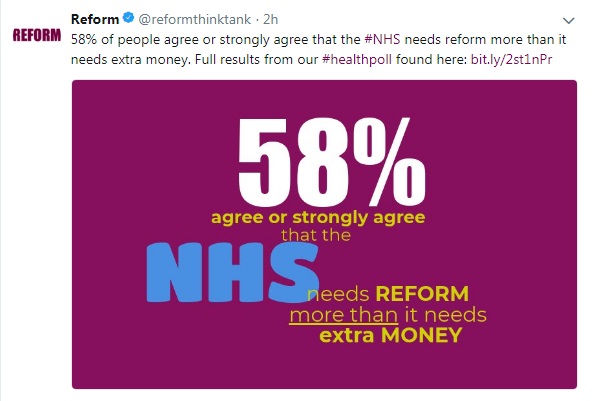
58 per cent of British voters believe that the NHS needs reform more than it needs extra money, according to a new poll commissioned by the independent think tank Reform.

64 per cent of voters believe that it should not matter whether hospitals or surgeries are run by the government, not-for-profit organisations or the private sector provided that everyone has access to care. This is 2 per cent higher than in 2014, despite the Populus poll of 2,106 people being conducted on the day Carillion went into liquidation.

The think tank finds that 59 per cent of voters would nonetheless be willing to pay higher income tax to fund the NHS. This is up from 33 per cent in 2014. On average, British voters would be willing to pay £5.25 extra a month, which is 0.4 pence in the pound of income tax.

The statistic that most of us are already familiar with is the final one – that a healthy majority (in this poll 59 percent) of Brits would be willing to pay higher income tax in order to support the NHS. We cannot escape stats and narratives like this because the media (and on this subject even the supposedly conservative-leaning newspapers are doggedly left-wing) trumpet the news from dawn to dusk.

But looking at this number alone is highly misleading, because all it tells us is that a majority of people would be willing to pay more money for the NHS, not whether they want to do so or even believe that it is necessary. And that is where the other two statistics come in, rather awkwardly for NHS defenders who loudly insist that everything would be perfect if only we firehose more taxpayer money at the same, unreformed system.

We learn in the first bullet point that a full 58 percent of voters believe that the NHS needs reform more than it needs more money, which suggests that contrary to the prevailing narrative, voters are not automatically opposed to significant reform and in some cases might even welcome it if the reforms were woven into a coherent, comprehensive plan to improve healthcare outcomes for patients. And who can seriously argue that the NHS could not do more to find even top-line efficiency savings when we see non-jobs and full-time union rep roles draining local trust budgets?

https://twitter.com/johnmknox1/status/959819605651984389


But it is the second bullet point which is truly surprising – the fact that a full 64 percent of voters don’t give two hoots whether the hospital or medical facility where they receive treatment is government-owned and operated or run by non-profit or even private service providers.

This flies in the face of everything that we are told about public opinion towards the National Health Service. We may as a country (wrongly) favour the re-nationalisation of the railways, but when it comes to healthcare it appears that we are far more pragmatic, preferring what works to leftist ideology or sentimentality for a system which has operated since 1948.

From the Reform blog:

This is an important message for politicians who have questioned the premise of the outsourcing model following Carillion’s liquidation. The reality is that public services would grind to a halt without private and third-sector involvement. Almost one-third of government spend (£242 billion) is spend on external providers for goods and services from paperclips to the trident nuclear deterrent. The NHS spent £54 billion on external suppliers in 2014-15. This model has delivered value for money through increased competition. While the execution of some contracts can be improved, it seems voters are more concerned with access to services than ideological arguments on either side.

Why this growing openness to non-government provision? It could potentially be a case of “the grass is greener on the other side” – the rail operators are already privatised, and so dissatisfaction is more likely to be expressed in terms of a desire to roll the system back to a previous state, whereas NHS delivery (particularly hospital care) is almost always government-provided, making fresh alternatives seem more appealing. This is very likely a factor.

But such is the strength of public feeling on the issue – with 64 percent supporting radical change – that I don’t think “grass is greener syndrome” can account for the entirety. On the contrary, it seems as though the Left have massively overplayed their hand, thinking that they stood on a rock-solid foundation of obstinate support for preserving the NHS in aspic when in fact they are on a bed of quicksand.

Interestingly, the Left have likely done this to themselves, to a large extent. Having bleated for decades that we have only X or Y number of days to “Save Our NHS” only for the NHS to persist through Tory and Labour governments alike, and with left-wing commentatorsmembers of the NHS Industrial Complex and alarmist agitators like Owen Jones penning articles suggesting that the “NHS as we know it” has in fact already been abolished, perhaps the general public has finally tired of their endless hysteria and started to take it for what it is – cynical emotional manipulation.

And if there really is a new openness to healthcare reform, then all it would now take to finally break free from British healthcare exceptionalism – the blind devotion to a tattered post-war consensus dogma which suffocated all previous impetus for healthcare reform – is a purposeful, visionary government with a clear mandate to lead and a Cabinet brimming with talent and political courage.

Oh well.

NHS Logo - Cross - National Religion - Worship - Idolatry

Support Semi-Partisan Politics with a one-time or recurring donation:

Agree with this article? Violently disagree? Scroll down to leave a comment.

Follow Semi-Partisan Politics on TwitterFacebook and Medium.