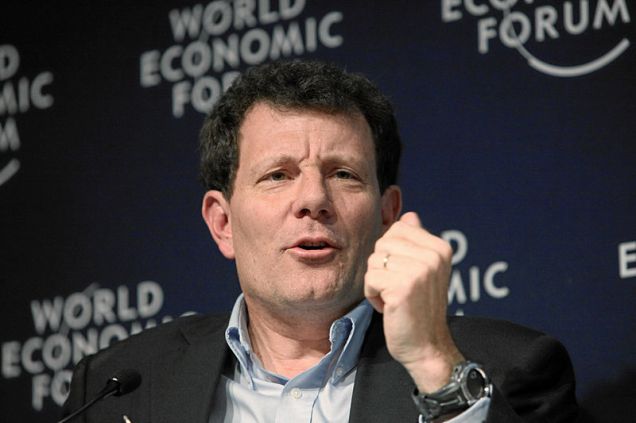
Nicholas Kristof Admits Illiberal Leftist Overreach In Purging Conservatism And Dissenting Views From Academia

nicholas-kristof-academia-conservatism-illiberalism-intolerance-identity-politics

“I say unto you that likewise more joy shall be in Heaven over one sinner that repenteth, than over ninety and nine just persons who need no repentance” – Luke 15:7

In the email introduction to his Sunday column in the New York Times, Nicholas Kristof writes:

My Sunday column will probably provoke a number of you to roll your eyes or curse me under your breath. I’m sure many will disagree with it, but here goes.

[..] I’ll get a torrent of angry emails and indignant comments, but as you read this I’m actually in southern Africa reporting a story. If the criticisms get too bad, I’ll seek asylum.

Such are the delicate eggshells that commentators on which the American Left must tread whenever they even think about holding up a mirror to the behaviour of their own side and calling out flawed thinking or bad behaviour.

What is the subject of Kristof’s column? You can probably guess. With great trepidation, Nicholas Kristof is asking his readers to consider the possibility – just the possibility – that the atmosphere of seething intolerance for conservative voices or opinions on the university campus may be a negative thing with potentially harmful consequences.

Kristof writes:

After Donald Trump’s election, some universities echoed with primal howls. Faculty members cancelled classes for weeping, terrified students who asked: How could this possibly be happening?

I share apprehensions about President-elect Trump, but I also fear the reaction was evidence of how insular universities have become. When students inhabit liberal bubbles, they’re not learning much about their own country. To be fully educated, students should encounter not only Plato, but also Republicans.

We liberals are adept at pointing out the hypocrisies of Trump, but we should also address our own hypocrisy in terrain we govern, such as most universities: Too often, we embrace diversity of all kinds except for ideological. Repeated studies have found that about 10 percent of professors in the social sciences or the humanities are Republicans.

We champion tolerance, except for conservatives and evangelical Christians. We want to be inclusive of people who don’t look like us — so long as they think like us.

I fear that liberal outrage at Trump’s presidency will exacerbate the problem of liberal echo chambers, by creating a more hostile environment for conservatives and evangelicals. Already, the lack of ideological diversity on campuses is a disservice to the students and to liberalism itself, with liberalism collapsing on some campuses into self-parody.

One can already imagine thousands of triggered New York Times readers spitting out their morning coffee and clicking away from Kristof’s column in disgust at having their worldview and prejudices challenged instead of flattered.

And Kristof continues in a similar vein:

Whatever our politics, inhabiting a bubble makes us more shrill. Cass Sunstein, a Harvard professor, conducted a fascinating study of how groupthink shapes federal judges when they are randomly assigned to three-judge panels.

When liberal judges happened to be temporarily put on a panel with other liberals, they usually swung leftward. Conversely, conservative judges usually moved rightward when randomly grouped with other conservatives.

It’s the judicial equivalent of a mob mentality. And if this happens to judges, imagine what happens to you and me.

Kristof goes on to recommend to his readers a number of prominent American conservative personalities to follow on social media, so as to get a taste of arguments and perspectives which may otherwise have been long ago purged from Facebook timelines and Twitter streams. Again, this is a good thing – other publications have preferred to ensconce their readers deeper in the bubble by publishing hysterical lists of “fake news” publications which cannot be trusted because they do not reflect the Democratic Party’s view of the world.

And he concludes:

I fear the damage a Trump administration will do, from health care to foreign policy. But this election also underscores that we were out of touch with much of America, and we will fight back more effectively if we are less isolated.

When universities are echo chambers, they become conservative punch lines, and liberal hand-wringing may be one reason Trump’s popularity has jumped since his election.

It’s ineffably sad that today “that’s academic” often means “that’s irrelevant.” One step to correcting that is for us liberals to embrace the diversity we supposedly champion.

This blog has not always been a fan of Nicholas Kristof, having only recently taken him to task for comparing the American Left’s coming endurance of Donald Trump to the agonies of somebody suffering from addiction and receiving treatment through a 12-step programme.

But as a reader pointed out at the time, the people who need to hear this message are not likely to accept it from people like me and blogs such as this, with a proud tradition of beating up on “liberal” intolerance and the Cult of Social Justice and Identity Politics.

Nicholas Kristof is clearly one of their own, however, as evidenced by the fact that he thought it was appropriate to compare surviving the Trump administration to attending AA. When somebody with otherwise impeccable social justice credentials like Nicholas Kristof questions the culture and dynamic on the American university campus, people might actually listen, and so one cannot entirely dismiss his work.

Overall, this is a positive development. Nicholas Kristof is a prominent and celebrated left-wing columnist and commentator, as well connected to the establishment as a writer can be. If he is now expressing reservations about the oppressive climate for academic freedom on campus, then there must truly be disquiet growing about the takeover of academia by the Cult of Social Justice and Identity Politics.

The Right cannot hope to win this fight on their own, but finally it looks as though we may be gaining a few unexpected allies. May many more follow in Kristof’s footsteps.


Postscript: At present, there are 93 comments to Kristof’s column, the majority expressing angry incredulity that anybody might think that hostility toward conservatism on American university campuses is in any way a bad thing. However, there are exceptions. One reader, a professor at a university I happen to know very well, writes:

An example: I am a professor at a university (Washington University in St. Louis) that brandishes “prestige” it doesn’t quite have—an Ivy League wanna-be. My web page contained some semi-controversial essays—arguing that science is a terrible career choice, that perhaps Summers’s ideas are worth consideration, “diversity”, “political correctness”, that some moral responsibility attaches to the movements that gave us the AIDS epidemic.

My essays, clearly marked as personal opinion, were censored—kicked off my university web page. As expressions of personal opinion, they didn’t belong in the classroom, and were never mentioned there. As thought-pieces on current issues, they are part of being a public intellectual, part of a professor’s job. Academic freedom? Not here.

As Yale University proved with the whole Halloween costume saga of 2015, Ivy League universities are often the worst offenders, so from that perspective Washington University in St. Louis is absolutely heading in the right direction.

Back in the real world, however, they are hurtling off a cliff, and threatening to take what is left of academic freedom down with them.

 

Danger Unsafe Space Sign - The Koala - UCSD


Safe Space Notice - 2

Top Image: World Economic Forum / Wikimedia Commons

Support Semi-Partisan Politics with a one-time or recurring donation:

Agree with this article? Violently disagree? Scroll down to leave a comment.

Follow Semi-Partisan Politics on TwitterFacebook and Medium.

Ann Widdecombe Is Right To Encourage Rebellion Against Political Correctness

18-year-old Sam would be horrified to hear 33-year-old Sam admit it*, but Ann Widdecombe is actually right more often than she is wrong – and never more right than when she recently gave an interview to BBC Parliament and veered onto the topic of political correctness.

(* As a 19-year-old lefty student at Cambridge, full of self-righteous assurance and moral superiority, I once accosted Ann Widdecombe in the bar of the Cambridge Union after the annual “This House Has No Confidence In Her Majesty’s Government” debate and no doubt made a complete idiot of myself in the process, though for some time afterwards it pleased me to brag about having supposedly confounded Widdecombe with my impeccable logic and well-rehearsed diatribe against the Evil Tor-ees.)

The BBC reports:

Political correctness is “silencing a great body of thought”, the 69-year old says, to the point where she wonders if we can still claim to live in a free society.

She worries that almost everyone is under pressure to keep their views to themselves, not just those with strongly-held political or ethical convictions

“You actually get bright, intelligent people that could hold their own anyway, saying to you: ‘Well, of course you can’t say that these days’. And I think: ‘Yes you can’.

“This is not the Soviet Union. You should not be constrained by state orthodoxy.

“You should be able to say what you individually think and if it is unpopular, you should stand your ground.”

And continues:

In such a climate, she says it is doubly important that politicians speak out.

“The only people who don’t have to (keep quiet) are the parliamentarians. We can say what we like. We can be against gay marriage, we can be against abortion, we can want to limit immigration – we can say what we like.

“The ordinary citizen is much less blessed these days. I’ve always said if you hold a view what is the point of holding it if you don’t stick by it.”

Widdecombe is absolutely right to emphasise the special responsibility which falls upon those with unpopular or minority views to actually air their beliefs so that unpopular ideas can be tested and either be found wanting and discarded or be acclaimed and more widely adopted based on their merits.

I have just come back from a friend’s Christmas party in a very fashionable part of London, a lovely evening, but one in which I was (for the second time this month) presented with the situation in which a fellow party-goer and friend-of-a-friend casually disparaged Brexit and Brexiteers to my face, automatically assuming that I would agree with their stance.

As happened last time, a virtual decision tree flickered to life in my mind. Do I do what the political blogger and ardent Brexiteer in me wants most, and dramatically out myself as a Leave voter before going on to deliver some barbed and witty put-downs of smug London-dwelling Remainers? If I do so, will it escalate into an argument which might be embarrassing for the hosts? Will it embarrass my wife? Is there a genuine opportunity to change minds, or is this just an opportunity to invite social ostracisation with no realistic potential upside?

On different days and in different scenarios and moods, I opt to go down different branches of the decision tree. On this occasion, knowing my audience, I deemed that there was no realistic opportunity to change minds or even plant the seeds of doubt, and so I changed the subject and ended up having a very pleasant conversation with the chap about other matters.

It is important to note that this friend-of-a-friend is a good guy in every respect – he is just lost to reason on one particular, highly important topic. And while I may not have been afforded the same courtesy had the situation been reversed, I think it is important for Brexiteers to hold themselves to higher standards of behaviour than some Remainers seem to be displaying in their sneering contempt of those who dared to vote their principles rather than their wallets.

On other occasions, I have taken the opposite approach and confronted idiotic EU-worship and criticism of Brexit with the immediate revelation that I am a eurosceptic Brexiteer and that anybody intending to insult Brexiteers in my presence had better be packing something more powerful than smug, idiotic, failed talking points from Stronger In. The last time I took this approach, a couple of weeks ago, the person concerned physically moved her seat a couple of inches further away from me, and frosty silence reigned throughout dinner.

Aside from casual interactions with friends (who no doubt feel duty-bound not to dismiss me out of hand because of our shared history) I have had zero success talking to Remainers in social settings with any degree of success, regardless of the approach I choose. But I am increasingly coming to the opinion that on this subject, as Ann Widdecombe says, “you should be able to say what you individually think and if it is unpopular, you should stand your ground”.

Of course there will always be times when getting into a heated political debate at somebody’s wedding reception is not the right course of action. But having now witnessed how a fairly representative sample of professional young Londoners feel about Brexit and Brexiteers, I think that these people urgently need to hear dissenting voices – if not to change their minds (for such a feat seems impossible) then at least to make the point that there are intelligent young professional Londoners out there who do support Brexit and whose political philosophy consists of something more than vacuous, superficial internationalism and a readiness to believe pro-EU propaganda and apologetics.

And whether the subject is Brexit or any of the issues falling under the suffocating blanket of social justice and identity politics, now is not the time for Brexiteers, conservatives, free speech supporters or other modern day heretics to stay hidden in the closet. Not with so much at stake.

Some of the most illiberal movements in society right now – the establishment’s rearguard fight against Brexit, the trampling of free speech under the jackboots of the Cult of Social Justice and Identity Politics – are fuelled by ignorance of and antipathy toward those who dissent from the leftist orthodoxy. Those dissenters such as myself, living deep behind enemy lines in places like central London, almost have a duty to show that Brexiteers, anti-SJWs and other latter-day thought criminals are more than the two-dimensional caricatures painted by screeching left-wing propaganda outlets like the Guardian and Independent.

95 percent of the time, this may be a lost cause. But once in awhile it may lead to a conversation, and even to a changed mind. Was swallowing my tongue and changing the subject in the face of lazy Brexit criticism the right decision this evening, given that the payoff for me was an hour of pleasant small talk and the knowledge that I helped perpetuate ignorance on such an important subject? Probably not.

Next time I am confronted with the Brexit/Social Justice-in-a-social-situation decision tree, I shall hold my ground unapologetically. Henceforth, the price of airily expressing half-baked political opinions in my presence, in the arrogant expectation that everyone present will concur, will be a thundering response from me which might make even Ann Widdecombe proud. Not only when I am feeling particularly up for a debate, but every single time, even when I would rather have a quiet, conflict-free evening.

That much is the least that I can do – that we all should be doing – for the causes in which we believe.


brexit-pixabay

Brexit - EU Referendum - European Union - Apocalypse

Support Semi-Partisan Politics with a one-time or recurring donation:

Agree with this article? Violently disagree? Scroll down to leave a comment.

Follow Semi-Partisan Politics on TwitterFacebook and Medium.

NHS Heresy, Part 4 – Junior Doctors Would Sell Out The NHS In A Heartbeat, If The Price Was Right

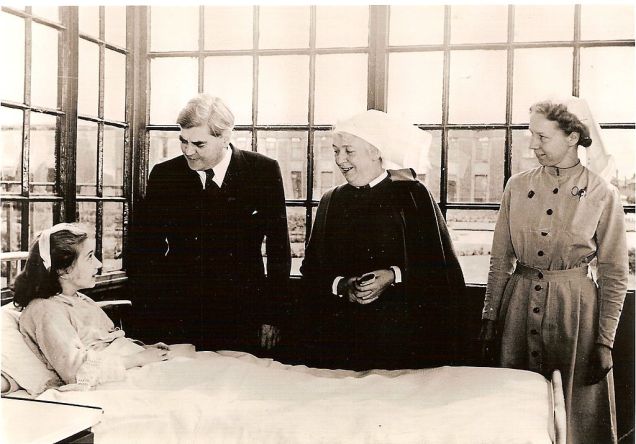
aneurin-bevan-national-health-service-nhs-1948

Brave and principled defenders of Our NHS? The junior doctors would knife Aneurin Bevan’s vision in the back and happily serve an Evil Tory privatised healthcare system (how awful) if the price was right

Few people have been pronounced more saintly in 2016 than the holy NHS Junior Doctors, whose brave, principled and not-at-all-about-money industrial dispute with Jeremy Hunt and the Evil Tor-ee government has seen these humble, altruistic folks fight bravely and against the odds to safeguard the future of Our Blessed NHS.

Oh, wait. Nope. Turns out that most of those cherub-faced stethoscope swingers would throw the NHS under the bus and see the National Health Service privatised if it meant more money flowing into their pockets.

Kristian Niemietz of the IEA reports:

While I never believed for a second that the junior doctors’ strike was a People’s Struggle against the demonic forces of neoliberalism, I did believe that most junior doctors had convinced themselves of it. I was under the impression that they sincerely believed that that they were fighting The Just Cause on behalf of The People. Slogans like “Save our NHS” were everywhere, after all, and we always find it easy to convince ourselves that what is good for us also happens to be good for everybody, even if in roundabout ways.

And yet, in a recent survey of almost 10,000 junior doctors, 93% said they would accept “complete privatisation” of the NHS if it resulted in “substantially” increased salaries. Surely, some will dismiss these figures as a vicious smear, while others will accuse junior doctors of hypocrisy and opportunism. I think neither response is appropriate.

In practice, many doctors already act in accordance with the preferences expressed in this survey. Last year, about 8,600 UK-trained doctors went to work abroad, with Australia being a particularly popular destination. Australia has a universal public insurance system, in which the government commissions and pays for most healthcare, but in which the delivery is largely private and market-based. They are not doing anything immoral, because there is nothing immoral about private, market-based healthcare; in fact, the Australian system produces some of the best outcomes in the world. Come to think of it, even in the UK, most GPs are self-employed, not NHS employees. This means that technically, they are part of the dreaded – whisper it – private sector.

It would, however, suit junior doctors to quit the populist, anti-capitalist posturing. And the rest of us should try to keep our anti-capitalist knee-jerk responses in check. Even when it comes to healthcare.

My emphasis in bold. And you read that correctly – 93% of all those doctors who love to paint the NHS logo on their faces and protest Jeremy Hunt would happily live in an Evil Tory dystopia of privatised healthcare if it meant they were paid a market wage.

Niemietz is kinder and more understanding in his piece than I am inclined to be. Personally, I think that the junior doctors’ strike was just another example of the NHS Industrial Complex – that vast connected web of connected special interests who have a direct stake in the world’s fifth largest employer continuing to operate along broadly the same lines as it does at present – flexing its muscles and throwing the entire country under the bus for their own economic gain. But that’s just cynical old me.

There is no disputing, however, that nearly every tawdry public (and private) sector dispute in modern history has been justified by the protagonists on the supposed grounds of “public safety”, whether it is London Tube drivers suddenly becoming concerned about safety on the Underground in time to tack an extra day onto their Christmas holidays, Southern Rail train drivers convinced that taking over responsibility for opening and closing their train doors will lead to regular platform bloodbaths, or the sainted junior doctors.

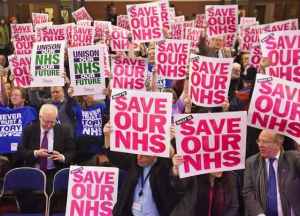
We have known since May that pay was the only real red line for junior doctors, though surprisingly none of their placards made reference to the desire for more cash – they chose instead to go with their “Save Our NHS” angle instead, to elicit maximum public sympathy (by whipping up maximum public fear). We have also known, thanks to the steady stream of junior doctors moving abroad to work for other, better healthcare systems than our own anachronistic NHS, that their supposed high-minded commitment to socialised, government-provided healthcare is often outmatched by the desire for a bigger pay cheque and a larger slice of finite taxpayer funds.

But now we find out that not only would many junior doctors consider abandoning the NHS and selling their services to hospitals in other countries, but that they would actively support the tearing down of Our Blessed NHS and its replacement with a privatised system here in Britain. The commitment to socialised public healthcare is literally tissue paper thin with these people, even more flimsy than the home-made banners on which they proclaim themselves to be tireless warriors fighting to defend the Best Healthcare System in the World.

Will the revelation of this hypocrisy change anything? Probably not. The Guardian and other sycophantic leftist outlets will no doubt continue to gush over the various vested interests within the NHS Industrial Complex, as instructed by High Priests like Owen Jones:

Ask a striking junior doctor why they’re taking this action, and you won’t simply hear an eloquent spiel about their contracts. It’s the very future of the NHS – which they have committed their lives to – which they fear is at stake. There are the government’s policies of marketisation and fragmentation – yes, accelerating what previous administrations did – stripping the “national” from NHS.

“Committed their lives to”? Heavens, you would think that these people had pledged themselves as members of the Swiss Guard, the Night’s Watch or the Order of the Phoenix, the way that Owen Jones talks about them, rather than simply signing up as employees of the fifth largest bureaucracy on the face of the planet.

But it is sneaky what Owen Jones does here, suggesting that people become doctors out of a desire to work in a large government bureaucracy rather than feeling the call of a vocation to heal. Other countries seem to manage to recruit and train doctors without danging the carrot of getting to work for a massive state-owned bureaucracy in front of them, but Jones would have us believe that we only have doctors and nurses because people are so dreadfully inspired by Aneurin Bevan’s rusting 1948 vision. Nonsense, of course, but very effective propaganda from the NHS Industrial Complex.

The NHS Industrial Complex is made up of many different actors, all with their own motivations. One has the ideological leftists like Owen Jones, whose entire worldview relies on supporting a monolithic state healthcare provider churning out a precisely equally dismal service to every postcode in the UK. Then one has the worker bees within the organisation itself, whose medical or bureaucratic expertise rarely qualifies them to pass judgment on the optimal healthcare system for a country of 65 million people. And then one has the vast supply chain serving the beast, which is motivated primarily by a desire to preserve and expand existing revenue streams and avoiding risky disruption.

How fortunate that this cast of villains and useful idiots is able to hide behind the junior doctors – most of whom are eminently decent people supporting a superficially worthy cause – as they press for the preservation of the status quo, the scuttling of reform and a wider pipeline direct from the bank account of every UK taxpayer direct to the fifth largest organisation in the world.

But perhaps now that we know that the NHS Industrial Complex’s most photogenic spokespeople are actually more than happy to upend the whole system, spit on Britain’s national religion and see the NHS fully privatised so long as the pay rise outweighs the public vilification, the junior doctors’ collective halo might tarnish a bit.

Still, there are always the nurses. Everyone trusts a good nurse.


NHS Logo - Cross - National Religion - Worship - Idolatry

Save Our NHS

Top Image: University of Liverpool Faculty of Health & Life Sciences / Wikimedia Commons

Support Semi-Partisan Politics with a one-time or recurring donation:

Agree with this article? Violently disagree? Scroll down to leave a comment.

Follow Semi-Partisan Politics on TwitterFacebook and Medium.

Hysterical Remainers Are Inadvertently Making ‘Hard Brexit’ More Likely

Sam White has a great piece in Country Squire Magazine, in which he warns that the juvenile behaviour of bitter and hysterical Remainers is doing more than anything else to imperil the prospects of a smooth and orderly Brexit.

White writes:

One of the false charges levelled at Leave voters is that Brexit is an act of self-harm. That whatever reasons a person might have for voting to escape from the European Union, the amount of damage caused will always outweigh the benefits.

But from where I stand, the only masochistic inclinations come from hardcore Remainers themselves, as they attempt to hinder or halt a clean, well executed departure.

As they snipe and circle in a constant, bad tempered performance, drawing attention to their own discontent like hormonal adolescents, it becomes clear that they’ll try every trick at their disposal to oppose democracy.

An already impatient Leave camp is being made twitchy by the Remain contingent’s obstructive posturing, but can the Europhiles do any real damage?

The most vocal Remainers are so entrenched and irrational that they’ve actually shifted general opinion toward the very thing they’ve spent the past few months ardently demonising: a hard Brexit.

There are Leave supporters who’ve consistently argued that the only real Brexit is hard Brexit, and Remain have unwittingly reinforced this view. In fact, the idea of simply repealing the 1972 European Communities Act and walking nonchalantly away as if we’ve never heard of Article 50 now has a certain nihilistic, up-yours attraction. It’s the kind of thing Sid Vicious would do if he was in charge. Not so much a hard Brexit as a brick to the face Brexit.

That might give credibility to the charges of self harm though, and it’s unlikely our politicians would have the poised recklessness to pull it off. Instead, given the space to play smart, our negotiators would do best to take that most composedly British of approaches, and play the long game.

And were we united behind Brexit, they could do that.

However, with Remain jabbering and poking in the background like irritating, spoiled children, the considered approach becomes less attractive. What Brexiteer would feel comfortable with such a cautious route now, in the knowledge that amoral Remainers would have more time to subvert the plan?

Suddenly we’re a little less Roger Moore, and a bit more like John Cleese in Clockwise—quite prepared to steal a Porsche while dressed as a monk, as we race to trigger Article 50 before the entire glorious achievement can be stolen from us.

My emphasis in bold.

Sam White is quite correct. If we are determined to look at Brexit as a purely economic matter, as Remainers often seem to do, then right now there is no bigger threat than the possibility that the pro-EU crowd’s whiny filibustering might fuel a backlash which forces the government and MPs to take a harder (or more foolhardy) line in the secession negotiations than would otherwise be the case.

Pete North has previously picked up on the same danger, with reference to Nick Clegg an the Liberal Democrats:

And that is a problem if the Lib Dems are setting themselves up as the voice of the obstructionist remainers. It pretty much makes the EEA politically toxic. The option itself is hated among the majority of leavers, not least because they have, hook, line and sinker, bought the remainer narratives about it.

That puts us all in very dangerous territory. It forces the government to double down on seeking any solution but the EEA and consequently has them fumbling around in the dark for something politically palatable when the options are few. What that likely means is further delay and an attempt to bring about some kind of bespoke agreement that is the EEA in all but name.

As White notes, there is already a tedious contingent of Brexiteers, particularly online, who insist that despite the very clear wording of the referendum question, the British people also secretly gave an instruction to leave the single market, and that anything short of full and immediate divorce is some kind of dishonourable betrayal.

Throw in the fact that dishonest Remainers who only months ago were arguing that Britain’s prosperity depends on remaining in the political union have now retreated to the fallback position of calling for continued participation in the single market, and one can understand how the narrative of an elite anti-Brexit conspiracy is gaining traction and potentially leading to a hardening of stances among some Brexiteers.

White concludes:

Something these anti-democrats can never get their heads around is patriotism. The idea that a citizenry could be willing to risk a short-term financial hit in order to secure priceless, permanent sovereignty is apparently unfathomable.

They also have difficulty reconciling national integrity with being an outward looking, internationally-minded country, but of course there is no conflict between these things. Right now it’s the EU that appears stagnant and insular, while an independent, agile Britain looks fresh and ready to do business.

Perhaps it’s this intractable refusal to consider the value of nation states—in their most inclusive and forward thinking colours—that holds the Remainers back.

It’s true – many Remainers simply do not “get” patriotism, at least according to any reasonable definition of the word. Those who style themselves as “citizens of the world” are in fact no such thing. For as long as the nation state remains the basic building block of the global community and the ultimate guarantor of our rights and freedoms, permitting Britain’s sovereignty to be undermined is highly counterproductive.

But as this blog has argued, it goes deeper than that. It is not just that Remainers see concerns about self-determination and democracy as entirely secondary to short-term economic scaremongering concerns. It is that they are actively hostile to patriotism-based arguments, or indeed any harmless expression of patriotism.

And this haughty attitude risks fuelling a backlash which, when translated into domestic political pressure, may make it much harder for Theresa May’s government to pursue the kind of Brexit deal that we should be making.


European Union - United Kingdom - Britain - Flags

Support Semi-Partisan Politics with a one-time or recurring donation:

Agree with this article? Violently disagree? Scroll down to leave a comment.

Follow Semi-Partisan Politics on TwitterFacebook and Medium.

No Patriotism Please, We’re British

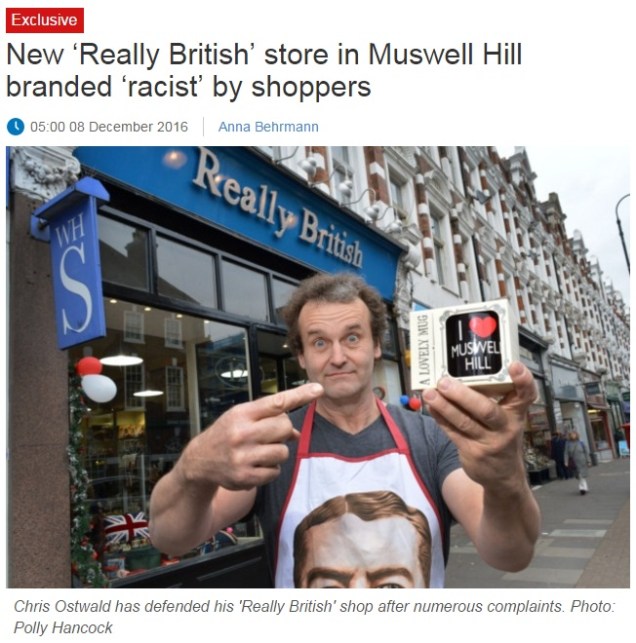
really-british-chris-ostwald-muswell-hill-london-patriotism

Only in North London’s leafy enclaves would a shop selling British goods and memorabilia be at risk of being run out of business by snarling locals convinced that union jack cushions are one step away from fascism

Another day, another painful reminder that London voted strongly against Brexit and is, in many ways, a different country within a country.

Local newspaper Ham&High reports:

A shopkeeper has defended his novelty gift shop after it has been boycotted by shoppers who branded it ‘pro-Brexit’ and ‘racist’.

The shop in Muswell Hill caused a storm on social media with owner Chris Ostwald, 54, forced to remove his British flags on the opening day on November 26 because he received so many complaints.

One of the shop assistants, who is Spanish, left after just one day because of all the snide remarks she received.

The shop sells British-themed gifts and homeware. Their products include condiments, such as brown sauce, London underground tea towels and “Muswell Hillbillies” mugs, which references the Kinks album. There are also suffragette aprons and stocking fillers such as old fashioned compasses.

Mr Otswald, 54, told the Ham&High: “The shop is in no way meant to be ‘political’ or ‘pro Brexit’, but we have had a lot of complaints saying it is or we are ‘racist!”

“A guy came in the other day and said, ‘what’s this, a charity shop?’ and we said, ‘no, not at all’, and he said, ‘well it’s racist’, and stormed out.”

Mr Ostwald added: “People have been coming in and just tutting and walking out.”

There have been other comments on Facebook, with one person arguing that the name is not inclusive.

One man wrote on public Facebook group Muswell Hill and Friends: “Chris, while I applaud you setting up a business in Muswell Hill and employing local people I’m curious as to why you decided to call your shop ‘Really British’ (besides the obvious point that you will sell British made goods)?

“Like many people I live in London because of its international nature, and for me personally having a big sign on the Broadway saying ‘Really British’ makes me feel you’re implying that other local businesses in the area are therefore somehow ‘not really British’.

“Some will no doubt say I’m over-sensitive but I can’t help thinking that given the recent divisive referendum and the current political climate you might have chosen a more inclusive name in 2016.”

This invidious disease of proud anti-patriotism is particularly British. In America, whether you are on New York’s Fifth Avenue or Main Street in some small Mid-Western town, a shop which celebrates Americana and American heritage would be celebrated and universally popular. In France, shops which sell traditional French produce and goods are happily frequented by tourists and locals alike.

Only in Britain are we cursed with a sub-population of pinch-faced killjoys who have been bred to believe that any expression of pride in Britain is “scary” and somehow tantamount to racism. Only in the fashionable and gentrifying parts of London and Britain’s other major cities does one find this pitiful tribe of people who are allergic to their own flag.

Only in places like London’s Muswell Hill do people hold the country which gives them life and liberty in such horrified, sneering contempt.


European Union - United Kingdom - Britain - Flags

Support Semi-Partisan Politics with a one-time or recurring donation:

Agree with this article? Violently disagree? Scroll down to leave a comment.

Follow Semi-Partisan Politics on TwitterFacebook and Medium.