Je Suis Tory Scum

Tory Scum - Left Wing Hatred

The hysterical left will always call conservatives “Tory scum” and hate us with a blind, unthinking rage. It’s time to stop cowering at their attacks and apologising for our values

As 2015 draws to an end, we still have four and a half more years of David Cameron’s wishy-washy, ideologically rootless, Conservative In Name Only government to look forward to, followed by a general election which will almost certainly deliver another five years of blandness.

For small government conservatives and libertarians, this continual betrayal of principle is bad enough. But as an added insult, it also means four more years of being spat on and called “Tory scum” by demented far-left types who view David Cameron and George Osborne’s half-hearted attempts to pare back the state as the modern-day equivalent of Nazi war crimes, and who have no reservations in publicly saying so. Not very appealing.

That’s why the time has come for conservatives of all stripes to finally seize back the word “Tory” from the haters and reclaim it with pride, rather than meekly and apologetically crawling around and apologising for our values – values which saved this country from decline and irrelevance three decades ago, and can do so again if only we fully unleash them.

In that spirit, Tony Parsons’ article from earlier this year in GQ magazine – in which he “came out” as a reluctant member of the Tory Scum collective – is a great opening salvo in the fight back against the hysterical Left.

In his article, entitled “Why I’ve Become Tory Scum”, Tony Parsons calls out the Labour Party and other forces on the Left for the sanctimonious nature of their campaigning during the general election, and their utter inability to empathise with their opponents – or even entertain the thought that those who oppose them might be doing so from a position of legitimate, morally valid disagreement.

Parsons points out:

The general election was decided not by shy Tories but by us reluctant Conservatives. The millions like me who saw nothing but catastrophe in Labour’s addiction to high taxes and big spending, their loathing of success, the way they could use a word like “mansion” with a straight face and, above all, that endless pious prattle about the NHS – as though the British have no other identity but as a sickly, enfeebled, diseased people in need of having our bottoms wiped by the state from dawn till dusk. 

Sadly, Parsons may be right about the British as an enfeebled and dependent people in thrall to the NHS, judging by the current exercise in mass virtue-signalling underway to make this awful song Christmas no. 1 in the charts.

But the truth is that David Cameron’s government is very much an unremarkable continuation of New Labour. Far from being a son of Thatcher, Cameron and his leadership team are very much the heirs to Blair, and would bear comparison with many centre-left governments around the world. The Conservative Party, even under Thatcher, has in many respects always been to the left of even the Democratic Party in the United States, and certainly is so now.

Of course, you would not think that the Conservatives were in any way moderate, judging by the hysteria among many vocal parts of the Left, who present David Cameron’s steady-as-she-goes paternalism and tentative deficit reduction as some kind of outrageous economic shock treatment combined with “human rights” abuses worthy of the Nazis.

Tony Parsons ponders why this is so:

Why are those of us who believe in a different economic model – one where aspiration is encouraged, where the state gets out of your way and doesn’t spend money it doesn’t have – morally reprehensible? Exactly why are we scum? History suggests that, when presented with the chance to vote for socialism the British people always run as fast as we can in the opposite direction. It doesn’t make us bad people. But the left have lost the argument and are reduced to shrieking abuse.

But then the hysterical far left have always talked about conservatives thus, and they always will. Parsons recognises this as he writes:

The loud left are as pertinent to modern Britain as blacksmiths. No wonder their protests are increasingly ugly. They react with furious disbelief at the result of a democratic election. They rave about balancing the nation’s books as if it was like drowning kittens in a sack. They scream in our faces about their own compassion while bandying around epithets like “scum” and “filth” with the vicious abandon of Nazis talking about Jews.

Since the abuse will never end, clearly there is nothing to be gained from running from it any longer. Nor is there anything to be gained by continually apologising for core conservative principles – free individuals and strong families, fiscal conservatism and a prohibitive national defence – as the current Conservative leadership sadly continues to do.

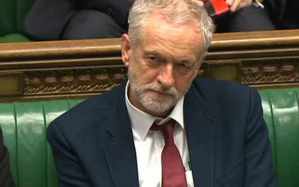
What British conservatism and libertarianism really need is their own version of Jeremy Corbyn – someone who unapologetically sticks to their principles, refusing to water them down for political expediency, and who seeks to lead and persuade rather than conform to the results of the latest opinion poll or focus group.

Or to use a West Wing analogy, British conservatism needs a Matthew Santos-like figure, someone willing to proudly wear the “Tory” label just like Santos refused to apologise for being a liberal in the famous presidential debate episode:


Speaking up for American liberalism in a way that one can only wish David Cameron or George Osborne would do for small government conservatism, Santos says to his Republican opponent:

What did liberals do that was so offensive to the liberal party? I’ll tell you what they did. Liberals got women the right to vote. Liberals got African-Americans the right to vote. Liberals created social security and lifted millions of elderly people out of poverty. Liberals ended segregation. Liberals passed the Civil Rights Act, Voting Rights Act. Liberals created Medicare. Liberals passed the Clean Air Act, Clean Water Act. What did conservatives do? They opposed every single one of those things. Every one.

So when you try to hurl that label at my feet – liberal – as if it were something to be ashamed of, something dirty, something to run away from, it won’t work, Senator. Because I will pick up that label and I will wear it as a badge of honour.

Of course it is almost unimaginable for a conservative to ever talk this way, with such passion, partly because we tend not to make such grand claims for ourselves in reshaping the world or forcibly changing human nature in pursuance of our goals. It is not in our nature to brag about our accomplishments, because the biggest accomplishment a conservative can aim for in government is to get out of the way and help remove obstacles from others so that they might reach their full potential.

But more than this, British conservatives since Margaret Thatcher have had precious little to brag about. Locked out of office under thirteen years of New Labour, the Conservative Party which emerged under David Cameron has made so many compromises with triangulating, Blairite centrism that there are almost no genuinely conservative policy victories or changes in the country which we can claim.

What are we supposed to brag about? Remember when the Tories stood up to the growing climate of intolerance toward freedom of expression, and formally codified a British citizen’s right to free speech? We can’t say that because it didn’t happen. Indeed, under Theresa May Britain is becoming an even more authoritarian police state than it was before, with human beings languishing in our prisons simply for saying, singing, or tweeting the “wrong” thing.

Remember when George Osborne struck a blow for fiscal conservatism, rallied the country with his argument that it was morally obscene for government to spend more on debt repayments than education or the military, and achieved a real budget surplus in order to finally begin paying down the national debt? We can’t say that either, because although Osborne is happy for the public and lazy journalists to believe that the Tories are “paying down Britain’s debts”, in reality the government is doing no such thing.

Conservative supporters truly have the worst of both worlds at present. We are attacked by the furious Left for an ideologically-motivated attack on the state and its poorest dependants, while in reality almost zero real conservative reform is being enacted. We are stuck with the leftist abuse, but have absolutely nothing positive to show for it.

As this blog asked when Jeremy Corbyn was on the cusp of winning the Labour leadership contest, finally giving one of Britain’s two main parties a leader who demonstrably believed in something more than the acquisition and keeping of power:

If David Cameron’s Conservative Party was voted out of office today, what will future historians and political commentators say about this government fifty years from now? What will be the Cameron / Osborne legacy? What edifices of stone, statute and policy will remain standing as testament to their time in office? Try to picture it clearly.

Are you happy with what you see?

No real conservative should be happy with what they see right now. Assuming that the political pendulum will at some point swing back in favour of the Labour Party, we conservatives have almost nothing to show after five years of David Cameron other than a half-finished job clearing the budget deficit. We have a reanimated Ted Heath sitting in Downing Street, not a worthy heir to Margaret Thatcher.

But just as the American Tea Party lay conspicuously dormant for the many years of fiscal profligacy and budget-busting spending under the George W. Bush administration only to miraculously awaken when a man named Barack Hussein Obama won the presidency, so the hysterical British Left are now shrieking bloody murder over a set of very pedestrian, middle-of-the-road centrist policies being enacted by the Conservative Party after having airily ignored the very same governing philosophy when the now-hated Blairites were in charge.

As conservatives, we realise there is no point in launching a futile battle against human nature or the instinct of many on the Left to demonise that which they do not or cannot understand. They will continue to call us “Tory Scum” and we have no control over that.

But we do have the power to take back ownership of the label “Tory” and refuse to see it as an insult.

We do have the power to point out that there is nothing virtuous or compassionate about throwing more money at unreformed healthcare and welfare systems, or spreading the wealth around so much that wealth creation is destroyed or driven overseas.

We do have the power to proclaim the importance of fiscal conservatism, not out of some wonkish obsession with balancing the books but because running up further government debt today is a blatant act of intergenerational theft, living at the expense of our children and grandchildren. And because as we have seen with other countries, excessive national debt can become a foreign policy and national security issue too.

We do have the power to point out to anyone who will listen that the modern Left love to parade their virtue and ideological purity but have apparently given up on coming up with alternative policies of their own, and to demand that Labour produce some costed tax and spending plans rather than simply railing against the inhumanity of the Evil Tories.

We do have the power to point out the many ways in which David Cameron’s pitiful excuse for a Conservative government ignores or betrays real conservative values, and to declare “not in my name”.

We do have the power to say “Oui, Je Suis Tory Scum – and I wish that our prime minister was a real conservative too, rather than a reheated Blairite with an ominous, socialist plan for every stage of our lives“.

The Left are not going to change, so we had better get used to the spitting, the vandalism, and the overwrought, emotional and short-termist way in which they discuss public policy.

But we can change. We can stop lying down and taking it every time a virtue-signalling lefty pontificates on welfare without offering a plan of their own, or seeks to win an argument on healthcare by stoking the public’s idolatry of the NHS.

We can stop fighting on the Left’s terms.

And who knows, if small government conservatives and libertarians actually succeed in getting off the back foot for the first time since Margaret Thatcher left 10 Downing Street, we might even manage to salvage something from David Cameron’s woeful premiership.
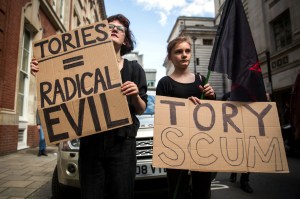
Bankers Toffs And Tory Scum - General Election 2015 - London Protests - Downing Street

Agree with this article? Violently disagree? Scroll down to leave a comment.

Follow Semi-Partisan Politics on TwitterFacebook and Medium.

The Daily Smackdown: Cynical Bishops Exploit Terrorism For Publicity

BBC Religion Television

Who will condemn the bishops for exploiting our fear of terrorism in their grubby bid to preserve taxpayer funding of the BBC’s religious output?

The Church of England is very upset that the BBC is considering cutting the amount of taxpayer money it spends on (predominantly) Christian television output.

From the Telegraph:

A spokeswoman confirmed that the BBC was planning to “look at ways we can reduce costs” as it faced “huge financial challenges” but added that cuts would come from across the corporation.

The Bishop of Norwich, the Rt Rev Graham James, the Church of England’s lead spokesman on media issues, said the move could threaten something which was “fundamental to our public life”.

“It seems to me that religion has already taken a hit,” he said.

“It has already been reduced certainly in terms of its scope as an independent part of the BBC, at a time when we already need – as everyone acknowledges – more religious literacy in the nation.”

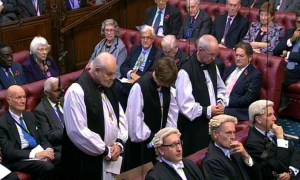
Nothing unusual there. The Church of England is a well oiled lobbying machine, and any private organisation lucky enough to have a bloc of 26 unelected representatives sitting in parliament to influence our laws in their favour would be foolish not to make good use of them. Thus it is no surprise that the unelected theocrats of our state church have been hard at work speaking out against the BBC’s planned actions.

But the fact that the Church of England’s behaviour is understandable does not make it any less reprehensible. Firstly, because it makes a total mockery of the idea of the BBC as an independent broadcaster. Nobody seriously believes that an organisation whose budget is nearly totally dependent on taxpayer money can be truly independent, but the fact that the Lords Spiritual are now actually speaking in parliament about the internal decisions and strategy of the BBC makes any pretence of the BBC’s impartiality or the government’s non-involvement utterly ridiculous.

Worse than this, though, is the flimsy rationale now offered by the bishops as a pathetic excuse for more taxpayer funded religious programming:

Bishops have warned the BBC it risks turnings its back on efforts to tackle extremism and aid integration by slashing spending on religious programming.

[..] The first female cleric in the House of Lords, the Bishop of Gloucester, the Rt Rev Rachel Treweek, remarked that the decision had presumably been taken “to reduce the possibility of offending people with too much God stuff over the holiday”.

It is good to see the newly enobled Rachel Treweek, my Lord Bishop of Gloucester, is wasting no time in rolling up her sleeves and interfering in our national democracy as generations of theocrats have done before her. She will be making the home team very proud. But unfortunately, she and her fellow Lords Spiritual are talking nonsense.

The argument that cutting the amount of taxpayer money devoted to religious television and radio programming on the state broadcaster is somehow a threat to anti-extremism efforts is as ridiculous as it is unfounded.

More moderate Christianity on TV will not result in less Islamic extremism on the margins of British society. And pontificating, busybody bishops who abuse their parliamentary platform to suggest otherwise should provide evidence for the supposed link, or else retract the claim and admit that they are simply exploiting serious issues of national security in a cheap ploy to gain more taxpayer-funded airtime.

The real issue is not so much the pull factor of extremism as the push factor of the alienation of too many young Muslims from British society. It’s the fact that we have living among us too many self-segregated societies comprised of people who hold the same passports as us, but look upon us – and the enlightenment values of reason, education, liberty and democracy to which we try to adhere – as alien and unwelcome. By failing to inculcate a strong and inclusive sense of Britishness, out of craven fear of causing offence, we provide the Islamist recruiters with easy fodder.

Do my Lord Bishops of Gloucester and Norwich (flowery titles for a bygone age) seriously believe that the kind of alienated youths and their families who are now quietly slipping away to ISIS in Syria or seeking out radicalising materials online are the same type of people who tune in to BBC Two at six o’clock in the evening, ready to be reached out to and placated with a documentary about public spirited imams, rabbis and priests working together to open a new community centre? What nonsense.

The people most in need of the BBC’s moderate religious programming and generally liberal worldview are those whose eyes are glued to YouTube videos of anti-American 9/11 conspiracy theories or seditious social media conversations on their smartphone screens. More government intervention – be it through Prevent or the BBC – is not going to make meaningful inroads to these people. The only lasting solution must come from the bottom up, a revitalisation of patriotism and pride in Britain, and the promotion of a common British identity which transcends racial divides (rather than revelling in a multicultural dystopia which sees groups living side by side but separately in parallel, alienated lives.

Do the Lord Bishops have anything meaningful to say about that? No, they do not – perhaps with the exception of the Bishop of London, Richard Chartres.

This is in no way intended as an attack on religion, or on the Church of England (so long as it stays within its own boundaries and stops trying to play an undue role in our public life). I grew up watching Songs of Praise on a Sunday, and have happy memories of doing so. But it is not right for general taxpayers of an increasingly secular country to continue funding religious programming using a model that invites some appointed bureaucrat or another to choose which religions or denominations are to be favoured above others.

Perhaps the Lords Spiritual begin to grasp this. Perhaps they are grasping at these increasingly ludicrous excuses for their continued influence because deep down, they realise that they have no place in the government of a twenty-first century democracy.

But if these are the death throes of theocracy in Britain, they are still very offensive indeed. Claiming that the BBC should continue to spend taxpayer money on religious output favouring the established church because failing to do so will unleash more extremism – and note how the bishops cannot bring themselves to utter the name of the religion from which that extremism currently emanates – is cynical and manipulative, playing on the fears of British people just to win more free promotion.

I have never expected much from the Church of England’s upper hierarchy, or their antidemocratic parliamentary delegation. But this is low, even by their rock-bottom standards.

First female bishop to sit in House of Lords

Agree with this article? Violently disagree? Scroll down to leave a comment.

Follow Semi-Partisan Politics on TwitterFacebook and Medium.

The Daily Smackdown: Toby Young’s Misguided Invitation To Dan Hodges

Dan Hodges - Labour Party - Defect to Conservative Party

Not so fast, Toby Young. Dan Hodges is an honourable man, but he has no place in the party of Margaret Thatcher

It wasn’t the first time and it probably will not be the last, so understandably you may have paid little attention when Dan Hodges quit the Labour Party this week in disgust at the leadership of Jeremy Corbyn and the behaviour of his supporters.

Hodges departed again this week, firing this parting shot:

I’m done. Yesterday I cancelled my direct debit to the Labour Party. “Why don’t you just sod off and join the Tories”, Jeremy Corbyn’s supporters regularly ask anyone who dares to challenge their rancid world view.

I won’t be joining the Tories. But I am sodding off.

Fair enough. Dan Hodges has legitimate, irreconcilable differences with Jeremy Corbyn – both his policies and the way in which he runs the party (though Hodges’ sudden sensitivity to supposed bullying from the Corbynites seems a little odd coming from someone who was only too happy to get scrappy in his past life as a political campaign manager).

But clearly Dan Hodges and Jeremy Corbyn have very different visions of what the Labour Party should be, and nobody should fault Hodges’ decision to quit. I made the conscious choice not to re-join the Conservative Party when I returned to Britain in 2011, out of disgust with the centrist course plotted by David Cameron and an unwillingness to associate myself with the record of the coalition government, and so I’m certainly not preaching any kind of “stand by your man” dogma.

And now, inevitably, the offers to Dan Hodges to come join the Conservative Party are coming rolling in. At first, these were mostly coming from mocking Corbynistas on social media, rejoicing that a turncoat “Red Tory” like Hodges had finally gone (again). But then the mocking from the far left was replaced by more earnest offers from the supposed political Right.

Foremost of these offers came from Toby Young, Hodges’ colleague at the Telegraph, who wrote an open letter attempting to woo the ex-Labour columnist into the Tory fold. This letter is well-meant, but utterly misguided and counterproductive, as we shall see.

Toby Young begins:

On all the biggest political issues facing our country – what to do about the Islamic State, tackling the deficit, the renewal of our independent nuclear deterrent, education reform – you and the other Labour moderates are far closer to the leadership of my party than to Labour’s. I think that’s even true of the NHS, given that the health budget has increased in real terms year-on-year since David Cameron became Prime Minister. The commitment to increase spending on the NHS even further in the Autumn Statement surpasses anything promised by your party. And, as I’m sure you know, the minimum wage is set to rise faster under this government than it would have done under Ed Miliband, assuming he’d stuck to Labour’s manifesto.

And it’s true – Dan Hodges does hold refreshingly realistic perspectives on tackling ISIS in Syria, the deficit and Trident. When it comes to fundamental issues of national security, as all of these are, people from the Left and Right are often united.

More worryingly though, when it comes to trampling civil liberties in pursuit of an unattainable degree of security, both he and Theresa May are on the same page. And if Dan Hodges actually believes that throwing more money at a fundamentally broken and outdated NHS model is a good thing, then there is great crossover potential there, too. I’m just not sure that this is a good thing, as Toby Young seems to believe.

Young continues:

Indeed, on all the most important aspects of Osborne’s economic policy, the Labour moderates are much more closely aligned with us than you are with John McDonnell, not least because it’s virtually indistinguishable from the policy set out by Alastair Darling. In this respect, as in so many others, the Prime Minister and his Chancellor are the heirs to Blair.

Toby Young clearly meant this to be a bright and positive pitch to Dan Hodges to jump ship. But by hammering home the similarities between George Osborne and Alastair Darling and their remarkably similar (in practice if not in rhetoric) approaches to deficit reduction, all he manages to do is reveal just what a weak and ineffectual supposedly conservative government we currently have – Blairites with a patrician Tory façade.

Young concludes:

If your only hope of improving the lot of the least well-off is to persuade the Conservative Party to be more compassionate, then shouldn’t you do exactly what you’ve been urging the leadership of your own party to do? Say to hell with ideological purity and strike a bargain?

[..] I also think that, in time, many people on my side will come to see the value of a Blairite faction within the Conservative Party. Some of us are already worried about the corrosive effect that a lack of serious opposition will have on the government and would welcome a proper challenge. If that’s not going to be provided by Labour, then it must come from within our own ranks. Those of us who style ourselves “modernisers” will regard you as natural allies. In my mind’s eye, I can already see Lord Finkelstein standing at the other end of the welcome matt, bottle of champagne in hand.

So come on over, Dan. You already have many friends in the Tory party,including the Prime Minister, and I’m sure you’d quickly make many more. I think we’d be lucky to have you.

Unfortunately, in his rash invitation to Dan Hodges, Toby Young is falling into the same trap as David Cameron’s woolly “One Nation” model. Sure, it may be possible for the Tories to eke out a couple more narrow election victories by becoming so blandly inoffensive and unrecognisable that a sufficient number of the most bovine voters grunt their approval. But these narrow victories, like David Cameron’s “miracle majority” of twelve, provide a mandate only for the dull, technocratic management of Britain’s public services. Essentially they elect a Comptroller of Public Services – someone to kick when the trains don’t run on time or NHS waiting times get too long – not a world leader.

Convincing majorities – margins of the sort that allow radical changes to the country like realigning foreign policy, rolling back the remaining vestiges of the post-war settlement and delivering a smaller, more effective state – don’t come from pretending to be sufficiently like the Labour Party that it tricks a few wavering voters into switching sides. They come from articulating a vision so clear, so exciting and so blazingly inspirational that people vote as enthusiastic citizens inspired by the message, not self-interested consumers voting based on fear or greed.

A Conservative Party that is tame and toothless enough to accommodate someone like Dan Hodges would by definition be of the former type, not the latter. The mere fact that Toby Young is able to make his offer with a straight face proves that there is not currently a cigarette paper’s worth of difference between Blairite Labour-in-exile and the Cameron Conservatives, a party which enthused the electorate with their vision so much that they are perpetually just six defections away from defeat in the House of Commons.

In 1968, over a decade before she became prime minister, Margaret Thatcher warned in a speech:

There are dangers in consensus; it could be an attempt to satisfy people holding no particular views about anything. It seems more important to have a philosophy and policy which because they are good appeal to sufficient people to secure a majority.

[..]

No great party can survive except on the basis of firm beliefs about what it wants to do. It is not enough to have reluctant support. We want people’s enthusiasm as well.

Many supposed conservatives and Tory party members seem to have forgotten that lesson – the essential truth which delivered three terms of a Thatcher premiership, saving this country from seemingly inevitable decline and irrelevancy. David Cameron and George Osborne, both old enough to reap the fruits of Thatcherism without having really understood why it was so necessary, seem never to have absorbed this lesson in the first place.

Announcing the defection of Dan Hodges to the Conservative Party – having David Cameron welcome him at the door of Number 10 Downing Street with a big bottle of champagne and a basket of pears – would be the ultimate triumph of One Nationism. It would complete the transformation of the Conservative Party, underway since Thatcher left office, from a party of some ideological coherence to a well-oiled and finely calibrated PR machine, excelling in being all things to all people. An intelligent but soulless hive mind of people who quite fancy being in power, and who are content to say anything or compromise on any conviction in order to keep it. Thus, David Cameron will go down in history as the twenty-first century version of Ted Heath.

I don’t think that this is good enough. A Conservative Party sufficiently bland and uncontroversial that it might appeal to Dan Hodges, even on his most jaded day, is not one which I could bring myself to vote for at the ballot box. It’s not good enough for me. But way more important than that, it’s not good enough for Britain. This country is crying out for real leadership, a renewed sense of national purpose, and the re-imagining of the state and its role in our lives. Monolithic institutions like the broken welfare state and “our NHS” (genuflect) – fraying anachronisms from the post-war consensus – need to be redesigned from the ground up, with their blind apologists and vested interests dragged kicking and screaming into the new century.

But if Dan Hodges is walking around with a Conservative Party membership card in his wallet by the time 2020 rolls around, it’s all over. None of this essential conservative reform will happen. Not because Hodges is in any way a bad person, but because he is Labour to his core – and a Conservative Party which provides a political home for him is quite simply no longer a conservative party at all. They will defeat Labour and win a third term, sure. But their voter coalition will be so broad and so lacking in common aspiration that they will be even more rudderless and scattershot in government than they are today.

I’m almost certain that I know who Toby Young would pick if he was forced to choose, but I’m going to make the ultimatum anyway, because I care deeply about the Conservative Party too, and I am deadly serious about this.

Toby Young: It’s Dan Hodges or me.

Toby Young - Dan Hodges - Defect to Conservative Party

Agree with this article? Violently disagree? Scroll down to leave a comment.

Follow Semi-Partisan Politics on TwitterFacebook and Medium.

Jeremy Corbyn, Owen Jones And The Thin-Skinned Labour Commentariat

Dan Hodges - Owen Jones - Labour Party

A campaigning journalist or opinion writer must write according to their conscience, without a second thought for whether it helps or hurts their own party in the short term

Owen Jones is angry that his attempts to make sympathetic, reasoned critiques of Jeremy Corbyn’s Labour Party are attracting the same levels of vitriol and hatred that those of us on the Right experience every day.

In his Guardian column yesterday, Jones complains:

I have several criticisms of the Labour leadership, held in good faith and constructive in approach. Because I want the left to succeed – otherwise, what’s the point? The need to build coalitions of middle- and low-income people; to reach out beyond the converted; to have a credible, coherent economic alternative; to rebut smears of being hostile to the country; and so on.

But when voiced, the right will use these as evidence that “even the left is losing faith”. Some on the left will see such suggestions and criticisms as playing into the hands of an aggressive media campaign regarding anything but blind loyalty as treachery. The isolated sympathetic commentators end up almost duty-bound to stay in line.

Such is the unrelenting nature of the media attack, any balanced discussion of the Corbyn leadership risks being shut down. That the media can be so dominated by one opinion – and so aggressive about it – is a damning indictment of the so-called free press. I’m an opinion writer: my opinions appear in the opinion section. But the media is swollen with opinion writers, and in too many cases their work ends up in the news section. A constructive critique of the Labour leadership is still needed for its own sake if nothing else. It is, however, an almost impossible task.

Meanwhile, Dan Hodges – a commentator with absolutely no concern about the potential impact of his words on the short term prospects of the Labour Party – has cancelled his direct debit and cut up his membership card (again) in no small part because of the vicious response to his opinions from the Corbynite Left.

In announcing his decision to quit Labour again, Hodges writes:

I’m done. Yesterday I cancelled my direct debit to the Labour Party. “Why don’t you just sod off and join the Tories”, Jeremy Corbyn’s supporters regularly ask anyone who dares to challenge their rancid world view.

I won’t be joining the Tories. But I am sodding off.

What’s a left wing polemicist to do if they find themselves disagreeing with the direction of the Labour Party in the Age of Corbyn?

It’s funny. Many of us on the right are well used to being called Evil Tories or labelled as heartless, uncaring monsters utterly lacking in all compassion – not because we don’t want to help the poor and disadvantaged, but simply because we don’t believe that endless, uncapped government spending is the best solution.

We are used to mainstream media outlets – heck, even the current Chancellor of the Exchequer himself – unquestioningly accepting and repeating the notion that conservatism is only about helping the wealthy, rather than the many. And when we are not being actively spat on or jostled in the street because of our political opinions, we are still used to being reviled, and our ideas not given a fair shake. And as a result, we have developed superior reasoning abilities, reserves of fortitude and patience, and very thick skins.

The left-wing commentariat utterly lack these qualities. For years they have marinated in the sanctimonious belief that their side has a monopoly on truth, compassion and decency. And since Labour lost power in 2010, it has been the easiest job in the world for them to sit on the sidelines throwing stones at the Conservative government.

(I’ll make an exception here for Dan Hodges, who correctly called Ed Miliband’s vacillating uselessness from the very beginning, and correctly predicted that he would lead the party to electoral ruin. And for his Cassandra-like efforts, he is now a pariah figure in the party he loves, with the small consolation of being David Cameron’s favourite columnist).

But to say that the left wing commentariat have had trouble adapting to the new reality under the leadership of Jeremy Corbyn is a huge understatement. Because now, more than ever, the Labour Party has devolved into warring factions and bitter rivalries. And all of them – MPs, writers and activists alike – are now treating each other with the same contempt and raw hatred that they previously reserved for “Tory Scum” like me.

And it turns out that the Left can dish it out, but can’t take it.

Owen Jones in particular seems to be struggling with the fact that writing critically about tactical errors by the Corbyn leadership is not generating a warmer and more receptive response:

I have several criticisms of the Labour leadership, held in good faith and constructive in approach. Because I want the left to succeed – otherwise, what’s the point? The need to build coalitions of middle- and low-income people; to reach out beyond the converted; to have a credible, coherent economic alternative; to rebut smears of being hostile to the country; and so on.

But when voiced, the right will use these as evidence that “even the left is losing faith”. Some on the left will see such suggestions and criticisms as playing into the hands of an aggressive media campaign regarding anything but blind loyalty as treachery. The isolated sympathetic commentators end up almost duty-bound to stay in line.

And when Dan Hodges found himself implacably opposed to the current direction of his party – with his anti-Corbyn positions being received even more coolly than his tirades against Ed Miliband – he simply upped and left.

One might suggest that Owen Jones & company could learn a thing or two from this site. I’m a natural conservative supporter, though I reluctantly voted UKIP in 2015 out of frustration with the pro-EU consensus, in solidarity with good people like Douglas Carswell who went out on a limb in pursuance of their ideals, and because my local constituency fielded a dithering left-wing Wet Tory candidate. And I made clear that the Conservative Party did not deserve my vote because in every important area – national sovereignty, rolling back the state, fiscal policy, civil liberties and more – they were quite simply not behaving like a conservative party.

This blog is the exact right-wing mirror image of left-wing commentators like Dan Hodges: a natural supporter of my party, but with complete contempt for the current leadership (Cameron and Osborne) and a strong desire to see the Tories move in a more conservatarian direction. Dan Hodges can’t bring himself to remain within the Labour Party while its leadership refuses to countenance military action against the middle age barbarians of ISIS. I can’t bring myself to give money to the Tories so long as their leadership remains slavishly pro-EU and believes that the British people can be distracted from the gradual loss of their sovereignty and democracy by manufactured “table-thumping rows” and a sham renegotiation with Brussels. Or when they field a Conservative In Name Only parliamentary candidate who rails against the “bedroom tax” and thinks that we should do away with our independent nuclear deterrent.

I get a lot of stick for my views. I’m universally hated by the Left (and recently discovered a Tumblr page full of foul-mouthed invective about yours truly), and can hardly get deeply involved in Conservative politics when I disagree so fundamentally and vehemently with the centrist wet rag of a leader who just delivered a resounding general election victory only in the total absence of a viable Labour prime minister in waiting.

But that’s my lot in life, and I accept it. I’ve been called every name under the sun on Facebook and Twitter, earned the opprobrium of friends and acquaintances, and written lots of mean things about my own party, taking them to task for their failure to advance conservative policies while in power. But the one thing I have never done is pull a punch or moderate a sincerely held opinion because of the friends I might lose or the immediate electoral damage I might do to the political party I used to call home.

Love him or hate him, Jeremy Corbyn remained a Labour Party member through all of the long wilderness years of Blairism, years which must have seemed to Corbyn like an unbearable compromise with flawed Tory-lite policies. Ridicule and obscurity were his crosses to bear, and he bore them patiently until quite unexpectedly his fortunes changed.

For many of the left-wing commentariat, however, just a few short months out of power and favour within the Labour movement is apparently already taking a psychological toll on people more used to calling the Tories “evil” and sitting back to soak up the lazy applause than being tarred with the same brush and called Red Tories themselves.

I have no sympathy for any of them. Jeremy Corbyn sits atop the Labour Party because of the wretched job that the centrists and their establishment buddies did in making a convincing public case for moderate Labour. And on the flip side, I accept my share of blame for the Conservative Party’s current directionless, centrist malaise – I should have done more and worked harder in my own small way to keep the party true to Thatcher’s legacy, and fought harder against the Cameron project. Sadly I only began writing in 2012, when it was far too late anyway.

But if nothing else, perhaps now that major and influential left-wing commentators like Owen Jones have been on the receiving end of the same kind of foaming-at-the-mouth left wing demagoguery that libertarians and conservatives receive every day, they will refrain from indulging in it themselves.

Of course, that would require that they stop feeling sorry for themselves long enough to recognise the pattern staring them in the face.

Jeremy Corbyn - Paris Attacks - Terrorism - Appeasement

Agree with this article? Violently disagree? Scroll down to leave a comment.

Follow Semi-Partisan Politics on TwitterFacebook and Medium.

The Daily Smackdown: Labour’s Pitch For Power Is A Child’s Temper Tantrum

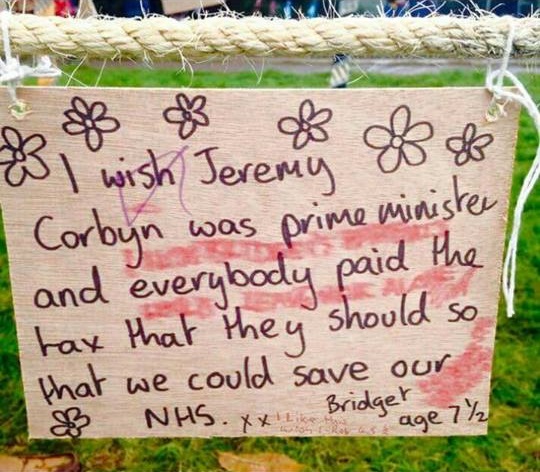
Labour - Save Our NHS

Thus far, Jeremy Corbyn’s elevator pitch for power would be more at home in the school playground than the adult political debate

When your core political argument and pitch to the electorate can be easily summed up in crayon by a seven year old girl, it’s time to develop a more robust vision for government.

A first good step for Labour to take would be to stop fomenting or tacitly condoning behaviours like these, from activists and supposed supporters:

Shouting “Tory Scum” at opponents

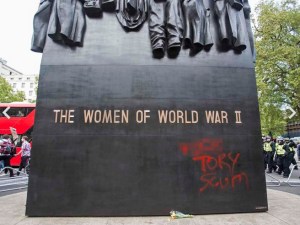
Vandalising war memorials

Shrieking about nonexistent human rights abuses

Physically threatening MPs

Being insufferable online

Pretending that there will be no offsetting behavioural consequences to dramatic tax hikes

Stubbornly believing in the magic money tree

I’ve written before about how, in their incoherent rage at the supposed transgressions of the Evil Tories, the Left are in great danger of becoming the British left wing equivalent of the American Tea Party – morally certain, impervious to facts, intolerant of the slightest internal dissent and quick to anger when contradicted by outsiders.

Where the Tea Party blindly venerate the US constitution (though they read it selectively, and from a highly originalist perspective) and would see the federal government shrunk back to its nineteenth century bare bones, the Corbynite Left venerate “our NHS” (genuflect) and the other monolithic edifices of the welfare state stemming from the socialist post-war consensus.

Neither seem very comfortable living in the present. And the worst excesses of both would be more at home stapled to the wall of a primary school classroom than reported and printed as serious ideas in the pages of a national newspaper.

Tory Protests

Agree with this article? Violently disagree? Scroll down to leave a comment.

Follow Semi-Partisan Politics on TwitterFacebook and Medium.