Middle Class Saviours Against Brexit: The Arrogant #FBPE Movement

img_0313

Middle class #FBPE-ers of Britain unite! Talk to your Brexity, working class butchers, builders, plumbers, electricians and gardeners and educate them out of their superstitious dislike of the European Union

There are few things more irritating than being called ignorant and closed-minded by a group of people who are themselves at that very moment being monumentally ignorant and closed-minded.

Sadly, this is the daily fate of eurosceptics and Brexit voters as they endure a daily barrage of insult, invective and condescension from a segment of British society who seem to believe that their naive, childlike faith in (and often equally childlike understanding of) the European Union makes them both intellectually and morally superior.

This manifests in numerous ways, from the political machinations of establishment fossils such as Lord Andrew Adonis or philosopher/conspiracy-theorists such as AC Grayling to the patronising tone in which much of the prestige media covers Brexit, both at home and abroad. But it is perhaps most visible on social media, where attitudes toward Leave voters ranging from smug condescension to bigoted hatred gather under the banner of #FBPE – Follow Back, Pro-European.

While a number of decent, thinking people still use the #FBPE identifier in their Twitter or online biographies, it is increasingly associated with age, race and class hatred-tinged attacks on “gammons” – white, working class, middle aged men who dare to express an opinion supportive of Brexit, particularly if they do not have academic letters following their name. Intentionally or not, #FBPE is becoming a redoubt of middle class, establishment resistance to the supposed horrors of Brexit – a cabal of people who believe that their moral and intellectual superiority entitles them to look down on others (at best) or even thwart their political aspirations by underhand means.

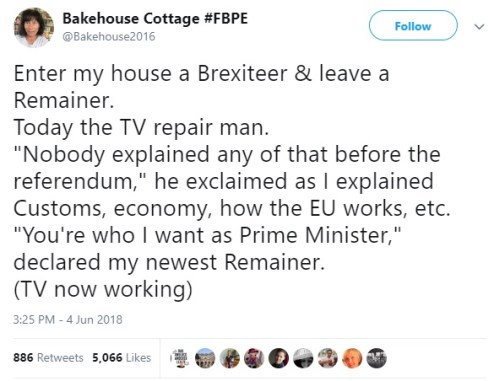
A new Twitter thread today shows the extent of the sanctimony and assumed intellectual superiority at work. Helen Holdsworth, who goes by the handle “Bakehouse Cottage” on Twitter and whose bio indicates that they are an “EU citizen” and “political theorist”, relates what she clearly believes to be an inspiring and respectful anecdote about her recent interaction with a Leave voter:

Helen Holdsworth FBPE Brexit 1

Here we see the Educated Upper Middle Class Saviour phenomenon in full action as Helen Holdsworth proudly boasts about her ability to “rescue” a benighted, intellectually limited tradesman from the clutches of his Brexity superstition.

This modern day Cicero later goes on to claim that “every one of the repair people & tradesmen has come here a Brexiteer and left a Remainer“, thus deftly stereotyping Leave voters and boasting about her immense powers of persuasion at the same time. Naturally this tale was retweeted numerous times by the approving #FBPE army, thus amplifying the dubious tale of an ignorant working class soul saved among the Continuity Remain echo chamber.

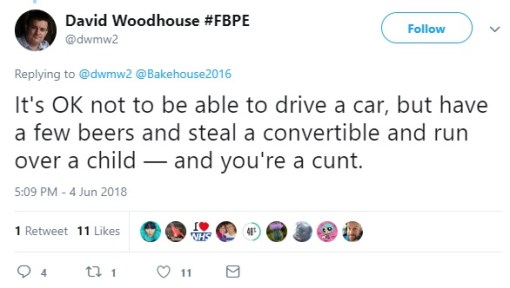
We then see this delightful exchange between Holdsworth and David Woodhouse, one of her #FBPE followers:

Helen Holdsworth FBPE Brexit 2 - David Woodhouse

Take a second to appreciate the rank bigotry in Woodhouse’s tweet, and the unconcealable condescension toward Leave voters evident in Holdsworth’s response.

David Woodhouse is publicly proclaiming that he is in the habit of making fleeting impressions of people and then denying them employment if, on some arbitrary criteria, they fit the mould of what he believes a Brexiteer looks or sounds like. He proudly states that he engages in such discrimination, which while not illegal (and rightly so – the last thing this country needs is more protected classes) is certainly to be condemned.

But worse than this is Holdsworth’s reply, which truly reveals the dark heart of the #FBPE movement. While at face value Holdsworth seems to be conciliatory, she is effectively stating that tradesmen and people who work with their hands possess such a different and inferior skill set that they cannot possibly be expected to “understand the EU” or render an informed, reasoned judgment on whether or not Britain should remain in supranational political union. Furthermore, Holdsworth believes that only when such intellectually limited people have the EU explained to them “with examples” – and quite possibly sock puppets and colourful diagrams to aid their comprehension – can they be trusted to make informed decisions.

At this point, Mr. Woodhouse veers from the bigoted toward the profane:

Helen Holdsworth FBPE Brexit 2 - David Woodhouse profanity

In other words, it is just about acceptable to not hold the same unquestioningly worshipful opinion of Britain’s European Union membership as David Woodhouse, but acting on one’s scepticism by voting to leave the EU is akin to killing a child while drunk driving.

I would like to be able to say that these attitudes are rare, and that they do not represent the wider #FBPE community or the broader Continuity Remain campaign in either tone or sentiment – but I cannot do so, because these tweets are remarkable only inasmuch as they are particularly frank and unguarded expressions of a very widely-held attitude toward Leave voters. Similar exchanges can be found on social media every day, and similarly arrogant attitudes toward Brexiteers heard from members of the general public to elected politicians or esteemed academics.

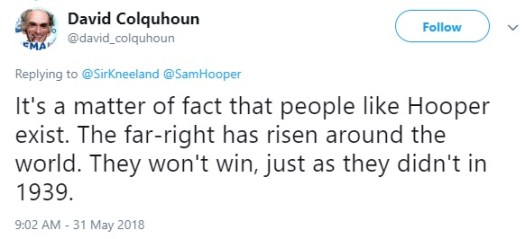
Only this week, David Colquhoun – a prominent academic from University College London – after realising that I supported Brexit and failing to defeat me in open debate, decided instead to mine my blog for “opposition research”, lie about my political beliefs to his thousands of Twitter followers and then slander me by falsely accusing me of belonging to the far right:

David Colquhoun - UCL - slander of Samuel Hooper - Brexit - Far Right

What power do I have, with my relatively meagre social media following, to push back against the false narrative peddled by public figures who are taken seriously and unquestioningly quoted in the media? Fortunately in this case, public ridicule and the vast overreach of his argument was sufficient to protect me from any reputational harm, but it could quite easily have been otherwise, had Colquhoun been more tenacious and less sensationalist in his attack.

While Brexiteers have their fair share of trolls, unpleasant and untruthful characters – some of them in government – the Remain camp purport to hold themselves to a higher standard. Their entire self image is one of well-intentioned, educated experts seeking to hold back an uninformed, dangerous populist tide. The entire rationale for casting doubt on the EU referendum result and agitating for a retake is predicated upon a conception of Remainers as sober-minded rationalists making benevolent decisions based on an evidentiary assessment of all pertinent facts. Yet in their rage at being defied by the electorate, many of the #FBPE crowd are taking to ad hominem attacks and conspiracy theories even more enthusiastically than the most unhinged of Brexiteers.

All of this might yet be understandable (if not justifiable) if only the #FBPE, Continuity Remain crowd truly were intellectually superior and possessed of a deeper, fuller understanding of the European Union and the necessity of supranational political union. But again, this is simply not the case, as aptly demonstrated once again by Helen Holdsworth:

Helen Holdsworth FBPE Brexit 3 - EU collaboration

Here we see that the intellectual and rhetorical wonder who claims to have convinced a whole army of humble Brexit-votin’ tradesmen of the error of their ways has still not moved on from childlike, simplistic tropes about “collaboration” and the need to “work together”, as though such international cooperation were only possible through the European Union.

Remainers have had nearly two years to engage in some introspection, to revisit their old campaign talking points and ask themselves what worked and what failed, and yet the #FBPE collective are still muttering exactly the same basic talking points as ever before. One of their bedrock arguments remains the facile claim that the European Union is the only significant means of international partnership and collaboration. Still they have not produced an effective response to the quite reasonable rebuttal that other countries cooperate deeply on a whole range of issues – and even manage to avoid going to war with one another – despite not dissolving themselves into continental political union.

Remainers have had every opportunity to realise that they lost the referendum because the values and facts on which they built their case were not the values and facts which mattered most to Leave voters; because their hysterically exaggerated warnings of economic catastrophe had tipped over into the realm of absurdist bullying; because one cannot win an argument about democracy and national identity by shrieking about reduced GDP growth or wailing about the supposed lost opportunities of a privileged and increasingly divergent segment of British society. And yet they have not moved on one inch from the “holding hands beneath a rainbow” crayon portrait of European political union which led them to abject and deserved defeat in June 2016. And these are the people to whose intelligence and expertise we are meant to defer?

Is it clear to you yet that Brexit has become part of a much larger, deepening culture war, with the #FBPE crowd viewing themselves as part of the Tolerant, Open and Educated group (whilst ironically behaving in a most intolerant, illiberal manner toward those in the out-group) facing off against what they consider to be the benighted savages of Brexitland? Because the dripping contempt evident in the typical #FBPE Twitter threads shown above should make it abundantly plain.

If you voted to leave the European Union (and increasingly if you deign to hold any political or cultural position not in full accordance with current progressive identity politics dogma) then the #FBPE, Continuity Remain community do not see you as a fellow citizen with differing political views. They see you as a stupid, backward and dangerous force for evil, someone who might potentially be worth educating out of your reactionary views if you seem like a sufficiently reformable soul but otherwise as someone to be ridiculed, sidelined, excommunicated from polite society and quarantined from the political decision-making process by any means necessary.

They consider you stupid, gullible and prone to influence by shadowy villains. They tell one another behind your back that you are borderline evil, and strongly imply the same to your face. They publicly shake their heads in resignation at your lack of education and intellect, whilst having repeatedly failed to deploy their vaunted intellect to address the genuine issues which prompted the Leave vote, or even admit the legitimacy of those issues. They comport themselves as though they are the magnificent, enlightened, moral centre of the universe, basking in their avowed tolerance while shrieking “gammon!” at anybody who disagrees.

Remainers who eschew the #FBPE moniker, attempting genuine dialogue with Brexiteers – and there are many such people, though regrettably they tend to enjoy a far lower profile than their extremist culture warrior brethren – should be given a respectful audience and deserve full respect as fellow citizens diligently acting according to their conscience.

But the #FBPE collective – they whose delusions of moral and intellectual superiority are belied by their rank bigotry, illiberalism and dogmatic regurgitation of basic pro-EU propaganda – fully deserve the crushing defeat they endured in 2016, and which they now beg to relive.

FBPE - Follow Back Pro EU

Support Semi-Partisan Politics with a one-time or recurring donation:

Agree with this article? Violently disagree? Scroll down to leave a comment.

Follow Semi-Partisan Politics on TwitterFacebook and Medium.

Review: The People vs Democracy

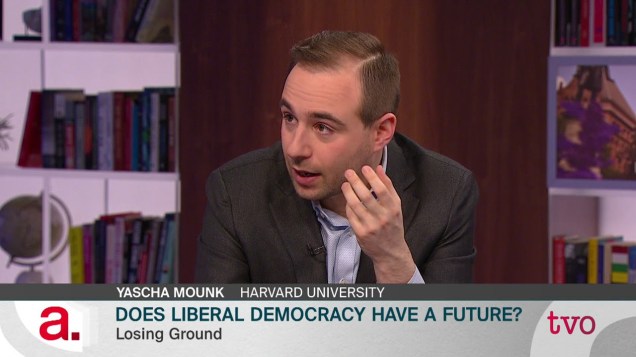
Yascha Mounk - The People vs Democracy - does liberal democracy have a future

“The People vs Democracy” goes further than many other books which claim to “explain” Brexit and the election of Donald Trump, showing that it takes both sides – outraged establishment centrists as well as populist insurgents – to successfully undermine liberal democracy. Political renewal depends on the former group finally accepting responsibility for some of the failings which brought us to this divisive moment

Introspection has been in short supply since the twin shocks of Brexit and Donald Trump’s election victory. Both sides are at fault – supporters of Brexit and Trump, well used to being the insurgent political outsiders, have frequently struggled to adapt to the fact that they now set the agenda (at least in part) and share responsibility for tangible outcomes affecting everybody. Meanwhile, dispossessed leftists and centrists, largely content with the old status quo and fearful about the speed and extent to which their worldview was repudiated at the ballot box, are so enraged at developments that they refuse to even consider how their actions and errors led to the present situation.

A new book by Yascha Mounk’s, “The People vs Democracy”, attempts to shake both sides out of their complacency while warning that doubling down on current behaviours – with populists displaying impatient contempt for norms and institutions which stand in their way, and establishment centrists concluding that even more areas of policy need to be lifted out of the “risk” of democratic influence – risk fatally undermining liberal democracy, which turns out to be a far less stable and inevitable system of government than we have all tended to believe.

The book was apparently conceived before either Trump or Brexit, but inevitably it has been seized upon by a political and media class who are overwhelmingly sceptical of (and often hostile to) both developments as a kind of guide book for how to avoid ever again losing control of the political narrative. Unfortunately, these audiences seem far more interested in analysing and condemning the supposed pathologies of voters who support populist leaders and initiatives rather than looking honestly at their own manifold failings. In an otherwise excellent interview and Q&A with the American author and journalist EJ Dionne, establishment centrist failings are barely considered at all, and certainly do not receive top billing.

Media organisations with an agenda to push have consistently portrayed the book as an analysis of the means by which “populist uprisings could bring down liberal democracy”, but this is disingenuous. Such deceptive portrayals begin in media res, assuming that populist uprisings begin spontaneously and unpredictably like forest wildfires rather than as a direct result of the failures of the increasingly antidemocratic pseudo-liberalism they champion in the form of institutions like the European Union and continuity politicians such as Hillary Clinton.

In reality, any intellectually honest observer must now concede that populists do not spring spontaneously from the earth, and that the ground must be fertilised with the arrogance and failure of establishment politicians and institutions before populism can take root and pose any systemic danger to democracy. Mounk himself acknowledges as much in his book, which is refreshing, but the biases of his target audience mean that this side of the story is consistently downplayed, both in the book and in many reviews.

Yascha Mounk begins with an overview of the West’s current political landscape, looking at factors which are common between countries:

Then there are those short years in which everything changes all at once. Political newcomers storm the stage. Voters clamor for policies that were unthinkable until yesterday. Social tensions that had long simmered under the surface erupt into terrifying explosions. A system of government that had seemed immutable looks as though it might come apart.

This description of increased political division also describe periods of discontinuity and the difficult, contentious process of forming a new political consensus from the ashes of an older, failing one:

There are ordinary times, when political decisions influence the lives of millions of people in ways both big and small, but the basic features of a country’s collective life are not at stake. Despite deep disagreements, partisans on both sides of the political battle line endorse the rules of play. They agree to settle their differences on the basis of free and fair elections, are committed to the basic norms of the political system, and accept that a loss at the ballot box makes it legitimate for their political opponent to take a turn at running the country.

[..] Then there are extraordinary times, when the basic contours of politics and society are being renegotiated. In such times, the disagreements between partisans on both sides grow so deep and nasty that they no longer agree on the rules of the game.

[..] As a result, the denizens of extraordinary times start to regard the stakes of politics as existential. In a system whose rules are deeply contested, they have good reason to fear that a victory at the polls may turn out to be forever; that a loss in one political battle may rob them of the ability to wage the larger war; and that progress defeated today may turn out to set the country on a path toward perennial injustice.

This could very easily describe the post-war socialist consensus which prevailed almost uncontested in Britain from 1945 to 1979, or the subsequent supranational and technocratic (or “neoliberal”) consensus which followed. The difference this time is that it is not the coal miners or those whose lives were made more precarious by globalisation protesting and striking, but rather members of the political and economic elite raging that their judgment as to what is best of the country has been second-guessed by other, less educated or refined people.

While Mounk plants his flag quite clearly on the “liberal” side of the argument, he is refreshingly willing to examine the flaws and missteps of his own side as they increasingly work toward a future of rights without democracy:

The rise of illiberal democracy, or democracy without rights, is but one side of politics in the first decades of the twenty-first century. For even as ordinary people have grown sceptical of liberal practices and institutions, political elites have tried to insulate themselves from their anger. The world is complicated, they insist – and they have worked hard to find the right answers. If the people should grow so restive as to ignore the sage advice proffered by elites, they need to be educated, ignored or bullied into submission.

Mounk uses the example of Greece and the Euro crisis as his example, but he could just as easily have taken any of the EU’s dealings with recalcitrant member states, or the economic and social consensus adopted in most Western countries.

And so we find ourselves locked in a negative spiral:

In democracies around the world, two seemingly distinct developments are playing out. On the one hand, the preferences of the people are increasingly illiberal: voters are growing impatient with independent institutions and less and less willing to tolerate the rights of ethnic and religious minorities. On the other hand, elites are taking hold of the political system and making it increasingly unresponsive: the powerful are less and less willing to cede to the views of the people. As a result, liberalism and democracy, the two core elements of our political system, are starting to come into conflict.

[..] Democracies can be illiberal. This is especially likely to happen in places where most people favour subordinating independent institutions to the whims of the executive or curtailing the rights of minorities they dislike. Conversely, liberal regimes can become undemocratic despite having regular, competitive elections. This is especially likely to happen where the political system is so skewed in favour of the elite that elections rarely serve to translate popular views into public policy.

This is absolutely correct but it is important to note that democracy has atrophied much faster and further than liberalism thus far in countries such as Britain and the United States. This may seem incorrect to bewildered centrists who tended to believe that everything was marvellous (or at least on a positive path toward progress) until Trump and Brexit appeared like bolts from the blue, but it is true nonetheless.

Much of the rising anti-liberalism has thus far been confined to rhetoric only, and has not yet rooted itself in public policy, while anti-democratic practices and the effective disenfranchisement of those who hold the “wrong” views have been flourishing for years and even decades. It is also the case that many policies now considered intolerably illiberal by many opinion setters (such as aggressive immigration enforcement under the Clinton or Obama administrations in America) were accepted or even positively encouraged by so-called liberals not long ago, raising the question to what extent the current fear of “illiberal” policymaking is primarily the result of goalpost-moving by those on the progressive left determined to find evil in present policy for cultural reasons and cynical political advantage-seeking. Yes, we must absolutely tackle both sides of the equation, but we can only do so when we recognise the extent of democratic corrosion compared to real-world illiberal infringements.

And of course this is a self-perpetuating cycle – more and more areas of policy being lifted free of responsive democratic control inevitably increases support for populists and assorted dissenters, which (from the perspective of elites) only validates their belief that the people are unqualified and untrustworthy of making key decisions for themselves.

Ultimately, Mounk correctly diagnoses the burning issue of the age:

Rights without democracy need not prove to be more stable [than democracy without rights]: once the political system turns into a playground for billionaires and technocrats, the temptation to exclude the people from more and more important decisions will keep on growing.

A large part of Mounk’s criticism of populist movements (and one of the main criticisms in general) is the idea that populist politicians offer glib and simple solutions to inherently complex problems, and in doing so perpetrate a fraud on the gullible people who vote for them. Citing Donald Trump and Nigel Farage as examples, Mounk writes that populists:

…all claim that the solutions to the most pressing problems of our time are much more straightforward than the political establishment would have us believe, and that the great mass of ordinary people instinctively knows what to do. At bottom, they see politics as a very simple matter.

Yes and no. It is certainly true that the complicated technology and regulation required to make the global economy hang together does necessitate a growing technocracy and makes politics far more complicated, but at times the populists are surely reacting with righteous and justified indignation to a bipartisan or consensus view to lift decisions out of democratic control. As Mounk later goes on to admit, there is no good reason why the citizens of a country should not be heard through the ballot box when it comes to immigration levels. The complex cost/benefit analysis of different types and scales of immigration may well be hugely complex, but the principle currently being violated in many Western countries is starkly clear, hence the stark (and supposedly simplistic) solution of returning some decision-making around immigration to the electorate.

Yet for most of the book, Mounk seems happy to dismiss this causal factor, rhetorically asking:

If the political problems of our time are so easy to fix, who do they persist?

Some of these problems are really entrenched and lack a simple solution, contrary to the populist claims. But at other times, the issue is simply that centrist consensus politics – or what those on the Left might denounce as peak neoliberalism – simply will not countenance the obvious and ready solutions.

Mounk rightly warns that the willingness of populist leaders to advocate the sidestepping or abolition of various institutional roadblocks – whether through earnest impatience or more malevolent intentions – is contrary to the spirit of liberal democracy. And indeed, in Britain we have seen this play out with attacks on the judiciary and now the House of Lords because of their interpretation of law or procedural foot-dragging. Mounk correctly expresses the ideal, and warns of the danger:

Liberal democracies are full of checks and balances that are meant to stop any one party from amassing too much power and to reconcile the interests of different groups. But in the imagination of the populists, the will of the people does not need to be mediated, and any compromise with minorities is a form of corruption.

Quite so. But we cannot level this criticism against populism unless we acknowledge that many of these cherished, long-standing institutions have thus far seemingly offered no defence against an effective cartel whereby both (or in some countries, all) the main political parties implement the same policies and pursue the same basic worldview without offering meaningful choice to the electorate. In such a case – as with EU membership and New Labour era mass immigration in Britain – it is not unreasonable to complain that the institutions or checks and balances currently in place are not fit for purpose, and require urgent reform at the very least.

Despite moments of real clarity, there are other occasions when for whole sections at a time, Mounk lapses into the kind of lazy, almost arrogant view of his political opponents which has for too long infected the media and mainstream opinion-setting public figures:

So much of the angry energy that fuelled [protests against Angela Merkel’s lax and permissive immigration policies  in Germany] had been on display in the streets of Dresden that I could not help interpreting the events of 2016 an 2017 in light of what I saw there: the hatred of immigrants and ethnic minorities; the mistrust of the press and the spread of fake news; the conviction that the silent majority had finally found its voice; and, perhaps more than anything else, the hankering for somebody who would speak in the name of the people.

Have journalists and academics really no alternative way to think about and describe opposition to mass migration than “hatred of immigrants and ethnic minorities”? This is half the problem – the determination of many opinion-setters to read the worst possible motives into popular protests, thus making it even harder for politicians to take those legitimate concerns seriously lest they be accused of “pandering”.

In fact, the best refutation to Mounk’s assertion is the story of the far right in Britain. While Mounk meticulously documents the rise of populist hard or far-right political parties in many European countries, he is conspicuously silent about the fate of the British National Party in the UK. Early on in the era of mass migration to Britain, in the early 2000s, the BNP secured a stunning series of victories in local and European elections, seeing their vote share climb and jostle for position with other more established and respectable smaller parties such as the Liberal Democrats. The BNP prospered in a climate where none of the major political parties promised to seriously grapple with the issue of mass migration, and rising support for the BNP was taken and portrayed by the commentariat as rising support for the BNP’s worst and most racist tendencies. However, the rise of the UK Independence Party, a staunchly Eurosceptic party lacking the racist baggage of the far right, saw the BNP quickly fade back into obscurity. In subsequent elections, the BNP lost almost all of their local council seats and entered a period of organisational dysfunction from which it has not yet emerged.

This shows that when the subjects of race and immigration are separated (as they were when voters were offered a clear choice between the BNP and UKIP), voters are far less racist and prejudiced than many establishment commentators give them credit for. The triumph of UKIP over the BNP proved as definitively as possible that concerns about mass immigration implemented without democratic consent were not primarily ethnicity based – why else would voters eschew the party which was more willing to make race and ethnicity an issue? Yet political and media elites continually over-conflate the issues of immigration and race, partly because of a soft bias which leads them to instinctively favour higher immigration and look down on those who equivocate, but also, one suspects, because they know that accusations of racism are the best way to discredit an otherwise legitimate policy argument.

The lazy charge of racism is not the only instance where Mounk unfortunately lapses into comforting establishment dogma. In this paragraph he effectively ventriloquises the sense of entitlement felt by displaced establishment politicians throughout the West, from displayed centre leftists in denial about their newly diminished position in Jeremy Corbyn’s hard left Labour Party to identity politics-worshipping Democrats who now want to double down on the divisive rhetoric of racial or gender-based grievance:

Populist leaders’ willingness to offer solutions that are so simple they can never work is very dangerous. Once they are in power, their policies are likely to exacerbate the problems that drove public anger in the first place. It would be tempting to assume that voters, suitably chastened by the ensuing chaos, would then return their trust to establishment politician.

Tempting? Chastened? Yascha Mounk is clearly an intelligent and conscientious writer, but these words reveal the extent to which he and other opinion-setters marinade in a very ideologically and culturally homogenous environment. “Tempting” suggests that it would be good if voters returned power to the same unrepentant establishment politicians that Mounk has elsewhere conceded to have led us into our current difficulties, and “chastened” suggests an establishment view of the electorate as spoiled children to be either indulged or reprimanded at various times, but never given full agency over their own lives. Mounk may not have intended it to come across this way, but there are few other ways of reading this paragraph, which itself is very reflective of prevailing opinion within the political bubble.

Throughout the book, generally the most extreme degrees of anti-establishment or populist argument are analysed, with the more moderate positions whose continued stonewalling led to a populist revolt in the first place are frustratingly avoided. We see this again here:

The major political problems of the day, populists claim, can be easily solved. All it takes is common sense. If jobs are moving abroad, you have to ban other countries from selling their products. If immigrants are flooding the country, you have to build a wall. And if terrorists attack you in the name of Islam, you have to ban all the Muslims.

On one hand it is quite right and proper to note the glib simplicity and unpleasant tone of these policies, particularly since Donald Trump did come to office promising to implement them all in one form or another. But taking potshots at the obvious impracticality of Trump’s proposals is easy. What is much harder – and would have made the book even stronger – is a more consistent and rigorous introspection as to why the continued downplaying of these issues (job displacement due to globalization and poorly enforced immigration laws with tacit acceptance of illegal immigration) by previously ruling elites led to their downfall in the first place. An understanding that continually crying “racism!” in the face of sober minded and reasonable policy proposals ultimately led to the emergence of someone with far catchier but less workable policies – the kind of introspection shown in Mark Lilla’s book “The Once And Future Liberal” – would have rounded out “The People vs Democracy” and made it a less frustrating read for moderate conservatives who agree with Mounk’s diagnosis but marvel at his inability to keep a fixed gaze on the root cause.

Too often, Mounk gives a free pass to the media, whose manifold failings also contributed enormously to this populist moment:

Critical media outlets cover protests against the populist leader. They report on his government’s failings and give voice to his prominent critics. They tell sympathetic stories about his victims.

All well and good, exactly as it should be. But where was this brave and critical media during previous administrations? Where are the equivalent stories about the victims of policies pursued through the establishment consensus? Yes, many news outlets, dazed and confused after Brexit and the election of Donald Trump, urgently dispatched reporters to far flung parts of their countries in a bid to speak with and understand the motivations of people who voted for populist options – and to be fair, there has been some good and incisive reporting as a result. But why were those journalists not always rooted in these communities, reporting sympathetically on the struggles taking place there? Why did so few media outlets or opinion-setters correctly predict the two most shocking electoral events of the century? The answer can only be that the media was and remains utterly unfit for purpose, thinking and reporting almost exclusively from one side of an emergent divide while having few authentic connections to – and zero credibility with – the other.

We should absolutely celebrate and defend a free press and reward good reporting and analysis wherever it is produced. But we delude ourselves if we hold up the existing media class as plucky heroes and defenders of democracy when their collective failure did as much as anything else to ensure that populist concerns were not fully heard until they exploded into the open with the election of Donald Trump.

Mounk is also sometimes too forgiving towards other institutions which have historically been part of the problem rather than the solution:

Attacks on the free press are but the first step. In the next step, the war on independent institutions frequently targets foundations, trade unions, think tanks, religious associations, and other nongovernmental organizations.

Populists realize how dangerous intermediary institutions with a real claim to representing the views and interests of large segments of society are to the fiction that they, and they alone, speak for the people. They therefore work hard to discredit such institutions as tools of old elites or outside interests.

Again, Mounk’s basic warning is a fair and important one. But focusing only on the attacks which these institutions are now attracting from populists and largely ignoring their significant failures makes it much harder to successfully argue for needed reform, or to reach a bipartisan compromise which might help rebuild trust in the various institutions while cleansing them of any existing bias or corruption. For example, many Brexiteers are wrong to propose the total abolition of the House of Lords due to the assembly’s scrutiny of the Brexit process and defeat of government motions, but those defending the institution are too willing to overlook the lopsided, unrepresentative and undemocratic nature of the Lords. And in America, defending the free press against the outrageous tweets and bluster emanating from Donald Trump’s White House risks overlooking the deep flaws and blind spots which run through many news organizations which consider themselves strictly objective and impartial.

Mounk also fails to consider other reasons why populist leaders may seek institutional or systemic change in addition to implementing their own policies, confidently asserting:

The reason why populists and political newcomers are so willing to challenge basic democratic norm is in part tactical: Whenever populists break such norms, they attract the univocal condemnation of the political establishment. And this of course proves that, as advertised, the populists really do represent a clean break from the status quo.

Fair enough, but one cannot offer this cynical explanation without offering the far more reasonable corollary – that if the existing political system and institutions had successfully kept his own worldview and preferred policies at the political margins despite significant public support, then he too might have just cause to believe that a deeper bias exists and that institutions really do need comprehensive reform or abolition.

“The People vs Democracy” is strong where it analyses the economic forces behind populism, going further than issuing the usual misleading banalities uneducated working class citizens voting against their own interests:

The most straightforward markers of economic well-being do not predict whether somebody voted for Trump or for Clinton. Whereas Americans who saw Trump favourably had a mean household income of nearly $82,000, for example, those who viewed him unfavourably had a household income of a little over $77,000. Similarly, Trump supporters are “less likely to be unemployed and less likely to be employed part-time” than other people in the sample. In short, the popular media narrative according to which Trump primarily appealed o the poor and the lowly just doesn’t hold up.

[..] But when we turn our attention from the attributes of particular voters to the places in which they live and the fates they likely face, it becomes clear that economic factors do mater. For one, voters who favour Trump are much less likely to hold a college degree or to have a professional job – which implies that they have a much better reason to fear that their economic fortunes might decline because of globalization and automation.

Mounk perceptively concludes that at present, countries like Britain and America are vulnerable to populism because they “can no longer offer their citizens a real sense of momentum.” This is prime Stepping Stones territory – only a comprehensive analysis of the challenges facing developed countries (and the complex linkages between them) can hope to restore the kind of positive national momentum which is needed to maintain widespread faith in liberal democracy. Piecemeal efforts to solve discrete issues (or, more realistically, to avoid bad headlines in the media) will always be insufficient. If one acknowledges that the global economy, financial and regulatory environment is so complex as to require a significant technocracy to aid good policymaking then it is ludicrous to believe that the democratic nation state can continue to prosper without any kind of forensically strategic analysis of a country’s strengths and weaknesses, opportunities and threats.

Yet far too many governments – Britain’s being one of the most dismally prominent examples – are stuck in neutral, focused on irrelevancies or fighting for political survival rather than maintaining a strategic outlook. And so the key questions raised by Mounk continue to go unanswered:

What do liberal democracies need to do to extend their remarkable record of past stability? Is it enough for them to afford their citizens a decent life? Or do they need to be able to cash in on the old promise, implicitly issued in the long decades of rapidly growing plenty, that each generation will do much better than the one that came before?

How indeed. We will never find out unless our politicians and governments lift their gaze from their navels and initiate a conversation about these pressing questions and the policy solutions required to confront them.

Where Yascha Mounk does offer proposed solutions, they tend to be quite sensible (if sometimes overly hopeful). Much like Mark Lilla, Mounk writes very much from the perspective of a US “liberal” writing for the consumption of other liberals, but he does not spare criticism of his own side. Citing the example of Poland, Mounk warns that splits in the opposition to an authoritarian regime can be instrumental in helping it to cement long-term control, a lesson that many Democratic Party activists might want to consider heeding, given the endless identity politics purity wars roiling the party and pushing them ever further to the left. Mounk’s counsel for liberals to tone down the public mockery of those they disagree with is also sound advice, for nothing shuts down debate and eliminates the possibility of persuasion than a dose of finger-wagging mockery – and this is as true for pro-EU activists in Britain who love to scoff at “uneducated” Brexiteers and deploy their new, racially-tinged “gammon” insult as it is of American leftists who demonise average Trump supporters.

Mounk also writes about the importance of constructing a rival, positive narrative to compete against the populist vision, rather than simply protesting or mocking the populists. At present, far too many of those people connected with the #Resistance in America or the anti-Brexit #FBPE collective in Britain visibly project an image of simply wanting to roll the clock back to the moment before the 2016 presidential election or EU referendum. The ongoing prominence of Democratic Party grandees like Nancy Pelosi and Steny Hoyer, and even the public utterances of Hillary Clinton herself, project an air of aggrieved entitlement rather than contrition or introspection for their role in bringing us to this point. New, fresh faces are needed, people with charisma, yes, but also the political vision and policy know-how to offer a viable, appealing alternative. As Mounk points out:

To rival the narrative according to which only they can fix the nation’s problems, defenders of liberal democracy have to put forward realistic promises of their own.

[..] the defenders of liberal democracy will not vanquish the populists as long as they seem wedded to the status quo.

[..] To avoid the mistake Clinton made in 2016, defenders of liberal democracy must demonstrate that they take the problems voters face seriously, and seek to effect real change. While they don’t need to emulate the simplistic solutions or pander to the worst values of the populists, they urgently need to develop a bold plan for a better future.

One of the most valuable contributions of “The People vs Democracy” to our discourse is its searching consideration of whether the growing identity politics movement and political activism within academia are truly helping the fight for equality or undermining the basic trust in the institutions of democracy which is necessary for the proper functioning of a democratic nation state.

The net effect of he deliberate failure to inculcate respect and reverence for democracy among young people (and to corrode whatever attachment to democracy does exist) is stark:

Millennials in countries like Great Britain or the United States [..] barely experienced the Cold War ad may not even know anybody who fought fascism. To them, the question of whether it is important to live in a democracy is far more abstract. Doesn’t this imply that, if they were actually faced with a threat to their system, they would be sure to rally to its defense?

I’m not so sure. The very fact that young people have so little idea of what it would mean to live in a system other than their own may make them willing to engage in political experimentation. Used to seeing and criticizing the (very real) injustices and hypocrisies of the system in which they grew up, many of them have mistakenly started to take its positive aspects for granted.

Mounk also inveighs against the current hysteria over “cultural appropriation”:

Far from celebrating the way in which different cultures can take inspiration from each other, the opponents of cultural appropriation implicitly assume that cultures are pure; that they are forever owned by particular groups; and that there should be strict limits on the degree to which they influence each other. In other words, they ultimately think of the culture of particular identity groups in much the same way as right-wing xenophobes who are continually on guard against foreign influences on their national cultures.

Mounk also possesses a more realistic take on nationalism and the nation state than is now common among academia and much of the elite, who tend to see patriotism as outdated and embarrassing at best, and inherently harmful at worst:

The energy on today’s left, by contrast, is increasingly directed toward a radical rejection of the nation and all its trappings: This is the left that delights in 4th of July op-eds entitled “The Making of a Non-patriot”. It is the left that chants “No Trump, No Wall, No USA at all!” And it is also the left that, not content with acknowledging the copious failings of the Founding Fathers, refuses to recognize that they might be defined by anything other than their moral faults.

Mounk, by contrast, favours “domesticating nationalism” and calls for both elites and the Left to embrace a more expansive form of patriotism instead of attacking and ridiculing the symbols and institutions which bind societies together. This sounds good in theory but is hard in practice, given the extreme to which the Democratic Party has moved in America and many activists have moved in Britain.

At its core, “The People v Democracy” identifies many of the same developments, trade-offs and challenges that several others have noted – solving international problems versus defending national sovereignty, the need for technocratic bodies vs the need for democratic input and accountability, for example. Many of these I have also laid out several times in my agitation for a new Stepping Stones Report – a document which, like the original 1977 report which Margaret Thatcher brought with her into 10 Downing Street and was used to help navigate the last great period of discontinuity in Britain – updated to identify and tackle the new challenges of the 21st century.

Yascha Mounk’s book is ultimately a call for people – particularly disaffected leftists and centrists – not to give up on all of the goodness inherent in the liberal democratic nation state just because some of the institutions of government have been temporarily captured by populists. Amy Chua made a similar point at the end of her excellent book “Political Tribes: Group Instinct And The Fate Of Nations”, quoting from the Langston Hughes poem “Let America Be America Again”:

O, let America be America again –
The land that never has been yet –
And yet must be – the land where every man is free….
O, yes,
I say it plain,
America never was America to me,
And yet I swear this oath –
America will be!

Mounk closes by referencing the end of the Roman Republic as a warning example, casting the populists of today as the heirs to Tiberius and Gaius Gracchus:

The brand of politics propagated by the Gracchi and perpetuated by their opponents shaped the Roman Republic long after they themselves had left the scene. Every dozen or so years, a new follower was able to capture power. Each time, the norms and rules of the Roman Republic were a little less capable of containing the assault.

There was no one breaking point, no clear moment at which contemporaries realized that their political institutions had become obsolete. And yet, over the course of a tumultuous century, the Roman Republic slowly withered. As the old norms of restraint crumbled, violence spiraled out of control. By the time ordinary Romans recognized that they had lost the freedom to rule themselves, the republic had long been lost.

A prescient warning indeed, particularly because it acknowledges that it often takes two sides to degrade institutions and norms of behaviour. After all, today’s establishment would be the Roman Senate and patricians in this analogy, groups which hardly covered themselves in glory during the period.

Much prevailing opinion still holds that the establishment holds a near-monopoly on wisdom and morality, and that the populist insurgencies we now witness are entirely the result of low-information, uncultured voters being preyed upon by opportunistic leaders with ulterior motives. There is a widespread, arrogant assumption that voter dissatisfaction is somehow displaced, that people do not understand the real causes of their own unhappiness and that elites should be allowed to continue governing as they see fit, explaining to the people why they are wrong rather than adapting to their will. Mounk’s book shows that establishment centrists are every bit as much to blame for our present crisis than the populists they fear.

The danger is that these establishment centrists, driven mad by their sudden fall from power and influence, react not by examining their own flaws and failings but rather by lashing out at their opponents and continuing the loss of faith in democracy whose consequences form the root of their present situation. There is such anger among elites – often (though not always) out of proportion to any so-called populist policy which has yet been proposed or enacted – that many establishment politician and activists will accept nothing less than total defeat of every populist initiative, regardless of merit, which then only confirms the populists’ suspicion of an open conspiracy against them.

Democracy without rights versus rights without democracy. The populists have been heavily scrutinised and fairly criticised for their sometimes cavalier attitude to rights, norms and institutions. When will establishment politicians be held to account for their cavalier attitude toward democracy?


Yascha Mounk - The People vs Democracy - book review

Support Semi-Partisan Politics with a one-time or recurring donation:

Agree with this article? Violently disagree? Scroll down to leave a comment.

Follow Semi-Partisan Politics on TwitterFacebook and Medium.


Matthew Parris, Yasmin Alibhai-Brown And Turbo-Charged Brexit Derangement Syndrome

Yasmin Alibhai Brown - Brexit - Mental Health - The edge of mental illness and madness

Warning of economic Armageddon didn’t work, and nor did peddling ludicrous conspiracy theories about government perfidy. So now, prominent Remainer opinion-setters are resorting to tear-stained pleas that Brexit is so personally stressful as to be injurious to their mental health

One of the more annoying aspects of modern political journalism is the way that those who cover events increasingly seek to insert themselves into the story, either by oversharing on social media, grandstanding during press conferences or writing tell-all books full of juicy campaign gossip which inadvertently reveals just how much the journalistic class traditionally suck up to those in power rather than holding them to account.

In Brexit Britain, however, this is being taken to a whole new level with newspaper columnists and TV talking heads – particularly those of a pro-establishment, pro-EU Remainer persuasion – taking a break from offering soundbites and analysis to let us all know just how traumatised and stressed Britain’s imminent departure from the European Union is making them feel.

First up this week was Matthew Parris, with a long stream-of-consciousness confessional in the Spectator:

My spirit is restless and I must confess. This Brexit thing is driving me slightly mad. And I do mean that clinically: not as a rhetorical flourish. My mental state, like that of so many I know on both sides of the Remain/Brexit divide, is capable of medical diagnosis. A shaft of insanity has pierced our interior lives. I really am becoming a Remainiac.

Is it not the first and clearest indication that the balance of one’s mind has been disturbed that, when having done all one reasonably can to achieve a result, one simply cannot let something go? What is the point of waking up at 3 a.m. and fretting sleepless until sunrise that we are leaving the European Union? What is the point of reading every one of the Times readers’ online posts beneath one’s column (they numbered more than a thousand last Saturday) and actually trying to answer scores of those many that are critical of one’s point of view? One knows perfectly well one will never change their minds, and they know perfectly well they will never change one’s own. So what are we doing staring at our stupid screens and taking verbal jabs at each other when outside the sun is shining?

[..] Well (you may say), isn’t that what fierce public debate on important questions of politics is all about? But no, not really. In my time I’ve taken sides with some passion on many great political questions, variously suffering reverses, chalking up victories or acknowledging myself impotent to influence the outcome — yet have always been able to sleep. But this ridiculous Brexit thing is spoiling my summer, spoiling my life; and I can see it’s doing the same for my adversaries on the Leave side too. I’m beginning to pine for a perhaps-imagined golden age when a Conservative-led coalition was in power and we didn’t all hate each other and the EU thing — whichever side you took — was just a minor irritation.

Of course, Britain’s EU membership and slow subsumption into antidemocratic continental political union was never just a “minor irritation” to those millions of British citizens who wholeheartedly objected to the project and would have loved to have made their feelings directly known at the ballot box much earlier, if only they had been given the opportunity. But then Matthew Parris displays that peculiar, almost robotic lack of empathy for people outside his own social caste common to many prominent Remainers, and so he could not have possibly known this.

But unlike many other prominent Remainers, at least Parris has the self-awareness to recognise that his behaviour may be counter-productive:

I mentioned the first indication of a disturbed mental balance: being unable to let something go. But I think there’s a second too, perhaps more worrying still. It’s when you self-diagnose and know this is the case, know you’re going crazy, know you’re self-harming, know that friends who tell you to leave Chazza alone because he isn’t worth it, are right — yet feel no inclination at all to mend your ways.

Like the paranoiac who is persuaded by the patient rationality of a kindly counsellor that ‘they’ are not all out to get him, but pursues his own mad train of reasoning undeterred by what he accepts to be wise advice, I rave on into the night.

I know it’s doing no good. I know I’m boring my readers; know there’s almost nothing left to be said; know that the voice in my head, my mother’s voice, telling me I just need a good night’s sleep, is right. But I’m not going to take a blind bit of notice of it. Having seen friends and colleagues drawn to their professional ruin by a fixation they cannot shake off, I resolve this summer to trudge forward, head down just like them, towards the wreck of whatever reputation I have left for dispassionate objectivity.

How bracingly, unexpectedly honest.

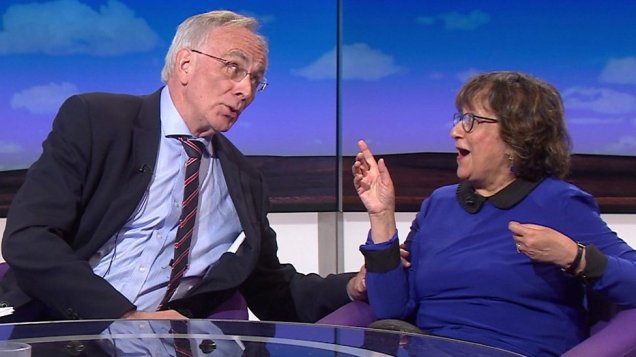
Not to be outdone by Parris, though, fervent EU hagiographer and Remainer Yasmin Alibhai-Brown then immediately took to the BBC Daily Politics studio to confess that Brexit has left her “feeling on the edge of madness and mental illness”:

I’m so glad that Matthew wrote this. I am behaving, feeling kind of on the edge of madness, of mental illness with this.

[..] I can’t go anywhere anymore, including with distant relatives, and not have a fight. I was at a wedding party last week, a wonderful wedding party – and it isn’t even left or right – and there were people from Momentum at this wedding party talking about why they were Brexiters, I had a big fight with them. And I had to go out and, like, cigarette smokers, get deep breaths, and I thought what are you doing, this is a wedding party.

[..] I can’t talk to relatives; I even had a fight with somebody on the bus, normal citizens talking about why they wanted out because they didn’t want foreigners here, I got up and had a fight. I think I’m there with Matthew.

But why is Britain’s imminent departure from the European Union so profoundly and earth-shatteringly disturbing to the likes of Matthew Parris and Yasmin Alibhai-Brown? Why is this event so much more weighty than any other political setback they may have endured in the past?

Part of the answer is that they are in fact not reacting just to Brexit, but to what they think that Brexit represents – Britain turning toward being a more introverted, hostile and unpleasant place – in a way that no other single political decision (such as a tax cut or education reform) alone can symbolise replicate. This much is evident from the Twitter timelines and public pronouncements of much of the #FBPE #WATON “Brexshit” crowd – not only do they (correctly) see Brexit as far harder to reverse than a normal political policy shift, they also fear a sea change in the character and fortunes of Britain.

But there is also something deeper and more obvious at work, driving this unprecedented hysteria from a group of commentators and public figures who generally love to portray themselves as calm, reasonable and pragmatic – the fact that the likes of Matthew Parris have never really known until now what a true political setback feels like. In recent decades (and in the case of younger pro-EU activists, their entire lives) many of the EU’s loudest cheerleaders have never known what it is for their political agenda to stall, their worldview to be repudiated or their preferred policies not to be enacted.*

For these opinion-setters and those they represent, general elections – supposedly the greatest regular opportunity for political change and democratic course correction in this country – have been largely meaningless, their outcome worth tussling over on a superficial level but never reaching the level where it might have grave or existential consequences for present trajectory of the country or for their own lives.

A decade after Tony Blair’s New Labour government took power, the top rate of income tax had not been raised from the level set by Margaret Thatcher’s government in 1988. Meanwhile, privatised industries had not been renationalised, nor was there any likelihood that they would be, to the chagrin of the Corbynite Left. And to the frustration of more conservative citizens, six years of Tory rule had seen no halt to the march of social progressivism or the persistence of a broken welfare and immigration system by the time of the EU referendum. It was not that there was no popular dissent against the effective bipartisan consensus on these issues, it was merely that in each case the political class had effectively decided to lift the “correct” course of action out of the bothersome influence of electoral politics.

Thus the Matthew Parrises of this world have long slept easy in their beds, knowing that Britain would be run as a technocratic social democracy with swathes of policy outsourced to the EU where the public could less easily interfere, and that broadly pro-business and pro-middle aged, middle class homeowner policies would prevail whoever sat in 10 Downing Street. The election of Jeremy Corbyn as Labour leader gave an early wake-up call that not everybody was entirely happy that the country was effectively being run for the personal benefit of Matthew Parris and others like him, but even then it was airily assumed that Corbynism would flame out and that moderate establishment centrism would reassert its dominance within the Labour Party, restoring balance to the universe and predictability to their lives. A pleasant predictability utterly lacking in the far more precarious and uncertain lives of millions of fellow citizens whom Matthew Parris and his cohorts barely deigned to notice, but a pleasant predictability nonetheless.

This is why what we are now witnessing from many establishment commentators more closely resembles an hysterical toddler’s tantrum than reasoned analysis or advocacy. With Brexit, something very precious of theirs (to their mind, their natural right to see the arc of history bend favourably toward their wallets, careers, lifestyles and preferred holiday destinations) has been rudely stolen – and they are not going to take it lying down.

Unfortunately, this strangely unmoving bid for public sympathy will prove to be just another failed tactic to add to the gallery of missteps and forced errors of the Continuity Remain campaign. Insulting Leave voters and accusing them of xenophobia or racist tendencies didn’t work. Casting aspersions about the intelligence and education attainment of Brexit supporters (as though a degree in chemistry or gender studies imparts some special wisdom about the best forms of government to secure freedom and prosperity) likewise did not work. Resorting to unhinged conspiracy theories (such as in-house Remainer intellectual AC Grayling’s insistence that the UK government planned to provoke China into sinking a Royal Navy frigate in order to distract from difficulties in the Brexit negotiations) failed to generate anything other than derision and embarrassment.

And now this belated establishment bid for public sympathy will also fail; not only because it makes a mockery of real mental illness and those who face stresses and mental difficulties of an infinitely more severe nature with none of the financial and social cushions enjoyed by prominent media personalities, but because those people now seeking sympathy in their time of “trial” have tended to show an astonishing disregard – and sometimes outright contempt – for the worries and concerns of those they now paint as the enemy and pick fights with at wedding receptions.

The next time a famous and well-remunerated journalist or opinion-setter takes to the television studios to bemoan the harm that Brexit is apparently doing to their mental health, they should first perform this role-reversal thought experiment: imagine that rather than Brexit being the first time in their life that they didn’t get their way on a matter of deep and abiding personal importance, that it was the first time that they ever knew victory. What might that have felt like, to have been so disenfranchised and overlooked for so long?

Any pro-EU personality of honour and dignity might then pause before flaunting their mental trauma and parading their emotional scars before a nation with far more important things to worry about.


* This hysteria and sense of a coming apocalyptic event which must be prevented at all costs is also what allows politicians like Lord Andrew Adonis and activists like Gina Miller to pose as plucky underdogs and doughty defenders of democracy in their long guerrilla war to derail Brexit. Many of the arguments they make about the dangers of unchecked executive power and disparagement of the judiciary are entirely valid, in principle, yet these Crusaders for the Preservation of Democracy had absolutely nothing to say when the executive under David Cameron was making highly questionable actions to sway the EU referendum in favour of the Remain campaign (such as the £9m government propaganda leaflet or the violation of the spirit and possibly letter of purdah rules). Their commitment to constitutional observance and separation of powers extends only so far as these principles can be leveraged to their own advantage – they have no compunction violating these principles when doing so serves their own purposes.


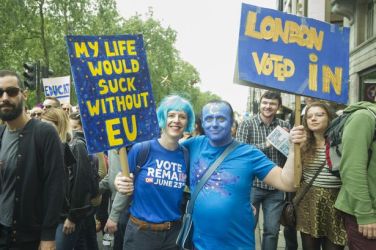
Brexit - EU protesters - My life would suck without EU

Support Semi-Partisan Politics with a one-time or recurring donation:

Agree with this article? Violently disagree? Scroll down to leave a comment.

Follow Semi-Partisan Politics on TwitterFacebook and Medium.

Update From The Road, Part 2

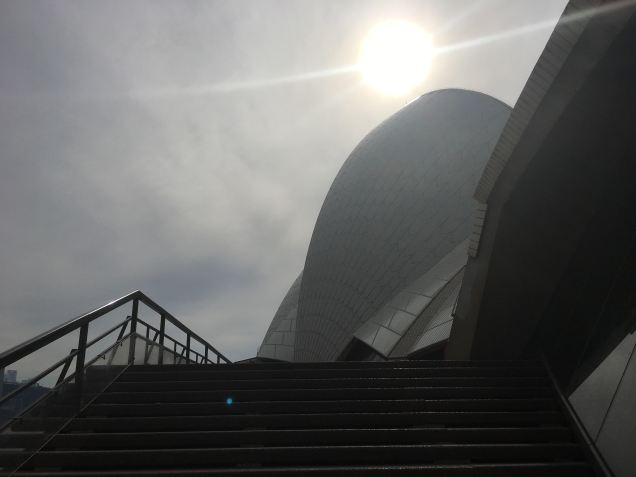
Sydney Opera House - steps and sails in the sunlight - SJH

A political union which might actually work

As day 57 of our slow-motion American migration (by way of Southeast Asia and Australasia) draws to a close, I thought it was about time for another brief update from the road.

After a frenetic, exhilarating time in Singapore (don’t go there without visiting  Liao Fan Hong Kong Soya Sauce Chicken Rice and Noodle, the cheapest Michelin-starred lunch you will ever eat, clocking in at about $1.50 USD) and an alternately wonderful and frustrating couple of weeks in Bali, we finally made it to Australia. We began in Melbourne, which the coffee snob in me enjoyed very much and which generally validates everything you read about Melbourne being one of the most liveable cities in the world, and then flew up to Sydney for five days, and now on to Cairns. I write this evening from the dining table in our motel room in Port Douglas.

Country highlights thus far would have to include the Great Ocean Road heading north from Melbourne, with its views of the majestic coastline and powerful sea. Also the private wildlife tour we took out of Sydney, in which we spotted a variety of birds, koalas, wombats, kangaroos, wallabies, a couple of (thankfully) baby huntsman spiders and a vain search for a platypus. My highlight, though, has to be the Sydney Opera House. This marvel was of course bound to tick all of my boxes as a classical music and opera-loving architecture geek, and the behind-the-scenes tour was fascinating. The sweeping beauty of the modernist architecture and the ingenuity of its construction make the building fully deserving of its status as a UNESCO world heritage site. It is the kind of building which, having beholden it, makes one feel sad that one can never again encounter it for the first time. Sadly there were no performances of interest scheduled while we were in town, but visiting the building was pleasure enough on this trip.

What a fantastic place is Australia. Those who know me personally probably grew tired of my pre-trip jokes about how I fully expected one or other of the many terrifying creatures which inhabit Australia to kill me, but the truth is that I have been very taken with this country since arriving a couple of weeks ago. The similarities to Britain are, as you might expect, almost too numerous to list, though there are also important and valuable differences too.

The spoken English and many of the idioms used here are of course easily recognisable and understandable by most Brits – we attended a show at the Sydney Comedy Festival a few nights ago, and while my wife (a Texan) struggled in some places to follow along, I was able to do so without effort. Much of the free-to-air television seems to consist of either old British shows from the 1990s (lots of Inspector Morse) or reality TV format exports, while the shorter store opening hours – many stores seem to shut up shop not long after 6pm, even in the cities – also resemble Britain prior to New Labour, circa 1996. Many UK businesses and brands have a visible presence here. The food is also very similar to that of Britain. Neither country really have a national cuisine as such; Australians may claim to produce superior meat pies or fish and chips, but after extensive personal research I can confirm that in reality it is pretty much a draw on that front.

We had the pleasure of visiting friends from London who moved to Sydney for work a couple of years ago, and it was interesting to hear anecdotes revealing their positive and negative experiences. Both found it very easy to make the transition from working in London to working in Sydney, not just because working culture is similar in the two cities but primarily because the general culture is so similar. Australians tend to be a little more direct and confrontational where necessary – much less British passive aggressiveness here – and in parts of Sydney there is a kind of health and body-obsessed vanity which those who know such things compare to the culture in Los Angeles, but overall there are few impediments save financial cost and homesickness which would stop any Brit from packing up and transporting their lives to Australia with relative ease. Well, aside from the points-based immigration system, of course.

All of which naturally led me to think about culture, national identity and the argument from Remainers in Britain that the UK has so much in common with our European friends and allies that a supranational political union is harmless at worst, and most likely deeply desirable. One need only spend half a day in Australia to realise that if there was to be a culturally viable supranational political union it would be between countries like Britain and Australia, with their deeply rooted shared history and multilayered cultural connections, than our closest geographic neighbours, dear and valued friends though they are.

The language barrier is the obvious issue, though far from the only one. For a supranational political union to work, there has to be a cohesive and willing demos to give the political institutions legitimacy – or at least a desire among the people to forge such a multinational demos and meld themselves into it. Without a shared language, this is an almost impossible task. Even conversational or business knowledge of another language can be insufficient to forge the kind of understanding and close relationships needed on a wide scale for people to see themselves as a single body. Being able to order food in a restaurant or even participate in a business meeting in a second language is often not enough, particularly when so few are likely to do the latter relative to total population size.

Rage against human nature all you want, but successful political systems and settlements are those which work with human nature rather than against it – capitalism being the prime example, harnessing individual self-interest and leveraging it in the ultimate service of the greater good. Supranational political union without consultation and consent is as doomed to failure as socialism, as both demand that human nature subordinate itself totally and unquestioningly to Utopian political theory.

If supranational political union is the goal – and to be clear, I’m not necessarily advocating this – it would be most likely to work where countries already share a language, a similar system of government and laws, numerous cultural references and deep links at all levels of society, not just between post-national elites. In other words, between countries like Britain and Australia (and most likely New Zealand and Canada too, though I shall have to confirm this as the grand tour winds its way toward America).

Those who say that Britain is so culturally aligned with Europe that we inevitably and rightfully belong in the EU’s political union find themselves not only delusional but also caught in a pincer movement by cold, hard reality. On one hand, there is the stubborn fact that ties of history, language and culture bind us much more strongly to the Commonwealth Anglosphere than to Spain or Germany, and on the other hand there is the fact that while “citizen of the world” post-national elites and knowledge workers may increasingly share a common culture and tastes, this emerging culture is itself global, not parochially European. A digital marketing executive from Bangkok or a hipster from Melbourne is likely to have as much in common with their British counterparts than mainland European, and in the latter’s case

I am presently reading “The People vs Democracy” by Yascha Mounk, himself no populist rabble-rouser, and even Mounk admits:

After a few months of living in England, I began to recognize that the differences between British and German culture were much deeper than I had imagined. They were also more wide-ranging. Far from being confined to food or language, they extended to humor and temperament, to personal outlook and collective values.

After college, when I spent more time in Italy, and then in France, I came to the same conclusion all over again. The residents of various European countries were much more attached to their national cultures, and much more resistant to thinking of themselves primarily as Europeans, than I had wanted to believe.

Again, Mounk is no Brexit apologist or excuse-maker for populism, but unlike many Remainers in Britain he is at least willing to change his assessment based on cold, hard reality and observance of human nature. EU defenders seem more determined than ever to ignore such qualitative facts, seemingly because unlike warnings of forthcoming economic doom, vital cultural issues cannot be so easily added up in an Excel spreadsheet and then pasted into an alarmist infographic to be shared on social media.

The furious insistence that Britain is culturally European and thus destined for political union centred in Brussels is primarily an elite phenomenon, and therefore a marginal viewpoint. If one has the money and inclination to ski in France or cycle in Italy every year, one is far more likely to perceive closer ties and similarities between Britain and Europe than exist on the macro level – and I say this as someone who has travelled a fair deal in Europe including four consecutive summer vacations in Santorini, Greece. While I love the Greek people and their culture, and readily acknowledge many similarities and crossovers with my own, I am deluding myself if I tell myself and others that the shared culture of Britain and Greece is more or equally capable of supporting political union than the shared cultural heritage of Britain and Australia.

For the final time, this is not to suggest that Britain and Australia do form such a union, or that the wildest dreams of the CANZUK fanclub be pursued – there is no real economic case, only a slender geopolitical one and very little mainstream interest for such a radical move in any of the concerned countries. The point is merely that if a political union were to be attempted, its chances of success would be infinitely higher among the Commonwealth Anglosphere than it is among the far more heterogenous countries of Europe.

And yet this does not stop the Remainers, with their endless tropes about the dangers of “going it alone” in the world and the evil “British exceptionalism” which leads us to believe we are somehow “better” than our continental European allies. They would struggle manfully against human nature right to the bitter end, furiously clinging to their dream of a supranational European government and political union, all the while ignoring the only kind of deep political union which might potentially work.

Brexiteers are often accused of a pig-headed refusal to engage with facts and deal with empirical reality, a charge which is frankly often deserved in the case of truculent leading hard Brexiteers who haven’t made the first effort to properly acquaint themselves with the details (or even the basics) of international trade and regulation, or who see Brexit not as a constitutional or technocratic challenge/opportunity but rather as nothing more than an exciting new front in their ongoing culture war.

But having now spent time in Australia and witnessed the degree to which cultural similarities with Britain are of such an entirely different (and higher) order than exists between the UK and most EU member states, I see that there is far greater pig-headed stubbornness on the other side – a stubbornness which is far less forgivable since its bearers love to portray themselves as highly educated disciples of reason, and have persisted in their delusion for so much longer.


Sydney Harbour Bridge at dusk - SJH

Support Semi-Partisan Politics with a one-time or recurring donation:

Agree with this article? Violently disagree? Scroll down to leave a comment.

Follow Semi-Partisan Politics on TwitterFacebook and Medium.

Why I Am Glad To Be Leaving Britain

Statue of Liberty

[As I continue to wend my way through Southeast Asia en route from London to my new home in the United States, below are some reflections on leaving Britain which have been percolating in my mind. Regular political commentary to resume once our travel itinerary calms down a bit and I reach a country with more reliable internet connectivity.]

I’d like to say that it has been a pleasure…

Britain will always be home to me. I will never renounce my citizenship, even though I will proudly take American citizenship and become a joint citizen of the other country to which I feel love and loyalty when I become eligible to do so. But speaking strictly from the perspective of someone who thinks about policy and writes about politics more than is probably healthy, I’m very glad to be escaping Britain for America at this particular juncture.

Not because of Brexit. I hear the keyboards of fifty Twitter wags clattering to life in my mind right now: “Ha, look at this die-hard Brexiteer who wanted out of the EU so badly but now won’t live in the apocalyptic hellscape he has bequeathed us”. Save the wisecracks, this has nothing to do with Brexit (though Brexit certainly shines an unforgiving light on the institutional and intellectual rot which makes me glad to move across the Atlantic).

I’m happy to be leaving Britain because we have become a small, petty and insular country. Not because of Brexit; we have been gradually becoming so for years prior, helped in large part by our EU membership, the stultifying centrist Westminster consensus and decades of bland technocratic government. The smallness I refer to has nothing to do with military or diplomatic power, though there are certainly warning signs in both these areas. It has nothing to do with our immediate economic prospects, since growth continues and the fundamentals of our economy are no more or less wobbly than they were prior to the EU referendum. It has nothing to do with the rise of other powerful countries or Britain’s supposed isolation outside the comforting embrace of supranational European political union.

The smallness afflicting Britain is a smallness of aspiration, of confidence, of purpose. It is the gradual draining away of any self-belief among those who run, report or comment on this country that decisions made here could actually matter, or influence human events and progress in a significantly beneficial way. It is the even more alarming realisation that the people with the potential intelligence and vision to help Britain recover our place as a visionary leader among countries increasingly self-select out of political life for reasons which are as obvious as they are tragic.

Why climb the greasy pole in a broken party system which rewards group conformity over ideological consistency or necessary pragmatism? Why inch one’s way up from town councillor to county councillor to MP’s bag carrier to ministerial SpAd to junior MP to parliamentary private secretary to junior minister to Cabinet minister to prime minister, compromising one’s ideas every step of the way, when one can have a far more fulfilling career in every respect working in the private sector, and have a more lasting and profound influence on humanity in the process?

For a couple of years now I have been writing about the great challenges facing Britain and the world in the new period of discontinuity which we are entering – an era when the old political settlement with its associated policies neither solve the new challenges we face nor command widespread public support any longer. The last such period of discontinuity in British politics took place in the late 1970s, when a sclerotic economy and over-powerful vested interests (particularly the trades union) were gradually choking the life out of Britain. Back then, we responded with the Thatcherite revolution, which for all its faults (and yes, those faults were real) revitalised our economy and rolled back the worst excesses of the socialist post-war consensus.

This new period of discontinuity is different, with new challenges in the form of globalisation, outsourcing, automation, mass migration and uncertainty over the role and long-term survival prospects for the nation state. These are problems which affect nearly every advanced economy, and which most countries are currently sidestepping or delaying their day of reckoning to some extent. Brexit offered Britain the golden opportunity to be not a helpless canary in the coalmine but rather an innovative testing laboratory and beacon to the world, confronting some of these challenges head on, breaking open political taboos and experimenting with heretofore unconsidered policy alternatives to meet the challenges we face. Britain could have seized this opportunity to genuinely lead the way for the first time in the post-war era, certainly in my lifetime.

This opportunity has been squandered, and the squandering is both tragic and unforgivable. In the 1970s there was enough intellectual life left in Britain for new policy ideas to germinate in places like the Centre for Policy Studies, then-revolutionary think tanks who brought in outside talent and evaluated ideas based on their innate worth rather than the connectedness or insider reputation of the individual putting them forward. That’s how the famous Stepping Stones Report came to be written in 1977, which Margaret Thatcher then took with her into Downing Street in 1979 and used as a blueprint for many of the policies and reforms which ultimately saved Britain from seemingly inevitable national decline.

In 2018, there is nobody left to do this kind of radical, disruptive work. Some of the same think tanks and organisations still exist (in name), but to a large extent they are rusted out old shells of their former selves, living on past glories and eking an existence by flattering government ministers or acting as a mouthpiece for existing party policymaking theatre rather than doing anything genuinely revolutionary or independent.

When I proposed a new Stepping Stones Report for 2022, a document which would seek to identify and classify all of the issues and threats facing modern Britain in order to discover their interlinkages and arrive at a suite of mutually-supporting policies to tackle and overcome them, I received a few polite and non-committal words or emails from various MPs and think tanks, and then no more. On one occasion I was cordially thanked and then told that there is “nothing in particular for you to do at this time”. You see, I am from outside the inner Westminster bubble so it is inconceivable that I might have stumbled upon a good idea or have anything whatsoever to contribute to government policy.

A few fruitless efforts at gaining the attention of influential figures within the Conservative Party made it abundantly clear that while normal people like me are good for stuffing envelopes or knocking doors to get out the Tory vote, best leave the policymaking and strategic thinking to those inside the bubble. And so the Conservative Party’s effort to make policy continues to throw up random half-baked ideas to solve the housing crisis, the productivity crisis, the migration crisis, the healthcare crisis, the education crisis and the so-called crisis of capitalism (many of these ideas lifted straight from the Miliband playbook) without any attempt to consider how these challenges might be linked or best be solved in conjunction with one another. A few genuinely heroic Tory MPs – George Freeman, Nick Boles and Robert Halfon, to name the most active – are engaged in serious work attempting to reimagine conservative policy for the 21st century, but they are receiving precious little air cover from CCHQ or Downing Street.

Things are no better on the other side of the aisle, where Jeremy Corbyn’s Labour Party is permanently one anti-Semitic tweet away from total self-destruction. This blog celebrated Corbyn’s victory in the Labour leadership contests of 2015 and 2016, not out of any admiration for or agreement with his policies but because he represented a bold step away from the suffocating centrist consensus whose policies overlook so many Britons and which has been hugely resistant to change. And there have on occasions been genuinely encouraging signs of intellectual life within Labour, such as with Corbyn’s proposed National Education Service – a horribly statist idea, but one which at least sought to recognise the limitations of our present system and try something different rather than continuing to shoot for the middle.

However, much of the political backing behind Jeremy Corbyn – Momentum in particular – is anything but modern or forward thinking, offering nothing so much as reheated 1970s statism. Worse, it comes infected with rabid and widespread anti-Semitism which the leadership ignores in order to avoid offending certain other fellow ideological travellers at home and abroad. Such has been the infighting that one can scarcely discern a Corbynite platform more nuanced than raising taxes and renationalising industry. Meanwhile, the displaced Labour centrists, full of entitlement and utterly lacking in introspection as to how their moral and intellectual failures led to this nadir, have done precious little policy thinking of their own and when given the chance to displace Corbyn in 2016 were so concerned for their own precious political careers that none of the remaining big beasts would stand, leaving it to the malodorous Owen Smith.

Ah, but what about the smaller parties? Well, UKIP has collapsed into now inevitable (if once avoidable) irrelevance, the Green Party continue to wage their ostentatiously anti-prosperity agenda and the Liberal Democrats have become nothing more than a futile Stop Brexit Party (and even on this ground they are challenged by new upstart anti-Brexit parties such as Renew). If there are signs of intellectual life or political courage to be found on the political periphery they have escaped my attention.

Look at education, healthcare, housing, automation and AI. Britain isn’t even currently aspiring to emulate best practice in (or achieve parity with) other countries, let alone pioneer new policy solutions which might see us leapfrog our competition and point the way for other nations. Take just education as an example, where technology could be revolutionising our current conception of school, opening up new possibilities for remote learning and real-time interaction with experts and other classes across distance and borders, and research in the social sciences has long hammered home the importance of proactive parental involvement in order to inculcate success at an early age. Where is the new technology in our classrooms? Where is the digital learning strategy? Where is the government promoting more responsible parenting?

Instead of these necessary endeavours to face up to policy failure and change direction, we either indulge in vainglorious British exceptionalism and imagine that the world has nothing to teach us (see the Tory Right’s insistence on a hard Brexit and our national obsession with the NHS, according to its hagiographers the world’s only compassionate universal healthcare service) or else resignedly believe that we are so feeble a country that there can be no hope in striking out on our own to road-test new ideas. How pathetic. How cowardly. What a betrayal of the next generation. How utterly, utterly small.

None of this is to say that things are significantly better in the United States. Lord knows that my new adopted home has not got everything all figured out just yet; America is also idling in neutral to a large degree, an unpredictable and vastly underqualified new president at the helm, his own worst enemy, and an opposition party which has sold its soul to the false god of identity politics rather than offering any uniting, uplifting alternate platform. But at least the big issues are still debated in America, however crudely may sometimes be the case.

As I wrote last year when lamenting the decline in British political rhetoric:

Maybe part of the reason that there are no great contemporary British political speeches reflects our diminished status in the world, no longer a superpower or the pre-eminent actor in world affairs. Lofty words are easier to reach for when one reasonably expects that they might reshape the world.

Despite having every opportunity to take the lead, Britain seems determined to be a follower – either cowering fearfully within the EU or attempting to roll back the clock to a time when economic integration, regulatory alignment and international just-in-time supply chains didn’t make a mockery of the Tory Right’s hard Brexit fantasies. We even import our social movements these days, with British universities racing to copy their American counterparts in capitulating to the censorious cult of identity politics and organisations like Black Lives Matter UK springing up despite lacking any of the context or triggers which prompted the formation of the original.

I have very little desire to spend my time engaged in the minutiae of political debate in a country which stubbornly refuses to lift its gaze above its own navel, whose activists have enough spare time on their hands to worry about non-issues or capriciously import social movements from abroad yet no time to agitate for universal reform, true egalitarianism or issues which do not immediately benefit their own wallets. America may not be the country it once was in terms of the richness and profundity of its civic life (though this is not to dismiss the great and necessary advances in civil rights and equality) since many of its greatest thinkers left the stage, but it is a darn sight healthier than contemporary Britain.

Interventionism versus non-interventionism? That debate burns more brightly in America because it is the United States which must do the bulk of intervening in an age of parsimonious European retrenchment. Healthcare reform? The American system may exist primarily to make Britain’s NHS look good by comparison, but at least radical healthcare reform is possible in the United States, unlike Britain where NHS worship is a mandatory religion for those in power. Education? The federal system and greater role for local government in America means that far more experimentation with new policies and technologies can take place than in Britain, where “postcode lotteries” are feared and policy competition is severely limited. The benefits and costs of laissez-faire social liberalism? Nearly all of the most thoughtful writing can be found in American journals, not the incestuous British publications.

Only on the question of national identity and societal cohesiveness is the political debate more interesting and pressing in the UK and Europe than in the United States, and even then only because years of bad and arrogantly-imposed policy have bequeathed Europe with significant subpopulations which feel little loyalty to or affinity with the countries which give them life and liberty, thus making it an existential issue. It is now fashionable among many elites to bemoan the decline of liberal democratic values, yet there is precious little introspection as to how policies which deliberately undermine the nation state and erode a common sense of identity accepting of liberal values might have played a part in their demise.

America is presently less far down this destructive path, and thus freer from the risk of the kind of societal unrest and breakdown which would make other policy experimentation impossible. In other words, if you don’t have to continually fight to justify your country’s existence (either from plotting euro-federalists on one side or unintegrated subpopulations and post-patriotic citizens of the world on the other) then one can comfortably think about other policy concerns, but if national survival underpinning essential liberal values is not assured then everything else becomes largely irrelevant.

So why this long, somewhat bitter screed as I depart the United Kingdom? After all, in the grand scheme of things I don’t matter at all. I’m not a genius, a policy wunderkind or a charismatic future political leader, so me quitting these shores to make my mark in the United States is no great loss for Britain. But if even people like me survey the state of British politics and civic life and feel overwhelmed by a feeling of resigned ennui, how must those individuals blessed with real talent and inspiration feel? You think they are going to stick around to watch Owen Jones, Ian Dunt and EU Supergirl slog it out with Nigel Farage, Jacob Rees-Mogg and Liam Fox, or feel compelled to step forward and offer their leadership skills to a country which itself has no desire to lead?

Britain can survive me flouncing off across the Atlantic; indeed, the country may well be much the better for it. But the pathetic state of British politics and civic life that I have described here is not only repulsive to me; it alienates talent and discourages innovation at nearly every level.

When British politics becomes little more than a technocratic debate about making the trains run on time or ensuring by national decree that hospital waiting times hit a certain target, we are thinking far too small.

When British political debate is more about desperately ignoring obvious truths (the unsustainability of the NHS, the failure of unmitigated multiculturalism, our broken welfare state) than tackling those problems head-on, we are being far too cowardly.

And when the desire and capacity of British elites to confront and overcome 21st century challenges gives way to a sense of resigned powerlessness and a petulant impatience for somebody else to do the difficult work, I can’t muster much sorrow to be taking a step away from that dismal stage.

I will never stop following or writing about British politics, and this blog continues. Britain is my homeland, a place towards which I will always retain a deep attachment and where I will undoubtedly spend some future years raising a family – and indeed, one of the unique selling points of this blog – I hope – is my ability to provide a familiar Brit’s perspective on American politics and a (nearly) American perspective on British politics, which would make unplugging from the debate quite counterproductive to my work.

But since Britain has repeatedly shown itself to be disinterested in domestic or global leadership of any kind, my focus will naturally gravitate more toward the politics of my new adopted home, a country which despite its many dysfunctions still retains that optimism and self-belief that matters debated and decisions made in America can shape the world for the better.

And Lord knows I am looking forward to that change of scenery.


Sign at Plymouh Rock - landing place of the pilgrims - 1620

Support Semi-Partisan Politics with a one-time or recurring donation:

Agree with this article? Violently disagree? Scroll down to leave a comment.

Follow Semi-Partisan Politics on TwitterFacebook and Medium.