Lack Of Empathy For Opposing Political Views Threatens Social Cohesion

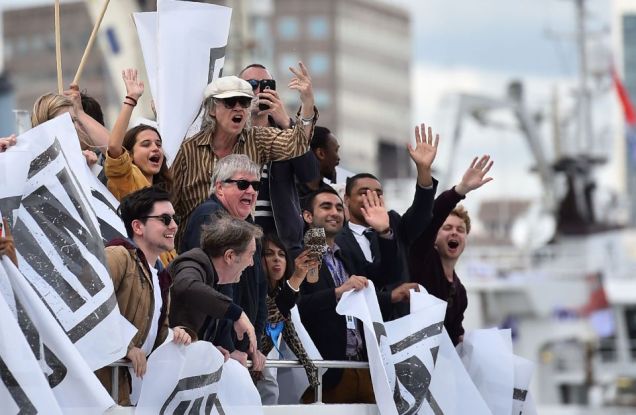
Bob Geldof - EU Referendum - Brexit- Fisherman boat protest

The inability of the political and professional classes to comprehend or respect the political opinions of those from other backgrounds is nearly as grave a threat to our social cohesion as unchecked multiculturalism

There is a whole bucketload of truth in this piece by Michael Merrick, which should make uncomfortable reading not only for metro-leftist, pro-EU types, but even those of us in the so-called professional classes who do not subscribe to majority opinion.

Merrick discusses the differing prevailing cultural and political norms which exist among working class people (generally more conservative) and those in the urban professional classes (much more progressive), and the difficulty of bridging the gulf of misunderstanding between the two. This is particularly relevant when it is almost exclusively the professional classes who are charged with setting public policy, despite often having no real empathy with those whom they seek to reform or re-educate.

Merrick writes:

It is a long established truth that graduates tend to be much more liberal than their non-graduate compatriots. Indeed, since the referendum, plenty on the Remain have been quick to point out the education gap between Leave voters and themselves. The observation is innocent enough, though it too often contains all the smirk and subtext of that teacher from my youth.

Thus the graduate professions take on a particular character, with norms of outlook, of worldview, indeed of morality. The moral compass of the liberal outlook is distinct from the conservative, and these things split broadly over class, which correlates with level of education; these tribes value different things, draw lines in different places. But when the deck is stacked so heavily toward one over the other, the chances of any effort to comprehend the difference diminish whilst self-certainty proliferates. And liberals, contrary to assumption, tend to be as intolerant as conservatives, who have a broader moral outlook, though less understanding of the conservative viewpoint than the other way round. In a profession which is graduate dominated, and with graduate-level education so tightly correlated with liberal outlook, so we might see the roots of an important disconnect. Conformity to the norms of the in-group becomes the mark of the sophisticated, the cultured, the educated. And transgression comes at a cost.

As such, if you arrive from a working-class background shaped by these subversive norms, the graduate professions are not always a comfortable place to be. You must grow accustomed to the objects of derision and mockery being people like your family, those you grew up with, those you know and love. Whilst the derision might be delivered in the abstract – against a general viewpoint or unidentified Other – the barbs are felt personally. The word bigot, or any of its linguistic manifestations, is chucked about casually, but it hits specific targets, especially when it addresses a common viewpoint amongst those who comprise your upbringing. Those ‘xenophobes’ and ‘racists’ who voted Leave, for example, are not disembodied, theoretical people, but those who you know to be nothing of the sort, such as grandparents, who were always so loving and kind, and parents, who have lived a life of service to others, friends, who are decent and hardworking, the folks who live next door, the lady who you see at Church each week, the priest who baptised your kids. It becomes personal, and it jars.

But with public affirmation of in-group norms comes prestige –  in the echo chamber of social media, there is status to be acquired through the sassy, the rude, the downright spiteful to working-class folk with more conservative views, on immigration, perhaps, or crime, or Brexit. An army of followers giddily RT and ‘Like’ such comments, as if their articulacy were evidence of their truth and justification for their prejudice. Thus the motes are plucked out whilst the beams remain – the cultured despisers find in their intellectual superiority a justification of their presumed existential superiority, too.

This truth tends to sail over the heads of people who currently exist and always remained largely in the same social class and culture in which they were raised – how would they know any different? But Merrick, who gained access to the professional classes after being the first in his family to get a degree, is better placed to notice the gulf of incomprehension and unwillingness to empathise with the other side, having occupied both sides of the divide at various times.

And this can have a real impact in terms of public policy, as Merrick notes:

In our schools, this has real consequences – as I have explored here and here – creating a representation vacuum as a class of Anywheres seek to educate a generation of SomewheresPioneers against Settlers, with the former holding all the power and believing professional success consists in educating the latter out of the values and culture of their upbringing. Pupils from a socially conservative background, which often (not always) overlaps with a working-class (or religious) background, will at times find themselves at odds with the ethical and moral paradigms of those who educate them, a culture chasm always framed as simply a matter of education (or the absence of it). And so the cycle starts over, an abiding tension between home and school, since in this case to be educated is to leave behind what you hear and are taught at home.

But some do choose home. Not because of a lack of learning but because of a refusal to shed heritage and home as the participation fee. If we want to talk about why working-class kids are alienated from education, we could do worse than start a conversation there. That those who agitate so fiercely for social justice, and write and speak so piously about the disenfranchisement of the working class, should choose to studiously ignore this particular deficit, and indeed locate their own virtue in the perpetuation of it, tells us a lot about the intractability of the culture clash we accommodate.

“Anywheres seeking to educate a generation of somewheres” – that phrase resonates, particularly as the self-described Citizens of the World tend to assume that the only thing preventing others from embracing their worldview is their lower level of education.

I actually see a lot of myself in what Merrick writes. I wouldn’t know whether to describe my upbringing as working class or middle class. Income-wise, being in a single parent family on benefits, living in Harlow, we were very much working class. But thanks to other branches of the family that worked in professional or academic circles, I wouldn’t say that my social upbringing was that of the typical working class. I should also note that my accent was never the standard estuary accent typical to Essex, but rather that of my wider family – and in Britain, accent does so much to demarcate one’s class status.

I certainly remember being both aware and very ashamed of being poor when I was young, and keenly noticed the difference in lifestyle between many of my schoolfriends who came from working families – their Sky television versus our black and white television set, for example. To be clear, I wanted for nothing when I was a child and had a great upbringing rich in love and family and culture. But a child notices these things, and it is silly to deny that they influence one’s development.

And so, when I went to university I was probably overly keen to embrace the distinctly more upper middle-class lifestyle and tastes enjoyed by my peers – not that I ever fell properly into the working class mould because of our extended family, but because I was keen to explore new horizons which had previously been somewhat limited. I enjoyed being on the Entertainments Committee of the Union Society and wearing black tie to the weekly debates featuring famous names from British political and cultural life. I admit that I enjoyed having transcended the town, the culture and many of the people with whom I had grown up.

This continued into my professional life. Living with other young professionals starting their careers in London, I was happy to make jokes about chavs, or otherwise look down on those from less educated and less wealthy circumstances. I would sometimes crack jokes about Harlow and the people there (despite the fact that I had, and continue to have, friends living in Harlow to this day). I remember attending one fancy dress party in a chav costume, which I thought to be terribly clever at the time.

In fact, it has probably only been in the past five years, since I started blogging (and consequently reading and thinking a lot more about various issues) that I realise the deliberate nature of what I was doing as an adolescent and a young graduate – and how insufferable I must have been to so many people from my earlier life during that time. And it is only now, in the aftermath of the EU referendum and the enormous establishment hissy fit which continues to this day in response to the outcome, that I fully understand what Michael Merrick is saying and identify very much with his experience.

I have always felt that the best people to analyse or give commentary on a situation are those who have held both sides of an argument at one time or another, or been on different sides of an important wedge issue. Why listen to somebody like Owen Jones analyse politics, when he was raised to hate the Tories and simply continued on the same uninterrupted intellectual trajectory his whole life, the only difference being that he can now use longer words and quote academic sources sympathetic to his position? There is no personal growth there, nor any real empathy for the other side (the possession of which is the only real acid test of one’s own political philosophy) and consequently no real attempt to engage with ideological opponents. That’s not being an intellectual, it’s being a partisan shill.

Similarly on Brexit, why listen to some millennial writer who has only grown up knowing life inside the EU and accepting its unquestioned brilliance all the days of her life? What can such a person really add to the national conversation besides a whole heap of confirmation bias and sanctimony?

Now, I would never claim to be better than Owen Jones or Generic Millennial Remainiac Writer. But I can at least plausibly claim to have had my feet on both sides of the political and cultural divide at various times, having grown up holding the typical youthful left-wing opinions and then made a gradual move toward the libertarian or conservatarian Right. And even more so having been a staunch euro-federalist in my university days, to the extent that I hung an EU flag on my dorm room wall and sometimes insufferably wore an EU flag lapel pin, to rediscovering the vital importance of the nation state and becoming an avowed Brexiteer over the past five years.

Generally I find that the most productive exchanges take place with people who have not simply percolated in likeminded groupthink for their entire careers, but who have either personal experience of occupying the other side of the argument or at least made a sincere effort to reach out in good faith to those who disagree.

I was a socialist in my youth, and know many of the old arguments inside and out – but crucially, I also know through personal experience that many of those who still hold socialist views are good and decent people. I was a pro-European in my youth and know the entire case for European political integration backwards and forwards, yet despite having reversed my position 180 degrees I know that many of those who still hold these views are intelligent and honourable people. I hope that this knowledge of the opposing viewpoint and acknowledgement of the decency of those with whom I disagree adds a bit of depth to my better pieces of writing.

Unfortunately, this attempt to bridge the chasm of cultural and political difference is almost nonexistent among the political class – on both sides. Rising star Labour MP Jess Phillips openly admits to being “raised in no uncertain terms to hate Tories“, a fact which shines through in many of her speeches and television appearances. And the inability of many of those in the Conservative Party and the centrist, machine politics wing of the Labour Party to empathise with working class people is self-evident – a particularly shameful indictment of the Labour centrists, who now openly scorn a large swathe of their political base.

And this failure to empathise with different people has real world effects, like when David Cameron went marching off to Brussels to conduct his faux renegotiation with the EU despite never really having stopped to ask what the British people wanted out of it, and today’s Conservative government pursuing an idiotic and damaging approach to Brexit on the assumption that immigration is the overriding factor for most people when post-referendum polls (and a few conversations with actual Brexiteers) reveal concerns about sovereignty and democracy to have been the primary driver of Brexit.

We currently have a political class who at best arrogantly think they can channel working class opinion without ever really stopping to consult the people they think they are ventriloquising, and at worst simply don’t care at all about what a whole swathe of the population thinks and believes.

More worryingly, it takes an immense effort to overcome this gulf of misunderstanding – in my case it took over five years, and that’s despite having occupied both sides of the debate at different times, such is the zealotry of a convert to professional class norms – and the political class generally show zero aptitude for that kind of introspection.

Michael Merrick has done a great job of diagnosing the problem, but right now I fail to see a ready solution. The gulf of incomprehension is likely to get wider before it narrows.
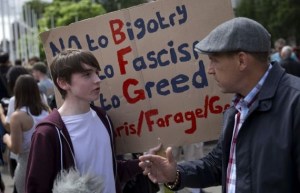
BRITAIN-EU-POLITICS-BREXIT

Support Semi-Partisan Politics with a one-time or recurring donation:

Agree with this article? Violently disagree? Scroll down to leave a comment.

Follow Semi-Partisan Politics on TwitterFacebook and Medium.

Centrism Is The New Extremism

Owen Jones - Brexit - Hardline Remainers - Extremism

For many years, the most angry and bitter invective in our political discourse hailed from the far Left and Right. But now it is the supposedly rational and pragmatic centrists who are becoming unhinged and increasingly uncivilised.

Like the stopped clock which still tells the correct time twice a day, once in awhile Owen Jones has a passing moment of clarity and perception and utters a statement with which a normal person can actually agree.

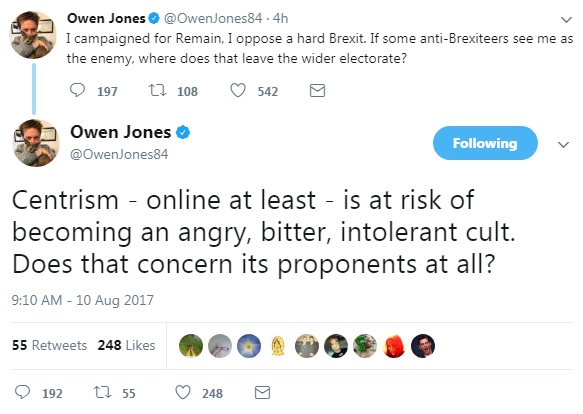
Today is one of those days. Noting that he is taking increasing amounts of flak not from hard Brexiteers but from hardcore ideological Remainers, Owen Jones noted on Twitter that “centrism – online at least – is at risk of becoming an angry, bitter, intolerant cult. Does that concern its proponents at all?”

Jones follows up by noting that “a certain type of Hard Remainer online have become angry, bitter, intolerant, and determined to root out the impure on their own side”:

Slow hand clap.

Jones isn’t wrong, and while one might legitimately question whether he is the best person to be accusing others of being angry and bitter, he makes a fair point – there is a very real and growing rage building among the pro-EU centre-left, a rage which is spilling over and causing people to say all manner of outlandish things.

In the immediate aftermath of the EU referendum there was a sort of stunned silence from the Remain camp. Many arch-Remainers were also the same establishment centre-left figures who found themselves banished to the margins of the Labour Party by the Jeremy Corbyn ascendancy back in 2015. To be cast from power and influence within their own party and then to feel Britain’s EU membership – which has become emblematic of their perception of themselves and the country as enlightened, progressive internationalists – slip through their fingers only a year later was more than many centrists could bear. At first.

But it did not take long for shock to turn into anger and defiant resolve. Harnessing huge amounts of denial (“the referendum was only advisory”, “the Leave campaign had a monopoly on lies and so the result should be invalidated”) many centre-leftists, realising that their entire worldview was not only under attack but on the verge of defeat, stirred themselves into action.

We saw this with the court case brought by Gina Miller, in which the Supreme Court ultimately ruled that Parliament must have a say on the final Brexit deal negotiate by the government. We saw it too in the flourishing of groups and social media accounts dedicated not to making the best of Brexit now that the country had voted for it, but rather trying to overrule that vote and remain in the EU at all costs.

I noted this phenomenon myself a few weeks ago, admitting that we Brexiteers had underestimated the ability of the pro-EU, centrist establishment to launch a reactionary hissy fit several orders of magnitude bigger than the anti-establishment backlashes which led to Brexit in Britain and President Trump in America:

Perhaps we should have seen it coming. Effectively overruling the establishment’s carefully laid out plan for our lives was always going to generate a huge backlash, from powerful and well-connected people with the ability to make traditional grassroots anti-establishment backlashes look like a cake sale at the Women’s Institute.

Perhaps we forgot this fact because we Brexiteers and defenders of nation state democracy were so used to being part of a backlash ourselves – the backlash against the establishment – that we didn’t give enough credence to the fact that globalists, disinterested “citizens of the world” and other assorted types are equally as invested in their worldview as we are in ours, and in a far stronger position to defend it from attack.

And now that they have experienced repudiation at the ballot box, the establishment’s ability to turn howls of outrage into a full-on filibuster of democratically-made decisions is stronger than many of us planned for.

We are definitely witnessing an ossifying or hardening of positions among many Remainers. Before the EU referendum last year, some of these people could occasionally be found admitting that the European Union was not perfect and urgently needed reform, and even that membership had some downsides (even if outweighed by the positives).

You won’t find arch-Remainers talking like this in the press or on social media any more. Now that the prospect of Brexit looms, the EU is perfect and irreproachable, and Brexiteers aren’t just misguided but actively evil for casting Britain into the abyss. (Well, to be fair, many hardcore Remainers always asserted that Brexiteers were evil racists, but they now do so with increased frequency and venom).

The Guardian recently published a piece by Will Hutton, who declared that Brexit is “our generation’s Dunkirk”, as though tactical retreat in the midst of an existential world war is in any way comparable to the peaceful, diplomatically negotiated departure from a supranational political union.

In a spittle-flecked fury, Hutton wails:

Last week, Labour peer Lord Adonis compared leaving the EU as a mistake analogous to appeasement. He is right. Brexiters Davis, Fox and Johnson are from the same anti-modern, delusional world view that produced the strategic foreign policy mistakes of the 1930s and the emasculation of the mixed-economy, state-led approach that underpinned the economic success of 1931-50.

Then, at least, we had underlying strengths, representing the opposite of their philosophy, upon which to fall back on. Brexit is our generation’s Dunkirk, but with no flotilla of small boats and no underlying economic strength to come to the rescue. It’s just defeat.

Now this blog has no time for Liam Fox or Boris Johnson, but even if Theresa May’s government drops the ball completely on Brexit the economic ramifications (bad though they may be) will still fall several degrees short of colossal military failure and impending invasion. To compare Brexit to Dunkirk or to Chamberlain’s policy of appeasement is wild hyperbole of the first order.

But this is what you now have to look and sound like to be accepted into the Remainer / centrist tribe – at least on social media, where nuance and restraint have never been in great supply. Just as the Cult of Social Justice and Identity Politics doles out “victimhood points” and social status depending on the number of ways that a person can describe themselves as oppressed, the Cult of the EU demands ever more flamboyant declarations of love for the European, furious denunciations of those who disagree and pledges of extreme measures to be taken to stop Brexit at all costs. Because being pro-EU is bound up so tightly in the centrist psyche, Brexit is making many establishment centrists behave like any other identity group that feels under attack, blindly lashing out and playing the role of the victim.

And so in many ways it was inevitable that arch-Remainers would be suspicious of the likes of Owen Jones, and seek to publicly denounce him. Back in 2015, when the EU was turning the screws on Greece and effectively subverting Greek democracy, Jones came close to openly advocating for Brexit. Of course, like many others (most notably Ian Dunt, who had virtually nothing good to say about the European Union until he realised that the EU referendum could boost his profile if only he switched sides) Jones eventually returned to the fold, taking the wishful thinking Varoufakis position that we should remain in the EU in order to reform it.

But like all extremist movements, the hardcore ideological Remainers have long memories and no statute of limitations when it comes to heresy. Owen Jones once expressed doubts about Our Beloved EU, Fount of All Good Things. And he compounded this thoughtcrime by accepting the reality of Brexit rather than raging against it, even penning a lengthy account entitled “Why I’m a remainer who accepts the EU referendum result”. Therefore he must be punished and cast out. As Jones notes, “the Hard Remainers want to overturn the EU referendum and regard the likes of me as traitors and impure for wanting a soft Brexit instead.”

The centrists of old – back when they were free and easy, on the ascendancy, certain that their basic worldview was coming to fruition and would perpetuate itself forever – had a reasonable degree of tolerance for differing opinions. That’s why the likes of Ken Clarke could fit (ideologically at least) under the same political umbrella as someone like Tony Blair, Yvette Cooper or Chuka Umunna. A few honest differences on a few political points were expected and allowed, since everybody was pulling in the same basic direction. But no longer. Cast out of power, hardcore centrists increasingly use a person’s attitude toward Brexit as an acid test to determine whether they are Good or Bad.

Where will this end? Well, certain excitable centrist MPs and their media cheerleaders seem to be itching to set up a new political party, first with the sole objective of stopping Brexit and remaining in the European Union, and once that deed is accomplished to turn into some kind of new centrist party, a shelter from Theresa May’s authoritarianism and Jeremy Corbyn’s unabashed socialism.

I wrote an entire blog post yesterday about why this idea is idiotic and will never come to fruition. But what would such a party look like, if the normal constraints of British electoral politics were magically removed and a new “centrist” party formed?

By definition it would be full of extremists – the kind of people whose fanatical devotion to the European Union is such that it overrides their previous party loyalties and makes them willing to jump into bed with other people who might have quite different ideas about the optimal size and function of the state, spending priorities, social issues or a million and one other policies.

Such a party would be full of EU-worshipping zealots who would pay any price and bear any burden to thwart Brexit – ironic, since many of them complain about so-called Brexit extremism. But more than that, it would be full of deluded souls who think that if only Brexit can be stopped, everything would just go back to how it was before David Cameron called the referendum; that the anti-establishment backlash which helped to deliver Brexit would simply melt away as people shrugged their shoulders and accepted being overruled by their social betters.

This is delusional. The reason that Blairite and Cameronite centrism lies discarded in the gutter right now is because its most ardent practitioners were content with a system which rewarded people like themselves while leaving millions of others in dead-end jobs or left on the welfare trash heap with little realistic prospect for self-betterment – and because they were openly, snarlingly contemptuous of anybody who dared point this out or raise an objection. Centrism is discredited because it inspired successive British governments to effectively outsource whole swathes of governance and policymaking to the European Union, with MPs and ministers enjoying the trappings of power despite having vested many of their responsibilities in a supranational government even less accountable or responsive to the popular will than Westminster.

A new political party (or government) full of centrist extremists, bitter and vengeful at having been temporarily dethroned, would immediately seek to roll Britain back to 2015 (or 2010, depending on whether they are centre-left or centre-right extremists). But the British people have moved on. A majority want to get on with Brexit even if they voted to Remain in the referendum. They want to move forward, not backward.

But despite being totally impractical and doomed to failure, expect to hear more talk of a new, dedicated anti-Brexit party. Expect to hear more overwrought headlines and tweets comparing Brexit to such and such atrocity or genocide. The rage continues to grow among the dispossessed centrists, and they have a vastly bigger platform to air their grievances than those on the ideological Left or Right.

You see, these people have never lost before. They are accustomed to winning, and do not know how to behave in the face of defeat. Since 1997, whichever party was in power, Labour or Conservative, the centrists’ worldview inched ever closer to fruition. And if that consensus failed to deliver for millions of Britons – those at the sharp end of globalisation or those who simply care a lot about democracy and constitutional matters – then so be it. They got theirs, and that’s all that mattered.

Thank goodness that this cosy centrist consensus has finally been broken, and that these arrogant, selfish and overrated people will have to take their failed and discredited ideology to battle in the political arena along with the rest of us, rather than continuing to win by default.


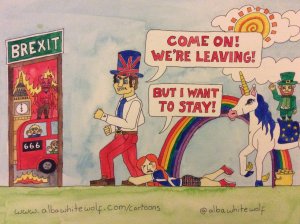
madaleina-kay-european-union-brexit-cartoons-unicorns-and-leprachauns-2

Support Semi-Partisan Politics with a one-time or recurring donation:

Agree with this article? Violently disagree? Scroll down to leave a comment.

Follow Semi-Partisan Politics on TwitterFacebook and Medium.

Bitter Remainers Dream Of A Single Issue Anti-Brexit Political Party

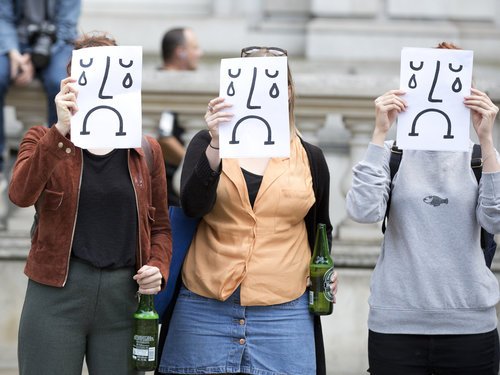
EU Referendum - Brexit - Despair

Still firmly stuck in the “denial” stage of the grieving process, some bitter Remainers are now pinning their hopes on a new political party with the sole aim of thwarting Brexit

A number of overexcitable Remainers seem to be getting carried away with the idea that a brand new political party, dedicated solely to the purpose of thwarting Brexit, might be the answer to their prayers.

We first saw this idea floated in the Financial Times by Janan Ganesh, who did a masterful job of suppressing everything he knows about the British political system to convince himself that the idea might actually have merit:

A new political grouping has been in fitful gestation since Britain voted to leave the EU. Uncomfortable in their own parties, a few Conservative and Labour politicians have probed the idea in discreet settings. Donors are primed with start-up capital. Tony Blair has improvised a role as a curator of these forces, and at times as their frontman. An electorate that has withheld a decisive win from any party since his own days as prime minister is plainly open to some disruptive entrant to the market. If it shows promise, Liberal Democrat MPs might subsume themselves into it rather than stagger on as a futile dozen.

For all this, the breakthrough never comes — and not because Britain’s first-past-the-post voting system stymies the new. The project never gets that far. The trouble begins earlier. To avoid caricature as pro-European monomaniacs, and to let their restless energies roam, the people involved aspire to stand for something broad: political moderation in an age of extremes. This requires them to have policies, or at least first principles, across the full spectrum of government business. But each time a putative party settles its view on, say, fiscal policy or healthcare, it will alienate some of its original and potential supporters. It also loses definition. Before the project has a single achievement to its name, it is bogged down in matters of internal theology. It becomes a paradox: a fissiparous political party with no MPs.

Ganesh concludes with a well-rehearsed yet tone-deaf paean to the kind of bland, managerialist centrism which sparked this anti-establishment backlash in the first place:

A wider manifesto for moderate government might emerge, but only over time and as a consequence, not a cause, of the movement’s success. To design an entire worldview upfront is to wallow in detail before any political momentum has been established. And to lose friends in the process.

And yet the foolish idea is now gaining traction, with journalist (and ex-Chief of Staff to Brexit Secretary David Davis) James Chapman promoting the idea, as the Guardian excitedly reports:

A former chief of staff to David Davis has said Brexit is a catastrophe that must be stopped and called on centrist MPs to form a new party.

James Chapman, who worked for the Brexit secretary for a year as the Department for Exiting the European Union was set up, suggested the new party should be called the Democrats and claimed some “very interesting people” wanted to be involved.

[..] Chapman, who previously worked for George Osborne, said anti-Brexit MPs such as Anna Soubry, Grant Shapps and Mark Harper had more in common with party opponents such as Rachel Reeves and Vince Cable than “Owen Paterson et al”.

Let’s all take a moment to appreciate the delicious irony of a political party explicitly founded to overturn the results of a democratic referendum – and all in order to ensure that Britain remains a part of a supranational political union whose very purpose is to undermine nation state democracy – calling themselves the Democrats. This utterly shameless tactic is taken straight from the Karl Rove playbook, with Remainers projecting their own flaws onto their opponents while claiming the virtues of Brexiteers (commitment to democracy) as their own.

Nevertheless, Janan Ganesh and James Chapman both seemingly believe that the best way to overturn the result of the EU referendum and thwart Brexit is for pro-Europeans to band together and campaign only on that single issue, in the name of moderation and to avoid deadly infighting by introducing other ideological squabbles to the debate. But the problem with this thinking is that by definition, only those disaffected MPs who feel most strongly about stopping Brexit would join such a party, and they tend to be the swivel-eyed euro-federalists or dim but enthusiastic EU cheerleaders.

What the Remainers forget is that while the Leave campaign may only have won the referendum 52% to 48%, many of the 48% also have no real love for the EU. Even in my own North London constituency of Hampstead & Kilburn, one of the most defiantly Remain-voting constituencies in the entire country, I have spoken to numerous people who voted Remain either grudgingly or out of alarm at the apocalyptic stories spun by Britain Stronger in Europe.

Arch-Remainers have tended to assume – wrongly – that the full 48% who voted to Remain in the EU did so because they share the same fanatical devotion to the European Union as themselves, but this is not the case. Many people strongly bought into the Leave campaign’s argument about sovereignty and self-determination, but voted Remain because they prioritised short-term economic security over long-term democratic security. And one cannot entirely blame them for doing so – I fully admit that I am something of an outlier with my unfashionable, somewhat fanatical obsession with constitutional issues.

So how would a British public which was probably much more than 52% hostile to the EU at the time of the referendum react to the formation of a new political party created with the expressed intention of overturning the referendum result? Janan Ganesh clearly thinks that such a party would be greeted like liberators, come to rescue benighted Britain from the evil clutches of Nigel Farage and Boris Johnson. I’m not so sure.

While as a country we may be increasingly confused about what “British values” really mean, most of us would still point to the importance we attach to “fair play” being a defining national trait. And I think that the British people would take one look at a bunch of establishment arch-Remainers (led by Tony Blair, no less) attempting to undo the referendum result as a grave insult and a brazen power grab.

The New Party campaigners also totally overlook the dynamics of individual constituency races in favour of national polling. Even assuming that a new political party got off the ground (I’m not holding my breath) it would face exactly the same challenges as the SDP back in the 1980s, squeezed between a rock and a hard place as Labour and the Conservatives refused to stand aside.

Even Owen Jones sees through the scam:

And what then would be the point of such a party with (at best) only a handful of fanatical europhile MPs in Parliament? Even if Theresa May’s government falls before the next scheduled general election, the chances are that Brexit will either be concluded by this point or more likely that negotiations will be so far advanced (perhaps with a negotiation extended) that it is no longer possible to undo without accepting revised membership on harsh new terms (no budget rebate, mandatory joining of both Schengen and the Euro) that an overwhelming number of Britons would find unacceptable.

The whole idea is a complete non-starter, the futile fantasy of an establishment class which still believes that it can simply circumvent or nullify democratic outcomes rather than doing the hard work of convincing people and winning them over to their side. A year on from the referendum and the tantrum continues with no sign of abatement.

Having said that, by all means let them try. Lord knows that the Conservative Party would be an immeasurably better entity without the likes of Anna Soubry and Grant Shapps.


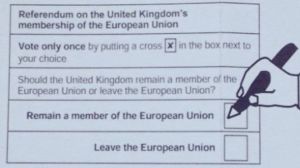
The Electoral Commission - EU Referendum Ballot Paper - Brexit - Biased Voting Guide

Support Semi-Partisan Politics with a one-time or recurring donation:

Agree with this article? Violently disagree? Scroll down to leave a comment.

Follow Semi-Partisan Politics on TwitterFacebook and Medium.

Remainers: You Can Stop Pretending To Be Patriotic Now

Jonn Elledge - Democratic World Superstate - Brexit

A rare moment of honesty from an arch-Remainer

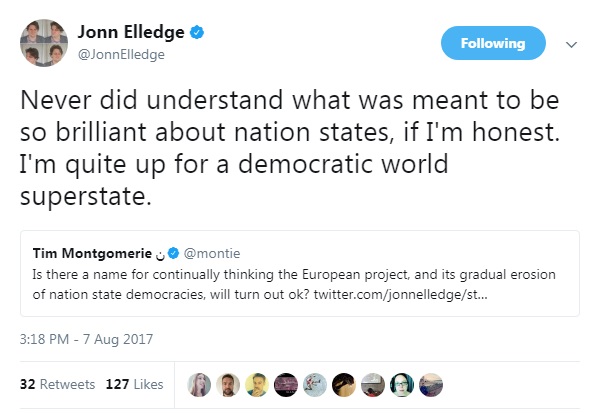
New Statesman staff writer Jonn Elledge – whom I recently described as “worse than a garden variety xenophobe” for his heinous statements about elderly Brexit voters, much to his indignant outrage – has been engaging in a minor Twitter spat with Tim Montgomerie this afternoon about the nature of Brexit.

This would be utterly unremarkable, but for one inadvertently revealing tweet in the exchange in which Jonn Elledge revealed in a moment of strange candour the real reason that establishment Remainers love the European Union and cannot conceive of a life outside of its cloying embrace.

Pressed by Montgomerie, who asked “Is there a name for continually thinking the European project, and its gradual erosion of nation state democracies, will turn out ok?”, Elledge replied, simply and honestly (for once) “Never did understand what was meant to be so brilliant about nation states, if I’m honest. I’m quite up for a democratic world superstate”.

This is an appallingly ignorant and historically illiterate statement, the kind of sentiment that could only be uttered by somebody who enjoys all the benefits of living in the age of the modern democratic nation state without pausing for a moment to consider the true source of all his comfort (hint: not the EU). Would Elledge at least concede that the nation state is a slight improvement on the city state? The multiethnic empire? The dynastic kingdom? Marauding tribes? He is at pains not to say, and yet is quite ready to roll the dice, jack in the nation state and try something new without really giving it a moment’s thought.

And there it is, ladies and gentlemen. Finally, a moment of honesty from the arch-Remainer side of the argument. Of course, those of us who followed the EU referendum debate closely and saw through the paucity and desperately narrow scope of the Remain side’s argument (focused almost entirely on negative scaremongering about trade with occasional rhetorical flourishes about “cutting ourselves off from the world”) knew that something deeper was motivating the EU’s loudest cheerleaders.

But of course Jonn Elledge and his co-conspirators could not admit their dirty desire in public during the referendum. They could not simply admit the truth – that they have no respect or appreciation for the nation state and its role in guaranteeing our core freedoms and liberties, and that they would sooner consign nations to the grave so long as they and their ilk could preserve their current perks and become true citizens of the world.

To admit their scorn for the nation state and eagerness of its demise would have been suicide during the EU referendum. Thus their only hope was to pretend to be patriotic and to have a love for this country and its many positive qualities (some of them are still continuing the pretence to this day to maintain their credibility in the hope of winning a potential second referendum) while secretly loving the EU precisely because it actively undermines nation states by design.

But of course the one world government (or “democratic world superstate”) longed for by Jonn Elledge (and no doubt many other Remainers in the secrecy of their own hearts) is totally impractical in any case, working against human nature rather than with it, as all Utopian left-wing pipe dreams tend to do.

Consider the case of the United States of America, fifty states combined into one great nation, bound together under the motto E Pluribus Unum (out of many, one). When it comes time for presidential elections, Americans do not stubbornly vote only for candidates from their own state, but instead choose from the candidate whose policies they prefer from any of the fifty states. A Californian might vote for a candidate from Illinois without so much as a second thought, knowing that the candidate will represent all of America if elected. Americans can do so in confidence because their sense of being American is stronger than their sense of being an Iowan, New Yorker, Nevadan or even Californian or Texan, the two states with the strongest sense of separate nationhood.

Now imagine an election for Leader of the World. Do you think that people from countries as diverse as Britain, Mexico, Malaysia, Russia, Greece, Kenya and Japan would vote high-mindedly for the candidate who offered the best suite of policies, regardless of his or her nationality? Would it even be likely that a candidate would offer a fair suite of policies rather than a manifesto geared toward benefiting his or her home nation? Of course not. Cultural differences are far more significant across national borders (despite the furious efforts of pro-EU “citizens of the world” to pretend otherwise), and out of protectionist instinct people would inevitably want to vote for a candidate from their own country, or at least a sympathetic country.

And who can say that they would be wrong to do so? Is Jonn Elledge seriously contending that he would be happy for the world to be led by a member of the Chinese Communist party? Or by a Putinesque Russian oligarch? Or a theocratic Saudi cleric? Of course he wouldn’t. Elledge, in his disdain for the nation state and desperate need to virtue-signal his abhorrence of patriotism, paints a fraudulent world of rainbows and unicorns where all cultures are equally praiseworthy and deep-seated cultural and religious differences are non-existent. Again, working doggedly against human nature rather than working practically with it.

There can be no world government because there is, as yet, no world demos. One day, probably quite far in the future, this may change. And that may be a good thing when it eventually happens. But we are not there yet, and to pretend that a “democratic world superstate” is either viable or desirable is foolishly naive as well as being oxymoronic – you can either have democracy or a world superstate, but not both.

I wrote about the ongoing importance of the nation state at some length back in 2015:

The liberties and freedoms we hold dear today can very easily slip away if we do not jealously guard them. By contrast, power is generally won back by the people from elites and powerful interests at a very heavy price – just consider Britain’s own history, or the American fight for independence from our Crown.

If we want to have a say in designing the new institutions that will govern our politics, trade, intra-bloc affairs (for we soon may not call it “foreign relations”) and other issues, we need to put the brakes on the demise of the nation state while we take stock and think about the future that we want, so that we do not end up in the future that our leaders and elites are building now in secret, without our consent.

Even if you find patriotism silly and the importance that conservatives attach to symbols and rituals to be absurd, it is still in your interests to slow down the juggernaut of European integration so that you too can help design the world our descendants will inhabit. You may laugh at the latest sensationalist Daily Mail headline, or think Nigel Farage a fool when he stands in his local pub, resplendent in tweed, drinking a pint of English ale. And that’s fine, you can laugh.

But think about what the world will be like in one hundred years, with its new technologies and services and ideas. Think about what innovations there will be in healthcare and banking and computing (and data collection) and travel. And then think about how much oversight and control we have over any of these things even today, in 2015. It it enough?

Imagine, then, the world of 2115. What institutions will then exist to safeguard our children’s  interests, and which bodies and authorities will they petition for redress of grievances? Who will control foreign relations between whatever nation states or multinational trading blocs remain, and who will decide whether to wage war using whatever unimaginable weapons we have conceived a century from now?

Do you entrust the EU with these powers? The World Trade Organisation? The United Nations?

The answer to this final question is apparently a resounding “yes!”, at least as far as Elledge is concerned. Any international or supranational institution is brimming over with legitimacy and ability to solve “a lot of stuff the nation state can’t do” in the mind of hardcore ideological Remainers, while the despised nation state offers nothing but insularity, bigotry and nationalism.

The naivety on display here is quite simply off the charts. Obviously it is one of the defining characteristics of those on the Left to leap towards radical change without stopping to think through the consequences, but to show a willingness to do so with something as fundamental as abandoning the nation state as the basic building block of human society is reckless indeed. Especially since neither Jonn Elledge or anybody else has proposed a viable alternative.

It is one thing to rage against the status quo and advocate for radical change. But to sneer at the nation state, close one’s mind to the stability and prosperity it has delivered and advocate for One World Government without even beginning to think through the consequences and practicalities should destroy once and for all whatever credibility Jonn Elledge and his ideological brethren have left.

And still we should be grateful. For too long, ideological establishment Remainers have walked a tightrope, angrily proclaiming that they are as patriotic as the next man (and taking great offence when the impossibility of this statement was pointed out to them) while doing everything in their power to ensure that the nation state is weakened, together with the fraying bonds which hold our society together. Now, finally, the mask is slipping. Whether through a moment of frustration or deliberate design, the real motivations are now being unmasked.

Now we see the hardcore ideological Remainers for what they are.


European Union - United Kingdom - Britain - Flags

Support Semi-Partisan Politics with a one-time or recurring donation:

Agree with this article? Violently disagree? Scroll down to leave a comment.

Follow Semi-Partisan Politics on TwitterFacebook and Medium.

Vince Cable Joins The Anti-Brexit War On The Elderly

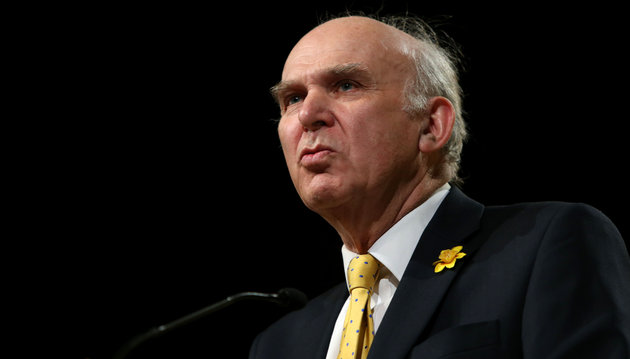
Vince Cable - Brexit

Remainers love to claim that the EU referendum “divided Britain”. But many prominent Remainers are perfectly happy to stoke divisions of their own in order to thwart Brexit

While any measured, rational human being ought to be immediately capable of seeing through YouGov’s recent flawed opinion poll – which was constructed to give the misleading impression of elderly Brexit voters being selfish extremists – new LibDem leader Vince Cable is happy to stoke intergenerational conflict in order to feed his desperate pro-EU confirmation bias.

Writing in the Mail on Sunday (surprising enough in itself, considering most bien-pensant elites view that paper as little more than a fascist propaganda newsletter), Cable moans and wails about how the older generations have supposedly “shafted the young”.

Cable writes:

The Remain argument about economic damage is now largely accepted. Mounting evidence of a slowing economy and rising inflation give substance to earlier warnings. The issue has become one of how to minimise or postpone the damage. And instead of countering the arguments, more and more Brexiteers are embracing economic pain as a price worth paying for ‘taking back control’: almost as a badge of honour.

This attitude has reached worrying proportions. Press stories refer to ‘martyrs for Brexit’ based on a YouGov survey suggesting 61 per cent of the public would accept ‘significant damage to the economy’ from Brexit and 39 per cent ‘don’t mind losing their job’. These figures seem wildly implausible.

I don’t encounter people running around saying ‘please make me poorer’ or ‘please sack me’. These figures are also difficult to reconcile with polling which shows 66 per cent of voters wanting to remain inside the single market.

Of course, as I explained at length in my response to an equally idiotic piece in the New Statesman, there is in fact no contradiction here. It has nothing to do with being a “martyr”, or acting irrationally against one’s economic self interest. Rather, elderly voters simply understand that there are other motivations and considerations besides short term economic gain.

Having grown up in the post-war years and through the Cold War, older voters tend to appreciate the value of democracy and self-determination more than young voters who have never faced existential threat and for whom the EU has been an ever-present reality and an unquestioned positive force. And Vince Cable probably knows this full well, but it suits his purposes to portray those with differing political opinions as somehow unhinged or even malevolent.

Ironically, immediately after impugning the motives and morals of older Brexit voters, Vince Cable then goes on to make a plea for tolerance and mutual respect:

But the last thing the UK needs is further polarisation. There is already more than enough bad-mouthing of opponents and questioning of the patriotism of those who criticise the Government.

The gall of these establishment EU-defenders is absolutely off the charts. Where once a senior politician might have felt a degree of shame that would have prevented him from contradicting himself so completely in an Op-Ed, Cable does so proudly, fully expecting not to be picked up on it. This is how little establishment centrist politicians think of voters and their capacity to understand political or rhetorical arguments. But it is also a sign of the desperation in the Remain camp, as the dream of thwarting Brexit altogether recedes further and further into the distance.

And it gets worse:

To describe such masochism as ‘martyrdom’ is dangerous. We haven’t yet heard about ‘Brexit jihadis’ but there is an undercurrent of violence in the language which is troubling. We have already had the most fervent of Brexiteers, such as Nigel Farage, warning of civil unrest if the ‘will of the people’ is frustrated.

Brexiteers may well be frustrated since the practical difficulties of Brexit, as well as the costs, could result in Brexit never happening.

This is a clever little construction of Cable’s, writing that we haven’t yet heard about “Brexit jihadis” while simultaneously inserting what he clearly hopes will become the Left’s new insult of choice into the public discourse. Let’s be clear – the leader of the Liberal Democrats, that party which considers itself so rational and pragmatic, has just compared Brexiteers who dared to weigh considerations other than economic gain when voting in the EU referendum to jihadis. To murderous Islamist terrorists who maim and kill.

At what point do we stand up to the establishment’s collective hissy fit over Brexit? At what point do decent people refuse to be thus insulted by what Tim Montgomerie called the very “greybeards” who only recently urged further EU integration and the Euro on us even as these failing policies devastated the younger generation, particularly in southern Europe?

That’s not to say that Vince Cable is wrong in many of his warnings about Brexit. In many ways he is right to warn about the implausibility of hammering out a bespoke deal with the EU by 2019, and to urge a slower, managed transition which maintains current access to the EEA. But all of these sensible warnings are completely overshadowed by the overwrought, flowery language suggesting that Britain’s grey-haired voters are supposedly full of hatred and malice towards the children that they raised.

Are the older generations completely innocent? Of course not. Valid arguments can be made that they have been too sheltered from “austerity” and the consequences of the Great Recession thanks to universal benefits and the “triple lock” on pensions. And certainly, as a demographic with a high propensity to vote, the retiree lobby has been very successful in seeing their interests turned into government policy.

But Vince Cable’s over-the-top attack on older voters immediately turns them back into sympathetic characters, and only makes it harder to question the privileges that they have accrued through successive government policy. Comparing decent people who have worked their whole lives and done so much to build the country in which we live today to radical Islamist terrorists is so heinous, so wildly excessive, that sensible discussion becomes impossible.

This kind of behaviour might be just about acceptable from someone like me – a relatively unknown political blogger perhaps looking to make a splash by saying something outrageous or provocative (see Abi Wilkinson’s clickbait call for a 100% inheritance tax in the Guardian). But Vince Cable is not an obscure political commentator. He is leader of the Liberal Democrats, a political party which still purports to be taken seriously.

In reality, most people vote both for reasons of self interest and for the perceived good of society. The truth about the elderly Brexit vote probably lies between Brendan O’Neill’s lionisation of these voters and Vince Cable’s haughty dismissal.

O’Neill has been effusive in his praise:

I find it deeply inspiring, moving even, that my fellow Brexiteers are willing to have it rough in the name of democracy, in the name of bringing law-making back to where every progressive of the modern, Enlightened era believed it should be: in the nation, under a people’s oversight.

I straight up got a lump in my throat when I read the bit of the YouGov research that says many Leave voters would even be okay with losing their own jobs, or seeing a family member lose a job, in the name of Brexit. Thirty-nine per cent said such personal hardship would be a price worth paying, against 38 per cent who said it wouldn’t be. Now that’s devotion. That’s idealism. And if it seems alien to us, that only goes to show what a flat, grey political era we live in.

Indeed, the rather elitist alarm that has greeted the revelation that people are willing to suffer for their democratic ideals sums up what a baleful influence technocracy has had on our political imagination. In the technocratic era, when politics has been drained of big ideas and reduced to a box-ticking exercise that is all about managing society, its inhabitants and their aspirations, political passion can seem threatening. Strong feelings, democratic devotion, self-sacrifice – these have become foreign bodies in a time when politics is about making things chug along as uncontroversially as possible. To the technocrat, to the EU suit who drafts laws far from the madding demos, the utterance ‘I am willing to go through hardship for what I believe in’ seems perverse. It’s disruptive. It is because we inhabit such a beige world of spun, small politics that the willingness of us Brexiteers to suffer for our beliefs can look like ‘extremism’.

I get where O’Neill is coming from, even though I think he goes a little too far, reading something that both he and I desperately want to see (a return to conviction politics and commitment to ideology rather than fudged centrist compromise) into a vote whose motivations were more nuanced than either extreme.

In truth, elderly Brexit voters are neither selfless heroes nor foaming-at-the-mouth jihadists. But as far as the media is concerned, the narrative about older voters being selfish is too convenient to ignore. Unfortunately it reveals a gulf of misunderstanding, as Vince Cable makes clear:

The old have comprehensively shafted the young. And the old have had the last word about Brexit, imposing a world view coloured by nostalgia for an imperial past on a younger generation much more comfortable with modern Europe.

If I had a pound for every time some sanctimonious Remainer airily asserted that Brexit was motivated by “nostalgia for an imperial past” then I would never need to work again. In reality, the Lord Ashcroft poll taken in the immediate aftermath of the EU referendum clearly showed that the principle motivating factor for Leave voters was “the principle that decisions about the UK should be taken in the UK”. Perhaps this lacks nuance and an understanding of modern day interdependence in the regulatory environment, but it is also a clear and unambiguous call for the same kind of autonomy enjoyed by countries far smaller than ours in terms of GDP such as Australia, Canada or Korea. This is by no means unreasonable, and cannot be fairly caricatured as some kind of imperial nostalgia.

So why pretend that it is? Either Vince Cable is so full of self-hatred for his own country and its history that he believes that our dissolution as an independent nation state into an increasingly federal EU is somehow appropriate “payback” for our transgressions in the days of empire, or he knows full well that the Brexit vote was not motivated by imperial nostalgia but simply finds this to be a convenient trope with which to whip up his own supporters.

For now I will do Vince Cable the courtesy of assuming the latter rather than the former – that he is in fact not a self-hating Brit, but rather just a cynical old politician like so many others. But the longer this tantrum against anyone and everyone who voted for Brexit goes on, the harder it becomes to assume good faith on the part of the furious Remainers.

At some point the Vince Cables of this world have to either engage with the real substance of Brexiteer arguments, attitudes and motivations, or else just admit that they don’t care – that they simply feel blind, unthinking hatred towards those who disagree with them and have no interest in rational discussion.

It might actually prove quite cathartic; rather than having to make increasingly ludicrous arguments that people voted for Brexit somehow want to bring back the Empire, Vince Cable and his ilk could simply have their Two Minutes Hate every day and be satisfied.


Vince Cable - Brexit - EU

Support Semi-Partisan Politics with a one-time or recurring donation:

Agree with this article? Violently disagree? Scroll down to leave a comment.

Follow Semi-Partisan Politics on TwitterFacebook and Medium.