–
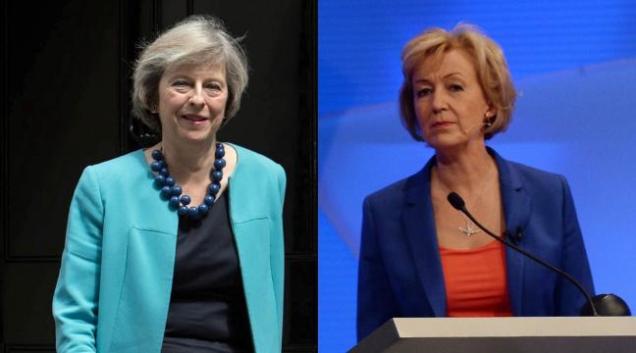
The very qualities which make Theresa May an awful Conservative leadership candidate on domestic policy mean that she is best equipped to handle our tough secession negotiations with the EU in Brussels. But the future leadership of the United Kingdom cannot be viewed solely through the lens of Brexit…
Dr. Richard North perfectly captures this blog’s dilemma in trying to choose between two highly sub-optimal candidates for Conservative Party leader and the next prime minister:
With a final contest between May and Leadsom, [if] Leadsom wins, we are faced with the great danger of having a woman as prime minister who has little understanding of what it takes to negotiate a successful withdrawal from the EU, and no capacity to develop that understanding.
On the other hand, if May is elected, we are faced with a danger just as great, in having a prime minister who brokers an exit plan which is so successful that we end up stuck with it, and in a position far worse than we are at present.
If this sounds perverse, it is. What we are seeing from the “remains” is a sudden enthusiasm for the Efta/EEA or “Norway option”, an option which, prior to the referendum, they had all been falling over themselves to demolish.
This, as readers here well know, we support as an interim option, acknowledging that it would be completely untenable for the United Kingdom in the longer term. We thus look for a different end game, which then takes us out of the EEA – with other Efta members – leaving the Agreement to collapse.
Unfortunately, the opposition is wise to the flaws of the EEA option and, from the Robert Schuman Foundation, the intellectual heart of the EU, we see proposals to modify the EEA to such an extent that it will soften some of the worst features of the EEA, and thus weaken the pressure to move on.
Dr. North goes on to describe the chicanery by which this might be accomplished – basically by making the EEA Council rather than the Council of the European Union the lead body in approving single market legislation, tackling the (already disingenuous) complaint that being in the EEA means accepting all of the rules while “having no say”.
While superficially appealing, this could lead to Britain being permanently parked in a significantly sub-optimal position on the edge of a still-integrating Core EU in which the eurozone would inevitably be dominant. It would certainly undermine one of the key benefits of Brexit to an interim EFTA/EEA access “departure lounge”, namely the restoration of Britain’s right of reservation which we could apply to new regulation which threatened to inflict significant or unacceptable harm on our key industries or vital national interests.
But while a Theresa May premiership increases the risk that Britain is sucked into a sub-optimal “associate member” status on the EU’s margins, Andrea Leadsom would do almost the exact opposite – invoke Article 50 almost immediately and then effectively let Jesus take the wheel, hoping that something satisfactory is miraculously negotiated within two years. Having recently started to appreciate the true complexity of the global trading and regulatory environment, largely thanks to my involvement with The Leave Alliance, it is immediately apparent that Leadsom’s cavalier approach to our EU secession negotiations is fundamentally unserious, no matter how genuine her euroscepticism.
Leaving aside issues of personality, experience and gravitas – for few could seriously deny that May would be the more formidable negotiator to fight Britain’s corner – it is hard to see how a Leadsom negotiation could succeed when the candidate seems sure of little besides her impulse to take Britain out of the EEA, making our trade subject to the EU’s common external tariff in the far from certain hope that doing so dramatically cuts immigration.
Therefore, from a purely Brexit-related perspective, Theresa May seems (counter-intuitively) to be the better choice if we want to maximise our chances of escaping from the EU’s always-tightening political union while disrupting trade as little as possible – even if this means that we have to remain permanently vigilant to ensure that May does not backslide from her commitment that Brexit means Brexit.
But of course this Tory leadership election is not only about Brexit – though our secession from the European Union is by far the most important issue on our national plate, and will be for some time. Still, other issues cannot be overlooked entirely. Foreign policy, civil liberties, economic freedom, education, healthcare and the role of government matter enormously too. And in many of these areas, Theresa May is extraordinarily deficient.
This is why I cannot simply swallow my distaste and endorse Theresa May outright. All of these other policy considerations must also be factored into the mix – which is what I shall attempt to do in my next blog post.

–
Top Image: BT
–
Agree with this article? Violently disagree? Scroll down to leave a comment.
Follow Semi-Partisan Politics on Twitter, Facebook and Medium.







 Semi-Partisan Politics