Problematising Boundary Review Is Just A Way Of Entrenching The Labour Party’s Structural Privilege

parliament-westminster

There are many obvious reasons for delaying or scrapping the upcoming constituency boundary review changes – but no good ones

See what I did with the headline there? Right-wingers can adopt the wheedling, victimhood-soaked language of the Cult of Social Justice and Identity Politics too, if we think it is going to advance our cause or smite our enemies.

Left Foot Forward editor Niamh Ní Mhaoileoin is in high dudgeon because the coming boundary review and shrinkage of the House of Commons from 650 seats to a slightly more manageable 600 MPs apparently means that too many of those who are left will be on the government payroll.

Ní Mhaoileoin writes:

The government’s plan to cut the size of parliament will increase the proportion of MPs on the government payroll, the Electoral Reform Society (ERS) has flagged.

According to new research, in a 600-seat Commons some 23 per cent of MPs would be on the government payroll, the highest proportion ever. The ERS warns that this could have ‘deeply worrying’ effects on parliamentary scrutiny and is calling for a cap on the number of payroll MPs.

‘This research shows we risk a crisis of scrutiny if the cut in MPs goes ahead without a corresponding cap on the number of payroll MPs,’ ERS chief executive Katie Ghose commented.

Having nearly a quarter of all MPs in the pocket of the PM is not a healthy situation for our democracy.

I think we can all agree that a body tasked with holding the executive to account which itself includes government ministers, parliamentary private secretaries and other hangers-on is always going to struggle to do an effective job – which is why many of us who think and care about constitutional issues all the time (as opposed to only when the system throws up a result we don’t like or disfavours our own preferred party) favour the total separation of the executive and the legislature.

Conservatives and progressives could potentially work together on reducing the size and cost of government while improving oversight by reducing the number of unnecessary junior ministers and official bag carriers, were it not for the leftist desire to have a government minister for everything under the sun, from Culture, Media and Sport to “Children, Young People and Families”. When your political philosophy expects and demands that the state be involved in every aspect of our lives, it inevitably necessitates a large cohort of ministers to do the meddling.

A cap on government payroll MPs would nonetheless be a reasonable (if typically British) compromise, but of course this is not what Ní Mhaoileoin really wants. And what Ní Mhaoileoin really wants is to maintain the current structural privilege currently enjoyed by the Labour Party. As Labour tends to perform best in urban seats, which themselves tend to be smaller and less populated than the suburban and rural constituencies where the Conservatives do well, the net effect for many years has been that it takes far fewer votes to elect a Labour MP than a Conservative MP.

Think of the gross anomaly whereby the SNP won 56 seats in Parliament at the 2015 general election with just 1.5 million votes, while UKIP won just a single seat despite winning 3.9 million votes. In the case of Labour and the Conservatives, the disparity is less pronounced – but it still exists. Boundary reform seeks to equalise constituency sizes, thus addressing the problem (though sadly not helping UKIP, who do not boast the SNP’s narrow geographic concentration of support). And this equalisation will enforce a basic fairness, the value of which makes it worth suffering through any negative side effects, particularly where these can reasonably be mitigated.

The concerns about the upcoming boundary review are well-rehearsed and rapidly becoming tedious. One might take them more seriously if those who raise the concerns showed any interest in solving or overcoming the issues that they raise rather than cynically using them as an excuse to halt something which – despite its inherent merit – is likely to be detrimental to the Labour Party’s electoral fortunes.

In short, this overwrought leftist concern about a toothless Parliament in the pocket of Theresa May is merely an attempt to problematise the issue of boundary reform, throwing a spanner in the works to prevent electoral disadvantage to Labour. Ní Mhaoileoin is doubtless in favour of reducing the size of the Commons as an abstrat theory, and if she were pressed through a hypothetical example would likely object to the current distribution of voters among seats which favours one party over another. But because the currently-favoured party in our system is Labour, and because Labour stands to lose out in relation to the Tories through this particular boundary review, Niamh feels compelled to oppose it.

But how to oppose something that is so self-evidently worthwhile and logical? The only way is to go grasping for every last flaw or possible technical hurdle in the review, inflating them out of all proportion and presenting each one as a show-stopper (or at least as justifiable grounds for interminable delay). As with the British Left’s general approach to Brexit, Ní Mhaoileoin is desperately problematising the boundary review, hoping to scupper it without ever having to reveal her true, grubby, anti-democratic reasons for doing so.

Smart politics? Maybe. The principled, moral, liberal thing to do? Absolutely not. Niamh Ní Mhaoileoin’s position is actually profoundly conservative – and not in a good way.

But apparently any behaviour, no matter how tawdry and self-serving, becomes noble and virtuous when it is performed in the service of the Labour Party.

boundary-commission-for-england

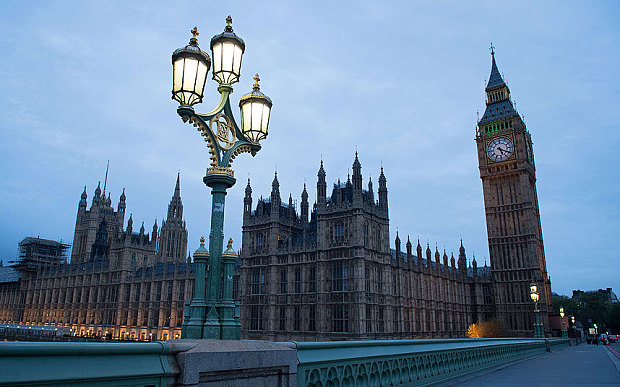
Top Image: Wikimedia Commons

Support Semi-Partisan Politics with a one-time or recurring donation:

Agree with this article? Violently disagree? Scroll down to leave a comment.

Follow Semi-Partisan Politics on TwitterFacebook and Medium.

Oh, So Now You’re A Liberal?

liberalism

The vote for Brexit and Donald Trump’s presidential election victory seems to have wrongly convinced an entire army of snarling, leftist authoritarians that they are actually the virtuous defenders of liberalism

Is anybody else getting mighty sick of the constant parade of left-wing, Big Government-supporting authoritarians suddenly rushing to cloak themselves in the veil of “liberalism” as they struggle to process what they see as successive defeats in the EU referendum and the US presidential election?

I can’t think of a word that has been more overused by pundits since everybody got together a couple of years ago and decided that the related N-word (neoliberalism) was this season’s hottest fashion statement, and started accusing everybody whose views they dislike of being an Evil Neoliberal, as though it were some devastatingly intellectual insult.

Here’s the FT, weeping into their cornflakes about the supposed death-throes of liberalism:

Mr Trump’s victory, coming after the Brexit referendum vote in Britain, looks like another grievous blow to the liberal international order. Mr Trump must decide, by his actions and words, whether he intends to contribute to the great unravelling, at incalculable cost to the west.

And the Independent:

Democracy is changing, and not for the better, but those who believe in liberal values, tolerance and protecting the environment can learn from this setback and fight back.

The Independent, of course, promotes liberal tolerance through its courteous and magnanimous treatment of those who dare to dissent from its positions on social issues, climate change and global governance.

Here’s the Spectator:

In her concession speech, Clinton said her goal had been ‘breaking down all the barriers that hold any American back from achieving their dreams‘. This is the dream of liberalism, which seeks freedom from any social or economic constraint. Elites like Clinton feel confident that they can navigate a deregulated society in which class, gender, and race are all fluid. They support deregulated markets as well, confident that free trade and open borders will serve their own interests in the near term and the whole country’s in the longer term.

Freedom from any social constraint? Only if one happens to agree with the elite.

And the Spectator again, covering itself in even more glory:

The challenge to liberalism is still seen as an argument to be won rather than an irreversible sea-change. But, if anything, the scale of the problem has been understated. The core tenets of liberalism are freedom and equality, ideas that are under siege.

Oh, and let’s not forget the prime minister herself, Theresa May, speaking at the Lord Mayor’s banquet on Monday evening:

Change is in the air. And when people demand change, it is the job of politicians to respond.

But it’s also the job of all those in positions of influence and power – politicians, business leaders and others – to understand the drivers of that demand too.

And I think that if we take a step back and look at the world around us, one of the most important drivers becomes clear – the forces of liberalism and globalisation which have held sway in Britain, America and across the Western world for years have left too many people behind.

Let’s be clear: those forces have had – and continue to have – an overwhelmingly positive impact on our world.

It really has come to something quite strange when Theresa May – a flinty eyed authoritarian who gives me pause any time I check a book out of the library, lest her government use my borrowing history as a pretext for throwing me in jail next week – seeks to wrap herself in the mantle of small-L liberalism.

But now everyone seems to be at it, suddenly claiming that they are terribly “liberal” while the people they dislike are not. Politicians and pundits who only months ago could be found calling for people to be banned from entering the country due to their political beliefs are now rending their garments at the election of a man who suggested that people should be banned because of their religious ones. And in so doing, they declare themselves to be the defenders of liberalism, while utterly oblivious to the irony of it all.

People who wanted to usher in national ID cards, strengthen the surveillance state, extend pre-charge detention, ban UKIP voters from fostering or adopting children, throw people in jail for their Facebook and Twitter posts, arrest people for singing the wrong songs at a football match, ban advertisements for being offensive, hike taxes even higher on cigarettes or alcohol or ban them altogether, levy regressive taxes on soft drinks, erect safe spaces on university campuses, slap trigger warnings on academic syllabuses, shame or punish people for the Halloween costumes that they choose to wear, get people fired from their jobs for holding or expressing the wrong opinion, strangle religious freedom and force people to violate their faiths by positively affirming the actions and lifestyle choices of others – these people are suddenly all over the airwaves, lamenting that it is actually those Evil Brexiteers and Donald Trump supporters who have supposedly brought our previously-idyllic liberal age crashing down in flames.

Well sorry, but this pious, self-aggrandising argument is complete baloney. I can’t speak for Donald Trump supporters, not being one myself, but I am very adamant that my vote for Brexit was a liberal vote for strong, globally-engaged nation state democracy. I and millions of others voted to leave the European Union because it sought to impose a degree of supranational government upon us which far outweighs the limited extent to which most Britons consider themselves European and consent to such governance. I did so because I judged that my inalienable rights to life, liberty and the pursuit of happiness are to this day best defended by a strong nation state with a reinvigorated national democracy, and not a remote supranational union with some of the superficial trappings – but none of the spirit – of democratic accountability. Voting for Brexit was perhaps the most profoundly liberal thing I have done on my thirty-three years on this good Earth.

And yet now I am supposed to sit back while every two-bit authoritarian with a newspaper column publishes tedious identikit dirges alleging that I, a staunch libertarian conservative, am supposedly at the vanguard of a dystopian new illiberal movement sweeping across the world and shrouding humanity in darkness and uncertainty? Hell no.

If liberalism is so great – and by and large, it is – then it would be nice if some of liberalism’s new fair-weather friends tried to remember the ideology’s core principles once they have finished weeping about Trump and Brexit and turned their attention back to more mundane political events. Perhaps they might care to remember the term they so glibly appropriated next time they call for something they disagree with to be banned, or for somebody who offends them to be punished by the criminal justice system. What do you think are the chances that this will happen?

After a week of this incessant, tedious refrain about the “death of liberalism” from the commentariat, I have just about had enough of my liberalism being culturally appropriated by the snarlingly authoritarian Regressive Left. It is only in the reflection of Donald Trump or Nigel Farage’s wildest rhetoric that their own paternalistic, control-freakish, coercive instincts can be even semi-plausibly pitched as being remotely liberal, and those of us with long memories and functioning brains know these pearl-clutchers for what they really are – persistent, deadly enemies to true liberalism.


Postscript: In this excellent piece, Pete North slaps down the idea that the West is somehow turning its back on liberalism, drawing a crucial distinction between genuine small-L liberalism which is as popular as ever and its decadent, identity politics and victimhood culture-infused cousin which has indeed been rejected by the electorate.

Money quote:

In a liberal society we appreciate that we all have our distinctions and limitations and we recognise that nobody should endure discrimination or punishment for those facets which cannot be changed. Gender, sexual preference, skin colour. But it goes further than that. We try to open doors for people os that people can break out of predetermined roles and destinies. That to me is social progress, where nobody is limited by class and physical attributes.

But when liberals begin to attack the very foundation of our morality and our values and seek to replace them with an ultra-permissive, anything goes morality we lose any kind of cohesion and moral authority. Moral relativism takes hold to such an extent that we can no longer defend those things we value.

What the left have done is to identify all social norms as inherently evil – which has given rise to the cult of the self which in turn has spawned the now toxic brand of feminism we see on the internet and the perverse social justice movement which processes everything through the prism of identity. It centres around a certain narcissism whereby individual rights become entitlements on the basis of one’s sense of victimhood. From this is born the right not to be offended or triggered – and with that goes the death of free speech. Opposition is inherently oppression it seems.

And this is why the culture war of the last decade goes so heavily with what is happening on a more visible level in politics. In what is now seen as a backlash against political correctness, there is something more seismic happening.

And North’s conclusion:

But then this tyranny of what is laughingly known as progressivism is on borrowed time. It always was a moral and intellectual perversion and it was always a minority view. How it came to be one of the most powerful ideas of a century is for the historians but now it seems the majority have finally lost patience and stood up to the left. In this we are not turning our backs on liberalism. We are merely putting an end to the gradual erosion of those, dare I say it, traditional values on which our modern and open society is built. I think this is what makes Theresa May, herself a church and shires Conservative, the right lady at the right time.

The sad part of this is that there will inevitably be a tiny minority who think we are going back to the old days where rampant and open homophobia is acceptable and we will no doubt see an unfortunate spike in racist incidents. But it is a typical left wing lie to say that mainstream society has suddenly become intolerant and racist. That trick might have worked for the last twenty years but the election of Trump tells you that the majority no longer care what you call them. The more offensive to the left the better.

And it is so telling that across the USA we now see the left spitting venom. We now see the true face of the “tolerant” left in all its bile. We can see that it was never about advancing a better society for all. It was about the minority wielding power over the majority – to impose a twisted morality on society without its consent – from the United Nations to the local primary school.

I repeat: genuine, small-L liberalism has not been rejected by the people, and is only under marginally more serious threat from ignorant authoritarians like Donald Trump than it has been over the past decades from highly learned progressives who sought to impose their “progressive” worldview on an uncertain population while actively criminalising dissent.

Those weeping most loudly today about the supposed death of liberalism have often themselves done as much as anyone to damage liberalism themselves through their decidedly illiberal and intolerant past behaviour.


liberalism-john-stuart-mill

liberal-definition

Support Semi-Partisan Politics with a one-time or recurring donation:

Agree with this article? Violently disagree? Scroll down to leave a comment.

Follow Semi-Partisan Politics on TwitterFacebook and Medium.

Left-Wing Brexit Acceptance Award

madaleina-kay-european-union-brexit-cartoons-unicorns-and-leprachauns-2

Finally, a prominent left-wing voice that accepts the result of the EU referendum and does not drip with contempt for democracy and the people’s choice to leave the EU

In his latest piece for the Independent, John Rentoul gives us that rarest of things from the political Left – a gracious and measured acceptance of Brexit.

Right off the bat, Rentoul declares:

There are two common views among people who wanted to stay in the EU that I think are mistaken. One is that David Cameron made a foolish and unforgivable mistake in promising the referendum. The other is that the result was obtained by a campaign of lies.

My contentions are that Cameron was forced to promise a referendum by the very democratic pressure that produced the vote to Leave, and that the referendum was about as fair as the rough and tumble of democracy usually is.

And Rentoul is quite right, I think, to state that with the rise of UKIP, never-ending power grabs from an increasingly tone-deaf EU and the systematic crises (euro, migration) facing the union, a referendum was ultimately coming, one way or another, regardless of whatever David Cameron did:

Cameron knew that if he didn’t promise a referendum, his party would become even harder to manage and it would lose votes to Ukip. As it turned out, he had a choice between cutting his throat and slitting his wrist: he could lose the election in 2015 and be thrown out of office or he could lose the referendum a year later and be thrown out of office. Being a politician – that is to say, human – he chose to maximise his chance of winning in 2015 and hoped that winning in 2016 would take care of itself.

Rentoul accurately notes that euroscepticism is hardly a new phenomenon in Britain. While we may not have been asked our opinion on the matter since the 1975 referendum, there has always been a significant chunk of the population opposed to our EU membership, even before mass immigration from eastern Europe or the euro crisis  were factors:

It may be objected that polls did not find that the EU was a priority for voters, and that support for leaving became significant only after the 2008 banking crisis. But there has been a majority in the British public for leaving or for reducing the EU’s powers since 1996, according to the British Election Study (page 6), and immigration has been named as one of the three most important issues facing Britain since 2001, according to Ipsos MORI.

But even more encouraging (from a Brexiteer’s perspective) is Rentoul’s refusal to fall back on lazy Remainer self-delusions that the Leave campaign had a monopoly on lies and misinformation, and that it was this uniquely one-sided dishonesty which somehow tricked a gullible population and swung the referendum:

The second complaint by many Remainers is that the people voted to Leave on the basis of disinformation. There is an implication that journalists failed in their duty to fact-check the post-truth politics – a criticism that must sound familiar in America.

But I don’t think the argument holds up. One of the surprising things about the referendum was that we didn’t hear that much about Eurosceptic press barons dominating the debate. This may be because they didn’t. The media landscape in Britain has been utterly transformed by the internet – as I know well, working for the first national newspaper to go online-only.

If you look at the readership of British newspapers, print and online, not only does The Independent have more readers than The Sun – not many people know that – but the total readerships of newspapers advocating Leave and Remain were about the same (of the 13 weekday newspapers, the Mail, Telegraph, Express, Star and Sun advocated Leave, with 95m monthly readers; the Guardian, Mirror, Independent, Standard, Times, Daily Recordand Scotsman advocated Remain, with 97m monthly readers; the Metro had no position). There are other new news sources online, Buzzfeed and other rivals of The Independent that I won’t mention, but overall I think the media was fairly evenly balanced.

As Rentoul points out, the Evil Murdoch Press doesn’t have quite the vice-like grip over the minds of the British people as many a Corbynite (or even a New Labour centrist) likes to believe. People consume their news from a variety of sources, and exist in social media bubbles of all kinds – pro-EU as much as eurosceptic.

More:

All the same, there were claims made in the campaign that were – I prefer not to call them lies – not absolutely evidence-based. The most prominent was the claim by the Leave campaign that the UK sends £350m a week to the EU. We don’t. It’s about half that. The Leave people justified it by saying it would be £350m if we didn’t have the rebate negotiated by Margaret Thatcher in 1985. Their argument is that politicians will be tempted to negotiate the rebate away in future – Tony Blair, for example, allowed it to be diluted when new countries joined the EU in 2004.

Most journalists reported that it wasn’t true. The trouble is that saying, “It’s not £350m a week it’s £180m a week,” didn’t really help the Remainers. It drove them mad because the Leavers kept on using the £350m, and the Remainers kept saying it wasn’t true, drawing attention to it, and reminding voters that we send a sum of money too big to be understood to the EU every week.

Besides, the Remain campaign was putting out leaflets claiming that for every pound we put into the EU we got £10 back. I wouldn’t describe that as absolutely evidence-based either.

Many of us – this blog included – campaigned long and hard and angrily about Vote Leave’s disingenuous “£350 million for the NHS” pledge, pointing out that it was false and that it served as a greater propaganda tool for the Remain campaign with which to attack Brexiteers than as an argument for leaving the EU. But Rentoul is quite right – the true figure of c. £180 million is just as impactful, and quantitative scaremongering claims by the Remain campaign were no less manipulative and deceitful.

This blog has been busy handing out awards for grotesque Brexit catastrophisation with some relish, so it is only fair to acknowledge times when those from the political Left exceed the low expectations which have too often been set by politicians and the media class. Rentoul’s overall assessment is quite right – the EU referendum campaign was cacophonous and messy, but it was in no way tilted in favour of the underdog, insurgent Leave campaign, and would never have succeeded if it had not ignited already-latest anti-EU feelings among entire swathes of the British people.

So credit where credit is due: John Rentoul is one of vanishingly few prominent left-wing commentators to broadly accept the result of the EU referendum with no ifs, buts or asterisks. If only other left-wing politicians and commentators found it within themselves to do the same, their political movement might not now be facing unprecedented unpopularity and rejection by the British people.


European Union - United Kingdom - Britain - Flags

Support Semi-Partisan Politics with a one-time or recurring donation:

Agree with this article? Violently disagree? Scroll down to leave a comment.

Follow Semi-Partisan Politics on TwitterFacebook and Medium.

The Seven Deadly Sins Of Momentum – NHS Edition

seven-deadly-sins-of-momentum-nhs-edition

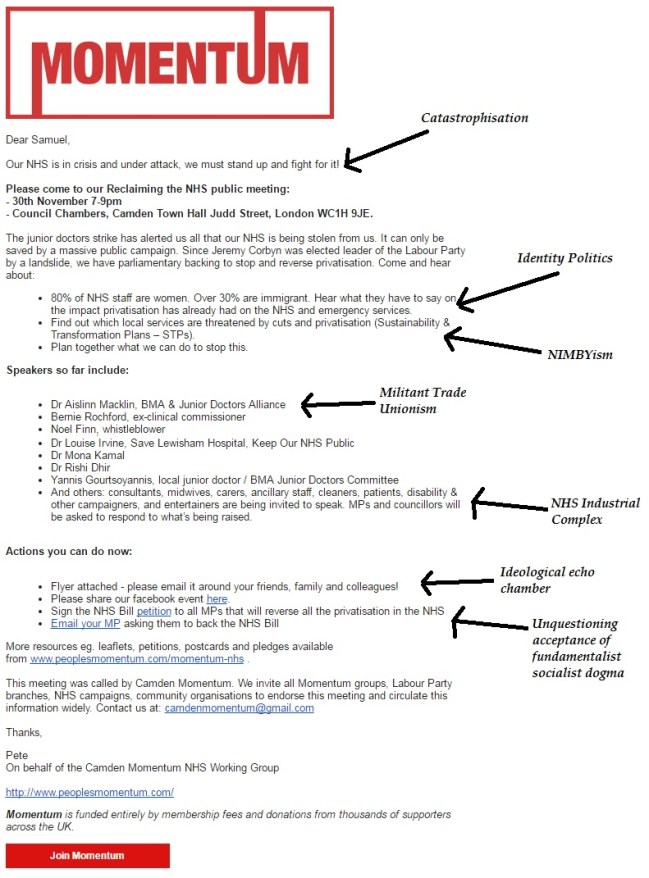
Catastrophisation, Identity Politics, NIMBYism, Militant Trade Unionism, the NHS Industrial Complex, Ideological Echo Chambers and Socialist Fundamentalism – the Seven Deadly Sins of Britain’s NHS-worshipping Taliban

This charming missive from the Camden Momentum NHS Working Group pinged its way into my mailbox this afternoon, and in an idle moment I thought I would point out all of the things that are wrong with it, and which actively undermine the vital cause of healthcare reform and thwart necessary moves to improve healthcare outcomes for ordinary Britons, all for the sake of rigid adherence to failed socialist dogma.

The email reads in part:

Our NHS is in crisis and under attack, we must stand up and fight for it!

Please come to our Reclaiming the NHS public meeting:
– 30th November 7-9pm
– Council Chambers, Camden Town Hall Judd Street, London WC1H 9JE.

The junior doctors strike has alerted us all that our NHS is being stolen from us. It can only be saved by a massive public campaign. Since Jeremy Corbyn was elected leader of the Labour Party by a landslide, we have parliamentary backing to stop and reverse privatisation. Come and hear about:

  • 80% of NHS staff are women. Over 30% are immigrant. Hear what they have to say on the impact privatisation has already had on the NHS and emergency services.
  • Find out which local services are threatened by cuts and privatisation (Sustainability & Transformation Plans – STPs).
  • Plan together what we can do to stop this.

The Seven Deadly Sins of Momentum and assorted other NHS-worshippers that I have identified are as follows:

1. Catastrophisation. Perpetually suggesting that the NHS is on the brink of destruction. Leftists have been making these breathless allegations during Tory administrations going back to the 1950s, including some long spells of Conservative rule, and yet miraculously the NHS survives – and with it, our unthinking devotion to government-provided healthcare. The hysterical alarmism card is really starting to get quite tiresome at this point. The NHS is far more likely to bury all of us (after quite possibly hastening us toward an early demise) than we are to bury the NHS.

2. Identity Politics. There is always time for identity politics now. If NHS acolytes can find an ethnic, gender or sexuality angle to support their argument they will inevitably do so, because they know just how fatal an allegation of institutional racism or sexism can be.

3. NIMBYism. A monolithic, socialised government healthcare delivery organisation must ration and allocate resources across the country in the most efficient way possible if it is to stand a chance of functioning correctly. Yet at every opportunity, NHS worshippers protest reorganisations that would close small and failing departments in favour of building regional centres of excellence because despite living in the age of the car and the air ambulance, these people come out in hives if they are not within five minute’s walk an NHS building at all times.

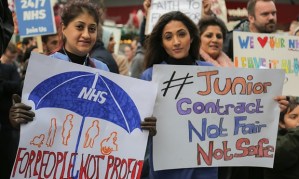
4. Militant Trade Unionism. Leaked emails revealed months ago that the junior doctors’ strike was nothing more than a tawdry, grubby pay dispute, with BMA chiefs and key junior doctor agitators deliberately hoodwinking the public by pretending that it was a high-minded dispute about public safety or indeed the very future of the NHS. Of course, every grubby public sector strike in history has been defended on the grounds that participants are engaged in a selfless stand for public safety, and in 2016 we really should be capable of seeing through these left-wing political antics.

5. Supporting the NHS Industrial Complex. The UK’s National Health Service is the fifth biggest employer on the face of the Earth, employing nearly as many people as global fast food giant McDonald’s and many more than the Indian railways, all to service a country of just 65 million people. When nearly the entirety of Britain’s healthcare sector is nationalised, there is inevitably a vast ecosystem of suppliers, support businesses, lobbyists and vested interests with every incentive to maintain the status quo so that they can continue milking the system. But such is the reflexive, unquestioning love that many have for the NHS that we never really stop to consider whether it is run for our benefit, or for the benefit of those vested interests. Just as the military-industrial complex has been a very real phenomenon in the United States of America following World War 2, so the NHS-industrial complex is a real phenomenon in modern Britain. We should be less credulous and recognise this fact.

6. Ideological echo chamber. As the UK general election, Brexit and the election of Donald Trump as US president have shown, by living in an hermetically sealed ideological bubble in which people talk only to others of the same political viewpoint, consume only news sources which validate their existing biases and mistake social media “clicktivism” with real activism and change, leftists end up talking to themselves while ignoring the wider country. The NHS cultists can continue to share social media memes and infographics all they like, but they are only preserving the failing status quo and making it impossible for reformers to be heard.

7. Socialist fundamentalism. Nothing reveals the NHS cultists’ devotion to socialist ideology over and above actual healthcare outcomes more than their blind, hysterical insistence that all privatisation must be eliminated and every NHS service brought back in-house as a matter of ideological purity rather than clinical value. These people will only be happy when the government (through our tax pounds) funds and delivers every single aspect of healthcare, from support functions like laundry, catering, cleaning, construction, marketing, staffing and management through to the front-line clinical work. Never mind the fact that no other advanced country in the world successfully operates a healthcare system as completely nationalised as the one which they favour. Forget learning from best practice around the world, or (heaven forbid) trying something new and bold. No, NHS cultists insist that Britain is to be a socialist beacon to the world, and if you or I have to die because of substandard care in order to glorify their vision of socialised healthcare then so be it.

What do you think? Would you change any of these Seven Deadly Sins, or add any others?

Please share your thoughts in the comments.


NHS Logo - Cross - National Religion - Worship - Idolatry

NHS Junior Doctors Contract Strike

Support Semi-Partisan Politics with a one-time or recurring donation:

Agree with this article? Violently disagree? Scroll down to leave a comment.

Follow Semi-Partisan Politics on TwitterFacebook and Medium.

Brexit, Public Protest And The Judiciary

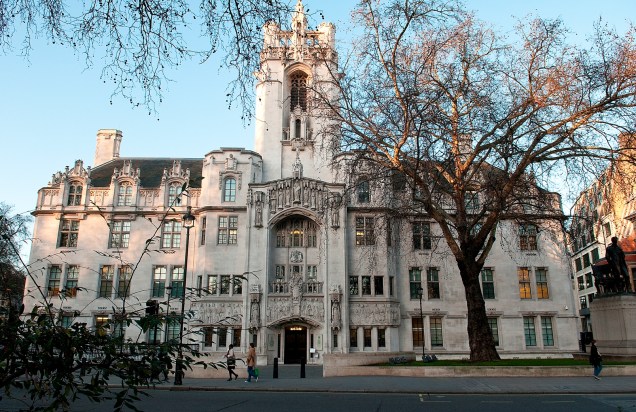
uk-supreme-court

No, criticising legal rulings is not fascism

Right now the internet is bubbling with a lot of nonsense about the role of the British judiciary as relates to Brexit, and though I have my head full of US election news ahead of tomorrow night’s Semi-Partisan live blog, there are a couple of pieces of egregious stupidity which need slapping down.

Today, of course, Nigel Farage made headlines by announcing his intention to lead a march of 100,000 people on the Supreme Court in an effort to demonstrate the public’s supposed strength of feeling about ramming Brexit through without any Parliamentary scrutiny.

From the Telegraph:

Nigel Farage is planning to lead a 100,000-strong march to the Supreme Court to coincide with the start of the Government’s attempt to stop peers and MPs delaying Brexit.

The march, organised by the anti-European Union campaign Leave.EU, will end with a rally in Parliament Square within sight of the court building where judges will be hearing the appeal.

The campaign group is planning to “crowd fund” £100,000 from its supporters to pay for barristers to represent Leave supporters in the court action.

This will mean that the anti-EU supporters will have their own barristers in the legal action, who can challenge claims made by Remain supporters and even the Government.

[..] A spokesman for the organisers said that Mr Farage and Leave.EU millionaire backers Arron Banks and Richard Tice had “secured support from thousands of Leave voters” for the march and legal action.

The march will most likely take place on December 5, which is expected to be the first day of the hearing. The Supreme Court has cleared four days for the hearing which will be streamed live on the internet.

As this blog recently laid out, I am fairly relaxed about the High Court case and the coming appeal to the Supreme Court. If David Cameron’s utterly useless government had a) planned the referendum properly, and b) considered the possibility of Leave winning then all of this might have been spelled out clearly at the time of the referendum, as it should have been.

That being said, MPs are aware of the hellfire which would rightly rain down on them if they seriously attempted to subvert the referendum result; if they now want to give their cosmetic blessing to a high-level instruction to the government to invoke Article 50 then they are welcome to go ahead.

Of course, some people inevitably then take it too far. UKIP leadership candidate Suzanne Evans quickly took to the airwaves making incoherent comments about the need to exercise “democratic controls” (whatever that means) over the judiciary.

From the BBC:

Ms Evans told BBC Radio 4’s Today programme there were likely to be “protests and demonstrations”, but added that these would be peaceful.

She added: “I have a concern that Article 50 is not intended to facilitate nation states leaving the European Union. I think it’s there to frustrate them.”

Ms Evans said she thought the legal process could “water down Brexit”.

She added: “I think it’s amusing that the very same people who say it’s all about parliamentary sovereignty have, for the last 48 years, been trying to undermine parliamentary sovereignty”.

Ms Evans said: “I think there’s a debate to be had about whether or not judges are subject to some kind of democratic control.”

She did not want to undermine “their judicial independence”, but added: “I suppose that in this case, we have had a situation where we have judges committed to stay in the European Union…

“I’m questioning the legitimacy of this particular case. We know that the legal profession threw a collective hissy fit when we voted to leave.”

This is just incoherent garbage. “Democratic controls” could mean anything from moving towards a system where many judges are elected (as in many American states) toward some kind of constitutional fix to prevent judges from ruling to delay or impede the government from carrying out the instructions from this or any future referenda.

At no point does Suzanne Evans articulate what kind of controls she has in mind, which naturally plays into the hands of tremulous Remainers who are lightning-quick to portray any intemperate or ill-considered language from Brexiteers as a sign of the oncoming fascist apocalypse wrought by Brexit.

From the Huffington Post:

Her comments were branded “irresponsible”. by Labour’s shadow Brexit secretary Keir Starmer. “Some of us have worked in countries where judges do as governments tell them and we know that is highly corrosive of the rule of law and democracy,” he told Today.

Starmer said the High Court had simply “upheld the rule of law” by deciding the prime minister did not have the power to trigger Article 50 without a parliamentary vote. “It’s a slippery slope,” he said of Evans’ comments. “Principle is really important here. The rule of law really matters. It underpins this country.”

However Evans said she had not been talking about judges being subject to elections, but instead “pre-appointment and confirmation hearings” and “scrutiny by select committees”.

Typically, hysterical and bitter Remoaners like Coke Zero Conservative Anna Soubry led the way with her cries of “fascism!”:

However, many pro-EU commentators, in their sudden high-minded support for the independence of the judiciary, seem to be suggesting that any form of protest directed at judges or the courts is absolutely unacceptable and fascistic, whatever the reason.

LBC’s notoriously and stridently europhile presenter James O’Brien ripped into the protest, essentially declaring that it is wrong to protest legal decisions and rulings:

Today James gave his reaction to the march and it’s safe to say he wasn’t impressed: “We’re post-truth now…what’s Mr Farage doing? Having a little march to the Supreme Court to complain about British judges enacting British laws in British courts.

“Truly we are down the rabbit hole!”

James continued: “He says to remind people what they voted for. I appreciate your core support is a little bit flaky pal, but I don’t think anyone’s forgotten what they voted for.

“It’s quite incredible. Yet we’re all still standing alongside, going: ‘Oh, I wonder why this is happening.’

“I’m not wondering why this is happening. I know why this is happening. Same reason it’s happened throughout history. You take angry people who feel like they’re not getting a fair deal, give them a false target for their fury and just sit back and watch the whole place burn down.”

Presumably O’Brien feels similarly sickened when crowds of people assemble in front of the United States Supreme Court to protest in favour of socially progressive outcomes, like striking down the Defence of Marriage Act (DOMA). Except we all know that O’Brien would have no problem with such protests. Demonstrating about legal cases is abhorrent and intimidating when Nasty Brexiteers do it, with their thuggish and populist ways, but absolutely fine when the people march under a rainbow flag or advocate for a progressive cause.

But some of the most thin-skinned people of all are those within the legal profession, who apparently feel under assault by Brexiteers and parts of the media in the wake of the High Court decision.

From the Guardian:

The justice secretary, Liz Truss, is embroiled in an extraordinary row with the country’s barristers, after she was accused by the Bar Council of not fulfilling her role as “the conscience of the government”.

Truss has failed to condemn vitriolic attacks on the three judges who last week ruled that parliament must be given a vote before Britain triggers article 50, launching the Brexit process.

Chantal-Aimée Doerries QC, the chairman of the Bar, the representative body for barristers in England and Wales, told the Observer that the cabinet minister had a duty to uphold the rule of law. “[Her job] is sometimes called the conscience of the government and one would expect her to speak out on something like this,” she said.

The high court ruling on Thursday, which the government has said it will appeal, unleashed a torrent of personal abuse directed at the judiciary, with one prominent cabinet member claiming the judges’ decision was “unacceptable”.

Under huge pressure to defend the independence of Britain’s judges, Truss – who is also lord chancellor – issued a terse statement on Saturday, observing: “The independence of the judiciary is the foundation upon which our rule of law is built and our judiciary is rightly respected the world over for its independence and impartiality.”

What more do these wobbly-lipped victims want? The High Court made a decision, and various citizens together with certain press outlets exercised their free speech rights to criticise that decision in loud and forceful terms. Did anybody attempt to physically or mentally coerce the judges who made the ruling? No. Has anybody hatched a plan to neuter the judiciary’s ability to rule in future such cases? No. So what, exactly, does the Bar Council want? Apparently they want to be exempt from criticism. And to elevate the judiciary into such an exalted position would be truly frightening and totalitarian.

If the Bar Council, assorted other members of the judiciary and a coterie of Remainers expect Liz Truss to stop the Big Bad Scary Media from uttering opinions about the validity of legal decisions or the motivations of the people who make them then they really have taken leave of their senses, as well as any conception of the role of a free press in a democracy.

All in all, many Remainers seem to be taking leave of their senses. Those people who never gave the judiciary a second thought but who are now lionising it simply because they delivered a verdict which seems to frustrate some Brexiteers need to realise that the judiciary is not always high-minded and impartial.

The BBC reports that Lord Judge, the former Lord Chief Justice, opined that the Supreme Court should not overturn the High Court’s ruling because to do so might be *perceived* as a victory for the demonstrators:

The justice system could be undermined if a ruling that only Parliament can trigger Brexit is overturned, a former lord chief justice has said.

Lord Judge said it would be seen as a victory for pro-Brexit demonstrators should the Supreme Court reverse last week’s controversial High Court ruling.

[..] Lord Judge, who was the most senior judge in England and Wales between 2008 and 2013 and who is now a crossbench peer, told BBC Newsnight that people were entitled to protest but he was concerned about the impact the case might have on the legal system.

“People can march as much as they like,” he said.

“I don’t think it makes any difference to the judicial decision but it does make a difference to public order.

“Let’s say for the sake of argument the Supreme Court decides the High Court was wrong, it will undoubtedly be conveyed as a victory for the demonstrators.

“It won’t be but that’s what will be conveyed. And if that is conveyed, you’ve undermined the administration of justice.”

In other words, the head of the judiciary from 2008 to 2013 thinks that the Supreme Court should make a decision not based on the law, but rather on a desire to signal to unruly Brexiteers that judges cannot be pushed around. Even if there are found to be legal grounds for overturning the lower court’s decision, Lord Judge believes that the Supreme Court should allow error to go uncorrected in order to put the people in their proper place.

And yet criticising these people or displaying the slightest scepticism about their motivations and objectivity is apparently tantamount to fascism.

Give me a break.

 

European Union - United Kingdom - Britain - Flags

Support Semi-Partisan Politics with a one-time or recurring donation:

Agree with this article? Violently disagree? Scroll down to leave a comment.

Follow Semi-Partisan Politics on Twitter, Facebook and Medium.