The Daily Mash’s inimitable take on the upcoming Diamond Jubilee celebrations:
Another old man on television, Sir Roy Hobbs, said: “Who could ever be cynical in this time of woo yay.”
Mother-of-two Emma Bradford was less enthusiastic. She said: “It’s hard to say exactly how good she is because there’s no other Queens of England currently working that we can compare her to.
“I mean, I might have made an even better queen. It’s something I mentioned to the careers advisor at school but he just made a face and gave me a leaflet about jobs in data entry.
“Still, I don’t want to be difficult so…woo yay, the Queen.
I do admire Michael Gove, the UK Education Secretary. When virtually all of the other Conservative cabinet members from David Cameron on downwards have proven themselves to be one disappointment, letdown and betrayal of principle after another, at least Michael Gove has been steadfastly working away at the Department for Education to bring about some real, conservative reforms.
So I was several steps beyond overjoyed when I found out that Gove had been giving evidence to the riveting Leveson Enquiry “into the culture, practices and ethics of the press”.
Suffice it to say that Leveson met his match yesterday:
Bravo! Since our taxpayer money is being frittered away in order that this pompous, self-aggrandising old gasbag Leveson can sit there like some modern-day oracle, cooking up new ways to constrain freedom of speech in our country, I am happy that those of us who disagree with the premise of the whole enquiry in the first place were able to extract some small measure of payback by sending Michael Gove into the fray to make him squirm a bit.
A couple of points to note from this video:
1. Just look at Leveson’s defensive, hunched posture compared to the relaxed, attentive stance of Gove. Leveson is clearly used to being flattered and deferred to almost all the time, and clearly was not ready to have his assumptions – and the preordained outcome of the enquiry – challenged in so articulate a fashion.
2. This is supposed to be an impartial enquiry, remember? So statements like “Don’t you think that the evidence I have heard from at least some of those who have been the subject of press attention can be characterised as rather more than ‘some people are going to be offended some of the time’?” have no place being uttered by Leveson. What does it matter what other evidence he has heard? Michael Gove is on the stand now, giving his opinion, which rightly should be his alone and not influenced by the parade of people who have already taken the stand. I’m not a lawyer, but isn’t that how these things are supposed to work? This is clearly a man who has made up his mind before he has even started deliberating.
The right-wing press in Britain was of course greatly cheered by this turn of events. From David Hughes, writing at The Telegraph:
Throughout the Leveson Inquiry it’s been pretty evident that it was the lawyers who felt they were the smartest guys in the room. Today that changed. Michael Gove, the Education Secretary, gave a virtuoso display of both intellect and guts as he made the case for press freedom. It’s perhaps no surprise that this journalist turned politician should, for the first time, take the argument to the Inquiry and swing it away from its focus on Murdoch and hacking and concentrate its mind on the wider issue of freedom of expression.
Plenty of witnesses have had mini-spats with Robert Jay QC, the counsel for the Inquiry, but no-one has so far tried to lock horns with Lord Leveson himself. Gove did so with brio: “Before the case for regulation is made, there is a case for liberty as well…I am unashamedly on the side of those who say we should think very carefully about regulation. By definition, free speech doesn’t mean anything unless some people are going to be offended some of the time.”
Michael Deacon, also writing at The Telegraph, came away similarly impressed:
Mr Gove was once a journalist, and three months ago said the inquiry might have a “chilling” effect on the press. He clearly hadn’t come to roll over. You could see it in his posture: always leaning sharply forward, as if to confront his interrogators. Without embarrassment he described Rupert Murdoch as “one of the most impressive and significant figures of the last 50 years”. He spoke out against the creation of new press regulations, and stressed the importance of free speech.
Perhaps all this makes his performance sound pompous. Yet it wasn’t. Even – or perhaps especially – at his most serious, Mr Gove is drolly camp. There’s more than a whiff of Niles Crane about him.
Lord Leveson didn’t seem amused. “I don’t need to be told the importance of liberty, Mr Gove,” he said frostily. “I really don’t.” Mr Gove didn’t so much as blink.
Even the BBC News analysis was quite complimentary:
He is one of the highest profile libertarians in his party and he gave a passionate defence of the right of freedom of speech. But the suggestion that it counted for nothing unless some people were offended some of the time, clearly got under Lord Justice Leveson’s skin.
The long, tense exchange that followed between the two men got to the very heart of the argument that Leveson is wrestling with – whether new laws and regulation will be needed to rein in the press.
The background to all this is a speech Mr Gove made a few months ago when he warned that the Leveson inquiry could have a “chilling” effect on press freedoms.
The education secretary has expressed his concern that the case for liberty could be drowned out by the anger over phone hacking. This performance in the witness box ensures that that argument will be heard and his close relationship with the prime minister means it’s a message that will go right to the top once the inquiry reaches its conclusion.
Sadly, this excellent exchange is highly unlikely to have any bearing on the outcome of the enquiry, the findings of which Leveson is probably already writing as he still hears evidence. Leveson clearly views himself as the moral arbiter of the media, and will no doubt recommend some new burdensome regulations and oversight to further suppress freedom of expression in the press. The best hope for those on my side of the argument will be that as has been the case with so many other enquiries, the findings will be warmly praised, filed away and never acted upon.
Nonetheless, yesterday was a good day for freedom of expression in Britain, as Michael Gove revealed the faux-concern of the Levesons and other pro-regulation afficionados for the overbearing, control-freakish sham that it is, and sounded a call to arms for the defence of freedom of speech in this country.
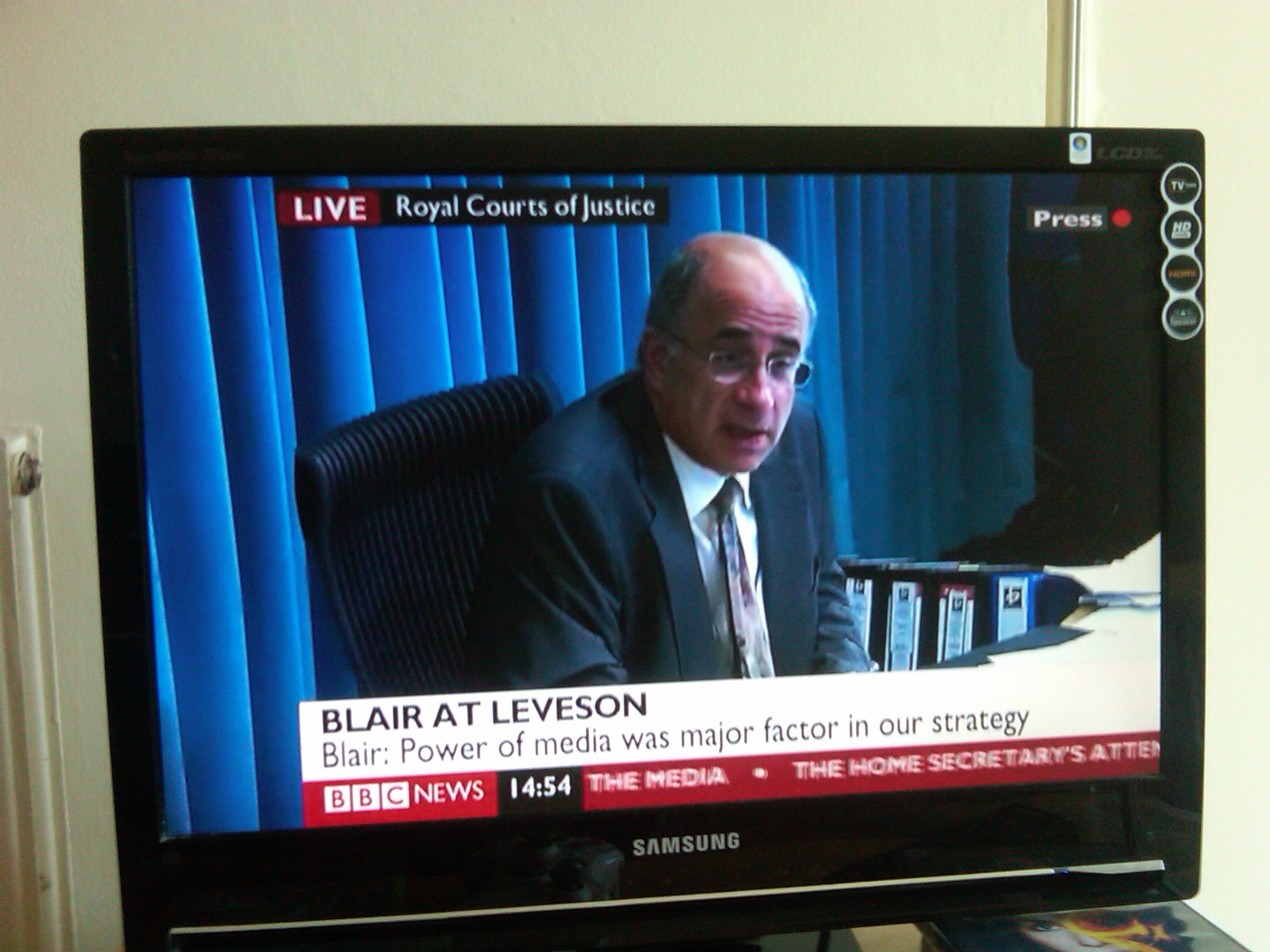
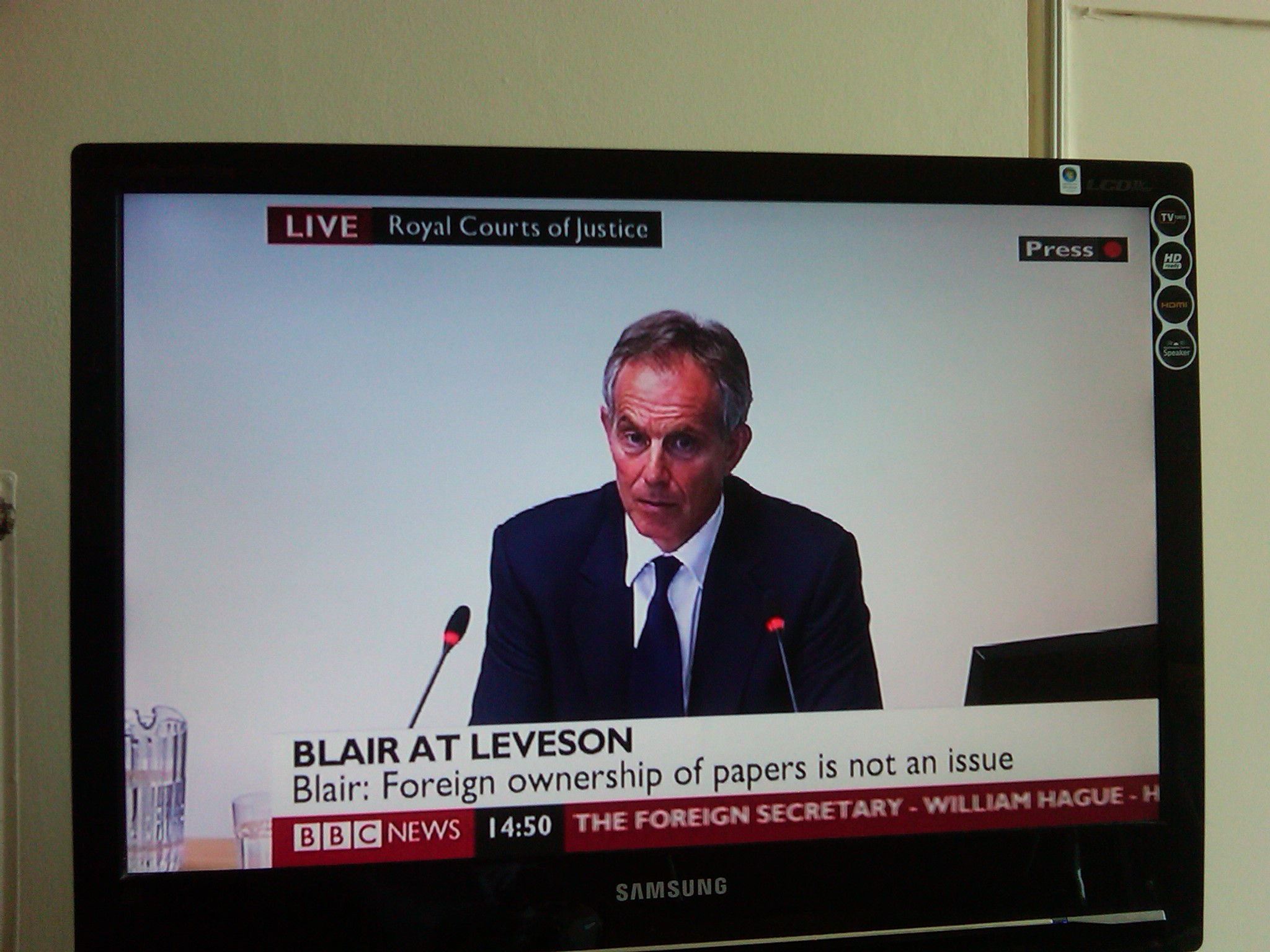
As I type, Tony Blair is giving evidence to the Leveson Enquiry. Why do I care? Because it is receiving wall-to-wall coverage on Britain’s rolling news channels, and as dull as the whole wretched thing is, I cannot bring myself to change channel to The Weakest Link or whatever other daytime television is on offer.
What is the Leveson Enquiry? For those unfamiliar, the enquiry has its own website. And logo. Funny how these things have become a kind of industry of their own in Britain.
I only tuned in toward the end of the session in which Tony Blair was giving evidence, but having subsequently seen the “highlights” repeated on BBC News, I am slightly concerned that we might just be paying a lot of people to sit around for no productive reason whatsoever.
The world’s most tedious man embarks upon a ten-minute, multi-clause question seemingly designed to flatter himself and not to extract any remotely useful information from the witness
Television at its best here.
Tony Blair listens to the incredibly long, pompous question being addressed to him before realising that another 3 hours of this lie ahead, losing the will to live and giving another predictably bland answer.
And after all of this drama and posturing, what did we actually learn today from Tony Blair’s evidence? Essentially, that the media is very powerful and that Tony Blair recognised this when he was Prime Minister, and devised clever strategies to try to keep as much of the media as possible on his side. Oh, and that he didn’t think it was really very proper for the press to say nasty things about his wife and children. Fascinating.
We are paying for all of these people to sit in a room, surrounded by their lever-arch files and court stenographers, so that a glossy report can be published and life can continue exactly as it did before.
Here is all anyone needs to know about regulation of the press and freedom of speech in Britain. Quite literally, this is all anyone needs to know:
1. There is a small elite of powerful people in Britain whose families know each other, who attended the same schools, the same parties, and the same social events. Whether they end up in politics (in either of the main parties), industry (running big companies that do business in Britain) or the media (newspaper or television), their personal preferences, feuds and biases are reflected in the attitudes of their respective political parties / companies / newspapers to one another. Anyone surprised by this non-revelation is a simpleton.
2. We will never know whether any secret deals have been done between any prior governments and media entities in the past, because there are no robust rules about lobbying, declaring interests or exercising influence in place at the moment, and no one involved in such a scheme is very likely to blurt out the fact during an on-the-record, televised enquiry. If you are wondering whether this fact renders the whole enquiry a complete waste of time, you would not be alone.
3. Our libel laws are ridiculous and need urgent reform. Nothing to do with the Leveson enquiry, just a fact.
4. The division between news reporting and opinion is not as clear as it should be in British newspapers.
5. British media companies, like companies in general, sometimes hire bad people who do bad things while on the job. Sometimes this becomes endemic in the organisation concerned. We don’t need to create special new laws to prevent such things happening in the future. If phone hacking was illegal before, prosecute the people involved under the existing laws. Just as we don’t need to design new regulations when the misdemeanour happens in a construction company or a bank, so we don’t need to design new laws when it happens in the media. Tempting though it may be when everyone is a lawyer and wants to be paid for doing something.
6. Until we as a country codify at a very high, hard-to-amend level (i.e. in a constitution or bill of rights of some kind) exactly what, if any, restrictions we are willing to accept on free speech – both as individuals and as media – any time that anything happens to rock the boat, any time that anyone in the media does something improper, we will have another enquiry like this and pay a bunch of former and current lawyers and judges to sit around doing what they are doing at the moment.
7. That’s it.
Isn’t our unwritten constitution a wondrous, beautiful thing? Oh, how we must treasure and preserve it for all time.
UPDATE – Oh, here’s the best bit. Because Tony Blair was interrupted by a protester while giving evidence to the enquiry, Lord Justice Leveson has now ordered an enquiry into how his enquiry was interrupted by a protester. I’m not joking. Welcome to Britain.
22.38 – I’ll live blog about something worth covering next time
15.13 – Tony Blair’s evidence has finished, and immediately the BBC stops caring. I guess I missed all the “interesting” stuff.
15.11 – There are people who go out in the world and do things, and accomplish stuff, and change peoples’ lives for the better (or the worse), but leave an impact either way. And then there are the people sitting in this room at the Royal Courts of Justice. Tony Blair is the former; everyone else…not so much
15.09 – I DON’T KNOW WHAT’S HAPPENING OR WHY I AM PAYING FOR ALL THESE PEOPLE TO SIT HERE
15.07 – Oh geez, why don’t you just get a hotel room and invite Blair up if you like him so much, Leveson? Enough pointless flattery, let’s accomplish something today!
15.06 – Tony Blair is a broken man. William Hague and David Cameron at their fiery best never exacted such a toll on the former PM as Leveson’s pointless question
15.05 – Why is Leveson at pains to say he has no interest in imperilling the freedom of expression in the press? Isn’t the whole point of this goddamn enquiry to hear evidence from other people, not to hear this gasbag preening in front of a load of TV cameras? His so-called “question” just lasted 10 minutes
15.05 – Leveson has heard of the internet! He mentioned twitter and the internet just now! Gosh, isn’t he modern? Looking at all of the angles on press and media regulation here
15.04 – Why can’t Leveson just join his local bowls club like most old people? It seems cruel to the general population of the UK to devise this elaborate and boring way of keeping him occupied
15.03 – So glad I’m not a lawyer (sorry, solicitor or barrister), especially in this country
15.02 – I wish the director would show the expression on Tony Blair’s face as Leveson’s multi-part non-question enters its fifth minute…
15.01 – Leveson postulating about some bizarre scenario about what to do if someones’ leg is going to be chopped off. No idea.
14.59 – Leveson clearly thinks he is being paid by the word, God only knows what he is talking about at the moment.
14.58 – BBC News is showing rolling coverage of Tony Blair’s evidence to The Leveson Enquiry, set up to analyse and recommend changes to press regulation in the wake of the “phone hacking” scandal. This is such a freaking exciting topic, and such great stewardship of our taxpayer money, that it seems to be the perfect candidate for the first live blog on SemiPartisanSam.
Great news for all those who tweet. The Daily Telegraph reports today that Twitter users are to be invited to help choose the next Archbishop of Canterbury:
Well, to clarify, it will not just be Twitter users. As the article states:
A spokesman for the Church of England said the invitation would be made through the church press but also through other media including the social networking site Twitter, where the CofE already posts news in nuggets of 140 characters or less. Tweeters and others will be asked to offer names and “views on the needs of the diocese of Canterbury and the wider community”.
So if too much weight is assigned to the views of those who respond on Twitter, it is entirely possible that we will end up with Archbishop Billy Connolly or Pete Doherty. And maybe inadvertently canonise St. Amy Winehouse while we are at it.
On a more serious note though, I read this article and my first thought was how silly, for such a major world religion to effectively take nominations for the top job via Twitter. But then I read and recalled how the process works at the moment:
Having wrestled with the best way to choose a new leader, the Church of England has decided to use the social networking site Twitter. It will also seek the views of people of all faiths and none, from the Chief Rabbi to Professor Richard Dawkins.
For the first time in history, the long and usually private process will begin with a widespread public consultation, to be finished by the end of May.
The Crown Nominations Commission, which must present the Prime Minister with two possible successors to Dr Rowan Williams, will also ask for contributions from “senior figures in other faiths, the secular world and the life of the nation”. [my emphasis in bold]
So yes. On reflection, compared to having the Prime Minister tossing a coin and choosing the next leader of the worldwide Anglican communion, asking for the opinions of a load of drunk Twitter users fresh back from the pub, people from rival faiths, an avowed atheist and Susan Boyle doesn’t sound like such a bad idea after all.
A democratic church, what a genuinely interesting concept. One that probably deserves a blog post all of its own.
To vote for Dr. John Sentamu, text “YORK” to 800555 or press the green button on your remote control. Text messages will be charged at your cellphone provider’s normal rate + 50p. Please ensure that you have the bill payer’s permission before texting.