Want To Change Religion? Get Permission From A Judge First

Royal Courts of Justice

Want to change religion? Then you’d better get permission from a judge first, if you happen to be under the age of eighteen and your parents can’t don’t give you their blessing.

That is apparently the law of the land in Britain today, or at least the precedent set by a recent ruling in which a a County Court judge ruled that a ten-year-old girl would be allowed to follow her wish to convert from Judaism to Christianity and be baptised, denying a request from the girl’s mother to grant an injunction forbidding the father from allowing her to proceed.

The Telegraph reports:

The court heard that the girl, who cannot be named for legal reasons, was born in late 2001 to Jewish parents and grandparents. But her mother and father divorced in 2010 and she, and her younger brother, now live for a week at a time with each under a shared parenting agreement.

Her father converted to Christianity after the breakdown of his marriage.

In November the girl’s mother, without telling anyone, applied for a court order forbidding the father from baptising or confirming her into the Christian faith. The judge heard evidence before deciding how to respond to the application.

I happen to think that the judge in this case ruled very wisely and sensitively on the case – you can read the full decision here. He also wrote and made public a letter to the girl in question, explaining his decision. I believe that he did a good job in a difficult situation.

But to my mind, this isn’t the type of matter that should ever come up for judicial review at all, or be subject to the whims of a random judge. Family law is a complicated area in which I have absolutely no expertise, but the crucial principle at hand in this case is liberty. There mere fact that the mother and father of this girl were arguing in court about the worthiness of an injunction preventing a person from changing their religion is highly inappropriate.

Religion and faith are matters of personal conviction and are private to that individual. No conceivable harm could befall this girl as a result of converting from one religion to another, and therefore this matter should be well beyond the remit of what a court injunction can be used for. The girl, and she alone, should be free to believe whatever she wants to believe, and to be received into the faith of her choosing in a manner consistent with their customary rites and practices. There is no welfare issue at stake for the child – indeed, the only conceivable harm that could occur would be to the hurt feelings of one or other parent.

In this case, the girl’s freedom of thought and speech were ultimately protected by an empathetic and restrained judge. However, a future court might rule differently, and issue an edict forbidding the person concerned from following their own will and their beliefs. In order to preserve freedom for the individual, and religious liberty, it must be made clear to the courts that they have no business arbitrating parental disputes such as this, or making religious choices for any British citizen.

Whether this is done through bespoke legislation, or my preferred route of a full-scale UK constitutional convention to once and for all settle the limits of crown, government and judicial power, rests – depressingly – in the hands of those who hold power today.

I would hope that they will see this case as a warning sign, and take meaningful action in defence of liberty.

No Lords Reform After All

Not so fast. First we need to preserve democracy by translating the referendum question into Cornish.


The Conservative-led coalition government is about to make another costly, unwise and unnecessary policy reversal, though finally a non-budget related one, with The Telegraph reporting that the planned reforms of the House of Lords are going to be shelved, in the face of strong Conservative backbench opposition.

They report:

Earlier this year, Mr Cameron and Mr Clegg outlined plans to replace appointed peers in the House of Lords with elected senators. The first elections were to be held in 2015 with the elected members of the house serving for 15-year terms.

However, dozens of Conservative MPs and peers expressed their strong opposition to the proposal amid fears it would undermine the supremacy of the Commons.

Downing Street was forced to delay a key vote on the reforms last month to allow further discussion with the rebels. It is thought that Mr Cameron was prepared to water down the reforms to help win over more than 90 Tory MPs.

However, The Daily Telegraph has learnt that this has now failed and the reforms will be scrapped. Downing Street feared that debate over the reforms could drag on for months and alienate the public at a time when ministers should be focused on pulling Britain out of recession.

This is yet another stinging rebuke of David Cameron’s leadership and ability to stamp his authority on his party, and to articulate and then deliver a vision for government. Indeed, in the same article, The Telegraph notes:

The Coalition has been accused of mounting more than 20 about-turns – moves which the Prime Minister has insisted show strong leadership as he rejected pushing ahead with unpopular policies.

There’s no strength in walking back so many elements of the Budget, and other policy and manifesto positions, in the face of opposition or a newly invigorated Labour Party in opposition. It just makes you look weak, and lacking in conviction or any real plan to turn the country around.

It is also a significant setback for those people such as myself who wanted to try to reinvigorate British democracy by bringing to an end the anachronistic setup of the current upper house, and replace it with a more powerful, democratically legitimate body that could act as a check on the “elected dictatorship” of the Commons. If, as expected, the reform plans are now killed, it is unlikely that they will be any appetite to revive them in the near future.

But more importantly, it has potentially very serious consequences for the ongoing survival of the coaltion government, as Isabel Hardman notes in The Spectator’s Coffee House blog:

This triggers that new phase of coalition that Nick Clegg and his colleagues have been warning about: the era of ‘consequences’. Although Conservative ministers have been considering other policies that they could hand to their coalition partners, these will not be enough to appease them: it’s Lords reform or nothing.

How this will play out is fascinating: the main threat is that the Lib Dems will scupper the boundary reforms, but to truly block their passage through parliament would require ministers in Clegg’s party to vote against the legislation. Would those ministers then be sacked? If they were, that’s curtains for the coalition. I’ve asked Number 10 about this before, and to date the response has been ‘that’s a hypothetical question’. Not for much longer: this new phase of coalition is very much uncharted territory, not simply because it heralds a new pattern of relations, but because it’s very difficult to see how the Lib Dems can carry out their ‘consequences’ threat without walking out of the government too.

Our attentions are currently consumed by the fantastic Olympic Games currently taking place in London, but it is certainly starting to look as though we could soon be living in very interesting political times, too.

Bravo, Bradley!

Three cheers for British cyclist and four-time Olympic Gold medallist Bradley Wiggins, who celebrated his follow-on victory from the Tour de France by knocking back a few drinks at a rooftop bar somewhere in the City of London, according to The Telegraph.

They report:

The four time Olympic Gold medallist and Tour De France winner told millions of viewers after his latest win in the time trial that he was going to have a rare night off from his punishing training regime and “get drunk” to celebrate.

And just hours later – shortly after midnight – he was pictured on a rooftop bar overlooking St Paul’s cathedral in central London achieving his goal.

The 32-year-old posted two pictures of himself on Twitter with friends declaring to the world he was “getting wasted at at (sic) StPauls.”

His spelling and grammar suggested he was well on the way.

Mission accomplished, in every sense of the word! And what well-deserved drinks they were, after Wiggins provided Team GB with their second gold medal of the 2012 Olympics.

Here’s hoping that we add significantly to that tally over the next few days.

The Best Thing Of 2012

I know that it is only the first day of August, but I am supremely confident that nothing will surpass this story reported by ITV News.

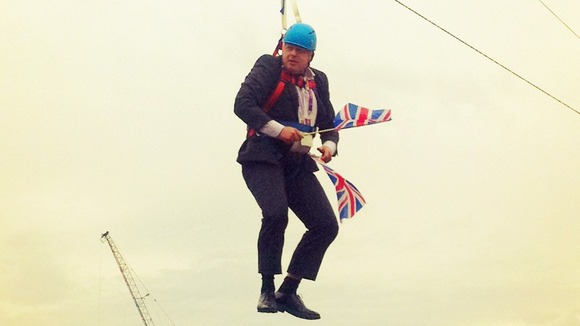
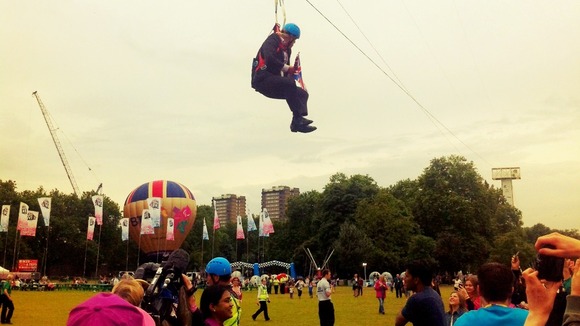
Apparently the Mayor of London, Boris Johnson, was at an Olympic event in Victoria Park, trying out a zipwire ride, when it malfunctioned and he became stuck, suspended some distance above the ground:

Boris Johnson flies the flag for Britain. Image from ITV News.

He spent several minutes in this indecorous pose, to the amusement of the crowds, apparently shouting “Get me a rope, get me a ladder!” until he was able to be winched to safety.

London Mayor Boris Johnson dangles above the ground before being rescued. Image from ITV News

I more or less support Boris Johnson’s mayoralty of London (he’s a zillion times better than “Red” Ken Livingstone, anyway), and while it is a little mean-spirited to laugh at another person’s misfortune, I seriously think that this may have made my political year.

Olympics Past And Present

Today seems to be the day to look back at Olympic Games past and marvel how far we have come. Both NPR and Slate have pieces documenting the differences in styles, fashions and sporting events that a spectator might have seen at the Olympics in 1908 and 1912 respectively.

NPR looks at the 1908 London games, the first time that the United Kingdom’s capital hosted the competition:

Topical Press Agency/Getty Images

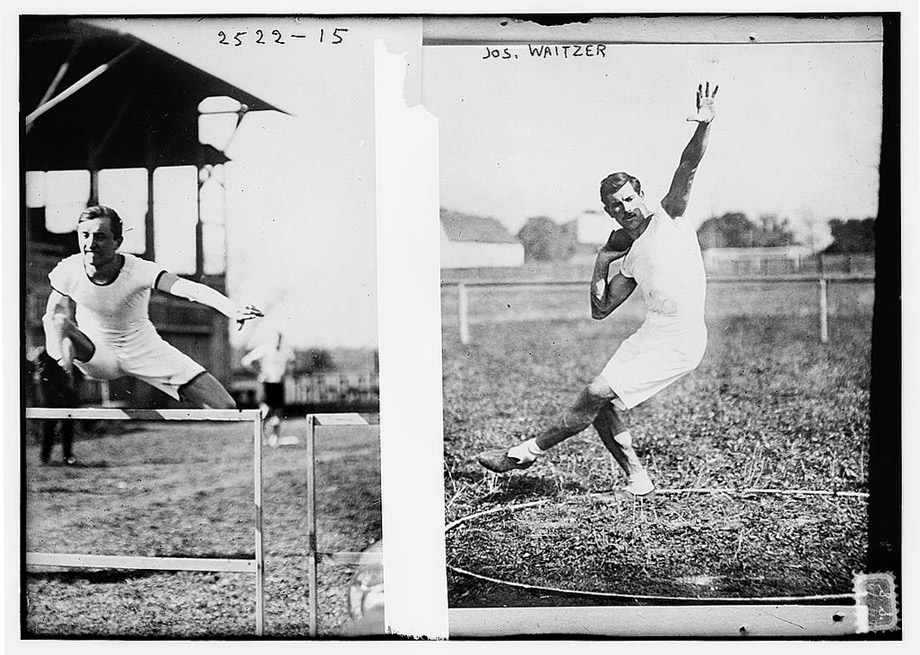
Slate reviews the following games, which took place in Stockholm in 1912:

Flickr Commons project and database, 2008, via Library of Congress.

They go on to explain:

… the 1912 Stockholm Games were “the last Olympics where any individual could just turn up and hope to enter a competition.” In that era, the idea that “natural” skill might enable someone to win a competition without any specialized training was still widely embraced.

As I sit in my living room with twenty four high-definition BBC channels showing almost every Olympic event taking place live, with commentary and instant replay and now apparently optional 3D, it is nice to appreciate what we have now, but also to look back at a time when people were happy to be entertained by watching the tug-of-war and a master of ceremonies wielding a megaphone to address the crowds.