The Day We Fight Back

thedaywefightback


Sometimes help comes from the most unlikely places. That was certainly the case today when Ed Miliband used his speech at the Hugo Young memorial lecture to call for major changes to the oversight of Britain’s intelligence and security agencies.

The Guardian reports:

A major overhaul of the oversight of Britain’s intelligence agencies, which could lead to an opposition politician chairing parliament’s intelligence and security committee and reform of the intelligence commissioners, needs to be introduced, Ed Miliband has said.

The Labour leader praised Barack Obama for starting an “important debate” in the US – after the White House appointed a panel in the wake of the Edward Snowden leaks – and called for a similar debate in Britain.

In some of his most extensive comments on the NSA leaks, Miliband told a Guardian audience that reforming the oversight of GCHQ, MI5 and MI6 was “definitely” part of his campaign to challenge “unaccountable power”.

Though the details remain sketchy, it appears that Miliband envisions quite a far-reaching review, looking not just at the methods used by the security services but also the degree to which the agencies are funded, the scope of their responsibilities and the granting of a more formal role in oversight to the main opposition party:

Miliband made clear that his challenge to “unaccountable power” would include Britain’s intelligence agencies as he said that reform should focus on two areas. These are parliament’s all party intelligence and security committee, which is always chaired by a senior MP from the governing party, and the commissioners who oversee the intelligence agencies.

The Labour leader said: “I already believe, and this is what my Labour colleagues have been saying, that there are clearly changes that are going to need to be made in relation to the intelligence and security committee and the oversight it provides.

“That is everything from the resources they have at their disposal, who chairs the committee and whether it should be somebody from the government party or the opposition party, their power to compel witnesses – a range of issues.

While this may warm the heart of many a weary libertarian, it must be noted that Miliband has barely scratched the surface in terms of confronting the growth of the British national security apparatus – after all, even miracles have their limits.

Miliband praises US President Barack Obama for starting what he calls an “important debate” but neglects to mention that Obama would have quite happily allowed the NSA to continue to violate the privacy of US and world citizens in secrecy and in perpetuity, and that he is actively seeking to extradite the person who really started the debate – Edward Snowden – back to America to face charges of treason. Thus restated in the proper context, Obama’s carefully cultivated philosopher-king image begins to lose some of its sheen, as does Miliband’s boyish admiration of him.

It should also be noted that Miliband sees the answer to concerns about privacy and civil liberties very much in terms of incremental changes to the existing framework, and certainly not in creating cast-iron rules about powers that the government should rightly have and those which should be reserved by the people.  In particular, he sees the fact of ministerial oversight and sign-off of interception requests by the security agencies as a good thing and a solid check on power, rather than the rubber stamp that it really is:

On the ministerial oversight of interception, he said: “It is worth saying also that there is in this country … ministerial sign off when intercept and so on takes place. That is a very, very important safeguard. I do believe the intelligence services do important work. But I absolutely endorse the idea that there are important issues of liberty and liberty is an important part of Labour’s agenda.”

Perhaps Miliband (or indeed David Cameron or Theresa May) would care to set out a scenario – any scenario at all – where the British intelligence services might approach the government to get sign-off for a communication intercept on a surveillance target and actually be rebuffed by a skeptical minister. It simply would never happen.

Elected politicians, weighing the likely fallout of two different courses of action, are almost always going to follow the path that chips away at civil liberties by approving the intercept request rather than defending privacy and denying the request on grounds of insufficient evidence, and later being implicated in a security failure. Decisions on the authorisation of communications intercepts should rest with the judiciary, not the executive.

It is certainly true that public opinion in Britain has not swelled with outrage at the revelations of NSA and GCHQ collaboration in collecting and viewing private communications data with no reason for suspicion and no warrant.

And so Miliband’s contribution to the British debate on privacy and (remarkably) constraints on the power of the state – a very muted, anaemic debate compared to that now taking place in many other countries – is welcome, and very important. In America, politicians from both main parties and of all temperaments have spoken out in condemnation of secret government surveillance, raising public awareness and, in some cases, making continued support for these draconian surveillance measures an electoral liability. Meanwhile, the British political establishment has largely closed ranks in defence of the national security complex, and against the people.
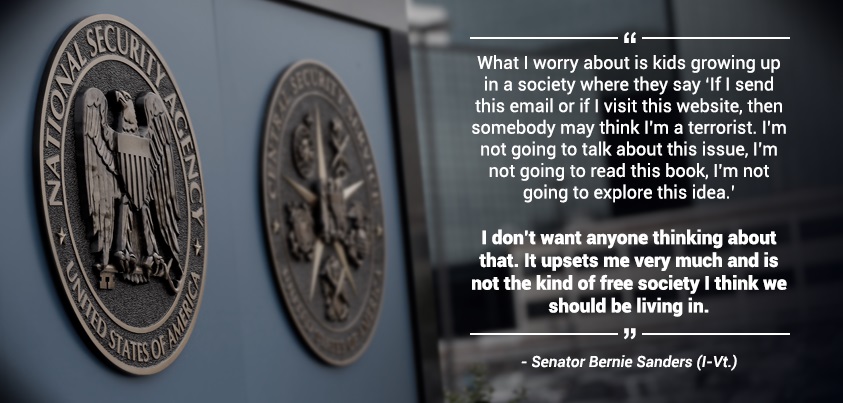
berniesandersNSA

Contrast this quote from the independent Vermont Senator, Bernie Sanders, with Prime Minister David Cameron’s dismissive and aloof response to concerns about the practices of MI5, MI6 and GCHQ:

“We have very good rules in this country. If a telephone call is going to be listened in to, that has to be signed off by the Home Secretary personally. There are very good safeguards in place,” Cameron told ITV’s The Agenda. “You get asked, ‘What are the rules’? I’m satisfied we have pretty strong safeguards. I thought part of the reaction to the The Guardian story was – big surprise, spies learn to spy…it’s to help keep us safe.”

Does the fact that Ed Miliband took the first tentative step in support of civil liberties and dared to suggest the state should not be all-powerful over us mean that the torch has been passed to a new generation of leaders on the issue? Of course not. Miliband seems to place his complete faith in the power of the state to accomplish a whole range of other matters relating to the personal and private lives of the British people, and it is far from certain a this early stage that he is not simply using his Hugo Young lecture to score a few cheap political points with no intention of pursuing the matter any further.

But for perhaps the first time in his senior political career, Miliband spoke out in favour of the private citizen over the government, when the issue of government surveillance has been met with nothing more than dismissal and condescension by Number 10 Downing Street and the rest of the government. And for that action, he must be given some credit.

Today, February 11th 2014, has been labelled The Day We Fight Back against mass surveillance. Numerous websites are carrying links to the organisation, which is supported by more than 360 organisations in 70 countries, and which plans to petition lawmakers in these countries to take action on the serious issue of government surveillance and constitutional overreach.

The Day We Fight Back has been well-marked in the United States, with many prominent politicians adding their voices to the chorus of protest. In the UK, on the other hand, there has been a deadly silence. The focus of the British news media and the political class remains fixed on the issues of flooding in southern England, with elected politicians falling over themselves to be seen in photo opportunities surveying the damage and taking decisive action. Taking any kind of action in support of our right to privacy and freedom from government oversight is far down the list of priorities, where it even features at all.

Former Texas Congressman Ron Paul is not right about everything, but his warning about the loss of liberty, echoing Franklin, is pertinent and timeless:
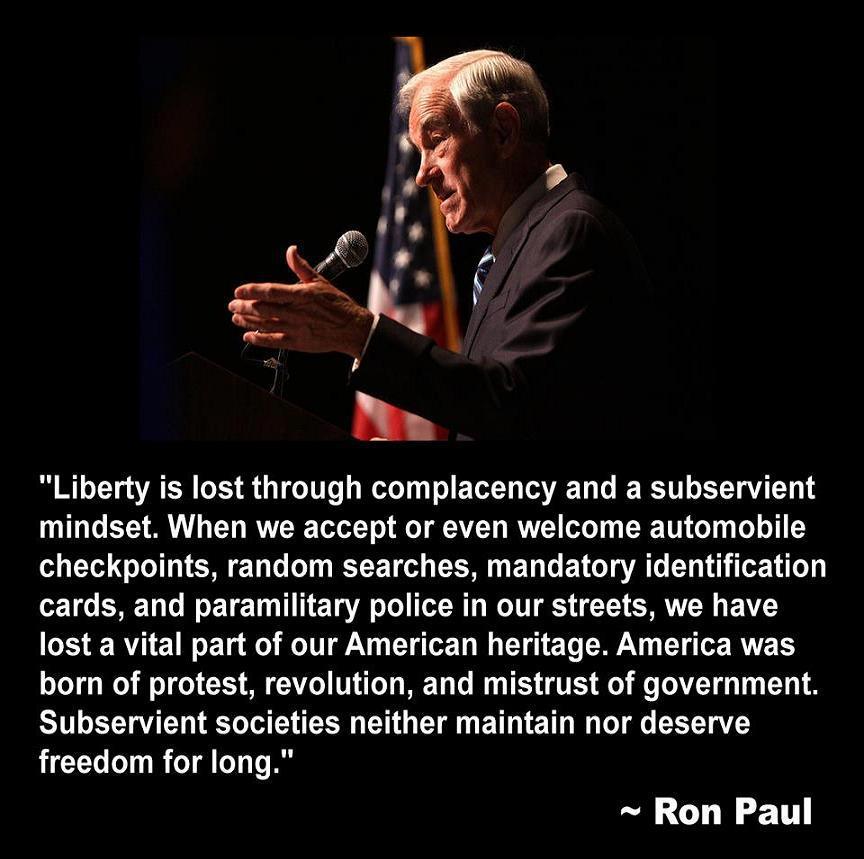
ronpaulwarning

People in Britain who truly appreciate the importance of the right to privacy and the need to place constraints of any kind on government seem to be few and far between, and consequently we must look for allies in unlikely corners.

Ed Miliband’s is certainly the very unlikeliest of corners. But perhaps the Labour leader’s taking a stand for civil liberties will shame others – those who should have been holding this issue aloft all along, and warning of the dangers of an omniscient, omnipotent government – into finally doing the same.


Concerned readers can visit The Day We Fight Back website and add their name to a petition here.

Vladimir Putin, Gay Marriage’s Best Salesman?

Temperatures in the netherworld dipped below zero yesterday, and the outlook is forecast to remain glacial for the indefinite future. It’s official – hell has frozen over. And you don’t need a thermometer to bear witness to this fact – simply head over to Cristina Odone’s blog at The Telegraph and see for yourself.

Odone has publicly re-examined and changed her stance on gay marriage. Throwing her hands in the air in apparent acknowledgement of the inevitable, Odone – somewhat resentfully – now supports extending the institution of marriage to homosexual couples.

If, like me, you held the chances of such a thing ever happening to be so vanishingly small that its occurrence would represent a bellwether event in the movement for equality and civil rights, then this is more than just cause for celebration. We should celebrate. There must always be pause for reflection and thanksgiving when someone who once sat on the other side of the fence comes out in support of equal marriage, and bringing a hitherto-excluded group of people into the fold of marriage.

But after the celebration, it is also right to wonder what makes someone who is seemingly implacably opposed to an idea suddenly change their mind. Proponents of gay marriage will want to know this so that they can focus their arguments and target their resources where they will do the most good. And it is here, unfortunately, that one of the most high-profile recent converts to the cause of marriage equality will do them absolutely no good at all.

Because Cristina Odone was convinced not by rational argument or through personal experience, but by the President of Russia.

Vladimir Putin made Cristina Odone support gay marriage.

All the reasoned argument in the world could not sway Cristina Odone. But apparently this man has what it takes.
All the reasoned argument in the world could not sway Cristina Odone. But apparently this man had what it takes.


And this dramatic volte-face was carried out by a woman whose own vast persecution complex over gay marriage only recently led her to this spectacular “feed me to the lions” meltdown:

[David Cameron] may get away with bullying a great many – perhaps the majority – into accepting his proposals. But in doing so Cameron will create a less liberal and tolerant society. Those who have held fast to their principles, will have to accept what the majority wants. But will the majority respect what the minority believes in? Not in Cameron’s Britain, they won’t. The moment the vicar or priest refuses to celebrate a gay marriage in their church, the aggrieved couple will see them in court — in Strasbourg. Here, at the European Court of Human Rights, Christians will once again be thrown to the lions as their opponents will strive to set a precedent: equal rights means equal access to religious marriage ceremony. Anyone who stands in a gay couple’s way will be persecuted by the law (and those strident gay rights lobbyists who tolerate only those who see everything their way.)

But that was Cristina Odone in 2012. The Odone of 2014 has this to say, in her most recent column for the Telegraph:

I have written before about my fear that legalising gay marriage would affect the special status of marriage as a sacred institution. I have argued that once gay people could demand to be married, believers who refused to open their churches or even church halls to the ceremony would be punished. But Putin’s homophobic measures have changed my mind. If I oppose gay marriage I may be seen as condoning his anti-gay campaign. I couldn’t live with that.

She rightly goes on to rake Vladimir Putin over the coals for his opportunistic and divisive decision to shore up his political position by focusing attention on gay people as the new “enemy within”:

Putin will continue to pursue this hateful campaign because it strikes a nasty populist chord. Sadly it would seem that his supporters are not just in Russia but abroad, too: Putin ranks as number three most admired world figure, ahead of Pope Francis. Why? because Putin has manoeuvred himself to be the crusader against “the other” – in the shape of immigrants, alternative lifestyles, and above all gays. He has driven a fault line through 21st-century culture. On one side, there are the Russian leader and his supporters, who believe gays are fair game for abuse. On the other side are gays – vilified and beaten –  and those who oppose their persecution. Putin is forcing us all to choose between him and his victims. I cannot stand with Putin.

Good. But think for a moment about the logic (or startling lack thereof) behind this statement. Cristina Odone apparently inhabits a world where deeply held personal convictions are no longer something to be defended through reasoned, intellectual debate and changed only in the face of persuasive evidence to the contrary. In this world, beliefs and opinions are instead chopped and changed as they wax and wane in popularity or inevitability, and can be picked up or discarded according to the reputation or behaviour of other people who hold them.

Always believed in low taxes, but just found out that a prominent individual got caught engaging in tax evasion? No problem, simply join the Labour Party and clamour for a mansion tax, because believing in low taxation is no longer fashionable. More horrific revelations in the media about the coverup of child abuse in your local Catholic diocese? Why not convert to Buddhism for a nice refreshing change, surely everyone loves a Buddhist?

The ease with which one can pick apart Odone’s reasoning does not mean that we should not be pleased at the end result. We can be delighted with the destination if still somewhat puzzled by the winding, circuitous route taken on the journey to reach it. But as someone who has long opposed gay marriage and full equality for gay people in Britain, I think Cristina Odone owes us a peek at the Google (or perhaps more likely Apple) Map routing that led her to this strange new place.

To publicly change a staunchly-held position on a major issue such as gay marriage without providing a line-by-line or argument-by-argument account of the evolution in her thinking is intellectually lazy, and significantly detracts from the impact of Odone’s announcement. That is bad for her personal credentials as a thinker and a writer, but it also denies equal marriage supporters the propaganda victory that could then take their argument further.

Until recently, Cristina Odone was thundering that the sanctioning gay marriage represented the “tyranny of the majority” and the end of religious liberty for anyone of faith. And yet she now supports gay marriage. So either her fears of tyranny and oppression were unfounded – in which case admitting as much would be the only intellectually rigorous and honest thing to do – or she considers aiding and abetting the onset of tyranny to be a small price to pay in exchange for preserving her reputation as a national newspaper columnist who does not want to be associated with a homophobic foreign regime.

Which is it?

The uneasy thought remains that perhaps Odone’s column was not intended seriously, and is simply the journalistic equivalent of throwing her toys out of the pram at being discredited by association with the likes of Vladimir Putin. We should certainly pay careful attention to her pronouncements on gay marriage once the Sochi Winter Olympics are over and the attention fades on Russia’s regressive attitude toward homosexuality.

Changing your mind on dodgy or unexplained pretexts once is cause for notice and concern. But if it were to happen twice on the same issue – if Odone should decide to backtrack on her words once Vladimir Putin is no longer commanding world attention and making her look bad – it would pose a very serious question as to why anyone should continue paying attention to anything she writes or says at all.

Let’s hope that Cristina Odone’s defection is the real thing, and not just a tactical ruse.

Where Are The Women In British Politics?

Blair Babes women British politics


The conventional wisdom holds that Ed Miliband managed to land a serious blow on David Cameron at this week’s Prime Minister’s Questions, exposing the Tory leader and his party for their chronic shortage of women in leadership positions and the key offices of state. Miliband makes a good point – an abysmal 4 out of 22 cabinet ministers in the coalition government are women, and only one of those, Theresa May at the Home Office, occupies a position that really matters (Culture, Northern Ireland and International Development, the other ministries headed by women, are either irrelevant or decidedly junior-league). That simply is not good enough, and David Cameron has just cause to feel ashamed.

The Guardian makes the case:

[David Cameron] was taunted about the Conservatives’ “women problem” by Ed Miliband in the same week it emerged several prominent women have recently been sacked from government jobs and Anne McIntosh, a high-profile female Tory MP, was deselected by her local association.

The Labour leader also claimed a prominent businesswoman, who is the wife of a Tory donor, had been greeted by Cameron with the remark: “Where’s your husband?”

He then accused the coalition of failing women across the UK by allowing the pay gap between men and women to widen for the first time in five years.

“You promised to modernise your party, but you are going backwards. You run your government like the old boys’ network – that’s why you are failing women across your party and across the country,” Miliband said.

And the initial exchange between the two leaders at Prime Minister’s Question Time can be seen here:


Less reported is the fact that the Labour Party has a record on promoting women every bit as appalling as do the Conservatives, as Dan Hodges correctly observes in his Telegraph column:

Women still aren’t allowed to hold senior positions in the Labour party. The three major political briefs are Prime Minister/Leader, Chancellor and Foreign Secretary. Apart from a short period during the fag end of Tony Blair’s administration when Margaret Beckett was placed in charge of the Foreign Office, and 14 weeks when Yvette Cooper oversaw the shadow post under Ed Miliband, none of those offices have been held by women. The Labour party has been in existence for 114 years. And during that time – under Labour – a woman has held or shadowed one of three major offices of state for a period of 14 months.

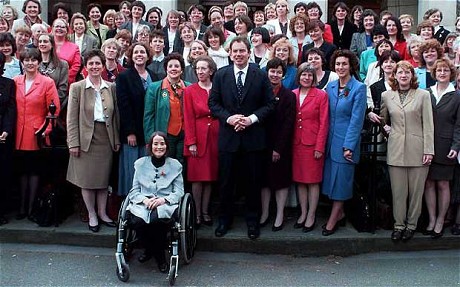
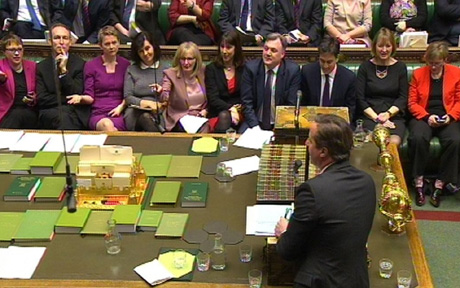
Fourteen months. And yet you would not think that Labour was sitting on such a poor record when Ed Miliband stood preening at the dispatch box in the Commons on Wednesday. One could have been forgiven for thinking that women made up a statistically and politically perfect 51% of Labour seats in Parliament and in the shadow cabinet, particularly given the rather unusual concentration of the Labour Party’s female talent on the front bench alongside their leader:

When PMQs started, several people commented on the fact that a number of Labour’s women shadow cabinet members were artificially concertinaed together close to Miliband. The reason they did that was because if they hadn’t done that they wouldn’t have been in camera shot. And that’s because there’s a convention that people sit alongside their leader based on seniority.

If something about the picture below strikes you as odd – don’t worry. There is indeed something different about the Labour front bench at PMQs this week – namely, a lot more women clustered on either side of Eds Miliband and Balls than is usually the case. It is hard to determine which is worse – Ed Miliband’s disingenuous photo opportunity, or the willingness of a number of female Labour MPs to go along with it by essentially allowing themselves to be used as props by their leadership.

Not your standard distribution.


A less-reported fact amid the furore is that all four women cabinet ministers in the coalition government are Conservative MPs, which rather begs the question of how the Liberal Democrats have managed to fly under the radar and avoid being called out for their own shameful inability to recognise and promote female talent within their own ranks. But somehow the party of Lord Rennard seems to be scoring a free pass on their own institutional sexism for the time being – at least as far as Ed Miliband’s focus is concerned.

The lack of women in senior positions in all political parties is a real problem, one which Miliband does little to debate or address by trading barbs with the Prime Minister. Some advocate all-woman shortlists as a solution to the problem, and of course the Labour Party has adopted this particular approach. This blog disagrees with it – firstly on the grounds that it robs local constituencies of the opportunity to select from the widest possible pool of talent when choosing who they want to represent them in Parliament, and secondly because if we must tolerate reverse discrimination as a necessary evil to help put right historic wrongs (and I’m far from convinced that we should), it should be done at the earliest stage possible and certainly not at the point of parliamentary candidate selection.

But while we may condemn Miliband’s posturing on the subject and question his methods, we must also acknowledge that at least the Labour Party under Ed Miliband is engaged in a bona fide effort to increase the number of women in their parliamentary party. There is a lot of rueful head-shaking from the Conservatives at the conspicuous lack of women in theirs, but not much action of any kind at all.

Four women out of twenty-two cabinet members in the British government, in the year 2014. This is a national scandal, far more serious than localised spats about the deselection or resignation of individual constituency MPs, or accusations of politicising quango appointments. This is about the integrity of our democracy and our desire to be a more practically and visibly meritocratic country.

The Conservatives, the party of Margaret Thatcher, should be leading the charge on anything to do with meritocracy. The fact that they are not currently doing so is alarming.

UKIP’s Choice

I like the commitment to giving the British people a say on our future membership of the European Union. I like the commitment to stripping away burdensome regulation from business. And I really like the libertarian streak which says (with the shameful and notable exception of opposing gay marriage) that you can do what you damn well like in your eating, drinking or recreational life without fearing either chastisement or prosecution by the government. But the recent scandals and dramas within UKIP are making me realise all over again that having a few really great core principles is simply not enough. Not for a political party with serious national electoral ambitions, at any rate.

In moment of great frustration with British politics and the day-to-day compromise of coalition government I have flirted with the idea of giving UKIP my vote. There are parts of the UKIP agenda – you’ll only find them on the UKIP website, the British media generally fails to report the serious stuff – that make perfect sense and which should appeal to anyone of a conservative-libertarian leaning. And in the past it has frustrated me that the focus on UKIP’s more sensible ideas has been continually taken away by the actions of some of UKIP’s more unhinged, out-of-the-mainstream supporters.

I continued to make this argument in good conscience throughout the Godfrey Bloom saga and then the David Silvester affair, because the first was a nonsense and the second was a nonentity. But not so this time.

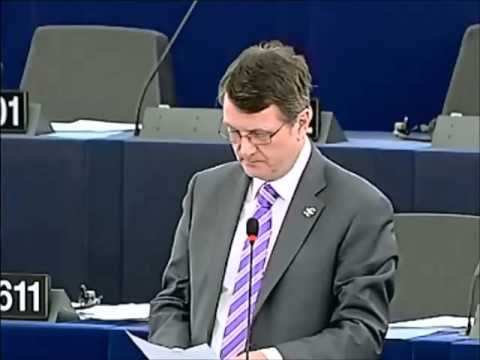
Gerard Batten is a serving MEP and a serious voice within his party – not a swivel eyed lunatic from the fringe. And so when he publicly advocates making Muslims effectively sign an oath of loyalty and nonviolence to prove their harmlessness to the state, this represents a very real problem for UKIP, damages their pro-liberty credentials and alienates many people (myself included) who were otherwise inclined to give them a fair hearing.

gerardbatten

The Guardian gives some of the detail:

Gerard Batten, who represents London and is member of the party’s executive, told the Guardian on Tuesday that he stood by a “charter of Muslim understanding”, which he commissioned in 2006.

The document asks Muslims to sign a declaration rejecting violence and says parts of the Qur’an that promote “violent physical Jihad” should be regarded as “inapplicable, invalid and non-Islamic”.

Critics said his comments represent the “ugliest side of Ukip” and “overlap with the far-right”, in spite of the efforts of party leader Nigel Farage to create a disciplined election machine ahead of the European elections.

Asked on Tuesday about the charter, Batten told the Guardian he had written it with a friend, who is an Islamic scholar, and could not see why “any reasonable, normal person” would object to signing it.

One hardly needs to restate their horror and revulsion at all forms of violence and terrorism in the name of religion before condemning this politician’s attempt to take a redacting pen to the holy book of a faith not his own – but I shall do so anyway. We can abhor the violence, but that does not make it right to propose amendments to the religious texts of a faith that you do not yourself practice. Indeed, if Gerard Batten is to apply his editing skills to every major religious text touting a menu of violent and uncivilised punishments to be meted out to those who accidentally violate the etiquette of their ancient day, he will not only raise Muslim ire but also the outrage of other religions perhaps much closer to his own heart.

Seeing the “I have Muslim friends” card played as a defence by Godfrey Bloom is also quite depressing, and hardly mitigates the fact that he is basically advocating state interference in the workings of a religion, state interpretation of religious texts and state monitoring of compliance with religious teaching.

And in a final flourish, Batten also failed to repudiate his 2010 call for a ban on new mosques in Europe, apparently confirming the suspicions of many that UKIP is concerned about freedom of religion and freedom from religious persecution only when it can be used as an argument to allow certain Christians to continue discriminating against gay people.

The latest UKIP scandal has, naturally and rightly, drawn condemnation from across the political spectrum, with Conservative MP Robert Halfon (of the Jewish faith) describing Batten’s “Islamic code of conduct” as the first step toward making a persecuted people wear a visible gold star on their clothing:

Halfon, who is Jewish and has spoken out repeatedly against Islamic extremism, told the Guardian he considered Batten’s views “unbelievably sinister” and “frightening”.

He tweeted: “Big difference btwn lawful Muslims & extreme Islamists. UKIP MEP Batten’s statement a 1st step to wearing a Yellow Star.”

Sarah Ludford, a Liberal Democrat MEP for London, also criticised the comments, saying they “rip apart Ukip’s pretence” that it treats everybody equally.

“His offensive blanket stereotyping of Muslims speaks volumes about Ukip’s extremism and should warn voters that voting Ukip means associating with hatred and Islamophobia,” she said.

These shenanigans within UKIP must come to an immediate halt if the party is to staunch the bleeding and begin to repair its tarnished reputation. The existing media portrayal of the party as a club for closet racists, little-Englanders and swivel eyed loons is harmful enough without having senior MEPs throwing more fuel on the fire. The fact that some of the provocative statements in question were given in the year 2006 is no defence or mitigating factor here – all that means is that eight years have passed without a public apology and withdrawal of the remarks.

True to recent form, Nigel Farage has been slow to respond to this latest volley of bad publicity – and so, for the moment, Gerard Batten is left to twist in the wind. This, in itself, is unacceptable. This is a time for the leader to lead. Perhaps UKIP wants to be a party of unapologetic Islamophobia and a cheerleader for freedom of religion, but only when Christian freedoms are perceived as being threatened. And if so, that is their choice to make – free speech is still just about protected in this country, and UKIP are entitled to campaign on that platform. In turn, I would also then be freed from the desire to give them any further serious consideration and airtime on this blog, because I would exercise my right to avoid associating myself with such a party.

But if the UK Independence Party actually stands for personal liberty and does not wish to associate itself with religion-specific loyalty tests and bans on practicing Islam (because that is what withholding permission to build new mosques would ultimately mean), with fearmongering or with discriminatory policies, then Nigel Farage needs to speak up and show any recalcitrant members the door.

Newer, less established and experienced political parties eventually have to choose between their fiery, populist rhetoric and the need for sober policymaking; between courting any stray vote that can easily be won and accepting that the votes of some other people are fundamentally undesirable. The Liberal Democrats faced their reality-check on the topic of undergraduate tuition fees, and for better or worse they chose responsible government over delivering on their tuition fee cap bribe to their starry-eyed voters. It increasingly looks as though UKIP will have a dual reckoning – with their attitude to gay marriage on one hand and the decision to condone or condemn Islamophobia on the other.

If Mr. Farage could please make up his mind on these issues and convey the message to his troops, the rest of us will know whether to keep giving UKIP the time of day, or letting them jog on by.

The Conservatives After Cameron

Apparently running the Home Office is no longer the political kiss of death that it once was. ConservativeHome highlights an interesting and worrying trend in the sentiments of the party base – a strong, and growing, preference for Theresa May to be the next Conservative Party leader after David Cameron:

Last month, the Home Secretary squeaked it, displacing Boris Johnson from the top of the poll by 22.7 per cent to 22.6 per cent – in other words, there was one vote in it out of some 800 responses.

This month, she does so again, by 23 per cent to 22 per cent – or, if you prefer, by a margin of three votes.  Michael Gove’s rating is down from 17 per cent to 14 per cent; William Hague’s is up from 10 per cent to the same total, 14 per cent.

What’s striking about this month’s result is that the gap between May and Boris is more or less unchanged – but the survey got roughly 200 more replies.

Looking back over the record of previous Home Secretaries, I was recently arguing with a friend about whether the office of Home Secretary tends to naturally attract the authoritarians and those casually dismissive of civil liberties from within their parties, or whether working in the Home Office makes a person that way, and that even an ardent libertarian would come out of the Home Office singing the praises of indefinite detention without charge, bulk data collection and citizenship revocation without criminal conviction. Which came first, the chicken or the egg? In the case of Theresa May, an uninspiring record prior to government has only been tarnished further since 2010.

The only thing more worrying about this preference for Theresa May is that her chief threat is the implausible Boris Johnson. The Mayor of London’s ability to say what he actually thinks, bypassing the usual politician’s filter, is admirable and refreshing in a high profile political figure. But he has a tendency toward the ridiculous, harms London’s competitiveness by his intransigence on the expansion of Heathrow airport, and is weak on free speech issues. His shortcomings exceed his no-nonsense attitude and his love of Latin.

By contrast, the Education Secretary, Michael Gove – perhaps the torchbearer for the more libertarian, small government / maximum personal liberty wing of the Tory party – languishes in third place, tied with William Hague.

Two very different visions for government.

The bright side, as Benedict Brogan points out in his Morning Briefing, is that Theresa May’s popularity with the party base is not matched by equal enthusiasm in the parliamentary party. Since the leadership election rules in the Conservative party give MPs the job of whittling down the field to the final two candidates who stand before the entire party membership, it is possible that May could fall at the first hurdle, perhaps opening the way for someone who does not quite so closely adhere to the authoritarian mould of New Labour.

Talk of the next Conservative leader may be very premature – Cameron could well win a second term in 2015, either to govern as a majority Tory administration (which would be a real test of his principles – no longer would he have the fallback excuse of placating LibDem coalition partners) or in another coalition. And of course the 2015 general election and upcoming European elections this year will change the electoral landscape further still. But it is disconcerting to note that as we stand, after reviewing the performance of all the Conservative ministers in government and comparing their rhetoric to their actions, a substantial part of the Tory base believes that Theresa May represents the best way forward.