Attention, Thought Criminals: Glasgow Police Have You In Their Sights

Greater Glasgow Police - THINK - Social Media - Police State - Free Speech

Glasgow Police’s conception of public safety is plain old fashioned tyranny

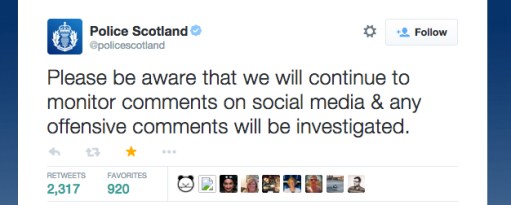
Imagine the kind of dystopian police state you would have to inhabit for it to be normal for the authorities to routinely warn citizens to be careful about what they think or say, on pain of criminal prosecution and potential incarceration.

Well, you don’t have to imagine, because Police Scotland and the Greater Glasgow Police are busy constructing their own tribute to North Korea right here in the UK.

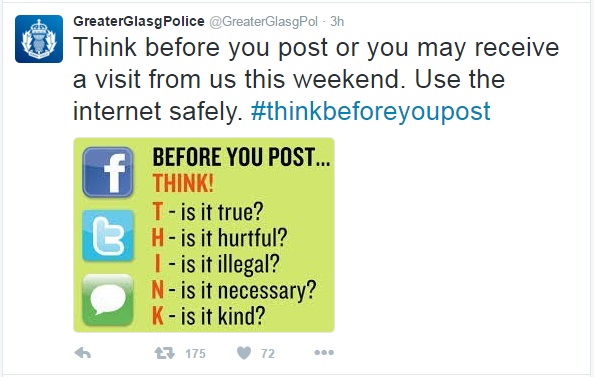
The tweet shown above was posted on twitter by the Greater Glasgow Police – unironically – this afternoon, along with the menacing hashtag #thinkbeforeyoupost.

Apparently before offering up our thoughts to the internet, whether they be on politics, cooking or sport, we are to ask ourselves whether what we are posting is True, Hurtful, Illegal, Necessary or Kind. The clear implication is that if our speech fails the THINK test, some snarling Scottish police officer will turn up on our doorstep to drag us away, much as the London Metropolitan Police did with Matthew Doyle last weekend.

This is something of a scope increase for the police, to put it mildly. Where once they largely confined themselves to preventing and solving crime, apparently having since eliminated all actual crime in our society (…) and finding themselves at a loose end, they are now eager to swoop in and punish speech which passes Britains’ already draconian hate speech laws but which happens to be arbitrarily perceived by others as hurtful, unnecessary or unkind.

Let’s call a spade a spade: this is tyranny. When an enforcement arm of the state can post jocular messages on social media warning citizens to be on their best, blandest and most inoffensive behaviour on pain of arrest, we do not live in a free society any more. And it is time that more of us acknowledged this, so that we can get on with the task of rolling it back and re-establishing our corroded right to freedom of expression.

Alex Massie thunders:

Whatever next? The monitoring of conversations in public houses? Why not? Twitter and Facebook, after all, are merely digital, virtual, gathering places. As the wags on social media have put it today, Thur’s been a Tweet and Detective Chief Inspector Taggart is on the case.

Beneath the necessary and hopefully hurtful mockery, however, lurks an important point. One that relates to something more than police stupidity and over-reach and instead asks an important question about the value placed on speech in contemporary Britain. The answer to that, as this and a score of other dismal examples demonstrate, cannot cheer any liberal-minded citizen. Such is the temper of the times, however, in which we live. Nothing good will come of any of this but you’d need to be a heroic optimist to think it will get any better any time soon.

What a country; what a time to be alive.

All very good points. If social media is fair game for the thought police, why not the local pub, too? What restraint should there be, besides time and resources, on blanket surveillance of everyone all the time in the pre-emptive battle against speech crime?

When will people finally start waking up to the sheer illiberality and the authoritarian nature of contemporary society?

When will people finally realise that weaponised offence-taking and the Cult of Identity Politics do not create a Utopian paradise of peace and harmony, that in behaving this way we are only driving bad ideas underground to fester and grow while punishing those who dare to think differently?

When will people get that having the state act as an overbearing, always-watching surrogate parent figure, monitoring our behaviour and punishing those who do no more than hurt our feelings, is creating a weak-minded and unresilient population who are unable to handle slights and setbacks without running to an external authority figure for redress?

In a healthy society, the author of that tweet by Greater Glasgow Police would have broken the law by using their position to threaten the right of the people to freedom of expression – a liberty which would be guaranteed in a written constitution enshrining our fundamental rights to life, liberty and the pursuit of happiness.

But we do not live in a healthy society, the police are free to do as they please without censure and there is no written constitution guaranteeing our liberties. Instead, we have a “make it up as you go along” constitution and form of government with a strong tendency to attempt to solve the immediate problem in front of it by taking power away from the people to act in their own interests and vesting those same powers in the state.

We are approaching the point where some kind of rebellion against this censorious, bullying, tyrannical behaviour by the police must be mounted – perhaps some kind of co-ordinated mass action whereby everyone tweets something “offensive”, gets a partner to report them to the police and vice-versa, the idea being to gum up the workings of the police and criminal justice system until the whole rotten edifice collapses in upon itself.

Semi-Partisan Politics is in very rebellious mood right now.


Police Scotland

Agree with this article? Violently disagree? Scroll down to leave a comment.

Follow Semi-Partisan Politics on TwitterFacebook and Medium.

The National Security Implications Of Failing To Support The Steel Industry

Save Our Steel - Tata Steel - National Security

With so many other glaring weaknesses in Britain’s national security infrastructure, does the loss of domestic steel production really matter?

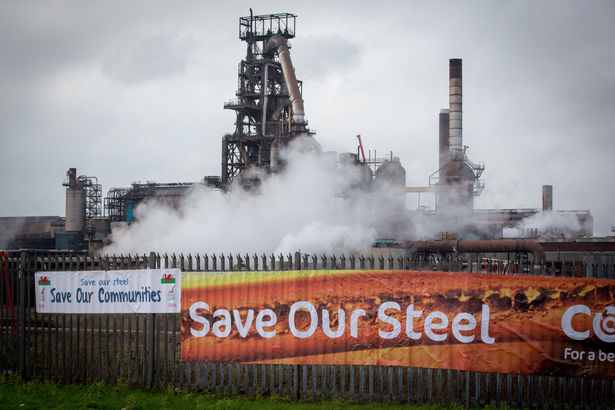
While everybody rends their garments about the threatened closure of Tata plants and other steelworks around the country, many commentators – from both ends of the political spectrum – are touching on the national security implications of failing to support our steel industry.

Arguing in favour of government intervention to support the British steel industry, the Daily Mirror quotes Labour MP Dan Jarvis:

The steel sector crisis rocking Britain could put our national security at risk, a top Labour MP has warned.

In a boost for the Daily Mirror’s Save Our Steel campaign, Dan Jarvis will tell the annual State of the North conference of the dangers of closing major plants.

“It undermines our freedom and our influence if we become overly reliant on other countries for essential resources that we will need in the future,” he will say.

“Deciding whether we preserve some of the best coke ovens and the largest blast furnaces in our country has implications for our national security as well as our future prosperity.”

While from the other side, Allister Heath writes in the Telegraph:

Then there are the strategic and military dimensions. There may one day be another major war, or a large emerging nation could go rogue. But we cannot run Britain on a war footing. The Government should engage in contingency planning: it could stockpile steel, or even set up a couple of mothballed plants. None of this is any justification for nationalising unviable businesses.

But how much of a hammer blow to Britain’s independent warmaking (or defensive) capability would the closure of our remaining steel plants actually be?

The argument in favour of retaining significant steelmaking capacity is that we might need it in case of urgent re-armament or replenishment of lost military hardware. But the lead time for the construction of a Type 45 destroyer is 3 years – compared to one year for the groundbreaking HMS Dreadnought in 1906 and thirteen months for the famous HMS Belfast in 1938. While the aircraft carrier HMS Invincible was built in seven years during the 1970s, HMS Queen Elizabeth – first of the Royal Navy’s two new aircraft carriers – will have been in production and trials for eleven years before finally becoming operationally ready in 2020.

If we found ourselves facing a dire security or military threat requiring additional naval ships, besides directing our ire at David Cameron – who has presided over a shameful degradation of the Royal Navy’s surface fleet – Britain would have little choice but to attempt to buy the requisite ships from a foreign navy (who may or may not be willing to sell to us). The lead time for commissioning a modern advanced warship is now so long that most conflagrations would be over by the time new ships were completed. And all the time they were under construction, the shipyards – and steelworks, and any other supporting industry – building them would be vulnerable to sabotage from within and aerial attack from without.

In other words, the days when we could melt down iron railings and salvage bits of scrap material to aid the war effort or rush produce a battleship in eleven months are over (to the limited extent that they existed at all). In any future major war, Britain will effectively go to war with the hardware it has available at the time, with little prospect of rapid re-armament – which is why we should all be concerned about this supposedly Conservative government’s failure to prioritise defence spending.

And it’s not just steel. Britain has almost no domestic supply of the rare earth minerals which are needed to manufacture the computer components which go into everything from vehicles, weapons and medical equipment. Sure, the government could keep stockpiles – though our government is too woefully inept to do so. But where does it end? When so many goods are the product of a disaggregated global supply chain, what do you insist is produced locally?

These are not easy questions to answer. But in answering them, policymakers have an obligation to delve deeper than the very two-dimensional “steelwork closures will mean that Britain is no longer a military power” level of debate we are getting so far. And they have an obligation – not that they are likely to fulfil it – to be honest with the public about the trade-offs which guide such decisions.

As it happens, this blog would like to see more critical national security infrastructure brought back under British control – energy independence for a start, and a strengthened military with a Royal Navy befitting a powerful island trading nation. But so far, I have yet to be convinced by anyone that the loss of domestic steel production weakens us as a country any more than the many other inevitable global interdependencies which undergird our ability to make war – never mind the Conservative government’s reckless vandalism of the armed forces, which was utterly avoidable.

And so I put this out there to those with strong opinions backed up by detailed knowledge: from a national security standpoint, with so many other glaring (and often recently self-inflicted) weaknesses in our national security infrastructure, does the potential loss of our remaining domestic steel production capacity really matter?


Postscript:

This is not to say there should not be some type of government intervention to delay the steelworks closures or mitigate their effects. Surely one of the lessons learned from Thatcherism is that no matter how essential industrial and economic realignment may be for long-term success, simply expecting people (particularly a coddled British population used to being helped by the government) to brush themselves off and start lucrative new careers after being made redundant is callous and wildly overoptimistic. The word “Tory” is still utterly toxic in some communities, over thirty years later, and we must avoid making it even worse.

People have no right to demand that the state (i.e. their taxpaying neighbours) permanently subsidise the loss-making industry which gives them employment, but we should provide those affected with transitional support through re-training and educational grants to equip workers with more lucrative skills. Failing to do so, either out of bumbling incompetence (David Cameron and Sajid Javid) or rigid ideology will only create more negative consequences of social deprivation and regional dereliction, which is morally wrong as well as more expensive in the long term.

This piece in Conservative Home explains the consequences of failing to provide such transitional support, and the advantages of doing so.


Tata Steel

Agree with this article? Violently disagree? Scroll down to leave a comment.

Follow Semi-Partisan Politics on TwitterFacebook and Medium.

This Reckless Talk Of Brexit Is Making Whiny Young People Anxious

Team of creative people taking a break and using computer.

Staying in the EU and surrendering our democracy is a small price to pay to keep self-entitled millennials happy, because nothing is more important than generation Me Me Me

We of the millennial generation are fast acquiring a reputation as lazy, self-entitled whiners, endlessly complaining about how hard we have it – as though we are the first generation in history to come of age during economically uncertain times.

One might have thought that living in an age when each of us has a mini computer in our pocket which can tap the accumulated knowledge of the entire world – and when we don’t have to worry about, say, dying from tuberculosis – might make us momentarily grateful. But of course we are not, and now apparently the latest “injustice” being inflicted on the millennial generation – my generation – is the terrifying idea that Britain might vote to leave the European Union and seek to govern ourselves as an independent democracy once again.

Channelling this fear, Abi Wilkinson has written a nauseating piece in the Telegraph, explaining why the existential question of Brexit and Britain’s place in the world should be based entirely on the selfish desires and career insecurity of our generation.

Her piece – hilariously titled “Stubborn old people who want to leave the EU are condemning the rest to a lifetime of uncertainty” – is so patronisingly, finger-waggingly sanctimonious (and so readily swallows every talking point from Britain Stronger in Europe) that it makes anyone under the age of 35 seem completely insufferable, not to mention utterly wrong on the fundamentals.

Wilkinson opens:

When you consider that the risks of leaving the EU fall disproportionately on young people, it’s unsurprising that 18-29s are the group least likely to support the move. Almost three quarters of us say we’ll vote to remain, compared with just 37 per cent of over 60s. For many under-30s, worrying about employment has been a defining feature of our adult lives. Having come of age at the height of the financial crisis I know I’m certainly not keen to endure another similar economic downturn.

Of course becoming an adult and entering the workforce during a major recession is tough. Back in 2008 I had friends at Bear Stearns and Lehman Brothers who came home from work one day with all of their possessions in a cardboard box, and I narrowly escaped a redundancy round at my own company. Nobody wants economic uncertainty if it can be avoided, but at what point do infringements on democracy and the fundamental right to self-determination outweigh the hope of greater short term stability?

Wilkinson sees no such tradeoff at all – she is ready to jettison democracy at the first sign of trouble, throwing away our freedom even if it buys a measly 0.1% additional GDP growth. But the truth is that Brexit is possible while keeping disruption to a minimum by exiting to EFTA and EEA membership (the “soft landing” approach which would almost certainly be adopted by civil servants even if it is currently being furiously ignored by the mainstream Leave campaigns).

Abi Wilkinson might have known that there exists a comprehensive plan to achieve Brexit, extricating us from political union while minimising economic and other disruption. But like too many others of my generation, Wilkinson can’t be bothered to do her research, and so instead she swallows and regurgitates propaganda from the Remain campaign.

A man walks past various currency signs outside a brokerage in Tokyo

Wilkinson continues:

Already, young people are particularly likely to be in low-paid, precarious employment. Many are stuck working jobs well below their qualification level and struggle to secure the full-time hours they need to pay their rent and basic living costs. For anyone in this situation, the TUC’s warning that workers’ rights enshrined in EU law could come under attack following a Brexit vote is another serious worry.

At this point, Wilkinson’s politics become clear. She is one of those cookie-cutter lefties who love the European Union because they believe it acts as a social democratic bulwark against the Evil Tory policies which would otherwise ravage the nation. Or to put it another way, Abi Wilkinson doesn’t give a damn about the right of the British people to vote for the policies that they want for themselves. The population is too conservative for Wilkinson’s taste, and so we must have values and policies imposed upon us which we are not currently enlightened enough to vote for ourselves.

Abi Wilkinson is a great champion of democracy, you see.

But now it starts getting really offensive:

Less negatively, many people in their teens and 20s also appreciate the broader benefits of belonging to the European community. We’re more likely to travel abroad to work or study. Many of us have friends who were born in other countries so we’re less inclined to be wary of other cultures. We’re also much more likely to date someone who was born outside the UK.

In contrast, supporters of Brexit often seem to be motivated by a fear of the unknown. Older people are more likely to distrust migrants and to feel nostalgic for the comparatively homogenous UK of days gone by. Though there’s a sizeable retiree expat community residing in countries such as as Spain, over 60s are statistically likely to see the free movement of people as a threat rather than an opportunity.

Of course, for those who’ve already exited the labour market – or are planning to retire within the next few years – it’s much easier to focus on your gut instinct. If you’ve not got to worry about your employment prospects, the economic facts of the matter can be treated as a secondary concern. Young people have a reputation for being reckless, but in the EU referendum it’s older folk who will be playing fast and loose with the livelihoods of younger generations.

And continues:

As more countries have joined the EU, migration to the UK has gradually increased.

As a 20-something living in London, this isn’t something that worries me. I’m used to hearing a whole range of different languages and accents as I go about my daily life. It’s a mundane fact that many of my neighbours are relatively recent immigrants, not a cause for concern.

For someone who has lived in the same area for decades, however, I can see that it might be harder to adjust to changes in the local community. Still, it’s worth noting that UK-born people who live in relatively diverse neighbourhoods tend to feel more positively about migrants than those who don’t — suggesting that fear of immigration might be disproportionate to the reality.

Young people, open and tolerant; old people, suspicious and racist. Got it?

Note too how Wilkinson has pivoted, portraying young Remainers as the fearless go-getters off to pursue international careers and date hot Italians, while old people are now “[afraid] of the unknown”. She switches perspectives at several points throughout the piece, as though she cannot make up her mind whether young people are brave pioneers or snivelling victims (probably because it suits her purposes to be both at different times).

But worst of all is the suggestion that older people supporting Brexit are doing so not out of considered deliberation, but through “gut instinct”; that they are somehow not taking this seriously, and playing “fast and loose” with the livelihoods of the young.

Here, Wilkinson is seriously suggesting that the generation who have abandoned watching a nightly news bulletin in favour of Buzzfeed listicles pushed to their smartphone screens are the wise and discerning citizens, while those who actually have living memory of the European Union’s incremental power grabs are the ones making light of a critical geopolitical issue. The sheer gall of it is quite unbelievable.

Read the whole thing, if you can get to the end of Wilkinson’s sanctimonious lecture without wanting to punch your computer screen.
EU Referendum - Brexit - Democracy

The problem with Abi Wilkinson – and too many other members of Generation Me Me Me – is that they believe their right to an easy path through life trumps everyone else’s right to live in a representative democracy. As far as they are concerned, the fact that our own elected Westminster and devolved parliaments are increasingly sidelined by a supranational European entity is just the price we will have to pay for their ongoing contentment, because heaven forfend that the fuzzy career aspirations of some first year Gender Studies student are thwarted by a badly-timed outbreak of democracy.

In other words, too many millennials don’t know how to think or act as engaged citizens. Rather, they are capable only of behaving like selfish consumers, jealously guarding what they see as their special pot of privileges without the slightest care for the wider impact on the customs and institutions which together make up the fabric of our country, and which have often existed for decades or centuries before they were even born.

To this arrogant mindset, the older generations (like those strange grey haired people who gather round the Cenotaph every November wearing their silly medals for doing something or other in the past) don’t have a clue about what is best for Britain.

Apparently the generation which fought and bled and died to secure our freedom – whose contemporary Britain was reduced to rubble and rationing and deprivation in the 1940s when they were in the prime of life – is the selfish one, while their descendants (and I include myself) who sacrificed nothing but have mastered the Art of the Selfie somehow have a lot to teach our elders about responsible citizenship.

I’m sorry, but I’m not buying it, and I will not have it proclaimed in my name. Abi Wilkinson can speak for her very selfish self, but she should not presume to speak for the rest of her generation, or to demean the older generations so haughtily and glibly.

Some of us actually respect our elders. Some of us appreciate that coming of age when the building on the corner was a smoking crater from a German V2 rocket – rather than an artisan coffee shop with free WiFi – might possibly have imparted some wisdom and experience that we have not yet managed to acquire for ourselves.

Some of us weren’t born expecting all of the good things in life to be handed to us on a golden plate, or raised to be so rude that we write articles in the Telegraph essentially declaring “to hell with your democracy, give me a job in Madrid and cheap mobile roaming charges!”

Some of us are not so arrogant to assume that because we are “the future”, we are free to completely reshape society as we please, with no regard for the traditions and proven solutions of the past – you know, things like representative democracy, that old-fashioned concept where you actually get to vote out the people who make the key decisions if you disagree with them (try doing that in Wilkinson’s beloved EU).

Abi Wilkinson’s narcissistic, self-centred embrace of the Remain campaign makes me sick. It represents everything bad about the millennial generation, confirming every worst stereotype and instantly negating all of the better angels of our generation’s nature.

To those older Britons who wore the uniform, who fought for this country, who grew up in real deprivation in the early post-war years, who actually remember a time when Britain was a sovereign democracy and who are rightly incensed at being addressed as though you are stupid and greedy by a vapid, know-nothing millennial: please know that Abi Wilkinson does not speak for us all.


 

Hello I'm A Millennial

European Union - United Kingdom - Britain - Flags

Agree with this article? Violently disagree? Scroll down to leave a comment.

Follow Semi-Partisan Politics on TwitterFacebook and Medium.

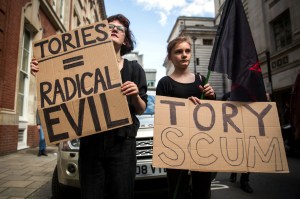
If The Conservative Government Is Truly Evil, Where’s The Left Wing Revolution?

Jeremy Corbyn - Hipster - Middle Class Left Wing

Virtue-signalling, vacuous middle class leftists are all talk and no action

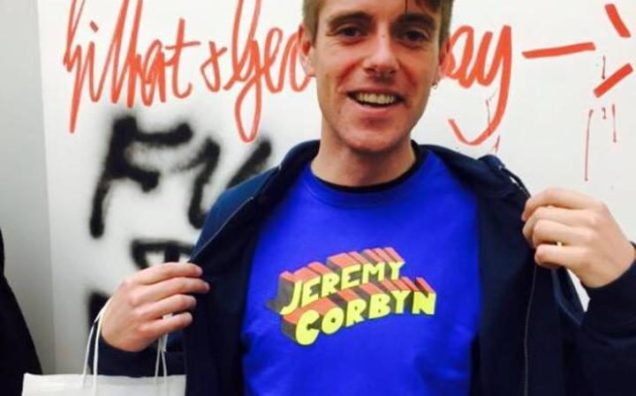
According to many a Corbyn-cheering, well-heeled leftist, modern Britain resembles an unjust, “neoliberal” dystopia in which the Evil Tories and their Evil Banker friends leech off the real producers and heroes in our society (usually people who are net recipients of government spending, curiously recast as the being most virtuous of all).

To this mindset, George Osborne is not simply wrong on the economics, he is engaging in a deliberate war of attrition against the poor, and Iain Duncan Smith’s abortive efforts to reform the welfare state were part of a Nazi-inspired eugenics programme to kill off the sick and disabled.

All of which begs the question – if David Cameron’s centrist, soul-sappingly unimaginative Conservative government really is evil incarnate, why do its many opponents content themselves with mere polite protest and ineffectual rants on social media?

If I believed for a moment that the state was engaged in a deliberate extermination of its weakest and most vulnerable citizens, I hope to think that I would have the moral clarity and fortitude to either take up arms against the government or to work for its downfall using every skill and talent at my disposal. And yet those who actually do believe that the Tories are “evil” can usually be found clad in skinny jeans and non-prescription hipster glasses, waging “resistance” via their (capitalism-produced) smartphones while sipping a hand-crafted flat white.

My Conservatives for Liberty colleague Martin Bailey sums up this moral hypocrisy perfectly in a piece entitled “The impotence of the middle-class Left”.

Bailey writes:

If I thought that the world was controlled by a secret ‘Neo-Liberal’ elite that oversaw government and mass media across the globe, I would do something about it. Take up arms, man a barricade, refuse to comply. If I genuinely believed that democracy was a sham and we were all willing drones to corporate bosses, I wouldn’t stand for it.

So what do they do? They sit in comfort and plenty streaming idle profanities across Twitter and Starbucks. They can’t even find an independent coffee shop in which to plan the revolution. Anonymous abuse of anyone on social media who dares to question their orthodoxy is about as rebellious as a wet fart in an empty train carriage. Che would be turning in his grave.

The EU referendum is a perfect example of stupefying left wing impotence, with thousands of social justice warriors happy to forget the glaring absence of democracy and willing to accept the biggest corporatist cartel in history, all for the fear that someone they know may or may not lose their job. I guess the revolution will have to wait, eh Comrade?

Read the whole piece, it is a highly entertaining takedown of the Left’s hypocrisy and wilful misunderstanding of capitalism.

And to my mind, there are only two explanations for the gulf between the Virtue Signalling Left’s angry talk and their lack of action commensurate with the inhuman Evil Tory threat that they constantly decry.

Option 1 – The left-wing outrage at the present Conservative (often in name only) government is completely fake, in which case the failure of its opponents to take concrete action makes perfect sense – after all, they are only invoking the memory of the Holocaust as a cynical political ploy to demonise their opponents and paint them as heartless and deliberately cruel.

Option 2 – Their outrage is genuine and they honestly believe that conservatives have blood on their hands, but they are also too cowardly to risk their own relatively privileged and comfortable lives by coming to the aid of the supposedly oppressed. In other words, the middle class Left are happy to parade their hatred of the Evil Tory Scum on social media and to friends, but would continue to let society’s most vulnerable people suffer and die before than risking their coveted London homes, worldly possessions and personal liberty by backing up their fighting words with real action.

Manipulative cynics or moral cowards. The only question remaining is which reflects worse on the virtue-signalling middle class Left?


Postscript: I happen to believe that most middle class leftists fall into Option 1. It’s trendy to moan about how beastly the Evil Tories are being, and posting a few IDS-as-Hitler memes on the internet is a good way to quickly signal to other bovine minded people that you are one of the “good guys”.

But that’s not to say that there are not also a number of credulous cowards out there – that is, people who genuinely believe the anti-Tory effluence which pours from their mouths and keyboards, but are too darn selfish to risk anything of theirs by physically attempting to stop the genocide that they believe is underway.


More Left Wing Hate Watch here.


Bankers Toffs And Tory Scum - General Election 2015 - London Protests - Downing Street

Agree with this article? Violently disagree? Scroll down to leave a comment.

Follow Semi-Partisan Politics on TwitterFacebook and Medium.

Tales From The Safe Space, Part 17 – Woman Assaults Student For “Cultural Appropriation”, Claims She Is The Victim

Identity Politics preaches that violence is an acceptable tool of coercion to make other people conform

Watch this video of a woman – believed to be Bonita Tindle, possibly a university employee – accosting a white male student in the corridor of a campus building at San Francisco State University, because she objected to the “cultural appropriation” behind his choice of hairstyle.

The Daily Wire gives context:

In a video published on Monday, a black female said to be a campus employee accosts a white male said to be a student at San Francisco State University out of hostility to the “cultural appropriation” of his dreadlock hairstyle.

“You’re saying I can’t have a hairstyle, because of your culture? Why?” asks the white male, who appears to be wearing a dress.

“Because it’s my culture,” responds the black female.

“Do you know that it was in Egyptian culture? Are you Egyptian? Naw,” replied the male student with animated body language.

Interjecting, a black male observer who appears to be wearing pink leggings asks the white male if he’s Egyptian.

As the white male attempts to leave up a staircase, the black female grabs his left arm sleeve. Giving in to the pull, the white male demands to be left alone as he descends back to the main floor.

Except that this is not the whole story. The white male student does indeed attempt to leave up a staircase, and is repeatedly prevented from doing so by the female. He is clearly, demonstrably trying to leave the scene and is prevented from doing so by the person accosting him.

At one point (20 seconds and 25 seconds in), she actually pushes him back as he attempts to walk up the stairs, prompting the student to say “Yo, girl, stop touching me.” Once he makes it up the stairs, the female has a hold of his sleeve and tries to cajole him back down, saying “come back”.

But then, when he does, she has the temerity to exclaim “you put your hands on me!” as though an unconscionable assault on her own person has taken place. “Do not put your hands on me” she warns, gleefully, as she takes out a notepad, presumably to document her own very biased take on the incident.

Forget the stupidity of taking offence at cultural appropriation in the first place.

Were it not for the fact that the encounter was recorded on video, it is not difficult to imagine the white male student being reported to campus authorities for having “put [his] hands” on his own aggressor, being dragged through a disciplinary process and quite possibly being found guilty at the end of it – especially given how spineless many university administrations have proven to be in the face of student power grabs.

Bonita Tindle - Assault White Student for Cultural Appropriation - Identity Politics

Consider the mindset one must have to accost a perfect stranger, harass them about their personal appearance, push them and actively prevent them from leaving, and then turn around and complain “you put your hands on me!”.

Consider, too, the entitled, mischievous grin of the perpetrator as she harasses the male student, believing that her weaponised Identity Politics-driven actions give her the license to do whatever she pleases, because she is “in the right”. We saw exactly the same look on the face of the young student protester who vandalised a pro-life campaign stand and was then unable to explain her actions to a campus security officer.

There is nothing noble about this person’s attempt to fight “cultural appropriation”. This is the action of someone who has been taught that she can get away with anything if only she only uses a few words from the Identity Politics lexicon as her shield. And if the San Francisco State University administration are even remotely competent, the aggressor will (if she is indeed a university employee) be terminated effective immediately.

But the point is not this one incident, caught on camera. Other, similar incidents like these are happening on college campuses across America with increasing frequency.

The same toxic ideology of Identity Politics has infected our academic institutions in Britain, and we are only lagging a couple of years behind the United States.

Those of us sounding the alarm are not making this stuff up. I follow this issue closely and have Google Alerts set to inform me when new stories break about campus authoritarianism, free speech curtailment and Identity Politics-inspired violence, and there are simply too many for me to cover on this blog. I currently have a backlog of over twenty incidents, each one worthy of comment, most of which will never be written up here for sheer lack of time.

Watch the video. Because this is where worshipping the cult of Identity Politics leads. Remarkably, it does not turn out well-rounded, robust young adults ready to become productive, engaged citizens. On the contrary, our Safe Space and Trigger Warning culture is turning out a generation of snarling, vindictive crybabies, people who are completely incapable of managing interpersonal relationships and interactions without the assistance of the higher authorities to which they constantly turn for help.

And when there is no higher authority to hand, these Identity Politics priests and priestesses are quite happy to lash out physically, assured of the righteousness of their cause.

This is no longer a joke. Bad actions – now including physical assaults – spring from bad ideas. And the cult of Identity Politics is the academic mother lode of bad ideas.


Update: It has been confirmed by San Francisco State University that the aggressor is not directly employed by the institution. The university has opened an investigation.


More outrageous “Tales From the Safe Space” are documented here.


Safe Space Notice - 2

Agree with this article? Violently disagree? Scroll down to leave a comment.

Follow Semi-Partisan Politics on TwitterFacebook and Medium.