Sorry, President-Elect Trump, But You Don’t Get To Choose Britain’s Ambassador To The United States

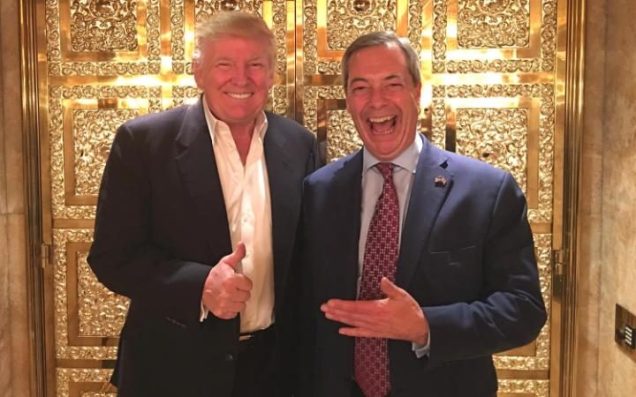
donald-trump-nigel-farage

It was wrong when President Obama sought to interfere in Britain’s EU referendum debate earlier this year, and it is wrong now when President-elect Trump tries to undermine the UK government and install his pal Nigel Farage as a replacement British ambassador

When Barack Obama saw fit to fly to London, stand next to David Cameron at a joint press conference and lecture/threaten the British people that voting to leave the EU would incur not only his personal wrath but also America’s cold shoulder, his behaviour was rightly denounced as an act of arrogant bullying and coercion.

This blog wasted no time in taking President Obama to task for his ignorance and presumption in daring to interfere with our domestic affairs. And UKIP leader and referendum-maker Nigel Farage was also quick to criticise Obama, noting “last time we followed foreign policy advice from a US President was when we went to war in Iraq. We should be wary“, and negatively comparing the American president to Vladimir Putin.

Unfortunately, Nigel Farage does not seem to be consistent when it comes to the principle of staying out of the internal affairs of other countries. Because now his good friend and campaign trail buddy, US president-elect Donald Trump, has made the highly irregular move of suggesting that Farage should become the UK’s ambassador to the United States – even though we currently have an ambassador in place (albeit not a very good one):

The Guardian reports:

The US president-elect, Donald Trump, has suggested that the Ukip leader, Nigel Farage, should be the UK’s ambassador to the US.

“Many people would like to see [@Nigel_Farage] represent Great Britain as their Ambassador to the United States,” Trump tweeted on Monday evening. “He would do a great job!”

In a brief call with BBC Breakfast, Farage said he had been awake since 2am UK time when the tweet was first posted.

The Ukip leader said he was flattered by the tweet, calling it “a bolt from the blue” and said he did not see himself as a typical diplomatic figure “but this is not the normal course of events”.

But a Downing Street spokesman said: “There is no vacancy. We already have an excellent ambassador to the US.”

Now Donald Trump is known to tweet strange and provocative things as and when they drift into his head, but the probability of him having penned this particular tweet without having first at least run it past Nigel Farage (and more likely Trump was acting on a specific request as a favour to Farage) is close to zero. So there goes Farage’s principled opposition to meddling in the affairs of a sovereign nation – he likely encouraged the president-elect of the United States to do what he criticised Barack Obama for back in April.

The Telegraph’s Michael Deacon also spots the hypocrisy:

When Barack Obama said he hoped Britain would stay in the EU, Nigel Farage was appalled. An American president, he said, had no right to meddle in British affairs. Britain was quite capable of making her own decisions, thank you very much. The president, in short, should “butt out”.

Today, however, Mr Farage appears rather more relaxed about political interference from across the pond. When Donald Trump told Britain she should make the on-off Ukip leader her ambassador to the US – even though she already has one – Mr Farage was not appalled. He did not say Mr Trump had “behaved disgracefully”, he did not order him to “butt out”, he did not remind him that the British don’t take kindly to being told “what we should do” by foreign powers.

On the contrary, he welcomed Mr Trump’s intervention. “I would do anything,” he said nobly, “to help our national interest.”

Taking back control from Brussels. And then handing it to Washington.

This episode also shows seriously bad judgement on the part of Donald Trump, though this of course is much less surprising. If offending the UK foreign office by airily suggesting on Twitter that the British ambassador should be replaced is the biggest diplomatic howler committed by the incoming Trump administration then we will be able to count ourselves extraordinarily lucky. Even assuming that Trump assembles a moderately experienced team around him by the end of the transition, the incoming president’s penchant for going off-script and acting unilaterally at 2AM is likely to lead to all manner of gaffes and calamities. But still – offending the government of your closest ally by publicly scorning their present ambassador is arrogant and foolish.

Adam Barnett at Left Foot Forward also has a crack at explaining why Nigel Farage becoming Britain’s ambassador to the United States would be a terrible idea:

Nigel Farage would make a great British ambassador to the US, according to Donald Trump, who will make a terrible President of the United States.

As Downing Street helpfully points out, the position is already filled, though they should have added it’s not Trump’s job to appoint foreign diplomats.

Unfortunately, not one of the reasons that Barnett then goes on to list has anything remotely to do with Nigel Farage’s competence or potential suitability for the role of ambassador. Rather, each is a finger-wagging, morally censorious (and often inaccurate) judgement and demand for Farage’s excommunication from any role in public life, the kind of thoughtless attack sadly now typical fare from the authoritarian, illiberal left.

The Spectator’s James Forsyth does a better job of explaining why Nigel Farage should be nobody’s choice for the role of ambassador, and suggests a better way for the British government to leverage Farage’s close relationship with Trump:

Now, obviously, Farage shouldn’t be the UK’s man in Washington. As Farage has admitted, he’s not a natural diplomat and it is hard to imagine Theresa May trusting him in that role. But it would be foolish of the Foreign Office not to pump Farage for information on Trump and his circle. Whatever information Farage has about who actually has influence with the president-elect would be useful for Britain.

The sensible thing to do would be to have Boris Johnson invite Farage down to Chevening for the weekend and over dinner try and talk out of the Ukip leader everything he knows about Trump world. I suspect that Farage would be both sufficiently flattered by the invitation and keen enough to help, that he would happily reveal all he knows about Trump and the people around him.

This sounds a lot more sensible. Nigel Farage should not become our ambassador, not least because he has no discernable diplomatic skills, nor any specific interest in that role (besides a desire to remain in the limelight and close to power). But the British government would be foolish to squander the relationship he has built with the new president-elect altogether.

After all, who is best placed to nurture that relationship? A bunch of effete, elitist UK civil servants and career diplomats like our current ambassador Sir Kim Darroch, who were all doubtless super-confident “Never Trump” people (as indeed I was) and therefore failed to build any meaningful relationships with the Trump team, or somebody whom the new president considers to be an ideological and perhaps even temperamental soulmate?

In other words, why reinvent the wheel? Why pour time and effort into leveraging a new relationship from scratch when Trump and Farage are clearly already friends and allies? Britain should not waste time emulating this relationship – we should appropriate it and use it for our own ends. Love him or loathe him, Nigel Farage happens to speak Trumpian with a natural accent at a time when we have few other native linguists. That isn’t an advantage you throw away just to express general disapproval of the man.

Now, of course Nigel Frage is a flawed individual – and one can argue about the precise way in which the government puts him to use. Rather than making him ambassador, I would forge a new role, perhaps investigating the possibility of formally seconding Farage to the Trump administration as a gesture of trust and goodwill. Not only would this give Britain valuable eyes and ears in Washington DC, it could greatly aid the future negotiation of a future US-UK free trade agreement.

The details can be worked out later, but one thing is crystal clear for now – Donald Trump has no business interfering in the diplomatic staffing decisions of the British government. The ambassadors we send to Washington D.C. should be chosen by the British government alone, not foisted upon us by an inexperienced not-quite-president.

Donald Trump claims to have great affection for Britain, which is good. But he needs to learn that the best way to display that affection is to respect British sovereignty. If the president-elect insists on appointing his kids as White House advisers and can find his way around the federal anti-nepotism rules, that’s one thing. But we can pick our own ambassadors, thank you, Mr. President-elect.
 

pop-art-donald-trump-2

Support Semi-Partisan Politics with a one-time or recurring donation:

Agree with this article? Violently disagree? Scroll down to leave a comment.

Follow Semi-Partisan Politics on TwitterFacebook and Medium.

Oh, So Now You’re A Liberal? Part 2 – Maajid Nawaz Calls Out The Illiberal British Left

maajid-nawaz-lbc-liberalism-left-authoritarianism

Maajid Nawaz warns about the rise of the “Control Left”, an authoritarian tendency which has left liberalism and liberal values far behind

Recently, this blog took to task those on the authoritarian Left who have reacted to Brexit and the election of Donald Trump by falsely draping themselves in the clothes of liberalism and hysterically mourning an idealised liberal past which they did as much as anybody else to knife in the back.

In that piece, I made the point that people who only weeks ago could be found arguing for greater censorship, the expansion of “hate crime” legislation, trigger warnings, safe spaces, higher taxes on alcohol and tobacco, national ID cards, longer pre-trial detention periods and even more intrusive government surveillance have absolutely no business calling themselves “liberal”.

Though the authoritarian Right are by no means innocent in this regard, it must be acknowledged that most of the recent assaults on liberty and liberalism have come from the Left, in America as well as Britain.

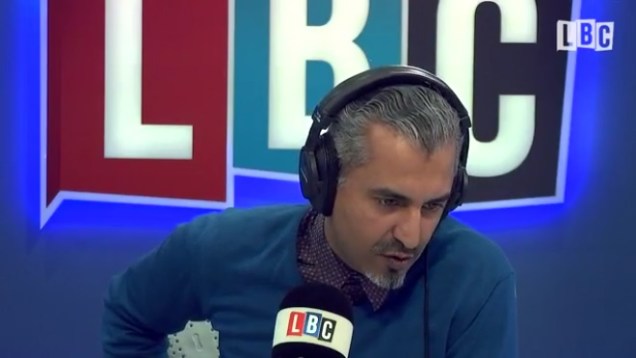
Picking up on this thread, Maajid Nawaz hits the nail on the head on his LBC talk radio show yesterday:

I suspect that the most vocal elements of the Left – and I don’t mean every single person who sympathises with left-wing views, let me make that very clear, I’m talking about the organised left, the most vocal elements of our Left, and the Left in the form of Momentum who have taken over the Labour Party under Jeremy Corbyn – my view is that that Left, today’s Left, today’s active, organised Left is no longer liberal.

What do I mean by that? Well let’s look at a few things that I don’t consider to be liberal. Let’s look at censorship, let’s look at being “post-factual”, let’s look at violence being seen as an option, let’s look at prioritising group identity over individual rights. None of these four traits are liberal.

Censorship is not liberal, so when today’s organised Left begins organising in campuses and across colleges across the nation, across the world, and says things like “you cannot say that here, this is a safe space, we will exclude you from speaking because your views offend us”, when they choose to take offence, when they become more sensitive, and so sensitive in fact that they want to shut debate down simply because they don’t like what somebody is saying, that’s not a liberal approach. A liberal will always prioritise free speech over offence.

What about being post-factual? Well I remember – and I hope many of you remember – at the beginning of this year, the way in which mass sex attacks were reported in the German city of Cologne. And what was known then as the liberal press actively conspired to cover up that news. Facts were known and they were not reported because they didn’t want to be accused of being racist. The German state television station had to come out and openly apologise, days later, when they realised that this story was not one that they could cover up. So being post-factual is also not being liberal.

What about considering violence as an option? When you have the Shadow Chancellor of the UK Labour Party, John McDonnell, being caught on video saying that it’s okay to riot, it’s okay to destroy property and to ruin people’s lives and their private property, that’s not liberal. That may be anarchist, it may be revolutionary hard-left socialist, as John McTernan suggested, but it isn’t liberal.

When people are prioritising group identity over individual rights, saying things like “kill all white men”, saying things like “black people can’t be racist because racism is about power and only white men have power” – Diane Abbott says that. Well I’m sorry Diane Abbott MP, go and walk into any council estate and speak to a white working class lad and try and have a rational, reasonable conversation with that young white working class lad and tell him that he has more power than you, and that’s why you can’t be racist towards him. Complete and utter rubbish. But when group identity is prioritised over individual rights in that way, when leftist activists think it’s okay to say “kill all white men” and that that’s somehow an empowering statement, when they think it’s okay to be racist to all white people as a group, and think somehow that’s what it means to be progressive, erasing the individual, stereotyping entire groups, that is not liberal.

So I have taken the view that this behaviour – censorship on the organised Left, post-factual behaviour, violence being seen as an option and prioritising group identity over individual rights, that isn’t liberal. And like the alt-right has emerged, we’ve now got this new group – it’s called the Control Left. They want to control our lives, control what we think, control how we behave, control how we even feel. And control what we think. That is not liberal. That is the Control Left.

So my message to you, Control Left, is stop telling us you are liberal. My message to the press: stop describing them as the liberal Left, they are no longer liberal. Call them for what they are – Control Left.

A devastating excoriation of the modern Left. And while I’m not sure that Nawaz’s preferred phrase “the Control Left” will catch on, it does describe quite plainly their new strategy of bringing about change not through persuasion but by coercion and force.

Maajid Nawaz has cause to be particularly aware of the new illiberalism gripping the Left, having recently been singled out by the fabled Southern Poverty Law Center in America for supposedly promoting anti-Islamic extremism, a ludicrous accusation given that Nawaz is himself a Muslim. (Nawaz’s real sin was to call for moderate Islam to take more responsibility for its violent, fundamentalist offshoots at a time when much of the Left is furiously pretending that “there is nothing Islamic about ISIS”).

We now need many more people to summon the courage and willingness to tell truth to power exhibited by Maajid Nawaz. It’s all very well having dyed-in-the-wool conservative, libertarian or conservatarian journalists and bloggers such as myself ranting on about the many ways that the modern Left has left liberalism behind. But we can only carry the message so far – since it is we who are most often the targets of this censorship and identity politics, it is too easy for the Control Left to accuse us of acting in our own self-interest rather than the national interest.

Therefore it is vital that more left-wing liberals like Maajid Nawaz stand up and call out these authoritarian tendencies, declaring “not in my name” to the censorship, bullying and control freakery of the modern Left. This is in their interest as much as anyone else’s – with the election of Donald Trump in America, we have seen that peddling a constant diet of authoritarian identity politics eventually provokes a similar identity politics backlash among those groups not marked out for special favour by the Left.

So for the country’s sake as much as their own, those on the Left must learn to renounce authoritarianism and seek to achieve their political agenda through persuasion rather than coercion. To continue on their present course is to plant the seeds of their own destruction, as well as ours.


liberalism

Support Semi-Partisan Politics with a one-time or recurring donation:

Agree with this article? Violently disagree? Scroll down to leave a comment.

Follow Semi-Partisan Politics on TwitterFacebook and Medium.

The Mainstream Media Will Never Rebuild Public Trust So Long As It Covers Immigration With Such Overt Bias

immigration-undocumented-vs-illegal-media-propaganda-journalism

If the mainstream media really wants to rebuild public trust in their own reporting and editorial content, they should halt their their insidious campaigning for open borders and hysterical scaremongering about proper border controls and finally cover the immigration debate with impartiality and objectivity

For those who still do not quite understand why so many people are no longer willing to be spoon-fed “facts” and opinions from the mainstream media and their patrons within the establishment, I can do no better than give you this case study from the Sacramento Bee, and that newspaper’s editorial about president-elect Donald Trump’s likely policies on illegal immigration.

From the Editorial Board’s article:

When President-elect Donald Trump vowed at times during his campaign to expel 11 million undocumented immigrants upon taking office, Americans wondered whether he was just opening a negotiation or seriously telling the foreign-born that they should be very afraid.

The answer appears to be some of both. In his post-election interview with “60 Minutes,” Trump lowered his number, saying his administration would focus, at least initially, on “people that are criminal and have criminal records – gang members, drug dealers, we have a lot of these people, probably 2 million, it could be even 3 million.”

“We are getting them out of the country,” he said, “or we are going to incarcerate.”

No one wants gang members and drug dealers to be out committing crimes, with or without papers. But beyond that, Team Trump has offered little to reassure this nation of immigrants.

My emphasis in bold.

The Sacramento Bee is utterly unable (or more likely unwilling) to distinguish between illegal immigrants – people who either entered the United States without permission or else deliberately overstayed their short term residencies – and “the foreign-born” in general.

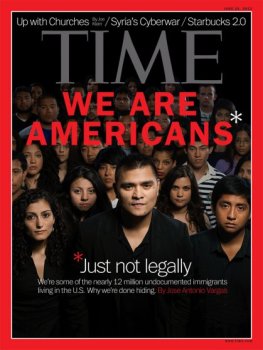
To aid in that deliberate blurring of the boundaries, the word “undocumented” has been brought in to replace “illegal” as an attempt to bridge the gulf between people who join the back of the queue and emigrate to the United States through the lawful channels and those who (for whatever reason) choose to circumvent the process and make a mockery of those laws and the people who follow them.

(Indeed, elsewhere in the media there are people like despicable propagandist Jorge Rivas who ludicrously try to suggest that “undocumented” is somehow the neutral term while the more accurate “illegal” carries negative connotations that we should somehow swat away and ignore in the name of social justice).

But why should the “foreign-born” as a generic group be afraid of Donald Trump, as the Sacramento Bee suggests? Why should somebody who married a US citizen and completed the proper paperwork to become a legal resident or citizen of the United States fear? Why should somebody whose firm transferred them to the United States for a certain period of time, in compliance with the various visa requirements? Why should future US citizens such as myself – married to an American, with the ultimate intention of settling back in the United States – be concerned that Donald Trump intends to thwart our plans?

The answer, of course, is that none of these groups have any reason to fear the presidency of Donald Trump. The only people who may be immediately impacted by the new administration’s immigration policies will be those currently residing in the United States illegally. But the Sacramento Bee – together with nearly all of the mainstream print and television news media – are determined to suggest otherwise, to imply that the Evil Donald Trump intends to purge America of anyone with dark skin or a funny surname.

The media does this first by softening the language to downplay the lawbreaking aspect of the situation, re-branding illegal immigrants as merely “undocumented immigrants” – people who have every right to remain in the United States, but whose passports, visas and other documents proving their eligibility mysteriously disappeared in a puff of smoke, rendering them sadly undocumented. And then they falsely suggest that Donald Trump’s (and much of America’s) concern about illegal immigration is about immigration in general.

Of course, Britain has experienced a very similar phenomenon, most visible during the EU referendum in Britain. Since the previous Labour government’s refusal to adopt transitory controls on immigration (or even consult the people about such a measure) when the A10 Eastern European countries joined the European Union, net migration to the United Kingdom has increased at a rate far above the previous normal baseline, outstripping the growth of housing, the upgrading of infrastructure and (sometimes) the ability of communities to socially assimilate the new arrivals. Meanwhile, the government’s approach to those immigrants from outside the EU was equally “hands-off”, asking little by way of assimilation or community contribution from those who arrived, many of whom set up parallel communities based on ethnicity or religion, openly refusing the give-and-take of the melting pot in favour of a stubborn refusal to participate in the wider society.

But for over a decade, to even question the inherent virtue of fully open borders was denounced by the hysterical Left as being xenophobic at best, and deeply racist and fascistic at worst. Even when articulate explanations were made that the issue is not a hatred of foreigners but rather the absence of democratic consent and the fact that net migration continues to outstrip our present ability to manage without adverse side-effects, still the leftists roared that the people with concerns were racists hiding behind a thin veneer of respectability.

For me, the real low point came when a Sky News presenter interviewing schoolchildren for a feature about the rise of UKIP just prior to the general election, asked a credulous boy what he would think of an MP in Westminster who “says it is a problem” for people to have Polish or Bulgarian friends (neither of UKIP’s two MPs at the time were remotely racist or had ever expressed opposition to friendship between British people and legal immigrants).

Here was a reporter for a national TV news channel so utterly unaware of his own internal biases (I’ll be kind and refrain from accusing him of deliberate malevolence) that he thought nothing of suggesting to an innocent schoolkid (and millions of viewers watching at home) that the one party seriously committed at the time to controlling immigration volumes was racist and against anybody befriending people of other nationalities.

And this remark went completely unnoticed, unpunished by Ofcom (the regulator) because it was so utterly typical of the mainstream media’s approach to immigration.

And that approach can be described as follows: All immigration, legal and illegal, skilled and unskilled, is to be encouraged to the fullest extent possible. There is no moral difference between coming to live in a (Western) country legally and doing so illegally. If anything, illegal immigrants are to be praised and put on a pedestal for their courage in flouting the law. Any attempts to limit immigration volumes in response to popular concerns are inherently racist, and are to be ignored or shouted down as forcefully as possible, while those people daring to express such views should be publicly demonised and accused of harbouring intolerant, xenophobic opinions. Private citizens demanding controls on immigration are racist. Politicians seeking to respond to public concerns about immigration are irresponsible populists seeking to stir dark and malevolent forces of bigotry.

The thing is, eventually people get sick of being told that they are mean or intolerant or racist simply for wanting to see the law properly enforced, or for the integrity of national borders to be defended. And while half the country (Britain or America) seem happy to lap up the Kool-Aid and parrot the establishment talking points that unlimited immigration is a good thing – usually those Americans who only ever see the positive sides of immigration, and whose economic position insulates them from the negative sides – the other half of the country is increasingly unwilling to let itself be cowed into silence by the moralising minority.

Americans are fully aware that they are a “nation of immigrants”, as the Sacramento Bee insufferably sees fit to remind their readers. And none of those first-generation immigrants who respected the law have the slightest thing to worry about. But the mainstream media and other open borders cheerleaders cannot admit this fact, as their only hope of achieving their open borders dream is by mobilising a political movement based on the false idea that all immigrants are under threat. This is nonsense.

Most Americans are probably willing to be reasonable about illegal immigration. They would be receptive to the argument that were they in the position of poor or desperate migrants looking for a better life for their families, they would probably be tempted to flout immigration law too. Many Americans understand that it is neither feasible nor moral to deport up to 11 million people overnight, and that to attempt to do so would be bad for the people involved, bad for an economy which relies on their labour and bad for the federal budget which would have to burden the cost of increased deportations.

In other words, a reasonable compromise around immigration – involving greater border security, the deportation of those illegal immigrants who have committed other crimes while in the United States and a path toward permanent residency (if not full citizenship) for those involved – was within reach. At least prior to the election of Donald Trump.

But no – the media and their establishment backers overreached. They did not want reasonable compromise (not, it should be noted, that the Republicans presented a tremendously friendly face for negotiating such a deal), preferring to shoot for everything they wanted (de facto open borders, legalisation of all those currently illegally living in the United States and less stringent rules for newcomers) by demonising all of those who dared to oppose that agenda.

And even now they can’t stop. Even now their maximalist position on open borders has helped to deliver Donald Trump to the White House, media outlets like the Sacramento Bee are wringing their hands that Trump intends to persecute all immigrants, and suggesting that there is no moral difference between “undocumented immigrants” and those who seek to become new Americans the legal way.

At this point the mainstream media deserve their fate. The fruits of their hysterical demonising of anybody with doubts about uncontrolled immigration are staring back at them in the form of president-elect Donald J Trump, and even now they are unable or unwilling to change the script, or to concede that perhaps not everybody with qualms about immigration harbours a seething hostility to brown people.

The media’s overt, unapologetic bias on the subject of immigration has helped to deliver Brexit to the United Kingdom and President Donald Trump to the United States – both results which they absolutely feared and detested. So given that their current strategy of overt bias is not working, why do they still refuse to compromise and play it straight with the people? Why will they not realise that openly cheering for one side while demonising the other simply doesn’t work in the age of alternative media and the independent blogosphere?

This is going to get worse before it gets better, unless the mainstream media stops mindlessly reciting the propaganda of the open borders zealots and starts reporting on immigration more objectively and less manipulatively. And right now, there is very little chance of such a miracle occurring.


g9510.20_Immigration.cover

Support Semi-Partisan Politics with a one-time or recurring donation:

Agree with this article? Violently disagree? Scroll down to leave a comment.

Follow Semi-Partisan Politics on TwitterFacebook and Medium.

The Myth Of Post-Factual Politics

post-factual-post-truth-democracy

The term “post-truth politics” is starting to become an emotional comfort blanket for those people unwilling to examine the reason for legitimate electoral failure

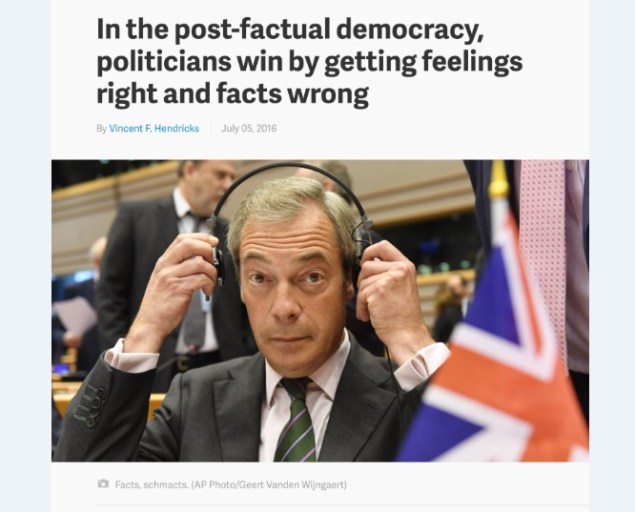
In these interesting times, a lot is being made of the idea that we live in a supposedly “post-truth” or “post-factual” society, where political debates take place and elections are swung not on the basis of evidence and rationality but rather on the basis of bluster and superstition.

Even those of us who supported either Brexit or the election of Donald Trump (this blog was strongly in favour of the former but against the latter) should acknowledge that there is a degree of truth to this criticism of the modern media landscape. As this Buzzfeed article makes clear, when there is a whole industry comprised of people producing inflammatory, fake pro-Trump news articles to earn ad revenue from the clicks of credulous partisans eager to have their existing biases confirmed, something is clearly awry.

But it is also true that dismissing electoral losses as the result of dumb people being duped in a lamentably post-factual world – just as some Trump supporters prepared for defeat by insisting that losing to Hillary Clinton could only be the result of a shadowy conspiracy – is an emotional comfort blanket too easily seized by people who don’t want to do the hard work of understanding why their own ideas were rejected by the public.

I recently attended the debate marking the launch of the 2017 Orwell Prize in London, where the panel – including Polly Toynbee and the excellent Christopher Snowdon – debated the role of the media and of “experts” in the recent EU referendum. Snowdon gives an excellent summary of his own remarks here, and concluded his speech:

Lying may be more morally objectionable, but bullshit is more common and it is just as damaging to public understanding of the world we live in. My argument is not that we are living in a truthful age. On the contrary, there is bullshit everywhere but deliberate political lies make up a very small portion of it – and that portion is not growing.

As long as people have an appetite for having their biases confirmed, newspapers will continue printing bullshit. As long as people think they can get away with it, they’re going to mislead the public. I don’t think we live in the post-truth era because I don’t think there was ever an era of truth. We are still in the pre-truth era and probably always will be.

As the other panellists – Toynbee most forcefully, of course – lamented the way in which the Evil Murdoch Press had supposedly manipulated its uniquely gullible readership with lies and disinformation while Evil politicians like Michael Gove encouraged people to ignore the pro-Remain advice of self-described “experts”, thus causing Brexit, I felt the need to take a stand. So at the appropriate time I seized the microphone and pointed out that wheeling out expert after expert to repeat the establishment line that Brexit would ruin the British economy (as though none of these experts didn’t let their personal biases and preferences colour their opinions) made all other aspects of the decision secondary considerations.

Sky News and the BBC had an endless parade of self-described experts talking about the theoretical economic consequences of Brexit, yet hardly any time was given to experts on governance, democracy, history or constitutional matters. At some point a decision was made that this debate would be All About Economics, and nothing else. One can dispute the dismal predictions of the Remain campaign’s economic “experts” – this blog certainly did – but at least we discussed economics. There was barely a proper discussion about democracy or the constitutional implications of staying or leaving the EU.

This was unfortunately taken by the debate’s moderator to mean that “feelings matter too”, which is not what I was saying at all. My point was that qualitative facts are every bit as important as quantitative ones, and often even more so. I would have expected more sympathy for my viewpoint – among the trendy-lefty, pro-Corbyn crowd at the event were countless people who clearly spend much of their time railing against free markets and capitalism, yet who seem to unquestioningly believe that the slightest potential threat to future GDP growth would make seceding from the European Union in pursuit of democratic renewal a calamitous idea.

When it comes to British membership of the EU, the Remain campaign’s Project Fear spoke only about numbers (and skewed ones at that), with only the occasional bit of fluff about “friendship ‘n cooperation” thrown in as a rhetorical garnish. My point was that in voting for Brexit, it is not that the British people disregarded the numeric facts entirely, but rather that they cared more about other, qualitative facts. Facts to which the Remain campaign never sought to acknowledge, let alone tackle.

The facts vs emotion reduction which met my contribution to the Orwell debate and which now colours nearly all of the media coverage of our supposedly “post-truth society” is therefore a bit too simplistic. There are quantitative facts but there are also qualitative facts – truths which are not based on emotion or hunch or prejudice, but which nonetheless cannot be added up in an Excel spreadsheet, slapped on an infographic and shared on social media.

I voted for Brexit because I believe that the EU actively harms and undermines the democracies of its member states, by deliberate design. I marshalled many facts to back up this position during the campaign – from primary and secondary historical sources, the stated positions of current EU leaders and various other proofs. Just because they are not quantifiable and I could not declare (for example) that leaving the EU will make Britain 11.2% more democratic and give the people 8.4% more control over the decision makers does not make the facts on which I argued my case untrue. And reducing those qualitative facts about democratic control, accountability and the known history and trajectory of the EU as mere “emotion” unfairly diminishes those facts.

When Brexiteers present quotes from EU “founding fathers” speaking of their vision for a federal Europe and tie them to quotes and draft bills from contemporary EU politicians pushing towards the same goals, these are facts. They are not quantifiable, but they are solid facts, much more than mere emotion. And they deserved to be considered and engaged with, yet by and large they were not during the campaign.

Modern politics has become excessively numbers driven. But when the Overton Window is so narrow, the range of policy options so constrained and politics largely reduced to the technocratic management of our public services then that probably becomes inevitable. And we must counter this trend by giving more of a focus to narratives and general principles again. That will lead to greater political engagement.

At present there is far too much self-satisfied criticism of “post-factual politics” in which defeated pro-EU supporters express alarm that people supposedly ignored the only facts available to them and made irrational decisions against their own self interest, and this is not so. There were other, unquantifiable facts which moved people to vote for Brexit. And these pivotal criteria deserve to be acknowledged as legitimate facts, not dismissed as mere emotions.

It is easy and comforting to believe that one’s own side thinks and acts according to reason, logic and evidence while one’s opponents are moved by base emotion, superstition or prejudice. But the divide is very rarely so clear.

And if the “post-truth politics” crowd do not soon realise this and practice some humility, that emotional comfort blanket could all too quickly become a funeral shroud when they next face the electorate.


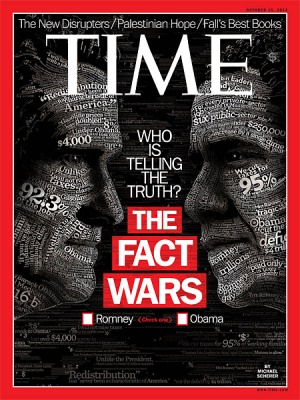
time-magazine-the-fact-wars

Support Semi-Partisan Politics with a one-time or recurring donation:

Agree with this article? Violently disagree? Scroll down to leave a comment.

Follow Semi-Partisan Politics on TwitterFacebook and Medium.

Problematising Boundary Review Is Just A Way Of Entrenching The Labour Party’s Structural Privilege

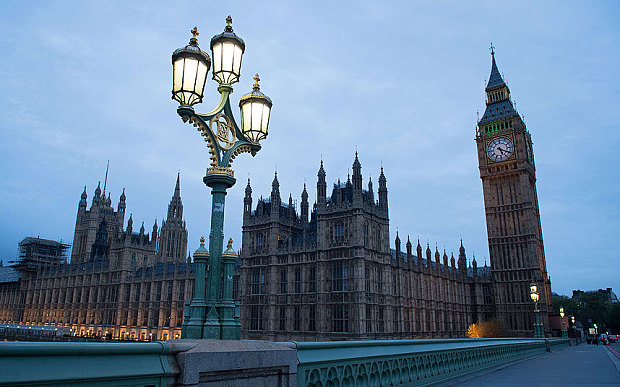
parliament-westminster

There are many obvious reasons for delaying or scrapping the upcoming constituency boundary review changes – but no good ones

See what I did with the headline there? Right-wingers can adopt the wheedling, victimhood-soaked language of the Cult of Social Justice and Identity Politics too, if we think it is going to advance our cause or smite our enemies.

Left Foot Forward editor Niamh Ní Mhaoileoin is in high dudgeon because the coming boundary review and shrinkage of the House of Commons from 650 seats to a slightly more manageable 600 MPs apparently means that too many of those who are left will be on the government payroll.

Ní Mhaoileoin writes:

The government’s plan to cut the size of parliament will increase the proportion of MPs on the government payroll, the Electoral Reform Society (ERS) has flagged.

According to new research, in a 600-seat Commons some 23 per cent of MPs would be on the government payroll, the highest proportion ever. The ERS warns that this could have ‘deeply worrying’ effects on parliamentary scrutiny and is calling for a cap on the number of payroll MPs.

‘This research shows we risk a crisis of scrutiny if the cut in MPs goes ahead without a corresponding cap on the number of payroll MPs,’ ERS chief executive Katie Ghose commented.

Having nearly a quarter of all MPs in the pocket of the PM is not a healthy situation for our democracy.

I think we can all agree that a body tasked with holding the executive to account which itself includes government ministers, parliamentary private secretaries and other hangers-on is always going to struggle to do an effective job – which is why many of us who think and care about constitutional issues all the time (as opposed to only when the system throws up a result we don’t like or disfavours our own preferred party) favour the total separation of the executive and the legislature.

Conservatives and progressives could potentially work together on reducing the size and cost of government while improving oversight by reducing the number of unnecessary junior ministers and official bag carriers, were it not for the leftist desire to have a government minister for everything under the sun, from Culture, Media and Sport to “Children, Young People and Families”. When your political philosophy expects and demands that the state be involved in every aspect of our lives, it inevitably necessitates a large cohort of ministers to do the meddling.

A cap on government payroll MPs would nonetheless be a reasonable (if typically British) compromise, but of course this is not what Ní Mhaoileoin really wants. And what Ní Mhaoileoin really wants is to maintain the current structural privilege currently enjoyed by the Labour Party. As Labour tends to perform best in urban seats, which themselves tend to be smaller and less populated than the suburban and rural constituencies where the Conservatives do well, the net effect for many years has been that it takes far fewer votes to elect a Labour MP than a Conservative MP.

Think of the gross anomaly whereby the SNP won 56 seats in Parliament at the 2015 general election with just 1.5 million votes, while UKIP won just a single seat despite winning 3.9 million votes. In the case of Labour and the Conservatives, the disparity is less pronounced – but it still exists. Boundary reform seeks to equalise constituency sizes, thus addressing the problem (though sadly not helping UKIP, who do not boast the SNP’s narrow geographic concentration of support). And this equalisation will enforce a basic fairness, the value of which makes it worth suffering through any negative side effects, particularly where these can reasonably be mitigated.

The concerns about the upcoming boundary review are well-rehearsed and rapidly becoming tedious. One might take them more seriously if those who raise the concerns showed any interest in solving or overcoming the issues that they raise rather than cynically using them as an excuse to halt something which – despite its inherent merit – is likely to be detrimental to the Labour Party’s electoral fortunes.

In short, this overwrought leftist concern about a toothless Parliament in the pocket of Theresa May is merely an attempt to problematise the issue of boundary reform, throwing a spanner in the works to prevent electoral disadvantage to Labour. Ní Mhaoileoin is doubtless in favour of reducing the size of the Commons as an abstrat theory, and if she were pressed through a hypothetical example would likely object to the current distribution of voters among seats which favours one party over another. But because the currently-favoured party in our system is Labour, and because Labour stands to lose out in relation to the Tories through this particular boundary review, Niamh feels compelled to oppose it.

But how to oppose something that is so self-evidently worthwhile and logical? The only way is to go grasping for every last flaw or possible technical hurdle in the review, inflating them out of all proportion and presenting each one as a show-stopper (or at least as justifiable grounds for interminable delay). As with the British Left’s general approach to Brexit, Ní Mhaoileoin is desperately problematising the boundary review, hoping to scupper it without ever having to reveal her true, grubby, anti-democratic reasons for doing so.

Smart politics? Maybe. The principled, moral, liberal thing to do? Absolutely not. Niamh Ní Mhaoileoin’s position is actually profoundly conservative – and not in a good way.

But apparently any behaviour, no matter how tawdry and self-serving, becomes noble and virtuous when it is performed in the service of the Labour Party.

boundary-commission-for-england

Top Image: Wikimedia Commons

Support Semi-Partisan Politics with a one-time or recurring donation:

Agree with this article? Violently disagree? Scroll down to leave a comment.

Follow Semi-Partisan Politics on TwitterFacebook and Medium.