How To Confront Hatred – Israeli Tourists Show The Way

Bradford Israel Protest George Galloway 2


Two separate acts of protest have today highlighted the best and the worst way to confront hatred and intolerance in British political discourse. Both were inspired by the self-aggrandising, faux-moralising actions of the repulsive MP for Bradford West, George Galloway. But with their witty response, a brave group of Israeli tourists put the British public’s own reaction to shame.

The Respect MP added to his notoriety on Saturday last week by declaring the city he represents to be an “Israel-free zone” in response to the current conflict in Gaza, reflecting his extreme anti-Israel views.

Here are the highlights from Galloway’s hate-filled remarks:


Building up to his climax of his speech, Galloway states:

“We have declared Bradford an Israel-free zone. We don’t want any Israeli goods. We don’t want any Israeli services. We don’t want any Israeli academics coming to the university or college. We don’t even want any Israeli tourists to come to Bradford even if any of them had thought of doing so. We reject this illegal, barbarous, savage state that calls itself Israel. And you have to do the same.”

As is now sadly typical in modern Britain, rather than simply deploring Galloway’s intemperate and rabid words, the police have become involved. The Huffington Post noted shortly after the event that the Yorkshire Police are investigating the MP’s remarks in case there has been a violation of the myriad intrusive rules and regulations that now stifle free speech within the UK.

These same draconian laws have seen the police knocking on the doors of private citizens – everyone from students to activists to business owners – because certain people have chosen to take offence at their words, so it is unsurprising that the odious George Galloway should receive similar treatment given his notoriety and the widespread publicity given to his latest anti-Israel diatribe.

But rather than letting the heavy-handed machinery of the British state police the public discourse on its own, some members of the public felt the need to proactively beg for the government’s active intercession in the matter. A petition uploaded to change.org by Robert Pegg from Manchester, signed by 7741 individuals at the time of this publication, petitions the government to prosecute George Galloway for his remarks under the 1998 Crime and Disorder Act.

From the text of the petition:

We, the undersigned, submit that these comments step way beyond the boundaries of free expression and legitimate debate and their only purpose was to cause harassment, alarm or distress to a specific group of people.

We further submit that this offence is a racially aggravated one.

Under S.28.1(a) of the Crime and Disorder Act 1998 a crime is racially aggravated if: “At the time of committing the offence, or immediately before or after doing so, the offender demonstrates towards the victim of the offence hostility based on the victims membership (or presumed membership) of a racial or religious group or; (b) the offence is motivated (wholly or partly) by hostility towards members of a racial or religious group based on their membership of that group.”

We would further submit that under S.28.4 a ‘racial group’ means a group of persons defined by reference to race, colour, nationality (including citizenship) or ethnic or national origins.

We further submit that the facts consitute [sic] a prima facie case against Mr Galloway and at this stage there is sufficient evidence to charge him and put him before the courts.

While George Galloway may have fallen foul of the letter of the law, rather than signing petitions, British citizens from across the political spectrum should be united together in urging a repeal of laws that criminalise speech which might potentially cause “alarm or distress” to bystanders, and thus limit our free speech to the narrow window of tolerance of our most thin-skinned compatriots.

Even when we find ourselves united in condemnation of the free speech in question (as all right-minded people should be on hearing Galloway’s remarks), we should defend Galloway’s right to speak his mind, secure in the knowledge that his bigotry and hateful agenda will incriminate him in the public eye far more effectively than any punitive sanction handed down by the courts.

By contrast to this embracing of the nanny state, it took a group of individuals from outside the UK – Israeli citizens, no less – to show the angry petition-signers a better way to respond to George Galloway’s unique brand of hatred.

The Huffington Post reports on the praiseworthy actions of a group of Israeli tourists who stepped up to Galloway’s challenge, defying the Bradford MP by visiting the city as tourists. The tourism protest was organised by Shneur Zalman Odze, a dual-Israeli citizen and former UKIP candidate, though the remainder of the group were Israeli nationals.

Odze, the organiser, perfectly sums up the reasons why his is a better form of protest than running to the police and asking them to lock up your political foes:

Odze told HuffPost that he had a warm reception from many people, even pro-Palestinians. “Actually that was more touching than people who came up to use who were obviously pro-Israel. People came over and said that, they disagree with me on Gaza, they hate the photos coming out of the war, but they didn’t think Israelis should be banned from Bradford, that they were ashamed of what he had said.

“I was surprised how many had actually heard of his speech and knew what he said and were embarrassed. I don’t think he has as much supports as he thinks. Later in the day, some pro-Palestinian demonstrators came from another demo happening at the same time. We spoke about the conflict, and even though one side is never going to convince the other, it was a respectful discussion and we shared our biscuits.”

Perhaps it was Odze’s libertarian UKIP roots that led him to seek to confront Galloway in a battle of ideas and values rather than seek to silence the Respect MP using the power of the state. Or perhaps it was just a sign of his good humour, and that of the Israeli tourists who made the slightly unusual detour to Bradford on their travels.

But either way, the brave and cheerful stance taken by these young tourists stands in very stark contrast to the angry, snarling victimhood embraced by the likes of George Galloway and (to a much lesser extent) those who want to bring the weight of draconian anti-free speech laws crashing down on his views.

George Galloway was elected to Parliament to represent the constituency of Bradford West in March 2012, with 30% of the vote and a majority of 10,140. The citizens of Bradford already have the unfortunate fact that they sent such a man as Galloway to represent them in Westminster on their collective conscience. But they also have the power to see sense and remove this bitter, divisive little person from office when they return to the polling stations in 2015.

Galloway’s latest remarks, calling for collective punishment of Israelis based on the actions of their government, form just part of a litany of reasons why he deserves to lose re-election. But it is there, through the democratic process, that the terrorism’s premier apologist in Parliament should face judgement.

Not in the courts, not in a Yorkshire police station, and certainly not via a change.org petition.


Photograph: From the Twitter account of @ShneurOdzeUKIP – “@georgegalloway in Bradford today with my Israeli friends, we got a tremendous reception – how’s your ban going?”

 

The Underwhelming Return Of Boris Johnson

Boris Johnson Parliament 2015 General Election 3


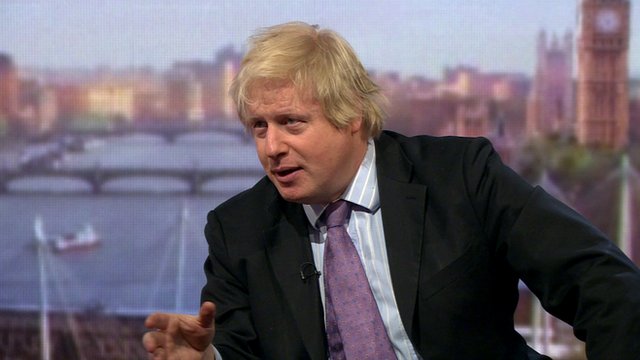
Who cares that Boris Johnson, the current Mayor of London, has finally admitted the blazingly obvious and declared his intention to stand for Parliament in the 2015 general election?

Almost everyone in the commentariat class seems to care, and to have a strong opinion about what is perhaps the most unsurprising revelation in British politics. But precisely why the rest of us should care about this revelation is not so self-evident. There’s obviously something in it for Boris Johnson: the opportunity to compete for the Conservative Party leadership in the event of a 2015 general election or 2017 EU referendum defeat. But what does a potential future Boris Johnson premiership offer the country that merits such a fevered round of speculation and media coverage?

Read any of the articles breathlessly speculating about David Cameron’s annoyance at being outmanoeuvred by Boris whilst on holiday, where the Mayor of London will make his stand as he searches for a constituency, or the pieces imagining the circumstances in which Boris might beat George Osborne and Theresa May to the leadership in the event of Cameron’s early demise, and you will learn everything you possibly need to know about The Decision. Everything, that is, except for why a Boris Johnson administration would be interesting, or different, or especially harmful or beneficial to Britain. But you can’t entirely blame the press corps for the oversight – if they are unable to answer these questions it is because the great man himself is just as uncertain of the answer, and has taken every opportunity to avoid revealing his vision.

Those people hailing Boris Johnson’s announcement should explain to the rest of us exactly what it is about their man that makes it worth getting excited about. Is it his bold, original policies on this or that? Because precious little has been written about the stark policy differences that distinguish the London mayor from the likes of David Cameron or George Osborne. Is it his approach to the electorate and politics in general? Because the Boris trademark down-to-earth, sometimes frank demeanour is nothing that UKIP’s Nigel Farage does not already offer. Or is it because of his years of executive experience managing the capital city of the world? Because the competencies needed to be a competent mayoral figurehead are not necessarily the same skills of tenacity, diplomacy and coalition-building needed to succeed as prime minister.

In one of the few tangible political divides where Boris Johnson has forcibly expressed an opinion, he has been wrong, and unabashedly part of the problem rather than the solution. At a time when airport capacity in southeast England is under pressure and London’s competitiveness impacted, the British government has done what it does best – handwringing, buck-passing and stalling for time with lengthy enquiries – and London’s mayor has campaigned against the obvious solution of expanding Heathrow airport in favour of a hare-brained scheme to close the UK’s largest airport and replace it with an entirely new facility in the Thames estuary. This blog has repeatedly explained the foolishness behind the mayor’s alternative vision.

Boris Johnson is also on manoeuvres to distinguish himself from Conservative Party orthodoxy on the thorny subject of Britain’s EU membership, but even here his newfound embrace of euroscepticism is riddled with disclaimers and lacks sincerity. It is particularly telling that when polled, over half of UKIP voters said that if Boris Johnson were to stand for the Conservatives on their local constituency, it would make no difference to their voting intentions. While eurosceptics and believers in nation state democracy should be pleased when any prominent Conservative politician commits to campaigning for a British EU secession in the event that renegotiations fail, in Johnson’s case it does not automatically make up for his previous equivocation and instinctive desire for Britain to remain inside the European Union.

In David Cameron and his coalition government, Britain already has a thoroughly conservative-lite leader, happy to talk the talk about fiscal responsibility and small government while carelessly treading the same uncompetitive, centrist and statist path as his predecessors. If the British electorate is to be asked to vote Conservative again, do they not deserve an upgrade from the Tories’ 2010 offering? Differences of image and style aside, it is very difficult to discern how Boris Johnson represents anything new, let alone an improvement on David Cameron.

And in a surprise twist, one of the few senior politicians (aside from Boris Johnson’s direct competitors for the Tory leadership) to see through the bumbling, affable persona is the usually hapless deputy prime minister, Nick Clegg:

“The thing about Boris Johnson is despite all the clumsiness and bumbliness he’s actually a really, really ambitious politician,” Mr Clegg said.

“He treats his political ambition like he treats his hair. He wants everybody to think he doesn’t really care, but he actually really, really does care.

“His tousled hair, his bumbliness, all that’s great. But behind all of that is someone who is absolutely fixated with his own political ambitions.”

The only thing missing from Nick Clegg’s timely critique is this blog’s concern that there might actually not be anything beneath the populist image and the driving ambition. It would be bitterly ironic if Britain’s next Conservative prime minister turned out to be the polar opposite of his most recent Labour predecessor in every area except for one – that they both shared a burning desire to reach Number 10 Downing Street, but had absolutely no idea what to do with the prize once they had it.

So why should we care that David Cameron’s former classmate has made official his plans to return to Parliament? The onus is still on Boris Johnson to convince us that it matters in the slightest.

1914 – 2014

WW1 centenary London 2014


They shall grow not old, as we that are left grow old:
Age shall not weary them, nor the years condemn.
At the going down of the sun and in the morning,
We will remember them.


Picture: A view from West Hampstead, London. A solitary beam of light (“Spectra”, by Japanese artist Ryoji Ikeda) pierces the London sky as lights are switched off across the nation in remembrance of the outbreak of the First World War on 4th August, 1914.

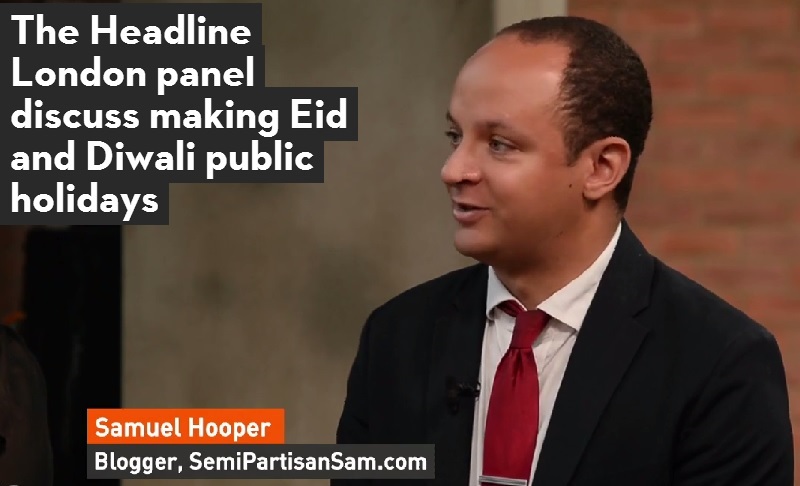
Headline London Debate: Should Britain Make Eid And Diwali Public Holidays?

Samuel Hooper London Live Headline London Eid Diwali Public Holiday 2


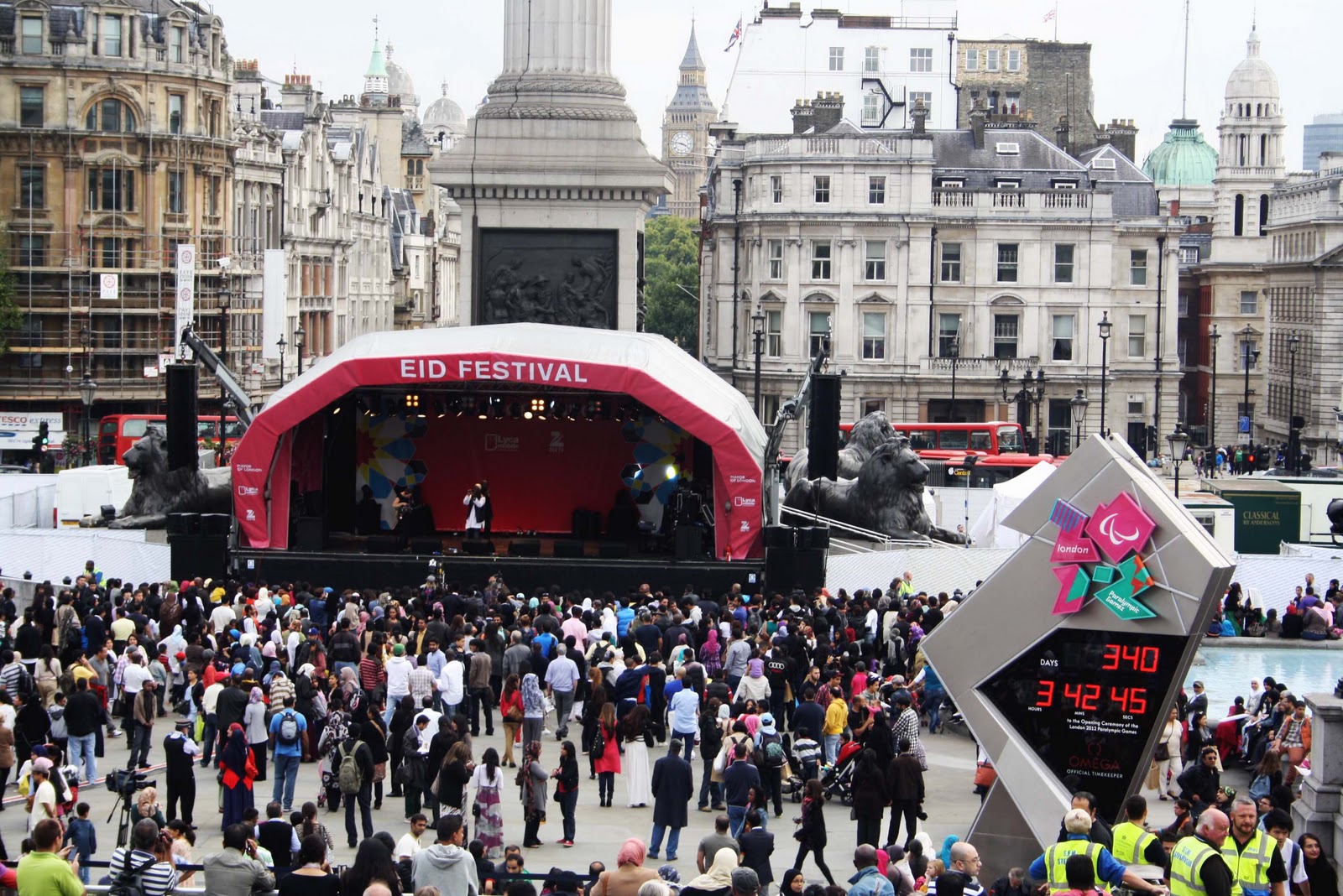
Yesterday, London Live TV’s Headline London lunchtime news programme covered the Eid celebrations taking place in the capital, and asked whether the UK government should make Eid (and the Hindu festival of Diwali) nationwide public holidays.

The idea was first raised in Parliament last week by Conservative MP Bob Blackman, in response to an online petition signed by more than 120,000 people. I vehemently disagreed with the proposal at the time, for the reasons set out here.

Semi-Partisan Sam was pleased to be invited to debate the issue with poet Mohamed “Mo Rhymes” Mohamed and political activist Peymana Assad on the Headline London panel. The debate was courteous and good-natured, which cannot often be said of debates on religion – but I believe my argument, founded on national unity, church/state separation and the rights of the individual won the day.

London Live’s website only shows the first part of the panel discussion, but the full segment is embedded here, via Semi-Partisan Sam’s YouTube channel:

If you enjoyed reading this article, please take a second to LIKE or SHARE it on social media using the buttons below. Help to spread the word and continue the debate.

TV Debate – Making Eid And Diwali British Public Holidays

Eid celebration london


Last week I vociferously disagreed with Bob Blackman MP’s efforts in Parliament to make the religious observance days of Eid and Diwali public holidays throughout the whole of Britain.

This was in no way out of animosity to Britain’s Muslim or Hindu communities; Semi-Partisan Sam acknowledges and appreciates the good that all of Britain’s religions and denominations (as well of people of no faith) contribute to the rich tapestry of our country.

But carving out a new exception, or concession, to minority religions in Britain would be a backward step just as small signs of progress are being made in rolling back the pervasive and anachronistic influence of our own established national church.

Furthermore, if we are to add a new public holiday to our calendar, Semi-Partisan Sam strongly believes that it should be one that unites, rather than divides, the whole of our United Kingdom. At a time when Britain is seemingly fracturing into a loose, uncomfortable coalition of competing interest groups and distinct sub-communities, and when many people struggle even to articulate any sense of British values, any new public holiday should celebrate the history and achievements of our entire nation – the one to which we all belong, Christian, Muslim, Hindu or otherwise – rather than flatter or appease any one particular group marked out for sponsorship by the government.

I will be on London Live TV’s Headline London show today, from 1230-1330 UK Time, participating in a panel discussion in which we will debate this topic.

You can watch on Sky 117, Virgin 159 or Freeview 8 from 1230 onwards.