Tales From The Safe Space, Part 14 – Too Many New Stories To Track

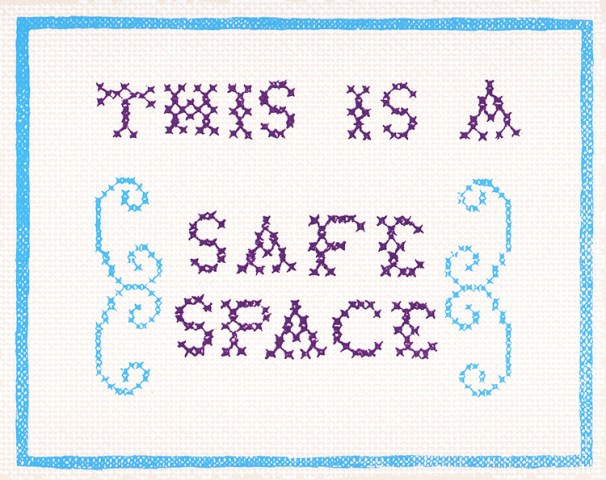
This Is A Safe Space - Embroidery

In which Semi-Partisan Politics admits defeat…

When I began the “Tales From The Safe Space” series, my intention was not for it to dominate the blog to the extent which it has done over the past couple of weeks. But I have continued to write the stories up, because each case covered here has exposed or highlighted a different side of the Identity Politics issue, and I think there has been something unique to say about them all.

That being said, there are other pressing things happening in the world. In Britain specifically, the coming EU referendum (and the upcoming launch of the Leave Alliance) is deserving of more coverage, as is George Osborne’s imminent Budget, which looks set to provide more fodder for our “What Conservative Government?” series.

Therefore, future “Tales From The Safe Space” may come in the form of occasional digests and summaries of stories from around Britain and America – since new campus controversies seem to be occurring faster than I can cover them individually on this site as a one-man operation.

So, without further ado:

A pro-life bus advertisement in Ottawa was reported to “trigger” several activists who objected to its message:


Activists at universities in southern California and Arizona are demanding that campus authorities ban U.S. Customs and Border Protection officials from recruiting on campus, on the inevitable grounds that it makes students who are in America illegally feel unsafe:

Protesters at several campuses in Southern California and Arizona have demanded administrators cut all ties with the federal agency, and some have protested agents’ presence on campus. Students say border protection representatives make students – especially students in the country illegally – feel unsafe.

At UC Santa Barbara in late January, a parade of students boisterously demonstrated against border patrol recruiters at a campus job fair, loudly chanting “f*ck your borders, f*ck your walls.” One organizer told The College Fix agents’ attendance was “triggering” for undocumented students, adding “there is no space on this campus for an organization that continues to threaten the safety of students.”

Last fall, after UC Irvine students circulated a petition that called on administrators to remove a U.S. Customs and Border Protection booth from the school’s fall career fair – saying officers’ presence would make the campus unsafe for students in the country illegally – the agency backed out of the event.

A student committee at Pembroke College, University of Cambridge abruptly changed the theme of a party which was to be based on Jules Verne’s novel “Around the World in 80 Days”, because of fears that student costumes would amount to cultural appropriation:

Cambridge university students have caused an Around the World in 80 Days-themed party to be cancelled because they claimed it could encourage “cultural appropriation”.

Undergraduates complained that the theme could even be seen as racist if revellers dress up in clothes from a different ethnic group.

Students at Pembroke College are now arguing about whether axing the event was restricting their freedom of expression or preventing offence towards ethnic minorities.

And in slightly more hopeful news, Peter Tatchell – recently the victim of a ridiculous attempt at Reverse No-Platforming by a particularly virtue-signalling and fame-hungry NUS activist, covered on this bloghas come out against university authorities who are often just as hostile to free speech as the safe space-dwelling students they serve:

University officials who censor student journalists pose as great a threat to free speech as controversial “safe space” policies, a leading activist has said.

A freedom of expression row has erupted at University College London (UCL) after The Independent revealed that the institution had been accused of threatening and intimidating one of its student reporters.

Rebecca Pinnington, 21, said she was made to feel “intimidated, anxious and scared” after UCL warned she may face disciplinary action – including expulsion – for possessing confidential documents found on a public university server.

The university initially denied that threats had been made, but last night conceded that the letter handed to Ms Pinnington “set out the full range of penalties available in the disciplinary code”.

Generally welcome words, and good to see the veteran activist taking the fight to the campus authoritarianism of university administrations as well as over-sensitive students.

And finally, a very welcome piece in the student newspaper of my own alma mater, Warwick University, pushing back against cultural appropriation hysteria:

Why do we all have to stick to our own cultures and not be allowed to merge? People should be able to wear whatever they want, and to engage with other cultures freely.

Just think what this could mean for the fashion world if culture-fusion clothing became more acceptable. Maybe the diversity would allow men to would have more clothing options too. This year at the Oscars the male actors all showed up wearing practically the same thing! It’s not really their fault; there just aren’t enough clothing options for men. In the future they could come to the Oscars in a sherwani? A Kilt? Or various other traditional clothes that I don’t know the names of because they aren’t mainstream enough.

A lot of fashion trends, are inspired from other cultures. There are some global trends emerging in fashion, for example I noticed that as crop tops and high wasted skirts became popular in the West, simultaneously South Asian designers reignited the lenga trend (which is basically a crop top and a long high wasted skirt).

Good to see some more voices raised against the attempts by censorious student activists to enforce a new kind of cultural apartheid on campus, whereby the enjoyment of one culture’s cuisine, fashion or art outside of its original context is viewed as tantamount to modern day colonialism.

More – inevitably – to follow soon.


Safe Space Notice - 2

Agree with this article? Violently disagree? Scroll down to leave a comment.

Follow Semi-Partisan Politics on TwitterFacebook and Medium.

Hot Women: Wrongfully Appropriate Nerd Culture At Your Own Risk

Olivia Munn - Cliff Bleszinski - Nerd Culture - Geek - Cultural Appropriation - Identity Politics

Identity Politics has created an arsenal of shrill and illiberal weapons which can now be picked up and used by anyone

The latest addition to the list of marginalised and oppressed victim communities: geeks and nerds, who are being made to feel unsafe because hot girls are appropriating their culture by daring to display an interest in comics and video games.

I’m not kidding:

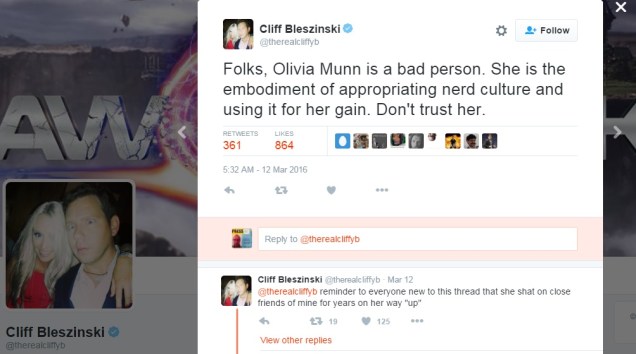
Yesterday, video game designer Cliff Bleszinski (widely known on the internet as “Cliffy B”) tweeted that actress Olivia Munn was “appropriating nerd culture”, taking advantage of it for personal gain.

That appears to have partly stemmed from an earlier interview wherein Munn was quoted as saying she did all of her own stunts for X-Men: Apocalypse – which, unsurprisingly, has the stunt community pretty unhappy, since it’s typically a stuntperson’s responsibility to test out a physical stunt for safety reasons before they’ll even allow the actor to try and take it on. So while Munn may have performed a large number of stunts herself, she didn’t give credit where credit’s due (and that also may have been an unintentional gaffe). But that’s not what the Internet glommed onto.

Barring whatever personal issues or history Bleszinski may have with Munn, the fact remains that the phrase he used is particularly unfortunate. The accusation is insulting to the real and on-going issue of cultural appropriation: instances of celebrities or brands embracing a culture other than their own and profiting from it without understanding it or fighting for the issues faced by said culture.

[..] Ultimately, it just feels like a slap in the face to real cultural appropriation and a mere rehash of the old and tired “fake geek girl” meme. At the very least, it’s someone using their beef with another person to manufacture outrage over a thing that doesn’t actually exist.

Another delightful case of Identity Politics cult members self-cannibalising and turning their fire on their own? Yes – and so soon after I had mentioned that this phenomenon seems to be less common in America than it is in Britain. It certainly looks as though the United States is racing to play catch-up.

https://twitter.com/therealcliffyb/status/708526086137708544

But there is a fair degree of nonsense to unpick on all sides here.

Take the stuntpeople who apparently feel “invalidated” – their professional accomplishments made to vanish in a puff of smoke – because one actress (probably unintentionally) failed to acknowledge their behind-the-scenes contribution sufficiently fulsomely. And people like TheMarySue’s Carly Lane, who then take offence at the original offence takers for daring to be offended by something which is less offensive than something else experienced by other, more righteously offended people.

What we are now witnessing – with people who were thus far completely removed from the Safe Space and Trigger Warning culture on college campuses now walking and talking exactly like today’s illiberal student activists – is akin to the efforts of a younger teenage sibling trying to ape the behaviour of their older siblings already at college by adopting their language and behaviour in an attempt to look “cool” and grown up.

If older brother or sister spends all of their time occupying the dean’s office protesting for the provision of more campus safe spaces for minorities, the younger sibling will often unsurprisingly learn to think that this is how young adults are supposed to behave, and apply the same nomenclature of Identity Politics, victimhood and oppression to their own, more juvenile lives. And this is the result:


Like the Tumblr therians, people who think they are cats and other self-promoting cases of species dysphoria, the idea of nerd culture being unjustly appropriated by outsiders is a natural consequence of what happens when the fussy, victimhood-soaked language of Identity Politics is picked up by ordinary people and used in mundane scenarios to describe everyday life.

The social networks Twitter and Tumblr in particular are awash with outraged ranting and virtue-signalling about the evils of cultural appropriation – only recently, Harry Potter author JK Rowling was hauled over the coals for unintentionally stepping on an Identity Politics landmine – and so it is hardly unsurprising that even people not deeply connected with the movement are adopting the same language and the authoritarian attitudes behind it.

Is the idea that nerd or geek culture can be “appropriated” in a way which is harmful to self-identifying nerds or geeks absurd? Absolutely. But no more so than the idea that a white person practising yoga harms the Indian culture, or that putting an unorthodox ingredient in your breakfast taco causes deep and lasting harm to the people of Mexico.

This is competitive victimhood plain and simple, with Identity Politics cult adherents on both sides of the Atlantic rushing to portray themselves as the most oppressed and “marginalised”, and then furiously denouncing others for supposedly overstating their position in the Hierarchy of Oppression.

The fact that is has now culminated in the spectacle of comic and video game-loving nerds and geeks being outraged that an attractive Hollywood actress has adopted and promotes elements of their lifestyle is only further proof of the ridiculous places you end up when you follow the Identity Politics trail to its logical end.


Safe Space Notice - 2

Agree with this article? Violently disagree? Scroll down to leave a comment.

Follow Semi-Partisan Politics on TwitterFacebook and Medium.

Tales From The Safe Space, Part 12 – Harry Potter Edition

History of Magic in North America - JK Rowling

Is it always wrong to misrepresent other cultures in art, or only when the culture in question is condescendingly considered to be “marginalised” and therefore insufficiently robust to withstand inaccurate portrayal in a book or movie?

The latest public figure to unintentionally step on a hidden Identity Politics landmine and self-detonate in an explosion of outraged Twitter condemnation is none other than Harry Potter creator JK Rowling.

The Guardian picks through the shrapnel for us:

JK Rowling has been accused of appropriating the “living tradition of a marginalised people” by writing about the Navajo legend of the skinwalker in a new story.

The Harry Potter author posted the first part of a four-part series, the History of Magic in North America on her website Pottermore, on Tuesday. Subsequent episodes are being published each day at 2pm until Friday. Tying in to the release in November of the film Fantastic Beasts and Where to Find Them, the short piece of writing deals with the magical New World in the 14th to 17th centuries.

Although the new insights into the universe of Harry Potter were welcomed by many, the author was strongly criticised online by a number of voices from Native American communities, particularly over her writing about skinwalkers, which in Navajo legend are said to be evil witches or wizards who can take on the form of animals.

Needless to say, JK Rowling has been summarily tried on Twitter and found guilty of the high crime of cultural appropriation and misrepresentation for taking Native American legends which were not her own (and God forbid that cultures ever intermix or borrow from one another) and using them for her own grubby commercial purposes. For shame.

And public shaming is exactly what was swiftly visited upon Rowling by the Twitter mob:

But campaigner Dr Adrienne Keene told Rowling on Twitter that “it’s not ‘your’ world. It’s our (real) Native world. And skinwalker stories have context, roots, and reality … You can’t just claim and take a living tradition of a marginalised people. That’s straight up colonialism/appropriation.”

The academic also took issue with Rowling’s use of the phrase “the Native American community”, saying that “one of the largest fights in the world of representations is to recognise Native peoples and communities and cultures are diverse, complex, and vastly different from one another.”

[..] Navajo writer Brian Young wrote on Twitter that he was “broken hearted” about the new piece of writing. “JK Rowling, my beliefs are not fantasy. If ever there was a need for diversity in YA lit it is bullsh!t like this,” said Young. “My ancestors didn’t survive colonisation so you could use our culture as a convenient prop.”

Well, when you put it like that, let’s waste no time No-Platforming JK Rowling, emptying library bookshelves of Harry Potter volumes and throwing them on the fire we have already set ablaze to dispose of our unwanted Cecil Rhodes memorabilia. Because the difference between the sins of these two “colonialists” is only one of severity, not of kind, at least according to the Identity Politics police who act as judge, jury and executioner in these cases.

One such typical virtue-signalling, outraged response to Rowling’s creation comes courtesy of Katherine Trendacosta, writing in Gizmodo:

Rowling reveals a lack of knowledge of American history that makes this an extremely hard read. She also either doesn’t realize the sensitive nature of some areas she’s treading on or does not care.

Who could have predicted that a white lady from the UK would have problems with appropriating Native American culture? Oh, wait, that should have been completely obvious to anyone even thinking of doing what J.K. Rowling did. When you’re combining a history of magic with Native Americans, you’re falling into an already prevalent trope of making them “mystical.” And Rowling not only didn’t avoid that trap, she leaned into it.

[..] Associating Native Americans with “animal and plant magic”—with, it should be noted, no more detail than that—is leaning so hard on a stereotype it’s hard not to find it offensive. It’s also not great that she says that wands originated in Europe, which reads very much as a Europe being the center of innovation and building in the magic world. You know, Native Americans and their “Earth magic” while European wizards were the ones smart enough to make wands.

Rowling may say that great things can be done without a wand, but it doesn’t offset the implications—that Native Americans may have raw power, but it’s refinement that only comes from Europe. Implications that she, with her background, was completely blind to.

You get the idea.

This level of wand-obsession is more commonly associated with the likes of Donald Trump than Social Justice Warriors, but when it comes to the Identity Politics brigade clearly no literary or descriptive detail is too small to be pecked over and analysed to death in the search for smoking-gun evidence of cultural insensitivity.

Note also the constant references to JK Rowling’s ethnic background. It almost seems as though Trendacosta’s anger is not so much that somebody misrepresented Native American culture, but rather that a “white lady” did so. It is almost as though there is some latent anger and rage against whiteness bubbling away under the surface, and that this whole cultural appropriation furore is just a convenient device with which to bash “white privilege”.

And this is the key question (to which we already really know the answer). Is the failure to represent every culture in a painstakingly accurate way always such a terrible crime, or is it only truly offensive when somebody from a majority (i.e. white) culture do it to a supposedly marginalised culture?

I’m British, and constantly see my culture represented less than wholly accurately in all manner of ways, particularly in American movies and television shows. A character might be studying at Oxford University and yet inexplicably live in London (because of course England is just one small, uniform place), or everyone might speak like Hugh Grant in one movie and like a soot-smeared Cockney in another. More galling still, Hollywood seems to go through phases where every villain in every movie has to be a suave, upper-class British guy, speaking in an accent not unlike my own. Sure, it’s irritating, but am I incurring “harm” when this happens?

Or is any harm that I might have suffered because of the misrepresentation of my country and people in the popular culture negated by the fact that as a British citizen, I hail from an Evil Colonial Power, responsible for so much that is terrible in the world? The sun may have set on the British Empire, but has it set on my apparent share of our collective guilt for the actions of kings and queens and statesmen who lived and died centuries before I was born?

The fundamental question is this: are JK Rowling’s critics angry because Navajo culture was misrepresented or because Navajo culture was misrepresented? Was the offence to commit an apparently heinous act of cultural appropriation against Native Americans specifically, or to have misrepresented any culture in the first place?

It hardly needs pointing out that it is the latter. Because the whole Identity Politics culture is based on the neo-colonial and racist assumption that certain cultures are “weaker” than others, and that the people belonging to those cultures are childlike victims with less agency than those from white, Western backgrounds.

Without a steady supply of “victims” to protect – and unwitting “villains” to blunder into their cultural booby traps – Identity Politics practitioners would have nothing to do, and so have no means of asserting their power over our language and discourse (which is the ultimate goal).

Of course, this dogma presupposes that those from minority cultures can actually be physically or mentally harmed by the mere act of having their culture, customs or history either accidentally misunderstood or deliberately misrepresented, even if they are not necessarily aware that it is happening at the time – a hugely condescending attitude to hold toward racial and cultural minorities in the present day.

At every stage it is taken for granted that even today, those from minority cultures totally lack any agency to seize control of the narrative for themselves and disseminate more truthful and accurate perceptions of their culture if they wish to do so – and if how they are perceived by complete strangers really matters that much to them.

And as always, it is the Identity Politics practitioners and those who believe that individuals can be harmed by non-malicious misrepresentations of their culture in the media who display the real contempt for these “marginalised” groups, even though that contempt is dressed up in the language of care and concern.


Safe Space Notice - 2

Agree with this article? Violently disagree? Scroll down to leave a comment.

Follow Semi-Partisan Politics on TwitterFacebook and Medium.

Tales From The Safe Space, Part 11 – From A Dissenter Behind Enemy Lines

Conservatives Libertarians Campus

From deep behind enemy lines…

The following lonely cry for solidarity and advice comes from a British student posting on a libertarian Facebook group, and gives a snapshot of the current climate of hostility facing conservative and libertarian students who refuse to buy in to the Identity Politics orthodoxy reigning on university campuses.

The student asks:

Any libertarians or even Tories here struggle with being shut down at uni? I’ve just handed in the most left wing essay I’ve ever written in order to get a good mark, I lost marks in a presentation for stating that the EU arrest warrant is unjust (because we signed up to it, so it’s voluntary according to the lecturer), a girl was literally shaking with rage when I said I will be voting to leave the EU and she had a lot of back up…but it gets to a point where it’s having a negative effect on my education and not sure how to tackle it. Should I just keep my views to myself and write left wing essays? Advice needed. I am treated like a fascist.

Such students increasingly face genuine hostility when they insist on being true to themselves and refuse to hide or disown their sincerely held political opinions, both from peers and even their own professors.

And particularly where students’ academic results are at stake, this real-world hostility stands in stark contrast to the largely imaginary hostility (microaggressions) dreamed up by the Identity Politics brigade as a pretext for demanding ever more restrictions on liberty, and ever more transfers of power to themselves from fawning, deferential university authorities.


Safe Space Notice - 2

Agree with this article? Violently disagree? Scroll down to leave a comment.

Follow Semi-Partisan Politics on TwitterFacebook and Medium.

At Least Jeremy Clarkson Is Honest About His Euro-Federalist Dreams

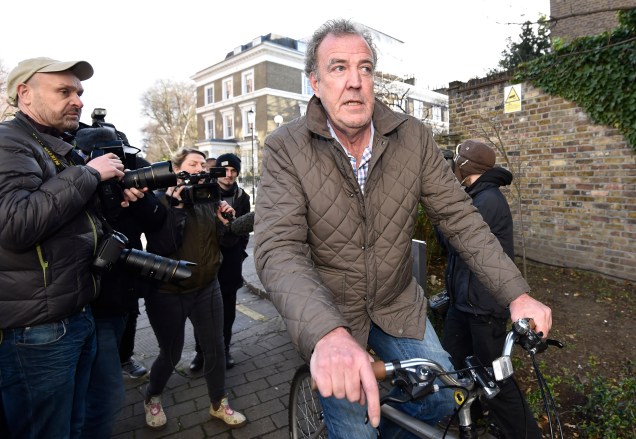
British television presenter Clarkson returns to his home in west London

Unlike most people in the Remain campaign, at least Jeremy Clarkson has the courage and decency to admit that he doesn’t just tolerate the European Union but actually dreams of Britain being part of a federal European country

So that great producer-punching pseudo Man of the People, Jeremy Clarkson, has come out definitively in support of Britain remaining in the European Union – and not just the EU as it is now, but the EU as it yearns to become in the near future, a fully politically integrated federal European state.

No great surprise there – Clarkson has made pro-European rumblings before. But what is surprising (and actually rather impressive) is the full-throated way in which Clarkson embraces his support of the EU.

Unlike nearly every leading politician and personality in the Remain camp, Clarkson does not attempt to flatter us or pretend that he “gets” our concerns about Brussels gradually usurping our democracy. Unlike the deceitful-yet-ingratiating Sajid Javid, Clarkson makes no promises to go back to ranting at Brussels the moment he has helped doom us to continued membership of the EU (though in Clarkson’s case, more ranting is all but guaranteed).

Jeremy Clarkson actually does something which almost nobody in the intellectually squalid, fear-based Remain campaign dares to do – he owns his pro-Europeanism and wears it as a badge of honour, rather than doing what so many Turncoat Tories and others have done, prancing around like the World’s Biggest Eurosceptic before meekly running to David Cameron’s heel and supporting Britain’s continued membership of the EU as soon as the prime minister snapped his fingers.

Clarkson writes in the Sunday Times (+):

I suppose that now is as good a time as any to declare my hand. I’m with the man whose wife we fancy. I’m in.

When Mr Cameron was touring Europe recently, seeking a better deal for Britain by sucking up to the leaders of such places as Romania and Hungary, I watched on YouTube an MEP called Daniel Hannan make an anti-EU speech to a group of, I think, students. It was brilliant. One of the best speeches I’ve ever heard. And, I’ll admit, it made me question my beliefs. But despite his clever, reasoned and passionate plea for us to leave Europe, I’m still in. He talked sense, but a lot of this debate is about how we feel.

In 1973 my parents held a Common Market party. They’d lived through the war, and for them it seemed a good idea to form closer ties with our endlessly troublesome neighbours. For me, however, it was a chance to make flags out of coloured felt and to eat exotic foods such as sausage and pasta. I felt very European that night, and I still do.

Whether I’m sitting in a railway concourse in Brussels or pottering down the canals of southwestern France or hurtling along a motorway in Croatia, I feel way more at home than I do when I’m trying to get something to eat in Dallas or Sacramento. I love Europe, and to me that’s important.

I’m the first to acknowledge that so far the EU hasn’t really worked. We still don’t have standardised electrical sockets, and every member state is still out for itself, not the common good. This is the sort of thing that causes many people to think, “Well, let’s just leave and look after ourselves in future.”

In other words, Jeremy Clarkson is your garden variety Euro-federalist. He looks at the bureaucratic opacity of Brussels, the contempt in which the EU is held by many of its citizens and the fact that cultural and regulatory harmonisation has not been completed to produce a single cultural identity where we all identify as Europeans first and use the same electrical outlets, and concludes that the correct answer is “more Europe”.

Fair play to him. He’s completely wrong, and betrays an almost criminal contempt for the democracy and right to self-determination for which our ancestors fought, bled and died. He is the archetypal person who votes as a consumer – because a harmonised, federal Europe would be better for his wallet and his weekend jaunts to France – rather than as a thinking, engaged citizen. But at least he has the god damn balls to honestly state his position. Hardly anybody in our own elected House of Commons supporting the Remain campaign would dare to do the same.

But then it begins to come off the rails (or the test track). Clarkson continues:

Britain, on its own, has little influence on the world stage. I think we are all agreed on that. But Europe, if it were well run and had cohesive, well thought-out policies, would be a tremendous force for good. I think we are all agreed on that as well. So how do we turn Europe from the shambles it is now into the beacon of civilisation that it could be in the future?

Oh really? We are “all agreed” on that, are we?

Actually, no we are not agreed at all. Our prime minister and foreign secretary may hold our country, its history and present capabilities in astonishingly low esteem, but fortunately the same cannot be said for many of the people. Many of us correctly believe Britain to be one of the few truly indispensable nations on Earth, that our contributions to the arts, sciences, commerce and global security are almost unmatched, and that we could throw our weight around in the world accordingly, if only we cared to stand up for our own national interest once in awhile.

But such views are unheard of outside the Chipping Norton set, the middle class clerisy in general and the fawning circle of friends and admirers surrounding David Cameron (of whom Jeremy Clarkson is one). These people, many of whom came of age at the peak of 1970s declinism and economic doldrums, have at their core a deep pessimism and scepticism about the ability of Britain to survive and prosper as an independent actor on the world stage.

So deeply have they internalised this self-doubt and self-loathing that no matter how much evidence you show them to the contrary – the examples of Australia and New Zealand, say, somehow surviving in the world without being part of an Asia Pacific Union and sharing a common parliament and court – they bat it away without even stopping to think.

Clarkson then sums up:

Right. So let’s switch our attention. Let’s leave the “parish councillors” alone and concentrate our big guns on the real decision makers in Brussels. Let’s have hacks outside their houses all day long, waiting for one of them to do or say something wrong. Let’s make them accountable. Let’s turn them from “faceless bureaucrats” into household names.

That is the biggest problem with the EU right now. Nobody is really concentrating on its leaders. Nobody is saying: “Hang on a minute . . .” And this means they are running amok.

It’s why we need to stay in. So our famously attentive media can try to stop them. To make them pause before they move. To make the Continent work the way the Continent should — as a liberal, kind, balanced fulcrum in a mad world that could soon have Trump on one side and Putin on the other.

And here we have the classic pivot back to “the answer is more Europe!” Rather than looking at public attitudes toward the European Union which range from disengaged indifference to blind, seething rage, Clarkson concludes not that the experiment in political integration by stealth has failed, but rather that we should just come to terms with it and re-order our media and culture around the EU’s artificial construct.

Clarkson is actually saying that if only more journalists doorstopped Jean-Claude Juncker and Martin Schulz every morning with awkward questions about budgets and foreign policy, we would immediately begin to feel more vested in the EU project and finally become enthusiastic Europeans. It’s pure wishful thinking, of course, but then so is everything about the EU, an political organisation build on the the principle of “If you build it, they will come” (they being a European demos willing to be led by Brussels).

But though Clarkson is wrong on nearly every point, cavalier with our democracy to the point that it does not even merit a mention in his article and unabashedly in hoc to the establishment’s ingrained europhilia, still he somehow comes away as the most intellectually honest and respectable of all the high profile Remain supporters.

Unlike an oleaginous Turncoat Tory, Clarkson does not feel the need to butter us up with constant anecdotes about how he hates Brussels just as much as we do, honest. And unlike those bland Remainers on the Labour benches, he does not just mutter inanities about countries “working together”, as though intergovernmental co-operation were not possible without the umbrella of an undemocratic political union.

No, Jeremy Clarkson owns his position, and has the guts to tell us that not only should we learn to love the European Union as it is now, we should actively fight for further political integration:

But, actually, isn’t it better to stay in and try to make the damn thing work properly? To create a United States of Europe that functions as well as the United States of America? With one army and one currency and one unifying set of values?

At last, an honest argument from a Remain supporter – someone who is brave enough to stand up and say “actually, I feel more European than British, I think that the nation state is kind of passé anyway, I’m envious of the size and power of the United States and terrified by the sight of Russia; therefore, we should proceed full speed ahead with the creation of a European country”.

Again: I find Jeremy Clarkson’s argument utterly repellent and contemptuous of our hard-won democracy and liberty. But my God, it’s refreshing to hear from someone from the Remain camp who actually says what they really feel about the European Union.

David Cameron, Philip Hammond, Theresa May and other assorted peddlers of FUD (fear, uncertainty and doubt) – your turn next in the honesty corner.


European Union - United Kingdom - Britain - Flags

Agree with this article? Violently disagree? Scroll down to leave a comment.

Follow Semi-Partisan Politics on TwitterFacebook and Medium.