On Renouncing Bigotry

Some very welcome news today from an organisation called Exodus International, an American-based Christian ministry that has courted much controversy in the past by advocating and practicing gay reparative (or conversion) therapy.

As does Marcus Bachmann

The leader of Exodus International, Alan Chambers, has published a seemingly very sincere and heartfelt apology for the pain and suffering that his organisation caused to those who came to seek “help” for their homosexual orientation:

And then there is the trauma that I have caused. There were several years that I conveniently omitted my ongoing same-sex attractions. I was afraid to share them as readily and easily as I do today. They brought me tremendous shame and I hid them in the hopes they would go away. Looking back, it seems so odd that I thought I could do something to make them stop. Today, however, I accept these feelings as parts of my life that will likely always be there. The days of feeling shame over being human in that way are long over, and I feel free simply accepting myself as my wife and family does. As my friends do. As God does.

Never in a million years would I intentionally hurt another person. Yet, here I sit having hurt so many by failing to acknowledge the pain some affiliated with Exodus International caused, and by failing to share the whole truth about my own story. My good intentions matter very little and fail to diminish the pain and hurt others have experienced on my watch. The good that we have done at Exodus is overshadowed by all of this.

On a very personal note, he continues:

Please know that I am deeply sorry. I am sorry for the pain and hurt many of you have experienced. I am sorry that some of you spent years working through the shame and guilt you felt when your attractions didn’t change. I am sorry we promoted sexual orientation change efforts and reparative theories about sexual orientation that stigmatized parents. I am sorry that there were times I didn’t stand up to people publicly “on my side” who called you names like sodomite—or worse. I am sorry that I, knowing some of you so well, failed to share publicly that the gay and lesbian people I know were every bit as capable of being amazing parents as the straight people that I know. I am sorry that when I celebrated a person coming to Christ and surrendering their sexuality to Him that I callously celebrated the end of relationships that broke your heart. I am sorry that I have communicated that you and your families are less than me and mine.

This is a rare, almost unprecedented volte-face from a Christian organisation that was until recently so stridently anti-gay. As is often the case with those most vociferously outspoken against homosexuality, the leader of the organisation himself admits to having same-sex attractions of his own. We see this time and time again with the many (usually Republican/Conservative Party) politicians who seem to spend every waking moment condemning homosexuality as an abomination, before being caught in a compromising position which rather undermines their legitimacy to talk about the subject.

Andrew Brown, writing in the The Guardian, is impressed with this very public and humble change of heart:

I think this deserves credit as a genuine example of repentance and public admission of shameful behaviour. It is not up to me to forgive him but I find it rather heartening.

The other interesting thing is that he hasn’t actually changed his mind about what the Bible says about gay sex. He still thinks it’s condemned. But he will no longer condemn it himself: “I cannot apologise for my deeply held biblical beliefs about the boundaries I see in scripture surrounding sex, but I will exercise my beliefs with great care and respect for those who do not share them. I cannot apologise for my beliefs about marriage. But I do not have any desire to fight you on your beliefs or the rights that you seek.”

Something like this must be what ought to be meant by the hideous cant phrase about hating the sin, but loving the sinner.

Andrew Sullivan celebrates what he calls an “unconditional surrender in the culture war”:

It’s very rare that one side in a culture war actively renounces its past positions and embraces a new one. That’s particularly true on the Christianist right, where absolutes hold sway, regardless of doubt or charity. So today is a banner day for those of us who have long fought for the equal dignity of homosexuals as children of the same God as heterosexuals, and deserving of no less love and support.

And with regard to the statement itself, he continues:

That’s an enormous statement given the recent past and, to me, a sign of God’s grace. That’s why when I say “unconditional surrender,” I hope Exodus won’t regard that as some kind of victory lap. It isn’t. It just springs from a deep appreciation of their grace-filled decision to re-examine their conduct as Christians and see where the world may have led them astray. Anyone in the public sphere who openly and candidly comes to terms with an error of judgment, and owns it, and even seeks forgiveness for it, is contributing to a more humane, honest conversation and dialogue.

This statement and change of heart from Exodus International is very welcome news indeed. May it spur other people, groups and denominations within the Church to also re-examine their consciences, and seek to welcome and love rather than try to “heal”.

The GOP’s Immigration Reform Game Theory Dilemma

My Nemesis

When I was in primary school, at about the age of eight, we had a class assignment to make our own abacuses out of wood. We lovingly spent ages glueing them together and painting them with bright colours – to this day, I am still quite proud of that piece of craftsmanship.

The next day, we were due to use our homemade abacuses in class as part of the maths lesson, and it was then that I brought disaster upon myself and earned the wrath of my entire class. There was a girl who had been sick at home the previous day when we were engaged in our arts & crafts, and who consequently didn’t have an abacus of her own to use when the time came. Our teacher approached my desk, where I sat with my best friend Scott, and asked us if we could lend one of our abacuses to the girl so that she could participate in the lesson.

Uh-oh. I looked at Scott. He looked at me. I didn’t want to let me new abacus out of my sight – it was brand new and I hadn’t had a chance to use it yet. Scott clearly felt the same way, even though his model was crooked, garishly painted and looked as though someone had taken an axe to it. I broke the silence first: “Scott, do you want to…?” but he countered “Sam, do you want to…?” (originality was never his strong point).

The teacher became impatient and told us to make up our minds who would lend out their abacus, or the lesson would go ahead sans abacuses for everyone in the class. And still we prevaricated. Even though both Scott and I knew that everyone else in the class was getting increasingly pissed off with us, and that we were in grave danger of ruining the fun lesson for everyone, we couldn’t compromise. So the lesson was cancelled, and Scott and I sat alone at lunch that day.

I recall this long-winded story because the Republican Party is currently making the exact same error that I made when I was eight years old and in primary school, with respect to their stance on immigration reform. Only they have infinitely less excuse, because they are not eight years old (perhaps in mental age) and are paid handsome federal salaries to produce legislation to solve problems.

The Huffington Post reports:

Many House Republicans are chilly or openly hostile to the bipartisan bill before the Senate, embraced by President Barack Obama. Even substantial changes to the bill may do little to placate these lawmakers, who demand strict crackdowns on unlawful border crossings and no “amnesty” for people here illegally.

These Republicans don’t deny that weak support from Hispanic voters is hurting GOP presidential nominees. And they concede the problem may worsen if Latinos think Republicans are blocking “immigration reform.”

These House members, however, worry much more about their own constituents’ opposition to the proposed changes. And they fear a challenge in the next Republican primary if they ignore those concerns.

“It’s hard to argue with the polling they’ve been getting from the national level,” said Rep. Kenny Marchant, R-Texas, referring to signs of serious problems for Republican presidential candidates if immigration laws aren’t rewritten. “I just don’t experience it locally.”

Even the house members themselves admit this gap between the interests of the national party and their local districts. The article goes on to explain the reasoning behind House Republicans’ stances in more detail:

House Republicans, however, spend far more time talking and worrying about their own election prospects, not the next presidential nominee’s.

“It’s a classic challenge when the best interests of the party are at odds with the best interests of the majority of the members individually,” said Rep. Tom Cole, R-Okla. He is close to Speaker John Boehner and other Republican leaders who want a major immigration bill to pass.

“What it takes to get a deal with a Democratic Senate and a Democratic president makes it extraordinarily difficult for a lot of (House) members,” Cole said, “because it can cause you a big problem in your primary.”

Ah yes, the much-feared Tea Party challenge from the right. That nagging fear in the back of the minds of all Republican congressmen and women in this age of the Unreasonable GOP. The fear that leads to gems like this:

Rep. Paul Broun, also seeking Georgia’s Senate nomination, said any immigration deal “must make English the official language of the country.” The U.S.-Mexican border, he said, must be secured “totally, whatever it takes. A double fence high enough to make sure it’s secure.”

Some Republicans wince at talk of massive double fences and making English the official language. They say it fuels arguments that the GOP is unwelcoming to all Hispanics, legal or not.

Hispanic voters are not a homogeneous block, and it would be patronising in the extreme to assume (as many do) that Hispanic disenchantment with the GOP is exclusively due to their policy on immigration reform and what to do with illegal immigrants already settled in the country. Hispanics, like every other voter block, have a whole web of different voting priorities. But with language like this from Rep. Paul Broun (incidentally nominated as America’s Craziest Congressman by Bill Maher), it is not hard to understand how the Republicans managed to lose the Hispanic vote 27-71% in 2012.

I generally don’t like to write articles about process, i.e. the mechanics of how a particular bill gets passed, or the ways in which parties and politicians manoeuvre for advantage. That stuff is usually personality-based gossip of secondary importance, and is covered more than enough by the likes of Politico. But in this case, the process is genuinely interesting and has ramifications that go way beyond who wins the news cycle on a given day, and therefore I decided that it is worthy of comment and discussion.

At some point the Republicans are going to have to make a choice. They cannot claim to be a national party with aspirations of winning future presidential elections without addressing the fact that they overwhelmingly lost the Black, Hispanic, Asian and Female vote in 2012. Yes, in the immediate aftermath of Mitt Romney’s implosion there was a little bit of hand-wringing and soul-searching, but we are now very much back to business-as-usual.

Scarcely a week passes without some new Republican (male) politician deciding to hold forth on the topic of rape in front of a live microphone, or accuse American Muslims of being complicit in terrorist attacks when they don’t denounce them as loudly as is apparently required, or talking about the superiority of a “man’s brain” when it comes to analysing the implications of laws such as ObamaCare.

These cheap, nasty little stunts might play very well back home in their heavily gerrymandered conservative districts, but they will be fatal for the Republicans in 2016. But right now, the party that likes to campaign under slogans such as “Country First” is fragmented, self-serving and unable to step back and solve any problem bigger than avoiding a Tea Party primary challenge.

But It Keeps Getting Worse …

Andrew Sullivan correctly calls out prominent Republicans for their failure to heed ANY of the lessons of 2012, as evidenced by their most prominent leaders turning up to address the Christianist Faith & Freedom Coalition conference with typically fiery, apocalyptic rhetoric.

Andrew Sullivan's avatarThe Dish

I keep being told that the Christianist base of the GOP is calming down, they learned their lesson, they’re not that important, etc. Josh Barro said that in a recent Ask Anything. Ross and Reihan are always poo-pooing the notion. So why did everyone who’s anyone in the GOP turn up for Ralph Reed’s religion-fest last weekend? Rubio, Paul, Jeb, Ryan, to name four, along with the usual nutters. Even Rand Paul – the supposed libertarian – said that there was a “war on Christianity” being conducted by “liberal elites at home and across the world.” And Cain and Palin – two essentially ridiculous figures – are still taken seriously. Alleged sexual harasser Cain:

This train is running full speed down the tracks towards socialism and towards communism. Yes, I said it. Before we stop it and reverse it, we got to slow it down. That’s what we do…

View original post 116 more words

The Santorum Threat

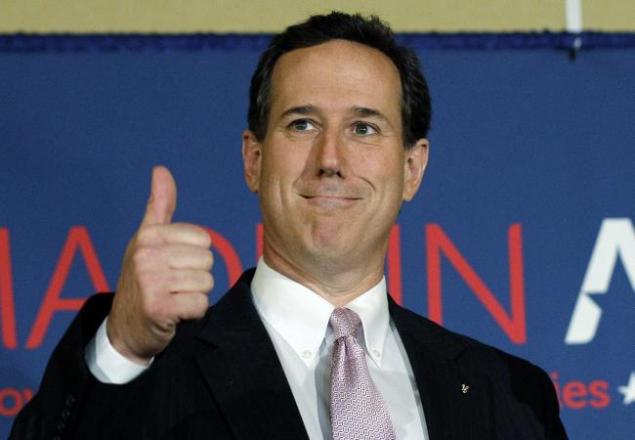
Rick Santorum

You would be forgiven for thinking that Rick Santorum disappeared back into the political wilderness with the end of the 2012 presidential campaign, destined only to pop up occasionally on Fox News to wring his hands about the private sex lives of his neighbours, or to pen wacky columns for World Net Daily.

But you would be wrong.

The great and the good of the Republican Party (and Mark Sanford) have been showing up at the annual Faith & Freedom Coalition conference this past week, to stroke the egos of the evangelical “Christians” and “moral majority” Bible-thumpers therein assembled. Featured prominently among the speakers, none other than Rick Santorum.

Politico reports his speech in the context of Santorum’s implicit criticism of the Mitt Romney 2012 campaign, specifically the focus on the “You Didn’t Build That” theme:

The former Pennsylvania senator recalled all the business owners who spoke at the Republican National Convention.

“One after another, they talked about the business they had built. But not a single—not a single —factory worker went out there,” Santorum told a few hundred conservative activists at an “after-hours session” of the Faith & Freedom Coalition conference in Washington. “Not a single janitor, waitress or person who worked in that company! We didn’t care about them. You know what? They built that company too! And we should have had them on that stage.

Rick Santorum is dangerous, because he alone (with the partial exception of Ron Paul’s principled candidacy) instinctively gets something about the American electorate that is all but completely lost on all of the other past and potential Republican presidential candidates over the past two election cycles.

He understands that – as we saw with the recent Bilderberg Meeting protests – an increasing number of people are becoming disenchanted with the status quo system of economic and financial governance, and are losing faith in the American dream and any hope of regaining the middle class lifestyles that they once took for granted. And he understands the undercurrent of resentment resulting from this realisation, and the corrosive effect on Mitt Romney’s base of support.

The article continues:

Santorum did not mention Romney, whom he challenged in the primaries, by name during a 21-minute speech in a dim ballroom at the Marriott (a company on whose board Romney sits). But there was no doubt who he was talking about.

“When all you do is talk to people who are owners, talk to folks who are Type A’s who want to succeed economically, we’re talking to a very small group of people,” he said. “No wonder they don’t think we care about them. No wonder they don’t think we understand them. Folks, if we’re going to win, you just need to think about who you talk to in your life.”

Trying to carve out a role as a leading populist in the 2016 field, Santorum insisted that Republicans must “talk to the folks who are worried about the next paycheck,” not the CEOs.

This really gets to the rub of the problem, and is an exact restatement of my recent arguments against the secretive Bilderberg group. The Bilderberg attendees meet in secret with other highly successful people just like themselves, and presume to prescribe policies and solutions for the entire world based on their extraordinarily narrow range of experience. Similarly, the majority of GOP presidential candidates wouldn’t spend a moment of their lives in the company of someone who couldn’t write them a fat campaign cheque at the end of the day, but instinctively understand the preoccupations and concerns of business owners and rich financiers. And based on this narrow set of acquaintances they presume to create solutions “for the good of the country”.

Rick Santorum stands out among a sorry crowd of potential Republican contenders as someone who can not only talk to the “47 percent”, but also speak up for them.

Never mind that the solutions that he proposes – more protectionism, propping up inefficient, declining American industries and preventing the inevitable and needed transition toward a more knowledge-based economy – would actually harm this constituency so dear to his heart, as I explained last year when I dubbed him the “Pied Piper of Pennsylvania”. By virtue of the fact that he actually takes the time to understand and advocate for this group of downtrodden Americans, he will inevitably pick up a lot of support should he choose to enter the 2016 Republican presidential primary race.

Unfortunately, by voting for Rick Santorum not only do you get his special nostalgic, doomed-to-failure (but very populist) economic policy, you also get the basket of socially regressive and (in some cases) out-and-out bigoted policies for which he proudly and unapologetically stands. Hence the danger.

Yes, it is slightly ridiculous to be thinking about 2016 already. But at the present time, there is only one Republican who really gets it when it comes to the economic frustrations of the American middle and working class. And the danger – the Santorum Threat – is that if the economic outlook has not significantly improved by the time of the next election, and if the rest of the Republican field remains incapable of sympathising with anyone other than hedge fund managers and “job creators”, the man who lost out to Mitt Romney in 2012 could steal the nomination in three years’ time.

On Bilderberg Withdrawal Syndrome

It’s all over.

The last armoured limousines have swept back out of the Watford Grove Hotel’s gates, and the helicopters have departed.

The steel fence is being disassembled, and Alex Jones has flown back to his “central command center” in Austin, Texas.

I’m not ashamed to admit that I have a rather acute case of Bilderberg Withdrawal Syndrome.

For a few precious days, at least a segment of the population who don’t normally pay attention sat up and looked at the protesters, covered on television at length for the first time, and listened to what they had to say. They heard about the concentration of power in the hands of a global elite, about our failed financial system, the lack of accountability in the political and corporate worlds, the pervasive nature of the surveillance state, and the efforts underway to undermine the importance of local power and the nation state.

And so for the first time in a very long time we were able to have something of a national conversation about causes rather than effects. About the disease rather than the symptoms (which are covered in one form another by the newspaper headlines most days – crime, immigration, unemployment, income inequality, education).

And it was amazing how widely and enthusiastically the message was received. I was particularly heartened to learn how many of the police officers guarding the meeting venue and the Bilderberg Fringe protest site had listened to the message from the protesters and taken an active interest, some even undertaking to go home and do their own research:


Ellen Grace Jones, writing at The Huffington Post, agrees with my assessment:

A triumph in securing – for the first time ever – wall-to-wall mainstream media attendance, subjecting the meeting to serious enquiry and inspection. And a triumph in hosting a peaceful, joyful Fringe event within the Grove grounds which united thousands of concerned citizens, activists and inquisitive Watford locals. This year felt like a sea change in dragging the shadowy cabal’s club kicking and screaming into the daylight.

She continues:

On Sunday, with the Fringe winding down and a hundred or so lining the gates as the delegates left, I questioned a police liaison officer if he’d felt awakened by the event he’d witnessed this weekend. “I’ve heard a lot of interesting ideas that I’m going to go away and research. I’ve got a reading list, Agenda 21, Endgame which I’m going to follow up. The one person who really made me sit up and go ‘oh my god’ was one of the audience, a former stockbroker. He was discussing things I’ve thought about like who’s controlling the energy companies, oil company cartels and the Libor bank scandal and he made me think, yeah actually, as someone who’s suffered from the housing crash somebody else should be paying for this but it’s the public sector that’s being screwed to pay for their mistakes – especially the police, we’re being cut.”

Of course, it wasn’t all good. The Bilderberg protests brought out the absolute worst in much of the British mainstream news media, who refused to take the issue seriously at all, treated the protesters as imbeciles and simpletons to a man, and covered the event only as the lighthearted end segment, where you would normally expect to be entertained by a squirrel on water-skis.

The foremost example was the truly dreadful segment from the BBC’s The Sunday Politics show, in which the lead-in to the segment focused only on the lunatic fringe of the protest and wholly ignored the serious concerns of the protesters, and the substance (if it can be called that) of the interview itself, with US journalist Alex Jones, whereupon host Andrew Neil decided to mock his guest from start to finish, fail to ask serious questions and ultimately provoke Jones into one of his famous rages:


There were also reports of Bilderberg-covering journalists being held or turned away at the border, and of harrasment of various kinds.

But on the whole, those wonderful days where we actually got to talk in public and on mainstream media about freedom and liberty without getting bogged down in the minutiae and drudgery of day-to-day political distraction were intellectually refreshing, and invaluable for the movement.

Roll on Bilderberg 2014 – if they dare assemble in public sight again.