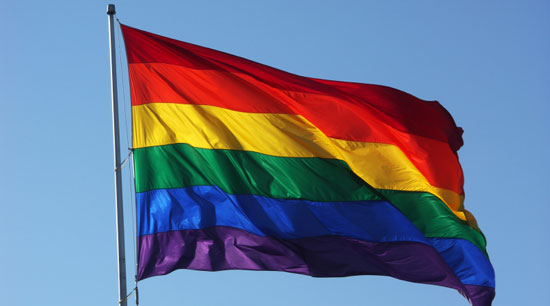
The Defense of Marriage Act (DOMA) has been struck down by the United States Supreme Court. Same-sex marriages conferred by the individual states can no longer be denied or not recognised by the federal government.
From the majority opinion, authored by Justice Anthony Kennedy:
The differentiation [between heterosexual and homosexual couples] demeans the [homosexual] couple, whose moral and sexual choices the Constitution protects, see Lawrence, 539 U. S. 558, and whose relationship the State has sought to dignify. And it humiliates tens of thousands of children now being raised by same-sex couples. The law in question makes it even more difficult for the children to understand the integrity and closeness of their own family and its concord with other families in their community and in their daily lives.
No longer will your legal married status fade and strengthen like intermittent cellphone service when you travel from one state to another.
Take the time to hug a Fox News viewer today. After the brief thrill experienced holing the Voting Rights Act beneath the waterline yesterday, today they have had to suffer the end of federal discrimination against same-sex married couples, and the onward march of immigration reform. It’s a tough day to be an intolerant, theocratical reactionary.
And, for all of its flaws and slowly turning wheel of justice, what a great thing is the United States Constitution, and a Supreme Court willing to overturn populist, discriminatory laws in favour of the universal right to life, liberty and the pursuit of happiness.
The complete ruling in the case of United States v. Windsor can be read here.
The US Supreme Court has struck down the 1996 Defense of Marriage Act (DOMA). The Federal government is now required to recognise same-sex marriages granted by those states that allow gay marriage, and to confer upon those couples the various human rights, financial perks, tax, inheritance and visitation rights that heterosexual couples have always enjoyed.
What a wonderful thing is the United States constitution – or any written constitution – and a Supreme Court that overturns (at the time) populist and discriminatory laws in favour of equal rights to life, liberty and the pursuit of happiness.
My personal thoughts will follow; in the meantime, here is Andrew Sullivan’s liveblogging of the day.
I am writing from overseas where I live with my partner of 32 years in a sort of self imposed exile. He has been unable to obtain any sort of residency visa for the USA. We have been looking forward to this day. The phone is ringing off the hook and everyone is saying “you’ll be able to marry and come home.” I think I’m going to go light a candle and thank God and all the people who have fought so long and so hard to make all this possible. Bless you.
Bless the souls of those whose courage in extremis gave me and others the strength not to falter in pursuit of their dignity as human beings and their equality as citizens. We did it in part for those we left behind. And part of the reason I am crying right now is…
On a day that ushered in what is seen by many as one of the biggest setbacks for the civil rights movement in many years, with the Supreme Court decision to strike down key provisions of the 1965 Voting Rights Act, we can at least take some small solace in the principled and well-argued dissent, written by Justice Ruth Bader Ginsburg and read by her from the bench.
Yes, it was exactly the usual suspects that you would expect to vote down key VRA provisions.
The US supreme court struck down 48-year-old protections for minority voters in states with a history of racial discrimination on Tuesday, in a decision lamented by campaigners who argued that it gutted the most important civil rights law ever passed by Congress.
The conservative-dominated court argued the act had largely served its purpose in encouraging equal access to the ballot box and said it was unconstitutional to continue singling out southern states for extra scrutiny without new legislation to determine signs of ongoing discrimination.
For nearly 50 years, the law forced certain, mostly southern states to seek permission from federal authorities in Washington for any changes to electoral rules, such as introducing literacy tests to reduce voter registration among minority groups.
However, chief justice John Roberts ruled on Tuesday that although there were some signs of continued racial discrimination, it was no longer sufficient to justify legal discrimination against the southern states caught up by the rules.
This has been a long-cherished goal for many conservatives, and we are already seeing some states (the usual suspects) moving almost immediately to implement new laws that had previously been stymied by section 5 of the Act.
As a general and broad supporter of localism, limited government and states rights, I am naturally sceptical about laws and provisions that make local laws subject to review, alteration or invalidation by an external authority. However, in the case of the Voting Rights Act, specifically the part that makes local authorities with a history of voter discrimination seek approval for changes to voting laws, I believe that the “lesser of two evils” doctrine clearly takes effect. So egregious were the measures used in an attempt to suppress the black and minority vote in many areas, and so important is the ability for all citizens to be able to participate in the democratic process, that a small infringement on local democracy in terms of oversight of local voting laws seems preferable to the larger threat to democracy of risking the exclusion of those same minorities once again.
Of course, the conservative activism which has become an increasingly prevalent hallmark of the Roberts court is unable to see nuance or shades of grey, dealing – as do most ideologues – purely in black and white.
Unfortunately, as Justice Ruth Bader Ginsburg notes in her dissent, numerous instances of blatant attempts to suppress the vote persist to this very day, and are by no means a distant relic of the Jim Crow era. MotherJones summarises some of the more recent examples in a “hall of shame” from Ginsburg’s dissent:
“Following the 2000 Census, the City of Albany, Georgia, proposed a redistricting plan that DOJ found to be ‘designed with the purpose to limit and retrogress the increased black voting strength…in the city as a whole.'”
“In 2001, the mayor and all-white five-member Board of Aldermen of Kilmichael, Mississippi, abruptly canceled the town’s election after ‘an unprecedented number’ of AfricanAmerican candidates announced they were running for office. DOJ required an election, and the town elected its first black mayor and three black aldermen.”
“In 1993, the City of Millen, Georgia, proposed to delay the election in a majority-black district by two years, leaving that district without representation on the city council while the neighboring majority white district would have three representatives…DOJ blocked the proposal. The county then sought to move a polling place from a predominantly black neighborhood in the city to an inaccessible location in a predominantly white neighborhood outside city limits.”
“In 2004, Waller County, Texas, threatened to prosecute two black students after they announced their intention to run for office. The county then attempted to reduce the avail ability of early voting in that election at polling places near a historically black university.”
It rather beggars belief that Chief Justice John Roberts and his fellow justices in the majority opinion can look at a political landscape still full of examples such as those shown here, and conclude that the problem is anywhere close to being solved. Or, as Ginsburg puts it:
Throwing out preclearance when it has worked and is continuing to work to stop discriminatory changes is like throwing away your umbrella in a rainstorm because you are not getting wet.
One ball more than Patrick Stuart – CEO of Strong Rock Christian Academy – possesses.
Some depressing but thoroughly unsurprising news from the land of segregated school proms, this time concerning sports and religion today, centering on a private Christian school in Atlanta where apparently the teachers and administrative staff are every bit as immature as some of the students.
ThinkProgress reports that a twelve year old girl was kicked off her school’s football team for a reason so jaw-droppingly moronic that it took me several minutes to come to terms with the knowledge that something of this nature could take place in the twenty-first century:
A private school outside Atlanta recently informed 12-year-old Madison Baxter that she would not be welcome at tryouts for the 7th-grade football team, even though she started on the sixth-grade team and has been playing football since second grade. The reason she won’t be allowed on the field? Because her male teammates are beginning to have “impure thoughts” about her, Strong Rock Christian Academy school administrator Patrick Stuart told Baxter’s mother.
“In the meeting with the CEO of the school [Patrick Stuart], I was told that the reasons behind it were one, that the boys were going to start lusting after her and have impure thoughts about her and that the locker-room talk was not appropriate for a female to hear even though she had a separate locker room from the boys,” Baxter’s mother, Cassy Blythe, told Atlanta’s WXIA-TV.
So the school’s reaction to finding out that the boys on the team were lusting after the one girl (which is pretty much what twelve year old boys do), was not to tackle the problem with any sense of proportionality, or direct their action at the people doing the “lusting” (which goes mysteriously undefined throughout the article and the school’s statements), but rather to penalise the innocent girl and remove her from the team.
The article caustically concludes:
There are more than 1,500 girls playing football at American high schools, according to the National Federation of State High School Associations, and that number has increased more than 17 percent in just four years. It’s not just a boys’ sport anymore. And more than that, playing football with a girl could have been a valuable experience for Baxter’s teammates about how to appropriately interact with women and girls, about how a person’s sex doesn’t make her inherently inferior athletically or in any other way, and about how having “impure thoughts” doesn’t mean you have license to act on them. They won’t get that lesson, though, because the adults in charge of Strong Rock Christian Academy’s athletics program apparently have yet to learn it themselves.
Absolutely. This poor girl is being denied the opportunity to continue to represent her school on the football team because the “adults” supposedly in charge of the Strong Rock Christian Academy (with a name like that, you can already be quite sure that they harbour and teach some fairly wacky views) are too prudish or squeamish to sit down with the boys on the team and have a serious – and yes, mildly uncomfortable and awkward – discussion about acceptable behaviour toward people of the opposite sex. If, given this gold-plated opportunity to impart some useful information to the boys on the team, the adults choose to duck the challenge, how much does this diminish the chances of those boys to grow and develop healthy attitudes to their female peers?
My shock at reading this story, not in 1953 but 2013, was tempered, however, when I realised that the unfortunate events took place in the great state of Georgia. Georgia is, of course, famous for being the last state in the union to have a school district that continues to hold racially segregated proms.
Real journalism vs. kiss-ass sycophancy. Glenn Greenwald vs. David Gregory. There’s no contest as to whose opinion and reporting I would generally trust, and it ain’t the guy from Meet The Press. Sullivan collates some of the fallout from the weekend’s explosive MTP interview with journalist Glenn Greenwald, who of course was first to break Edward Snowden’s allegations of illegal NSA snooping.
There has been an understandable collective wince at David Gregory’s asking a fellow-journalist whether he should go to jail (I speak of Glenn Greenwald) for helping a whistle-blower. Now, as readers know, I’m somewhat skeptical about the large claims made by Glenn and Snowden as to PRISM but, equally, I emphatically do believe that these revelations were clearly released to further what Snowden felt in good faith was the public interest. In a piece that would be close to perfect if it had any acknowledgment of the other side of the equation – that plenty of fanatical Jihadist extremists are trying to kill us every day – Glenn explains:
In what conceivable sense are Snowden’s actions “espionage”? He could have – but chose not – sold the information he had to a foreign intelligence service for vast sums of money, or covertly passed it to one of America’s…