Shutting down political rallies with the threat of violence and blocking public access to hear a political candidate speak is not behaviour worthy of any citizen of a democracy
People have every right to feel alarmed or even scared about the presidential candidacy of Donald Trump. This blog believes that a Trump presidency, were he to secure the Republican nomination and win the general election, would be jarringly populist at best and economically ruinous at worst, though I dismiss any alarmist talk that Trump is in any way equivalent to the Nazis or other genocidal fascists.
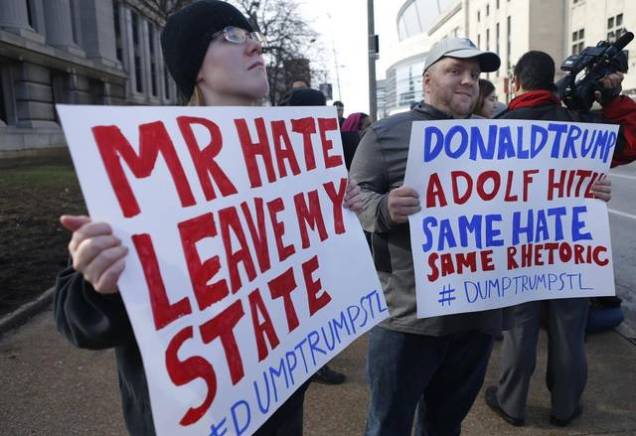
Such hyperbole from anti-Trump activists is thoroughly unhelpful at a time when tempers are already flaring on both sides. After all, if you are a supporter of Donald Trump then having an angry college student yell in your face that you are supporting the new incarnation of Hitler will likely make you quite unreceptive to engaging in further debate and potentially being persuaded to change your views.
But the invective (on both sides) and hand-writing hysteria (primarily from the anti-Trump crowd) are nothing compared to the more blatantly anti-democratic methods by which some liberals are now attempting to shut down Donald Trump’s message rather than take it on in the battle of ideas.
Protesters on Saturday blocked the roads leading to a Donald Trump rally in Fountain Hills, Arizona.
[..] An ABC 15 anchor reported at least three people had been arrested in connection with the protests. Deputy Joaquin Enriquez, a spokesman for the Maricopa County sheriff’s office, told ABC 15 the arrests were for blocking the road, not protesting.
The roadblock didn’t stop some determined people from getting out of their cars and walking to Trump’s rally.
Tomas Robles, executive director of Living United for Change in Arizona, a workers’ rights organization, told HuffPost that law enforcement was cooperative and treated protesters fairly. He said some Trump supporters “did try to get get aggressive,” but they were not violent.
“It was a peaceful protest, we got our point across, and we showed the nation and our state that just because Arizona at a time has been seen as anti-immigrant and somewhat racist, this is not that state anymore,” he said. “We’re not going to allow people like Trump to spew that rhetoric.”
Note the authoritarian tinge to the words of Tomas Robles, one of the protesters quoted by Huffington Post. Because he and his organisation disagree with Donald Trump, they are “not going to allow” him to air his views in public – at a political rally of all places, that most sacrosanct of venues in terms of the necessity for free speech.
While the rally in question went ahead, the demonstration prevented many Trump supporters from attending and forced others to abandon their cars and walk the rest of the way to the venue:
Hilariously, the Huffington Post – clearly sensing that running a story about liberal activists interfering with a political rally might not sound terribly progressive – felt the need to add the following editor’s note to the end of the article:
Editor‘s note: Donald Trump regularly incites political violence and is a serial liar, rampant xenophobe, racist, misogynist and birther who has repeatedly pledged to ban all Muslims — 1.6 billion members of an entire religion — from entering the U.S.
The obvious implication of this note is that it is perfectly appropriate and justified to stifle and attempt to shut down some forms of speech, and that we shouldn’t think badly of the protesters because they are waging war against a bad person who thinks the wrong things as opposed to a good person, “one of us”, who holds the correct beliefs and whose speech should be protected.
Or in other words: “Don’t worry, Trump and his supporters had it coming. They are bad people”.
The furious liberals outraged at the rise of Donald Trump need to realise that their usual tactic of shouting, screaming and now blockading things that they dislike is actually feeding – not killing – the beast. Maybe they do realise, but simply don’t care. Maybe the opportunity to signal their own moral virtue by ostentatiously raging against Trump is all that they care about.
But until Trump’s most ardent enemies on the Left learn to use their words rather than their fists they will only succeed in undermining free speech and American democracy, making Trump stronger all the while.
–
Agree with this article? Violently disagree? Scroll down to leave a comment.
If you trawl for votes by quietly suggesting to people that their country has been taken over by a socialist, foreign-born, America-hating Muslim, don’t be surprised when they gravitate towards a politician who plays more effectively to those fears
The Republican Party has a lot to answer for when it comes to the rise of Donald Trump.
As a British conservative who has lived in America, knows the country (and not just the coasts) well and is married to a Texan, I have a sense of perspective lacking in many American conservatives. I come from a country with a far more left-wing political climate, in which edifices of the post-war consensus – the welfare state, the NHS – are idolised and often exempted from nearly all meaningful criticism.
I grew up in a culture which is a lot more suspicious of conspicuous success and achievement, more collectivist (though less so than continental Europe) and generally more expectant that government will play a hectoring, overbearing role in our lives. And therefore, when I see Republicans rending their garments wailing and rending their garments about the intolerable left-wingery of Barack Obama, I know exactly how whiny and entitled they are being.
The Republican Party reacted to the election of Barack Obama as though his presidency was going to usher in the end of the Republic. They acted as though a suite of rather workaday centre-left policies were part of a sinister conspiracy to turn America into a socialist country. Needless to say, they barely uttered a peep when their own side was busy ratcheting up the size of the state under the “compassionate conservative” Big Government presidency of George W. Bush, in which massive Medicare expansions – heck, even entire wars – were placed on the national credit card, and fiscal conservatism was put through the shredder. No, it was Obama who represented an un-American step too far, according to this false narrative.
And of course it was all nonsense. As Barack Obama’s second term reaches its end, the size and scope of the federal government is still stubbornly large, but America has by no means transitioned into a Soviet-style planned economy. Even the hated (in right-wing circles) ObamaCare has only tinkered around the margins, funnelling a few million uninsured into some form of health coverage, inconveniently disrupting the existing coverage of a number of other people but otherwise doing nothing to change the private insurance, private provision model of American healthcare. The Second Amendment has not been substantially undermined, let alone repealed. Defence spending may be misaligned but still eclipses the rest of the world, and the US military has not been decimated. In terms of domestic policy, in other words, the world has not ended.
Has America become a libertarian paradise under President Obama? Of course not. But that’s because a Democrat won the White House and focused (as much as he could, given a spineless Democratic congressional caucus and entrenched Republican opposition) on the kind of centre-left priorities you would expect from a Democrat. And crucially, neither has America become a socialist dystopia in that time.
That’s not to say that the Republicans did not often have a point, or that they were perpetually in the wrong – in many cases, their opposition to Obama’s agenda was justified. But at all times this opposition was carried out in a shrill, alarmist and hyperbolic manner – much as British left-wingers are currently mirroring the American Tea Party with their “pass the smelling salts” horror at the thoroughly unexciting, centrist government of David Cameron.
And when you go trawling for low information votes by feeding on prejudice and stoking up concerns about the personal motivations, the loyalty and even the American-ness of the president in a childishly obstructionist scorched earth strategy, you can’t really feign surprise when the sentiments you unleash give rise to a populist demagogue like Donald Trump. And people should call you out for doing so if you even try, as many Republicans are now doing as part of their cynical #NeverTrump movement.
During the panel discussion on his show, Maher said:
So let’s get right to it – the Republican Party, having an existential crisis. They are very upset that half their voters wanna give nuclear weapons to a guy who gets into Twitter feuds with D-list celebrities, and we understand that. I almost feel bad for them, except I really don’t, because they brought it on themselves. They made a Faustian bargain with the racist devil many years ago, and now those chickens are coming home to roost.
Let me read what Paul Ryan said this week. He said “if a person wants to be the nominee of the Republican Party they must reject any group or cause that is built on bigotry. This party does not prey on people’s prejudices”. LOL.
To which I would say to him: what about voter ID laws? What about once defending the guy who gets shot – the black guy, unarmed – instead of the cop? Y’know, I mean who are they kidding? This is the party they are, and Trump is just the latest.
And then the killer line:
They always say that it’s a big tent. To me it’s more like a house – think of it more like a house. And they let the racists have a room in that house. They didn’t go in that room with all the memorabilia, but they made a very comfortable room in there. And now they took over the house, and the regular Republicans are afraid to go to the kitchen at night to get a snack.
Ouch.
To be clear, while this blog does not support Donald Trump’s candidacy, neither does it subscribe to the idea that Trump or the majority of his supporters are racist. Certainly criticising illegal immigration in America is not racist, despite the cynical attempts by many Democrats and those on the left to suggest otherwise. Building a wall is not the solution, but the idea of properly enforcing the perfectly reasonable existing laws about illegal (the leftists love to leave out the word “illegal”) immigration is entirely defensible. Similarly, Trump’s nationalist, protectionist policies may well also be very counterproductive were they ever implemented, but this does not make them – or him – evil.
As with many of Trump’s left-wing critics, Bill Maher is wrong to make this all about race. But he is quite correct in pointing out that in their desperation to win back the White House, the GOP tolerated all manner of crazy squatters and couch-surfers sleeping under their party’s roof. And while they did not explicitly add these people to the deeds of the house, they certainly left the front door wide open and stood on the street corner beckoning the crazies inside with a wink and a smile.
It is therefore exquisitely hard for me to feel sorry for the modern Republican Party as they are devoured by the very monster they kept as a pet and fed – particularly as I hail from a country which is planted a couple of steps firmly to the left in terms of the political centre ground, and have first-hand experience of the kind of “socialism” that the GOP cynically pretended was about to be unleashed on America.
I don’t want to see Donald Trump become the Republican Party nominee – though I feel much sympathy with many of his supporters – but if it does happen, as now seems increasingly likely, I cannot say that it was undeserved.
–
Agree with this article? Violently disagree? Scroll down to leave a comment.
President Obama’s timely criticism of the Safe Space Generation of students
It may come as a surprise to his conservative critics, but President Obama’s stance on the creeping authoritarianism and Identity Politics culture infecting American college campuses is very much on the side of free speech and robust debate.
Pressed to discuss his views on “politically biased colleges” at a high school town hall event held late last year, Barack Obama said:
Sometimes, y’know, there are folks on college campuses who are liberal and maybe even agree with me on a bunch of issues, who sometimes aren’t listening to the other side. And that’s a problem too. I was just talking to a friend of mine about this, you know, I’ve heard some college campuses where they don’t wanna have a guest speaker who, you know, is too conservative. Or they don’t want to read a book if it has language that is offensive to African Americans, or somehow sends a demeaning signal towards women. And you know, I gotta tell you, I don’t agree with that either.
I don’t agree that you, when you become students at colleges, have to be coddled and protected from different points of view, y’know? I think that you should be able to – anybody who comes to speak to you and you disagree with, you should have an argument with ’em. But you shouldn’t silence them by saying “you can’t come because, y’know my – I’m too sensitive to hear what you have to say”. That’s not the way we learn either.
It is interesting to watch the reaction of the students standing behind Obama while he makes these remarks. Some are clearly bored and not paying close attention, but most clap politely when Obama reaches a natural break in his speech.
However, there is also a significant minority of students in the audience who are giving what can best be described as death stares. Clearly they do not like what they are hearing one bit, because Obama’s pragmatic suggestion that college is place where autonomous adults go to debate sometimes difficult ideas in the pursuit of personal and intellectual growth is contrary to everything that they have been taught is progressive and socially just.
Note in particular the two women on the top right of the screen when Obama says that campus speech restrictions are more suited to the former Soviet Union, approximately 3 minutes and 50 seconds into the video. While the other students seem to have fairly neutral expressions at this point, these two students look angry, sullen and passive-aggressive. The president of the United States has dared to come to their school and blaspheme against the Cult of Identity Politics to which they fully subscribe, and so they sit there, arms crossed and doubtless feeling quite triggered, plotting their revenge.
The point is this: it only takes a few such angry zealots to cow and intimidate an entire student population – and university administrations which should know better – into embracing every corrosive aspect of the Identity Politics culture. Of an entire student body, only a minority will drink deep enough from the well of competitive grievance culture that they turn and become the angry, authoritarian stars of many a YouTube video. But those who do are incapable of leaving everybody else alone. They cannot practice their new secular religion privately; all must share in their beliefs and abide by their behavioural codes, on pain of punishment.
Just seven years ago, the image of an African-American man addressing a group of high school students as President of the United States would have been seen as a powerful display of the social change that is possible when free speech is celebrated, guaranteed and used. Barack Obama, whatever one thinks of his record in office, did not become president by sheltering inside an academic safe space, after all. But Identity Politics does not encourage reflection on progress made; it primarily fosters resentment about the sins and injustices of the past.
There is no longer an Edward Murrow or Walter Cronkite to stand up to Donald Trump
Could mainstream television, radio, print and internet journalism outlets have done more to prevent the rise of Donald Trump? And should they have done more?
Actually, many people are alarmed [by the rise of Trump], but it is difficult to know that by observing media coverage, where little journalistic alarm over Trump is expressed. That’s because the rules of large media outlets — venerating faux objectivity over truth along with every other civic value — prohibit the sounding of any alarms. Under this framework of corporate journalism, to denounce Trump, or even to sound alarms about the dark forces he’s exploiting and unleashing, would not constitute journalism. To the contrary, such behavior is regarded as a violation of journalism. Such denunciations are scorned as opinion, activism, and bias: all the values that large media-owning corporations have posited as the antithesis of journalism in order to defang and neuter it as an adversarial force.
[..] This abdication of the journalistic duty inevitably engendered by corporate “neutrality” rules is not new. We saw it repeatedly during the Bush years, when most large media outlets suppressed journalistic criticism of things like torture and grotesque war crimes carried out by the U.S. as part of the war on terror, and even changed their language by adopting government euphemisms to obscure what was being done. Outlets such as the New York Times, the Washington Post, and NPR refused to use the word “torture” to describe techniques long universally recognized as such — which were always called torture by those same media outlets when used by countries adversarial to the U.S. — because to do so would evince “bias,” lack “neutrality,” and “take sides” in the torture debate.
Contrary to what U.S. media corporations have succeeded in convincing people, these journalistic neutrality rules are not remotely traditional. They are newly invented concepts that coincided with the acquisition of the nation’s most important media outlets by large, controversy-averse corporations for which “media” was just one of many businesses.
I’m not so sure.
While Greenwald is absolutely right to chastise mainstream media outlets for clinging desperately to an “appearance of objectivity at all costs” dogma which routinely sees them humiliate themselves by speaking and writing about the utterly ridiculous as though it were merely an equal and opposing side to an argument, the idea that prestige nightly news anchors could have killed Trump’s candidacy in the crib either by initially declaring it ridiculous and mocking it, or by waging an Edward Murrow or Walter Cronkite crusade against him, seems to be wishful thinking.
It’s wrong because it underestimates the anti-establishment surge now underway in America (and in Britain too, as we saw with the rise of UKIP and the SNP). Suppose that mainstream news outlets like the New York Times, NBC, NPR and others had come out strongly to argue that Donald Trump’s ideas were outside the Overton window of “acceptable” political thought in America, and that he should henceforth be ignored by the media regardless of how many people were attending his rallies or how high he climbed in the opinion polls. What difference would it have made?
Political journalism is scorned by the public as much as Washington politics itself, and often for quite valid reasons – the incestuous, back-scratching relationship between the two is often entirely self serving and actively prevents the holding of government to proper account. Trump’s candidacy is fuelled in significant part by the opposition of those opinion columnists and TV talking heads who have come out to criticise him. If they were joined by everyone else, including news anchors and print journalists whose material does not appear in the opinion section of their television shows or newspapers, it is hard to see it doing anything other than confirming the suspicion of Trump fans that the “establishment” is out to get them, thus driving his poll ratings even higher.
This is important. Trump is riding high partly because of a small group of “let it burn” conservatives who believe that Washington is so corrupt that an authoritarian outsider beholden to no one is as good a choice as any to sweep out the garbage, but mostly because Trump supporters feel ignored and patronised by almost everybody else. And frankly, the opposition to Trump in the media has not helped, tending toward hand-wringing “ooh, isn’t he evil” editorials and one-sided accounts of violence at his campaign rallies rather than granular deconstructions of his policy proposals (such as his policies exist). Increasing the frequency and volume of the existing anti-Trump media coverage will not fix the problem, because it does little to tackle the sentiments and ideas which drive his support.
But more to the point, if we are to set arbitrary limits on our political discourse, beyond which any candidate promoting “unacceptable” ideas is rounded on by the corporate media as it is currently comprised, who gets to set the limits? Who gets to decide which ideas are okay to debate, and which are traps which will bring the entire media establishment crashing down on the person who dares to raise them?
There is almost nothing as infuriating as watching high profile journalists discuss an issue where one side obviously has the moral and intellectual high ground in terms that suggest that it is a finely balanced debate – witness the debates on torture, climate change, Brexit (UK secession from the European Union) and more. But even worse than this would be a collusion between media outlets to freeze out certain ideas or candidates from being mentioned altogether because they are “evil” or contradict prevailing orthodoxies.
I’m sure that this is not what Greenwald has in mind. As a consistent advocate of free speech, I’m sure that he would prefer a brash and lively media landscape of much more fractured ownership, in which a multitude of independent news outlets are free to carry out the kind of unabashedly partisan campaigning journalism that Greenwald (and to some extent this blog) advocates. Greenwald would likely be fine if some outlets produced coverage very supportive of Trump, so long as other outlets were equally free to oppose him.
But we do not have such a media landscape right now, and moving in this direction would be a process taking years, not months – certainly too long of a timescale to have any impact on the rise of Donald Trump. The difficult truth is that given the hysterical, rabble-rousing behaviour of the Republican Party over the course of the Obama presidency – in which they chose hyperbolic, apocalyptic scaremongering over principled opposition to bigger government – there was nothing that could have prevented the monster they created from coming to life, breaking free of its chains and devouring them, as Trump is now doing.
It may feel good to imagine an American media landscape filled with luminaries like Edward Morrow and Walter Cronkite, journalists who would have taken one look at Donald Trump back when he launched his presidential bid, and masterfully snuffed it out in the course of one withering nightly news broadcast or newspaper column. But that is not the world we live in. Any attempt by major media outlets to scrutinise or inveigh against Trump in these anti-establishment times would only have fuelled his campaign even more than his many critics already have.
Far more deserving of blame are the Republican Party establishment, who shamelessly and hypocritically rode the anti-establishment, anti-Obama tiger for seven years before finally it turned on them. And also at fault is an entire remote and self-serving political establishment which in many ways thoroughly deserves the kicking it is now receiving – just not by Donald Trump, the opportunistic and undeserving current beneficiary.
Would it be a cathartic experience to witness more mainstream media types casting objectivity aside and coming out against Trump? Quite possibly. But would it have done anything to stop his rise? Let’s not kid ourselves.
Earlier, the Senator asked, “Upon what meat does this, our Caesar, feed?” Had he looked three lines earlier in Shakespeare’s Caesar, he would have found this line, which is not altogether inappropriate: “The fault, dear Brutus, is not in our stars, but in ourselves.”
No one familiar with the history of this country can deny that congressional committees are useful. It is necessary to investigate before legislating, but the line between investigating and persecuting is a very fine one and the junior Senator from Wisconsin has stepped over it repeatedly. His primary achievement has been in confusing the public mind, as between the internal and the external threats of Communism. We must not confuse dissent with disloyalty. We must remember always that accusation is not proof and that conviction depends upon evidence and due process of law. We will not walk in fear, one of another. We will not be driven by fear into an age of unreason, if we dig deep in our history and our doctrine, and remember that we are not descended from fearful men — not from men who feared to write, to speak, to associate and to defend causes that were, for the moment, unpopular.
This is no time for men who oppose Senator McCarthy’s methods to keep silent, or for those who approve. We can deny our heritage and our history, but we cannot escape responsibility for the result. There is no way for a citizen of a republic to abdicate his responsibilities. As a nation we have come into our full inheritance at a tender age. We proclaim ourselves, as indeed we are, the defenders of freedom, wherever it continues to exist in the world, but we cannot defend freedom abroad by deserting it at home.
The actions of the junior Senator from Wisconsin have caused alarm and dismay amongst our allies abroad, and given considerable comfort to our enemies. And whose fault is that? Not really his. He didn’t create this situation of fear; he merely exploited it — and rather successfully. Cassius was right. “The fault, dear Brutus, is not in our stars, but in ourselves.”
Good night, and good luck.
–
Agree with this article? Violently disagree? Scroll down to leave a comment.
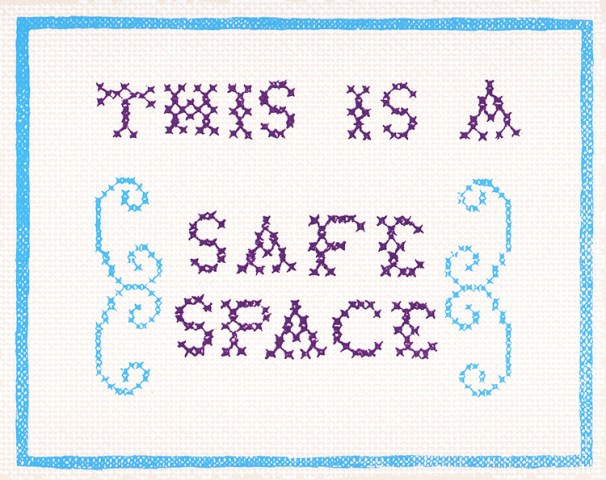
When I began the “Tales From The Safe Space” series, my intention was not for it to dominate the blog to the extent which it has done over the past couple of weeks. But I have continued to write the stories up, because each case covered here has exposed or highlighted a different side of the Identity Politics issue, and I think there has been something unique to say about them all.
That being said, there are other pressing things happening in the world. In Britain specifically, the coming EU referendum (and the upcoming launch of the Leave Alliance) is deserving of more coverage, as is George Osborne’s imminent Budget, which looks set to provide more fodder for our “What Conservative Government?” series.
Therefore, future “Tales From The Safe Space” may come in the form of occasional digests and summaries of stories from around Britain and America – since new campus controversies seem to be occurring faster than I can cover them individually on this site as a one-man operation.
Protesters at several campuses in Southern California and Arizona have demanded administrators cut all ties with the federal agency, and some have protested agents’ presence on campus. Students say border protection representatives make students – especially students in the country illegally – feel unsafe.
At UC Santa Barbara in late January, a parade of students boisterously demonstrated against border patrol recruiters at a campus job fair, loudly chanting “f*ck your borders, f*ck your walls.” One organizer told The College Fix agents’ attendance was “triggering” for undocumented students, adding “there is no space on this campus for an organization that continues to threaten the safety of students.”
Last fall, after UC Irvine students circulated a petition that called on administrators to remove a U.S. Customs and Border Protection booth from the school’s fall career fair – saying officers’ presence would make the campus unsafe for students in the country illegally – the agency backed out of the event.
Cambridge university students have caused an Around the World in 80 Days-themed party to be cancelled because they claimed it could encourage “cultural appropriation”.
Undergraduates complained that the theme could even be seen as racist if revellers dress up in clothes from a different ethnic group.
Students at Pembroke College are now arguing about whether axing the event was restricting their freedom of expression or preventing offence towards ethnic minorities.
University officials who censor student journalists pose as great a threat to free speech as controversial “safe space” policies, a leading activist has said.
A freedom of expression row has erupted at University College London (UCL) after The Independent revealed that the institution had been accused of threatening and intimidating one of its student reporters.
Rebecca Pinnington, 21, said she was made to feel “intimidated, anxious and scared” after UCL warned she may face disciplinary action – including expulsion – for possessing confidential documents found on a public university server.
The university initially denied that threats had been made, but last night conceded that the letter handed to Ms Pinnington “set out the full range of penalties available in the disciplinary code”.
Generally welcome words, and good to see the veteran activist taking the fight to the campus authoritarianism of university administrations as well as over-sensitive students.
Why do we all have to stick to our own cultures and not be allowed to merge? People should be able to wear whatever they want, and to engage with other cultures freely.
Just think what this could mean for the fashion world if culture-fusion clothing became more acceptable. Maybe the diversity would allow men to would have more clothing options too. This year at the Oscars the male actors all showed up wearing practically the same thing! It’s not really their fault; there just aren’t enough clothing options for men. In the future they could come to the Oscars in a sherwani? A Kilt? Or various other traditional clothes that I don’t know the names of because they aren’t mainstream enough.
A lot of fashion trends, are inspired from other cultures. There are some global trends emerging in fashion, for example I noticed that as crop tops and high wasted skirts became popular in the West, simultaneously South Asian designers reignited the lenga trend (which is basically a crop top and a long high wasted skirt).