Tales From The Safe Space, Part 29 – The Surreal NUS Annual Conference

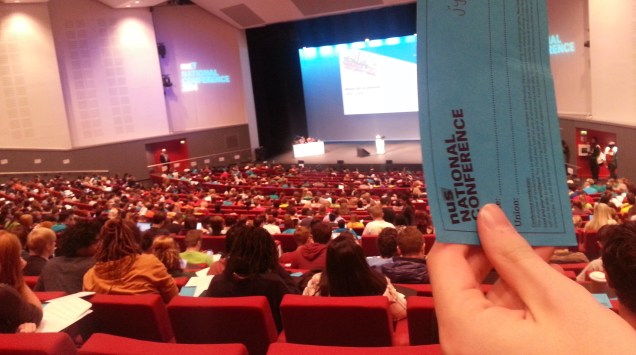
NUS annual conference

Down with the National Union of Students

We know that they are highly averse to clapping and that many of their affiliate university students’ unions have been entirely conquered by the Cult of Identity Politics, but what is life really like at the NUS annual conference?

Jack Grove has been into the lion’s den (or should that be sheep’s pen?), and reports in the Times Higher Education:

On arrival at the registration desk at the Brighton Centre, I was able to choose from a range of stickers that would indicate to delegates if I’d prefer to be addressed along the lines of “he/him/his” or perhaps “they/them/theirs”. Later in the day, delegates elected a full-time sabbatical officer to deal with trans issues – a major financial commitment for a union that can’t afford a paid post dedicated to postgraduate issues.

When Ms Bouattia was elected as president – the union’s first female black Muslim leader – her supporters were chided by the panel chair for clapping and cheering as this may cause distress to other delegates and trigger a trauma episode.

Instead, delegates were asked by a sincere delegate not to whoop or holler, or clap at all, but use “jazz hands” to show appreciation (people were asked to wiggle their fingers) as the noise created was “ableist” and had indeed caused the delegate in question to have a panic attack on previous occasions.

While Spiked’s Tom Slater reports:

The National Union of Students conference is over. But we’ll still have the memories – the jazz hands, the whingeing and the casual anti-Semitism. For this was the year when this tyranny of crybabies, this politburo of plonkers, truly outdid itself. Not only did delegates call for social-media apps to be banned (people are saying nasty things on them) and for Holocaust Memorial Day to be scrapped (apparently it’s not ‘inclusive’) — they also elected as the new NUS president Malia Bouattia, someone who thinks condemning ISIS might ‘send the wrong message’ and is wont to wax lyrical about the ‘Zionist-led media’.

This year’s shitshow has led to students around the country calling for their unions to disaffiliate from the NUS. About time. The NUS is a censorious, anti-democratic husk, propped up by right-on middle-class cliques. Though it claims to fight for students’ rights, it doesn’t have much truck with their right to speak freely, their right to conduct their sexual lives as they see fit, or even their right to party. In 2013, the NUS signed up to minimum pricing: this is a students’ union that thinks beer is too cheap.

It’s time to smash the NUS and start anew. Students need a union that truly looks out for them, that allows them to make common cause on the issues that matter. But, above all, they need a union that treats them as morally autonomous adults, that takes them seriously, that believes students can change the world rather than just be triggered by it.

I cannot emphasise enough that this is no longer a niche phenomenon. This is not a few isolated incidents, or a few overenthusiastic students on a few of the more liberal university campuses. This is not only nationwide, but also transatlantic.  And it is here to stay.

Here is a National Union of Students whose theoretical purpose is to represent the academic and pastoral interests of all students in the country, but which feels the need to lavish resources on a full-time Trans Issues officer at a time when they do not even have a paid officer to represent the different needs of postgraduate students. In other words, here is a union which has left behind any pretence of doing what a union should do, and instead devoted itself wholly to the furtherance of the identity politics agenda.

We would never witness this dereliction of duty in pursuit of secondary objectives in any other trade union, even (or especially) the most militant and prone to industrial action. The RMT union – and one has to hand it to them – seeks to grind out the best financial settlement possible for its members, and uses strikes or even just the threat of strikes to paralyse London, bring an elected Conservative mayor to his knees, and win key concessions for already well-paid tube drivers on the London Underground.

You would never see the RMT being half-hearted in its negotiations with Transport for London because its leadership was too distracted instituting a new Safe Space policy or agitating for mandatory social justice re-education courses for workers. They focus, with undeniable effectiveness, on fulfilling their primary duty to their members – namely, achieving the best possible employer settlements on wages and conditions.

And this is the key point. The National Union of Students not only no longer represents the majority of university students, it now pursues aims and objectives which are irrelevant to many of them and are even sometimes directly antagonistic toward them (particularly in the case of conservatives, small-L liberals or assorted others who simply value free speech). They no longer even claim to act for all students. They act primarily for those students bound up in the social justice movement.

It is now ten years since I graduated, and during my time at Cambridge and Warwick universities the NUS was never anything more than an annoyingly persistent leftist buzzing in my ear. Sure, it was stupid when the Warwick Students’ Union wasted time debating a motion to express their objection to George W. Bush making a state visit to Britain, but they did not actively go out of their way to interfere in my life. This is no longer the case. Now, the Warwick Students’ Union is rated Red in the annual Spiked university free speech rankings, and actively seeks to control what every student in campus is allowed to read, buy, think, hear or say.

In other words, a lot has changed in a decade. In just the last few years in particular, identity politics cultists and assorted Social Justice Warriors have made an unprecedented power play within students union, against university administrators and against any of their peers who do not subscribe to their own worldview. Those who graduated a decade or more ago and do not pay close attention to what is happening in our universities may well see this as alarmism at first glance – “surely things can’t be that ridiculous?” goes the common refrain.

But they are. And it is going to get worse. We are already at a point where holding conservative views on campus attracts outright ridicule and hostility. In a few more years, this opprobrium will spread to those who merely fail to sing from the social justice hymn sheet loudly and sincerely enough. And to date there has been almost zero fightback from the supposed adults in the room, the university faculties and administrators. Liberty-loving students have been left to face the onslaught alone.

Now, nobody can predict exactly what will be the consequence of a growing number of identity politics-infected young people graduating and joining the labour market and becoming involved in party political activism. Some will doubtless be jolted to their senses by their collision with reality, and come to look back in shame on their illiberal student ways. But many others will survive the impact, and when they regroup they will begin to look for ways to recreate their university Safe Space environment here among us. It has already begun.

So calling attention to the identity politics/social justice takeover of universities is not a fringe interest or a massive overreaction. This new focus by writers – including this blog’s own “Tales From The Safe Space” series – provides an unsettling preview of what life will be like in another decade, unless those who object to this therapeutic, victimhood culture begin to get organised and fight back.

But if you are happy for your future workplace to gradually turn into a never-ending NUS conference, then by all means continue burying your head in the sand.


Safe Space Notice - 2

Top Image: Lancaster University Students’ Union

Agree with this article? Violently disagree? Scroll down to leave a comment.

Follow Semi-Partisan Politics on TwitterFacebook and Medium.

Tales From The Safe Space, Part 28 – When Both Sides Use SJW Tactics

Safe Space University

If unchecked, identity politics and Social Justice Warrior tactics will lead to a stalemate on university campuses where everything is offensive, everyone is offended and both protest and counter-protest become impossible

Recently, this blog speculated as to what would happen if and when conservatives on university campuses finally get sick of being shouted down and censored on campus by social justice activists using the tactics of identity politics, and begin to adopt the same kind of arguments and tactics themselves as a kind of self-defence mechanism.

As I concluded at the time:

Nobody likes a pity party, but that is exactly what will get if conservative and liberal students face off against each other not as they should, through lively debate, but rather through constant, tear-stained appeals for the university authorities to intercede on behalf of their respective sides.

And in a sense, one cannot blame [conservative students] for behaving in this way. They have watched for months and years while identity politics-wielding left-wing students get every little thing that they demand from spineless university administrations, and shame into submission anybody who stands in their way.

It is not therefore an illogical leap when other students conclude that this is the best and most effective way of advancing one’s own agenda. If the Social Justice Warriors can mobilise support and win concessions by emphasising (and frankly, grossly exaggerating) their supposed victimhood and oppression, why should conservatives not do the same?

[..] But in the longer term, if through repeated practice young students become adept at flaunting their fragility and exalting in their helplessness, both sides will fight to a bloody draw, with nobody able to say or do anything on campus without immediately triggering a protest and counter-protest. University will truly no longer be a place for the discussion of ideas, but a sheltered place of “comfort and home” for weak-minded adult babies, an intellectual demilitarised zone protected by a field of verbal landmines laid by every competing minority group over the academic and political discourse.

And an “intellectual demilitarised zone” is exactly what we are now just beginning to see, with those people and groups who were traditionally the target of social justice warrior tactics now adopting the same language of victimhood and fragility in an attempt to deflect criticism of themselves and shame their accusers into dialling back their criticism.

The context in this case is that of UC Davis and the ongoing protests on that campus to force the resignation of their Chancellor, Linda Katehi. Much of the criticism of Katehi is actually justified in this case – she came to prominence for presiding over an infamous incident in 2011 where Occupy protesters were pepper sprayed by campus police, and subsequent efforts to scrub the internet of mentions of the event in the name of “online reputation management. Some of her failings are detailed in this local press report.

But the rights and wrongs of Katehi’s actions are irrelevant for the purposes of our analysis. What is if interest here is the fact that Katehi’s defenders among the university student population, faculty and administrators are now using the same language of beleaguered and bullied “victims” in an attempt to win public sympathy as well as respite from their accusers.

Jonathan Haidt comments on this phenomenon at The Atlantic:

At UC Davis, where student activists still hope to oust Chancellor Linda Katehi, critics of their activism are using concepts like “safe space” and “hostile climate” to attack it.

The student activists had occupied a small room outside Katehi’s office, planning to stay until their chancellor resigned or was removed from her post. By the time they left 36 days later, a petition that now bears roughly 100 signatures of UC Davis students and staff were demanding that they prematurely end their occupation, criticizing their tactics, and alleging a number of grave transgressions: The signatories accused the student activists of sexism, racism, bullying, abuse, and harassment, complaining that many who used the administration building “no longer feel safe.” The student activists say that those charges are unfair.

While regarding a different protest at Ohio State University, Conor Friedersdorf notes that this is not the only time that targets of a student protest have used the language and tactics of social justice warriors to plead vulnerability and seek to escape from criticism or protest:

Insofar as campus concepts like safe spaces, microaggressions, and claims of trauma over minor altercations spread from activist culture to campus culture, the powerful will inevitably make use of them. Where sensitivity to harm and subjective discomfort are king, and denying someone “a safe space” is verboten, folks standing in groups, confrontationally shouting out demands, will not fare well. When convenient, administrators will declare them scary and unfit for the safe space, exploiting how verboten it is to challenge anyone who says they feel afraid.

In cases like this one, it won’t matter that one of the least scary experiences in the world is walking into a university administration building at 7 a.m., well-rested and ready for work, to be greeted by a bunch of exhausted 18-year-old OSU students groggily looking up from the corner where they curled up with college hoodies as pillows. After years of reporting on occupations like this one, I’ve never heard of even one case of a college staff member of administrator coming away with even a scratch. Yet in the name of preserving “safe space,” these protesters were evicted.

This emergence of competitive grievance culture is only going to grow. Only last month, this blog remarked that competition between different identity groups all using the same anti free speech tactics is currently less marked on American university campuses compared to British institutions, but already it seems that the United States has caught up.

This is what our new victimhood culture has wrought. Expect to see this same scenario repeated again and again in the coming months, as those people who are traditionally the target of leftist campus activism – conservatives, university administrators and others – realise that they can “appropriate” the language and tactics of the SJWs to portray themselves as the real victims and get themselves off the hook.

As yet, the SJWs have no response to this tactic. As we have recently seen, many students indoctrinated into the Cult of Identity Politics are so terrified of putting a foot wrong themselves by saying or doing something “offensive” that their first reaction when confronted with any identity politics claim is to freeze like a deer in the headlights and then automatically accept it as valid.

According to this mindset, if a university administrator – heck, even a university Chancellor – claims that student protests and disagreement are making them feel unsafe, then it is the duty of the identity politics adherent to withdraw in deference to the fragility of the supposed victim. Thus any debate or protest, regardless of the participants, can now potentially be shut down simply by uttering the three words “I feel unsafe”.

As Jonathan Haidt notes, by using these illiberal tactics so freely and excessively, student activists have effectively created the weapon with which campus authorities may now attempt to silence them:

The civil-rights movement, the free-speech movement, the anti-Vietnam protests, and protesters on both sides of the gun and abortion questions have all deliberately tried to make others uncomfortable, intellectually if not physically. They’ve all shouted, insulted, provoked, and tried to deny their opponents “safe spaces.”

Today’s strain of campus progressivism has a more ambiguous relationship with traditional liberal values, finding them too viewpoint neutral and rough-and-tumble.

Still, most campus protests are left-leaning. And administrators cannot help but realize that almost all of that activism is, on some level, about confrontation—that it frequently involves a lot of shouting or chanting or marching or banging on drums. Now, any time such protests challenge the interests of the administration, or make their jobs marginally harder or their lives marginally more inconvenient, they can always pinpoint some folks who are earnestly upset or unnerved by all the ruckus.

They can always undermine the activists of the moment by finding the students experiencing “trauma” from all the conflict; the staff members who feel “unsafe” around protesters, the community member who, in the new paradigm, somehow feel “silenced.”

As best I can tell, this does not worry leftist activists yet, perhaps because they mostly operate on shorter time-horizons than other campus power brokers, or perhaps because they see themselves as marginalized and mistakenly believe these standards will never be applied to them, even though it’s already happening.

Haidt concludes his own analysis:

In the end, unreformed social justice activism may destroy itself.

One gets the slight impression that Haidt, despite his sterling work drawing attention to the growing illiberalism within universities, sees this as something at least partially regrettable.

This blog would regard the collapse of social justice activism under the weight of its own sanctimony – at least for as long as it is so closely intertwined with poisonous identity politics – as a great and unexpected triumph. But a prolonged stalemate with both sides using identity politics tactics to shame the other and parade their supposed victimhood in front of authorities and the observing public – with free speech rights being continuously eroded at both ends – still seems like the more likely outcome, at least in the medium term.

In short, our new victimhood culture is not going anywhere in a hurry. Therefore, those who oppose it must find other means of fighting back besides the counter-productive instinct to play the social justice warriors at their own game.


Safe Space Notice - 2

Agree with this article? Violently disagree? Scroll down to leave a comment.

Follow Semi-Partisan Politics on TwitterFacebook and Medium.

Thanks For The EU Referendum Advice, Mr. President. America Should Give Supra-National Political Union A Try

David Cameron - Barack Obama. President Barack Obama - 2

An open letter to Barack Obama, responding to the American president’s heartfelt intervention in our EU referendum debate

Welcome back to Britain, Mr. President. It’s always a pleasure to have you here.

Thank you also for sharing the fruits of your wisdom on how we should vote in our coming referendum to leave or remain in the European Union. Your deep respect and affection for the United Kingdom (and the countless small ways in which you have honoured the special relationship since taking office in 2008) is well known here, and we are sure you would not have made this intervention at David Cameron’s personal request unless you sincerely believed it was the right course of action, and had our country’s best interests at heart.

But before you jet back to Washington DC on Air Force One, Mr. Obama, please allow us to reciprocate by sharing some words of advice for your own country and fellow citizens. We offer this advice in exactly the same spirit with which you blessed us with yours.

Mr. President, it is time for the United States of America to admit that the age of the nation state is over, to let go of excessive pride and patriotism, and form a political Union of the Americas. Don’t waste another moment. Assemble the heads of state from North, Central and South America and immediately sign and ratify a Treaty of Tijuana creating a political and customs union between your respective countries. For this is the only way that the great prosperity which Americans have known in the twentieth century can possibly be preserved in the twenty-first.

Now, we know what you’re going to say. The United States is still the world’s pre-eminent military and economic power. That’s true. But the same was said of the United Kingdom a mere century earlier, and look what a beating Britain took in the first eighty years of the 20th century – a huge expenditure of blood and treasure defending freedom in Europe, a global empire lost and an economy which went from being the world’s largest to smaller than that of Italy.

It was only by the election of Margaret Thatcher joining the European Community that a battered and declining Britain managed to staunch the bleeding and halt the decline. America should seize the initiative, recognise that – like Britain – her best days are firmly in the past, and hedge against the scary and uncertain future by dissolving the political ties which separate her from Canada, Mexico, Belize, Guatemala, El Salvador, Honduras, Nicaragua, Costa Rica, Panama, Suriname, Colombia, Argentina, Venezuela, Peru, Paraguay, Uruguay, Bolivia, Chile, Ecuador, Guyana, French Guyana and Brazil.

Consider: America’s economy will soon be overtaken by China in terms of raw nominal GDP, as will that of our own blessed European Union. And the population of the United States is dwarfed by both India and China, two developing countries with nuclear arsenals and strong regional interests which are often at odds with America’s. If you wait too long to band together into a regional political union based on your shared continental values it may be too late – China will divide and conquer the continent.

No one country from the Americas can hope to stand up to China or wield the leverage to sign the amazing trade deals that one of your potential successors is promising. Only by binding your fate inexorably to that of Venezuela and Ecuador can the United States hope to secure a fair deal. Remember: united you stand, but divided you fall.

And speaking of being united, isn’t it about time that any citizen of North or South America was able to live, work or retire anywhere they please? The new American single market for goods, services and capital is incomplete if there is not also a single labor market, and so the very first act of this new Union of the Americas should be to abolish national borders and establish passport and visa-free travel across the entire continent.

Now, some may object to this with shrill warnings about national security, but consider – as part of this new Union, the United States will have access to the world-class intelligence services of Peru and Costa Rica. As we all know, national security cooperation is only possible through full political union, and so by joining this Union of the Americas the CIA and FBI will for the first time ever be able to share information with Mexico and Canada for the prevention of crime and terrorism.

We anticipate that your labor unions will also kick up a fuss at the thought of millions of economic migrants from South and Central America moving to the United States in search of work and higher living standards. But if you give Tony Blair a quick call, he will tell you that it is possible to overcome these objections by furiously ignoring them and labelling anybody who gets angry about the suppression of wages and conditions as a racist or xenophobe.

So how should this Union of the Americas work? Well, we humbly suggest that you model it on our own European Union, whose institutions are so beloved by all European citizens and whose founding fathers are no less well-known and revered than Thomas Jefferson, James Madison and Benjamin Franklin.

Of course you will need a government for this union. We have found that a Commission of 28 mostly failed politicians from our respective countries serves this purpose very well indeed. This body will be the only one which can propose new laws for your union, so finding the right calibre of candidates is important. It’s the strangest thing, but former prime minister and presidents who left office under a cloud of scandal and popular dissatisfaction often turn out to make amazing commissioners. We don’t know why it works, it just does.

You will need a Parliament for your union, too, in order to act as a rubber stamp for new directives and legislation. But it is no good having each country voting along national lines – remember, the goal is to gradually weaken and erode national identity so as to gain public acceptance for our new Union of the Americas. So each member state should be divided up into regions, with each region represented by a number of MAPS (Members of the American Parliament). You might think that the United States is already ideally divided into fifty such constituencies in the States, but this is entirely the wrong way of thinking. The regions should be arbitrary places to which nobody feels any sense of connection or belonging. Geographic descriptions like “North East” and “South West” are always a good choice, because they help to break down peoples’ backward and antiquated feelings of patriotism and pride in their home, and finally begin to see themselves as the pan-American citizens that they are.

And we can’t forget the judicial branch. Your new Union of the Americas must uphold the rule of law and ensure that national governments, corporations and individuals are in compliance with foundational treaties and Union laws and directives. The American Court of Justice (ACJ) will fit nicely above your own Supreme Court – and of course, any decisions which the US Supreme Court makes are subject to review by the ACJ because lovely though your own Constitution may be, Union Law must have primacy if this new arrangement is to work.

The goal, as you can probably tell, is the gradual accretion of power and responsibility at the supranational level, so that key decisions are taken in Tijuana rather than the capitals of each member state. National identity is so anachronistic, and stubbornly clinging to outdated concepts of nationhood will doom the American peoples to a lost century of relative decline. Now, naturally you may encounter some resistance to all of this from the voters, which is why it is actually best to talk about the whole enterprise exclusively in terms of trade and co-operation. If anybody accuses you of harbouring grander plans for political union, just dismiss them as cranks and conspiracy theorists. It works really well.

And don’t worry – you can keep all of your institutions. Congress, the Supreme Court, the office of the presidency, all of it will still exist under the new Union. It’s just that various powers and responsibilities will need to be outsourced to the supranational level to ensure the smooth running of the new Union. We think you will quickly come to like the arrangement – having dedicated civil servants in Tijuana administering social policy, negotiating trade deals and hammering out a common foreign policy will free up so much time for partisan grandstanding, political fundraising or a few more sneaky rounds of golf.

We know how tiring you have found the partisan gridlock in Washington. Well, by signing the United States up as a founder member of the Union of the Americas, you don’t have to worry about it any more! Democrats and Republicans can continue to posture, argue and filibuster about a whole range of largely symbolic issues, while increasingly all of the governing that actually matters moves to the supranational level. It’s a win-win situation.

I hope that by now you can sense the excitement we feel for the potential of this new Union of the Americas. And frankly, from a selfish European (I nearly said British – old habits die hard) perspective it would make our lives much simpler, too. It is rather time-consuming and expensive to maintain embassies and consulates in so many countries and cities across North, Central and South America. And at times of crisis, I know that Federica Mogherini, our incredibly well-qualified and able High Representative for Foreign Affairs, would find it so much easier if she only had to dial one number to speak to the Americas.

Nation states are a thing of the past. And good riddance, too – they have brought us nothing but war, misery and shame (as our French and German compatriots keep reminding us). So, Mr. President, let your parting legacy to the United States be setting in motion the process of her abolition.

But we do not need to convince you of any of this. After all, it is you urging us vote to remain in the European Union, because you understand the advantages of post-democratic, supranational governance better than many of our own stubborn, backward citizens.

And of course you would never recommend anything for your closest ally that you do not also consider good enough – and earnestly desire – for the United States.

Would you, Mr. President?


European Union - United Kingdom - Britain - Flags

Top Image: Mirror

Agree with this article? Violently disagree? Scroll down to leave a comment.

Follow Semi-Partisan Politics on TwitterFacebook and Medium.

Therapets For Students, And The Downward Definition Of Mental Illness

Therapets - Mental Health - University - Students

The current focus on student mental wellbeing infantilises grown adults, pathologises everyday emotions and trivialises real mental health issues

Earlier this month, our “Tales from the Safe Space” series looked at the way in which mental health is being trivialised and used as a tool to infantilise students on our university campuses – specifically Cardiff University on that occasion.

Now, Spiked (one of the first outlets to sound the alarm about the defining downward of mental health issues) take up the case again, in light of goings on at the Edinburgh University Students’ Association:

For the past year, the Edinburgh University Students’ Association (EUSA) has been promoting a message of ‘wellbeing is everything’. EUSA has introduced a special mental-health fund, and our president even took a pay cut to boost the totals. Now, after a year of mental-health activism, some of the dangerous effects are being felt. Students are being infantilised and are pathologising normal experiences. Students at council meetings are complaining that they are being ‘intimidated’ by hand-raising or head-nodding. And, surprise surprise, there has been a 75 per cent increase in the demand for counselling.

EUSA has been advertising its new ‘de-stress therapets sessions’. This follows the rising trend of animal therapy on campuses in the US. For example, students at Oberlin College flocked to their Safe Space along with a ‘therapy dog’ after academic Christina Hoff Sommers (‘the factual feminist’) delivered a controversial speech.

Therapy dogs are used worldwide to help those suffering from PTSD. They are also used by carers to assist children with serious autism, and in hospices to help bring joy to those suffering in isolation. Now, therapy dogs are being used to ‘treat’ students suffering from exam stress. Students, no longer trusted to deal with the challenges of academic life, are being treated as if they are suffering from debilitating illness.

And it’s not just therapets. You can also see the wellbeing obsession in ‘self-care’ initiatives, offered at Oxford and elsewhere, where students are encouraged to do finger-painting or bake cupcakes. Or the Safe Space at Manchester, a plush, comfy room where students can retreat to when the ‘triggering’ is just too much. When students aren’t being told they’re mentally ill, they’re being treated like easily upset children.

Therapets. For students. Not for returning veterans who witnessed death, carnage and unbelievable stress close-up while serving our country in uniform. For students.

The mind boggles.

Charlie Peters, University of Edinburgh student and author of the piece, points out the damaging effect that this dumbed-down mass application of mental health treatments is already having in the real world:

The emotionalisation of politics, academia and debate has damaged the intellectual capacity of students. If you ask a student today what they think about a pressing social issue, they’ll tell you how they feel about it. Thinking is no longer important – emotions are. Rationality and reality go out the window when offence-fearing students are asked a difficult question. As for those who deviate from the prevailing groupthink, they tend to answer weakly, or insincerely, so as not to upset the campus thoughtpolice.

But campus hypersensitivity is not only damaging the academic sphere – it is stretching already limited resources and pulling them away from those who are truly suffering. Student therapists are being overworked, and the quality of care is bound to suffer. Queues of students complaining about exams, deadlines and stress are putting a strain on resources to the detriment of those who are genuinely in need.

It is also dangerous – and contrary to the very idea of university – to debate ideas primarily in emotional terms, as students are encouraged to do by the excessively broad focus on mental wellbeing and the cult of Identity Politics.

There is a real element of selfishness at work here. But then perhaps it is no surprise that a generation raised to believe that they are unique and precious snowflakes have difficulty considering the needs of others, or appreciating that by clogging up student mental health services complaining about exam stress or their”trauma” at hearing contradictory ideas in class might actually result in fewer services available for those with, say, depression or bipolar disorder.

As this blog recently remarked:

This is dangerous stuff, inflating good mental health with a regression to a sanitised version of childhood, with face painting and cookies and puppy dog videos. And whatever transitory benefit it may provide to students who are not really mentally ill but are simply stressed or homesick, it will do nothing for – and in fact diverts attention and resources away from – the far smaller number who are genuinely in need of help.

True mental health comes about by building a healthy resilience to the kind of everyday emotional bumps and scrapes which characterise adult life. In the real world, people sometimes have completely contradictory views about fundamental issues, but must nonetheless live, shop and work together.

Safe space policy makes that harder by sending the message that students should not have to so much as glimpse opposing ideas, while the entire cult of Identity Politics is built on the notion of a backbiting Hierarchy of Privilege, where everybody is an oppressor and nearly everyone (except for cis white men at the top of the pyramid) is also oppressed.

Therapets for students. And bouncy castles, and finger-painting, and Play Doh and puppy videos.

Soon these people will have jobs.


Safe Space Notice - 2

Top Image: Queen Margaret University Students’ Union

Agree with this article? Violently disagree? Scroll down to leave a comment.

Follow Semi-Partisan Politics on TwitterFacebook and Medium.

White Privilege Conference: Social Justice Warriors Can Never Be Placated

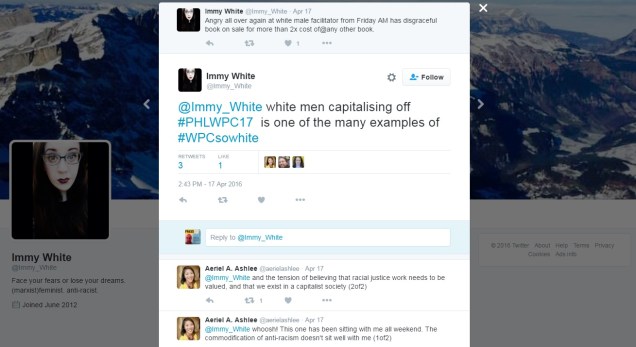
WPC2016 twitter anger

Social Justice Warriors do not want to end oppression. They merely want to become the oppressors themselves

If any further proof were needed that Social Justice Warriors can never be appeased or placated – and that they will keep on moving the goalposts indefinitely so that people with “privilege” can only ever fail the moral tests set for them – then one needs to look no further than the seventeenth annual White Privilege Conference which just concluded in Philadelphia.

One might have thought that an annual confab of contrite white people and their Allies in Privilege to self-flagellate and ruminate on the many ways in which they structurally oppress minorities would have been met with some approval by the SJW brigade. If anything could possibly please the Social Justice Warriors, it should be this event.

And so naturally, the SJWs crawl all over the conference and pick through every speech and interpersonal interaction to find fault with it, to wail and clutch their pearls in shock at the terrible oppression and insensitivity taking place, and to generally flaunt their More Moral Than Thou credentials in public.

The Daily Caller reports:

Disaffected participants in the 2016 White Privilege Conference (WPC) have taken to Twitter to complain that the conference was, ironically, too white and was actually filled to the brim with white supremacy.

Adopting the hashtag #WPCSoWhite, inspired by the recent #OscarsSoWhite campaign, Twitter users claimed the conference that was supposed to battle white privilege instead served to entrench it.

The tag appears to have been started and pushed with particular vigor by Aeriel Ashlee, an education consultant who attended WPC and objected to several parts of a keynote address delivered by (white) historian James Loewen.

She said Loewen’s rhetoric, which was solidly progressive throughout, actually entrenched white supremacy, partly because his speech allegedly lasted too long. When Loewen attempted to defend himself, Ashlee said that any defense was invalid and only further showed his white supremacy.

Every act by non-SJWs, even those desperately designed to appease them and lessen their anger (like university administrators resigning for upsetting their crybaby student populations or whole conferences being set up to discuss the problem with white people) is only more evidence of their guilt. Non-SJWs literally can do no right in the eyes of these totalitarian complainers.

This Twitter exchange between one of the keynote speakers and an antagonist shows the futility of debate, or even of complete capitulation to their demands:

James Loewen - Aeriel Ashlee - Twitter exchange

What exactly was Loewen supposed to do after being accused of overrunning his speaking time when in reality he did no such thing? According to SJW logic, the only appropriate response would have been for Loewen to fall on his knees and beg for forgiveness, even though he had done nothing wrong. And when Loewen failed to do so, the mere act of correcting Ashlee’s false accusation was interpreted as “a white man’s defensiveness intead of accepting responsibility”.

This is madness. In this universe, factual errors and misunderstandings can no longer be corrected if it involves a white male attempting to defend himself or contradicting a POC (person of colour) or other identity group, whose judgement is always final when it comes to determining whether any word or act constitutes “oppression”.

As Rod Dreher commented when social justice warriors criticised a classical music scholar for having the temerity to spend his free time teaching a class about “opera and ideas” to prison inmates:

SJWs ruin everything. They kill everything they touch. Why would anyone want to work in a field where these nuts run rampant?

There is literally no good deed or benign intention which modern Identity Politics cultists will not pick through, determined to find fault. But more tragically for these SJWs, this mindset dooms them to be prisoners of their own (real or perceived) circumstances, passing up endless opportunities for personal growth and even material advancement because they are so self-obsessed and captivated by the injustices meted out on past generations decades and even centuries ago.

More to the point, in the shorter term they will quickly become friendless. Except within their hermetically sealed circle of fellow Identity Politics cultists, nobody will want to socialise or work with these people. Because who wants to be in the company of highly-strung perpetual victims who consider themselves so morally superior that they police the words and behaviour of everyone around them?

But maybe that is where this will end up – with Identity Politics cultists sequestering themselves away in a closed, parallel society, unwilling to engage with the real world lest it corrupt or “harm” them. Perhaps SJWs will be the monks of the twenty-first century, worshipping their narcissistic god of self-identity and living unbearably tense lives as they seek to purge any oppressive behaviour from their systems and excommunicate those who make the smallest transgressions.

Far better than the rest of us having to submit to their tyranny.


The White Privilege Conference

Agree with this article? Violently disagree? Scroll down to leave a comment.

Follow Semi-Partisan Politics on TwitterFacebook and Medium.