Hat tip to Andrew Sullivan, fresh from his two week vacation (during which time I had no one to tell me what to think about the humanitarian crisis in Syria and the potential upcoming military action), who publicised an interesting new Tumblr blog, entitled “Where Bloggers Blog“.
From the site’s description:
I pulled this tumblr together so that we can all see the workspaces of our favourite bloggers — the places where all the magic happens. For the record, this isn’t a decorating blog — this is purely about sharing the diversity of creative spaces of our favourite bloggers, illustrating that blogging magic and inspiration happen in many different awesome, eccentric, spacious, cozy, neat, messy, colourful ways.
Whilst I am waiting for my own contribution to be uploaded to the site, readers can get a sneak peak of my current blogging cave below:
The Semi-Partisan Blogging Cave
The American flag went up to celebrate the 50th anniversary of the March on Washington last week, and will be brought back down when I have the inclination to do so. Fox News is playing on the television because (1) it is the only US news channel available in the UK (CNN’s pathetic International Edition does not count), and (2) you have to keep an eye on those crazy guys at Fox News Channel, because you never know what they will get up to if left unsupervised.
NBC news reports that US Supreme Court Justice Ruth Bader Ginsburg has become the first sitting Supreme Court justice to officiate at a same-sex wedding ceremony:
Saturday marked the first time that a Supreme Court member conducted a same-sex marriage ceremony. Justice Ruth Bader Ginsburg officiated at the marriage of a longtime friend, John F. Kennedy Center for the Performing Arts President Michael M. Kaiser, to economist John Roberts in the atrium of the center in Washington.
[..] Ginsburg, who turned 80 this year, was among the majority in a Supreme Court decision earlier this summer declaring that people in same-sex marriages are entitled to the hundreds of federal benefits that couples in opposite-sex marriages have.
Well, three cheers for that! Ginsburg has long been one of my favourite justices on the Supreme Court, both for her compelling life story and her written opinions and dissents – which, while I do not always agree with them, are always sharply and persuasively written. I think that it is very fitting that she was the first justice to help usher in this new era of tolerance and equal rights for gay and lesbian Americans.
I generally try to avoid writing about the shenanigans that take place on Fox News’ morning show, “Fox & Friends”. The cast is assembled from a pool of failed, lightweight, B-team journalists who either know nothing about the complexities of the world (think Steve Doocy), or ones who are highly educated but disingenuously dumb themselves down to appeal to the Fox News viewer (think Gretchen “I looked up the word Czar in the dictionary” Carlson).
But on this occasion they make it to the pages of my blog because one of them – Brian Kilmeade, on the right in the above picture – was taken back to school by Senator John McCain, who was a guest on yesterday’s show. Politico reports:
Sen. John McCain criticized Fox & Friends’s Brian Kilmeade on Tuesday after the co-host said he had “a problem with helping out” members of the Syrian opposition who were shouting “Allahu Akbar” as rockets rained down in a government-held district of Homs.
During an interview with Sen. McCain, Kilmeade played the clip of the Syrian opposition fighters in order to suggest that McCain’s plan to deliver weapons to opposition groups could ultimately backfire, putting rockets in the hands of terrorists.
“Allahu Akbar” means “God is great”, of course. It is akin to a Christian shouting “Thank God!”, as McCain patiently explains to the dimwit Kilmeade. Just because a phrase is hijacked by radical fundamentalists and turned into a war cry as they fly aeroplanes into buildings or press the plungers on their suicide vests, does not mean that it loses its original meaning:
“I have a problem helping out those people screaming that after a hit,” Kilmeade said.
Sen. McCain fired back, “Would you have a problem with an American person saying ‘Thank God! Thank God!’?”
“That’s what they’re saying. Come on!” Sen. McCain said. “Of course they’re Muslims, but they’re moderates. I guarantee you that they are moderates. I know them and I’ve been with them. For someone to say ‘Allahu Akbar’ is about as offensive as someone saying ‘Thank God.'”
As difficult as it can sometimes be to agree with John McCain – given his erratic oscillations between being the bitter, ornery old man failed presidential candidate and the measured voice of reason and geopolitical knowledge (if not foreign policy wisdom) – one must admit that he is quite right in this particular case.
And if Brian Kilmeade needs any further reminder that hearing the phrase “Allahu Akbar” does not necessarily mean that a Big Scary Muslim is about to kill him, he would do well to watch the video, shared previously on this blog, in which a grieving Syrian father is reunited with the little son that he believed to have been killed in a strike by pro-Assad forces:
The words that the family and the overwhelmed father cry out in joy as they embrace the boy?
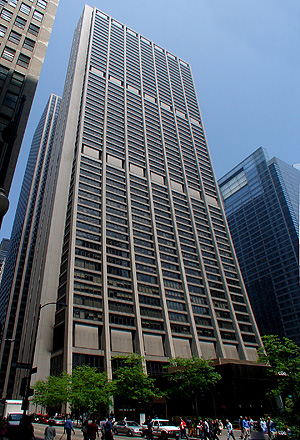
Apparently the glass panes of the new curved skyscraper under construction at 20 Fenchurch Street – nicknamed the “Walkie Talkie” – are reflecting and concentrating light in a rather unfortunate way so as to superheat and melt objects on the street.
20 Fenchurch Street. Image by AFP/Getty.
The Telegraph reports that a temporary scaffold and sun screen has been erected over the affected portion of the street, after rays reflected by the building were reported to have melted plastic components of a Jaguar car parked in a nearby parking bay, and enabled a man to fry an egg on the pavement:
Business owners in Eastcheap say the £200 million project has blistered paintwork, caused tiles to smash and singed fabric. A motorist has also said the intense heat melted part of his Jaguar.
Developers Land Securities and Canary Wharf said the screen was designed to prevent the “phenomenon”, caused by the current elevation of the sun in the sky, from taking place.
Baker Tom Logan said: “I’ve long suspected that London was trying to kill me, with the cumulative effects of pollution, stress and a generally harrowing atmosphere.
“Oh well. I suppose psychotic buildings firing lethal beams of pure energy is another thing we’ll have to get used to, like the congestion charge and parking permits.”
Speaking via a mouth-like orifice in the Gherkin, London said: “I shall also be using flying manhole covers to decapitate you. And look out for London Bridge turning into a giant metal snake with sewage-dripping fangs.”
It can certainly feel that way sometimes.
And finally, The Guardian reports that there are many other buildings around the world that cause similar problems:
Some of the burnished stainless steel panels of Frank Gehry’s Walt Disney Concert Hall in downtown Los Angeles, which opened in 2003, had to be sanded down to prevent drivers being blinded by the glare, and pedestrians fried by pavement hotspots that reached 60C. Residents across the street also threatened legal action over their sky-high air-conditioning costs.
The impact of buildings is by no means confined to heat and light. Skyscrapers with curved walls (notably in Chicago) have been known to accumulate large quantities of snow and ice on their surfaces before dumping them without warning on unsuspecting pedestrians below.
Beware when walking beneath the Chase Tower, Chicago in winter.
The only sensible conclusion to draw from all of this – you are not safe on your morning commute. Beware!
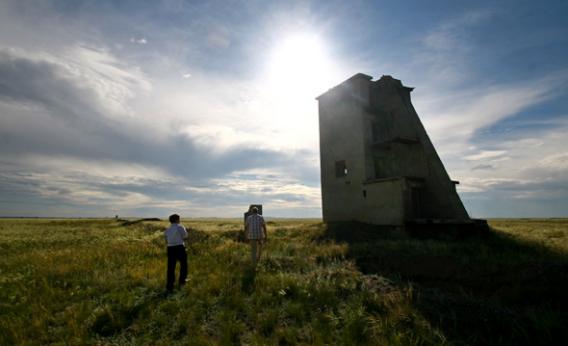
Slate Magazine has a thought-provoking article exploring the condition of disused above-ground nuclear test sites in the former Soviet Union, and the nascent tourism industry which is springing up to give intrepid explorers an experience of this slice of recent military and geopolitical history:
Nuclear test site in Kazakhstan. Photo by Jacob Baynham.
Focusing on a particular test site in Semipalatinsk, Kazakhstan, the article looks at the impact that 116 above-ground nuclear tests can have on the wildlife and topography of an area:
Looking out from the epicenter of these blasts, you can still see remnants of structures the Soviets built to test the power of these explosions. To the right are the crumpled remains of a bridge. To the left are fortified bunkers and barracks that had been filled with dogs, pigs, and goats to approximate the effects a blast would have on soldiers. In a line in both directions, 10 four-story concrete buildings rise from the Earth like the moai of Easter Island. These structures were filled with sensors to measure the explosions. Strilchuk calls them “geese,” because from a distance that’s what they look like: giant goose necks craning up from the grass, facing the place where man played God.
As well as the human impact on those in the nearby towns, fifty miles away:
Anastacia Kyseleva is an 86-year-old resident of the Institution for the Elderly and Disabled in the nearby town of Semey. She was newly married and living in a village near the test site when the explosions began. “We didn’t know what it was,” she recalls 60 years later, wringing a scarf in her hands. It wasn’t until a test in 1956 that soldiers told the villagers to leave their houses and stand beside the river. “We could see the mushroom cloud from the field,” she says. “It looked like a sunset. Since that year, a lot of people started dying.”
But amidst this ongoing legacy of sickness, birth defects and infant mortality, there is also cause for optimism:
The government’s optimism for the Semipalatinsk test site reflects Kazakhstan’s emergence from a Soviet nuclear wasteland into a prosperous capitalist economy. Kazakhstan has come to terms with its history quicker than most former Soviet republics. A wealthy, resource-rich country, Kazakhstan is broadening its profile as a leader of the nonproliferation movement by hosting negotiations on Iran’s nuclear program. They’ve volunteered to establish an international nuclear fuel bank, a measure of nuclear security that the International Atomic Energy Agency is seriously considering. The government even talks of building a nuclear energy reactor of its own, a peaceful application of the fierce atomic power that the Soviet Union once wrought upon the Kazakh steppe.