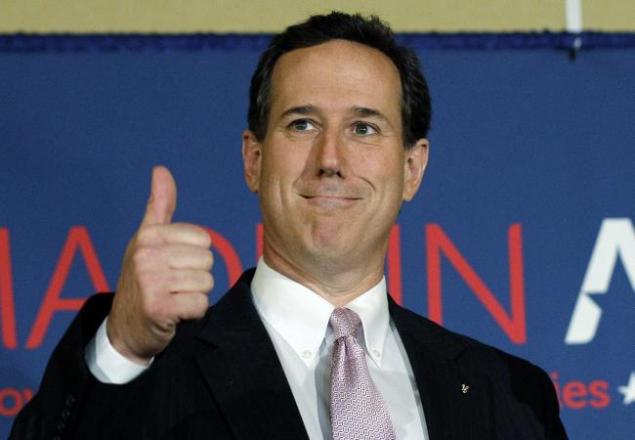
The Santorum Threat

Rick Santorum

You would be forgiven for thinking that Rick Santorum disappeared back into the political wilderness with the end of the 2012 presidential campaign, destined only to pop up occasionally on Fox News to wring his hands about the private sex lives of his neighbours, or to pen wacky columns for World Net Daily.

But you would be wrong.

The great and the good of the Republican Party (and Mark Sanford) have been showing up at the annual Faith & Freedom Coalition conference this past week, to stroke the egos of the evangelical “Christians” and “moral majority” Bible-thumpers therein assembled. Featured prominently among the speakers, none other than Rick Santorum.

Politico reports his speech in the context of Santorum’s implicit criticism of the Mitt Romney 2012 campaign, specifically the focus on the “You Didn’t Build That” theme:

The former Pennsylvania senator recalled all the business owners who spoke at the Republican National Convention.

“One after another, they talked about the business they had built. But not a single—not a single —factory worker went out there,” Santorum told a few hundred conservative activists at an “after-hours session” of the Faith & Freedom Coalition conference in Washington. “Not a single janitor, waitress or person who worked in that company! We didn’t care about them. You know what? They built that company too! And we should have had them on that stage.

Rick Santorum is dangerous, because he alone (with the partial exception of Ron Paul’s principled candidacy) instinctively gets something about the American electorate that is all but completely lost on all of the other past and potential Republican presidential candidates over the past two election cycles.

He understands that – as we saw with the recent Bilderberg Meeting protests – an increasing number of people are becoming disenchanted with the status quo system of economic and financial governance, and are losing faith in the American dream and any hope of regaining the middle class lifestyles that they once took for granted. And he understands the undercurrent of resentment resulting from this realisation, and the corrosive effect on Mitt Romney’s base of support.

The article continues:

Santorum did not mention Romney, whom he challenged in the primaries, by name during a 21-minute speech in a dim ballroom at the Marriott (a company on whose board Romney sits). But there was no doubt who he was talking about.

“When all you do is talk to people who are owners, talk to folks who are Type A’s who want to succeed economically, we’re talking to a very small group of people,” he said. “No wonder they don’t think we care about them. No wonder they don’t think we understand them. Folks, if we’re going to win, you just need to think about who you talk to in your life.”

Trying to carve out a role as a leading populist in the 2016 field, Santorum insisted that Republicans must “talk to the folks who are worried about the next paycheck,” not the CEOs.

This really gets to the rub of the problem, and is an exact restatement of my recent arguments against the secretive Bilderberg group. The Bilderberg attendees meet in secret with other highly successful people just like themselves, and presume to prescribe policies and solutions for the entire world based on their extraordinarily narrow range of experience. Similarly, the majority of GOP presidential candidates wouldn’t spend a moment of their lives in the company of someone who couldn’t write them a fat campaign cheque at the end of the day, but instinctively understand the preoccupations and concerns of business owners and rich financiers. And based on this narrow set of acquaintances they presume to create solutions “for the good of the country”.

Rick Santorum stands out among a sorry crowd of potential Republican contenders as someone who can not only talk to the “47 percent”, but also speak up for them.

Never mind that the solutions that he proposes – more protectionism, propping up inefficient, declining American industries and preventing the inevitable and needed transition toward a more knowledge-based economy – would actually harm this constituency so dear to his heart, as I explained last year when I dubbed him the “Pied Piper of Pennsylvania”. By virtue of the fact that he actually takes the time to understand and advocate for this group of downtrodden Americans, he will inevitably pick up a lot of support should he choose to enter the 2016 Republican presidential primary race.

Unfortunately, by voting for Rick Santorum not only do you get his special nostalgic, doomed-to-failure (but very populist) economic policy, you also get the basket of socially regressive and (in some cases) out-and-out bigoted policies for which he proudly and unapologetically stands. Hence the danger.

Yes, it is slightly ridiculous to be thinking about 2016 already. But at the present time, there is only one Republican who really gets it when it comes to the economic frustrations of the American middle and working class. And the danger – the Santorum Threat – is that if the economic outlook has not significantly improved by the time of the next election, and if the rest of the Republican field remains incapable of sympathising with anyone other than hedge fund managers and “job creators”, the man who lost out to Mitt Romney in 2012 could steal the nomination in three years’ time.

Patriot Watch, Ctd. 5 – Bilderberg Meeting

I’m removing the ” ” quotation mark symbols around this particular edition of Patriot Watch, because I think Alex Jones is right and undeserving of parody on something rather crucial currently taking place. His show from Wednesday 5th June, broadcast from London, is shown in full below:


Currently, the Bilderberg group of elites from the worlds of royalty, finance, media and industry are meeting at an exclusive hotel in the town of Watford, Hertfordshire, England.

For those who hear the word “Bilderberg” and immediately think “nonsensical conspiracy theory and black helicopters” – it is not – at least not as much as in the group is real and exists. They actually have a website now, which briefly details their official public aims, and meeting dates (but crucially, no minutes of those meetings or list of decisions taken or policies approved to be implemented). You can find their own website here to verify.

Why should any of this matter?

Well, as Alex Jones of InfoWars.com fame (or notoriety) says, if 150 of the biggest entertainers, movie stars and other celebrities, mostly very wealthy private individuals, were meeting for several days at an exclusive resort with tight, taxpayer-funded security around it, not only would the TMZ.com helicopter be flying overhead capturing live footage, but hundreds of thousands of people would converge on the scene to see their favourite stars and find out what was taking place inside.

But when people who hold the real reigns of power in our world – the heads of the largest banks, tech companies, royalty and others – meet with people who are currently in government (both George Osborne and Ed Balls, the UK’s chancellor and shadow chancellor respectively are attending, along with various heads of state and politicians from other countries, no one seems to care.  Even though surely, the least crazy conclusion to reach is that those people serving in government are going to come away from their luxurious meeting and enact policies that primarily serve the interests of the high-flyers with whom they were consorting?

Fortunately, more people are now starting to pay attention to this hide-in-the-open-air tactic of our elites meeting in wide open but unapproachable view to stitch up policies that benefit them but harm almost everybody else. See this interview on-site outside the Bilderberg steel wall, with UKIP MEP for London, Gerard Batten:


As Batten correctly states, people increasingly feel that government is something that is done to them, rather than of them, by them and for them, as is the ideal that we all hopefully still share, and was so eloquently expressed by Abraham Lincoln in his Gettysburg Address of 1863.

Hence, partly, the appeal of the Tea Party in America, and UKIP in Britain. Anything anti-establishment and perceived of being outside the rotten, corrupted system is being embraced with ever-increasing fervour.

I’m not writing this post to announce that I am now a card-carrying InfoWars subscriber, or that now I suddenly believe that the JFK assassination was a conspiracy, in “false flags”, or that the US government perpetrated or allowed the 9/11 attacks or the Boston Marathon bombings. Not at all.

But is it not a mightily strange coincidence that the people currently gathered at the Grove Hotel in Watford, Hertfordshire, UK – the royalty and dignitaries and media moguls and industry titans and captains of finance – have all done extraordinarily well financially and professionally, even since the great recession tore through our countries, while we have faced lost jobs, long term unemployment, fewer prospects, food insecurity, rising inflation, increased taxation and reduced living standards?

If Bilderberg were just a club for the rich of the world to get together and play golf, protected by their own privately-funded security, that would be one thing – even though, as Adam Smith wisely and presciently wrote in The Wealth of Nations:

People of the same trade seldom meet together, even for merriment and diversion, but the conversation ends in a conspiracy against the public, or in some contrivance to raise prices. It is impossible indeed to prevent such meetings, by any law which either could be executed, or would be consistent with liberty or justice. But though the law cannot hinder people of the same trade from sometimes assembling together, it ought to do nothing to facilitate such assemblies; much less to render them necessary. (Chapter X, Part II)

But Bilderberg is more than this because (1) we the people, through our taxes, are paying for these people to be shielded with privacy and protected with armed police, and (2) our elected officials are going to meet with them, and we will have no record of with whom they met, what was discussed in their meetings, or what was decided at the outcome.

There will be no press conference or public statements, as at least you get from self-congratulatory back-slapping events such as the Davos Forum. Just silence, silence that we are supposed to accept from our elected leaders after they share lobster dinners year after year with these elites, whilst meanwhile year after year these elites magically manage to continue to prosper, even as we the people suffer.

And as for the argument that our intrepid media would of course bring it to our attention if anything untoward or bad were taking place, when it comes to journalists and their role covering and exposing nefarious deeds or acts that are contrary to the public good, their credentials and reputations are totally and utterly undermined, in the US by their fawning over power and inability to question the Bush Administration’s feeble reasoning for war with Iraq, and in the UK by the phone hacking scandal, as just two of their most recent abdications of professional ethics failures.

So it can hardly be a surprise when the BBC’s lone reporter on the scene accuses Alex Jones of conspiracy theorising, shares none of his curiosity about what might be going on behind the big steel fence, and tries to provoke him into another one of his famous Piers Morgan show-style rants:


This video clip is many things, but good journalism it is not, from the BBC, and I would defy any right-thinking person to disagree with me. And if this is what we get from one of the most “prestigious” news and media organisations in the world, who knows what other news organisations might have overlooked, disdained, ignored, covered up or fawned over in the past, leaving us all in the dark? Can we then trust Sky News in the UK, or Fox News in the US, given their ownership? Of course not.

I find it strange and somewhat of a stylistic and political departure to be writing this article, but I’m sick and I’m tired. I don’t think it’s right that someone like Mitt Romney can pay a far lower effective rate of tax than me because he derives his income from investments whereas I derive mine from a salary. I think that if fairness means anything, tax rates should be flat.

I don’t understand why it should be that shoplifting or marijuana possession can see a person sent to prison and their life ruined, but conspiring to fix the LIBOR rate doesn’t result in any conviction for any of the people involved.

Oh, I understand why it is, but not why it should be.

And for all of his over-exaggerations, egotism, self-promotion and tendency to see the New World Order in every single event that happens around the world, Alex Jones and others like him are some of the only ones talking about this, even while they are mocked by the haughty, semi-secure, comfortable middle class journalists and newsreaders who are much closer to the edge of the economic precipice than they realise.

I’ve had enough of it. I want to know who my elected representatives are meeting at that sealed-off, taxpayer funded security protected site for wealthy private individuals. I want to see the pertinent minutes after the meeting detailed lists of what was discussed with elected officials, what was decided, and what new cack-handed policies we can expect to germinate in our national and EU legislatures as a result of the super-rich gala bash taking place in Watford this week.

Call me an idealist, but I still believe that my government should be first and foremost accountable to me, a British citizen, and not to Amazon or Starbucks or Google or Jeff Bezos or Eric Schmidt or Bill Gates (for all the excellent philanthropic work his foundation may do), or anyone or anything else other than other living, breathing, British citizens.

Semi-Partisan Sam is saying No.

Exit Bachmann, Ctd.

Oh, God.

She’s going to make a reality TV show, isn’t she?


It may be freezing and rainy in London on this afternoon in late May, but boy am I glad to be well outside the broadcast reach of the TLC network right now.

Good luck, America.

Exit Bachmann

Well, this is a very sad day for American comedians and political junkies across the land. Our thoughts (but certainly not our prayers) must especially go out to Bill Maher at this difficult time. Why?

Because US Congresswoman Michele Bachmann of Minnesota’s 6th district – otherwise known as Minnesota Palin – will not be running for re-election in 2014.

And she made this incredibly cheesy YouTube video to break the devastating news to her constituents:


She assures as that her decision has nothing to do with any of the following potential juicy reasons:

1. The fact that she barely held on to her seat in 2012, and the same Democratic Party challenger is gearing up to take her on again in 2014.

2. Her 2012 presidential campaign is being investigated by the Federal Elections Commission for potential serious improprieties.

3. She goes on dirty, McCarthy-ite, partisan witch hunts against loyal public servants.

4. She’s quite clearly insane.

So what, oh what could the real reason be? Did Michele Bachmann jump or was she pushed?

Normally I wholeheartedly agree with the likes of Glenn Greenwald, who argue that this type of Politico-esque process and personality-obsessed gossiping should not be part of our political discourse, and that it distracts from real journalism, and serious discussions of policy when we need them most. Quite right. But this particular dose of schadenfreude is too good to pass up.

Farewell, Michele Bachmann.

At least she was looking directly at the camera this time around.

Sanford Wins

Well, I was wrong.

Based on pre-election polling data, and an excess of trust in the wisdom of the electorate, I predicted that the Democrat Elizabeth Colbert Busch would defeat the Republican former governor Mark Sanford in South Carolina’s 1st congressional district election.

Politico reports:

In the end, the nail biter that late polls hinted at never materialized: Sanford crushed Colbert Busch, 54 to 45 percent.

A turning point in the race came two weeks ago, when Sanford held a mock debate with a cardboard cut-out of House Minority Leader Nancy Pelosi, implying that the California Democrat — persona non grata in conservative South Carolina – was a stand-in for his Democratic opponent.

The former governor endured days of derision from the press for the move — Mark Sanford, once regarded as a viable potential presidential candidate, was debating a piece of cardboard.

But behind the scenes, Sanford’s aides grinned: Every time a reporter put “Pelosi” and “Colbert Busch” in the same sentence, the Republican was winning.

From reading this article it is clear that Sanford ran a far superior campaign to Busch. Tightly-controlled campaigns such as Colbert Busch’s, with handlers keeping the candidate away from any potentially awkward encounter with a real person, are almost never the best way to win, let alone the right way to behave, and yet that is precisely the model that Colbert Busch chose to follow.

Sanford, by contrast, ran an old-fashioned retail politician campaign, barnstorming the district, accepting every invitation for interview or appearance, and offering no end of mea culpas whenever he was asked about his chequered past.

The article continues:

This time, Sanford was, in a sense, running from scratch once again. Without the trappings of the governorship, he hop-scotched the Lowcountry in a black van driven by an aide. After spending a year in obscurity, he was reintroducing himself to voters — soothing the concerns of voters who still felt squeamish about what he had done.

In a district rich with evangelical voters, he adopted religious language to describe his personal journey, talking about a “God of second chances.”

“His strength of his campaign style is that he’s out there every day,” said Scott English, who served as Sanford’s gubernatorial chief of staff. “He loves being around people, and that’s the hallmark of his campaign.”

He ran a smart campaign because he knew how to run a smart campaign. Because he has been doing this since the age of 34. Because he is a career politician.

In South Carolina, the better candidate – but the worse representative – prevailed.