Booker, Bain And Private Equity

Cory Booker - Newark - Bain Capital

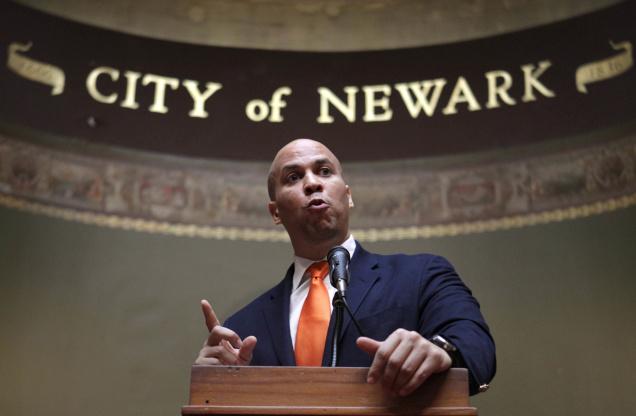
Today’s post is on the furore generated by Newark Mayor Cory Booker’s recent comments on last weeks’ NBC Meet The Press show, in which he appeared as a surrogate for the Obama reelection campaign.

When asked about attacks originating from the Obama campaign and aligned PACs, attacking Mitt Romney’s record at Bain Capital, Mayor Booker essentially said that those attacks were an unfair and unnecessary distraction from the real issues of the election:

“To me, it’s just this — we’re getting to a ridiculous point in America, especially that I know. I live in a state where pension funds, unions and other people are investing in companies like Bain Capital. If you look at the totality of Bain Capital’s record, it ain’t — they’ve done a lot to support businesses, to grow businesses.”

For those unfamiliar with the maelstrom of ridiculousness, accusation, counter-accusation, retraction and non-retraction that these innocuous comments generated, the consequences are related in amusing style by Kathleen Parker at The Washington Post.

Though really if you have taken in any American political news over the past week or so, you can hardly have failed to have heard about this story from one source or another. And in terms of the “press coverage to newsworthiness ratio” mismatch, this story scores quite highly.

As far as I can tell, despite all of the noise and column inches that this “story” has generated, most reasonable people could agree with the following sentiment: that there is nothing wrong with private equity – well, no more than what is right or wrong with any other industry – and the Obama reelection campaign has not publicly suggested otherwise.

No for-profit business is run for the sake of creating jobs – that just happens to be a fortunate side effect of growth and success, and private equity plays an important role in ensuring that capital is allocated most quickly and efficiently to those enterprises that can generate the best return on it. I don’t recall Mayor Cory Booker attacking private equity, capitalism and the American dream when he went on Meet The Press last week, nor Obama himself (though the Obama campaign and associated PACs and campaign surrogates have certainly crossed this line on occasions).

So what exactly is wrong with saying that attacks on private equity are nauseating? It may be a rather strong choice of words, but attacks on private equity are certainly irrelevant. And saying so does not blow apart Obama’s central campaign issue, as many conservative commentators seem eager to believe.

If we leave out the words of the Super-PAC political ads (and really we have to – on both sides, be they Republican and Democrat aligned – because they are loose cannons, unconnected with the campaigns and able to say anything they please regardless of the views of either candidate), what the Obama campaign is trying to point out is that a successful career in private equity is not of itself either a qualification for, nor indication of success at the presidency. Incidentally, one could (and many have) made the same argument about a career in community organising and constitutional law teaching.

Quite a few people work in private equity. And many more people – including ‘normal’ people, through their savings and investments and pensions – benefit from the work that these people do. Having a successful career in private equity does not of itself qualify someone to be President of the United States – it is a hard job, and probably nothing short of a previous stint as Head of State of another powerful nation really qualifies you for it.

And so if the Obama campaign wants to try to draw a contrast between the president’s four years of on-the-job experience and Mitt Romney’s lack thereof, that seems fair enough (though the old “don’t change horses midstream” argument is rather old and worn at this point, especially after George W. Bush’s reelection campaign), and as long as he avoids straying into “the corporations are raping the world” territory he should be allowed to make that point without being jumped on and labelled an anti-capitalist reactionary.

This seems to me like a big fuss about nothing – after eight days, let’s finally move on from this one now.

On Young Voters And The GOP

Republicans - GOP - Young Voters

At least some people in the Republican Party seem to have woken up to the demographic timebomb ticking away under their feet, and have started to lament, if not yet analyse, the fact that the vast majority of young people in America today would sooner give up their loud music and Pac-Man video games (or whatever it is that young people do for fun these days) than vote for a GOP candidate in a presidential election.

There is an article worth reading on this topic by Jeff Jacoby in today’s Boston Globe, entitled “As Dems rack up debt, youth should flock to GOP”.

Mitt Romney is apparently the latest Republican to develop a sense of outrage that no one outside of the grey haired brigade would be seen dead voting for him:

‘I don’t mean to be flip with this,’’ said Mitt Romney during a Q&A with students at the University of Chicago last week. “But I don’t see how a young American can vote for a Democrat.’’ He cheerfully apologized to anyone who might find such a comment “offensive,’’ but went on to explain why he was in earnest.

The Democratic Party “is focused on providing more and more benefits to my generation, mounting trillion-dollar annual deficits my generation will never pay for,’’ Romney said. While Democrats are perpetrating “the greatest inter-generational transfer of wealth in the history of humankind,’’ Republicans are “consumed with the idea of getting federal spending down and creating economic growth and opportunity so we can balance our budget and stop putting these debts on you.’’

At which point the needle on my “Are You For Real?” machine jolted as far toward the “You Must Be Kidding” end of the spectrum as it could go before the whole machine exploded in a shower of sparks.

The author himself does a good job of pouring cold water on any Republican claims to the mantle of fiscal restraint:

But that debt wasn’t piled up without plenty of Republican help. During George W. Bush’s presidency, annual federal spending skyrocketed from $1.8 trillion to $3.4 trillion, and $4.9 trillion was added to the national debt. Bush left the White House, in fact, as the biggest spender since LBJ . Granted, the profligacy of Barack Obama has outstripped even Bush’s bacchanal: CBS reports that Obama has added more to the national debt in just three years and two months than Bush did in his entire eight years. Still, younger voters can hardly be blamed if they haven’t noticed that Republicans are “consumed with the idea of getting federal spending down.’’

Therefore I do not intend to say anything more about the glaring, shameless hypocrisy of the Republicans – the party that gifted America two unfunded wars, large tax breaks not balanced by spending cuts and the joke that is Medicare Part D – laying any claim whatsoever to competency in handling the nation’s finances. Except that I will say that much of the “profligacy of Barack Obama” mentioned by the author was the result of a fiscal stimulus implemented (despite its imperfections) at a time when the US economy was in freefall, and without which the tepid recovery currently being experienced would likely be nothing but a sweet dream.

Mitt Romney and those others in the Republican Party who scratch their heads wondering why young people don’t like them miss the point entirely when they sulk that young people should embrace their economic policies. Though their fiscal policies may perhaps benefit young people in certain ways (and even this is arguable), there is no evidence based on past behaviour that they will actually have the political courage to implement them if voted into office. Old people (the beneficiaries of the “wealth transfers” that Romney claims to lament) actually vote in large numbers. Younger people don’t. The policy priorities of our political candidates duly reflect this fact.

Besides, it is not the GOP’s economic policies that are the main problem. The problem is the fact that in a bad economy, the opposition party is spending more time talking about abortion, contraception, mass deportations of illegal immigrants, repealing ObamaCare, questioning the president’s eligibility to hold office, and reinstating “Don’t Ask, Don’t Tell” and a host of other socially regressive policy positions which are anathema to a majority of young people today than they are about how to reduce unemployment and help a population ill-equipped to perform the more highly-skilled, non-manufacturing jobs of tomorrow.

Rick Santorum in particular often complains that the media focuses on his socially conservative policy positions and not his economic plan, but he can hardly expect young voters to thrust him into office on the back of his inspired ideas on the economy (spoiler – they are not that great) when they are more worried that he will cut off their unemployment insurance, or close down the Planned Parenthood centre where they go for medical care, or start a war with Iran.

It is no coincidence that the one Republican presidential candidate who actually walks the fiscal conservatism walk and who doesn’t continually bleat on about social issues and the culture wars – Ron Paul – vastly outperforms his rivals with young voters, in primary after primary.

Newsflash to Mitt Romney, Rick Santorum and Newt Gingrich:

Even if you had a cogent economic policy (which, by the way, none of you do) you will never appeal to young people by just tweaking your fiscal message a little bit. You had a choice when you started your presidential campaigns, and in your desperation to secure the party base you chose to fearmonger and rant about “taking back America”, and fret about turning into a socialist state, and speak about the importance of individal freedom in one breath while promising to impose your religious values on the whole country in the next.

Many young people would like an alternative to President Barack Obama, but you offer them nothing by way of a contrasting, conservative vision for the country that they could ever find acceptable. You offer them nothing. You offer racial minorities nothing. You offer women nothing. You offer the working poor and the unemployed nothing. And all of these constituencies will dutifully line up to vote for Barack Obama, and you will lose the presidential election on November 6th.

It could be otherwise, if only you offered the American people a genuine acceptable choice when they cast their votes.

The Daily Beast Falls Under The Santorum Spell

Rick Santorum

Oh dear. The good people over at The Daily Beast have heeded the call of the Pied Piper of Pennsylvania and endorsed the never-gonna-happen pro-manufacturing-rennaissance mirage offered up by Rick “Blue Collar” Santorum.

Of course, they are at pains to distance themselves from his more extreme social policy positions, and they get that out of the way at the beginning:

“There’s a lot not to like about Rick Santorum on the social-issues front. He’s an anti-abortion absolutist, no fan of gay rights, and possesses politics so influenced by faith that even contraception remains controversial in his mind.”

But after this, and a couple of disclaimers about the effect of such a manufacturing policy on the budget deficit, they are all praise:

“But at least the man is making a bold proposal that attempts to address an issue that has helped destroy the jobs that used to enable families to get on the first rung of the ladder out of poverty. Rather than simply having products designed in the U.S.A. and then produced overseas, an added incentive to make things in America could help tip the scales back in favor of American manufacturing. It might help make a real dent in our half-trillion-dollar trade imbalance with China and other countries.”

Okay, firstly: future manufacturing jobs will be more highly skilled and require a greater level of education or prior training than many of those displaced by the decline in manufacturing currently have. They aren’t going to get these jobs, if employers bother to create them in the US at all, despite a big tax giveaway. Those jobs that don’t require this higher level of skill won’t offer a rung on the ladder out of poverty any more than an entry-level job in the service sector.

Secondly: What if I write and distribute an awesome piece of new software? What business is it of the government to tell me that my work isn’t as worthy as that of someone else who opened a factory or a sawmill? Are we supposed to pick winners now, based on perceived societal good? The Daily Beast seems to lean to the left somewhat so I can understand them espousing this argument, though I vehemently disagree with it.

But my point remains: a Republican – especially one who rails about government handouts to individuals and bailouts to Wall Street and Detroit – has no business espousing policies to favour one segment of the economy over the other. I mean, that’s European/Soviet style planned-economy socialism, right?

Newt Gingrich’s Path To Victory

I didn’t think there was one either, until I saw this footage:


Here, Newt Gingrich is waiting to address the AIPAC conference via ABC News satellite feed, and at one point the Happy Man nods off in front of the camera as the previous speaker, Leon Panetta, finishes his remarks.

Sadly, the moment comes eventually when he wakes up and starts delivering his speech. But captured here are at least 50 blissful seconds in which Newt Gingrich doesn’t really do or say anything overly grandiose, pompous, far-fetched, or in any other way further condemn his chances of winning the nomination.

If Sheldon Adelson has not yet turned off the financial life support taps to Mr. Gingrich’s campaign, perhaps this footage can be turned into his next television commercial. All he would need to do is whisper “I’m Newt Gingrich, and I approve this message…” in a voiceover at the end.

Rick Santorum, Honest Politician?

Rick Santorum - Obamacare - ACA - Healthcare Reform

Ian Leslie, over at the excellent blog Marbury, talks about Rick Santorum’s violent reaction to John F. Kennedy’s famous speech about the separation of church and state:

Money quote from Marbury:

“One of Santorum’s most striking characteristics as a politician is a willingness to own his most controversial remarks. Most politicians running for president wouldn’t have criticised JFK’s speech in the first place, JFK being the iconic figure he is for Americans across the political spectrum. Neither would they have used such extreme language. But if they had, they would definitely find a way to “walk it back” when asked about it on national TV. Santorum doesn’t do that. He repeats, explains, and intensifies. He doesn’t succumb to pressure from advisers, because he doesn’t have any advisers, at least not in the professional sense. He can truly claim to be “unspun”; an honest politician.”

I quite agree with the point about Santorum being willing to own his most controversial remarks. That is very true, and in many ways is admirable for a politician in this age. Too often, politicians will pander by straying across the line of acceptable or reasonable discourse in order to pick up a few stray outlier votes (sadly, we see this time and again with some Republicans and the birtherism movement), only to walk their remarks back just enough when called out by the media. And to give Santorum credit where credit is due, he usually does not do this. He doubles down, stands by his position and defends his remarks. As I have said before, this does make him one of the most genuine candidates.

However, calling him an honest politican goes too far. Honesty is not just the trait of saying what you believe, it also must be the practice of calling out and correcting those who speak falsehoods in your presence, especially those who support your candidacy. Rick Santorum was notably silent when an audience member at one of his town hall meetings stated that President Obama was born outside of the United States and was therefore ineligible to hold office, pivoting instead to agree that he should be removed from the White House at the next election rather than disavowing her words.

Neither can Rick Santorum be said to be honest when he peddles false hope of a manufacturing renaissance in America, as I discussed in this previous post.