Debating Political Diversity And The Importance Of ‘Brave Spaces’ At The University Of Miami

college-lecture-hall-safe-space

Whether “brave spaces” are any less infantilising than “safe spaces” is a matter for debate, but the University of Miami community’s recognition of the importance of a more politically diverse faculty and campus is an encouraging sign

The editorial board of the University of Miami student newspaper, the Miami Hurricane, takes a surprisingly bold stance on the problem of progressive ideological dominance on campus, and – encouragingly for a student publication – calls for greater ideological diversity rather than the fearful conformism demanded by many students.

From the Hurricane’s editorial:

UM leans to the left, as do most universities. A report published earlier in the campaign by The Tab documented that 60 percent of faculty donations were made to Hillary Clinton’s campaign; the other 40 percent was split between the other Republican candidates and Bernie Sanders.

In the classroom, professors can be very vocal about their political opinions, whether that’s a subtle joke woven into a lecture or an actual discussion of their political beliefs.

When professors deride or mock certain political views in their teaching, that only alienates students and undermines the purpose of an educational forum. Part of the reason that conservative students feel so disenfranchised from the media and academia may be because for most of their lives, the intellectual “authorities” in their lives have been liberal and taught in left-leaning ways.

At this point, I actually felt a little uneasy. While it is certainly true that the progressivism and intolerance of conservative ideas shown by many university professors is often off-putting to conservative students and academic peers, the idea of people being disenfranchised or excluded because of the words of other peers and authority figures skates awfully close to the wheedling complaints of Social Justice Warriors that criticism and free speech must be suspended for their own mental health.

This blog has warned before that it is only a matter of time before conservatives, persecuted for their beliefs by fellow students and university administrators alike, begin to use the same language of fragility and vulnerability used by the SJWs – and I think we are now starting to see that prediction come true. None of that detracts from the point made by the Hurricane’s editorial board, which remains valid. But as always, a creeping culture of victimhood is something to watch out for, and guard against.

Fortunately, the editorial soon improves:

Courses like The Election are great because they expose students to professors and guests from both sides of the aisle, which can help break down the barriers of bias.  It is much easier to dismiss the opinions of a peer, a social media troll, or a crazy uncle than it is to automatically dismiss the ideas of an authoritative figure who has a Ph.D. in the relevant discipline. Ideological diversity may also help students recognize the flaws in their own opinions and be more self-critical.

When conversations focus on sweeping platitudes rather than individual reasons, our personal networks suffer as well. Too many students have given up Facebook friends or real-life acquaintances over political differences. It’s easy to generalize a whole group of people just based on one or two beliefs that they voice, but these generalizations create many false assumptions, especially in this election when few people are completely behind their candidate.

Restrain from automatically assuming that another student is racist, sexist, elitist or corrupt due to a few of their demonstrated ideological beliefs. People have reasons for holding their beliefs, and if they’re willing to talk about it in a respectful way, then take the opportunity to respond with dialogue rather than a diatribe. Identity politics has made political opinions just as personal as ethnicity and religion, making it hard to separate feelings from ideas.

This is good. Most of us can at times be too quick to pigeonhole and condemn people based on a few assumptions and extrapolations about their political leanings, and the board’s point that many people are not strongly behind their candidate this time (either disappointed Bernie Sanders supporters reluctantly supporting Hillary Clinton or Republicans holding their nose while supporting Donald Trump) should warn us of the sweeping range of variety and nuance which is lost when we simply label people as Trump or Clinton supporters.

The editorial board is also quite right to observe that the rise of identity politics has made it much harder to separate feelings from ideas. A self-aggrandising worldview which places the individual at the centre of everything is an atrocious way to discuss ideas, as it makes rejection of an idea seem like a personal attack. That’s why weepy young students now talk about their identities being “invalidated” when people do not accept the new orthodoxies around sexuality and gender, as though they might simply vanish in a puff of smoke unless everyone on campus is forced to approve of everyone else’s life choices.

And then comes an unusual suggestion:

A healthier alternative for a “safe space” is a “brave space.” A “brave space” encourages people to freely explore different questions and issues – still trying to respect other people, but not restricted by the fear that certain ideas make others feel uncomfortable.

The goal of a diverse college campus is not to create comfortable spaces, but to be caught a little off guard by all of the different types of people and ideas that might not be found in East Portland or a small town in South Dakota. That’s okay. If we embrace that vision, we can create a more tolerant, educated and cooperative community.

Well, a brave space is certainly an improvement on a space where the First Amendment is suspended in order to prevent glass-jawed snowflakes from colliding with reality. The rejection of the notion that uncomfortable ideas should be avoided is, in these depressing times for free speech and academic freedom, a positive step forward.

But surely it would be better still to simply cease talking about “spaces” at all? The term is now ubiquitous – even news articles totally unrelated to the Social Justice agenda talk about the need for public bathrooms to have a “safe space” for parents to change their baby’s diapers. As opposed to what, an unsafe space like a gun range or a demolition site?

Why, when the term “a convenient place” would have sufficed a decade ago, must we now describe everything as a “safe space“? Welcome to my home; here’s a safe space for you to hang your coat, and over there is a safe space for you to sit and watch television. It’s puerile and infantilising.

Is the whole world really so riddled with danger that we need to mark out those places which are actually safe for human foot to tread? The journey from my dorm room to my Ivy League college classroom is fraught with many dangers, but at least the gender neutral restroom offers me a safe place to pee, the shuttle bus provides a safe space for me to ride across campus, the students’ union is a safe place for me to relax between classes and the lecture hall itself is a place where no idea that I deem central to my identity can ever be challenged.

Flippant, yes, but also an accurate transcription of how the contemporary student mind seems to work. And of course it is utterly offensive – there are people in benighted parts of the world where daily physical safety cannot be taken for granted and is routinely violated, yet here are some of the most privileged youths of any generation in history trembling in fear that they may encounter disapproval or mean comments while walking between buildings at their $40,000-a-year degree factory.

(As Malcolm Gladwell explains, this is a result of a shift in the way which we describe actions or behaviours which are undesirable. Whereas once we would have condemned sexism, racism or homophobia as simply being wrong, today we talk spuriously of the “harm” that these words and encounters visit upon us. And when every single human interaction is viewed as having the ability to physically or emotionally harm us, calls for network of safe spaces to act as stepping stones through the world inevitably follow).

Brave spaces are marginally better, perhaps, but it is depressing indeed that we now have to pat ourselves on the back and give ourselves a lollipop for being “brave” and subjecting ourselves to the mere possibility of hearing contradictory viewpoints or unpleasant ideas.

This used to simply be called “being an adult”. Is it really too much to ask that we return to that bygone age of resilience and maturity?


Safe Space Notice - 2

Top Image: Pixabay

Support Semi-Partisan Politics with a one-time or recurring donation:

Agree with this article? Violently disagree? Scroll down to leave a comment.

Follow Semi-Partisan Politics on TwitterFacebook and Medium.


Conservatism, Behind Enemy Lines

Rod Dreher reports on a fascinating (and depressing) exchange posted on the wall of Princeton professor Robert P. George, between Professor George and a closeted conservative colleague.

The recounted exchange is worth posting in full:

Closeted conservative colleague: “I don’t feel I can say what I think, at least not at this stage. I have a family to care for and other responsibilities, you know.”

Me: “Sure. I’m not criticizing you.”

CCC: “I’ve seen people’s careers ruined for saying what they think.”

Me: “I have, too. I’m really not criticizing you. I assume you’re following your conscience.”

CCC: “You say what you think and you’ve survived. But your the exception.”

Me: “I’ve been very fortunate. That’s true. But there are plenty of others. I’m not unique. There’s Harvey Mansfield, Hadley Arkes, Mary Ann Glendon, Jim Ceaser, and others. Even some people they’ve tried hard to destroy have survived. Mark Regnerus at the University of Texas, Austin,” for example. They threw everything they could find at him, every calumny imaginable. They tried to get him formally investigated and fired. But he has beaten them. I predict he’ll be promoted to full professor this year.”

CCC: “Yes, but there have been lots of victims, too.”

Me: “Yes. Alas. Lots of victims.”

CCC: “You think I should say what I think.”

Me: “I think you should follow your conscience.”

CCC: “That’s just your way of saying I should say what I think.”

Me:; “Look, as I said, I’m not criticizing you. Only you can discern the demands of your own conscience. I didn’t even bring this whole subject up, you did.”

CCC: “I know what you tell your graduate students to do. You tell them not to hide their politically incorrect views.”

Me: “Well, yes, I hardly hide my advice to them. They initially find it counterintuitive. Their natural instinct is to hide their dissenting beliefs or downplay them. I think that’s risky from a character point of view and also not the best strategy for success.”

CCC: “You ARE judging those of us who keep our opinions to ourselves, then.”

Me: “For heaven’s sake, I’m just saying that there is a certain moral hazard in not speaking your mind. As scholars, we’ve got a special obligation to truth and a vocation to truth-telling. Of course, everybody has a basic obligation to honor the truth, as best they grasp it, but our obligation is even more central to who we are. So, speaking for myself, I don’t see what the point of being a scholar is if we’re not willing to speak the truth as best we understand it. I mean, there are lots of other fields we could go into. We could be lawyers, or doctors, operate hedge funds. There’s the insurance business. Wendy’s franchises. Anyway, again speaking for myself, if I felt I couldn’t speak the truth out loud, I would abandon academic life and go do something else.”

CCC: “You’re not afraid to say what you think because you’ve been able to get away with it without your academic career being ruined.”

Me: “That’s exactly backwards. I’ve been able to get away with it because I’m not afraid to say what I think. Fear empowers the bullies. They’re far less bold and aggressive when they know you’re not afraid of them.”

CCC: “Well, I am afraid of them.”

What emotion do you suppose is primarily motivating CCC? I think that the answer is quite clear: terror. Sheer, unbridled terror at the thought of being purged not only from one’s current job but from one’s profession field altogether if one so much as questions the progressive, social justice/identity politics dogma which has descended on academia like a suffocating blanket.

Where else in history have we seen such terror, such fear of having one’s heretical personal beliefs exposed and punished by the state or the mob? It’s hard not to give way to hyperbole, but this is literally the stuff of Orwell’s 1984, or (back in the real world) Soviet Russia during the purges.

And for what? To bring about forced adherence to the new orthodoxy on gender identity, racial politics, climate change, immigration and any other left wing cause du jour. Left-wing academics and students have abandoned any glancing interest in persuasion as a tool, and have jumped straight to brutal enforcement. Some academic fields will take longer than others to fall under the jackboots of this new authoritarianism – the STEM subjects are still relatively free, the humanities dangle over the precipice while the social sciences have long since fallen – but all are heading in the same direction.

And this is why Robert P. George’s own stance matters, and is correct. Just as there can be no equitable accommodation with people who want to establish a fundamentalist Islamist caliphate across the West, neither can conservative academics and other defenders of free speech split the difference with the authoritarian, petty tyrants who are busy consolidating their control over the university campus. One either has academic freedom and the right to free speech, or one does not. There is either censorship and an ideological test for working in certain professions, or there is not.

The time for keeping one’s head down and trying to avoid trouble is over. Those of us who believe in free speech and unrestricted academic enquiry have an obligation to speak out in defence of those being persecuted or intimidated for their beliefs, today and in the future, whether we agree with the particular speech in question or not.

They can’t arrest us all and they can’t fire everyone simultaneously. Conservatism needs to make a stand, to boldly assert that it will not be intimidated and purged from academia without a fight, or without exposing the progressive, social justice cultists as the modern day tyrants that they are.


academia-learning-conservatism

Support Semi-Partisan Politics with a one-time or recurring donation:

Agree with this article? Violently disagree? Scroll down to leave a comment.

Follow Semi-Partisan Politics on TwitterFacebook and Medium.

The Cult Of Social Justice: Many Students Do Not Want To Be Coddled, But Universities Give Them No Choice

Would you rather your child went to a university which promotes rigorous debate and the search for truth, or a coddling daycare centre which seeks to shelter young adults from contradictory opinions and unpleasant facts while enthusiastically validating their every life choice?

In this short, entertaining lecture delivered to American high school seniors preparing for college, social psychologist Jonathan Haidt (and co-author of “The Coddling Of The American Mind“) switches between characters to portray two different university recruitment speakers, one representing Strengthen University and the other attempting to attract students to Coddle University.

Strengthen U. is described in these terms:

We are kind of a cult. We worship truth – this is our sacred value. We will throw anything overboard if it conflicts with this sacred value. In fact, the one act of sacrilege in our school is dishonesty.

Our motto actually comes more recently, from Thomas Jefferson: “For here we are not afraid to follow truth wherever it may lead, nor to tolerate any error so long as reason is left free to combat it.”

[..] So at Strengthen University, we offer hard classes. Everybody doesn’t get an A. You might even get some Ds, you might even fail a course. At Strengthen, we will not do anything to bolster your self esteem. We will teach you skills, we will give you opportunities to succeed, and if you do, you will feel very proud of yourself, you will deserve your self esteem. But we will not build it for you.

We will give you no safe spaces. We do not buy Play Doh and put it in safe spaces for students who feel “threatened”. We will never give you a trigger warning. When you are in a course, if the professor assigns a book we expect that you will not be destroyed by reading the book. If it has ideas you don’t like, we hope you’ll object.

At Strengthen, our sacred value is truth. And what that means is that we are very vigilant – that we never allow a climate in which our students feel they are walking on eggshells. If everybody is afraid of saying something, afraid that if they open their mouth and say what they think they’ll get pulled over by PC Principal [..] that is just death for free inquiry. So we will not allow that to happen.

So here’s the most dangerous thing you need to know about Strengthen University. Adults will not get involved in your relationships. Now think about this: what are you gonna do if somebody insults you? What are you gonna do if somebody uses a racial slur? What are you going to do if someone uses the N-word?

Now, for thousands of years – up until the 1990s – students dealt with this on their own. They might fight back, they might shame the person, they might talk to the person. Since the 1990s there have been speech codes that give adults authority to punish people who commit hate crimes or who use hate speech. What I’m telling you is that we are currently fighting the Department of Education on this, and we expect to win [..] and we expect that we will be legally allowed to stay out of your relationships. We expect you to handle it yourself.

While Coddle U. is pitched to the students in this way:

It’s a wonderful school, a very safe school, supportive school, I urge you to come. We were founded in 1965 based on the ideas of Herbert Marcuse, who was a German sociologist and political philosopher. He came to America – fleed the Nazis, did much of his work at Brandeis and many other schools.

At Coddle, our sacred value is Inclusion. We create a safe, welcoming space for all students. Any colour, any gender, any gender identity, whatever it is, we want to include you. Our sacrilege – the worst thing you can do at Coddle – is blame victims. We will not allow this, that is a violation of our sacred value. We don’t want anyone to feel excluded.

We have very good justification for this policy because the works of our founder, Dr. Marcuse. He wrote this wonderful essay in 1965, it was published in a book “A Critique of Pure Tolerance”, in which Marcuse explained why it is that things should not be tolerated if they impede “the chances of creating an existence without fear and misery”. Of course that’s our goal – don’t we all want the world to be free of fear and misery? So if certain kinds of actions and speech impede the creation of that world, why should we tolerate them?

[..] He goes on to describe what he calls “liberating tolerance”, which would mean intolerance against movements from the Right – because they are intolerant – and toleration of movements from the Left. We will make space for any movement from the Left, but we will not allow movements from the Right at Coddle University.

[..] We are based on a very simple psychology which is that people are fragile. People are so easily hurt. Anything that upsets you could trigger trauma, repressed trauma, unrepressed trauma, trauma that you somehow put up there in the closet and forgot to take – there’s trauma all over your mind and your memory. And we don’t want to trigger your trauma. That could damage you.

And this is especially true for members of the six protected classes [women, African Americans, Latinos, LGBTQ, differently abled, and Native Americans]. If you are a member of one of the six marginalised and oppressed groups you are especially vulnerable. You’ve been traumatised and oppressed your whole lives. Microaggression theory teaches us that when people repeatedly cut these little nicks, these little insults, these little exclusions, they don’t develop calluses, they bleed to death. And so we will not let you be cut while you are at Coddle. We will protect you. Now don’t try to do it yourself, that’s very dangerous. WE will protect YOU from aggression.

At Coddle University we offer access to therapists 24/7. Just dial 811 from any phone, or we have this new feature – just raise three fingers, go like this [he gestures] and we have sensors all around campus, go like this and a therapist will be airlifted right into you. We are a campus-wide safe space, there is no risk of exposure to non-progressive ideas. You will not find it in our curriculum, that would be triggering.

Watch the whole thing when you have a chance.

As amusing as this short video is, it is remarkable how little Jonathan Haidt had to exaggerate his pastiche of a modern liberal university campus. Save for the drones buzzing around, ready to winch fully-trained therapists down to soothe your emotional crisis at a moment’s notice, everything which Haidt talks about is already the norm on many campuses.

Non-progressive groups are banned or their speakers disinvited from campus.

The curriculum is mutilated in an attempt to replace the western canon with “marginalised voices” of dubious lasting value.

Those who do not go along with the progressive orthodoxy are subject to violence and intimidation.

However, there are just a few encouraging signs that we might finally be approaching Peak SJW, that the sheer intolerance of academic freedom and debate shown by the Cult of Social Justice and Identity Politics is becoming untenable within an academic environment. At the University of Missouri, scene of campus protests, sit-ins and hunger strikes in sympathy with the Black Lives Matter movement, new student enrolment is significantly down and financial crisis beckons. Turns out, many parents have qualms about sending their kids off to shrill social justice indoctrination factories when they could be getting a rigorous education elsewhere.

Jonathan Haidt’s presentation distils the issue neatly, and asks a group of young school-leavers what kind of institution they think will best serve their future interests – the overbearing, 24/7 watchfulness of Coddle U or the resilience and antifragility-building environment of Strengthen U.

It is a question which needs to be put to more school leavers as they make their decisions over which universities to apply to. Though the Cult of Social Justice and Identity Politics is hard at work subverting secondary/high schools, for now it remains the case that most school leavers will not yet have been indoctrinated into the cult. There is a narrow, precious window to reach these young people to emphasise the importance of academic freedom, and Jonathan Haidt’s lecture should be required watching for all school-leavers.

In fact, combining thought-provoking talks like this with better information as to the state of academic freedom at different institutions (as with Spiked‘s Free Speech University Rankings) could help many students make better, more informed choices about which institution they choose to spend the next three or four years of their lives.

And while a pervasive hostility to conservative ideas and contempt for free speech may matter less to most students than a lively social scene and the prospect of cheap beer, those students who value academic freedom and robust debate should be given the information to vote with their feet.


Safe Space Notice - 2

Support Semi-Partisan Politics with a one-time or recurring donation:

Agree with this article? Violently disagree? Scroll down to leave a comment.

Follow Semi-Partisan Politics on TwitterFacebook and Medium.

The European Union’s Long Game

European Union - EU Parliament

The dream of a federal Europe is not dead, or even resting. European political union is a long game – watch closely on a day to day basis and you will notice nothing moving. Only when viewed at a distance of years and decades does the direction of travel become crystal clear

Pete North warns people against complacency:

One political meme travelling around academia at the moment is that the vision of the EUs founding fathers has stalled and will never become a reality so it’s ok to remain in the EU because there is a different destination of concentric circles bound under a loose alliance. It’s actually a convincing argument when you look at the reality on the ground, but it’s a piece of creative writing which ultimately ignores the nature of the beast.

The founding fathers were savvy in their design of le grande project. They always knew it could never be done all at once because the central vision would never secure a mandate. Integration by deception has always been the modus operandi. It salami slices powers little by little, so gradually that few ever notice. And you’d never see it unless you know what the game plan is. They were long term thinkers. They knew it would take a generation or so to advance their agenda and they had a roadmap to do it.

It has always used funding of local projects to manufacture consent. It’s why you’ll find EU logos emblazoned on any nature reserve or community hall or obscure museum out in the shires, to convince the plebs that their benevolent EU guardians cared more for them than the London government. It is why it funds universities too. Every strata of civil society has an injection of EU cash. Education, NGOs, you name it. And it works.

It is important to rebut the claim from EU apologists that Brexiteers are somehow exaggerating or indulging in conspiracy theories – often a sneering Remainer will say that eurosceptics have been warning about the coming European superstate for decades, and the fact that it has not yet quite arrived means that we are somehow wrong.

While the EU’s “founding fathers” were not exactly shy about their intentions for the nascent union, they also realised that supranationalism and the various tenets of statehood could not be spoken of too often in relation to the EU for fear of scaring people off. The process of integration would have to take place in stages, inching forward at opportune moments and often using crises as a pretext for the transfer of more powers (as we now see with the euro). Richard North and Christopher Booker’s masterful history of the EU, “The Great Deception”, draws on primary sources to spell this out in clear detail.

Pete continues:

The founding fathers always knew a day would come where the legitimacy of the EU would be questioned. And now you see how well their pernicious scheme worked, with the entirely of the civic establishment coming out in favour of remain. They have made idle supplicants of our institutions, robbing them of their vitality, curiosity and dynamism.

And those who speak up about this are often labelled cranks or conspiracy theorists. Except it is a conspiracy and one they published in full. They even founded an academic institution to promote it: “The Robert Schuman Centre for Advanced Studies is an inter-disciplinary research centre at the heart of the European University Institute”. The hellmouth of europhile academics and functionaries.

The modus operandi is encoded into all of the treaties and articles of the EU. It is worked into the philosophy of the institutions and it is designed to resist any kind of reform – especially anything which may introduce democracy. There it lies, dormant in the system, but sufficiently restraining in order to prevent deviation from the path.

It may stall, it may go quiet, but the agenda is always there with the noose ever tightening – engineering for irreversibility. That is why the remains make such an issue of how we leave the EU. It was never meant to be easy. It was always a quicksand trap for democracies. The harder you pull away the more it sucks you in.

And so when we hear the ignorant prattle of cosseted and sinecured LSE academics telling us it’s safe to stay because the dream is dead, they are speaking from a position of naivety and ignorance. The Ghost of Monnet lives on. The ghoulish servants of the ideal still roam the corridors of Brussels and an infest social media spreading their poison, sewing doubts and rewriting history.

The more people learn about the history of the European Union, the more eurosceptic they become – almost every time. And part of that history is a shameful and profoundly undemocratic legacy of integrating slowly and by stealth, patiently overcoming obstacles (like referendum “no” votes) and grinding away to achieve the ultimate objective.

We should certainly not allow a bunch of highly self-interested and fundamentally untrustworthy academics to lull us into a false sense of security at this late stage.


European Union - United Kingdom - Britain - Flags

Agree with this article? Violently disagree? Scroll down to leave a comment.

Follow Semi-Partisan Politics on TwitterFacebook and Medium.

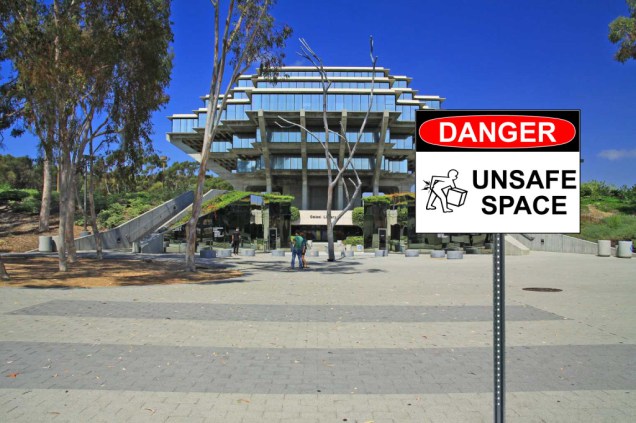
Tales From The Safe Space, Part 39 – UC San Diego, The Koala And The Battle To Censor Student Media

Danger Unsafe Space Sign - The Koala - UCSD

Student identity politics cultists and their craven university administration enablers are now gunning for student journalism and the free press

When University of California – San Diego student publication The Koala published this satirical article, they probably had some idea of the reaction that it would inevitably provoke:

Too long have trigger warnings plagued the airwaves. Too long has the no-blacks rule been removed from our campus. Too long have students not been free to offend their hypersensitive peers. “Spam Musubi only $1” and “Holy shit they opened up Starbucks” have replaced the long-gone chants of “Nigger nigger nigger nigger nigger.” Next week, that will all change.

Administrators at UC San Diego are creating an all new, state-of-the-art Dangerous Space for UCSD students who just don’t feel like their needs have been met on campus. In the past few weeks, the lack of dangerous space at UCSD has become increasingly apparent; students have been lashing out with puppy parades, non-violent protests, and other equally safe gimmicks. Safe spaces at UCSD are commonplace, and threaten individuals who do not like feeling safe. The logical next step has been taken by the university in creating a place to fairly support all UCSD students, continuing the university’s theme of inclusion and equality.

Located in the center of Library Walk, the new Dangerous Space is the ideal place for students to do whatever the hell they want. Senior Frank Yu gave The Koala the following statement: “The needs of dangerous-space students have been overlooked for generations, but UCSD is finally recognizing what means the most to 19-year-old Asian nerds: fucking a dead body with a picture of my waifu taped on the face.”

F. Yu isn’t alone. Not only will this new dangerous space allow people of all ethnicities and sizes – even unnaturally large sizes – it will allow for knifes, guns, opinions that might be different than yours, drug paraphernalia, sharp writing instruments, and explicit pornography.

The new Dangerous Space is guaranteed to get students excited for a good time, and will probably end like all good things do, with body mutilation and feelings of remorse.

Not world class humour, you might think, but certainly something that falls well within the boundaries of constitutionally protected speech in America.

(And from this blog’s perspective, an always-welcome attack by students on the illiberal cancer metastasising through the English-speaking Western academia.)

But on this occasion, the publication was not merely the recipient of angry protests and tearful accusations from “triggered” snowflake students. Instead, the entire weight of the university leadership, egged on by vengeful student protesters, came crashing down on the small student newspaper.

From Inside Higher Ed:

On Nov. 18, the university’s administrators responded to student complaints, condemning the Koala in a statement. “We, the UC San Diego administration, strongly denounce the Koala publication and the offensive and hurtful language it chooses to publish,” several administrators, including the university’s president, stated. The Koala responded to the denouncement by publishing a series of profanity-laden and slur-filled fictional emails meant to be written by administrators.

So far, so unsurprising. Just another craven university administration cowering in fear and issuing Stalin-like denunciations of alleged thoughtcrime at the behest of entitled student protesters.

But it gets worse:

In an attempt to starve out a controversial student publication without violating the First Amendment, the student government at the University of California at San Diego voted last week to cease any funding of student media.

The move — which First Amendment experts said does not pass constitutional muster, despite the student government’s maneuvering to avoid targeting a specific group — came after UCSD administrators condemned the most controversial of the university’s publications amid student protests about racism on campus.

In other words, the officious student council was not satisfied with having bullied the spineless UCSD university administration into denouncing humorous free speech, they wanted to starve The Koala of funding, effectively shutting it down.

In Britain, this would have been a slam-dunk. Game over. But in America, the pesky First Amendment makes such blatant retaliation illegal, and so instead the student government had the bright idea of ceasing funding to all student media organisations – essentially killing off an entire campus industry and ruining everyone’s fun in order to punish one organisation accused of causing “offence”.

The political machinations here are so crude that there is simply no disguising them, try as the student council might:

Student leaders appear to have been worried that if they just ended funding for the Koala, and did so based on its content and language, they would be violating the First Amendment. So later that day, the Associated Students Council voted to defund all student media by removing a section from its constitution about financial support of student media organizations.

The Associated Students provides about $15,000 per year, drawn from student fees, to several student media organizations, including student-run research journals and magazines. The twice-weekly student newspaper, the Guardian, is independent and was not affected.

“When this was brought to council floor, I made it a point to address that this issue was not to be tied to any particular organization,” Dominick Suvonnasupa, the student government’s president, said in an email. “The question was whether to fund media at all, and at the end of the meeting, council decided not to. AS decided to discontinue print media funding as it was determined that there were other areas of campus that could better benefit from the limited resources of the Associated Students. All campus media organizations have received suggestions of alternative funding sources.”

Uh-huh. Sure. And of course the Associated Students Council would have come to exactly the same conclusion, independently, had The Koala not published their heretical article back in November of 2015 (funding was withdrawn from all student publications a week later). Right.

Incidentally, these are exactly the same tawdry tactics which were once used by die-hard segregationists during the last gasp of Jim Crow, where some racist whites chose to privatise their school districts and close their public amenities rather than submit to federally mandated integration. Only now it is moralising student activists and their cowardly enablers within academic leadership who would rather burn all student media to the ground than allow one publication to continue posting material which they find “offensive”. But don’t expect today’s virtue-signalling student activists to note the irony.

Just as many British leftists are desperate for Britain to vote to remain in the European Union in the coming referendum because deep down they don’t think that the people are capable of making the “right choices” if proper democracy was restored with Brexit, so these Social Justice and Identity Politics cultists on both sides of the Atlantic seem to think that fellow students are somehow unable to handle free speech, and that it must therefore be withdrawn or highly circumscribed in order to prevent “harm” from occurring.

Fortunately, the San Diego chapter of the American Civil Liberties Union is now riding to the rescue. From The Daily Caller:

The American Civil Liberties Union (ACLU) filed a lawsuit against the University at California at San Diego (UCSD) for defunding a student publication that offended UCSD students.

[..] The ACLU alledges this action runs afoul of the First Amendment.

“The student government violated the First Amendment in two ways,” a statement from the ACLU read. “First, it targeted the student press by stripping it of revenue that remains available to support other student speech. Second, it retaliated against the editorial viewpoint of The Koala, an action that is not immunized by inflicting collateral damage on all student media.”

Although the organization expressed sympathy with those offended, it asserted The Koala piece was “classic protected speech.”

“Trauma is real,” said David Loy, legal director of the ACLU in San Diego and Imperial Counties, “but censorship is not the cure, because it inevitably blows back on those it purports to protect.”

It is good to see the ACLU come down on the right side of this issue and take up the case of this small student-run publication. One does not have to approve of The Koala, or this article in particular, to decry the way that the UC San Diego student government, drunk on power, sought first to shut down the paper and then effectively silence all campus media as a collective punishment for the heretical editorial viewpoint of one outlet.

The ACLU’s case seems quite watertight, and it is likely that the lawsuit will succeed, but student protesters will not take a defeat lying down. If they cannot accomplish their primary objective (shutting down the offensive publication) or secondary objective (suppressing student journalism altogether) they will come back with a third strategy, and a fourth.

These people are relentless. Caving in to their shrill and authoritarian demands encourages them to come back for more, while rebutting them only encourages the snowflakes to shout louder. All of which might be admirable, if only their cause was a just one. But despite the name, there is nothing “just” about the Cult of Social Justice and Identity Politics.

On the contrary, it is a poisonous, tawdry ideology which preaches personal fragility, collective guilt, voluntary re-segregation and a rampant culture of victimhood. And as such it must be actively opposed on all fronts.

God speed the ACLU lawsuit, and may The Koala survive to publish many more editions filled with edgy, unapologetically provocative student humour.


Safe Space Notice - 2

Top Image: The Koala

Agree with this article? Violently disagree? Scroll down to leave a comment.

Follow Semi-Partisan Politics on TwitterFacebook and Medium.