Jeremy Corbyn’s Europe Speech Was Cynical And Naive At The Same Time

Voting to stay in the EU in the hope that a left-wing movement might make the organisation simultaneously more socialist and democratic is like moving to North Korea in the expectation that a friendly word with Kim Jong Un will see the country immediately become a capitalist land of plenty

Yesterday, Jeremy Corbyn gave his much-heralded intervention in the EU referendum debate, which is worth analysing as perhaps the single biggest disappointment of Corbyn’s tenure as Labour Leader thus far.

In his speech at Senate House, we were treated to statements like this:

The Labour Party is overwhelmingly for staying in because we believe the European Union has brought: investment, jobs and protection for workers, consumers and the environment, and offers the best chance of meeting the challenges we face in the 21st century.

In fact, Britain’s bounce back from (Labour-inflicted) 1970s decline was due to the free-market policies of the Thatcher Conservative government. The limited extent to which our membership of the European Union helped bring jobs and investment to Britain are the very same reasons why Corbyn now dislikes the current EU – because it is “neoliberal”, market oriented and has awkward rules about state aid and nationalisation of industry.

By voluntarily placing Britain in the EU’s regulatory straightjacket at a time when we were most decidedly mad (with price and wage controls and vast nationalisation of industry) we were indeed prevented from inflicting more harm on ourselves. But Corbyn pines for all the edifices of state socialism which were worn down by Thatcherism and constrained by the EU.

Corbyn basically wants 1970s declining Britain, repeated at a European level. He may admire the social, employment and environmental regulation, but he will not be happy until member states are free to pursue strongly left-wing policies without interference or blocking from Brussels. And of course this is a hopeless fantasy, because the EU is travelling in a direction where member states are able to do fewer and fewer things autonomously in their own national interest, while the euro crisis demands more, not less, convergence.

Corbyn continues:

In the coming century, we face huge challenges, as a people, as a continent and as a global community.  How to deal with climate change. How to address the overweening power of global corporations and ensure they pay fair taxes. How to tackle cyber-crime and terrorism. How to ensure we trade fairly and protect jobs and pay in an era of globalisation. How to address the causes of the huge refugee movements across the world, and how we adapt to a world where people everywhere move more frequently to live, work and retire.

All these issues are serious and pressing, and self-evidently require international co-operation. Collective international action through the European Union is clearly going to be vital to meeting these challenges. Britain will be stronger if we co-operate with our neighbours in facing them together.

Not one of these issues is something which cannot be tackled by determined, well-executed inter-governmental co-operation between sovereign member states. There is nothing mysterious about climate change or terrorism or free trade which can only be solved if the countries of Europe dissolve themselves into a single supranational political entity which sits above them, its unelected leaders making decisions on their behalf.

Jeremy Corbyn - Labour In For Britain - EU Referendum - Brexit

So what is the answer to the European Union’s problems if not recognising that it is a terminally flawed, anachronistic holdover from the early twentieth century, and pulling the eject lever before we impact with the ground?

Corbyn’s solution:

So Europe needs to change. But that change can only come from working with our allies in the EU. It’s perfectly possible to be critical and still be convinced we need to remain a member.

[..] I have listened closely to the views of trade unions, environmental groups, human rights organisations and of course to Labour Party members and supporters, and fellow MPs. They are overwhelmingly convinced that we can best make a positive difference by remaining in Europe.

Then they are all part of the same collective delusion. The European Union is not shy about its ultimate goal of ever-closer, not simply more perfect union. And the juggernaut has continued to trundle inexorably in the same integrationist direction for decades. What, exactly, gives them hope that a twinkly-eyed, bearded British socialist and his starry eyed chums like Greece’s Alexis Tsipras (who was pretty much castrated by the eurogroup on live television during last year’s euro crisis) are going to change the direction of travel?

Don’t expect an answer. Every EU apologist from the dawn of time has been ready with mealy-mouthed protestations that “of course the EU is flawed” and “of course we need to push for reform in Europe”, but there are two problems. One is that the European Union is not interested in their kind of reform, and the second is that the EU apologists lose all interest in actually agitating for reform after awhile. Running into a brick wall at full speeds begins to lose its appeal, after awhile.

Then we get to the meat of Corbyn’s speech:

When the last referendum was held in 1975, Europe was divided by the Cold War, and what later became the EU was a much smaller, purely market-driven arrangement. Over the years I have been critical of many decisions taken by the EU, and I remain critical of its shortcomings; from its lack of democratic accountability to the institutional pressure to deregulate or privatise public services.

Here’s the obligatory “I hate the Romans as much as anybody” part, which inevitably precedes a declaration that the EU has given us “the sanitation, the medicine, education, wine, public order, irrigation, roads, the fresh-water system, and public health“.

Except that what the EU does is not so much lavish spending on cash-strapped institutions being starved to death by the mean Tory government in Westminster. What it actually does is bribe citizens with their own money. In the case of a huge net contributor to the EU budget like Britain, that means sending our taxpayer money to Brussels where it goes through the bureaucratic machine, before a portion of those funds are redistributed to organisations and councils within Britain, to be spent in the way agreed with the EU.

Friargate - Coventry - EU Regional Development Fund - Bribery - Brexit

That so many academic, artistic and cultural leaders are so desperate for Britain to remain in the EU should indeed tell us something. It should tell us that they are either stupid for not realising that they are being bribed with their own money, or that they are very smart and cynically think that the EU’s anti-democratic nature is a great way to get taxpayer funding for things which are either so pointless or so much more at home in the private sector that the British public would never countenance spending the money.

One of the very few messages that Vote Leave actually gets right is the idea that if we leave the European Union, we can spend the money on our own priorities, as democratically chosen by the British people (rather than being agreed by dubious application processes to various EU grant-giving bodies). Of course, Vote Leave immediately go on to spoil it by confusing gross and net contributions and suggesting that we lavish all of the money unthinkingly on the NHS as a mass act of public virtue signalling. But their basic premise is right, not that Corbyn cares.

So what exactly are these never-gonna-happen reforms supposed to look like? Corbyn sets out his vision:

But we also need to make the case for reform in Europe – the reform David Cameron’s Government has no interest in, but plenty of others across Europe do.

That means democratic reform to make the EU more accountable to its people. Economic reform to end to self-defeating austerity and put jobs and sustainable growth at the centre of European policy, labour market reform to strengthen and extend workers’ rights in a real social Europe. And new rights for governments and elected authorities to support public enterprise and halt the pressure to privatise services.

So the case I’m making is for ‘Remain – and Reform’ in Europe.

Today is the Global Day of Action for Fast Food Rights. In the US workers are demanding $15 an hour, in the UK £10 now. Labour is an internationalist party and socialists have understood from the earliest days of the labour movement that workers need to make common cause across national borders.

Working together in Europe has led to significant gains for workers here in Britain and Labour is determined to deliver further progressive reform in 2020 the democratic Europe of social justice and workers’ rights that people throughout our continent want to see.

But real reform will mean making progressive alliances across the EU – something that the Conservatives will never do.

Ah, so “reform” actually just means lashings more socialism in Europe.

Anyone proposing a change to the workings of the EU based on a single political ideology is immediately doomed to fail, because they are by their own admission less interested in democracy, governance and international co-operation, and more interested in inflicting their own worldview and values on others. And so it is with Jeremy Corbyn’s vision of a left-wing Hands Across Europe movement.

Corbyn has no interest in working with conservative or centrist voices in Europe to create a better-functioning set of institutions and rules, because for him (and many on the left), policies and structure are inseparable. Corbyn doesn’t really care that the EU is antidemocratic – after all, right now he is grateful that the EU is undemocratically imposing on Britain various employment and social directives with which he agrees. Therefore his only interest is seeking out other like-minded people on the continent to grab as much power as possible, only then considering changes to the structure of the organisation to make it harder for conservatives to mount a counter-attack.
Jeremy Corbyn - Labour In For Britain - EU Referendum - Brexit - 2

And when it comes to partisan point-scoring against conservatives, Jeremy Corbyn’s extended diatribe against tax avoidance incidentally reveals the single biggest hypocrisy in his entire position on Europe.

Corbyn begins this section:

The most telling revelation about our Prime Minister has not been about his own tax affair, but that in 2013 he personally intervened with the European Commission President to undermine an EU drive to reveal the beneficiaries of offshore trusts, and even now, in the wake of the Panama Papers, he still won’t act.

And on six different occasions since the beginning of last year Conservative MEPs have voted down attempts to take action against tax dodging.

But then he dramatically overreaches:

Left to themselves, it is clear what the main Vote Leave vision is for Britain to be the safe haven of choice for the ill-gotten gains of every dodgy oligarch, dictator or rogue corporation.

They believe this tiny global elite is what matters, not the rest of us, who they dismiss as “low achievers”.

For any apologist or supporter of the EU to stand up in front of a room full of people and declare that it is those fighting for Brexit who are the elitists takes real cojones, and an inscrutable poker face. Because back in the real world, nothing epitomises the desire of a small political and financial elite to escape national democratic accountability for their actions more than the existence of the EU.

As Brendan O’Neill puts it so brilliantly in Spiked:

The EU is not, as its cheerleaders claim, a coming-together of European peoples. Rather, it represents the outsourcing of key parts of national political life to the unaccountable, unreachable realm of the European Commission and other Brussels-based bodies. It directly waters down our democratic clout through granting ever-greater authority to institutions like the EC and the European Court of Justice, whose edicts and rulings can be imposed on nations regardless of what national governments, far less national plebiscites, think of them. That is anti-democratic. End of. And it should be viewed as intolerable by anyone who considers himself progressive, and who recognises that every radical, inspiring leap forward in modern times – from the Levellers to the Chartists to the Suffragettes – has been about people wrestling from the authorities the right to choose who governs them; the right to political say-so.

The EU is a union not of peoples, but of elites. It has in recent decades become the sphere in which national elites, feeling ever more estranged from their national electorates, have effectively taken refuge. In pooling their national sovereignties into the EU, our national rulers absolve themselves of the responsibility to have tough, testy debates with us about various political and social matters, in favour of seeing such issues discussed and resolved by the commissioners and self-styled experts of this rarefied zone.

The EU is not any kind of internationalist or cosmopolitan project, as its supporters claim. Nor is it a conspiracy of French and German blaggards to do over decent Blighty, as its detractors insist. Rather, it is the institution that has grown from and been constantly fed by national elites’ own growing feeling of exhaustion with democracy – and with democracy’s engine: the demos – be it politicians who would rather an aloof court decided something they haven’t got the stomach to debate or advocacy campaigners who agitate for an EC regulation because nothing repulses them more than the idea of trying to win over the plebs of their own nations.

And O’Neill’s conclusion in the same piece could be aimed directly at those left-wing EU supporters who, like Corbyn, insist that we must stay locked in unwanted political union to protect our “rights”:

All those things that the Remain lobby claims will be better if we stay in the EU – workers’ rights, freedom of movement, anti-terror security measures – are things that should be discussed and decided by us. To say the EU does ‘good things’, even though it does them without any real democratic oversight, is to support a benevolent tyranny. A tyranny enacted not to crush us but to save us – the worst kind.

But of course Jeremy Corbyn (and much of the Left) do not trust us to make the “correct” decisions on these or any other issues, so they are more than happy for democratic control of these things to be outsourced to a supranational European level of government which is more amenable to their demands.

Britain Labour Party

So to summarise – Jeremy Corbyn supports Britain remaining in the European Union on the basis that the EU may one day magically reject capitalism and seek to become a socialist paradise. And yet no serious watcher of the EU or its member states believes that this is remote possibility, whatever Yanis Varoufakis and his Democracy in Europe Movement may say.

Therefore Jeremy Corbyn is willing to subject Britain to the ongoing uncertainty of remaining part of a relentlessly integrating supranational political union (not to mention the probability of a violent, uncontrolled Brexit further down the line when the EU either disintegrates or takes another major step toward federalisation) because he is holding out the flimsy hope that a ragtag assortment of socialist and communist groups across Europe will get together and take over the EU’s institutions, recasting Brussels in their own image.

Of all the grandiose claims from both official sides in this referendum campaign, how likely does this proposition seem to you?

Exactly. There is not a snowball’s chance in hell that any of the things that Jeremy Corbyn freely admits to finding most objectionable about the European Union will change any time soon. Deep down, Jeremy Corbyn knows this, and yet here he is, telling us about the wonderful, socialist-friendly EU which could soon be ours.

When Jeremy Corbyn won the Labour leadership contest and almost immediately recanted his long-held euroscepticism, this blog remarked:

There are lots of words you can use to describe the Labour Party’s fawning and uncritical “IN at all costs” attitude toward the European Union, but it is certainly not the “new politics” promised by Jeremy Corbyn.

And as Corbyn’s leadership of the Labour Party continues, it will be very interesting to observe where he chooses to make a stand in defence of his left-wing principles, and where else he is willing – or forced – to make concessions to the majority centrists of the parliamentary party.

On nearly every other issue – armed intervention in Syria, Trident nuclear weapons, you name it – Jeremy Corbyn has been more than willing to provoke rage and hysteria within his own party by treading a different path and rejecting a number of sacred New Labour shibboleths. But when it came to the European Union, Corbyn didn’t simply send out Hilary Benn to give the doe-eyed, europhile position. He swallowed his pride and did it himself.

One might call it a rather bold act of leadership by Corbyn, were it not also such a grotesque betrayal of his own beliefs on the subject of Europe.

Ultimately, Jeremy Corbyn wanting to stay in the European Union to bring about democratic socialist reform is like me wanting to go to North Korea to single-handedly convince Kim Jong Un to surrender power and help his country transition away from totalitarian dictatorship. The aim is certainly ambitious, maybe even noble, but the audience’s receptiveness to the message is decidedly limited. And both are equally doomed to failure.

The only difference is that as a private citizen, I am free to indulge in as many far-fetched daydreams as I like without consequence, whereas Jeremy Corbyn is leader of the Labour Party and the official Opposition.

When I waste my time and energies advocating for a futile cause, it harms nobody. When Jeremy Corbyn does the same, as he did at Senate House yesterday, he betrays not only his conscience but also the people who voted for Corbyn trusting him to speak his true mind and defend their interests.

 

European Union - United Kingdom - Britain - Flags

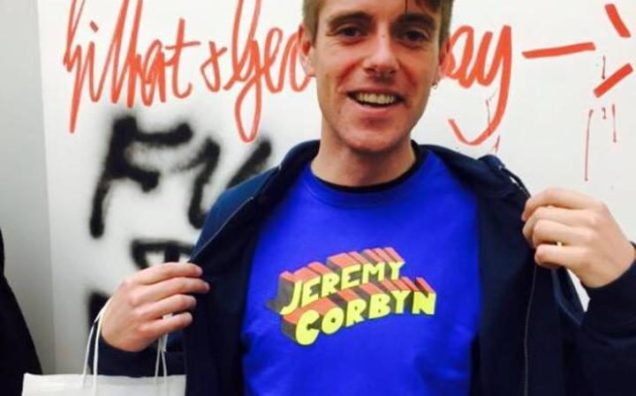
Top Image: International Business Times

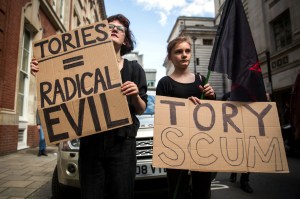
Second Image: BT News

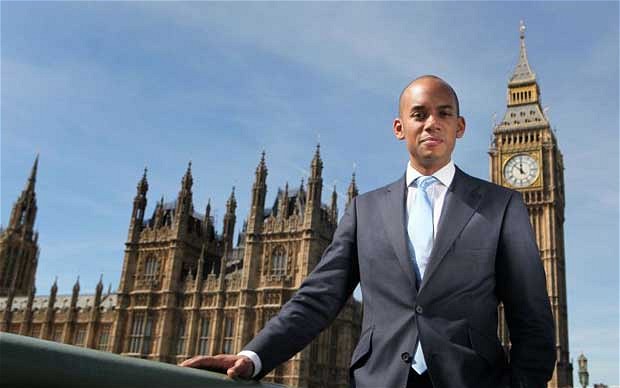
Third Image: Semi-Partisan Politics

Bottom Image: Huffington Post

Agree with this article? Violently disagree? Scroll down to leave a comment.

Follow Semi-Partisan Politics on TwitterFacebook and Medium.

If The Conservative Government Is Truly Evil, Where’s The Left Wing Revolution?

Jeremy Corbyn - Hipster - Middle Class Left Wing

Virtue-signalling, vacuous middle class leftists are all talk and no action

According to many a Corbyn-cheering, well-heeled leftist, modern Britain resembles an unjust, “neoliberal” dystopia in which the Evil Tories and their Evil Banker friends leech off the real producers and heroes in our society (usually people who are net recipients of government spending, curiously recast as the being most virtuous of all).

To this mindset, George Osborne is not simply wrong on the economics, he is engaging in a deliberate war of attrition against the poor, and Iain Duncan Smith’s abortive efforts to reform the welfare state were part of a Nazi-inspired eugenics programme to kill off the sick and disabled.

All of which begs the question – if David Cameron’s centrist, soul-sappingly unimaginative Conservative government really is evil incarnate, why do its many opponents content themselves with mere polite protest and ineffectual rants on social media?

If I believed for a moment that the state was engaged in a deliberate extermination of its weakest and most vulnerable citizens, I hope to think that I would have the moral clarity and fortitude to either take up arms against the government or to work for its downfall using every skill and talent at my disposal. And yet those who actually do believe that the Tories are “evil” can usually be found clad in skinny jeans and non-prescription hipster glasses, waging “resistance” via their (capitalism-produced) smartphones while sipping a hand-crafted flat white.

My Conservatives for Liberty colleague Martin Bailey sums up this moral hypocrisy perfectly in a piece entitled “The impotence of the middle-class Left”.

Bailey writes:

If I thought that the world was controlled by a secret ‘Neo-Liberal’ elite that oversaw government and mass media across the globe, I would do something about it. Take up arms, man a barricade, refuse to comply. If I genuinely believed that democracy was a sham and we were all willing drones to corporate bosses, I wouldn’t stand for it.

So what do they do? They sit in comfort and plenty streaming idle profanities across Twitter and Starbucks. They can’t even find an independent coffee shop in which to plan the revolution. Anonymous abuse of anyone on social media who dares to question their orthodoxy is about as rebellious as a wet fart in an empty train carriage. Che would be turning in his grave.

The EU referendum is a perfect example of stupefying left wing impotence, with thousands of social justice warriors happy to forget the glaring absence of democracy and willing to accept the biggest corporatist cartel in history, all for the fear that someone they know may or may not lose their job. I guess the revolution will have to wait, eh Comrade?

Read the whole piece, it is a highly entertaining takedown of the Left’s hypocrisy and wilful misunderstanding of capitalism.

And to my mind, there are only two explanations for the gulf between the Virtue Signalling Left’s angry talk and their lack of action commensurate with the inhuman Evil Tory threat that they constantly decry.

Option 1 – The left-wing outrage at the present Conservative (often in name only) government is completely fake, in which case the failure of its opponents to take concrete action makes perfect sense – after all, they are only invoking the memory of the Holocaust as a cynical political ploy to demonise their opponents and paint them as heartless and deliberately cruel.

Option 2 – Their outrage is genuine and they honestly believe that conservatives have blood on their hands, but they are also too cowardly to risk their own relatively privileged and comfortable lives by coming to the aid of the supposedly oppressed. In other words, the middle class Left are happy to parade their hatred of the Evil Tory Scum on social media and to friends, but would continue to let society’s most vulnerable people suffer and die before than risking their coveted London homes, worldly possessions and personal liberty by backing up their fighting words with real action.

Manipulative cynics or moral cowards. The only question remaining is which reflects worse on the virtue-signalling middle class Left?


Postscript: I happen to believe that most middle class leftists fall into Option 1. It’s trendy to moan about how beastly the Evil Tories are being, and posting a few IDS-as-Hitler memes on the internet is a good way to quickly signal to other bovine minded people that you are one of the “good guys”.

But that’s not to say that there are not also a number of credulous cowards out there – that is, people who genuinely believe the anti-Tory effluence which pours from their mouths and keyboards, but are too darn selfish to risk anything of theirs by physically attempting to stop the genocide that they believe is underway.


More Left Wing Hate Watch here.


Bankers Toffs And Tory Scum - General Election 2015 - London Protests - Downing Street

Agree with this article? Violently disagree? Scroll down to leave a comment.

Follow Semi-Partisan Politics on TwitterFacebook and Medium.

A Chuka Umunna Leadership Bid Now Would Destroy The Labour Party

Chuka Umunna Labour Party Champagne Socialist 2

The current Labour Party will not transition seamlessly from Jeremy Corbyn to Chuka Umunna, and any leadership coup proposing an Umunna-like replacement for Corbyn will make the Republican Party presidential primary look like a model of restraint and civility

Clearly the EU referendum and upcoming Budget are not providing enough excitement for Fraser Nelson, because he is also busy agitating for an immediate (and almost certainly ill-fated) coup to depose Jeremy Corbyn from the leadership of the Labour Party and replace him with exactly the kind of person who the Labour grassroots detest with every fibre of their souls.

Yes, that would be Chuka Umunna:

It’s the Ides of March today, and there are pitifully few signs of a Labour plot. I was on ITV’s The Agenda last night with Chuka Umunna, one of the putative successors to Jeremy Corbyn, who was teased by Tom Bradby about his ambitions. He came out with the usual hedged denials (“there’s not a vacancy.,, I’ve said I would never say never”) but then came out with the rationale for ousting Corbyn.

The problem: most Labour members were not members this time last year. The party has been taken over by Corbynistas and while Labour MPs could technically change the leadership it’s harder to change the membership. Chuka agreed- but then gave the democratic case for deposing Corbyn, in defiance of the wishes of party members.

“Clearly, Jeremy has a very strong support amongst our membership. But then if you look at the parliamentary Labour party they have a direct mandate from 9.3m Labour voters. If you look at the research on things like Trident the parliamentary party would be closer to the views of the voters than the members and there’s that tension.”

So how to resolve the tension? I do hope the Labour moderates come up with a way soon, and bring this sorry pantomime to a close. PS At the end of The Agenda, guests are invited to present a fantasy front page. Mine was intended to give some encouragement to the Labour moderates.

Fraser Nelson’s pitch for a Chuka Umunna leadership bid consisted of this rather unlikely picture:

My views on Chuka remain unchanged until new evidence (of the non-hagiographic kind) prompt me to revise them:

Just what the Labour Party needs. Another dazed and confused London career politician stumbling shell-shocked and bewildered beyond the M25 in a belated effort to understand why so many working and middle class people – Britain’s strivers – spurned his party at the general election, totally unconvinced by a Labour manifesto and message conceived in Islington but barely embraced even in Hampstead.

At a time when David Cameron is building an inclusive Tory cabinet which conspicuously harnesses the talents of women and MPs from working class backgrounds, for Labour to respond by crowning a well-moneyed, metropolitan, UKIP-hating elitist such as Umunna would only serve to confirm everyone’s worst suspicions about the party.

And those suspicions are that the modern, virtue-signalling, style-over-substance Labour Party would rather dwindle to an angry, self-righteous, ideologically pure talking shop for the London dinner party set than do the hard work of rebuilding in order to actually help the people it claims to represent; that it lacks the wisdom to recall its ideological roots or the humility to reach out to its scorned party base.

The notion that the Labour Party as it is presently constituted could go from being led by Jeremy Corbyn to the stewardship of someone like Chuka Umunna without about three transitional leaders to ease the way is absolute fantasy. While New Labour centrists and wistful media types may wish it were otherwise, the Blairite Labour Party is in a state where it cannot simply be rejuvenated with a click of the fingers and a telegenic new leader.

At this point, even managing to replace Corbyn with somebody like Ed Miliband (himself considered unpalatably left wing by much of the country) would be a major achievement, and even that is highly unlikely. The fact that Dan Hodges – the columnist whose finger is closest to the pulse of Labour Party plots – thinks that the party’s current greatest hope is Angela Eagle, of all people, shows just how far the ground has shifted to the Left under Labour.

Fraser Nelson was hopefully just making a lighthearted joke when he suggested that Chuka Umunna succeed Jeremy Corbyn after a leadership coup which would be sure to enrage over half of the party’s membership. Because to even attempt to go from Jeremy Corbyn to Chuka Umunna in one step would precipitate such a period of rancour and infighting that it would make the Republican Party’s rage at its ongoing takeover by Donald Trump look like the model of civility and restraint.


Chuka Umunna - Labour Party Leadership Bid - General Election 2015

Agree with this article? Violently disagree? Scroll down to leave a comment.

Follow Semi-Partisan Politics on TwitterFacebook and Medium.

Left Wing Eurosceptics – An Endangered Species Flirting With Extinction

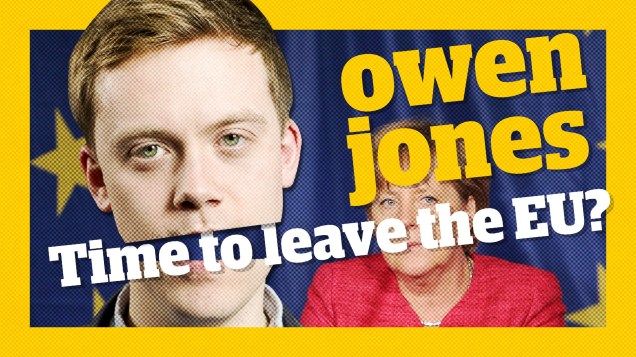
Owen Jones - The left must now campaign to leave the EU - Brexit

Many left-wing Remain supporters have no great love for the European Union, but nonetheless want Britain to remain subservient to Brussels as a means of inflicting left-wing policies on a reluctant Britain. And they call themselves champions of democracy!


“We must be clear about this: it does mean, if this is the idea, the end of Britain as an independent European state. I make no apology for repeating it. It means the end of a thousand years of history. You may say ‘Let it end’ but, my goodness, it is a decision that needs a little care and thought.”

– Hugh Gaitskell, speech to 1962 Labour Party Conference


Pete North, in a justifiably bitter tirade aimed at that group of British left-wingers who persist in stubbornly supporting the EU and campaigning for Remain against their better instincts, writes:

I don’t think I can win over leftists to the Brexit cause. They keep saying “If we leave the EU, the Tories might do stuff I don’t like” – which roughly translates as “I don’t want to live in a democracy where the government responds to the views and wishes of the public”. It also translates as “I am happy to deprive others of the right to choose because my politics are superior”. There’s not really much I can say to that. Traditionally, people like that are wearing uniforms and we shoot them rather than engage in polite discourse. What worries me is that if these people get their way, eventually they will be wearing uniforms and we will have to shoot at them.

Absolutely.

If you ever wanted proof of the British Left’s paper-thin commitment to democracy, you need only compare these two paragraphs from Owen Jones – one written when he was flirting with euroscepticism last year as the Greek euro crisis was at its peak, and the other shortly after David Cameron declared victory in his “renegotiation”.

First, Jones in Grexit mode:

Even outside the eurozone, our democracy is threatened. The Transatlantic Trade Investment Partnership (TTIP), typically negotiated by the EU in secret with corporate interests, threatens a race to the-bottom in environmental and other standards. Even more ominously, it would give large corporations the ability to sue elected governments to try to stop them introducing policies that supposedly hit their profit margins, whatever their democratic mandate. It would clear the way to not only expand the privatisation of our NHS, but make it irreversible too. Royal Mail may have been privatised by the Tories, but it was the EU that began the process by enforcing the liberalisation of the natural monopoly of postal services. Want to nationalise the railways? That means you have to not only overcome European commission rail directive 91/440/EEC, but potentially the proposed Fourth Railway Package too.

Other treaties and directives enforce free market policies based on privatisation and marketisation of our public services and utilities. David Cameron is now proposing a renegotiation that will strip away many of the remaining “good bits” of the EU, particularly opting out of employment protection rules. Yet he depends on the left to campaign for and support his new package, which will be to stay in an increasingly pro-corporate EU shorn of pro-worker trappings. Can we honestly endorse that?

And here he is last month, falling into line with the Remain crowd:

Last July, I suggested that the left should at least consider Brexit, not least because Cameron believed left-leaning voters were in the bag for an “in” vote, giving him little incentive to preserve the progressive elements of the EU. My view is now to stay in, but unite with those across the continent – like the former Greek finance minister Yanis Varoufakis’s new movement – who want a democratic EU run in the interests of working people.

[..] People like me can say: like you, I was sceptical. I’m no pro-EU ideologue, but a genuine floating voter. I understand your concerns. But I’ve come to the conclusion that we must remain in the EU, as a first step to the reform it so desperately needs.

In other words: democracy is a great and noble thing to be defended when it is delivering good old fashioned left-wing policies and high-taxing, high-spending governments. But when the people look like they might be about to vote for anything centrist or right-wing, the Left disown democracy at lightning speed, and embrace any and every procedural or bureaucratic obstacle which might thwart the people’s wishes.

Owen Jones is a smart cookie. He knows the true nature and purpose of the European Union, just as he knows that any “reform” or democratising of the EU is impossible because it would go against the very purpose of the organisation (the creation of a supranational and unaccountable layer of government above the nation state, freeing European leaders to make decisions and implement policies that their own electorates would never otherwise permit).

So when Owen Jones “saw the light” and came out in support of the Remain campaign, it wasn’t because he had suddenly found reason to hope that the EU can actually be reformed. No, it was purely and simply because cold hard political calculus told him that while the European Union may be a “neoliberal” dystopia for lefties, an independent Britain with conservative government would be far worse.

Jones changed his tune because he realises that a conservative government in an independent Britain might – shock horror – implement conservative policies desired by the voters, and the Left would have no means of undemocratically preventing it.

As a strategic piece of hard-headed and pragmatic realpolitik, you can’t fault the vanishing armies of left-wing euroscepticism for their tactical retreat. But as self-styled morally virtuous warriors for social justice and democracy, their hypocritical stance on Brexit stinks to high heaven.


Brexit - EU Flag

Agree with this article? Violently disagree? Scroll down to leave a comment.

Follow Semi-Partisan Politics on TwitterFacebook and Medium.

Tony Blair And The Shell-Shocked Centrists: The Fears Of A Fading Elite

Tony Blair - New Labour - Centrism

Pity Tony Blair. Unloved and discredited in his own country, he still fails to understand the role he played in the anti-centrist backlash on both sides of the Atlantic

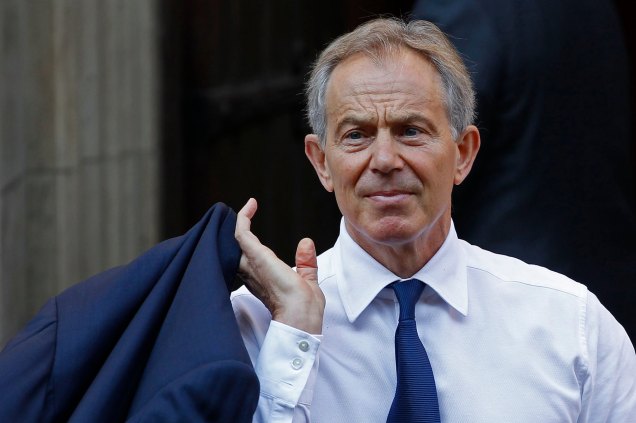
A panicked, uncomprehending Tony Blair is struggling to understand the appeal of left-wing insurgents such as Bernie Sanders and Jeremy Corbyn, LabourList reports:

Tony Blair has said he finds it difficult to understand the surge to prominence of Jeremy Corbyn and Bernie Sanders amid doubts over both men’s capacity to win general elections.

The former prime minister said the two veteran left-wingers faced a “question of electability” but admitted that stagnating living standards for people on lower- and middle-incomes had generated anger at elites in Britain and the US.

Blair also warned political parties they would be powerless to help people unless they “selected someone who is electable”.

[..] Blair, who was speaking to The Guardian and The Financial Times, said candidates who could “rattle the cage” were emerging, in a reference to Corbyn, who came from the left fringe to easily beat the party establishment to claim the Labour leadership, and to Sanders, who hopes to emulate him by winning the Democrat nomination ahead of Blair’s friend Hillary Clinton.

“It’s very similar to the pitch of Jeremy Corbyn,” Blair said. “Free tuition fees: well, that’s great, but someone’s going to have pay for it. An end to war, but there are wars.”

Where to begin?

Let’s start with Tony Blair’s “pass the smelling salts!” terror at the supposedly unhinged and crazy far-left politics of Bernie Sanders. That’s the same Bernie Sanders who would be chased out of Britain with flaming torches and pitchforks for being too right-wing, were he the UK prime minister, thanks to his support of private sector-delivered healthcare and the right to bear arms.

The interesting thing – and Todd Gillespie at Spiked has also picked up on this – is that with his support for civil liberties and the rights of the individual over the big guy (corporation or government), Bernie Sanders is in some ways a better conservative standard-bearer than most of the people currently squabbling for the US presidency – and certainly far more so than our own Coke Zero Conservative prime minister, David Cameron.

In many ways, when Tony Blair comes charging into the US presidential contest in support of Hillary Clinton and against Bernie Sanders, he is not making the principled case for a pragmatic, centre-left policy platform capable of winning elections, as he so smugly claims. After all, the American Right is also tearing itself apart at the moment, and there is nothing to say that Sanders could not defeat one of the more inexperienced or unpalatable GOP candidates still standing.

No, what Tony Blair is doing here is siding with the political elite – of which he is very much a part – and the tired old orthodoxies which people have grown so heartily sick of that they are now desperately casting around for alternatives in people like Donald Trump and Bernie Sanders. A former Labour prime minister who remembered anything at all about his party’s roots might not be quite so quick to publicly embrace a US presidential candidate awash in Wall Street donations and influence.

But Blair genuinely can’t see the problem with consistently, publicly and unapologetically siding with globalisation’s winners and richest beneficiaries while either ignoring or actively harming those who are left behind. And he cannot understand why this fawning deference to money and power is creating a populist backlash which has changed the course of his party.

Which brings us on to Jeremy Corbyn. LabourList’s report of Tony Blair’s comments continues:

He suggested the sudden rise of Corbyn and Sanders, each after years spent toiling in relative obscurity on the left of their parties, reflected a loss of faith in the centre-ground of politics as well as the changing technology of political communications.

“I think there is a combination of factors behind these movements which are happening both sides of the Atlantic. Part of it is the flatlining of lower and middle income people, the flatlining in living standards for those people, which is very frustrating. It’s partly an anger for sure at the elites, a desire to choose people who are going to rattle the cage.

“And it’s partly also about social media, which is itself a revolutionary phenomenon which can generate an enormous wave of enthusiasm at speed. When I first started in politics, these things took so long to build up momentum; your decision points were well before that moment was achieved. But it’s also a loss of faith in that strong, centrist progressive position and we’ve got to recover that…

“One of the strangest things about politics at the moment – and I really mean it when I say I’m not sure I fully understand politics right now, which is an odd thing to say, having spent my life in it – is when you put the question of electability as a factor in your decision to nominate a leader, it’s how small the numbers are that this is the decisive factor. That sounds curious to me.”

Blair is absolutely right that there has been a loss of faith in centrist politics. But centrist politics is not an innocent victim. Centrist politics has delivered a cross-party political consensus which was defiantly pro-European in face of public euroscepticism, which doggedly refused to talk about immigration even as a centre-left New Labour government spurned transitional controls and allowed hundreds of thousands more economic migrants a year into Britain without ever consulting the people, which sought to label anyone who questioned this policy as racist, and which trotted out the same tired old tropes about Our Beloved NHS and precious public services while doing almost nothing new or radical to reshape them for the twenty-first century.

Many people in Britain yearn for more genuinely left-wing solutions to be offered by a political party. Many would like the railways renationalised, and the energy companies too. This blog believes that such moves would be hugely regressive and statist, and very quickly result in poorer service and less choice for consumers. But those who believe in nationalisation deserve a voice in the political debate – a voice which Labour studiously excluded for many years. If Tony Blair seriously believed that high-handedly shutting people out of his party would store up no resentment for the future and possibly one day result in a backlash, then he is quite delusional.

Blair acts as though the rise of Jeremy Corbyn is merely a function of social media, and angry far-leftists hijacking the conversation. But it goes far deeper than that. The rise of Corbyn on the British Left, Sanders on the American Left and Trump on the Right are not an inchoate expression of public rage, but rather an indicator that a fully rational public has finally realised that the political consensus of the main political parties is not delivering what they need – be it middle class job security or success on the world stage.

The growth and prosperity delivered by the centrist political consensus in Britain has not been experienced uniformly by all citizens. That much is understandable – different policies will impact different socio-economic groups differently. What is unacceptable, though, is the fact that the centrists from both main parties never made a concerted effort to tweak those policies to help people who were left behind. They simply advocated more of the same.

More European Union. More government spending on the bloated, unreformed welfare state. More uncritical praise for the NHS. And more of the depressing view of Britain as nothing more than a nation of schools, hospitals and public services rather than a great nation built on our commercial, private sector initiative, and with boundless untapped potential.

Choose to treat the people like mindless, avaricious consumers rather than thinking, engaged citizens with a stake in their world, and you had better make damn sure that you deliver sufficient prosperity to keep everyone happy and distracted. This is how the centrists have treated us for years – essentially saying “you leave the global governance and great ideological questions to us, and in exchange we will deliver you a cheap supply of flat-screen TVs and other consumer goods”.

But when not everybody can afford the flat-screen TV or the iPhone or to scramble on to the property ladder, they start to look around them and notice things. Awkward things. Things like the fact that they no longer have the final say in issues affecting them, because sovereignty has been outsourced to the European Union. Or things like the character of their towns and cities – even their whole country – visibly changing because of levels of immigration about which they were never consulted. Or things like a broken welfare state which ensnares some people in lifelong dependency while allowing others to fall straight through the safety net to their deaths.

Brendan O’Neill picks up on this point – the fact that it is those who have not benefited economically from centrist consensus politics who are most likely to recognise that all is not well with our democracy – in his excellent piece in the Spectator:

The Third Wayists are quaking in their boots. The middle-class, middle-of-the-road technocrats who have dominated politics for the best part of three decades are freaking out. These people who bristle at anything ideological, are disdainful of heated debate, and have bizarrely turned the word ‘moderate’ into a compliment feel under siege. And no wonder they do, for on both sides of the Atlantic their very worst nightmare — a revenge of the plebs — is becoming flesh.

You can see this sometimes clumsy but nonetheless forceful reassertion of pleb power in everything from Trumpmania to the staggering back to life of Euroscepticism — or what snooty moderates call ‘Europhobia’, because every point of view that runs counter to their own must be a mental illness, right?

[..] In both Middle America and Middle England, among both rednecks and chavs, voters who have had more than they can stomach of being patronised, nudged, nagged and basically treated as diseased bodies to be corrected rather than lively minds to be engaged are now putting their hope into a different kind of politics. And the entitled Third Way brigade, schooled to rule, believing themselves possessed of a technocratic expertise that trumps the little people’s vulgar political convictions, are not happy. Not one bit.

And with regard to euroscepticism specifically:

We’ll see more of this in the coming months, more defamation of those who dare to say: ‘I don’t like Brussels.’ But Euroscepticism represents, not some swirling, xenophobic disgust with Europeans, as it has been pathologised by the pleb-fearing PC lobby, but a people’s feeling of exhaustion with the ossified oligarchy of the Brussels machine. It speaks to a desire among ordinary people to take back some control over their lives and destinies. And as The Economist pointed out, this Eurosceptic urge is strongest among the less well-educated — that is, the plebs, those tired of being treated as welfare, nudging and paternalism fodder by the new political elites.

So bring it on, this revenge of the plebs. Let’s cheer their rude, intemperate injection of ideology into the flat, lifeless sphere politics has become over the past 20 years. And let’s enjoy the squirming of an aloof political class and commentariat who mistakenly thought they had put the pesky masses and their troublesome views out to pasture.

If Tony Blair does not understand the anger and disillusionment directed not just at him but toward consensus politics in general – and there is no reason to doubt that his bewilderment is genuine – then one has to ask: what happened to the political nous of the man who won three consecutive general elections for Labour?

Why, when he has one foot firmly planted on each side of a massive new fault line emerging in our politics – not between Left and Right but between consensus politics’ winners and losers – is Tony Blair unable to understand his own starring role in precipitating the earthquake?


Bernie Sanders - Refutes Bernie Bros

Agree with this article? Violently disagree? Scroll down to leave a comment.

Follow Semi-Partisan Politics on TwitterFacebook and Medium.