Donald Trump, The Republican Fringe And Their ‘Second Amendment Remedies’

Donald Trump is not the first politician to invoke the Second Amendment as a potential tool for remedying grievances

From all of the media outrage, one would think that Donald Trump is the first major political candidate to ever hint at encouraging an armed uprising – that we are somehow in entirely unprecedented territory for a major party candidate to talk this way.

This is what Donald Trump actually said earlier this week:

“Hillary wants to abolish – essentially abolish – the Second Amendment. By the way, if she gets to pick – if she gets to pick her judges, nothing you can do, folks. Although the Second Amendment people, maybe there is, I don’t know.”

Trump’s apologists, including the increasingly unbearable Rudy Giuliani, leapt to their man’s defence, insisting that Trump was referring to the unified power of pro-2A lobbying efforts and the combined political might of gun owners. This is – how best to put it – a bold faced lie. If Trump was speaking about political activism he wouldn’t have said “maybe there is”. He would have issued a much stronger, more ringing call to arms, and probably specifically name checked the National Rifle Association while doing so.

Everybody knows that the NRA and allied Second Amendment supporters can muster a strong political campaign in support of gun rights – Trump’s “maybe” clearly refers to something else, something left unsaid but which no serious person can reasonably doubt (whether the suggested target is Hillary Clinton or her judicial picks).

It is sad to see Tim Stanley, whose American political commentary is usually so on the money, accepting this weakest of excuses:

Second, some people seem to want to condemn Trump for things he did not say. This is unnecessary: there’s plenty of legitimate reasons to dislike him without having to make more up. Trump did not say, for instance, that gun rights people should shoot Hillary Clinton to save the Constitution – he actually said that second amendment fans should lobby her to stop her unbalancing the Supreme Court.

Nope. No no no. That isn’t what Trump said at all (ironic, considering the thrust of Stanley’s point was criticising people who put words into the mouths of political candidates). If Trump wanted to make the point that Tim Stanley makes, he could have uttered words to that very effect. But he didn’t. We can be charitable and assume that Trump was joking when he made his comments, but what we cannot do is pretend that he meant something innocuous when the ominous suggestion was clearly left hanging open.

Besides which, Donald Trump knew exactly how his remarks would be interpreted and picked up by the media. He doesn’t find himself topping the news headlines every day by some quirk of chance – he deliberately says things and does things, knowing that they will be interpreted a certain way while still leaving himself just enough wriggle room to claim plausible deniability.

In this parallel universe, Trump didn’t mean to suggest that Fox News presenter Megyn Kelly was menstruating when he talked about “blood coming out of her…wherever”, he was going to say “nose” but couldn’t be bothered to finish his own sentence. He wasn’t really imitating a disabled reporter, he was just indulging in general mockery. This remark is just the latest in a litany of similar under-the-radar provocations.

But does this latest statement from Trump amount to “fighting words”, or a clear call to violence? No – and those authoritarian critics shrieking for Trump to be interrogated by the FBI (as though he is seriously hatching assassination plots) or thrown in prison need to go away and take a good long look at themselves. One can (and should) defend Trump’s technical right to skirt the line between passionate rhetoric and dog whistle politics while still abhorring his behaviour; not everything we despise should automatically be illegal.

(Reading online comments, one is also struck by the number of people who openly yearned for somebody to assassinate Donald Trump who are now clutching their pearls at Trump’s own casual allusion to violence).

Besides, the Republicans have form when it comes to this type of behaviour. This is why the current GOP elites who reach for the smelling salts every time Donald Trump says something inflammatory have no right to be shocked, because they are guilty of presiding over the dramatic increase in GOP craziness over the past eight years, mistakenly thinking that whipping people into an unthinking frenzy would offer them a short cut back to power.

Case in point, here is former Republican senatorial candidate Sharron Angle, fighting a tough senate race against Democratic Senate majority leader Harry Reid, playing to the Tea Party crowd back in 2010:


This is what Sharron Angle says about the Democratic-controlled Senate and her opponent Harry Reid:

“You know, our Founding Fathers, they put that Second Amendment in there for a good reason and that was for the people to protect themselves against a tyrannical government. In fact you know, Thomas Jefferson said it’s good for a country to have a revolution every twenty years. I hope that’s not where we are going, but, you know, if this, this Congress keeps going the way it is, people are really looking toward those Second Amendment remedies and saying my goodness, what can we do to turn this country around? And I’ll tell you the first thing we need to do is take Harry Reid out. 

What Trump is saying is nothing new, and nothing surprising about the morally debased Republican Party.

The only difference is that six years ago, they were funding and supporting a senatorial candidate in Nevada whom the majority of people nationwide and worldwide were paying no attention to. Now their ultra high-profile presidential nominee is saying the same things and they suddenly find it uncomfortable. Why? Because the GOP is willing to indulge in scummy behaviour when they think that nobody will notice, but get visibly upset when they are caught doing the same thing in the media glare of a presidential election.

So has this episode taught us anything new about Donald Trump, about the Republican Party or about this presidential election? No, it has not. We already knew that Donald Trump is a man who believes that any publicity, including (or especially) the screeching condemnation of the establishment media, is good publicity. We already knew that the Republican Party routinely trawls for votes by pretending that the Second Amendment itself is teetering on some kind of precipice when it clearly is not. And we already knew that this depressing presidential election comes down to a question of temperament.

And that question is as follows: Do the American people want as their leader and as the commander-in-chief of their mighty armed forces somebody willing to jokingly hint that “Second Amendment people” should take unspecified action against his political opponent (who, let’s face it, is so centrist and focus group led that she would never dream of touching the Second Amendment as long as there are votes to be lost by doing so) in order to protect their gun rights from a largely nonexistent threat?

In these highly charged times, when somebody not so smart and not in on the joke could easily miss the nuance and take the political rhetoric very literally, is suggesting that “maybe there is” something that Second Amendment people can do to protect their rights from a nonexistent threat a responsible way for a presidential candidate to behave?

Nobody is suggesting that the Donald Trump or the Republican Party actually want a lone wolf Second Amendment fanatic to take the defence of the Constitution into their own hands and start taking pot shots at Hillary Clinton or her potential judicial nominees. But the Republican Party does have a tawdry recent history of trawling for votes among people  who would heartily approve of such a course of action – always with just wiggle room in the comments to allow plausible deniability when called out.

At this point, nobody expects any better from Trump himself. But some of those politicians and commentators now leaping to his defence have reputations which presumably they would like to maintain beyond this presidential election cycle.

They should think on that the next time Donald Trump says or does something appalling.
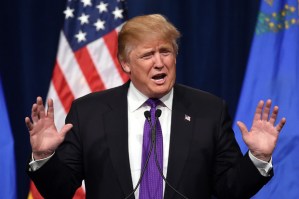
 

Donald Trump Hosts Nevada Caucus Night Watch Party In Las Vegas

Support Semi-Partisan Politics with a one-time or recurring donation:

Agree with this article? Violently disagree? Scroll down to leave a comment.

Follow Semi-Partisan Politics on TwitterFacebook and Medium.

On Gun Control In Britain

UKguns


It’s difficult at the moment to know precisely how seriously to take Nigel Farage’s public pronouncements. In a matter of days he has managed to offend a great number of people by suggesting that once you adjust for maternity leave, women working in finance have at least a level playing field with (if not an easier time overall than) men; he appeared to prevaricate when confronted with another loony UKIP local councillor, this one publicly attributing the UK’s recent bad weather to the coalition government’s legalisation of gay marriage; and he publicly disowned the 2010 UKIP manifesto, which he personally helped to launch.

All of this is rather unfortunate, because in many ways Nigel Farage remains one of the most principled and straightforward politicians in Britain today. Aside from some heavy-handed and paternalistic conservative attitudes to social issues such as gay marriage and an excessive obsession with immigration restrictions, the policies currently espoused by UKIP are ones which would appeal to many a libertarian-minded voter grown disenchanted with the Tories under David Cameron – myself included. Therefore, I hope and trust that the PR wobbles of this week will soon be behind him.

But more importantly, I hope that the current furore does not drown out a more important debate that Farage has initiated – whether or not to relax Britain’s stringent gun control laws and relax the blanket ban on handguns. Farage is of the opinion that to do so is right in accordance with conservative principle, with individual liberty and with common sense.

The Guardian reports:

Asked about gun controls, Farage said: “I think proper gun licensing is something we’ve done in this country responsibly and well for a long time, and I think the kneejerk legislation that Blair brought in that meant that the British Olympic pistol team have to go to France to even practise was just crackers.

“If you criminalise handguns then only the criminals carry the guns. It’s really interesting that since Blair brought that piece of law in, gun crime doubled in the next five years in this country.”

“I think that we need a proper gun licensing system, which to a large extent I think we already have, and I think the ban on handguns is ludicrous.”

The initial arguments brought to bear against Farage are not terribly convincing:

Ian Mearns, Labour MP for Gateshead, said the comments were an example of “how extremely dangerous Ukip are”.

“Families facing a cost-of-living crisis will find it bizarre that one of Nigel Farage’s priorities would be to relax Britain’s tough gun controls,” he added.

So we are told that the policy is “dangerous”, and then fed the old line that the British public believe that politicians can and should only ever focus on one issue at the time, and that the economy must crowd out everything else. When someone leads off with the “why aren’t we focusing on something else?” argument, they generally don’t have much else in the way of persuasive arguments.

As a libertarian-minded voter, given a blank slate and in an ideal world I would like to see the blanket bans on handguns in the UK repealed. While recognising that Britain is very different culturally to America on this issue, where the Second Amendment enshrines the right to bear arms very clearly, I believe that our country (at least the people, if not our government) do also place great value on the freedom to defend oneself with any force necessary if required. The strength of public feeling in the Tony Martin case rather proves my point, no matter how much gun control advocates might desire to wish it away.

Where we differ more substantially is the fact that in America, the Constitution makes clear that the right of the people to bear arms shall not be infringed not only for reasons of protection and self-defence against personal violence, but also against oppression by the government. In Britain, where our rights are granted to us by the government and it is our lot to bow and scrape and be thankful for what we are given by way of freedoms, this is clearly not the case. The government is not ours; rather, it belongs to Her Majesty. This may seem like a quibbling detail, but when looking at issues of civil rights and liberties it is an important one.

As a general principle, I don’t think it should be the government’s business to ban or to allow small arms, or to do many other things. I would be quite happy if the government could content itself with competently undertaking its core functions of defending the nation, protecting property rights, providing law and order and providing a framework for other institutions to deliver much of what currently falls under the welfare state. I have sufficient belief in the goodness of human nature to think that, if properly guided and harnessed, this might be achievable.

However, I also recognise that this is not the seventeenth century, and I am not a stockinged, bewigged colonist in the New World. We do not live in a time of attempting bold new methods of self governance – or bold new methods of doing anything at all, and there is little desire among the public to become the kind of country where such experimentation takes place. And this is where conservative pragmatism comes into play. On the topic of gun control specifically in the UK, I cannot support Nigel Farage’s belief that gun control laws should be repealed.

Guns are not plentiful in the UK as they are in the United States. Making it legal for average members of the public to own firearms again would initially empower those people, but there would be a gradual and inexorable drift of firearms from law-abiding citizens to active criminals. Like almost anything, if you are criminally minded and you want to lay your hands on a gun, you can do it if you invest time making the right connections. But it is difficult to do unless you already have those links with the criminal world, and so guns are not purchased in the UK on a whim, or by ordinary folk for use in a moment of high passion – the supply is small and in the hands of professional criminals, and therefore it simply takes too long for someone not in the know to make the purchase. Why expand the supply and start to make it exponentially easier?

In the United States, the case is very different. Guns are a dime a dozen, and any blanket ban on firearms in America, as well as being grossly unconstitutional, would leave law-abiding citizens defenceless in a country where almost every criminal has ready access to a gun. In short, banning guns in the United States would put the population at risk while the population of the United Kingdom would be more endangered by the legalisation of firearms.

I freely admit that a bulk of conservatism and libertarian opinion may differ with me on this issue. Indeed, The Commentator last year revealed something of the depth of feeling on the repeal-gun-control side:

The choices include term limits for Prime Ministers, a flat tax, a law to encourage the ‘greening’ of public spaces and the repealing of Britain’s hand gun ban. Following the Dunblane massacre in 1996, in which 16 schoolchildren were killed, Parliament passed The Firearms Act of 1997, which essentially banned handguns for the atrocity.

But Britons seem unconvinced by the law. The proposer, known as “Colliemum” asked, “…why should only criminals be ‘allowed’ to possess guns and shoot unarmed, defenceless citizens and police officers?”

While the poll continues, so far over 80 percent of the 11,000+ respondents have told the Telegraph that they want to see the handgun ban repealed.

Unscientific, yes. But also highly emphatic.

I have called often and loudly for a constitutional convention for the United Kingdom, to decide once and for all the powers we are willing to give to the government and those which we insist on keeping for ourselves, as well as to fairly and equally devolve powers to the four home nations under a federal system. Part of the output of such a convention would inevitably be a decision on whether we are happy to continue being granted our rights or having them taken away by the whim of each successive Parliament, or if we want to enshrine certain inalienable rights in a more permanent and unyielding document.

But until my call is heard and a Constitution is written and adopted, there is no document to which we British can point to say that government shall not deprive us of the right to own guns. Neither is there precedent, or a persuasive common sense argument. Ceteris parabus, just as there is no sound or legal way in which American citizens can be deprived of their right to bear arms, so there is no reason rooted in law why the British should have theirs returned.

As the American civil war drew to an end, James Russell Lowell wrote:

Among the lessons taught by the French Revolution there is none sadder or more striking than this, that you may make everything else out of the passions of men except a political system that will work, and that there is nothing so pitilessly and unconsciously cruel as sincerity formulated into dogma.

Sincerity formulated into dogma. We see this a lot today, both in Britain and America. In the United States it is manifested most obviously in the Tea Party and the demands of its more fanatical members to immediately roll back the functions of government regardless of the potential suffering of those who have come – and in many cases been encouraged – to depend on it. Pitiless yes, and often cruel too. And in Britain we see this dogmatic approach, I am sad to say, in Nigel Farage’s call to repeal the gun control laws.

When my libertarianism meets the fact of modern Britain, the conservative in me must side with the real world as I find it, and for that I do not apologise.

More On Gun Control

Ross Douthat, in his New York Times column, tackles the issue of gun control. Coming from a conservative perspective, he points out that if we frame the gun control debate in terms of a culturally rooted activity versus the negative externalities that it causes, we may end up back on the slippery slope to Prohibition:

The consumption of alcohol, like the ownership and use of firearms, carries all kinds of second-order risks, and it’s easy to run a Foer-style argument against the claim that the happiness people derive from beer and wine and liquor is worth the toll that alcoholic beverages take on life and limb and happiness: (How many of the thousands of Americans killed by drunk drivers every year does your desire for a cold Dogfish Head justify? How many lives ruined by alcoholism? How much spousal abuse? Etc.)

He also makes the valid point that because of the sheer ubiquity of guns in private hands in America today, reducing the numbers to anything close to a level that might make a dent in the gun crime rate would require the use of some very draconian tactics indeed:

47 percent of Americans report having a firearm in the home, and there may be as many as 270 million privately-owned guns in the United States. So if you actually wanted to put a real dent in accidental firearm deaths, you would need not just a ban on large magazines or stiffer background checks for gun purchasers, but an actual Prohibition-style campaign, complete with busts and raids and so forth, whose goal would be not only be a simple policy change but the rooting-out of a very well-entrenched aspect of American culture. And the experience of Prohibition itself suggests plenty of reasons to be dubious that such a campaign would ultimately be worth the cost.

This chimes very closely with my own views. Whether or not you think that stricter gun control laws are a good idea, the unescapable fact remains that there are so many guns in circulation in America today that anyone with sinister intent will likely not have a very difficult time in finding the weapon that they need to commit the offence that they wish to commit.

If a gun amnesty was held, in which people could return firearms that exceeded any future regulations concerning the type or caliber of weapon, only the law-abiding (and least likely to use their weapons for nefarious purposes) would do so, leaving the pool of “hot” weapons that are actually used most often in crime almost untouched.

And if the government were to really tighten gun restrictions and seek to enforce them on the population (not that this would happen in a million years given the power of the pro-gun lobby and American resistance to big government dictums), this would require the type of busts and raids that Douthat talks about in his column. Quite rightly, this would never be allowed to happen in America, or anywhere else.

As defeatist as it may sound at first glance, there really isn’t anything much that can be done to curb gun crime in America from the weapon supply side, aside from obvious measures (nonetheless opposed by the NRA) such as requiring background checks to be made by all vendors including at gun shows, and acknowledging the fact that no hunting, recreational or self-defence purpose can be filled with semi-automatic weapons or armour-piercing ammunition, and banning these.

Any political capital, legislative effort and community work should instead be directed at efforts that can reduce the rate at which people use the guns that are already out there – early intervention with troubled young people, more work to combat gangs and perhaps (shock horror) the legalisation and regulation of many of the drugs whose illegal trade forments so much violence.

Given that none of this is likely to happen, we can all be roundly ashamed that after more than a week since the horrific shootings in Aurora Colorado, after all the many words spoken and written by victims and commentators and policy makers, absolutely nothing is going to change.

I would dearly like to be proven wrong on this one.

Aurora, Colorado, And The Right To Keep And Bear Arms

I have now had the time to read and digest a lot of the immediate responses to the horrific shootings in Aurora, Colorado.

Some people (President Obama, Mitt Romney) have sought to explain, unify or heal.

Some people (Louie Gohmert, Brian Ross) have sought to make political hay out of the events.

Yet others have urged everyone to reserve their words and judgments while so many details of this terrible story remain unknown, and while the wounds and bereavements are so raw.

But I have yet to hear anyone – supporters of gun rights, or the interpretation of the Second Amendment that permits them – utter a statement such as this:

“Guns are an integral part of American history and culture, and the right to bear arms freely is enshrined in our nation’s constitution. On occasions, people who legally and legitimately own weapons will tragically misuse them, either through mental illness or malicious thought, and turn those weapons on themselves or on others. The twelve people who died in Aurora, Colorado yesterday were irreplaceable and will be missed, but they also represent a part of the sad, heavy price that we pay to live in a free society that upholds the right of individuals to own and carry firearms.”

If you do support the right to bear arms, surely this is what you actually think? Massacres and individual shootings are awful, but taking away the right of 300 million Americans to defend themselves against aggressors or a potential future tyrannical government is more awful still? No?

If you support a policy that has potentially negative adverse effects (such as removing benefits or subsidies from certain groups – family farms, long-term unemployed, those on sick leave) you should have the courage to own the bad as well as the good and have the guts to explain why the human benefits outweigh the human costs. As a conservative-leaning voter living in the UK, I have to do this all the time at the moment in today’s supposed “age of austerity” and government spending cuts. Supporters of individual gun ownership should do the same. No more mealy-mouthed phrases about “guns not killing people, criminals killing people”. No. Own the consequences of your policy position. Wait until the dead from Aurora have been buried, and then prominently proclaim something to the effect of the paragraph that I wrote above.

Some people say that the aftermath of civilian massacres or other high-profile gun crimes is an inopportune time to discuss the laws controlling the ownership and use of firearms. I say that taking that view is the height of cowardly avoidance – when else to discuss gun laws, regardless of the position you hold, than when their consequences are being felt most deeply?

I’ll nail my colours to the mast right here and now: I believe that individuals should be allowed to own guns suitable for recreational hunting or self-defence. That means shotguns, handguns, pistols, revolvers, tasers and nothing much more. No grenades, no semi-automatic weapons, no armour-piercing bullets.

However, I also believe that the second amendment, properly interpreted, does not currently permit gun ownership at all – a “well regulated militia” no longer being “necessary to the security of a free state” in any sensible modern worldview. Therefore I believe that a constitutional amendment is both necessary and desirable in order to enshrine the right to own firearms for the strictly limited purposes that I have outlined above.

Yes, I recognise that this position probably puts me at odds with everyone – strict gun control advocates and gun rights supporters alike, for different reasons. But at least I have put on record what I think about gun ownership, and why (not just cheap soundbites about liberty, the constitution and so on).

Let’s see the NRA and other advocates for even looser restrictions on gun ownership do the same.