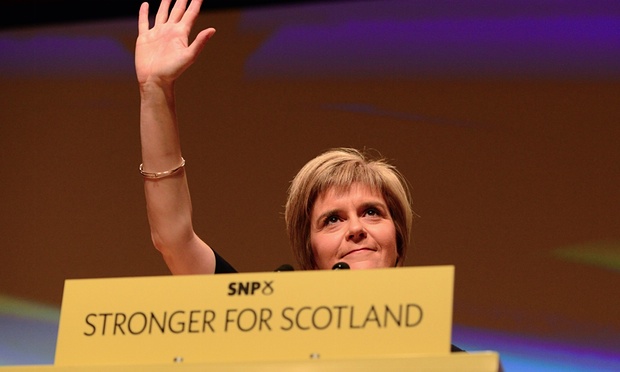
Nicola Sturgeon And The SNP Are Trying To Blackmail Britain

Nicola Sturgeon - SNP - Scottish Independence - IndyRef - Blackmail

First published at Conservatives for Liberty

For the sake of everyone else in the United Kingdom, 2016 must not be another year of coercion and blackmail by selfish Scottish nationalists

Nicola Sturgeon, First Minister of Scotland, has presumed to tell the elected Prime Minister of the UK that our country is on “borrowed time”, and that if we do not mend our ways and immediately start enacting left-wing policies which were comprehensively rejected in the 2015 general election, we will lose the pleasure of Scotland’s company in the United Kingdom.

From the Telegraph:

Ms Sturgeon has prompted speculation about a quick second referendum by promising the SNP’s 2016 Holyrood election manifesto will contain details of potential “triggers” for another vote, such as the UK leaving the EU, and a timescale.

However, amid warnings it would be the nationalists’ last chance, she has made clear she will only call another vote when she is sure of victory.

[..] she warned David Cameron that Scots would weigh up independence “against the alternative” of Westminster rule and warned that he was “living on borrowed time” thanks to his refusal to listen to their views on Trident, austerity and greater devolution.

Nicola Sturgeon needs to learn her place. With all its new powers, the SNP has governed Scotland poorly; its policies on policing, education and tuition fees have failed. The economic success of Scotland – including high employment – is facilitated by the union.


Continue reading

The Curiously Brittle Bonds Of Left Wing Patriotism In Britain

EU - European Union - Flag - Cross - Eurosceptic - 2


People of all political stripes sometimes say things they don’t mean, or come to regret, in the heat of passionate argument, either out of anger or just for dramatic effect.

The Sun newspaper once famously warned the last person fleeing Britain in the event of a Labour election victory to “turn out the lights”. Every Labour Party campaign in living memory has warned voters that they had only “24 hours to save the NHS”, though somehow it never seems to disappear in the Tory years. Paddy Ashdown said he would eat his hat if the Liberal Democrats did as badly in the 2015 general election as the exit poll predicted (they did worse).

Meanwhile, across the Atlantic, angry liberals threatened to move to Canada when George W. Bush was re-elected, while social conservatives – high on passion but lacking in international awareness – responded to the Supreme Court’s ruling legalising gay marriage by themselves threatening to move to Canada, that well-known bastion of homophobia and social conservatism.

So rhetorical hyperbole is not restricted to any one political party or any one type of outlook or worldview. But there is a certain type of political argument to which those on the political Left seem to resort far more often than their opponents on the Right.

When faced with electoral defeat and years in political opposition, those of a conservative mindset tend to lick their wounds for awhile and then set about the business of trying to re-acquire power and influence, however angrily or unsuccessfully. However, when those of a left-wing mindset are faced with rule by the other side, they are far more likely to view the situation as intolerable to the extent that even remaining part of the same country or political structure becomes undesirable.

Continue reading

Constitutional Reform Is The Elephant In The Room This Election Season

Constitutional Reform British General Election 2015


Conservative Home is currently running an important series on the three urgent political issues which are being pointedly and shamefully ignored by the main political parties in the run-up to the 2015 general election. These are identified as the constitution, national defence and the truth about spending reductions.

On constitutional reform in particular, ConHome is quite right to call attention to the lurking threat:

Yes, there’s plenty of speculation about what might happen in a hung Parliament, and who might form coalitions or pacts with whom.  But there has been no big debate to date about how we should be governed – what an English-votes-for-English-laws Commons would look like; what the knock-on effects on Scotland might be; what would happen to the Lords in consequence; how much devolution there should be in England (and elsewhere); what would replace the ECHR (if anything) were Britain to leave it; where an EU referendum fits into this picture; whether the UK will survive at all.

Will the UK survive at all? A sobering question to ponder, and yet when faced with these unresolved questions of national character, purpose and even survival, too often our politicians focus on the minutiae of daily life as they seek to either prey on our fears or appeal to our wallets.

This blog makes no apology for having singled out the Labour Party and Ed Miliband as the worst culprits as they seek to reduce the 2015 general election to a petty contest about public services, when Britain’s greatness is so much more than the sum of local government services and “our NHS”, here on the occasion of the Labour Party leader’s most recent relaunch:

Continue reading

In Opposing EVEL, Labour Struggles To Defend The Indefensible

Saltire Downing Street BBC EVEL constitutional reform scotland


It’s mighty hard to defend the Labour Party’s current position on devolution and constitutional reform.

Most normal people would not call loudly for a United Kingdom constitutional convention unless they had a brightly shining idea – hell, at least a rough approximation – of what they wanted to come out of it.

And if the concept of EVEL – English Votes for English Laws – is one of those acceptable outcomes, why not simply say so and sidestep all of the criticism now coming their way from the Conservative Party, the media and the general population?

But the Labour Party was silent or dismissive of EVEL during today’s parliamentary debate on the ramifications of the Scottish independence referendum decision precisely because they intend to use a UK constitutional convention (or rather, the distant prospect of one) as a convenient means of burying EVEL forever and maintaining their already heftily unfair electoral advantage in perpetuity.

Continue reading

With Constitutional Reform, Labour Puts Politics Before Country

ed miliband devolution


The idea that Welsh, Scottish and Northern Irish MPs should no longer be able to vote on matters affecting only England when devolution prevents any English reciprocity is the only reasonable, logical viewpoint for a British citizen to hold – particularly in the aftermath of the Scottish independence referendum.

One might expect that a political party so self-avowedly obsessed with promoting “fairness” would recognise this universal truth, and work swiftly to ensure that the new reality comes to pass.

But Ed Miliband’s Labour Party has many priorities, and advancing this most fundamental form of constitutional fairness is very far down the list. Indeed, it is almost universally viewed as a threat.

The status quo keeps alive the possibility of a future Labour government in Westminster, while ensuring that a Conservative UK government is prevented as much as possible from interfering with any left-wing policies that take shape in the devolved assemblies.

Continue reading