Sarah Palin Lurks

The political zombies from previous failed Republican campaigns simply refuse to go quietly into the night.

First we had Rick Santorum maintaining his moral crusader profile and penning articles for conspiracy “news” site World Net Daily as he treads water waiting for 2016.

Then we had Rick Perry announcing his intention to stand down from the Texas governorship after his current term expires, and floating the hilarious possibility of a second presidential run.

And now it is the turn of everyone’s favourite reality TV star, Sarah Palin, to publicly float her future political intentions. Yes. The person who makes Michele Bachmann look cerebral and wise.

The lady with the uncontrollable facial tick thinks that she would make a good US senator.

RealClearPolitics reports on a recent appearance by Palin on Sean Hannity’s radio show:

SEAN HANNITY: There’s been talk that you might run for Senator in Alaska. Have you considered that at all?

SARAH PALIN: I’ve considered it because people have requested me to consider it. But, I’m still waiting to see what the lineup will be and hoping that — there again, there will be some new blood, new energy, not just kind of picking from the same old politicians in the state that come from political families, that have sort of reigned up there for so many years because too many of them have been part of the problem.

I’m glad you brought that up because Senator Mark Begich has got to be replaced. He has not done what he has promised to do for the people of Alaska, and that was to represent what it is that the nation needs in terms of energy development and so many other natural resources — development issues that are near and dear to Alaskans hearts because he is on the wrong side of the aisle he has to go along to get along with his Democrat leadership. And that is a shame. That is a waste of opportunity for our nation.

HANNITY: If you think that whoever is running doesn’t have the ability to win, and you think you could, would that propel you into the race you think?

PALIN: Well, I think any American with a heart for service has to always have in the back of their mind that they would do anything, everything that they could to help the cause, even if perhaps it doesn’t look necessarily appealing or necessarily fitting in with a conventional plan that they tried to orchestrate for themselves or their family. I, along with anybody, would have to say that I would do whatever I could to help. If that was part of that help, then it would have to be considered. (Sean Hannity Show, July 9, 2013)

Of course, this declaration of intent is couched in the usual “reluctant saviour” terms that Palin and others love to use, i.e. they very much enjoy being private citizens, but are reluctantly considering returning to public office because they are being urged by so many people to do so. Because the one thing that the World’s Greatest Deliberative Body (ha!) lacks at present is the wisdom, experience and political conviction of Sarah Palin.

God help us all.

The GOP’s Immigration Reform Game Theory Dilemma

My Nemesis

When I was in primary school, at about the age of eight, we had a class assignment to make our own abacuses out of wood. We lovingly spent ages glueing them together and painting them with bright colours – to this day, I am still quite proud of that piece of craftsmanship.

The next day, we were due to use our homemade abacuses in class as part of the maths lesson, and it was then that I brought disaster upon myself and earned the wrath of my entire class. There was a girl who had been sick at home the previous day when we were engaged in our arts & crafts, and who consequently didn’t have an abacus of her own to use when the time came. Our teacher approached my desk, where I sat with my best friend Scott, and asked us if we could lend one of our abacuses to the girl so that she could participate in the lesson.

Uh-oh. I looked at Scott. He looked at me. I didn’t want to let me new abacus out of my sight – it was brand new and I hadn’t had a chance to use it yet. Scott clearly felt the same way, even though his model was crooked, garishly painted and looked as though someone had taken an axe to it. I broke the silence first: “Scott, do you want to…?” but he countered “Sam, do you want to…?” (originality was never his strong point).

The teacher became impatient and told us to make up our minds who would lend out their abacus, or the lesson would go ahead sans abacuses for everyone in the class. And still we prevaricated. Even though both Scott and I knew that everyone else in the class was getting increasingly pissed off with us, and that we were in grave danger of ruining the fun lesson for everyone, we couldn’t compromise. So the lesson was cancelled, and Scott and I sat alone at lunch that day.

I recall this long-winded story because the Republican Party is currently making the exact same error that I made when I was eight years old and in primary school, with respect to their stance on immigration reform. Only they have infinitely less excuse, because they are not eight years old (perhaps in mental age) and are paid handsome federal salaries to produce legislation to solve problems.

The Huffington Post reports:

Many House Republicans are chilly or openly hostile to the bipartisan bill before the Senate, embraced by President Barack Obama. Even substantial changes to the bill may do little to placate these lawmakers, who demand strict crackdowns on unlawful border crossings and no “amnesty” for people here illegally.

These Republicans don’t deny that weak support from Hispanic voters is hurting GOP presidential nominees. And they concede the problem may worsen if Latinos think Republicans are blocking “immigration reform.”

These House members, however, worry much more about their own constituents’ opposition to the proposed changes. And they fear a challenge in the next Republican primary if they ignore those concerns.

“It’s hard to argue with the polling they’ve been getting from the national level,” said Rep. Kenny Marchant, R-Texas, referring to signs of serious problems for Republican presidential candidates if immigration laws aren’t rewritten. “I just don’t experience it locally.”

Even the house members themselves admit this gap between the interests of the national party and their local districts. The article goes on to explain the reasoning behind House Republicans’ stances in more detail:

House Republicans, however, spend far more time talking and worrying about their own election prospects, not the next presidential nominee’s.

“It’s a classic challenge when the best interests of the party are at odds with the best interests of the majority of the members individually,” said Rep. Tom Cole, R-Okla. He is close to Speaker John Boehner and other Republican leaders who want a major immigration bill to pass.

“What it takes to get a deal with a Democratic Senate and a Democratic president makes it extraordinarily difficult for a lot of (House) members,” Cole said, “because it can cause you a big problem in your primary.”

Ah yes, the much-feared Tea Party challenge from the right. That nagging fear in the back of the minds of all Republican congressmen and women in this age of the Unreasonable GOP. The fear that leads to gems like this:

Rep. Paul Broun, also seeking Georgia’s Senate nomination, said any immigration deal “must make English the official language of the country.” The U.S.-Mexican border, he said, must be secured “totally, whatever it takes. A double fence high enough to make sure it’s secure.”

Some Republicans wince at talk of massive double fences and making English the official language. They say it fuels arguments that the GOP is unwelcoming to all Hispanics, legal or not.

Hispanic voters are not a homogeneous block, and it would be patronising in the extreme to assume (as many do) that Hispanic disenchantment with the GOP is exclusively due to their policy on immigration reform and what to do with illegal immigrants already settled in the country. Hispanics, like every other voter block, have a whole web of different voting priorities. But with language like this from Rep. Paul Broun (incidentally nominated as America’s Craziest Congressman by Bill Maher), it is not hard to understand how the Republicans managed to lose the Hispanic vote 27-71% in 2012.

I generally don’t like to write articles about process, i.e. the mechanics of how a particular bill gets passed, or the ways in which parties and politicians manoeuvre for advantage. That stuff is usually personality-based gossip of secondary importance, and is covered more than enough by the likes of Politico. But in this case, the process is genuinely interesting and has ramifications that go way beyond who wins the news cycle on a given day, and therefore I decided that it is worthy of comment and discussion.

At some point the Republicans are going to have to make a choice. They cannot claim to be a national party with aspirations of winning future presidential elections without addressing the fact that they overwhelmingly lost the Black, Hispanic, Asian and Female vote in 2012. Yes, in the immediate aftermath of Mitt Romney’s implosion there was a little bit of hand-wringing and soul-searching, but we are now very much back to business-as-usual.

Scarcely a week passes without some new Republican (male) politician deciding to hold forth on the topic of rape in front of a live microphone, or accuse American Muslims of being complicit in terrorist attacks when they don’t denounce them as loudly as is apparently required, or talking about the superiority of a “man’s brain” when it comes to analysing the implications of laws such as ObamaCare.

These cheap, nasty little stunts might play very well back home in their heavily gerrymandered conservative districts, but they will be fatal for the Republicans in 2016. But right now, the party that likes to campaign under slogans such as “Country First” is fragmented, self-serving and unable to step back and solve any problem bigger than avoiding a Tea Party primary challenge.

Dancing With Yourself

Tea Party Protest - Barack Obama

It is hard to disagree with this assessment of recent GOP obstructionism from Jamelle Bouie at The American Prospect:

The crux of the matter:

If I sound frustrated—and I am—it’s because we’re in the middle of an absolutely ludicrous scenario. Under a Republican president, the United States endured eight years of disastrous economic stewardship—arguably the worst of the post-war era—that nearly led to a second Great Depression. In response, voters elected a Democratic president and gave him huge majorities in both chambers of Congress. Rather than work with the new president, Republicans ran to the right and promised to defeat this president by any means necessary. They abused institutional rules to block nominees, and imposed a de-facto super-majority requirement on all legislation. Republicans rejected stimulus, the automobile rescue, a climate bill built from their ideas, a health care bill built from their ideas, and a reform bill designed to keep the Great Recession from happening again.

This was an amazingly successful strategy. It destroyed Democratic standing with the public, energized the right-wing fringe, and led to a historic victory in the House of Representatives. Once in command of the House, Republicans pushed hugely draconian budgets, risked a government shutdown, and nearly caused a second economic collapse by threatening to default on the nation’s debt. This reckless behavior depressed the economy, prolonged the recovery, and destroyed trust in the nation’s political institutions. The Speaker of the House has even promised to do this again, if Democrats don’t bow to his demands for greater spending cuts.

The Republican party of today has drifted so far – not just to the right, but into the realm of crazy, where the eight years of disastrous Bush economic stewardship apparently never happened, and the economic malaise is entirely Obama’s fault – that it’s hard for me to see how I could ever bring myself to vote for them. I have joined firmly with those who are hoping for a complete electoral landslide in the upcoming presidential elections, to perhaps convince the GOP to tack back toward a reasonable, pragmatic conservatism.

Of course, this would have been easier if one of the crazies had managed to wrest the nomination away from Mitt Romney. As it is, we will probably have to wait until Romney’s likely defeat in 2012, and then a further tack to the right and an even bigger defeat in 2016 before we might finally have a viable choice between two parties again.

The Hypocrisy of Mitt Romney – Birther Edition

donald-trump-barack-obama-birth-certificate-birtherism

A lot of people have been wondering about the extent to which Mitt Romney would tack back to the centre of the political spectrum in the highly, highly, highly unlikely event that he manages to defeat Barack Obama in November’s contest. And to be fair, Mitt Romney has certainly added fuel to the fire of such speculation by some of his statements, most recently his surprise revelation that everything he has said before about immediately balancing the budget was just a big joke, because he is actually a Keynesian at heart, and knows that to reduce federal spending by $1 trillion in year 1 would not be the most positive thing to do to a fragile economy.

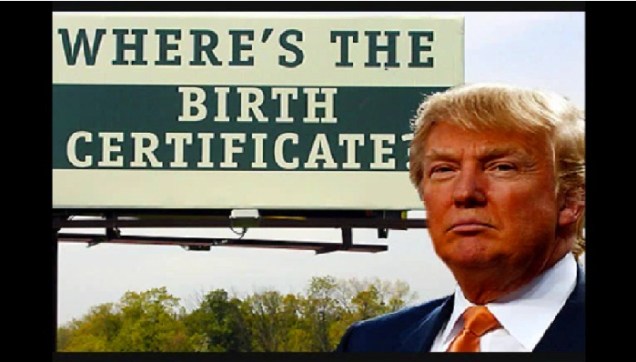
But those people thinking (either worrying or hoping) that a Romney presidency would move to occupy the political centre ground need speculate no more. Because Mitt Romney has now proved beyond question that he is fully and totally beholden to the extreme right wing of the Republican Party, and would no sooner do anything to anger that bastion of support than he would chop off his own hand. How do we know this? Because Mitt Romney refused to distance himself from his most high profile campaign surrogate and supporter, Donald Trump, when he said this:


And then doubled down with this:


Romney, meanwhile, had only this to say when asked about his wayward campaign surrogate:

Mitt Romney said Monday he wasn’t concerned about Donald Trump’s commitment to the “birther” conspiracy, one day before the GOP presidential candidate hosts a fund-raiser alongside the celebrity business magnate.

Asked on his charter plane whether Trump’s questioning of President Barack Obama’s birthplace gave him pause, Romney simply said he was grateful for all his supporters.

“You know, I don’t agree with all the people who support me and my guess is they don’t all agree with everything I believe in,” Romney said. “But I need to get 50.1% or more and I’m appreciative to have the help of a lot of good people.”

Even when his most high-profile supporter and key surrogate goes totally off the rails and revives his old birther conspiracies prompted by nothing at all, Mitt Romney is too afraid of angering his base to unequivocally disassociate himself from the remarks. Surely no one now harbours any remaining belief that Romney would tack back to the centre if he got elected. Tea Partiers, fear not – you may not like the guy and distrust the sincerity of his convictions, but it doesn’t matter – he’s scared of incurring your wrath, so you have him safely in the bag.

If, in some dystopian world, I had to choose between a President Romney and a President Trump, I think I am minded to go for President Trump. He may be batsh*t insane with an ego the size of one of his towers, but at least I would always know what he really thinks about something.

The Republican Party, Or The Mikado

Okay, so some good news out of St. Louis. Ron Paul, the only Republican presidential candidate still in the race whose political ideology, record in office and personality that I can reasonably tolerate, is apparently doing well in the Missouri caucuses. So says the St Louis Post-Dispatch:

http://www.stltoday.com/news/local/metro/ron-paul-supporters-dominate-gop-caucus-in-st-louis/article_4c7977d4-75e0-11e1-858e-001a4bcf6878.html

Hooray.

Except, why is Missouri having a caucus, didn’t they just have a primary last month? Why, yes, they did, but it was a non-binding primary because some awesome person or people in the legislature screwed up and left a law requiring the state to hold a primary on a date that was earlier than the Republican National Committee would sanction. So they went ahead and held the primary in accordance with their state law, but it was essentially a “beauty contest” because the results counted for nothing. These caucuses, happening now, are the ones that count.

As The St. Louis Post-Dispatch helpfully explains:

“The slate backing Paul cast 158 votes in the non-binding caucus Saturday. The purpose was to choose representatives to a round of Congressional district meetings in April and June that will repeat the process to send 52 delegates from Missouri to the August convention in Tampa, Fla.”

Is that clear everyone? What do you mean, no?

So. The primaries that happened last month in Missouri counted for nothing. But that’s okay, because the caucuses that are happening now will choose the representatives that then go on to another round of meetings in April and June, the output of that meeting being the selection of 52 delegates to travel from Missouri to Florida where they can then all bicker together about who will have the honour of being electorally destroyed by Barack Obama in November.

Ladies and gentlemen, I give you the greatest democratic system on the face of the earth, etc.

Seriously, this is the stuff of which Gilbert & Sullivan operettas were made in terms of farcical plots, topsy-turvydom and bureaucratic nonsensical officialdom.

Firstly, having a long series of primaries and caucuses is dumb, because by the time the race gets to the big states that actually, y’know, contribute the most to the union (we can quibble about how we define “contribute the most” but we all know it’s true – lose Alabama, for instance, and the USA will pick itself up and limp on, ‘real America’ or not; lose California or New York or Texas and there’s a mortal wound right there) the race is pretty much already decided. Sure, it’s great to make the big rich hot-shots trek around a million diners and pancake houses pressing the flesh every morning and participating in good ol’ fashioned retail politics. But why should ethanol-swilling rural Iowans and their special interests have more of a say in choosing the nominee than those residents of the industrial midwest, or the two heavily populated coasts? It makes no sense, and the way in which those overlooked states which rightly try to increase their influence by bringing forward their primaries have been bullied, slapped down or penalised by the establishment is, if anything, the real affront to democracy taking place in America at the moment.

Secondly. if you are going to have a series of primaries and caucuses, can we at least get together to apply roughly the same rules to them all, so that you don’t need to fire up IBM’s Deep Blue supercomputer to work out the impact of each primary election night on the fortunes of the respective candidates? I know, I know, state’s rights and so on and so forth. That’s fine. Every state is allowed to do what they want and organise their primaries the way they best see fit. But when the existing method makes you all look like a disorganised bunch of ass clowns, maybe it’s time to actually get together and come up with a more uniform system. Now when might be a good opportunity to do that? If only there was some upcoming pre-arranged big gathering of the nation’s top Republicans, in a big convention city like, say, Tampa, Florida, that would perhaps be ideal. But we can only wish.

Thirdly. As long as America persists with the ridiculous system they have in place at the moment (and the Democrats aren’t much better on their side, but of course Obama’s renomination is not being contested so we hear nothing about the “superdelegate” shenanigans this time around), I will continue to unapologetically act as cheerleader for Ron Paul’s scrappy efforts to increase his delegate haul by using his army of devoted supporters to out-organise the front-runners and win the apparently-crucial but almost-unreported actual meetings that assign the delegates for real.

After all, if the rules are stupid or flexible enough that winning a majority of votes in a state’s primary or caucus doesn’t guarantee you something approaching a commensurate proportion of delegates to the convention, three cheers for the guy with the smarts to actually play the system.