The Remain Campaign’s Last Stand

Stronger In - Kind Open Inclusive Tolerant Together - EU Referendum

The Remain campaign is so used to loudly claiming the moral high ground and dismissing Brexiteers as backward, nasty reactionaries that even their “positive” closing message is unintentionally insulting toward half the country

Well, that calmer, politer politics didn’t last very long, did it?

On the first day of real campaigning following the murder of Jo Cox MP, the Remain campaign has hit the airwaves with this new meme, now being widely shared on social media.

Displaying a heart shape in the colours of the Union Flag, Britain Stronger in Europe exhort us to:

Remain kind

Remain open

Remain inclusive

Remain tolerant

Remain together

All pleasing words, you might think. But what does it say about those Britons – nearly half the country, according to opinion polls – who think that Britain should leave the European Union. Are they unkind people? Are they closed-minded and closed-hearted? Do they all seek to exclude people? Are they all racist? Apparently the official Remain campaign thinks so.

The image is accompanied on social media by the following message:

This referendum is about the type of country we want to live in.

SHARE this if you believe Britain is at our best when we’re outward-looking, inclusive and we stand together.

Just hammering the point home.

From a purely strategic and tactical viewpoint one can understand why Britain Stronger in Europe went for this approach. After all, almost none of their argument for staying in the EU has been based on the positives of the European Union (beyond woolly platitudes about “cooperation” and “working together”, which a ten year old can work out does not require the intermediation of Brussels). Rather, their argument has been a relentlessly fear-based approach, threatening and even bullying voters to vote Remain on pain of supposed economic disaster compounded by George Osborne’s vindictive “punishment budget”.

But to get Remainers to the polling station on Thursday, the campaign needs to give them something positive to think about, too. Even if it later turns out to be a pile of nonsense, their supporters must be made to think that they are doing something noble in choosing to fearfully stick with the status quo. And in this day and age, even better if they can then broadcast this positive message to others in order to signal their own virtue.

This social media post accomplishes the Remain campaign’s objectives brilliantly. It doesn’t get bogged down in the details of why the European is so great (it isn’t) or necessary (it really isn’t), or even why leaving would be so calamitous (it wouldn’t be). On the contrary, the Union Jack coloured heart and childish font keep things very superficial. It declares to the world that the person liking or sharing the message is a Good, Enlightened and Virtuous Person, unlike those knuckle-dragging, murderous subhumans who dare to believe in Brexit.

Another similar meme is also being shared widely on Facebook, as a play on Nigel Farage’s tired old “I want my country back” theme:

I want my country back, too. The country which celebrated Mo Farah winning at the Olympics, the same one who is proud to call Tom Daly or Mark Foster part of the British Olympic team, the country who cheers for Tanni Grey-Thompson. That, that’s my country. The same country which took Malala Yousafzai to its heart. My country is better for the diverse country it is, from the food available in the supermarket to St Paul’s Carnival & drinking Kenyan coffee with a Jewish bagel to cure a hangover from French wine. My Britain is not filled with hate or extremism. My Britain is not perfect but it isn’t better alone. My Britain is open, inclusive, progressive and an inspiring place to live.

Because of course a post-Brexit Britain would rejoice in none of these things, all of which are only made possible thanks to our membership of the European Union. Quite why Britain’s departure from a supranational political union would mean that Britain would become a country which starts booing its own black athletes, burning down bagel shops or pouring French wine into the sea at Dover harbour is of course never explained. But the Remain campaign don’t need to explain it. This is their own form of “dog-whistle” campaigning. They just have to suggest these these links, and immediately everyone who is preconditioned to equate euroscepticism with xenophobia or racism immediately pricks up their ears and awaits orders.

This is insulting beyond words to half the country who currently favour Brexit, particularly considering the hurried vow everybody took in the wake of the Jo Cox murder to immediately (and rather implausibly) be nice to one another. But one must admire the way that the Remain campaign stuck to the letter (if not the spirit) of their pledge – they managed to grievously insult half the country without using a single negative word, instead simply suggesting that Brexiteers represent the opposite of all these positive values.

Though as one commenter put it on the Britain Stronger in Europe Facebook page:

This idea that only those voting for Remain uphold those values is disgusting. None of us have a monopoly on those things. Remain shouting the loudest about being decent – total and utter hypocrisy #Brexit

But this is literally all they have. The Remain campaign kept the focus relentlessly and myopically on the economic question, wheeling out all of the same experts who told us two decades ago that Britain would wither and perish outside the euro. And the message has not gained sufficient traction to leave Remain confident of victory. So all they have left is to demonise the other side.

They cannot speak too passionately and warmly about the European Union, because the organisation is distrusted or hated – quite rightly – by anybody who remotely cares about democracy or the continued importance of the nation state. They cannot openly commit Britain to the EU’s clearly stated end goal – a common European state – because it would alienate too many people.

So all that is left for Remain is to demonise the other side, either explicitly (as they did before the murder of Jo Cox) or implicitly (as they are doing now, by suggesting that Leave voters are the antithesis of the wonderful, warm qualities listed in the Facebook meme).

And in terms of winning the referendum, it may just work. The relentless fearmongering, the demonising of Brexiteers, the desire of many people to virtue-signal the fact that they hold “open” and “progressive” views and the usual tendency for people to gravitate back towards the perceived status quo at the closing stages of a referendum campaign may push Remain over the line. Possibly quite convincingly.

But it has made the job of stitching the nation back together again almost impossible. And each time sanctimonious, preachy little graphics concocted by Britain Stronger in Europe are created and shared, it makes the task that much harder. Because whatever misanthropes, racists and bigots may support Leave, the vast majority of Brexiteers are good, honest decent people. They are patriots who genuinely (and in this blog’s view, quite rightly) believe that they are doing the right thing. And you can’t spend three months loudly questioning half the country’s intelligence, tolerance and moral code and then expect everybody to hold hands like one big happy family.

Given the way that this referendum has been fought by pro-EU forces, a vote to Remain will therefore resolve absolutely nothing. And prissy, sanctimonious little declarations of virtue like Stronger In’s “Remain Together” campaign message are the reason why.


Postscript: Mark Wallace also takes exception to Stronger In’s latest advert, in a piece for Conservative Home:

The implication is clear – if you’re someone who is voting Leave, you are supposedly declaring yourself to be unkind, closed, not inclusive, intolerant and in favour of division.

Not only is that entirely in conflict with the weekend’s warm words about a more reasonable and less unpleasant tone in the final days of the referendum campaign, but it is an extraordinary attack on the millions upon millions of voters who are – rightly, in this site’s view – planning to Vote Leave.

It isn’t the first time we’ve heard such dismissive criticisms of those who dare to disagree. Only yesterday, the Prime Minister declared that there is not “a single credible voice” arguing we will gain by leaving the EU, implicitly suggesting several members of his own Cabinet lack credibility. But the content of this particular advert makes it the broadest insult to voters, Party members, MPs and Ministers so far, and the timing makes a mockery of recent promises to raise the tone.

If Stronger In’s management intend to stand by this scurrilous line, will their overseers, Cameron and Osborne, continue to do so as well?

 

European Union - United Kingdom - Britain - Flags

Agree with this article? Violently disagree? Scroll down to leave a comment.

Follow Semi-Partisan Politics on TwitterFacebook and Medium.

The Petition To Cancel The EU Referendum Showcases The Remain Campaign’s Dim View Of Democracy

Cancel EU Referendum - Brexit - Remain - Parliament Petition

The divergence between the strong preference of most MPs and the sentiment of the British people is the main reason we are having this EU referendum, not a reason to cancel it

Last week, before the awful murder of Jo Cox MP changed the character and atmosphere of the campaign, it was widely agreed that the Remain campaign were on the back foot, behind in some of the polls and certainly lacking in anything like momentum.

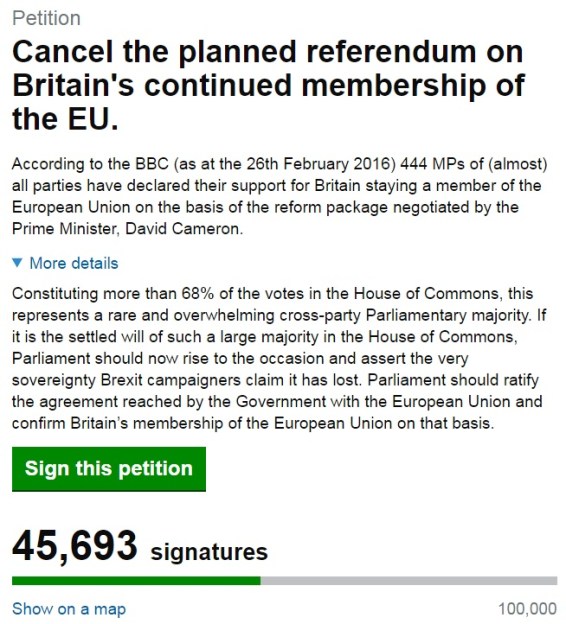
And so perhaps it is unsurprising that late last week, a petition started by Remainers began to circulate on social media, calling for the EU referendum to be scrapped altogether.

The text reads:

According to the BBC (as at the 26th February 2016) 444 MPs of (almost) all parties have declared their support for Britain staying a member of the European Union on the basis of the reform package negotiated by the Prime Minister, David Cameron.

Constituting more than 68% of the votes in the House of Commons, this represents a rare and overwhelming cross-party Parliamentary majority. If it is the settled will of such a large majority in the House of Commons, Parliament should now rise to the occasion and assert the very sovereignty Brexit campaigners claim it has lost. Parliament should ratify the agreement reached by the Government with the European Union and confirm Britain’s membership of the European Union on that basis.

What a cynical, opportunistic and fatuous thing to do – to seek to cancel an imminent referendum just because their own side happens to be in danger of losing.

The “444 MPs” line does not hold water, either. The whole purpose of this referendum is to settle what is in effect a dispute between past and present parliaments on the one hand, and the British people on the other. It is parliament which has knowingly and willingly signed away endless new competencies and powers to the EU, hollowing out the British state at the expense of the growing supranational European government in Brussels – a parliament often composed of many MPs who described themselves as “eurosceptic” while being complicit in the process.

This includes many Conservative MPs who were only ever selected by their parties or constituency associations as candidates because they professed strongly anti-EU sentiments to the Tory party base. Now, it has sadly been the case that many of these MPs were revealed to have lied during their selection processes, telling eurosceptic party members what they wanted to hear while themselves being ambivalent or even pro-European, as evidenced by their decision to support the Remain campaign. But it is clearly disingenuous to claim (as the petitioners do) that the majority of MPs favouring Remain represents the settled will of the people – the tightening polls, some showing a lead for Leave, prove this to be otherwise

It should also be pointed out that many of the “444 MPs” supporting Remain would not presently be sitting in Parliament had David Cameron not taken the sting out of UKIP’s tail by promising the referendum in the first place. Prior to that pledge, two former Tory MPs (Douglas Carswell and Mark Reckless) had already defected to UKIP in a blaze of publicity, and more threatened to follow. If Cameron had not neutered part of UKIP’s appeal by promising the referendum, there could have been up to a dozen more defections prior to the general election, and then tens more UKIP MPs elected in May last year. If anything, promising the referendum helped to keep a pro-EU majority in the House of Commons. That same majority can not then also be used as grounds to take the referendum away.

But the root of the matter is the “parliamentary sovereignty” referenced in the petition text. I cannot speak for all Brexiteers, but I know I speak for many other liberal leavers when I say that I am not fighting with every fibre of my being to secure a Brexit vote because I want to re-establish the sovereignty of parliament and re-empower the very people who so blithely gave it away to Brussels in the first place. On the contrary, I want the British people to finally be sovereign in this country. And this is the wider debate which has been entirely missing throughout this sorry referendum campaign, but which we need to have.

What, after all, would be the point of striving to claw back sovereignty and decision-making power from Brussels only to give it back to the same people operating under the same laws who gave it away? This is why Brexit must just be part of a broader process of democratic renewal, making the people sovereign and beginning with the assumption – much as in the United States of America – that “Parliament shall make no law…” except in those areas where we the people explicitly grant permission.

This then opens up a whole load of other questions which gleeful Remainers would doubtless seize upon as more evidence that Brexit would cause problems and be “difficult”. Well, yes, it would. Unsurprisingly, great deeds require a commensurate effort in their accomplishment, and throw up lots of problems which need to be patiently solved along the way. Man did not walk on the moon the day after John F Kennedy idly thought out loud that it might be a good idea. The Apollo Programme took place in many stages after Kennedy set the initial goal, each one solving a particular problem or proving a new competency until all of the pieces were in place for Apollo 11 to finally touch down on the surface of the moon.

It is reasonable to expect that the process of extricating our country from forty years of gradual, incessant political integration by stealth should be a task of comparable difficulty. But it is not scientific and technical expertise which we must rebuild, but political, constitutional, democratic, trade and regulatory knowledge, much of which we have lazily outsourced to the EU.

And unfortunately the prize cannot be measured in pounds or euros, or any economic model pointed to by David Cameron’s hallowed “experts”. The ability of people to exercise meaningful control over their leaders, communities and futures cannot be boiled down to numbers in an Excel spreadsheet or one of the smug infographics shared by the Remain campaign. But this does not mean that democracy lacks value – rather, that it is priceless.

Those who would have us vote Remain on June 23rd look at British independence and see it as a series of problems and risks, all of which our country and our people are too small, too weak and too incompetent to overcome. They genuinely cannot understand why a country as “small” and supposedly inconsequential as Britain would want to leave a supranational political union in which we trade our democracy for the illusion of influence which comes from being a member of a big club.

Those advocating Brexit, on the other hand, see opportunity and feel a sense of optimism grounded in a healthy sense of what this country and its people are capable of accomplishing. They generally accept that there may be some short term political instability, but that there is just as much instability in our future if we remain shackled to an EU beset with so many intractable problems it is simply unwilling and unable to address. And they also value democracy sufficiently highly that endless, apocalyptic scaremongering with doomsday economic scenarios simply doesn’t resonate. The prime minister appears genuinely frustrated that we Brexiteers are not more responsive to his Project Fear, because he fails to appreciate that the core Remain argument does nothing to neutralise the reasons why many of us want out of the EU.

And sadly, this difference in mindset is not one which we can reconcile (or persuade any hardcore Remainers to the Brexit side) in the little time left of the campaign. But while we Brexiteers are happy to fight on to the end, making the case as best we can, some on the Remain side want to circumvent the process and take the choice away. Hence this ridiculous petition, arguing that because a majority of the very people you would expect to love the EU think that we should stay in it, there is no need to further consult the British people.

I would state again that the very existence of this petition shows a contempt for the will of the British people – but when the entire Remain campaign focuses myopically on short term economic indicators rather than the long term health of our democracy, it hardly needs saying.


European Union - United Kingdom - Britain - Flags

Agree with this article? Violently disagree? Scroll down to leave a comment.

Follow Semi-Partisan Politics on TwitterFacebook and Medium.

The Deployment Of Jeremy Clarkson, Self-Described European Citizen, Suggests A Remain Campaign In Disarray

What was David Cameron thinking, allowing himself to be pictured joking around with an arch euro-federalist days before the EU referendum?

I strongly suspect that David Cameron will come to regret trying to enlist Jeremy Clarkson and the remainder of the ex Top Gear rabble to support his tawdry and deceitful campaign to keep Britain in the European Union.

For while it made a great photo op, our dashing prime minister ladding about with old Clarkson, unfortunately Jeremy Clarkson then opened his mouth and spoke. And what he said was very far from the official Britain Stronger in Europe line of “oh gee, the EU is awfully frustrating, but we have to stick with it because we are just not good enough to handle this whole independence thing”.

No, as we saw earlier this year, Jeremy Clarkson is a committed EU federalist – and to his credit, he makes no effort to hide the fact that he feels European first and foremost, and that he wants the embryonic common European state to hurry up and finish hatching so that he can be a true European citizen.

And so, just when David Cameron needed Jezza to come out with a suitably “Eurosceptics for Remain” soundbite, Jeremy Clarkson instead gave us this (my emphasis in bold):

Really, it’s my gut. My gut tells me, as you know, I feel European, and therefore I want to be in Europe – for no other reason.

Because I’ve heard some very compelling reasons for leaving, sitting next to people who want to leave. And they are quite compelling.

And then Clarkson’s sidekick, James May, joins in the unwitting sabotage:

If I’m honest it’s a gut feeling for me as well. It’s because I feel that Britain is naturally disposed, if we’re not careful, to being rather backward in its view on the world. And there are too many people who think that we’ll be alright because we’ve got the E-type Jag. But that’s just not true, and being part of Europe is part of moving on.

In other words, instead of “I hate the EU too, but we are stuck with it because it’s the only thing on offer”, instead Clarkson and May gave us “Britain sucks and we’re all European citizens anyway! Let’s strive on to complete the grand project!”. Which rather undermines every single thing that the prime minister has been saying since he launched the Remain campaign – namely that the EU is a benign club devoted to trade, cooperation and nothing more, with no intentions to further impinge on our democracy, as well as the already-tenuous idea that voting Remain is in any way the patriotic thing to do.

It also rather contradicts the Remain campaign’s claim to have all of the facts on their side, while we knuckle-dragging Brexiteers exist in a kind of Trumpian, Palinite post-fact world. After all, Jeremy Clarkson’s argument for remaining in the EU doesn’t even remotely touch on the economic scaremongering which is so central to Stronger In’s messaging, which rather calls it into question. If the economic question is key and the “expert opinion” so settled that Brexit would be a disaster, why is the prime minister doing a photo op with someone who couldn’t give two figs about the economy because all he cares about is casting off his hated Britishness and becoming a truly European citizen?

Watch David Cameron’s pinched expression as Clarkson goes on about how European he feels, and then when May waxes lyrical about hopeless, parochial Britain with its backward inhabitants. You can see in the prime minister’s face the suppressed annoyance of a man who realises that his clever photo op has just massively backfired, and that the video footage they are capturing will be of absolutely zero use during the remainder of the campaign.

Why? Because unsurprisingly, the remaining undecided voters in this EU referendum campaign are not themselves ardent euro-federalists. Indeed, almost nobody falls into this peculiar category. And the last thing that the Remain campaign wants to be showing undecided voters – most likely people with no great love for the EU, but with gnawing fears about the economic risks of Brexit – is a self-satisfied millionaire celebrity who probably spends half the year sunning himself in the south of France and who sniffs at Britishness and considers himself European.

But still, one has to respect Jeremy Clarkson for at least being honest, as this blog pointed out when he first nailed his colours to the EU mast:

Unlike an oleaginous Turncoat Tory, Clarkson does not feel the need to butter us up with constant anecdotes about how he hates Brussels just as much as we do, honest. And unlike those bland Remainers on the Labour benches, he does not just mutter inanities about countries “working together”, as though intergovernmental co-operation were not possible without the umbrella of an undemocratic political union.

No, Jeremy Clarkson owns his position, and has the guts to tell us that not only should we learn to love the European Union as it is now, we should actively fight for further political integration.

Of course, this failed photo op took place before the tragic murder of Jo Cox MP changed the atmosphere of the referendum campaign. But it provides a snapshot of a Remain campaign not functioning as well as it should, and making bad tactical decisions – like wheeling out an ardent, unapologetic euro-federalist to try to reach a group of voters with significant doubts about the EU.

Whether or not the Remain campaign has used the past few days to steady the ship and reassert some sensible decision making will probably become clear on Monday, when both campaigns spin back up to full speed. But little vignettes such as this do paint a picture of a Remain campaign in disarray, if not outright panic – which can only be good for Brexiteers.


Jeremy Clarkson - EU Referendum - European Union

European Union - United Kingdom - Britain - Flags

Agree with this article? Violently disagree? Scroll down to leave a comment.

Follow Semi-Partisan Politics on TwitterFacebook and Medium.

The Economist Endorses Remain, In A Display Of Bad Journalism And Worse Citizenship

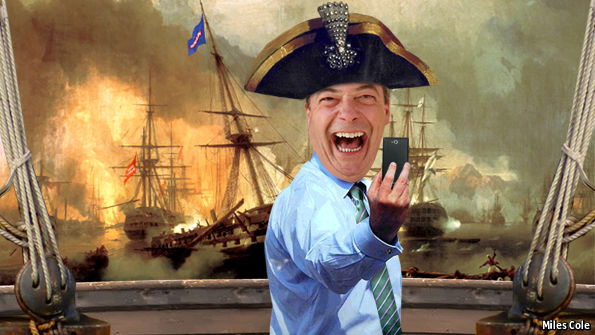
Nigel Farage Show - The Economist

How to suck at modern citizenship, by The Economist

The Economist has, inevitably, now thrown its support behind the campaign to keep Britain in the European Union.

Their endorsement of the EU is full of the usual denial about the EU’s trajectory and bromides about cooperation and not weakening Europe at a time of global uncertainty, but more astonishing is their condemnation of the very campaign in which the Economist – like all other major media outlets – played a major role.

In a separate piece published concurrently with their endorsement of Remain, the Economist declares:

Such has been Britain’s EU referendum. David Cameron first promised the vote in 2013, spooked by UKIP’s success in local elections and importuned by UKIP-inclined MPs on his Conservative benches. The result has been an unedifying campaign that has both bolstered Mr Farage and carried his imprint. It has been divisive, misleading, unburdened by facts and prone to personality politics and gimmicks. What might have been a hard-nosed debate about Britain’s future, about the pros and cons of EU membership, has turned into a poisonous row about the merits of what is ultimately Mr Farage’s vision of England: a hazy confabulation of content without modernity; of warm beer, bowler hats, faces blackened by coal dust; of bread-and-dripping, fish-and-chips, hope-and-glory.

The outcome has been a contest with the logical architecture of an Escher drawing: Remain and (in particular) Leave issuing assertions that double back on themselves, Möbius-strip arguments that lead everywhere and nowhere. Knowledge has been scorned (“I think people in this country have had enough of experts,” huffs Michael Gove, the pro-Leave justice secretary). Basic facts have fallen by the wayside: Mr Cameron claims Brexit would help Islamic State; Leave implies Turkey, with its 77m Muslims, is about to join the EU. The complicated reality of an evolving union and Britain’s relationship with it has been ignored.

[..] To some extent the referendum has revealed things that were already present: the growing void between cosmopolitan and nativist parts of the country, the diminishing faith in politics, the rise of populism, the inadequacy of the left-right partisan spectrum in an age when open-closed is a more salient divide. Yet it is hard not to conclude that the campaign has exacerbated all of these trends. Polls suggest that trust in senior politicians of all stripes has fallen. And that is just the start. If Remain wins on June 23rd, Brexiteers will tell voters they were conned. If Leave wins, Mr Cameron will go and his successor will negotiate a Brexit that does not remotely resemble the promises of the Leave campaign, which trades on the lie that Britain can have full access to the European single market without being bound by its regulations and free-movement rules.

Either way, politics is coarsened. Voters will believe their leaders less. Short of a total reconfiguration of the party-political landscape (possible but unlikely), the existing Westminster outfits will look increasingly at odds with political reality. The currency of facts will be debased, that of stunts inflated, that of conviction sidelined. It will be de rigueur to question an opponent’s motives before his arguments, to sneer at experts, prefer volume to accuracy and disparage concession, compromise and moderation. Mr Farage’s style of politics has defined this referendum. It will live on in the muscle memory of the nation.

It is frankly astonishing that the Economist can survey the dismal scene of this referendum campaign and choose to be dismayed not by the behaviour of our prime minister – a man who has boldly and shamelessly lied, bullied, deceived, threatened and intimidated the country into voting his way – but rather by the now typical antics of an increasingly sidelined Nigel Farage.

The Economist is quite right to point out that politics has been coarsened throughout this debate. This is partly inevitable – we are debating serious, existential issues in a once-in-a-generation plebiscite. And human nature being what it is, distortions will be made and tempers will flare. But it is thoroughly depressing to see the Economist seemingly hold the people in charge of the country on the Remain side to a lower standard of behaviour than those outsiders, typically with less experience of top level politics, who are advocating Brexit. Apparently we should all be aghast at the fact that there are some Little Englanders and conspiracy theorists on the margins of the Brexit movement, but simply accept that the prime minister of the United Kingdom has become a serial liar who happily threatens his own people.

If a certain style of politics is to “live on in the muscle memory of the nation”, as the Economist frets, it will be the style of politics practised by those on the Remain side who have abused their offices of state, their bully pulpits and any sense of common decency to wage a narrow campaign of fear based almost entirely on economic scaremongering. It will be the Tyranny of the Experts, in which the politically motivated verdicts of Highly Credentialed People are shouted louder and louder to drown out dissent – as though a consensus of “experts” has never been wrong about anything before (and as though democracy can be measured in an economic model).

But since the Economist is so willing to overlook the scandalous behaviour of our own prime minister and concentrate all of its fire on Nigel Farage’s personality, it is worth calling into question the Economist’s own role in this referendum campaign. Have they helped to shed light, to inform, to raise the level of debate? No. They have peddled in exactly the same glibly superficial, personality-based lazy journalism as nearly every other major outlet.

All this time, out of sight of the shining ones at the Economist, there was a rich, informative and inspiring debate taking place online which the rest of the legacy media entirely missed because they were so busy quoting each other and hanging on the every last word of Nigel Farage and Boris Johnson.

The bloggers of The Leave Alliance in particular have exposed the fascinating world of international trade and regulation, and the slowly emerging global single market – comprised of the real global “top tables” – of which Britain could be a part, if only we had the national confidence to stop hiding behind the euro-parochialism of Brussels. This is really interesting stuff, when you dive into it – the kind of topic which might make an excellent Economist Special Report, come to think of it, though it is apparently too obscure for their journalists to take the time to learn.

What the Economist (and many other publications) fails to realise is that Nigel Farage and Boris Johnson do not speak for the entirety of the Brexit movement, least of all the liberal Leavers whom the Economist scandalously misrepresents in their sloppy wet kiss to the EU. A few quick Google searches and some basic human curiosity (combined with a willingness to look outside the Westminster bubble for original thinking and writing) on the part of journalists could have completely changed the nature of this EU referendum. Opened it up. Taken it to a higher level, where we actually debated the importance of global regulation and how Britain can best wield our influence in the global bodies which actually hand regulations down to the EU. We could have spent this time debating the meaning of democracy and sovereignty in the 21st century, and how Brexit could just be part of a process of democratic renewal in Britain.

In short, the Economist has no right to scorn the very referendum campaign in which they were themselves utterly complicit. They could have sought out other, more informed voices and given them a platform and a sceptical but fair hearing. But all they wanted to hear from the Brexit side was the ranting of Nigel Farage, so that is all they did hear. The Economist wanted to see the Brexit campaign as a Little Englander movement spurred by nostalgia, insularity and xenophobia and they made sure to pay attention only to those facts and those voices which reinforced that viewpoint.

And in so doing, the Economist gave its readers exactly what most of them wanted to read – people in that prized demographic too busy being captains of industry with glittering international careers (and buying the Patek Philippe wristwatches advertised on the back cover) to really care much about democracy or how we exercise control over our leaders. Why would they care? They are generally doing very well, thank you very much. Most of them don’t see any need for things to change, or for people to be held to account for bad decisions in government which only ever affected “other people”, very different to themselves.

You can call that what you will. The Economist are certainly very proud of themselves. But to my mind it is shoddy journalism, and a truly rotten form of citizenship.


European Union - United Kingdom - Britain - Flags

Top Image: Miles Cole, The Economist

Agree with this article? Violently disagree? Scroll down to leave a comment.

Follow Semi-Partisan Politics on TwitterFacebook and Medium.

The Arrogant Labour Party Pathologises Pro-Brexit Working Class Sentiment

South Park - Smug Cloud - EU Referendum - Labour Party - Working Class - Brexit - Brexity - Owen Jones

The modern Labour Party, totally unable to relate to its alienated working class base, now seeks to pathologise overwhelming working class support for Brexit rather than question their own blind devotion to the European Union

To truly understand the gulf between the modern, metropolitan Labour Party and its increasingly alienated core working class vote, one need only read the latest column by Owen Jones, in which the “Chavs” author frets that “working class Britons feel Brexity and betrayed”.

Brexity.

Jones’ column in the Guardian doesn’t say that working class people have conducted a rational assessment of their social, material and economic interests and decided that Britain would be better off outside the European Union, in the way that a middle class professional might deliberate and weigh their options. No, when it comes to working class people, they just “feel Brexity”, like babies might feel gassy after feeding, or tetchy while teething – a simplistic emotion or reflex, not a considered thought.

In other words, when a “good” middle-class left-winger (the only kind of person that the Labour Party now much cares about) decides that the EU is simply wonderful, that Brussels is only about “trade and cooperation” and that we should stick around to reform the EU because “Another Europe is Possible!“, they are acting rationally and sensibly. But when working class Britons decide overwhelmingly that the European Union is a bad thing for their interests and kryptonite to our democracy, they must have been wildly misled by nefarious forces (read: Nigel Farage) into voting against their obvious true interests.

Let’s dive in to Owen’s piece:

If Britain crashes out of the European Union in two weeks, it will be off the back of votes cast by discontented working-class people. When Andy Burnham warns that the remain campaign has “been far too much Hampstead and not enough Hull”, he has a point. Even Labour MPs who nervously predict remain will scrape it nationally report their own constituencies will vote for exit. Polling consistently illustrates that the lower down the social ladder you are, the more likely you are to opt for leave. Of those voters YouGov deems middle-class, 52% are voting for remain, and just 32% for leave. Among those classified as working-class, the figures are almost the reverse: 36% for remain, 50% for leave. The people Labour were founded to represent are the most likely to want Britain to abandon the European Union.

A political movement with the smallest shred of humility might look at these numbers and wonder whether maybe the working class voters know, or are attuned, to something which the middle classes are not, rather than automatically assuming that the middle classes are right and the working classes wrong. And a political party capable of introspection might be alarmed to find itself diametrically opposed to “the people Labour were founded to represent” on so fundamental an issue as Britain’s independence and place in the world.

Needless to say, the Labour Party of Jeremy Corbyn and Owen Jones (and Gordon Brown and Peter Mandelson too) has no such humility and no such capacity for introspection. When confronted with evidence that the metropolitan intelligentsia have gone marching off in a completely different direction to the base, the only instinct is to furiously question how the plebs could possibly  have gotten it wrong, and who led them astray.

Owen Jones continues, becoming even more offensive with every paragraph:

A Conservative prime minister lines up with pillars of Britain’s establishment with a message of doom – and it makes millions of people even more determined to stick their fingers up at it.

The leave campaign knows all this. It is Trumpism in full pomp: powerful vested interests whose policies would only concentrate wealth and power even further in the hands of the few, masquerading as the praetorian guard of an anti-establishment insurgency dripping in anti-immigration sentiment. It is political trickery long honed by Ukip, a party led by a privately educated ex-City broker that claims to be the voice of the little guy against a self-interested powerful clique. If Donald Trump succeeds across the Atlantic, the terrible cost of leaving millions of working-class people feeling both abandoned and slighted will be nightmarishly clear. The same goes for this referendum.

So believing that Britain should leave the dysfunctional and deliberately antidemocratic EU is now apparently a symptom of “Trumpism” – a zesty blend of brashness, proud ignorance and overt prejudice. This is Owen Jones trying to be understanding and win people over, remember. And he does so by comparing them and their sincerely held political beliefs to the egotistical ranting of Donald Trump. Not a great start to the outreach effort there, Owen.

In Owen Jones, here we have a walking, talking mascot for the Labour Party’s refusal to understand why they are not more popular and why the working classes continue to vote for conservative parties and conservative policies. A generation ago, faced with Margaret Thatcher’s three general election victories, the British Left was unable to admit to itself that the Tories won fair and square because people preferred their sales pitch of individualism and opportunity. And this denial continued until late-stage Neil Kinnock and a still youthful Tony Blair finally delivered the harsh dose of reality required to make Labour electorally viable again.

Fast forward to 2016, and a Labour Party beaten back to its fortresses in the city and university campus simply cannot fathom why working class Britons might not like the idea of an increasingly powerful supranational government of Europe seeking to take over more and more competencies from its member states, and ultimately supplant them on the world stage, or why the working classes are stubbornly unwilling to participate in their carefully laid-out left-wing delusion that it is really just about trade and cooperation, honest.

Jones concludes:

It is certainly true that Labour’s coalition is fracturing. The Labour left – which has now assumed the party’s leadership – is in large part a product of London and its political battles from the 1970s onwards. London, of course, has increasingly decoupled from the rest of the country, economically and culturally. As the commentator Stephen Bush puts it, Labour does well “in areas that look like [the] UK of 30 years hence”: in particular, communities that are more diverse and more educated. In many major urban centres Labour thrives: witness the victory of Labour’s Marvin Rees in Bristol’s recent mayoral election. It is in working-class small-town Britain that Labour faces its greatest challenge. And it is these communities that may decide the referendum – as well as Labour’s future.

That’s why Labour’s remain effort needs to bring voices that resonate in northern working-class communities to the fore, such as Jon Trickett, who represents Hemsworth in West Yorkshire. These voices need to spell out the danger of workers’ rights being tossed on to a bonfire; to emphasise the real agenda of the leave leadership; and to argue that we can build a different sort of Europe. It would be foolish for either side to call this referendum. But unless a working-class Britain that feels betrayed by the political elite can be persuaded, then Britain will vote to leave the European Union in less than two weeks.

Well, at least Jones is able to concede that the London-centric leadership of the Labour Party might not be conducive to winning support from outside the middle-class clerisy. This is a start, but the problem will not be truly addressed until the likes of Owen Jones dare to concede that the working classes might have something to teach people like him about values and policy.

At present, even Owen Jones – the media’s standard bearer for defending the working classes – is still at pains to set himself apart from them on the issues. Sure, he will happily empathise with their frustrations, but he will never concede that they might be right on points of policy. He has an elite education, after all, while they work at places like Sports Direct (ew).

Take immigration. In a million years, you will never get Owen Jones to admit that the scale of immigration into Britain over the past decade has been problematic. He will do a better job than almost anyone of saying in that ever so ‘umble tone of his that he sympathises with those who do have concerns about immigration. But then watch him pivot to explain that the real problem is the Evil Tories and their failure to enforce a £10 minimum wage, or build sufficient new schools and hospitals and doctors surgeries to cope with 300,000 net arrivals a year, or to create magically appearing jobs.

In other words, while middle class leftists are allowed to speak for themselves, working class Britons must be “interpreted” by trained interlocutors like Owen Jones. And even when they directly say “I think that there is too much immigration, and it is causing problems”, we should not take it at face value, because really they mean all of these other things, but are not articulate enough to properly express themselves.

And so it is with the EU referendum. Working class people are saying in record numbers that they dislike the EU and want to leave. But the Labour Party, whose true masters and beneficiaries love the EU and are determined for entirely selfish reasons that Britain should remain, is unable to accept that the working classes might be right. And so they wheel out people like Owen Jones, who then tell them exactly what they want to hear – that the party’s working class voters don’t really mean it when they say they want Brexit, that what they really mean is that Britain should stay in the EU to reform it with the help of the Magical Brussels Reform Unicorn.

Don’t mind Kayleigh from Stoke-on-Trent, she’s just feeling a bit Brexity today.

Oh, how a noble political party has fallen. A party that once boasted deep roots in the industrial towns of Britain, and in the trades union movement, has now become a shallow and debased party designed to make London-based creative professionals feel good about themselves while their privileged lifestyles diverge ever more widely from those at the bottom. A party led by the affable-looking Jeremy Corbyn is still very much the party of professional politicos like Chuka Umunna and Luciana Berger.

And so it will remain, until Labour – and the British Left in general – learn to stop pathologising those with different political views, particularly those who are supposedly on their own side. Because quite frankly, it is becoming rather grating to hear the self-proclaimed party of equality and opportunity bleat on about how progressive and democratic they are, while percolating in a closed information loop of self-reinforcing metro-left platitudes and furiously ignoring the fact that they increasingly have absolutely nothing in common with those whom their party was founded to represent.

Owen Jones was supposed to be better than this. But none of them are. Labour deputy leader Tom Watson has started making noises about pushing back on the free movement of people issue a bit more, but you can bet that he wouldn’t be doing so if he (and the people he is really fighting for) didn’t have a referendum to win. The fears and concerns, hopes and dreams of working class people are only ever something to be mollified, contained or exploited for electoral gain, certainly not to be used as direct input to the policymaking process.

Right now, with the Parliamentary Labour Party slavishly cheerleading for a European Union loathed by many of its own supporters, the only thing standing in the way of Labour’s complete destruction south of the Scottish border is UKIP’s capacity for self-immolation. If the Remain campaign prevail and win the EU referendum, working class fury at the result (and the way in which the campaign was waged, in which Labour are fully complicit) could see many more defections to UKIP. The only thing likely to prevent this is the chaos which may engulf UKIP when Nigel Farage steps down or is deposed.

With the Labour Party living on borrowed time, one might expect a little humility from its leaders and chief supporters in the media. But these people don’t do humility. They have expensive educations and patiently-acquired groundings in all the right-on progressive values. They earned their right to sit at the top table of the Labour Party and call the shots. And the working classes? They exist to be referred to in speeches and soundbites, or sometimes to be used as a backdrop for media events so long as the event is tightly controlled and they don’t try to speak.

Funny. While the Conservative Party is consumed by a profound crisis of confidence and character within its own leadership, right now it is the Labour Party and British Left – even including poster boy Owen Jones – who most exude the stench of born-to-rule arrogance.

Never let it be said that this EU referendum campaign has not been instructional.


Postscript: It’s fair to say that Owen Jones isn’t best pleased with being called out for his condescending attitude towards working class Brexit supporters. He engaged with me on Twitter, taking great umbrage that I had briefly quoted from the headline – though he did not disavow the term “Brexity”

Jones is throwing his toys out of his pram, and has baselessly slandered me in the process – though frankly, being insulted by Owen Jones is a badge of honour which I shall wear with pride. There was no attempt to misrepresent or sensationalise what he wrote. The sub who produced the headline (if indeed it wasn’t Jones) did an excellent job of channelling the overall tone and content of his message – that working class people only support Brexit because they are the dumb victims of “political trickery” – and all of the quotes in this blog post reveal the same rotten attitude towards working class Brexiteers.

It is quite telling that Owen Jones popped up to smear me on Twitter before disappearing without actually defending his tawdry, condescending little piece in the Guardian. He knows that comparing Brexiteers to Donald Trump (as he did) is an unconscionable insult to working class voters, and more evidence of the Labour Party’s growing disconnect from its roots. But more than that, he knows deep down that he is wrong to support the Remain side in the EU referendum. Last year he showed promising signs that he might lead a left-wing awakening and uprising against the undemocratic European Union, but since then Jones – like Labour leader Jeremy Corbyn – has fallen dutifully into line praising the EU and furiously pretending to himself that “another Europe is possible”.

This is why Owen Jones is so sensitive and reacted so furiously to being called out on Semi-Partisan Politics. Whether Jones coined the term “Brexity” or not is immaterial – his attitude toward left-wing Brexit supporters, as evidenced by every single word in his Guardian column, is conclusive evidence that he views working class euroscepticism as a pathology, something to be treated, rather than a legitimate political viewpoint to be engaged with (and perhaps adopted as policy).


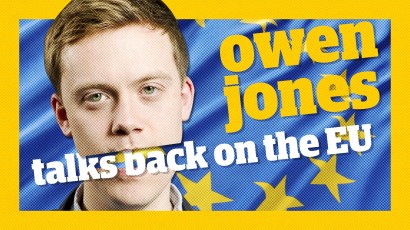
Owen Jones talks back on the EU referendum - European Union - Brexit

European Union - United Kingdom - Britain - Flags 

Support Semi-Partisan Politics with a one-time or recurring donation:

Agree with this article? Violently disagree? Scroll down to leave a comment.

Follow Semi-Partisan Politics on TwitterFacebook and Medium.