Dear Insert Name, Thanks For Your Generic Efforts, Love DC

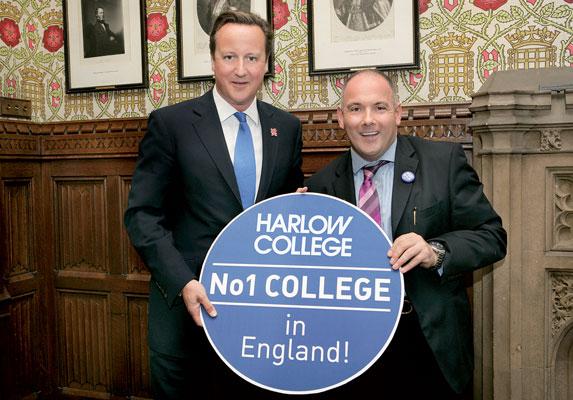
David Cameron Robert Halfon Backbencher MP Conservative


Many people, Semi-Partisan Sam included, receive at least one round-robin letter, trumpeting the glittering achievements and detailing the tribulations experienced by far-flung branches of the family, in the run-up to Christmas each year.

Folksy newsletters of this kind have long-attracted a mixture of ire, derision and pity, but we grudgingly read them because were it not for this (and the real-time bragging that takes place on Facebook), we would otherwise have absolutely no idea what’s new with Aunt Cersei and Uncle Jaime in Kings Lynn or cousin Arya in her gap year travels around the world.

But the one thing we round-robin recipients never do is boast about having received the same mail-merged missive as every single one of our other extended family members. This only makes it more odd that Robert Halfon, the Conservative MP for Harlow, took to Facebook today with evident pride to share a letter purportedly written and sent by David Cameron to celebrate the government’s achievements in the year to date.

The mediocre, mail-merged round-robin letter is shown in its banal entirety below:

David Cameron Robert Halfon Backbencher MP Parliament Letter

Cameron’s attempt at a morale-boosting letter is full of the meaningless platitudes about securing a “brighter future for Britain” that one might expect from a tired politician going through the motions on a local radio interview at 6AM, but it is doubtful that the prime minister personally authored the letter whilst away on vacation in Portugal. Far more likely that the job was delegated to a junior special adviser or some other paint-by-numbers Downing Street aide.

But what is truly interesting about this seemingly dull letter is the fact that the only identifying marker tailoring the letter to Robert Halfon is the inclusion of his name after the word “Dear” at the top. From that point onwards, David Cameron’s missive takes a lazy ramble across the current political landscape, touching on high-level achievements rather than the particular work or campaigning issues of Halfon and his fellow backbenchers.

The prime minister proudly acknowledges the “difficult decisions” that were taken to stabilise and return the British economy to growth. With a fanfare he takes credit for reducing the deficit by a third – some credit, considering that the government fell far short of its target on deficit reduction, and that the national debt continues to grow.

In his summer hubris, Cameron goes on to take personal credit for falling unemployment, reduced immigration (again, far from achieving the targets set out in the 2010 general election campaign), improved schools and, at probability’s furthest stretch, the supposed repatriation of previously outsourced and off-shored jobs to Britain. And the memo ends with a limp call to action, exhorting the prime minister’s Westminster foot soldiers to continue fighting the good fight to keep Ed Miliband out of Number 10 Downing Street (and Cameron on the business side of the famous black door).

But would it really have been so hard to add even a dash of customisation before firing out these letters? The recipient in question, Robert Halfon, is a relative newcomer to Westminster having joined the 2010 parliamentary intake, and so does not have a huge stable of stories, anecdotes, policies or victories for a hapless intern to research. But he does have several solid achievements and bold stances to his name that could have been used, had anyone been bothered.

The top paragraph of the Cameron-O-Gram might have approvingly mentioned the successful Fair Fuel campaign led by Halfon, conveyed thanks for leading the way in advocating more youth apprenticeships, or pledged to work with the Harlow MP to address the problem of prohibitively high car parking prices at NHS hospitals. But it did none of these things. In fact, the standardised email to lowly backbenchers went even further in demonstrating its ignorance or indifference to the work of individual MPs by prominently hedging its bets:

“So a big ‘thank you’ for everything you have done to get us this far. And thank you too for your campaigning this past term – whether that be in the local and European elections in May, or in Newark last month, where our Party came together to win our first by-election in government for 25 years.”

“Whether that be…”? Shockingly, David Cameron and his office seem entirely ignorant as to which MPs contributed the most and the least to recent campaigns, despite Grant Shapps’ threat to shame and punish any MP who failed to pull his or her own weight on the campaign trail. People accuse Ed Miliband’s office of being out of control and unable to properly co-ordinate, but now it seems as though the Conservatives are rapidly falling to a similar dull point.

“Letter-gate” reveals a picture of a prime minister and a government that not so long ago fawned over restive backbench MPs to keep them sweet, but which now believes that they can be treated with any amount of contempt given the fact that they will need help from CCHQ to survive the 2015 general election, and will overlook the snub.

And there can be few better ways to showcase this contempt than spamming hardworking backbench MPs with a cheesy, internal and non-specific campaign memo – ostensibly to give thanks for backbench loyalty – which is hardly different to the regular mailing list bulletins “written” by various Tory ministers and still received by Semi-Partisan Sam as a former member of the Conservative party.

At this point in the life cycle of government, a proactive and attentive leader might take the time to properly shore up morale and accrue some goodwill among his troops heading into party conference season. At the very least, a good party leader might feign an interest in the constituency work or personal causes of their MPs. But Cameron seems unable to even fake this enthusiasm.

Ironically, the earnest and hardworking MP who was so delighted to receive this piece of junk mail from Number 10 – the political equivalent of a pizza delivery leaflet shoved through the letterbox – was chastising his constituents, charities and community groups for spamming / petitioning MPs and adding to their workload in precisely this automated fashion only 30 months ago. In February 2011, Halfon wrote:

So what’s the best way to persuade an MP to support your cause? It’s simple. When I get an invite to visit the local branch of an organisation, I will always go. When I get a personalised letter, hand-signed from a chief executive (as opposed to public affairs officer) that contains local statistics and information, how can I not fail to be interested? When a local constituent calls me asking for a meeting, to talk about his or her involvement in her charity, I will always do it. I remember particularly how I was recently lobbied directly in the Commons by a resident who was involved with a breast cancer charity. She had a profound effect on me. I was only too pleased to support her cause.

So my final advice to charities and the voluntary sector is this: forget the impersonal emails, move away from computer generated email campaigns, stop sending reams of paper by post. Make it personalised and local, and you will not just have my real support, but that of many other MPs as well.

To counsel constituents against using inappropriate forms of communication while lauding precisely the same impersonal tactics when executed by 10 Downing Street, as Halfon seems to be doing, is puzzlingly contradictory to say the least. And at a time when Conservative MPs defending narrow majorities most need the help of their leader to retain their seats in 2015, it is especially odd that at least one backbencher is not more offended at being condescended to in this manner.

As the sweltering Parliamentary summer recess rolls on, the question we are left asking is this: With potent threats from both UKIP on the right and Labour on the left, how on earth does David Cameron expect to lead the Conservatives party to a majority and victory in 2015, when he clearly has so little respect for his generals in the field?

A postcard from Portugal would have cost so little, but said so much more.

A Black Flag Flies In London, Revealing A Schism In Britain

Will Crooks Estate Flag London


A black flag was flown from the gates of an east London housing estate, and an entire neighbourhood was effectively declared last week not only to be in solidarity with the people of Gaza and the cause of Palestinian statehood, but – contrary to any available evidence or the residents’ consent – to also be united in a shared, extremist interpretation of the Islamic faith.

As the Guardian reported at the time:

The flag bears similar writing to the jihadi flags that have been flown by the extremist group in Iraq and other jihadi groups since the 1990s. When the estate was approached last night, a group of about 20 Asian youths swore at Guardian journalists and told them to leave the area immediately. One youth threatened to smash a camera.

When a passerby tried to take a picture of the flag on a phone, one of the gang asked him if he was Jewish. The passerby replied: “Would it make a difference?” The youth said: “Yes, it fucking would.” Asked if the flag was an Isis flag, one local man said: “It is just the flag of Allah.” But another man asked: “So what if it is?”

Should the black flag be banned from the streets, as it is in some European countries such as the Netherlands? Absolutely not – the right to free speech and freedom of expression is one area where it is actually right to take a maximalist, uncompromising stance despite the difficulties and tensions that it may cause.

Banning the black flag, despite its similarities to the jihadi flags flown by ISIS, is not the right move. If a private individual wishes to mark themselves out in public as a ideologically extremist bigot with pro-terrorism sympathies, that should be their protected right. But the flag had no place being flown on council-owned housing property as though it spoke for all of the residents when it did not, and so it was right that the flag was removed by Sister Christine Frost, a Roman Catholic nun and local community activist.

Douglas Murray summed up the most appropriate reaction to the provocation at the time in The Spectator, explaining in stark terms the gravity of the fact that some British Muslims chose to proudly display a flag of this type in London, so far removed from the various conflicts:

When historians look back on Europe in this era, they will rub their eyes in disbelief. ISIS is carrying out actual genocide, ethnic and religious cleansing on the people of Syria and Iraq. Their exact ideological soul-mates in Hamas, Hezbollah and al-Qaeda are doing everything they can to set light to the same region. Right now the western states are finally talking of intervening in Iraq to stop ISIS wiping out the ancient Yazidi and Christians communities of Iraq. Yet we do nothing to stop the same murderous ideology thriving here.

Instead another pattern is set. When we see this disgusting ideology at work, as we have done for the last month, much of Europe turns its hatred onto the Saturday people for defending themselves. Israel continues to defend itself. And we may do something to hold back ISIS in Iraq. But what will we do in our societies when we finally realise that behind the flag of Hamas is the black flag of jihad, and that after failing to stand up for the Saturday people there will be fewer people left to stand up for the Sunday people?

Most importantly, what will we do when we wake up to the fact that, far from being in some neighbouring or far-flung country, we have allowed the enemy to plant itself deep inside our own countries?

But perhaps predictably, LondonLive is now reporting that the same young people who raised the flag over a housing estate in east London are complaining that the flag’s very removal is a sign of racism and Islamophibia:

A controversial black flag flown above the gates of an east London council estate is being defended by young Muslims.

The flag – which has been linked to some jihadist groups – has been removed twice by a concerned nun and police officers. 

But youths at the Will Crooks estate in Poplar have today said assumptions that the flag is linked to extremist groups is ‘racist’. 

One youth said: “It’s just racists complaining. If it was the St George’s flag, it would be alright. But this is our version and there’s this big reaction.”

More than the fact that the flag was raised in the first place by one or two deluded hotheads, it is the fact that the flag was then defended by other, supposedly representative local youths, that should give everyone the greatest cause for concern.

Here, in the young peoples’ protest, is the whole problem in a nutshell, the root of the problem with Islamic extremism in Britain. It’s the regrettable attitude by some Muslims that proclaims “You may be English, but we’re Muslim”. It’s the stubborn belief among its adherents that they are Muslims who just happen to live in Britain, rather than British people who happen to follow the religion of Islam. And yes, it’s the craven support from some appeasers on the left, who overlook or excuse the lack of  integration with British society, and echo their accusations of Islamophobia and racism directed at anyone who argues for greater cultural assimilation and the embracing of British values.

The fact that the go-to defence offered up by the local youths was a comparison with the St George’s Flag, one of the home nation flags of the United Kingdom, reveals the height of the mountain that must be overcome. The St George’s Flag belongs just as much to the angry Muslim youths in the Will Crooks housing estate as it does to anyone else in England, but they choose to reject it in favour of a religious flag, despite the fact that their chosen standard has a violent, gory recent history.

In modern Britain (with the partial exception of Northern Ireland, where sectarianism and flags are still linked with intolerance and violence), one’s religion and faith is not demarcated with a flag. Indeed, religion and national identity or patriotism exist, for the most part, on separate planes – and much the better for it. A British Catholic may follow Church doctrine and hold the Papacy in the highest reverence, but will likely identify as British first and foremost, and it is to the country that their primary allegiance lies. The same could be said of most British Jews, or mainstream British Muslims.

But there is a sizeable, vocal block of non-mainstream Muslims who clearly do not identify themselves as British first and foremost, who in some cases feel that they are pitted against their non-Muslim neighbours and compatriots because of their faith. And these people are eagerly capitalising on events taking place many thousands of miles away – in Iraq, Syria and Gaza – to pledge their solidarity with and allegiance to this religious, cross-border fraternity before they give any thought to Britain, the country that gives them life and liberty.

This has to stop, but in order for the situation to change it must first be recognised as a problem. This recognition needs to come from Britain’s mainstream Muslims first and foremost – of course community leaders and parents can only do so much to teach tolerance and British values when social media and internet voices speak the language of extremism, but still an effort must be made commensurate with the scale of the problem.

But the rest of us have a role to play too. Where there is genuine Islamophobia, we must confront it and correct misconceptions about moderate, mainstream Islam. But equally, we must not be cowed into defending extremism when we encounter it, for fear of being labelled racist or intolerant. We have seen the insidious harm that can be done when a blind eye is turned to the extremist threat in the case of the Birmingham “trojan horse” schools scandal.

The people who chose to hung the black flag from the gates of the Will Crooks estate in Tower Hamlets were not merely expressing solidarity with the people of Gaza in the course of the current conflict with Israel. They went above and beyond that statement of solidarity (which was itself inappropriate as it presumed to speak for the whole community without their consent), and flew a flag which they knew to have connotations of violence and extremism. Any pretence that it was all just an innocent misunderstanding was shattered when the flag was re-flown again days after being taken down.

Unless and until the wall of stubborn, self-imposed segregation is broken down between tolerant, mainstream Britain (including moderate British Muslims) and those sullen holdouts who feel stronger identification and fealty to primitive, medieval dogma than to their own country, Britain will continue to wrestle with this toxic (and increasingly existentially threatening) issue.

And before long, an offensive flag flying in the shadow of Canary Wharf will be the very least of our concerns.


Photograph: From Trial by Jeory blog.

How To Confront Hatred – Israeli Tourists Show The Way

Bradford Israel Protest George Galloway 2


Two separate acts of protest have today highlighted the best and the worst way to confront hatred and intolerance in British political discourse. Both were inspired by the self-aggrandising, faux-moralising actions of the repulsive MP for Bradford West, George Galloway. But with their witty response, a brave group of Israeli tourists put the British public’s own reaction to shame.

The Respect MP added to his notoriety on Saturday last week by declaring the city he represents to be an “Israel-free zone” in response to the current conflict in Gaza, reflecting his extreme anti-Israel views.

Here are the highlights from Galloway’s hate-filled remarks:


Building up to his climax of his speech, Galloway states:

“We have declared Bradford an Israel-free zone. We don’t want any Israeli goods. We don’t want any Israeli services. We don’t want any Israeli academics coming to the university or college. We don’t even want any Israeli tourists to come to Bradford even if any of them had thought of doing so. We reject this illegal, barbarous, savage state that calls itself Israel. And you have to do the same.”

As is now sadly typical in modern Britain, rather than simply deploring Galloway’s intemperate and rabid words, the police have become involved. The Huffington Post noted shortly after the event that the Yorkshire Police are investigating the MP’s remarks in case there has been a violation of the myriad intrusive rules and regulations that now stifle free speech within the UK.

These same draconian laws have seen the police knocking on the doors of private citizens – everyone from students to activists to business owners – because certain people have chosen to take offence at their words, so it is unsurprising that the odious George Galloway should receive similar treatment given his notoriety and the widespread publicity given to his latest anti-Israel diatribe.

But rather than letting the heavy-handed machinery of the British state police the public discourse on its own, some members of the public felt the need to proactively beg for the government’s active intercession in the matter. A petition uploaded to change.org by Robert Pegg from Manchester, signed by 7741 individuals at the time of this publication, petitions the government to prosecute George Galloway for his remarks under the 1998 Crime and Disorder Act.

From the text of the petition:

We, the undersigned, submit that these comments step way beyond the boundaries of free expression and legitimate debate and their only purpose was to cause harassment, alarm or distress to a specific group of people.

We further submit that this offence is a racially aggravated one.

Under S.28.1(a) of the Crime and Disorder Act 1998 a crime is racially aggravated if: “At the time of committing the offence, or immediately before or after doing so, the offender demonstrates towards the victim of the offence hostility based on the victims membership (or presumed membership) of a racial or religious group or; (b) the offence is motivated (wholly or partly) by hostility towards members of a racial or religious group based on their membership of that group.”

We would further submit that under S.28.4 a ‘racial group’ means a group of persons defined by reference to race, colour, nationality (including citizenship) or ethnic or national origins.

We further submit that the facts consitute [sic] a prima facie case against Mr Galloway and at this stage there is sufficient evidence to charge him and put him before the courts.

While George Galloway may have fallen foul of the letter of the law, rather than signing petitions, British citizens from across the political spectrum should be united together in urging a repeal of laws that criminalise speech which might potentially cause “alarm or distress” to bystanders, and thus limit our free speech to the narrow window of tolerance of our most thin-skinned compatriots.

Even when we find ourselves united in condemnation of the free speech in question (as all right-minded people should be on hearing Galloway’s remarks), we should defend Galloway’s right to speak his mind, secure in the knowledge that his bigotry and hateful agenda will incriminate him in the public eye far more effectively than any punitive sanction handed down by the courts.

By contrast to this embracing of the nanny state, it took a group of individuals from outside the UK – Israeli citizens, no less – to show the angry petition-signers a better way to respond to George Galloway’s unique brand of hatred.

The Huffington Post reports on the praiseworthy actions of a group of Israeli tourists who stepped up to Galloway’s challenge, defying the Bradford MP by visiting the city as tourists. The tourism protest was organised by Shneur Zalman Odze, a dual-Israeli citizen and former UKIP candidate, though the remainder of the group were Israeli nationals.

Odze, the organiser, perfectly sums up the reasons why his is a better form of protest than running to the police and asking them to lock up your political foes:

Odze told HuffPost that he had a warm reception from many people, even pro-Palestinians. “Actually that was more touching than people who came up to use who were obviously pro-Israel. People came over and said that, they disagree with me on Gaza, they hate the photos coming out of the war, but they didn’t think Israelis should be banned from Bradford, that they were ashamed of what he had said.

“I was surprised how many had actually heard of his speech and knew what he said and were embarrassed. I don’t think he has as much supports as he thinks. Later in the day, some pro-Palestinian demonstrators came from another demo happening at the same time. We spoke about the conflict, and even though one side is never going to convince the other, it was a respectful discussion and we shared our biscuits.”

Perhaps it was Odze’s libertarian UKIP roots that led him to seek to confront Galloway in a battle of ideas and values rather than seek to silence the Respect MP using the power of the state. Or perhaps it was just a sign of his good humour, and that of the Israeli tourists who made the slightly unusual detour to Bradford on their travels.

But either way, the brave and cheerful stance taken by these young tourists stands in very stark contrast to the angry, snarling victimhood embraced by the likes of George Galloway and (to a much lesser extent) those who want to bring the weight of draconian anti-free speech laws crashing down on his views.

George Galloway was elected to Parliament to represent the constituency of Bradford West in March 2012, with 30% of the vote and a majority of 10,140. The citizens of Bradford already have the unfortunate fact that they sent such a man as Galloway to represent them in Westminster on their collective conscience. But they also have the power to see sense and remove this bitter, divisive little person from office when they return to the polling stations in 2015.

Galloway’s latest remarks, calling for collective punishment of Israelis based on the actions of their government, form just part of a litany of reasons why he deserves to lose re-election. But it is there, through the democratic process, that the terrorism’s premier apologist in Parliament should face judgement.

Not in the courts, not in a Yorkshire police station, and certainly not via a change.org petition.


Photograph: From the Twitter account of @ShneurOdzeUKIP – “@georgegalloway in Bradford today with my Israeli friends, we got a tremendous reception – how’s your ban going?”


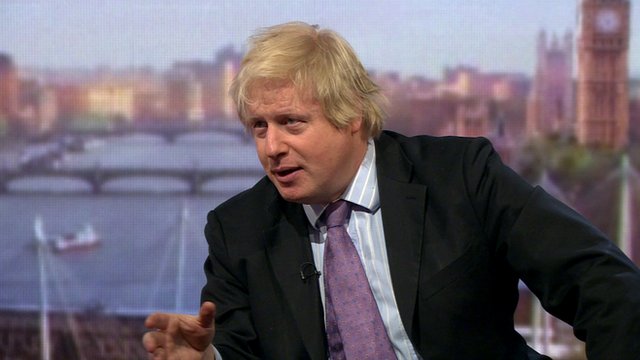
The Underwhelming Return Of Boris Johnson

Boris Johnson Parliament 2015 General Election 3


Who cares that Boris Johnson, the current Mayor of London, has finally admitted the blazingly obvious and declared his intention to stand for Parliament in the 2015 general election?

Almost everyone in the commentariat class seems to care, and to have a strong opinion about what is perhaps the most unsurprising revelation in British politics. But precisely why the rest of us should care about this revelation is not so self-evident. There’s obviously something in it for Boris Johnson: the opportunity to compete for the Conservative Party leadership in the event of a 2015 general election or 2017 EU referendum defeat. But what does a potential future Boris Johnson premiership offer the country that merits such a fevered round of speculation and media coverage?

Read any of the articles breathlessly speculating about David Cameron’s annoyance at being outmanoeuvred by Boris whilst on holiday, where the Mayor of London will make his stand as he searches for a constituency, or the pieces imagining the circumstances in which Boris might beat George Osborne and Theresa May to the leadership in the event of Cameron’s early demise, and you will learn everything you possibly need to know about The Decision. Everything, that is, except for why a Boris Johnson administration would be interesting, or different, or especially harmful or beneficial to Britain. But you can’t entirely blame the press corps for the oversight – if they are unable to answer these questions it is because the great man himself is just as uncertain of the answer, and has taken every opportunity to avoid revealing his vision.

Those people hailing Boris Johnson’s announcement should explain to the rest of us exactly what it is about their man that makes it worth getting excited about. Is it his bold, original policies on this or that? Because precious little has been written about the stark policy differences that distinguish the London mayor from the likes of David Cameron or George Osborne. Is it his approach to the electorate and politics in general? Because the Boris trademark down-to-earth, sometimes frank demeanour is nothing that UKIP’s Nigel Farage does not already offer. Or is it because of his years of executive experience managing the capital city of the world? Because the competencies needed to be a competent mayoral figurehead are not necessarily the same skills of tenacity, diplomacy and coalition-building needed to succeed as prime minister.

In one of the few tangible political divides where Boris Johnson has forcibly expressed an opinion, he has been wrong, and unabashedly part of the problem rather than the solution. At a time when airport capacity in southeast England is under pressure and London’s competitiveness impacted, the British government has done what it does best – handwringing, buck-passing and stalling for time with lengthy enquiries – and London’s mayor has campaigned against the obvious solution of expanding Heathrow airport in favour of a hare-brained scheme to close the UK’s largest airport and replace it with an entirely new facility in the Thames estuary. This blog has repeatedly explained the foolishness behind the mayor’s alternative vision.

Boris Johnson is also on manoeuvres to distinguish himself from Conservative Party orthodoxy on the thorny subject of Britain’s EU membership, but even here his newfound embrace of euroscepticism is riddled with disclaimers and lacks sincerity. It is particularly telling that when polled, over half of UKIP voters said that if Boris Johnson were to stand for the Conservatives on their local constituency, it would make no difference to their voting intentions. While eurosceptics and believers in nation state democracy should be pleased when any prominent Conservative politician commits to campaigning for a British EU secession in the event that renegotiations fail, in Johnson’s case it does not automatically make up for his previous equivocation and instinctive desire for Britain to remain inside the European Union.

In David Cameron and his coalition government, Britain already has a thoroughly conservative-lite leader, happy to talk the talk about fiscal responsibility and small government while carelessly treading the same uncompetitive, centrist and statist path as his predecessors. If the British electorate is to be asked to vote Conservative again, do they not deserve an upgrade from the Tories’ 2010 offering? Differences of image and style aside, it is very difficult to discern how Boris Johnson represents anything new, let alone an improvement on David Cameron.

And in a surprise twist, one of the few senior politicians (aside from Boris Johnson’s direct competitors for the Tory leadership) to see through the bumbling, affable persona is the usually hapless deputy prime minister, Nick Clegg:

“The thing about Boris Johnson is despite all the clumsiness and bumbliness he’s actually a really, really ambitious politician,” Mr Clegg said.

“He treats his political ambition like he treats his hair. He wants everybody to think he doesn’t really care, but he actually really, really does care.

“His tousled hair, his bumbliness, all that’s great. But behind all of that is someone who is absolutely fixated with his own political ambitions.”

The only thing missing from Nick Clegg’s timely critique is this blog’s concern that there might actually not be anything beneath the populist image and the driving ambition. It would be bitterly ironic if Britain’s next Conservative prime minister turned out to be the polar opposite of his most recent Labour predecessor in every area except for one – that they both shared a burning desire to reach Number 10 Downing Street, but had absolutely no idea what to do with the prize once they had it.

So why should we care that David Cameron’s former classmate has made official his plans to return to Parliament? The onus is still on Boris Johnson to convince us that it matters in the slightest.

Headline London Debate: Should Britain Make Eid And Diwali Public Holidays?

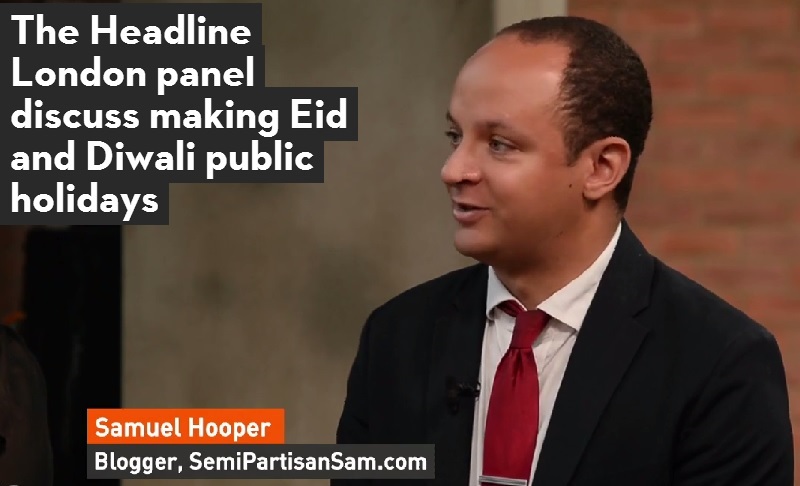
Samuel Hooper London Live Headline London Eid Diwali Public Holiday 2


Yesterday, London Live TV’s Headline London lunchtime news programme covered the Eid celebrations taking place in the capital, and asked whether the UK government should make Eid (and the Hindu festival of Diwali) nationwide public holidays.

The idea was first raised in Parliament last week by Conservative MP Bob Blackman, in response to an online petition signed by more than 120,000 people. I vehemently disagreed with the proposal at the time, for the reasons set out here.

Semi-Partisan Sam was pleased to be invited to debate the issue with poet Mohamed “Mo Rhymes” Mohamed and political activist Peymana Assad on the Headline London panel. The debate was courteous and good-natured, which cannot often be said of debates on religion – but I believe my argument, founded on national unity, church/state separation and the rights of the individual won the day.

London Live’s website only shows the first part of the panel discussion, but the full segment is embedded here, via Semi-Partisan Sam’s YouTube channel:

If you enjoyed reading this article, please take a second to LIKE or SHARE it on social media using the buttons below. Help to spread the word and continue the debate.