Chuka Umunna Plays The Race Card

Chuka Umunna - UKIP- Nigel Farage - Immigration - Race Card - General Election 2015


There are few more toxic accusations in British public life than that of racism.

To be accused of racism by anyone with a high profile and a media platform is the modern day equivalent of being tarred and feathered – the allegations stick indelibly in the public memory, impossible to scrub away, while everything you do subsequently will be viewed suspiciously through that ugly, distorting prism – “he may have only said X, but we all know he really means Y, because he’s a racist”.

Consequently, decent and honourable people should be damn sure of their facts before throwing the word “racist” around – it summons visceral recollections and images of real-life prejudice, discrimination, attacks and lynchings, murders and even genocides; the Jim Crow laws in America and the spectre of Enoch Powell in Britain.

Unfortunately, Labour’s Shadow Business Secretary, Chuka Umunna, has once again demonstrated that he is neither honourable nor decent, using an interview with the Independent on Sunday as a free opportunity to throw some more mud at UKIP ahead of polling day next week:

Nigel Farage and Ukip “hate modern Britain” and have a “problem with race”, Chuka Umunna says in an interview withThe Independent on Sunday.

The shadow business secretary, whose father was born in Nigeria, responded to the Ukip leader’s description of two of Ukip’s spokesmen as “fully black” and “half black” by saying there is a “virus of racism” that runs through Mr Farage’s party. Mr Umunna added that, by contrast, a Labour government would celebrate British multiculturalism and refuse to bow to “anti-immigration sentiment”, which, he said, had been whipped up by Ukip.

Mr Umunna was speaking during a visit to the Croydon Central constituency, where Labour’s candidate Sarah Jones is hoping to overturn a Conservative majority of 2,879 currently held by Gavin Barwell. He mounted a staunch defence of the benefits of immigration to the UK, although refused to condemn the Labour Party mug that trumpeted “Controls on Immigration”.

Put simply, Chuka Umunna’s latest “smoking gun” evidence of endemic UKIP racism and prejudice consists of the fact that Nigel Farage used the terms “fully black” and “half black” when speaking about people shown in the UKIP manifesto.

Continue reading

Labour’s Happy Fundraising Emails Turn Paranoid And Authoritarian

Labour Party - Fundraising Email - Ben Nolan - General Election 2015


Ben Nolan, the Labour Party’s Head of Membership, is having a nervous 2015 general election campaign.

Whereas other Labour figures (or their MailChimp newsletter administrators) have been relentlessly upbeat in their messages – “GUESS where our JAWS are this morning, Samuel, after we saw our latest fundraising totals!” – Nolan seems to be paid to be pessimistic. And creepy.

As a political blogger, I make a point of staying on the mailing lists for all the main political parties. Normally they are completely unrevealing missives, simple straightforward requests for cash. Sometimes they direct you to a website where you are invited to enter your postcode to reveal a bespoke list of that party’s achievements in office or future spending bribes, customised for your local area.

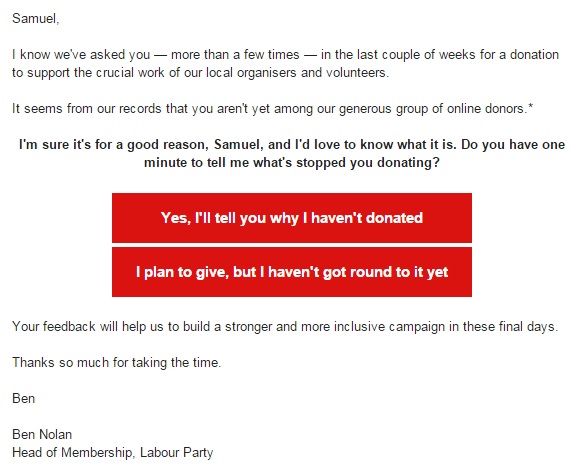
But sometimes they look like the one that Ben Nolan sent today, fired out to “supporters” who he has decided are not trying hard enough to propel Ed Miliband into 10 Downing Street:

Samuel,

I know we’ve asked you — more than a few times — in the last couple of weeks for a donation to support the crucial work of our local organisers and volunteers.

It seems from our records that you aren’t yet among our generous group of online donors.*

I’m sure it’s for a good reason, Samuel, and I’d love to know what it is. Do you have one minute to tell me what’s stopped you donating?

Your feedback will help us to build a stronger and more inclusive campaign in these final days.

Thanks so much for taking the time.

Ben

Ben Nolan
Head of Membership, Labour Party

Note the undertone of menace in the words “I’m sure it’s for a good reason”.

Continue reading

Labour Now Best Friends With HSBC, Thanks To Bank’s Stance On Brexit

HSBC Canary Wharf London - Brexit - European Union


Much is being made of HSBC’s statement that the UK-based bank is considering moving their headquarters away from London, with senior Labour politicians quick to take this corporate bellyaching as vindication of their plan to deny the British people any say in their democratic future.

From the report in the Guardian:

HSBC, Britain’s biggest bank, has issued a stark warning about the economic risks of the UK pulling out of the European Union as it revealed it was considering moving its headquarters out of London.

The surprise announcement of a full-blown review into where the bank should base its operations will stun politicians on the general election campaign trail.

HSBC listed the economic uncertainty created by the risk of the UK going alone – a blow to the Conservatives which have pledged to hold an “in-out” referendum on the EU.

Its shares jumped almost 4% after the statement, which was released before the bank’s annual shareholder meeting in London. The rise added more than £4bn to the value of HSBC – already one of the most valuable companies on the London stock market.

Among the Labour politicians to jump on the announcement was the shadow Business Secretary, Chuka Umunna, who wasted no time in fashioning HSBC’s announcement into a weapon with which to bash the Tories.

In a series of tweets, Umunna claimed that it is “irresponsible” for the British people to have a debate about whether we wish to become a sovereign country again, and that it would be a “disaster” for the economy if Brexit (British secession from the EU) were to happen:

Continue reading

For The Left, St. George’s Day Was A Great Chance To Mock UKIP Supporters

St Georges Day - England Flag - Patriotism - Public Holiday - Bank Holiday - UKIP


What did you do today to celebrate St. George’s Day?

If you’re like most people, quite understandably, you probably did nothing at all – after juggling work and the stress of daily life, there simply isn’t much time left in the day to celebrate the overlooked and unexciting Feast of St. George.

But of those people who did mark the day, a small but vocal minority were determined to use St. George’s Day not as a day to celebrate Englishness, England and her patron saint, but rather as an opportunity to mock and belittle those people who do try to celebrate our national heritage, and those who are proud (and brave enough) to be openly patriotic in modern Britain.

UKIP, virtually the only British political party that doesn’t view patriotism as something embarrassing or gauche (sometimes, on a good day, some Tories can still make a decent effort), called for all Britons to mark St. George’s Day by wearing a red rose, and lobbied for the day to be made into a public holiday.

From the Daily Express:

Ukip deputy leader Paul Nuttall said the gesture was needed as a way of registering protest against attempts by local councils and quangos to ignore or obliterate English identity.

“It saddens and angers me that this day marking Englishness is so low key compared to how days for the other three countries of the union are publicly celebrated,” Mr Nuttall said.

“The situation has improved over recent years but it passes by unrecognised by many English people. I have long argued that it should be a declared a Bank Holiday and I have not lost my passion for that idea.”

Ukip yesterday released a dossier of examples of public authorities attempting to ban or denigrate the England flag in recent years. They included supermarket staff and taxi drivers being ordered not to display England flags and pennants on their vehicles.

The response from the establishment was predictably scornful, sometimes verging on outright hostility.

Continue reading

General Election 2015: There Will Be No Passion Until We Rediscover Our National Ambition

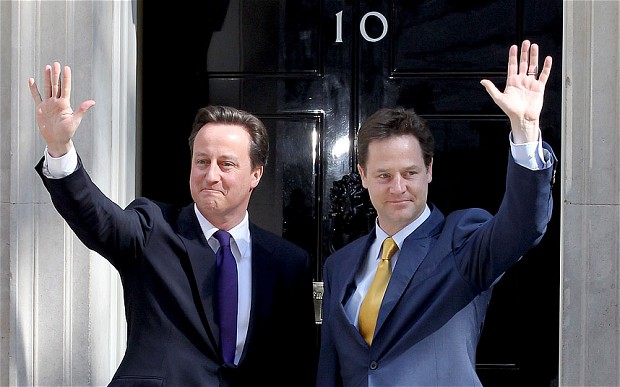
David Cameron - Nick Clegg - Passion - General Election 2015


As the 2015 general election campaign grinds past the halfway point with none of the main party leaders doing or saying anything remotely interesting or inspiring – choosing only to shriek about the chaos and carnage that their opponents would do in government – people are starting to ask: where is the passion?

The Spectator’s Fraser Nelson and James Forsyth pick up on this supposed lack of “passion” in politics in their recent interview with David Cameron, conducted as the Prime Minister hurtles around Britain failing to electrify voters with talk of his Long Term Economic Plan and doomsday scenarios about a Labour-SNP government.

Interestingly, Cameron appears totally bemused that his coalition government’s technocratic, risk-averse management of the country from 2010-2015 has failed to win him legions of adoring fans:

The Prime Minister is aware of the criticism and finds it ‘frustrating’. ‘I feel I have worked my socks off for the last ten years to get to this point,’ he says. ‘I feel we are on the brink of something amazing in our country. If I don’t succeed on 7 May I will be furious more for my country — but furious for myself.’ He says this quietly, not crossly, as if he has been confronting his own political mortality. ‘We have done so much to get so far — I do not want to pull back now.’ And then, a promise to do better: ‘If I need to do more to communicate that I will.’

What he is trying to communicate in the final fortnight of the campaign is that Britain’s recovery has been extraordinary, but that it didn’t happen by accident. And that if people want the recovery to continue, they’ll have to vote Conservative. He is writing the speech he’ll give that day, with ‘jobs’ scribbled as the first bullet point. He has created them at a faster rate than any prime minister in history, which he puts down to tax cuts and welfare reform. So he is travelling to Yorkshire to sell ‘an extremely positive plan to transform the education of young people in our country, to keep going with this welfare revolution’.

He accepts that the revolutionary character of his government is not widely appreciated. ‘I think it is very undersold in many ways,’ he says. He doesn’t say by whom. He later refers to the government’s ‘quiet revolution: pro-work, pro-saving, pro-enterprise’.

Revolutionary character? The coalition government came into power promising an economic recovery and the elimination of Britain’s vast budget deficit. It achieved the former but failed spectacularly to eliminate the deficit, reducing it only by a third (now changed to a “half”, thanks to the disingenuous use of different metrics). The Labour Party would have likely done far worse, but this is beside the point – a stable economy should be a hygiene factor, the absolute base in terms of expectations of a “revolutionary” government.

Continue reading