The Fiscal Profligacy Of The Labour Party Is Not A Myth

Tony Blair Gordon Brown - Labour Party


By Ben Kelly, blogger and editor of The Sceptic Isle.

The Labour Party did not cause the economic crash or the recession, this is undeniable. Still, it is becoming a great diversion technique for those who are attempting to abdicate the previous government of all responsibility to focus entirely on this simple fact, and to exaggerate the extent to which people actually believe that they directly caused the crash.

Often those who deny that Labour were at fault at all for their economic policies then, in turn, completely oversimplify the actual causes by saying “it was the bankers”.  Clearly the global crisis was multi-layered and had may root causes including irresponsible and amoral behaviour from the financiers themselves, the central bankers and regulators who allowed them to behave in such a way and poor government policy and supervision of the whole debacle. It may make it easier to understand to simply blame one entity, but that does not make it true, or reasonable.

Still, Ed Miliband continues to deny that the previous government over spent and makes no apologies for its economic policy. This is deeply concerning because he and Ed Balls worked in the treasury and now want to run the country. The recent Question Time audience were not impressed by Miliband’s refusal to accept that Labour overspent, it may transpire that the wider electorate are equally unimpressed. I used to think it was spin, pure politics, but now I think he genuinely believes that the debt and deficit crisis we are now suffering has absolutely no connection to his own actions, or those of his chancellor Gordon Brown.

Continue reading

Brendan O’Neill Is Right – Not Voting Can Be The Honourable Choice

Polling Station - Voter Apathy - Voter Disengagement - General Election 2015


It speaks volumes about the dire state of our politics and our democracy that best thing yet written about the 2015 British general election campaign is not a stirring paean to any of the political parties – not even one of the populist insurgents – but an angry, snarling article which mocks the illusion of voter choice and actively discourages people from bothering to vote at all.

And no, it’s not another Russell Brand intervention – he of The Trews sold out spectacularly this week, urging his legions of fans to vote Labour and install Ed Miliband in 10 Downing Street because apparently “this bloke will listen to us”. As if.

The true standard bearer for the politically engaged but fiercely indifferent contemporary British voter is Spiked editor Brendan O’Neill, who lets rip against the stale centrism of British politics with a powerful piece in The Spectator entitled “I’m not voting on Thursday – but don’t you dare call me apathetic“.

Directly contradicting the endless conveyor belt of career politicians who have been telling us incessantly that this is the most important election for a generation (as was the last, and the one before that), O’Neill writes:

Well, I’m not voting on Thursday, and don’t you dare call me apathetic. It isn’t indolence of mind — ‘sluggishness, laziness, love of ease’ — that’s keeping me out of the voting booth. On the contrary, it is an agitation of mind, a love of difficulty, that’s making me withhold my vote.

I, like many others, want my politics hard, existential, frightening even, addressing the biggest questions facing humanity: freedom, progress, morality, war, the future. But all we’re being offered is a choice between managers, primarily of Britain’s economic decline. ‘Who will YOU trust to shave the public deficit?’

Continue reading

A Vote For Ed Miliband’s Labour Party Is A Shallow Exercise In Virtue Signalling

Labour Party - Why I'm Voting Labour - Virtue Signalling - General Election 2015


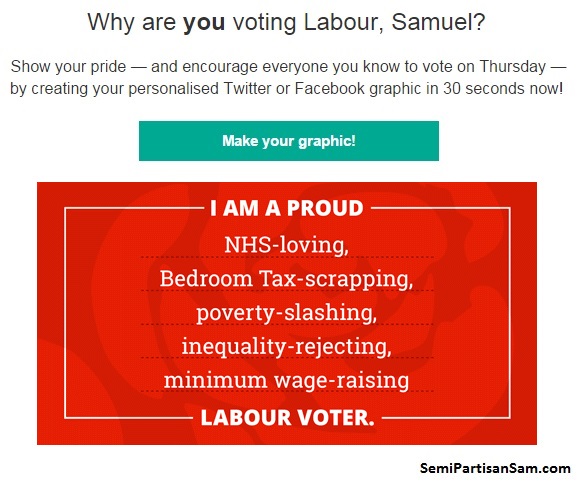
Labour’s latest pre-election gimmick, fired out to everyone on their mailing list this morning, is a customisable, fill-in-the-blanks placard, designed to be shared on social media so that the recipient can quickly and conveniently boast to their friends about just how morally superior they are for voting Team Red.

Click the link and you are taken to a page where you are invited to pick your top reasons for supporting Ed Miliband – “I’m an NHS-loving, inequality-rejecting, fair tax-demanding, Lib Dem-distrusting, Bedroom Tax-scrapping kinda guy” – in order to generate your own personalised pro-Labour profile, like some kind of ghastly political dating app.

You couldn’t ask for a better example of the vacuousness and ideological bankruptcy of the modern Labour Party.

For many activists – the regular folk who chip in small donations, put up posters and share bilge like this on social media – it’s no longer really about helping the poor and disadvantaged, and wanting to improve their lot. That worthy aim has been supplanted by a far more pressing goal: being seen (on social media, most importantly) and recognised by others as a “compassionate” and generous person – albeit generous with other peoples money.

It’s no longer about finding real lasting solutions to the housing crisis or inequality or the education gap or healthcare. It’s about being seen to be saying the “right” thing, whether  it represents a coherent, workable policy or not.

Continue reading

Russell Brand: The Endorsement


So it’s official: Russell Brand has been duped by Ed Miliband into endorsing the Labour Party for the coming general election.

Here’s the Guardian’s excited announcement:

Russell Brand has urged people in England to vote Labour, saying Ed Miliband has convinced him that “this bloke will listen to us”, days after the party leader visited him for an interview.

The comedian, who previously dismissed the idea of voting, said he had changed his mind because he believed it was important to get rid of the Conservatives from government.

In a newly released video on his The Trews YouTube channel, Brand said: “What I heard Ed Miliband say is that if we speak, he will listen. So on that basis, I think we’ve got no choice but to take decisive action to end the danger of the Conservative party.

“David Cameron might think I’m a joke but I don’t think there’s anything funny about what the Conservative party have been doing to this country and we have to stop them.”

When new first broke of Ed Miliband’s secret midnight visit to pay homage to the comedian/activist, this blog offered the following detailed commentary:

Continue reading

After Brexit We Can Strengthen The Bonds Of The Anglosphere

Anglosphere - Brexit - European Union - EU - United Kingdom - Britain - England


By Ben Kelly, blogger and editor of The Sceptic Isle.

The recent plea from Nile Gardiner of the influential US think-tank The Heritage Foundation was a pleasing reminder that there are still some voices in the US who see the merits of an independent United Kingdom. It is unfortunate that official US policy is to compel Britain to remain within the union as part of its desire to see a united Europe modelled on its own image.

Such homogeneity is easier to interact with diplomatically and also easier to manipulate and handle in matters of foreign affairs, such has been the case in US support for a politically loaded association agreement between the EU and Ukraine.

The US administration has little time for the concerns of British EU-sceptics, such as conserving the independence of our legal system and our foreign, economic and security policy, and restoring the sovereignty of parliament. This is a shame because a Britain integrated into the EU and unable to act independently will be a limited ally and a far weaker friend to the United States.

American conservatives especially should see the merits in an independent UK. They have in the past called for greater economic ties, they should also champion the conservation of our culture of liberty, law, government and economic freedom; the sturdy foundations their own great country is built upon. These are our common traits and they are being eroded and threatened by EU integration.

In 1952, then-U.S. Secretary of State Dean Acheson said that “Britain has lost an empire but has failed to find a role.” Its role should have been one befitting the mother of the Anglo-sphere. A role as a global champion of the liberty, democracy and rule of law nurtured on this island and spread across the globe.

Continue reading