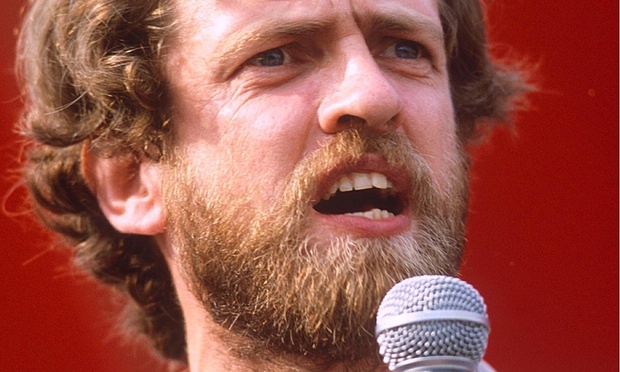
Where Is The Conservative Party’s Jeremy Corbyn?


Where is the Conservative Party’s Jeremy Corbyn? I don’t mean an ornery old relic from the 1970s with dubious facial hair – the Tories have plenty of those. But where is the charismatic Tory personality who – like Corbyn does for his supporters – makes their fellow conservatives walk a little taller?

Owen Jones is happy at the moment. Cheerfully, blissfully happy. Almost too happy for someone who only months ago felt trapped in a Thatcherite, “neo-liberal” dystopia ruled over by the faceless, unaccountable grey men of the Establishment. But what a difference a few months and a resounding election defeat makes. What a difference Jeremy Corbyn’s presence on the ballot makes.

Read or listen to Owen Jones now and the excitement is palpable. This is not Cleggmania revisited, where the former LibDem leader briefly surged in the 2010 general election campaign by simple virtue of sounding like a human being (in contrast to the wooden Gordon Brown and the plastic David Cameron).

Nick Clegg’s brief spell of popularity was based on style, on appearing like a decent bloke. But Jeremy Corbyn’s surge in the Labour leadership election is the product of style and content – of sounding authentic, but also refusing to draw from the same deck of centrist policies automatically adopted by nearly everyone else.

No wonder a generation of young people who came of age during the tyranny of Consensus Politics, when holding strong political beliefs and refusing to apologise for them mark a politician out as a heretic unfit for high office, are finally sitting up and taking notice.

Continue reading

Are You A Populist Simpleton?

Populism - British Politics


Ukippers and Jeremy Corbyn supporters have often been steadfast in their political views for years, and as a result have languished in the political wilderness while those willing to bend, flatter and shapeshift their way toward sanitised focus group approval have been richly rewarded with power and success


Are you a populist simpleton?

I am, according to the Telegraph’s Janet Daley, because I am guilty of expecting more from politics than two shades of the same old drab consensus.

It’s a shame – I thought I had an ally in Daley, who is absolutely right in identifying the dull managerialism that now defines British politics, where dull technocrats reign supreme and general elections are fought over which party leader would make the best Comptroller of Public Services.

From Daley’s Telegraph piece, in which she attempts to compare the rise of Jeremy Corbyn with Donald Trump’s temporary ascendancy in the Republican Party’s presidential primary race:

There is no doubt that the politics of Western governing has become consensual and centrist. It is now a cliché – but no less important for that – to say that the arguments on which democratic choice revolve are puny and marginal. Parties and their leaders are reduced to debating the detail: a bit more of that, a bit less of this. No basic principles are at stake because they are all pretty much settled. The slogans are quite deliberately boring: recession is to be tackled with a “long-term economic plan”. It doesn’t quite have the ring of “Workers of the world unite! You have nothing to lose but your chains.” It often seems as if party strategists are having to thrash around desperately for some semblance of a compelling vision to distinguish themselves from their opponents.

Daley’s analysis of the problem is spot on, echoing what this blog has been saying for over a year. And yet Daley seems to hold in contempt those of us who have also identified the problem, but seek to redress it by supporting politicians who do not conform to the centrist mould.

Continue reading

Is Jeremy Corbyn The Cure For British Conservatism’s Centrist Virus?

Samuel Hooper Labour Party signup - Labour Leadership - Jeremy Corbyn - 2


First published at Conservatives for Liberty

Today, I took the plunge. I got out my debit card, opened my laptop, held my nose as I navigated to the Labour Party website – and then paid £3 to become an official Labour supporter, solely in order to advance the leadership candidacy of the MP for Islington North, Jeremy Corbyn.

No, I haven’t taken leave of my senses, and no, I haven’t had a miraculous conversion and become a Born Again Socialist – far from it. My earnest desire remains the same: to see British politics move in a far more libertarian, pro-individual freedom direction.

But I have come to the reluctant conclusion that the Conservative Party currently has no intention of governing in the pursuit of smaller government and a strong nation state, and that therefore the best way of advancing the cause I believe in is to act externally to force the Conservative Party to sharply change direction.

I stumped up my £3 not out of any desire to “consign Labour to electoral oblivion“, like the Telegraph’s Toby Young, or to cause low-level mischief of any kind at all. I vehemently disagree with most Labour Party policy, but the vast majority of members are good people and I bear them and their party no particular ill will. I have always wanted to see conservatism win, not see socialism lose.

I became a short-term Labour supporter today because I am putting my money where my mouth is, and seeking to reward success, steadfastness and political courage. And when it comes to steadfastness at least, Jeremy Corbyn has more of this quality in his little finger than the Conservative Party leadership possess in their entire bodies.

Continue reading

Why Is The Right Suddenly Scared Of Jeremy Corbyn?

Jeremy Corbyn - Labour Leadership - Labour Party - Socialism


Somehow, in the space of one month, the political Right seems to have gone from #Tories4Corbyn mania to acute Corbynphobia, switching positions in direct proportion to Corbyn’s rise in the opinion polls and his proximity to clinching the Labour leadership election.

The latest to lose his nerve is Allister Heath, who writes very well and sensibly about most things, but seems to have lost both perspective and ambition in his latest piece for the Telegraph.

For in truth, small-C conservatives and believers in small government and individual liberty have very little to fear from Jeremy Corbyn becoming leader of Her Majesty’s Loyal Opposition. But the fact that notes of panic are creeping in – even among stalwarts such as Allister Heath – reveals a deeper malaise within British conservatism, one which needs to be quickly identified and rooted out.

Heath begins well enough:

Britain needs as many pro-capitalist parties as it can get. For a brief period in the mid-1990s, it had at least three: the Tories, a reformed Labour Party under Tony Blair which appeared ready to embrace markets for the first time, and the Liberal Democrats, who at the time were still pretty centrist.

It seemed as if the free-market counter-revolution of the 1970s and 1980s, combined with the collapse of the Soviet Union and Warsaw Pact, had finally killed off socialism. The choice from now on would be between a particular brand of capitalism, with varying degrees of intervention, but nobody would any longer suggest ending the economic system that has created so much wealth for humanity over the past 250 years.

So far, so true. Yes, indeed there was a large degree of consensus from the mid-1990s through the early New Labour era, and yes, this consensus broadly accepted free markets and the fact that people could become filthy rich, so long as they paid their taxes. But there was also a consensus among all parties that the European Union was a great and benevolent institution, and that we should happily cede ever more sovereignty to Brussels in the service of some “common European” good.

Continue reading

Jeremy Corbyn’s Ambition For Britain: Building A National Education Service


“What if the rise of Corbyn, a man with a political philosophy, is not an aberration, but the future?” – Douglas Carswell

For someone who is supposed to be a political dinosaur, a fossil, a cantankerous relic from a long-gone political age, Jeremy Corbyn can sure talk a lot of sense when he puts his mind to it – and when the pressure is really on.

Sunday’s long set-piece interview on the Andrew Marr show (see video above) proved that Corbyn could withstand tough personal scrutiny and difficult questions designed to throw him off-balance, and not only get through the encounter intact but also managing to leave his centrist rival candidates for the Labour Party leadership looking somehow diminished and superficial.

None of this is to say that Jeremy Corbyn has the right answers – he doesn’t – or that he is the Saviour of British Politics. And none of this changes the reality of what Britain was like the last time people like Corbyn had their hands on the levers of power, back in the 1970s. But of the four people competing for the leadership of the Labour Party, Corbyn is the only one who seems to make his supporters actually feel good about their candidate and their party.

Why is this? Well, in this age of sanitised soundbite politics, you really can’t place enough of a premium on a politician who dares to say what he or she actually means, someone willing to think out loud rather than simply regurgitate pre-rehearsed talking points.

Continue reading