The European Union’s Long Game

European Union - EU Parliament

The dream of a federal Europe is not dead, or even resting. European political union is a long game – watch closely on a day to day basis and you will notice nothing moving. Only when viewed at a distance of years and decades does the direction of travel become crystal clear

Pete North warns people against complacency:

One political meme travelling around academia at the moment is that the vision of the EUs founding fathers has stalled and will never become a reality so it’s ok to remain in the EU because there is a different destination of concentric circles bound under a loose alliance. It’s actually a convincing argument when you look at the reality on the ground, but it’s a piece of creative writing which ultimately ignores the nature of the beast.

The founding fathers were savvy in their design of le grande project. They always knew it could never be done all at once because the central vision would never secure a mandate. Integration by deception has always been the modus operandi. It salami slices powers little by little, so gradually that few ever notice. And you’d never see it unless you know what the game plan is. They were long term thinkers. They knew it would take a generation or so to advance their agenda and they had a roadmap to do it.

It has always used funding of local projects to manufacture consent. It’s why you’ll find EU logos emblazoned on any nature reserve or community hall or obscure museum out in the shires, to convince the plebs that their benevolent EU guardians cared more for them than the London government. It is why it funds universities too. Every strata of civil society has an injection of EU cash. Education, NGOs, you name it. And it works.

It is important to rebut the claim from EU apologists that Brexiteers are somehow exaggerating or indulging in conspiracy theories – often a sneering Remainer will say that eurosceptics have been warning about the coming European superstate for decades, and the fact that it has not yet quite arrived means that we are somehow wrong.

While the EU’s “founding fathers” were not exactly shy about their intentions for the nascent union, they also realised that supranationalism and the various tenets of statehood could not be spoken of too often in relation to the EU for fear of scaring people off. The process of integration would have to take place in stages, inching forward at opportune moments and often using crises as a pretext for the transfer of more powers (as we now see with the euro). Richard North and Christopher Booker’s masterful history of the EU, “The Great Deception”, draws on primary sources to spell this out in clear detail.

Pete continues:

The founding fathers always knew a day would come where the legitimacy of the EU would be questioned. And now you see how well their pernicious scheme worked, with the entirely of the civic establishment coming out in favour of remain. They have made idle supplicants of our institutions, robbing them of their vitality, curiosity and dynamism.

And those who speak up about this are often labelled cranks or conspiracy theorists. Except it is a conspiracy and one they published in full. They even founded an academic institution to promote it: “The Robert Schuman Centre for Advanced Studies is an inter-disciplinary research centre at the heart of the European University Institute”. The hellmouth of europhile academics and functionaries.

The modus operandi is encoded into all of the treaties and articles of the EU. It is worked into the philosophy of the institutions and it is designed to resist any kind of reform – especially anything which may introduce democracy. There it lies, dormant in the system, but sufficiently restraining in order to prevent deviation from the path.

It may stall, it may go quiet, but the agenda is always there with the noose ever tightening – engineering for irreversibility. That is why the remains make such an issue of how we leave the EU. It was never meant to be easy. It was always a quicksand trap for democracies. The harder you pull away the more it sucks you in.

And so when we hear the ignorant prattle of cosseted and sinecured LSE academics telling us it’s safe to stay because the dream is dead, they are speaking from a position of naivety and ignorance. The Ghost of Monnet lives on. The ghoulish servants of the ideal still roam the corridors of Brussels and an infest social media spreading their poison, sewing doubts and rewriting history.

The more people learn about the history of the European Union, the more eurosceptic they become – almost every time. And part of that history is a shameful and profoundly undemocratic legacy of integrating slowly and by stealth, patiently overcoming obstacles (like referendum “no” votes) and grinding away to achieve the ultimate objective.

We should certainly not allow a bunch of highly self-interested and fundamentally untrustworthy academics to lull us into a false sense of security at this late stage.


European Union - United Kingdom - Britain - Flags

Agree with this article? Violently disagree? Scroll down to leave a comment.

Follow Semi-Partisan Politics on TwitterFacebook and Medium.

The Significance Of That Bizarre Eddie Izzard Appearance On Question Time

Eddie Izzard, Brexit Ambassador

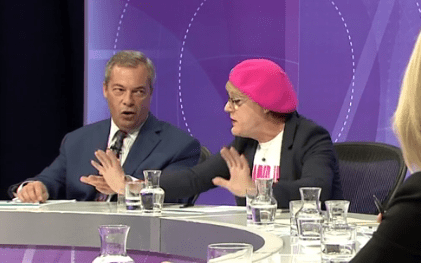
While it was infuriating to watch at the time – I actually had to put down my iPad at times to stop myself tweeting things which I might later regret – Eddie Izzard’s tour de force of ignorance and condescension on BBC Question Time last night will have been a great boon to all Brexiteers.

Here, in one man, is embodied the distilled nature of the entire Remain campaign argument – a child’s level of understanding of the European Union’s history, what it does and how it actually works coupled with an unjustified level of arrogance and assumed intellectual and moral superiority which somehow makes them come off as smug, arrogant, condescending, pitying and self-aggrandising all at the same time.

Eddie Izzard’s strategy for the programme was clearly “Take Down Nigel Farage In A Blaze Of Glory”, and the comedian went at the UKIP leader from the outset. He would have been far better to focus his fire on the others. Nigel Farage is a man who has easily dispatched stageloads of Britain’s leading politicians in a single debate and twice bested Nick Clegg in one-on-one encounters. Coming at him with a paper thin case and the debating style of an over-excited sixth former is never going to work. It certainly didn’t last night.

The shriller Eddie Izzard became, the more he cut across Nigel Farage and make his grandstanding appeals to the audience, the more Farage looked like the adult in the room. As Izzard’s plea for more ice cream became ever more desperate, Farage leaned back in his chair with a look of bemused resignation. Considering that one of the Remain campaign’s key aims is to demonise Farage and then inextricably tie him to the Leave campaign, this was a huge unforced error.

But more than that, it showed the vacuity at the heart of the Remain campaign. Sure, there are a few honourable die hard euro federalists out there – my friend Paddy Briggs is one – but you will scarcely hear from them in this campaign. The only people with a coherent and honourable case for Britain remaining in the EU (and indeed deepening our participation) are shoved in the closet, the Remain campaign’s dirty little secret as they pretend to the rest of us that We Are All Eurosceptics Too.

The rest of the campaign is built on ignorance and fear. Yes of course large swathes of the Leave campaign are little better. But once Remain have dispatched with their meaningless pleasantries about “staying in Europe to reform it” and the importance of “cooperation” (which in europhile land can only take place between countries when facilitated by a supranational political union, for some reason), all they have left are their Armageddon stories about how Brexit would bring us all to economic ruin, or how the supposedly benign and friendly EU would behave like an abusive spouse to a departing Britain.

Pete North agrees:

We’ve heard all the europhile fluff. All the sanctimonious cliches about “not walking away from the table” and “getting in there to make it work better” and “respecting the rules of the club” and when you’re dealing with someone of great charisma it’s hard not to want to buy into that.

These are all positive and constructive sentiments reinforced with words like “cooperation” and “unity”. But sentiment is all it is. Contrivances. And if you hold only a superficial notion of what the EU is, how it works and the actual consequences of it, then that leap of faith is easier to make.

And this perhaps explains the gulf between age groups and voting intentions. Those who have wised up to the EU want out. The youthful ideologues lack the maturity and historical context to see through the veneer of shallow and meaningless rhetoric. This is what the remain camp is banking on.

And this is why I can muster a venomous contempt of Eddie Izzard. Think what you will of him and his politics but he is not a stupid man. Fatuous maybe, but not stupid. He has always been a true believer. He is a europhile to the core. And while they are capable of an extraordinary self-deception one thing europhiles do without exception is lie through their teeth. Up becomes down, black becomes white, dog becomes cat. No lie is too big and any lie will do.

Being a comedian and habitually attuned to audiences accepting a flawed premise in order to relate to the material, Izzard is able to lie with no self-awareness at all. It’s what permits him to lie as often as he does to an extent that even professional politicians would hesitate.

And this is what has characterised the European Union debate for as long as we’ve been having this debate. The attempt by europhiles to frame this as though it were a generational stand off between young progressives and old reactionaries. For one to be against the EU, in the mind of the europhile, one must naturally be a xenophobic, little Englander who could only possibly have selfish motives. This is the deceit that they wish to impress upon those new to the debate.

And this is actually what drives the blood curdling hostility between the two camps. We have a broadly europhile media class. A set of self-regarding luvvies largely culturally and financially insulated from the consequences of EU membership, believing themselves to be the living embodiment of virtue.

People wonder how the country will knit back together after this referendum. I’m not sure that it will. Pete North is certainly convinced that it will not. One thing is certain – there will be no magnanimity from the Remain side if they win.

Sure, a smiling David Cameron might come out of 10 Downing Street and make a little speech about his “renegotiation” just being the start, and how he will continue to fight for change in Europe. I can write the speech in my head already. But it will mean nothing, just as every single one of David Cameron’s convictions is built on sand. The Remain camp will take their gruesome little victory lap and crow about having defeated the forces of “xenophobia and isolationism”, and that will be that. A reconciliation reshuffle? That means nothing.

But the intellectual case for Brexit and the moral case for democracy will not have been defeated. What’s more, those of us who are custodians of these high ideals will not easily forget what has been said about us by sneering, grandstanding, virtue-signalling oiks in the Remain campaign, and their spokesperson Eddie Izzard.

Call someone wrong and they may be angry for a time. Call them morally deficient in some way (as Remainers do with their claims of boomer selfishness etc.) and it will wound a lot more. But call someone stupid and publicly mock them to their face, and you will nurture a resentment and antipathy which are almost impossible to undo. Over the course of this referendum campaign, the Remain camp have done all three.

Fortunately for Brexiteers, the glibness and shallowness of the Remain case become more exposed with every passing day. There is no new layer of complexity once one overturns their false assertion that Brexit means leaving the single market, or that all of the cooperation and partnership they seek can be accomplished just as easily outside of our current political union. The Remainers can hardly wheel out the hardcore euro federalist brigade to make their impassioned case – they would alienate far more people than they could possibly attract with their creepy, dystopian vision.

By contrast, a greater depth to the Brexit case is finally starting to emerge, as more and more influencers in the media pick up on the interim EFTA/EEA (Norway) option as an attractive first step in the Brexit process. Though it has taken an age (and may in fact still have come too late) at least the only thorough, comprehensive and safe plan for achieving Brexit is now finally starting to get a public hearing and an opportunity to allay the concerns of undecided voters.

I still feel that the odds of victory very much favour Remain, no matter what the opinion polls may say two weeks out from Referendum Day. But it is also undeniable that the broader Leave campaign has finally gained some traction – despite, rather than because of Vote Leave.

And if the Remain campaign continues to respond to these turns of events by wheeling out people like Eddie Izzard – who I think probably created a thousand new Brexiteers for every minute he had the floor on last night’s Question Time – then this might be a much more closely run thing after all.


Nigel Farage - Eddie Izzard - BBC Question Time - EU Referendum

European Union - United Kingdom - Britain - Flags

Bottom Image: Huffington Post

Support Semi-Partisan Politics with a one-time or recurring donation:

Agree with this article? Violently disagree? Scroll down to leave a comment.

Follow Semi-Partisan Politics on TwitterFacebook and Medium.

Following A Remain Vote, The Slow, Inevitable Descent Into Irrelevance, Apathy…And Worse

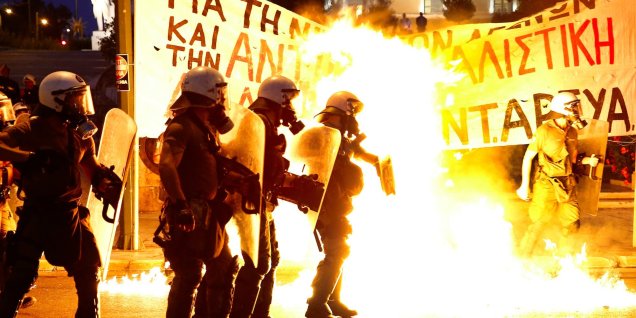
Protest - Greece - Athens - EU- European Union

In case of a Remain vote, brace for impact…

Pete North fears the consequences of a Remain vote:

If Britain votes to remain in the EU we will have permanently forfeited most of our rights to influence policy over trade, fishing, aid, energy and agriculture. These are absolutely crucial to our overall domestic industrial policy and these areas have a profound impact on our lives and our economy. Having sealed the deal to no longer take an interest in such affairs, parliament will be able to seal itself into its tiny little bubble where reality may never intrude. It will be the absolute final death of adult politics.

As much as Britain will withdraw from the world, it will largely delegate the important policy areas to the EU technocrats and will instead be fixated permanently on the minutia of our lives. Controlling what we do and our individual choices is all that will be left for them to influence.

And so I can see Britain becoming a distinctly illiberal place, where politicians use their remaining powers to restrict our personal freedoms in what we do, what we consume and what we say to one another. They will become ever more controlling over things which are none of their business. I see a political system making itself wholly redundant and resorting to displacement activity to fill the void.

Consequently the public debate will be an ever more diminished one, where the House of Commons becomes a gallery for vanity and virtue signalling. To many extents we are already there but a remain vote pretty much seals our fate.

It’s hard to disagree with this assessment. Unless, of course, one inhabits the EU apologists’ alternate universe, where a Remain vote signals a new era of enthusiastic British leadership in the European Union (despite not being a member of the euro or Schengen), and the EU starts falling over itself in its desire to reform and respond to the individual concerns of member states.

In Owen Jones / David Cameron / Jeremy Corbyn La-La Land, having positively re-affirmed our commitment to the EU with a Remain vote we will all join hands beneath a rainbow and “work together” to solve the intractable crises and internal contradictions of this creaking, mid century-era political union with a snap of the fingers. But for those of us back on planet Earth, the next few years will actually be profoundly depressing.

Pete continues:

I do not see this coming without a price to pay. Certainly I don’t see that I have a place in the new model of post-democratic politics. We will have a political class which does not believe in Britain’s capabilities and lacks the will to govern.

We will be an insular country of diminished significance having turned our back on global participation. We will have empty shells of political parties neither of which are worth a vote. And voting to be rid of them will accomplish little. We have seen how the system neatly castrates insurgent parties and we have see how those not native to the system can be marginalised. There will be no value in voting.

And when it comes to Euro-elections, where we have the dubious honour of selecting overpaid button pushers to rubber stamp global regulations, the details of which are already decided, we will, at best, send the very worst of what we have in protest. If we even bother at all that is. I won’t.

We will in effect be an occupied country where there is no value in participating in the public debate since the conclusion of any debate will simply not translate into policy or reform.

Consequently politics as a subject heading will be a subheading of light entertainment, where if anybody holding any expertise wishes to influence policy they will depart for Geneva and never look back. Anyone with a hectoring and nannying agenda though, will head for the Westminster gossip bubble.

Meanwhile the disconnect between the governed and the governors will grow. From there, there are only two paths. Permanent idiocracy or a furious backlash the likes we have not seen for generations. There is always a price for turning our backs on democracy. Always.

This echoes my own thoughts exactly –  it is not coincidental that our politicians increasingly seek to meddle in the minutiae of our lives at the very time they are divesting themselves of ever more power and responsibility for any of the truly big political and ideological questions.

And this is the reason why I simply cannot fathom so many people from outside of politics – usually the first ones to grumble about the state of the nation – enthusiastically cheerleading for the status quo and our continued participation in the EU.

Do these people like the fact that voter apathy is a major problem? Do they rejoice in the fact that all of the main political parties in Westminster fit within such a narrow ideological window that the views of many are entirely excluded? Are they happy that the British people have not been called on to strive together towards an important goal of any kind in nearly seventy years, and that we are increasingly a nation of passive, whiny consumers of public services? And assuming they are not happy with the status quo, how on earth to they think that any of this is likely to change while the single biggest drain on our democracy, independence and entrepreneurialism remains intact?

Already we have a parliament in Westminster stuffed to the rafters with politicians who would rather make grandstanding anti-austerity speeches in the hope of going viral on YouTube or wax lyrical about banning Donald Trump from our shores in a dismal act of virtue signalling than actually get to grips with policy. If we continue to divest power and sovereignty to the EU (and as Cameron’s fraudulent renegotiation shows, we sure as hell ain’t getting any of it back) then how is the calibre of our own politicians going to do anything other than decline yet further?

And yes, there will ultimately be a backlash. Pete is right. You can just about get away with governing in an aloof, high-handed and profoundly anti-democratic manner when you are delivering rip roaring economic growth – just ask the dictators of China. But in a mature advanced economy facing serious structural issues, the government can do little to distract us from the gaping chasm where real local democracy and an informed citizenry should be.

At some point the divergence will become too great. The EU’s primary purpose is to steadily integrate the various member states toward the goal of political and economic union – the common European state spoken of so fondly by Francois Hollande last year. This objective overrides everything else. Certainly, trivial matters like mass unemployment in Spain, Italy and Greece are utterly irrelevant compared to the obsessive desire to unite the continent under a single currency and government. The EU simply doesn’t care.

Of course, when the mass political disengagement and civil disorder comes, all of those now eagerly chanting hymns of praise to the EU and encouraging us to vote Remain will feign utter shock. In some cases it may even be genuine. But the blame will lie squarely with them.

For despite our material progress and the current flourishing of London as the world’s capital city, Britain is on a negative democratic trajectory right now, and a vote to remain in the EU is nothing less than a vote to pitch the nose downward a few degrees and turn up the throttle.

And the ground will make no distinction between Remainer or Brexiteer as it rushes up to meet us.


European Union - United Kingdom - Britain - Flags

Top Image: Business Insider

Agree with this article? Violently disagree? Scroll down to leave a comment.

Follow Semi-Partisan Politics on TwitterFacebook and Medium.

Flexcit And The Interim EFTA/EEA Brexit Approach Reported On Newsnight

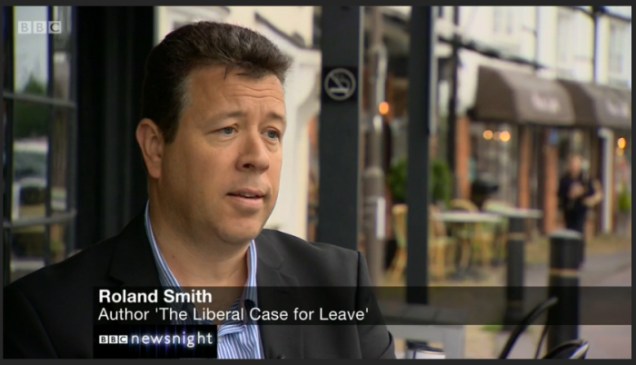
Roland Smith - Adam Smith Institute - ASI - Newsnight - Brexit - EEA - EFTA - Norway Option - EU Referendum

Having finally analysed every possible facile, gossipy and shallow angle on the EU referendum in breathtaking detail, finally the media get round to examining the ideas laid out long ago in the only existing comprehensive Brexit plan

Well, it had to happen eventually. Tired of adjudicating shrill and pointless contests in unsupported assertions and lying by omission from Vote Leave and Britain Stronger in Europe, some in the media have finally started paying attention to the safe, stable Brexit option which was there all along.

Tony Edwards of The Brexit Door blog marks the occasion:

The Liberal Case for Leave, written by Roland Smith for the Adam Smith Institute, is based on the Flexcit plan. Roland is one of a number of us who have coalesced around this idea, proposed by Flexcit author Dr Richard North of the EU Referendum Blog, that Brexit should be a multi stage project. To avoid shocks, and to escape diplomatic impasse, we must take each stage in a safe and ordered manner. This not only avoids economic pitfalls, but reassures the people that will not vote to leave the EU, or would like to but are risk averse, that they are not being forced into some great leap of faith, that there is a sensible route to full democratic freedom.

And now, in the last week, Flexcit as a plan has finally broken cover and its first stage is being discussed openly by members of Parliament, Talk radio, the BBC, the Telegraph and today the rest of the print media  (although sometimes not by name).

Tony goes on to point out an important point which is overlooked by many detractors on the Brexit side – that the EEA/EFTA arrangement is transitional, the departure lounge from the EU rather than the ultimate destination:

What is not always being heard in the public domain, and what Roland Smith explained last night, is that the EEA stage of Flexcit is transitory. It will last for a number of years for several reasons, but will not be the end point for a post EU membership UK.

Firstly, while we will want to build trade links with the rest of the world, we will also want to preserve our current markets while we do this. EFTA has been very good at negotiating FTAs, and while in EFTA there is no impediment for the UK in seeking deals within and without the group. We lose no competence in this area to EFTA as we do to the EU – that’s a massive difference in the level of freedom of action the UK will gain immediately.

While Pete North celebrates:

Thanks to Roland “White Wednesday” Smith, our comprehensive Brexit plan made a bit of a splash these evening having been announced on Newsnight as the plan under consideration by the civil service. As ever Newsnight managed to make a pigs ear of it without expanding on the critical details but it’s free publicity.

Lost Leonardo of the excellent Independent Britain blog is pleased, but unimpressed by cynical efforts underway by assorted Remainers to slander the interim EEA/EFTA (Norway) Option as some kind of betrayal of a vote to leave the EU, when it is no such thing:

With the legacy media finally turning its attention to the realities of Brexit—even Newsnight is now name-checking Flexcit—now seems like a good time to look again at the great vistas of opportunity that await a post-exit Britain.

First of all though, one has to address the “criticism”—if one can really call shouting, stamping of feet and pulling of hair critique—that adopting a phased approach to EU exit has elicited from a portion of the legacy media and the oh-so-tedious legacy campaigns.

It scarcely needs saying, but the Remainers’ feigned concern for the most belligerent voices in the “leave” camp is beyond cynical. The same people who have spent weeks, months, even years, verbally abusing anybody who has expressed the view that immigration is a bit high are now saying that it would be a “betrayal” for the UK government, supported by the House of Commons, to insist upon using the European Economic Area (EEA) agreement as a staging post for disengaging from the EU’s political and judicial union without any of the economic after effects that David Cameron and George Osborne have so irresponsibly exaggerated. Give me a break.

The hysterical reaction of Vote Leave and its associated sycophants is particularly loathsome. That organisation has done everything in its power to prevent the idea of a pragmatic, practical and non-hostile Brexit plan, which addresses the political realities as we find them not as we might like them to be, from taking hold in the public imagination.

This is a point which this blog also hammered home:

There is nothing on the paper whatsoever about the European Economic Area or “single market”. A vote to leave the EU is a vote for Britain to do exactly that – to leave an explicitly political, ever-tightening union of European countries all embarked on a journey to one day become a common state (as the EU’s founders and current leaders happily admit).

Many people are rightly now coming to the conclusion that the best way to achieve Brexit with the minimum of political and economic disruption is to exit to an “off the shelf” interim solution which already exists in the form of the EFTA/EEA membership enjoyed by Norway. This is why David Cameron has suddenly started talking about “a vote to leave the single market” over the past few days – it is a tacit admission that if we vote to leave the EU but remain in the EEA, every single one of the Remain campaign’s arguments are instantly negated.

Hence the [eagerness of Remainers] to do everything possible to slander the interim EFTA/EEA option, painting it as some kind of unconscionable scam when in fact it is an utterly pragmatic and realistic way of leaving the European Union while completely avoiding all of the apocalyptic economic scenarios which the Remain camp love to throw around.

The official Leave Alliance blog takes a deserved mini victory lap, while warning of the newfound hostility to the plan among Remain supporters and some unreconstructed Leavers. Proclaiming that reality is finally sinking in, Ben Kelly writes:

One of the most crucial elements of The Market Solution [..] is its aim of de-risking Brexit and neutralising the economic uncertainty associated with a vote to leave. We offer several scenarios that would minimise disruption and protect the economy and the most optimal of those is the EFTA/EEA route a.k.a the “EEA option” a.k.a the “Norway option”.

Leaving the EU will be a staged process; the EFTA/EEA route facilitates our transition from an EU Member State to an independent nation by protecting the economy, simplifying secession negotiations and providing us with a soft landing and a decent perspective of what “out” looks like for the near future. One of the key aims of The Leave Alliance was to disseminate this Brexit scenario amongst influential opinion formers; we were rebuffed by Vote Leave and Leave.eu, but we are now having great success late in the day as the EEA option is becoming potentially pivotal.

Due to the fact that it means leaving the EU in an economically secure way it has been the source of much fear for remainers, hence why they do everything they can to smear it. Many on the Leave side can’t get past the fact it means retaining freedom of movement, but their folly is to assume that controlling our borders is simple and abolishing free movement is a silver bullet. They are unreasonably uncompromising in refusing to accept the necessity of a transitional arrangement; we cannot leave the EU in one fell swoop.

Overall, a positive development, though we may wish to recall the words of Winston Churchill: “We may allow ourselves a brief period of rejoicing; but let us not forget for a moment the toil and efforts that lie ahead”.

Suddenly, at long last the interim EFTA/EEA option is being discussed seriously at the highest levels in politics and the media. It took an extraordinary effort to make it happen – involving the tireless work of many of my Leave Alliance colleagues, and more than a little subterfuge here and there to ensure that the Great And The Good of British political life actually took it seriously rather than summarily rejecting it as the work of mere citizens, but here we are.

But with little more than two weeks to go until we cast our votes, is there enough time to establish the right narratives about the Norway Option and rebut the desperate smears of the Remain campaign? Or will it be too little, too late?


European Union - United Kingdom - Britain - Flags

Agree with this article? Violently disagree? Scroll down to leave a comment.

Follow Semi-Partisan Politics on TwitterFacebook and Medium.

Unmasking The Anti-Democratic European Union

Democracy - European Union - EU Democratic Deficit - Referendum - Brexit

Elections alone do not make democracy

You’ll probably have heard it a thousand times by now, from a succession of glazed eyed EU apologists – “people have a nerve calling the EU anti-democratic! The European Parliament has proportional representation, which is better than the House of Commons! And what about the unelected Lords?”

The insidious idea that because parts of the British constitutional framework are undemocratic we should freely accept the deliberately antidemocratic governance of the European Union is glib and toxic, and deserves to be rebutted.

Fortunately, the bloggers of The Leave Alliance have been hard at work doing just that.

Lost Leonardo of the Independent Britain blog breaks it down to basics:

Democracy, from the Greek—demos and kratia—literally means ‘people power’. A democratic system is one in which decisions are taken as closely to the people as possible. The UK system of parliamentary or representative democracy could be said to be a limited democracy while the Swiss system of direct democracy is what one might call a true democracy.

The EU government, for that is what it is, is not only undemocratic but anti-democratic. The people have no control over the decision-making process whatsoever.

First of all, there is no self-identifying European demos. I am happy to identify as European, but I do not regard German or French people as my fellow countrymen. Although we are all born of the same civilisation, our different languages, cultures, customs and traditions makes us foreign to one another. The kind of solidarity needed to constitute a demos cannot be forced or faked and it is simply not present at the continental level. I am British first, not European.

As a result, the idea that the European Parliament represents the people of Europe is absurd. European elections are not really European elections so much as snapshots of how discontented a given people are with the politicians in charge of their respective national governments. Turnout in European elections is low, not only in Britain, and very few people take the results seriously. The European Parliament is the weakest of the five most important EU institutions: the European Commission, the European Parliament, the European Court of Justice, the European Council and the Council of the EU.

Lost Leonardo then goes on to detail how the strength and breadth of the EU Commission’s power alone is proof that the system was deliberately designed to lift power and decision making as far above the heads of the people as possible:

There are three features of the EU system which cement the European Commission’s dominance. First of all, the EU is the supreme law-making authority in the Member States. The precedents for this are long-established in European and English law. EU law trumps British law, and where the two conflict, the judge will find in favour of the EU. In the event that a decision is disputed, the final judgement is made by what is, while Britain remains in the EU, the highest court in the land, the European Court of Justice (ECJ).

Second, the European Commission has sole “right of initiative” within the EU. No new EU law can be proposed, amended or repealed without Commission involvement and approval. This is the key to the anti-democratic character of the EU. There is no way to “reform” this aspect of the EU because no initiative can or will progress without Commission consent. There is no mechanism to compel the Commission to act; legislative proposals put to the Commission by other EU institutions are advisory only.

The Commission is the executive arm of a supranational government, but the commissioners are not directly accountable to anybody. The European Parliament has the power to unseat the entire Commission, which has happened once, but there is no mechanism to hold individual commissioners to account.

Third, the Commission itself is comprised of political appointees who swear an oath of allegiance to act in the interests of the EU as a whole rather than representing the interests of any particular nation-state. Thereby does the Commission protect the body of EU law from democratic accountability.

This is the inverse of the British idea of freedom under law which is founded on the principle that no Parliament may bind its successor. Under the EU system of governance, every law is sacrosanct unless or until the Commission says otherwise.

Some EU apologists will try to hold up the fact that there is always a British commissioner as some kind of safeguard or firewall protecting our interests, but as Lost Leonardo points out this is entirely misleading – their allegiance is to the European Union only.

Tony Edwards of The Brexit Door blog gives us an overview of the type of calibre individuals which often make it to the European Commission:

Our present commissioner is Lord Hill, his role is in the financial stability portfolio. He has never been elected to any office in the UK. Other commissioners have often been failed or deposed politicians, none so more that the UK representatives: Mandleson, Kinnock, Patten, Jenkins, Brittan. Others were totally unelected at any stage such as Baroness Aston who was held the foreign affairs portfolio during the failed Ukraine adventure.

Which is less than ideal, because:

Individual commissioners cannot be removed by anyone but the commission or the council. The entire commission can be removed by a no confidence vote in the parliament.

So in essence the executive is almost unassailable, has prerogative on all legislative matters and its members are unelected. Not only that, they cannot be removed by the will of the people unless the parliament is willing to unseat the entire commission – a very unlikely scenario.

And Edwards rightly concludes:

The structures of the EU are in a sense democratic in one feature, in that they hold elections. But the power of the people is incredibly far removed from the real holders of power, the commission itself, which is not democratically elected nor removable by the people directly. It is not democracy in any form that would be acceptable in the UK institutions, and the people are largely voiceless in it.

Not only that, the bodies are constituted in such a way that those who are against the general direction of further federalisation are always in the minority. In effect, once a competence has been passed to the EU, there is no mechanism for it to be returned. The ECJ, by activism can also extend the role of the EU through interpretation of the treaties, and this transfer of competencies is also irreversible in practice. Any move to repeal legislation must realistically be made by or sanctioned by the Commission.

Reform of the EU is therefore impossible. It is designed with only one purpose, to integrate more and more power to the Commission which then acts as the head of a European Superstate. The commission makes the law and sets the direction of travel with little resistance from the EU representative structure.

But still, Remainers love to suggest that it is the United Kingdom which is democratically broken, and the European Union the white knight come to rescue us. Of course our British democracy has its flaws. The unelected nature of the House of Lords. The fact that Britain ranks alongside Iran as the only other country to have unelected clerics sitting in its upper legislative chamber – a literal theocracy.

But these are reasons to take back power first from the European Union, and then set about reforming our broken government in Westminster. We need root and branch constitutional reform to unpick decades and centuries of patching, fixing and bribing, so that at long last we have a constitutional settlement we might be proud of (or at least less ashamed of having to explain to perplexed foreigners).

We should devolve power equally to the four home nations of the United Kingdom, giving Wales, Northern Ireland and England the kind of policymaking and fiscal autonomy currently enjoyed by Scotland. Tax should be devolved even further, with a low base rate of UK income tax to fund the functions of the federal Westminster government – things like defence and foreign affairs – topped up by the home nations, regions and local authorities as they see fit, according to local needs and priorities.

But even if you disagree wholeheartedly with this suggested approach, these are decisions that Britain should make as an independent, sovereign state, not as a vassal of the European Union, which exists solely to act as a ratchet towards political union and for whom good governance is very much an afterthought.

But as Pete North darkly warns, we should be under no illusion as to what will happen if we fail to take this opportunity to wrest back power from the European Union as the first step toward revitalising our democracy:

Having failed to break the political deadlock the referendum will be used as an excuse to ignore the dissent and resentment bubbling under the surface. They will be free to do as they please as though a remain vote was a mandate. The cycle of introverted navel gazing will continue among our political class while the vitality of the media continues to drain away and journalism slides into the abyss.

And having surrendered the substance of government we shall see a further abdication from grown up decision making. We will have lost any kind of effective early warning system by way of having totally dysfunctional politics and we will be forever be on the backfoot, responding ineptly to crisis after crisis without the means to defend ourselves and lacking the political intelligence to formulate policy.

In that regard, one might have some sympathy with the remainer view that Britain does not have the capacity for self-governance. We have already squandered much of it. And if that be so, and the verdict from this referendum is that we should simply surrender and fade into obscurity, travesty though that will be, then this really is the end of Britain as an independent nation.

And what then?

There is a fork in the road. One road leads to a reboot; a collective reorganisation of everything to reshape our country to meet the challenges of the future. The other road leads to subordination, irrelevance and the quiet death of democracy.

In this, should we choose to remain, I don’t expect to see a big implosion. Just a very gradual crisis of competence. Things will break down without anybody quite knowing why – or even noticing that they are broken. Taxes will go up, prices will go up, the number and quality of services will decline. We will find ourselves paying for that which we assume we have already paid.

Corporates and government will do as they please to us as they will have figured out that all of the power is theirs and we won’t resist. We won’t rock the boat. We won’t risk anything radical. We will do anything to preserve the status quo and not let anything difficult intrude on our lives. Obedience is always the path of least resistance.

In that, you will be free in your gilded cage. Free so long as you live within the margins and pay your bills on time. If you make a stand individually you will be picked off. The whole weight of the system will come crashing down on you. You will have no democratic recourse. No day in court. No defence. No justice.

The European Union exists first and foremost as a ratchet process toward the full economic and political union of its constituent member states. You don’t have to take my word for it, or anyone else’s – the EU’s founders and past and present leaders openly admit as much. Only in Britain do we bury our heads in the sand as to this crucial fact.

This is the EU’s first and only priority. And if achieving it means dooming the south to permanent recession, exacerbating a worsening migrant crisis or committing any other kind of governmental vandalism, so be it. The EU certainly has no particular desire for individuals and communities to gain more control over their lives and the decisions which affect them – indeed, the entire structure of the EU reflects an enormous fear and disdain for the sentiments and priorities of ordinary people among the sainted “founding fathers”.

So whatever flaws may exist in our imperfect British democracy, do not believe for a moment that we shall transcend them by fearfully voting to remain in the European Union. We shall not.

And if you think things are bad now, wait until our Westminster parliament is truly just a council chamber in Europe.
 

European Union - United Kingdom - Britain - Flags

Top Image: The Economist

Agree with this article? Violently disagree? Scroll down to leave a comment.

Follow Semi-Partisan Politics on TwitterFacebook and Medium.