With David Cameron’s Resignation From Parliament, British Conservatism Can Begin A New, Bolder Chapter

david-cameron-resigns-as-mp-for-witney-parliament-westminster

Finding himself prematurely out of power and seeing no value in life as a mere backbench MP, David Cameron brings the curtain down on a bland, centrist, disappointing and entirely forgettable political career

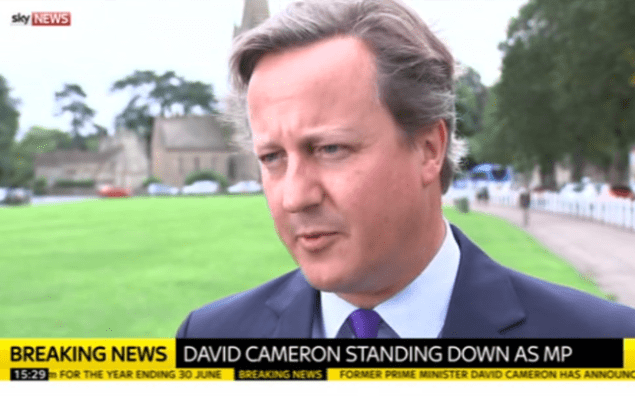
Having successfully completed Tony Blair’s fourth term of office and having a premature end called to his fifth, David Cameron today announced his decision to flounce out of parliament – despite having earlier promised to stay on as an MP after his fall from power.

He took his leave of us with these words:

With modern politics, with the circumstances of my resignation, it isn’t really possible to be a proper backbench MP as a former prime minister. I think everything you do will become a big distraction and a big diversion from what the Government needs to do for our country.

And I support Theresa May, I think she’s got off to a great start, I think she can be a strong prime minister for our country and I don’t want to be that distraction – I want Witney to have a new MP who can play a full part in parliamentary and political life without being a distraction.

[..] I hope I’ll continue to contribute in terms of public service and of course contribute to this country that I love so much.”

[..] I spoke to Theresa May and she was very understanding about this decision. I support her, I support what she’s doing, she’s got off to a cracking start. Obviously I’m going to have my own views about different issues – people would know that. And that’s really the point: as a former prime minister it is very difficult, I think, to sit as a backbencher and not be an enormous distraction and diversion from what the Government is doing. I don’t want to be that distraction; I want Witney to have an MP that can play a full role in parliamentary and political life in a way I think I would find very difficult if not impossible.”

Naturally this has led to speculation that David Cameron somehow disagrees with Theresa May’s loudly-trumpeted plans for new grammar schools and the return of potentially widespread academic selection to the education system.

I find this explanation…unconvincing. If the capsuled history of David Cameron’s premiership and leadership of the Conservative Party has taught us anything about Cameron the man, it is that he has absolutely no core political convictions which he is not more than willing to toss overboard for the sake of political expediency and his relentless desire to engage in centrist triangulation.

Fiscal conservatism? As long as he and George Osborne were able to find some statistical or rhetorical device to falsely claim that they were “paying down Britain’s debts”, Cameron was more than happy to continue spending hand over fist, driving Britain’s national debt ever-upward while exhibiting enormous timidity in reversing many of Gordon Brown’s most draconian tax increases.

Strong national defence? It took his successor, Theresa May, to drive through the parliamentary vote on the renewal of Trident, while under David Cameron’s watch Britain temporarily waived goodbye to our aircraft carrier capability (a true diminution in the eyes of the world) as well as the ability to effectively patrol our own coastline and airspace without the help of allies.

A smaller state? The much-vaunted “Big Society” was dead on arrival in 10 Downing Street back in the spring of 2010, and whatever rearranging of deckchairs the coalition government engaged in, nothing was done to tackle the biggest budget black holes – pensions and the NHS. Under David Cameron, the government preferred to virtue-signal their progressive credentials by spending borrowed money on international aid than get to grips with departmental spending.

So given this singularly unimpressive track record, the idea of David Cameron suddenly discovering an ideological backbone and beliefs strong enough to resign over is frankly ludicrous.

In fact, what really happened is quite obvious. Cast from power unexpectedly and with unexpected speed, Cameron lied when he said that he intended to stay on and complete his term as MP for Witney. To have said otherwise and admitted his intention to resign would have appeared churlish, and more than anything Cameron wanted to cultivate the image of himself as an easy-going happy warrior, ready to relinquish the trappings of office without regret and re-assume a more humble role as a backbencher.

This announcement came as quickly as it possibly could without making Cameron look completely dishonest and reprehensible. At least when Gordon Brown resigned as an MP he had managed four years as a backbencher – albeit four years in which he collected a hefty MP salary while being virtually invisible in Westminster. David Cameron’s brittle ego wouldn’t even permit him to last a year on the backbenches. His top flight political career having been brought to an unexpected end, Cameron saw no reason to stick around as a mere constituency MP.

To politicians like David Cameron, the role of constituency MP is merely a springboard to ministerial power. When the possibility of prize cabinet jobs or the keys to Number 10 Downing Street are no longer an option, wasting time on select committees or dealing with constituents’ issues appears a supreme waste of time – time which could be better spent cashing in on fame and carefully tended relationships while they are still relatively fresh and can bear the most fruit.

James Kirkup is similarly unimpressed with the manner of Cameron’s departure:

On June 27, David Cameron issued this statement: “I will continue with my duties as the MP for Witney. It is an enormous privilege to serve the people of West Oxfordshire.”

So enormous that he could only bear it for a few more weeks, apparently. He’s off, leaving the Commons and triggering a by-election in Witney: some lucky Tory will soon inherit one of the safest and prettiest seats in the country.

What does this tell us about Mr Cameron? Nothing terribly positive, to be honest. Let’s remember, he fought the EU referendum campaign promising not to quit if he lost, then quit when he lost — but only having clung to office as long as possible and having banned the Civil Service from doing any preparatory work for Brexit, thus making it harder for his successor to actually get on with the job.

In between breaking his promise not to resign as PM and breaking his promise not to resign as an MP, the only significant official work he undertook was drawing up an honours list handing an OBE to his wife’s stylist and a knighthood to his press officer.

Not exactly the most dignified departure from office, is it? And certainly not one that’s easy to reconcile with many, many statements from Mr Cameron about the sense of duty he owed to his nation, the selfless service he felt obliged to render.

And Kirkup’s unsparing conclusion:

And this is why flouncing out of Parliament in this way is so telling: it speaks to something fundamental about Mr Cameron’s character and his approach to politics: a lack of seriousness, the absence of real commitment.  Yes, he wanted the job and yes he put the hours in, to the cost of his family.

But he would never die in a ditch for his political beliefs, never shed blood and move mountains to hammer home his arguments. It was always enough to get by, to do just enough to get the top grade and do better than the rest.

Sadly, that describes Cameron perfectly – far more obsessed with optics than reality, and forever in search of the path of least resistance, even when that path ran direct through traditionally left-wing territory.

Ultimately, David Cameron was a weak and instantly forgettable prime minister because he was a centrist triangulator and a technocrat at heart. As prime minister he had no real interest in reforming Britain in his own image, imposing his own worldview or being a statesman. Rather, he was content to campaign and govern as a mere Comptroller of Public Services, the living, breathing symbol of the diminution of our national politics.

With his happy departure from Parliament (en route to a minor footnote in history) one hopes that the ground has shifted under British politics, and that the age of the technocrat might be coming to an end. His successor, Theresa May, while far from being this blog’s preferred choice, at least seems to have some strongly held political views of her own, while Jeremy Corbyn’s imminent re-election as Labour Party leader promises a 2020 general election offering genuine choice to the electorate.

All we need now is for George Osborne to follow his chum David Cameron into political retirement and we may finally be able to turn the page on this most boring and depressing chapter in Conservative history.


David Cameron - Coke Zero Conservative - I Cant Believe Its Not Miliband

Support Semi-Partisan Politics with a one-time or recurring donation:

Agree with this article? Violently disagree? Scroll down to leave a comment.

Follow Semi-Partisan Politics on TwitterFacebook and Medium.

Mandatory Reselection Of MPs Should Be The Norm For British Political Parties, Not A Scandalous And Controversial Idea

Jeremy Corbyn - Mandatory Reselection Labour MPs

MPs do not have a divine right to represent their constituencies forever once selected by their local party, Jeremy Corbyn is quite right to consider mandatory reselection for MPs and all political parties that profess to care about democracy should follow his lead

The Telegraph leads today with a breathless piece warning of Jeremy Corbyn’s intention to press for mandatory reselection of MPs whose constituencies are changed as a result of the coming boundary review, assuming he prevails in the Labour leadership contest.

Jeremy Corbyn’s allies are planning to end the parliamentary careers of dozens of critical Labour MPs by approving plans for mandatory reselection by the end of the year.

The Telegraph understands his supporters will use their increased majority on the party’s ruling body to clarify rules about which MPs can stand for election after the 2018 boundary review.

Rhea Wolfon, elected to the Labour’s National Executive Committee [NEC] this week, hinted at the move by saying the party must have a “conversation” about “mandatory reselection”.

However Andy Burnham, Labour’s new mayoral candidate for Greater Manchester, said it would “pull the rug from under our MPs” and fuel a “climate of distrust”.

While Politics Home reports that Steve Rotheram, Jeremy Corbyn’s PPS and now Labour’s candidate for the Liverpool city regional mayoralty, has also made approving noises about challenging the “divine right” of MPs to remain in their position come what may:

Steve Rotheram, who serves as Jeremy Corbyn’s parliamentary private secretary, said elected politicians should not think Westminster is the “repository of all the best ideas”.

It comes after Rhea Wolfson, a newly elected member of Labour’s ruling National Executive Committee, said the party should have a “conversation” on the mandatory reselection of MPs.

When asked whether he was in favour of such a proposal, Mr Rotheram said he was “attracted” to Tory MP Zac Goldsmith’s 2014 plan that would see misbehaving MPs face a by-election if 5% of constituents signed a “notice of intent to recall” and 20% then sign a “recall petition”.

He said he did not support Mr Goldsmith’s defeated amendment to the Recall of MPs Bill amid concerns about the exact motion he was putting before the House of Commons.

The MP for Liverpool Walton added: “But yes, I think that MPs should reflect what the membership who select them are putting them into parliament to do. We shouldn’t believe that we’re down here and that we’re the repository of all the best ideas.

“We really should be looking at what our members are telling us to do and I think that’s part of the role as a Member of Parliament.”

Cue shock, horror and clutching of pearls from the political establishment – Andy Burnham, himself about to jettison a Westminster career cul-de-sac in the hope of municipal glory in Manchester, says that it would be “pulling the rug” out from underneath MPs. Well, perhaps MPs need to have the rug pulled out from underneath them. Perhaps they need the rug to be yanked hard enough so that they either become genuinely responsive to the party activists who work to get them elected or quit the field of play altogether.

The great thing about democracy at its best is that it rewards those who show up when the times comes to choose. Old people reliably vote in large numbers, therefore government policy when it comes to housing, welfare spending and any number of other policy areas is generously skewed in their favour. If only young people could put their Pokemon Go games down for long enough to make it to a polling station, government policy might begin reflecting their concerns too. But they don’t, so it isn’t.

Unfortunately, the way MPs are currently selected by Britain’s main political parties takes this important aspect of democratic responsiveness and throws it out the window. Once an MP has been chosen as their party’s nominee, they have very little use for their own party activists. These dedicated and principled people are hardly likely to ever support a candidate from another party, and therefore an unscrupulous MP can abuse and betray them to their heart’s content knowing that they automatically qualify as their party’s parliamentary candidate the next time a general election rolls around.

And inevitably this can lead to a growing gulf between the political stance of a constituency party and the views espoused (and votes taken) by that constituency’s Member of Parliament. This is what we now see happening to the Labour Party, where depending on your view either the parliamentary party has shifted to the right or the membership has shifted dramatically to the left (in reality a bit of both) and no longer stand for the same principles.

The brutal truth right now is that many Labour MPs, including some quite prominent ones like former leadership contender Angela Eagle, are now irreconcilably out of step with their own local parties. Why, therefore, should they have the automatic, divine right to continue to represent local parties who despise them and wish to put forward someone for parliament who more closely reflects their own priorities and positions?

When viewed this way, Jeremy Corbyn’s proposal seems quite tame. In fact, this blog would go further – MPs should not only face mandatory reselection in the case of constituency boundary review (the specific circumstance currently under discussion) but every five years ahead of a general election. This would bring Britain into line with other countries like the United States, where Representatives and Senators do not have “jobs for life” and must compete in party primaries if they wish to run for their seat at the next election. Such a move would put the wind up an often self-entitled political class, forcing MPs to justify their worthiness of a place on the ballot at regular intervals and forcing many of the older, less useful bench warmers off into retirement.

No constituency should be lumbered with a doddering old MP who doesn’t care any more, or a sharp-elbowed go-getter who ignores their constituency as they focus on climbing the greasy pole. Mandatory reselection goes a long way to solving those problems.

The current system, by contrast, is an abomination – incumbent MPs, often initially selected to stand for parliament in their constituencies through dubious, opaque or even downright corrupt means are then largely free from scrutiny by their own party for the rest of their career. As soon as they enter parliament they are enveloped in the Westminster self-protective cloak which serves to insulate parliamentarians from the consequences of their behaviour and political decisions.

If you know that nothing you can do will ever get you fired – if there is no political betrayal (like, say, pretending to be a eurosceptic during selection and then turning around and supporting the Remain campaign) for which you will ever be held to account – then there is every incentive to lie about your real political beliefs and motivations during selection, and then behave in as abominable and self-serving a way as you please as soon as your are elected to the Commons.

The status quo needs to change, and whatever else one may think of Jeremy Corbyn (and however self-serving his motivations may be), he should be applauded for taking a stand for democracy and accountability and against the entrenched privilege of the political class.

If political parties are to be accountable to their supporters then there needs to be an established process for the base to hold their candidates to account for decisions taken in office. Mandatory reselection – together with a proper right of recall, empowering constituents to recall a failing or unpopular MP subject to a certain percentage of the local electorate signing a petition – is an important aspect of that process.

Under a properly democratic system, MPs should fear the wrath of their local constituency party and be closely responsive to their priorities and concerns. At present, too many MPs take their local party for granted as soon as their selection is assured, shunning the activists who knock on doors and deliver leaflets on their behalf in order to cravenly pander to the centre.

This needs to change. This can change. And Jeremy Corbyn should be commended for trying to do something about it.


Ed Miliband Labour One Nation

Top Image: Huffington Post

Support Semi-Partisan Politics with a one-time or recurring donation:

Agree with this article? Violently disagree? Scroll down to leave a comment.

Follow Semi-Partisan Politics on TwitterFacebook and Medium.

Shameless, Conniving Centrist Labour MPs Plot To Create A Shadow Party

Jeremy Corbyn - Labour Leadership Coup

In threatening to break away and form their own parliamentary caucus of anti-Corbyn MPs vying for recognition as the official opposition, Labour’s coddled centrist MPs are pitching a giant “if I can’t run it, no one can” tantrum in which the future of one of Britain’s great political parties is at stake

So it has come to this: a failed rump of centrist Labour MPs who inspire such great devotion among the party faithful that their preferred candidates somehow lost to Jeremy Corbyn last year and whose sole stalking horse is set to lose to him again this year are now plotting to strike out on their own.

From now on, if the plotters get their way, centrist Labour will no longer be wedded to those pesky ordinary people who make up the party rank and file – now, they will be an entirely self-serving, autonomous bloc, jostling with Jeremy Corbyn for use of the Labour Party brand and quite possibly pitching Britain into a constitutional crisis in the process.

The Telegraph reports:

Senior Labour rebels are so convinced that Jeremy Corbyn will win the leadership contest that they are planning to elect their own leader and launch a legal challenge for the party’s name.

Leading moderates have told The Telegraph they are looking at plans to set up their own “alternative Labour” in a “semi-split” of the party if Mr Corbyn remains in post.

The move would see them create their own shadow cabinet and even elect a leader within Parliament to rival Mr Corbyn’s front bench and take on the Tories.

They are considering going through the courts to get the right to use Labour’s name and assets including property owned by the party across the country.

They would also approach John Bercow, the Commons Speaker, and argue that having more MPs than Mr Corbyn means they should be named the official opposition.

While the plans are in an “embryonic” stage, it will increase fears that the party will further fracture if Mr Corbyn wins the leadership on September 24.

Ladies and gentlemen, this is why the political class is so reviled, and why MPs are so widely distrusted. People have long feared that politicians are in it for themselves, that their pious and self-congratulatory words about representing the people are just boilerplate language, going through the motions, while in reality they care only about acquiring and exercising power for its own sake. Well, now centrist Labour is giving the doubters just the proof that they need, and making fools of all of us who have defended politicians and tried at times to think the best of them.

Never mind the betrayal of Labour Party members that this would represent – the parliamentary party effectively sticking two fingers up at the ordinary people who pound the pavements, knock on doors, hand out leaflets and make telephone calls to get them elected in the first place. Never mind the appalling visual of a political class which cannot stand the people who put them in office, a parliamentary caucus which arrogantly presumes the right to sit in the House of Commons as non-aligned MPs when they were elected under the banner of the Labour Party. And never mind the potential constitutional crisis which could be triggered when this army of self-serving rebels calls on the Speaker to be made the official opposition when Jeremy Corbyn is currently recognised as Leader of the Opposition.

None of these things matter, apparently. Because the real injustice, the thing which should be making us all angry, is the fact that people like Chuka Umunna and Yvette Cooper don’t get to take the Labour Party in their preferred direction for a few years while Corbyn and McDonnell have a go. And the professional frustration of these Red Princes is apparently worth destroying a 116-year-old political party.

The political history of this country stretches back entire millennia, and its main political parties have all been in existence for over a century. Yet Labour’s centrist MPs are apparently willing to ignore this history, casting it aside because of what they perceive as weak electoral chances in one measly general election. The short termism on display here is remarkable – but drearily predictable.

After all, if Jeremy Corbyn remains as leader and takes Labour to an historic defeat in the 2020 general election, the party will be out of power for nine more years at most. But if the centrists, acting in a fit of pique at finding themselves out of favour and influence for once, decide to split the party then it will be ruined and broken forever. The time horizon in the minds of the centrist rebels conveniently gels with the likely length of their own political careers. When centrist Labour MPs earnestly declare that the future of the Labour Party is at stake, what they really mean is that their own parliamentary careers are at stake. The Labour Party has survived bad leaders before. What it cannot survive is the treachery and self-serving behaviour of the majority of its own parliamentary caucus.

If Labour’s centrists are serious about regaining control of their party and influence within in, there is only one course of action. And it involves sitting down, shutting up and letting Corbyn drive Labour off a cliff at the 2020 general election. Anything less than their full-throated support (or at least their tacit acceptance of his rule) will see bitter Corbynites attempt to pin the blame for their defeat on lack of enthusiasm (or indeed sabotage) within the parliamentary party. If Corbyn is to be deposed and Corbynism rejected once and for all, he and McDonnell must be given a clear shot at the general election and allowed to fail on their own.

“But people can’t take nine more years of Tory rule”, sanctimonious centre-leftists wail, indulging in their favourite pastime of painting themselves as the sole Defenders of the Poor. This would be a marginally more convincing if there was actually a radical, Thatcherite conservative government in office rather than the Cameron/May Tories who preach statist, paternalistic big government solutions to every problem – effectively Tony Blair’s missing fourth term.

It would be more convincing if there was more than a cigarette paper’s difference between centrist Labour and the leftist Toryism practised by a party which has more to say about “social justice” than liberty and freedom. But since there is so little difference, it doesn’t really matter whether Labour are in power or not – so they may as well take this decade to get their house in order and decide exactly what kind of party they want to be.

And if, at the end of that process of sober reflection, the decision remains that the party would be better off splitting into a hard left contingent and a centrist contingent for the professional political class then so be it. But this is a grave and permanent decision indeed, of sufficient magnitude that it ought to be determined by something more than the frustrated career aspirations of a few restless centrist Labour backbenchers.

There is a long-term case for splitting the Labour Party if its warring factions cannot coexist. But it deserves far more thought and consideration than today’s hot-headed parliamentarians and commentators seem willing to bring to bear on the question.


Jeremy Corbyn - PMQs

Support Semi-Partisan Politics with a one-time or recurring donation:

Agree with this article? Violently disagree? Scroll down to leave a comment.

Follow Semi-Partisan Politics on TwitterFacebook and Medium.

We Do Not Suspend Our Democracy As A Gesture Or Tribute; The Batley And Spen By-Election Should Be Contested

Airey Neave Assassination - INLA

Suspending democracy is no way to pay tribute to a murdered MP

I’m strongly inclined to agree with Archbishop Cranmer’s take on the decision by the major political parties not to contest the Batley and Spen by-election brought about by the despicable murder of Jo Cox, essentially giving Labour a free run at a seat they were almost certain to hold regardless.

Metro reports:

The Lib Dems and Ukip have joined the Conservative Party to announce they will not contest the by-election in Batley and Spen resulting from the death of Jo Cox.

Mrs Cox, 41, died yesterday after she was stabbed and shot outside a library in Birstall.

The Labour MP had held her seat in West Yorkshire since the General Election last year, which she won with a majority of 6,057.

No date has yet been set to elect a new representative.

To which Cranmer writes in response:

Whoever Labour chooses to be their candidate will be gifted a seat in Parliament. We honour a murdered democrat by suspending democracy. Our political leaders respect her values service, community, tolerance – by treating her former constituency as heritable property. There can be no disjunctive voice, no division and no dissent: Jo Cox’s values, her political philosophy and her apprehension of the world order must be perpetuated “as a mark of respect to a much-loved and respected politician”. The Batley and Spen by-election thereby becomes a memorial, and her successor a living monument.

[..] The thing is, there is something odd in not contesting a seat after a sitting MP has been murdered:

1990 Murder of Ian Gow by PIRA – By-election contested – LD gain
1984 Murder of Sir Anthony Berry by PIRA – By-election contested – CON hold
1981 Murder of The Rev Robert Bradford by PIRA – By-election contested – UUP hold
1979 Murder of Airey Neave by INLA – No by-election, but GE seat contested – CON hold
1922 Murder of Sir Henry Wilson by IRA – By-election uncontested.

So the last uncontested by-election in this tragic circumstance was in 1922 for North Down (which had occasional uncontested elections into the 1950s).

Perhaps things have moved on since the murder of Ian Gow: 26 years is an eternity in politics. Or is it that only murdered Protestants and Tories have to be challenged in the hope of driving their particular brand of hatred, division and intolerance from public life? Whatever, the decision not to contest Batley and Spen permits the Labour Party to put into Parliament anyone they want. Although it is extremely unlikely that the seat would have changed hands, it is an offence against democracy to respond to attack upon democracy with a rigged political appointment. Far better for all the main political parties to put up a full slate of candidates, and then for  those candidates to selflessly exhort the people of Batley and Spen to vote Labour as a mark of respect to a much-loved and respected politician. At least then the people would have been free to honour Jo Cox’s values of service, community and tolerance as they would wish to do, instead of being coerced into a contrived expression of political unity, or hectored into a mellow manifestation of Anglican generosity and integrity.

“A contrived expression of political unity”. And isn’t that all that this would be – like the symbolism of MPs mixing it up in parliament and sitting next to members from opposing parties on one day before calling each other’s motives and morals into question again the next? If so, it hardly seems like a good enough reason for the suspension of democracy in one constituency.

And let’s not pretend that this will not happen. The Labour Party in particular have tremendous form in suggesting that those with conservative leanings are morally defective or singularly lacking in compassion. Is this all to cease now, because of the awful murder of Jo Cox? Will Labour MPs finally accept that it is possible to care about the poor and the vulnerable while believing that conservative policies are best for them and the country? I wouldn’t bet on it.

In fact, while there is an undeniable and odious far right element in British politics at the fringes, in terms of the voices currently heard in parliament and in the mainstream media, I would argue that it is the supposedly morally virtuous Labour Party which is guilty of most of the intemperate and divisive rhetoric heard today. And if we are to be political about it, if one party’s behaviour has been least deserving of being given a free run in a by-election, one could make a strong case that it is the Labour Party.

And yet how things seem to have changed. As Archbishop Cranmer points out, after the brutal assassination of several other MPs during the twentieth century, the idea of suspending competitive by-elections was never even considered. Of course the affected constituents should pick themselves up and avail themselves of their democratic right, was the prevailing thinking. And yet in 2016, in order to show solidarity or respect (or in actual fact, I’m almost hesitant to say, to signal virtue) it is apparently necessary to suspend democracy. To make a nice gesture.

As a society, we are getting very good at making nice, sentimental gestures in the face of tragedy. In the West, we have become particularly adept at lighting up our national landmarks to mourn terrorist attacks in one country or another. And there is obviously an important place for vigils, and grieving, and ritualised mourning. But it rather seems that this is now all that we can do. We can make the public gesture but not change the behaviours which makes the gesture necessary in the first place.

Just as one can predict with fearful certainty that the London Eye, Eiffel Tower and Brandenburg Gate will soon be lit up in the national colours of the next country to face a major terror attack while our politicians remain unable even to properly articulate the nature of the Islamist terror threat which we face, so it seem we are now about to celebrate democracy by effectively suspending it. In a twisted homage to Jo Cox, we are about to allow the Labour Party, through whatever opaque selection process they choose, to parachute a new MP into parliament without giving the people a real choice.

There are many appropriate ways to pay tribute to the late Jo Cox, a universally liked MP and the cruel victim of presumed far-right terrorism (for we should call it what it is). But the spectacle of an uncontested by-election, or a by-election fought only by a handful of ugly fringe candidates, is not one of them.

And for once, it would be gratifying if our commitment to democracy could trump the desire to make ourselves feel good with showy but ultimately counterproductive demonstrations of virtue.


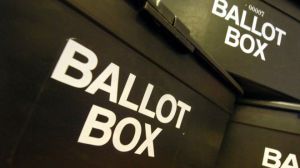
By election - ballot box - Democracy

Agree with this article? Violently disagree? Scroll down to leave a comment.

Follow Semi-Partisan Politics on TwitterFacebook and Medium.

The Petition To Cancel The EU Referendum Showcases The Remain Campaign’s Dim View Of Democracy

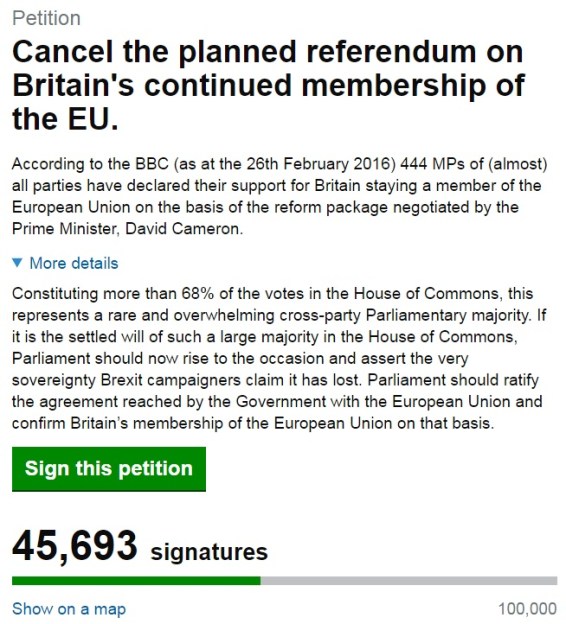
Cancel EU Referendum - Brexit - Remain - Parliament Petition

The divergence between the strong preference of most MPs and the sentiment of the British people is the main reason we are having this EU referendum, not a reason to cancel it

Last week, before the awful murder of Jo Cox MP changed the character and atmosphere of the campaign, it was widely agreed that the Remain campaign were on the back foot, behind in some of the polls and certainly lacking in anything like momentum.

And so perhaps it is unsurprising that late last week, a petition started by Remainers began to circulate on social media, calling for the EU referendum to be scrapped altogether.

The text reads:

According to the BBC (as at the 26th February 2016) 444 MPs of (almost) all parties have declared their support for Britain staying a member of the European Union on the basis of the reform package negotiated by the Prime Minister, David Cameron.

Constituting more than 68% of the votes in the House of Commons, this represents a rare and overwhelming cross-party Parliamentary majority. If it is the settled will of such a large majority in the House of Commons, Parliament should now rise to the occasion and assert the very sovereignty Brexit campaigners claim it has lost. Parliament should ratify the agreement reached by the Government with the European Union and confirm Britain’s membership of the European Union on that basis.

What a cynical, opportunistic and fatuous thing to do – to seek to cancel an imminent referendum just because their own side happens to be in danger of losing.

The “444 MPs” line does not hold water, either. The whole purpose of this referendum is to settle what is in effect a dispute between past and present parliaments on the one hand, and the British people on the other. It is parliament which has knowingly and willingly signed away endless new competencies and powers to the EU, hollowing out the British state at the expense of the growing supranational European government in Brussels – a parliament often composed of many MPs who described themselves as “eurosceptic” while being complicit in the process.

This includes many Conservative MPs who were only ever selected by their parties or constituency associations as candidates because they professed strongly anti-EU sentiments to the Tory party base. Now, it has sadly been the case that many of these MPs were revealed to have lied during their selection processes, telling eurosceptic party members what they wanted to hear while themselves being ambivalent or even pro-European, as evidenced by their decision to support the Remain campaign. But it is clearly disingenuous to claim (as the petitioners do) that the majority of MPs favouring Remain represents the settled will of the people – the tightening polls, some showing a lead for Leave, prove this to be otherwise

It should also be pointed out that many of the “444 MPs” supporting Remain would not presently be sitting in Parliament had David Cameron not taken the sting out of UKIP’s tail by promising the referendum in the first place. Prior to that pledge, two former Tory MPs (Douglas Carswell and Mark Reckless) had already defected to UKIP in a blaze of publicity, and more threatened to follow. If Cameron had not neutered part of UKIP’s appeal by promising the referendum, there could have been up to a dozen more defections prior to the general election, and then tens more UKIP MPs elected in May last year. If anything, promising the referendum helped to keep a pro-EU majority in the House of Commons. That same majority can not then also be used as grounds to take the referendum away.

But the root of the matter is the “parliamentary sovereignty” referenced in the petition text. I cannot speak for all Brexiteers, but I know I speak for many other liberal leavers when I say that I am not fighting with every fibre of my being to secure a Brexit vote because I want to re-establish the sovereignty of parliament and re-empower the very people who so blithely gave it away to Brussels in the first place. On the contrary, I want the British people to finally be sovereign in this country. And this is the wider debate which has been entirely missing throughout this sorry referendum campaign, but which we need to have.

What, after all, would be the point of striving to claw back sovereignty and decision-making power from Brussels only to give it back to the same people operating under the same laws who gave it away? This is why Brexit must just be part of a broader process of democratic renewal, making the people sovereign and beginning with the assumption – much as in the United States of America – that “Parliament shall make no law…” except in those areas where we the people explicitly grant permission.

This then opens up a whole load of other questions which gleeful Remainers would doubtless seize upon as more evidence that Brexit would cause problems and be “difficult”. Well, yes, it would. Unsurprisingly, great deeds require a commensurate effort in their accomplishment, and throw up lots of problems which need to be patiently solved along the way. Man did not walk on the moon the day after John F Kennedy idly thought out loud that it might be a good idea. The Apollo Programme took place in many stages after Kennedy set the initial goal, each one solving a particular problem or proving a new competency until all of the pieces were in place for Apollo 11 to finally touch down on the surface of the moon.

It is reasonable to expect that the process of extricating our country from forty years of gradual, incessant political integration by stealth should be a task of comparable difficulty. But it is not scientific and technical expertise which we must rebuild, but political, constitutional, democratic, trade and regulatory knowledge, much of which we have lazily outsourced to the EU.

And unfortunately the prize cannot be measured in pounds or euros, or any economic model pointed to by David Cameron’s hallowed “experts”. The ability of people to exercise meaningful control over their leaders, communities and futures cannot be boiled down to numbers in an Excel spreadsheet or one of the smug infographics shared by the Remain campaign. But this does not mean that democracy lacks value – rather, that it is priceless.

Those who would have us vote Remain on June 23rd look at British independence and see it as a series of problems and risks, all of which our country and our people are too small, too weak and too incompetent to overcome. They genuinely cannot understand why a country as “small” and supposedly inconsequential as Britain would want to leave a supranational political union in which we trade our democracy for the illusion of influence which comes from being a member of a big club.

Those advocating Brexit, on the other hand, see opportunity and feel a sense of optimism grounded in a healthy sense of what this country and its people are capable of accomplishing. They generally accept that there may be some short term political instability, but that there is just as much instability in our future if we remain shackled to an EU beset with so many intractable problems it is simply unwilling and unable to address. And they also value democracy sufficiently highly that endless, apocalyptic scaremongering with doomsday economic scenarios simply doesn’t resonate. The prime minister appears genuinely frustrated that we Brexiteers are not more responsive to his Project Fear, because he fails to appreciate that the core Remain argument does nothing to neutralise the reasons why many of us want out of the EU.

And sadly, this difference in mindset is not one which we can reconcile (or persuade any hardcore Remainers to the Brexit side) in the little time left of the campaign. But while we Brexiteers are happy to fight on to the end, making the case as best we can, some on the Remain side want to circumvent the process and take the choice away. Hence this ridiculous petition, arguing that because a majority of the very people you would expect to love the EU think that we should stay in it, there is no need to further consult the British people.

I would state again that the very existence of this petition shows a contempt for the will of the British people – but when the entire Remain campaign focuses myopically on short term economic indicators rather than the long term health of our democracy, it hardly needs saying.


European Union - United Kingdom - Britain - Flags

Agree with this article? Violently disagree? Scroll down to leave a comment.

Follow Semi-Partisan Politics on TwitterFacebook and Medium.