People of all political stripes sometimes say things they don’t mean, or come to regret, in the heat of passionate argument, either out of anger or just for dramatic effect.
Meanwhile, across the Atlantic, angry liberals threatened to move to Canada when George W. Bush was re-elected, while social conservatives – high on passion but lacking in international awareness – responded to the Supreme Court’s ruling legalising gay marriage by themselves threatening to move to Canada, that well-known bastion of homophobia and social conservatism.
So rhetorical hyperbole is not restricted to any one political party or any one type of outlook or worldview. But there is a certain type of political argument to which those on the political Left seem to resort far more often than their opponents on the Right.
When faced with electoral defeat and years in political opposition, those of a conservative mindset tend to lick their wounds for awhile and then set about the business of trying to re-acquire power and influence, however angrily or unsuccessfully. However, when those of a left-wing mindset are faced with rule by the other side, they are far more likely to view the situation as intolerable to the extent that even remaining part of the same country or political structure becomes undesirable.
You know there must be a serious disturbance in the Force when left-wing commentators like Owen Jones begin openly flirting with euroscepticism. But this is exactly what we are now witnessing, with formerly staunch eurofanatics up and down the land executing sharp 180-degree U-turns in their general attitude toward Brussels, sometimes with quasi-admissions of former error (see Owen Jones) but usually done quietly in the hope that nobody will notice.
Never mind the fact that just a couple of short months ago, many of these same left-wing talking heads were taking to the airwaves during the general election campaign to argue that the European Union represents enlightened internationalism at its best, and that only the most unlettered and unsavoury characters (read: Ukippers) could possibly believe otherwise.
Never mind the cognitive dissonance required to accuse Nigel Farage of paranoid xenophobia one month and then find fervent common cause with him the next; wherever there is a David vs Goliath struggle raging in the world, the virtue-signalling Left are never slow to exploit it, even if it means resorting to twisted pretzel logic or making themselves look extremely silly in the process. Thus the British Left have decided that plucky little Greece is “good”, while the European Union – for so long a beacon of social democracy in Britain’s ‘capitalist darkness’ – has suddenly become the evil enforcer of a punitive “neo-liberal” agenda.
Of course, this is done with the level of sanctimonious obnoxiousness that you would expect. Those filthy Ukippers hated Europe for all the ‘wrong’ reasons, one can imagine them thinking as they penned their first tentative polemics against once-loved EU institutions. But we changed our opinion of the EU for ‘good’ reasons, reluctantly, after watching Greece being bullied. So you should sit up and take notice when we criticise the EU, because we’re not like the fruitcakes and closet racists who bang on about Europe the rest of the time.
You don’t have to agree with Jeremy Corbyn to welcome his presence in the Labour leadership contest
It is a pity that the inclusion of Jeremy Corbyn in the Labour leadership race is pretty much only being discussed in the context of the growing #Tories4Corbyn movement.
Putting Corbyn on the ballot paper does have one unintended consequence, which is amusing the Conservatives greatly. Suddenly, there is great interest from senior Tories in helping Labour to elect Corbyn, because they think, rightly, that it would equal oblivion for Labour and a generation of Tory rule.
There is a practical way Tory voters can help, the Conservatives have realised. For just £3 anyone can sign up as a Labour supporter and a get a vote in the party’s leadership contest. On Twitter, Ruth Davidson, the Scottish Tory leader, has already described getting the chance to help make the completely unelectable Jeremy Corbyn Labour leader as a notable bargain.
This Tories4JeremyCorbyn movement could take off. How long before someone establishes a website and Twitter account explaining how Tory voters can win it for Jeremy?
This is all well and good, but it is also a distraction, the type of fun Westminster parlour games that the political class like to play to entertain themselves, leaving the vast majority of Britons either oblivious or turned off. Meddling in the other side’s leadership election might elicit smirks and chuckles in the Westminster Arms, but it hardly does anything to improve the reputation of a political class seen as totally cut off from the people.
Owen Jones is clearly channelling the British Left’s guilty conscience.
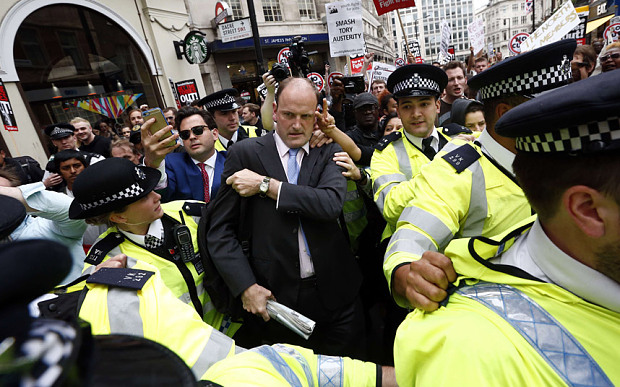
As the stories of left-wing hysteria and bad behaviour following the Conservative election victory rack up, at least one left-wing commentator is finally starting to feel a sense of shame and embarrassment at the words being said and misdeeds committed in the name of so-called principled opposition to the Evil Tories.
For Owen Jones, the straw that broke the camel’s back was the way that UKIP’s sole MP, Douglas Carswell, was set upon by foul-mouthed, threatening activists as he waited for a bus outside Parliament. But even now, Jones is unable to simply express regret or disapproval, choosing instead to water down his criticism of the anti-Tory hysteria in a broader (and redundant) argument defending the activists’ right to protest.
So we’re clear, the way [Carswell] was reportedly treated was out of order. Protest is a basic democratic right, won at great cost by our ancestors. It is often passionate and angry, be it about cuts to public services or opposition to the ban on fox hunting. It includes civil disobedience, employed by protest movements ranging from the suffragettes to tax justice campaigners.
If a disabled sufferer of the bedroom tax angrily accosted Iain Duncan Smith, it would not be the place of privileged me to tut at them. But subjecting Douglas Carswell to what was undoubtedly a frightening and upsetting experience was totally wrong, and it is difficult to see what those involved hoped to achieve.
However, his attempt to use the incident to make political gain – and resort to sweeping generalisations about the left – cannot go without a response. “Austerity, according to the left, is the ultimate evil,” writes Carswell. Well, no, actually. I suspect most on the left, if asked for “ultimate evils”, would opt for, say, genocide, war or murder.
Heaven forfend that those of us on the right should point out the moral wrong of physically and verbally intimidating someone simply because they hold right-wing political views. This is the kind of principle that the Old Left (wherever they went) would have been rushing to the barricades to defend – but apparently no longer.
There is something awe-inspiring yet disconcerting about walking into an NHS hospital. More than any other institution in the free world (with the possible exception of the Pentagon in the United States) a visitor to an NHS hospital in Britain is quickly made to feel that they are but one very small and temporary part of an unimaginably huge and powerful organisation, one which hums with a life and agenda entirely of its own, far bigger than – and not accountable to – any one person or office of state.
That’s not to denigrate the standard of care which may be provided, or the empathy shown every day by many NHS staff. And yet to sit in a waiting room and watch the crisply uniformed workers – from the lowliest cleaner to the highest-paid consultant – hurry about their business, it feels slightly Orwellian to know that the exact same scenes are playing out, with zero variation, in every town and city throughout the country. The uniformed defence chiefs in Arlington, Virginia may hold the power to extinguish all human life with the push of a few buttons, but as far as the British hospital patient is concerned, the power of a harried, middle-aged manager in the NHS is no less absolute.
Why does this matter?
Healthcare – the way that it is rationed, delivered and spoken about – is a hugely important issue, one which engenders unusually strong feelings among people, especially when their own use of the service gives them an added personal stake. It should follow, then, that our national conversation about healthcare is equal to the weight of the subject matter – that it is informed, reasoned, respectful and always guided by a few core principles to which we can all agree as relatively decent, rational human beings.
And the conversation should focus on those core aims – say, providing the best, most holistic healthcare to the entire population that our finite resources can buy – above all else, with lesser considerations such as tradition, vested interests and organisational or partisan loyalty coming a distant second.
It hardly needs stating that we in Britain are not currently having that kind of conversation.
Sure, there are ideological zealots on both sides. They may be few in number, but read enough newspaper online comment sections and you will find the odd absolutist libertarian arguing his lonely case that the intentionally uninsured person who developed cancer made their own deathbed and must now lie in it. But if you want to see ideological fervour and vested interests taking priority over rational thought on a truly large scale, you must look to the British political left – and specifically towards the sound of footsteps steadily marching south from Jarrow to London.
This weekend, a pressure group called 999 Call For The NHS will complete its People’s March For The NHS, a rolling demonstration that has been following the route of the 1936 Jarrow March with the aim of increasing the British people’s already sky-high approval of our nationalised healthcare provision – or to scaremonger and raise false fears about its imminent demise, depending on one’s perspective. From the group’s site:
The People’s March is a perfect opportunity to build support for the NHS and to join up with amazing NHS campaigners across the country. Following the basic route of the 1936 Jarrow Crusade, the People’s March for the NHS will head to Parliament. On route we aim to make the public aware of what the coalition government has been doing to our NHS and what has been happening to our hospitals and health services.
According to 999 Call For The NHS, our national healthcare provider is under mortal threat from the Conservative-led coalition government, who have worked tirelessly to undermine the nation’s health by (counterintuitively) increasing NHS spending every year since 2010, and ringfencing the organisation from any future spending cuts at the expense of almost every other department, including our national defence.
The group’s purpose is clear, and summed up perfectly by their name, 999 Call For The NHS. According to this inverted world view, we the people exist to serve the state bureaucracy (in this case the NHS) and come to its aid in an emergency, rather than the other way around.
It’s like a perverse reimagination of John F Kennedy’s inaugural address – ask not what the NHS can do to make you and your family well; ask what you can do to unthinkingly support this sprawling, inevitably flawed organisation, and all with a level of fervour more commonly seen among cult members.
That certainly was not the case when the NHS was founded. Back then, the focus was very much on the people to be served by the fledgling organisation, rather than the appropriate level of financial and human sacrifice to throw at an unreformed, unresponsive behemoth. As Aneurin Bevan said in his speech at the second reading of the NHS Bill in 1946:
The first reason why a health scheme of this sort is necessary at all is because it has been the firm conclusion of all parties that money ought not to be permitted to stand in the way of obtaining an efficient health service … It is cardinal to a proper health organisation that a person ought not to be financially deterred from seeking medical assistance at the earliest possible stage … Therefore, the first evil that we must deal with is that which exists as a consequence of the fact that the whole thing is the wrong way round. A person ought to be able to receive medical and hospital help without being involved in financial anxiety.
Not only is this the case, but our hospital organisation has grown up with no plan, with no system; it is unevenly distributed over the country and indeed it is one of the tragedies of the situation, that very often the best hospital facilities are available where they are least needed. In the older industrial districts of Great Britain hospital facilities are inadequate. Many of the hospitals are too small – very much too small … There is a tendency in some quarters to defend the very small hospital on the ground of its localism and intimacy, and for other rather imponderable reasons of that sort, but everybody knows today that if a hospital is to be efficient it must provide a number of specialised services. Although I am not myself a devotee of bigness for bigness sake, I would rather be kept alive in the efficient if cold altruism of a large hospital than expire in a gush of warm sympathy in a small one.
Even 999 Call For The NHS reference these founding aims in their own campaign literature:
In modern times it’s sometimes hard to have faith in what our politicians do and say. But not so long ago, politicians spoke about and acted on ideals. When Nye Bevan founded the NHS in 1948 it was formed on 3 core principles: 1. The health service will meet the needs of everyone 2. It will be free at the point of delivery 3. Healthcare will be delivered according to clinical need, not the ability to pay
This is how the NHS began. The dream of nationalised healthcare was a brave new world where a person’s financial means no longer determined their access to quality healthcare, and where poverty was no longer an implicit death sentence. There was less obsession over who delivered the services, and less paranoia about keeping certain types of undesirables as far away from the process as possible.
The emphasis then focused on the fact that healthcare was to be free at the point of use; today’s Labour politicians seem to care nothing at all about the healthcare itself, aside from their obsession that the person providing it must get their pay cheque from the government and not a private firm.
It is interesting to read some of these early speeches. Sure, many of them contain the same hyperbolic Tory-bashing that one now expects from Owen Jones or Polly Toynbee, but they are also lofty speeches that even political opponents can appreciate thanks to their nobility of purpose. These visionary statements make a stark contrast with today’s bitter, one-dimensional screeds accusing them (the evil Tories) of trying to take healthcare away from us (the good, decent folk).
And note the tough-minded defence of large, centralised centres of specialised service provision in Bevan’s speech. How many of the latter-day Jarrow marchers have also been involved in NIMBY-style protests and efforts to keep small, inefficient local services running at huge cost to the taxpayer and to the detriment of overall healthcare outcomes? This too, is in contravention of the NHS’s founding spirit.
Lest there be any doubt about the 999 protesters’ aim to preserve a 65-year-old institution for reasons amounting to little more than sentimentality, here is the movement’s hero, Owen Jones, in full rhetorical flight:
“It is not for us to allow our greatest national institution, built by the determination and courage of our ancestors, to be dismantled and privatised by a Tory party that did not even win the election. That’s why I’m backing this incredible march – which demonstrates we will not stand aside whilst our NHS is shredded by vultures.”
This is quite extraordinary. All this talk of ancestry, of national endeavour and shared heritage coming from the mouth of a UKIP or Tory voter would be immediately jumped upon as evidence of the worst sort of Little Englander mentality, and yet here is one of the doyens of the British left indulging in precisely the same rose-tinted nostalgia – albeit about a socialist cause célèbre.
Comparisons to a cult may seem overblown, but just look at the hagiography and aura of personality being carefully curated by NHS fanatics surrounding the life of Aneurin Bevan. As 999 Call For The NHS breathlessly boast on their own website:
A sister march and rally is being held in Tredegar, the birthplace of Aneurin Bevan. Organised by local people we’ll be linking with them via satellite.
When the socialist march to London is mirrored by a twin pilgrimage to the birthplace of the founder of the church, one cannot help but wonder to what extent this exercise is really about healthcare at all.
Reading the biographies of the 999 Call For The NHS Team, it is evident that a number of the movement’s leaders were spurred to organise partly because they felt they owed a “debt of gratitude” to the NHS for either having received treatment themselves, or through a loved one having done so. But this is a particularly poor reason to campaign for the status quo. The NHS (like any system or bureaucracy) has flaws and problems as well as good points, and it helps no one if people feel beholden to support an institution in its current form just because they once used the service that was on offer at the time.
Indeed, when considering the best way to administer healthcare to a nation of 63 million people and growing, any kind of sentimentality is probably best avoided. People may look with distaste at the work undertaken by NICE (and certain Americans may shudder and think of death panels), but these structures and organisations simply reflect the fact that there is unlimited demand for healthcare, and a limited supply. One way or another, from capitalist America to totalitarian North Korea, rationing decisions are made, be it by the invisible hand of the almighty dollar or the literal death panels of Pyongyang.
(It’s interesting that some on the left, more used to running Britain down and singing the praises of other countries and of international co-operation, have developed such a blind spot when it comes to the way that other, nominally more socialist countries such as France administer healthcare to their citizens).
But if sentimentality about the individual is an unfortunate distraction when planning healthcare delivery, sentimentality about the particular institutions and specific modes of provision is an almost unpardonable indulgence in 21st century Britain. In fact, the extent to which the interests of the latter are served will likely see a corresponding fall in meeting the needs of the former. Far better to serve the interests of human beings who think, breathe, bleed, laugh and cry than a soulless master built of bricks, mortar and organisation charts.
This doesn’t mean that ditching the NHS and making the abrupt transition to a completely different system is necessarily the right approach for Britain – it could well be the case that the costs of any such upheaval would outweigh the benefits, especially if made carelessly or in haste.
But to take to the streets in support of what is essentially just a government department (would that the Department of Agriculture had such devoted admirers), protesters should at least be clear of precisely what it is they like about the NHS, what needs to be preserved and what can go; and they should have a basic understanding of the costs and tradeoffs involved in all of these decisions. Seeing their opponents as more than evil, two-dimensional caricatures would also help.
To those people now marching south from Jarrow, and those many others who will join them in London on Saturday:
If you must be outraged at something, be outraged that a baby born in Britain is more likely to die before their first birthday than a child born in Brunei, Estonia, Greece, Italy, Israel, Portugal, Slovenia or eighteen other nations – if not more. And note that this was the case long before David Cameron entered 10 Downing Street.
If you feel compelled to take to the streets, grab a placard and protest the fact that British cancer survival rates stubbornly lag behind those of our western European neighbours, most of whom do not have nationalised health systems.
If you want to help the NHS trend on social media this weekend, invest some time looking at the healthcare systems of other successful countries and consider ways that Britain’s own arrangements could be reformed and improved, rather than preserved as close to their 1948 incarnation as possible.
But if you find yourself marching from Edmonton Green to Parliament Square on Saturday in support of the NHS in particular – and especially if you are one of the few who trudged the entire route from Jarrow in northern England to protest spending cuts that have not happened and to talk about delivery modes rather than outcomes – you have a solemn duty to make absolutely certain that you are really defending the interests of your fellow citizens rather than doing the bidding and furthering the ends of deeply entrenched special interests.
The protest’s organisers have failed to make a case for blindly “supporting the NHS” that is based on anything more than nostalgia at best, and scaremongering at worst – read their literature closely and dare yourself to reach any other conclusion.
This is no way to make policy. This is no way for politically engaged citizens to behave. This is no way to honour the legacy of Nye Bevan.





 Semi-Partisan Politics