For British voters who believe in the wisdom of small government and personal freedom – as well as those who believe that the British people are capable of achieving so much more than angrily lobbying for endless new perks and benefits from the state – the 2015 general election campaign thus far has been a dreary, depressing spectacle.
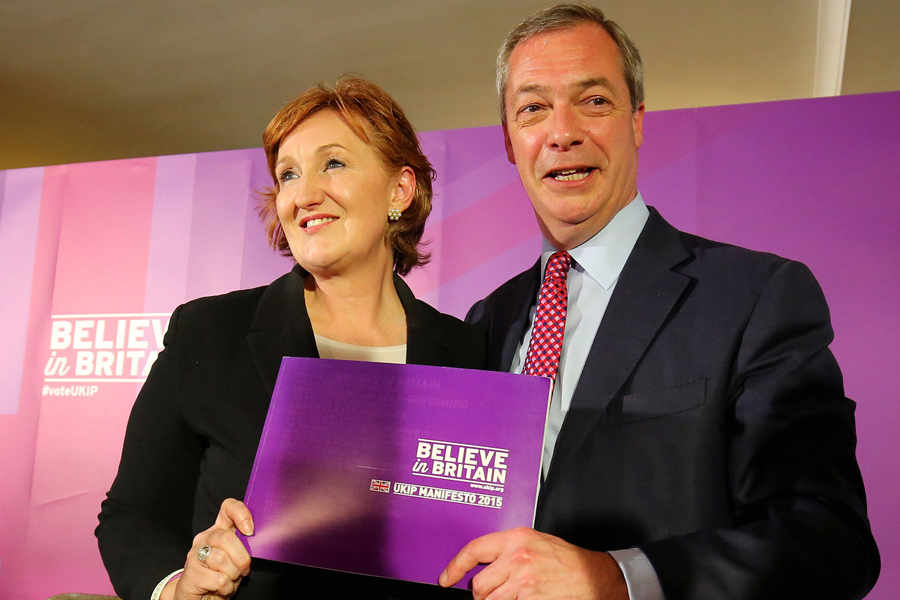
But in Thurrock today, the United Kingdom Independence Party gave what was perhaps their most convincing pitch to voters thus far, with the launch of their 2015 general election manifesto, entitled “Believe in Britain”.
This blog wholeheartedly concurs with the introduction to UKIP’s manifesto, in which Suzanne Evans (Deputy Chairman, Policy) bemoans the remarkable lack of optimism and faith in Britain now evident, to some degree, in all of the other political parties:
If only all politicians could believe in Britain as UKIP does. If only they could share our positive vision of Britain as a proud, independent sovereign nation, a country respected on the world stage, a major player in global trade, with influence and authority when it comes to tackling the pressing international issues of the day.
On fiscal policy, UKIP advocate a flatter, less redistributionist tax structure which puts the Conservatives to shame:
The longer term aspiration of a UKIP government will be to create an income tax structure of a basic rate of 20 per cent, an intermediate rate of 30 per cent, and a top rate of 40 per cent, meaning income taxes will be flatter and lower. Bringing down taxes on working people at the bottom and in the middle ranges of the income scale is our priority. In the longer term, we will aim to restore the personal allowance to those earning over £100,000 and make 40 per cent the top rate of tax for all, as it used to be.
On defence, UKIP can now make a plausible claim to be the new natural party of the Armed Forces, showing a commitment both to our veterans and to the robust defence Britain’s national interests that make the other parties – who have treated the Defence budget as a piggy bank to be raided to fund fuzzy electoral bribes, rather than the most sacred function of a nation state – look opportunistic and immature by comparison:
The first of UKIP’s party political broadcasts for the 2015 general election sets quite a different tone and mood than we are used to from the party. In fact, everything about the broadcast, now viewable on YouTube, seems designed to confound the expectations and prejudices of those who are reflexively opposed to UKIP and Nigel Farage.
Yes, the subject of immigration – UKIP’s key vote winner – is discussed in some detail. But this is the only context in which the European Union is mentioned, perhaps reflecting the party’s realisation that “banging on about Europe” is not attractive to voters in itself, and can only bear fruit when clearly linked to other subjects that voters consider important – like the state of Britain’s schools and hospitals.
The broadcast begins with Nigel Farage, seated against a black backdrop, channelling Monty Python by saying “And now for something completely different!” before breaking into a cheeky grin.
But what follows is neither laughably absurd nor tub-thumpingly, flag-wavingly nationalistic, which will no doubt come as a great disappointment to the party’s detractors.
Cue footage of Nigel Farage arriving at UKIP’s spring conference in Margate, greeting supporters and waiting in the wings while he is introduced before going on stage to deliver his speech. We then snap away to a voiceover, where Farage explains:
“UKIP was founded because people like me who were businessmen, not involved in politics at all, felt our political class were disconnected from ordinary people and were taking the country in the wrong direction. I think the point about UKIP, and the reason we call it the People’s Army, is it’s ordinary folks against the political class. That we’re a broad-based party and you’ve got people from all different walks of life, all classes, all races, all ages, and we want change”.
This is good counter-argument to those on the left who insist that Nigel Farage is every bit as much a part of the establishment as David Cameron or Ed Miliband, simply because he went to a private school and worked in the city – while overlooking the fact that Farage did not attend university, and makes the convincing case that he only entered politics because nobody else in Britain was advocating the policies that UKIP now champions.
When Farage goes on to claim that UKIP are “closer to the kind of conversations that go on in households up and down this country” not only is he likely right, he is also effectively rebuking the other party leaders – Ed Miliband is particularly guilty here – for their endless recounting of supposed interactions with “ordinary people” who just happen to think that they are doing a brilliant job, and who agree with their every policy pronouncement.
The broadcast then goes on to talk about concerns shared by nearly all British citizens, not just firm UKIP supporters – like worries about being able to afford a house, their children being able to find a good job, and whether the next generation will enjoy a better living standard than we enjoy today. When Farage bemoans the fact that “the rich are getting richer in this country, the poor are getting poorer and we want to do things, positive things, to help people” such as removing any income tax on the minimum wage, he sounds positively Labourite, not at all the Son of Thatcher.
It takes until the half-way mark until the first mention of “an end to uncontrolled, unskilled migrant labour coming into Britain and putting British people out of work” – as the camera cuts to the white cliffs of Dover. And then comes UKIP’s key message, placed very firmly in the context of needing independence from the EU to fully achieve everything else that the British people want: “I’m not against anybody, but I do think we have got to put the interests of ordinary British people first. We cannot have a net 300,000 people a year coming into Britain because of the impact on schools, on hospitals, on houses. But the problem is this: we cannot control our borders as members of the European Union.”
One man talking simply and honestly to the camera, contrasted with UKIP’s leader receiving a rapturous welcome at a local town hall meeting. With no tub-thumping and no scaremongering, no accusations or scapegoating of immigrants in sight. This calm and measured party political broadcast by UKIP is the work of a party no longer trying to expand its support base, but rather reassure their existing supporters that a vote for UKIP is “okay”, not something to second guess as polling day draws closer, or feel ashamed of as the other parties step up their attacks.
In an election campaign where Labour decided to wheel out the celebrity endorsements and the supposedly resurgent Green Party decided to squander any claim to seriousness with their boyband-themed election broadcast, UKIP decided to keep it simple – a sign of a party quietly confident of achieving gains, despite the barrage of attacks and a brace of new polls and articles suggesting that the party’s support is slipping back from its highs of late last year.
No dark warnings of invasion by foreigners. No union flag bunting. Not a single rendition of Land of Hope and Glory.
UKIP’s political operation is growing up. And the other political parties should be afraid.
An interesting (and concerning) poll in Conservative Home this week reveals that more Conservative supporters would prefer David Cameron to enter into a future coalition with the Liberal Democrats (again) rather than UKIP.
Liberal Democrats – 73 per cent. This finding may be a proof that familiarity doesn’t necessarily breed contempt. To some degree it reflects the fact that Tories have simply got used to working with the LibDems. It is also a tribute, in its own way, to the staying power of the Coalition: I put my hand up to not having expected it to last all the way to the end.
UKIP – 49 per cent. Some members will see UKIP as a natural partner for the Party. Others won’t, but will believe that differences can be fudged. Others still, as with the Liberal Democrats, will feel that coalition is a price worth paying to keep a Conservative-led administration in office: in some cases, respondents will have selected both options.
What does it say about the modern Conservative Party and the mindset of its supporters, that they would prefer to enter into coalition with a party that is rabidly pro-EU and in favour of an ever-expanding public sector funded through ever-increasing tax bills on the successful, rather than UKIP, the party which (just about) believes in smaller government, lower and flatter taxes, personal responsibility, a stronger military and secession from the European Union?
The answer, of course, it that it says nothing good at all.
The fact is that some Conservatives have quite enjoyed having Nick Clegg and the Liberal Democrats as bedfellows for the past five years – the coalition has helped the wet Tories to cover their left flank, giving the party a plausible excuse for making little progress on shrinking the size of the state and zero progress on reclaiming power and sovereignty back from the EU.
But if the current course of the 2015 general election campaign tells us anything, it is that the bland centrism that characterises the modern Labour and Conservative parties is increasingly unattractive to voters. True, the smaller parties are seeing some shrinkage in their support as polling day nears, but we remain on course to see the largest ever number and percentage of national votes cast for parties outside the big three.
Whether left or right wing, people are finally getting tired of seeing their core convictions (be it trade union solidarity and income redistribution on the left, or personal liberty and small government on the right) bartered away in pursuit of ineffectual policies calculated to cause minimal offence to anyone.
Yes, the Tories still have work to do in order to detoxify their brand. But the answer is not for them to dress up in Labour Party clothing and bang on endlessly about the importance of public services and “our NHS”. Such an approach will never work – it has been tested to destruction by David Cameron and George Osborne, and has convinced no one.
To move to the left is to sidestep the issue and avoid the hard work detoxifying conservatism in Britain, when what is needed most is patient explanation and passionate promotion of the idea that small government and less state (and EU) interference in our lives would be something to celebrate, not to fear.
Here is an interesting – and different – way to frame the question to Tory activists and the Conservative Party leadership. Rather than simply asking whether they would prefer the devil they know or the devil they don’t when choosing a future coalition partner, let’s ask which of these UKIP policies and ideas have suddenly become so offensive to the modern Conservative Party that they would sooner jump back into bed with Nick Clegg than with Nigel Farage:
A smaller government, with less than 52% of British citizens as net dependants on state benefits and services
The reassertion of the continued relevance of the nation state, expressed by a rejection of the European Union and the holding of an immediate in-out referendum
Sadly we already know many of their answers, and they give us very little hope for the immediate future of British conservatism.
It is increasingly fashionable among self-identified progressives and left-wingers, particularly within academic environments, to promote the idea of “safe spaces” – places where the normal right to free speech is heavily curtailed in order to protect designated minorities and victim groups from encountering words and ideas that might cause them mental discomfort.
This blog finds the idea of such “safe spaces” utterly repellent, and a prime symptom of the infantilisation of many students in Britain and America – a generation of cosseted idealists who interpret any political disagreement as a sinister attempt to “invalidate their experiences”, who are unable to tolerate even polite dissent and who are lightning-quick to call for authority figures to come crashing down upon the heads of those who question their “dearly and closely held beliefs”.
But put aside the childishness of the “safe space” and the potentially chilling implication of such policies on the fundamental right to freedom of expression. Put aside the fact that protecting certain ideas from scrutiny, however noble they may be, leads to intellectual atrophy and erodes our democracy in just the same way it undermines the core purpose of a university.
What is really shocking is the double-standard at play. Those designated victim groups and their advocates on the left are free to say and do anything they please, empowered and protected by the perceived righteousness of their cause, while those outside this bien pensant collective have no right to hold their own opinions, let alone to express them or to campaign for them politically.
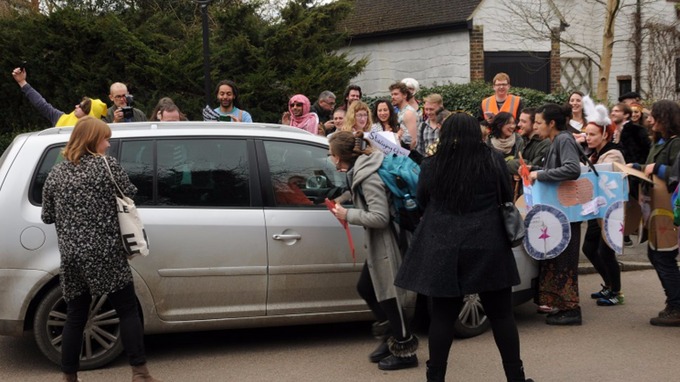
It is this double-standard which allows a mob of young anti-UKIP protesters to invade a London pub far from the campaign trail where UKIP leader Nigel Farage was quietly enjoying lunch with his family, to harass and intimidate Farage’s family to the extent that his young children fled and were separated from their parents, and to jump on the bonnet of his car as he attempted to drive away – and still come away feeling as though it were they, the mob, who had taken a stand for freedom, tolerance and decency.
After a few quiet months, prompting endless speculation about party rifts and even the health of its leader, UKIP are dominating the news agenda once again. Most notably in the Telegraph, which has had us capitvated all weekend with the serialisation of Nigel Farage’s latest book.
There were breathless passages shedding light on the secret talks which lead up to defection of former Tory MPs Douglas Carswell and Mark Reckless. Indeed, parts of the serialisation read almost like like Ayn Rand’s novel Atlas Shrugged, with Nigel Farage assuming the role of John Galt, the outlaw who furtively persuades America’s leading industrialists to abandon their failing nation and defect to his Objectivist promised land.
Mark Reckless came twice to see me at my home in Downe, Kent. No lunch, no wine, just pots of tea, and we talked. The first time he came was before Douglas joined, but the second was after. By then, the campaign to put the frighteners on any Tory looking to join us was intense, Mark turned up in dark glasses and a baseball cap so that the neighbours wouldn’t recognise him. He was convinced that he was being followed, most likely by someone at Conservative central office. It was certainly our suspicion that everyone at Ukip HQ – from me to the press office to the strategists – had their mobiles tapped. Life had become quite surreal.





 Semi-Partisan Politics